Walking Tours in Melbourne
30 Landmarks in Melbourne
AC/DC Lane
AC/DC La, East End Theatre District, Melbourne, 3000, Australia
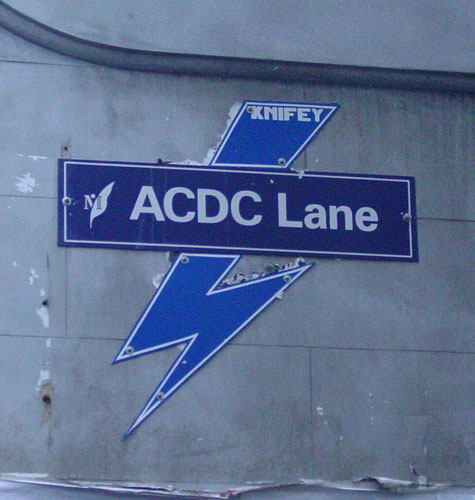
You are standing in a laneway that used to have no name at all. It was just Corporation Lane, an anonymous service alley. Then in two thousand and four, the City of Melbourne unanimously voted to rename it AC/DC Lane, in honour of the band that gave this city its hardest rocking anthem. The Lord Mayor John So launched it with a speech about a laneway to heaven, and then bagpipers played It's a Long Way to the Top If You Wanna Rock and Roll, the song famously filmed on a flatbed truck rolling down Swanston Street in nineteen seventy-six. But here is a detail that will make music nerds smile. Look at the street sign. You will notice the lightning bolt slash between AC and DC is missing. The trademark slash that appears in the band's logo contravened the naming policy of the Office of the Registrar of Geographic Names. Punctuation rules killed the thunder. Officially, on paper, this is ACDC Lane, no slash. The lane quickly became a magnet for street art, much of it dedicated to the band. In two thousand and eighteen, as part of the State Government's Rockin the Laneways funding programme, local artist Mike Makatron created a sculpture of former lead singer Bon Scott bursting out of the brickwork, microphone in hand. Scott, who died in nineteen eighty at the age of thirty-three, grew up partly in Melbourne after emigrating from Scotland as a child. The band formed in Sydney but Melbourne claims them, and this lane is the proof. It runs between Flinders Lane and Exhibition Street, surrounded by some of the best live music venues in the city. On a warm evening, you can hear guitars bleeding through the walls from half a dozen gigs happening simultaneously.
Birrarung Marr
Batman Ave, Melbourne City, Melbourne, 3000, Australia
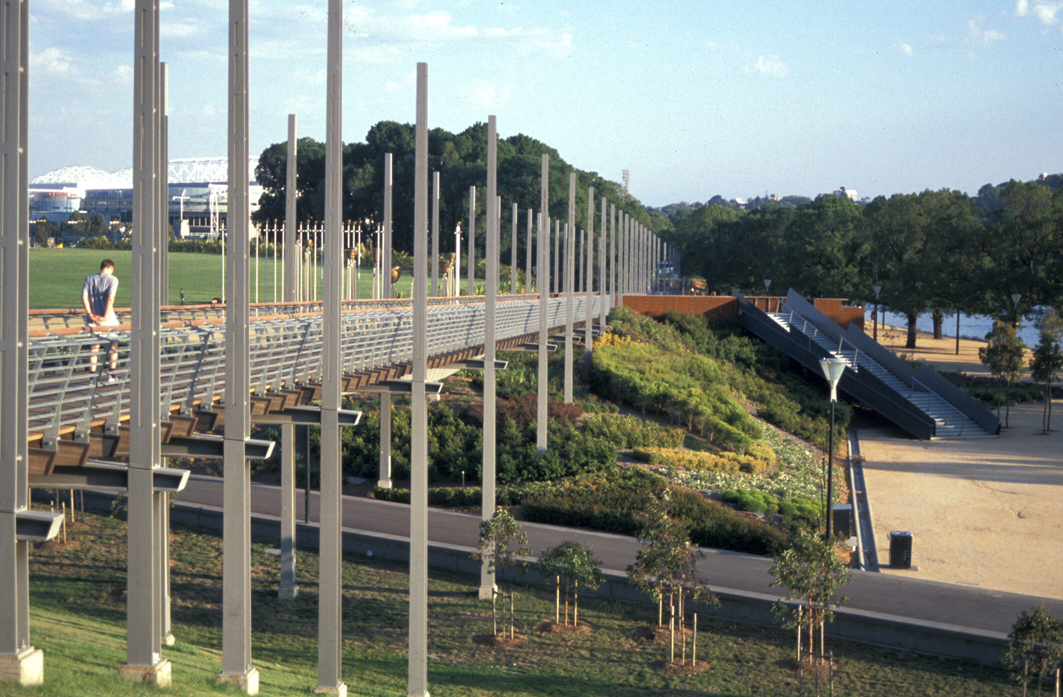
This is Melbourne's newest major park, opened in two thousand and two, and its name is one of the most significant acts of cultural recognition in the city's history. Birrarung Marr means the bank of the Birrarung in the Woiwurrung language of the Wurundjeri people. Birrarung translates as river of mists. The Yarra River's English name is actually a colonial mishearing. The Wurundjeri word for the river was always Birrarung. Walk through the park and you will find the Birrarung Wilam art installation, which is one of the most important indigenous cultural sites in urban Australia. A winding pathway shaped like an eel acknowledges the significance of eels as a traditional food source for the Kulin people, who engineered sophisticated aquaculture systems in this region for thousands of years. A semicircle of metal shields represents each of the five language groups of the Kulin Nation: the Wurundjeri, Boonwurrung, Taungurung, Dja Dja Wurrung, and Wathaurong. For most of the twentieth century, this eight-hectare site was a tangle of rail yards and industrial wasteland. The public was not welcome here. When the rail lines were rationalised and the site cleared, the City of Melbourne invested fifteen point six million dollars to design and build the park, and the State Government funded the rail clearance. Before European settlement, this stretch of riverbank was a meeting place for the Wurundjeri. Thousands of years of indigenous gatherings happened here before the trains came, and now, with the trains gone, the park has returned this land to something closer to its original purpose: a place where people come together. The William Barak bridge at the park's edge is named after the Wurundjeri diplomat and artist who spent his life advocating for his people's rights.
Block Arcade
282 Collins St, Collins Street Precinct, Melbourne, 3000, Australia
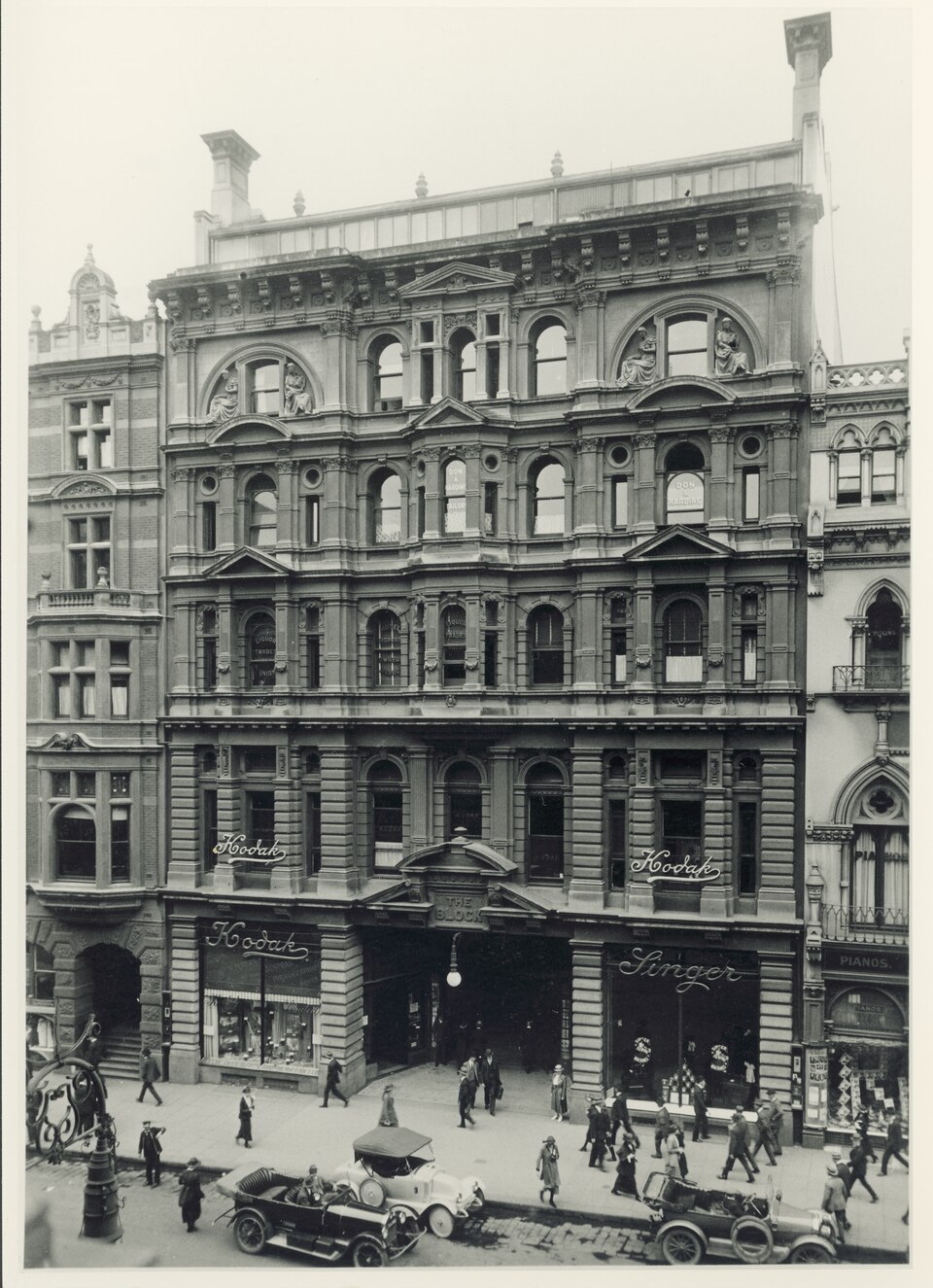
This might be the most beautiful interior in Melbourne. The Block Arcade was built between eighteen ninety-one and eighteen ninety-three, right at the peak of the city's gold rush wealth, and the architects Twentyman and Askew made absolutely sure everyone knew Melbourne had money. Look at your feet first. Those mosaic tiles on the floor were imported from Italy and laid by Italian craftsmen. Now look up. That glass canopy is supported by cast and wrought iron, and the timber shop fronts are among the tallest and most elaborate surviving examples of Victorian retail architecture in Australia. The name comes from the social ritual of doing the block, which was Melbourne's version of the evening promenade. In the eighteen eighties and nineties, the fashionable set would walk a circuit around Collins Street, from Swanston Street down to Elizabeth Street and back, showing off their outfits and catching up on gossip. It was the social media of the Victorian era. The arcade was built right in the middle of this route, giving the promenaders somewhere glamorous to walk through. The design was inspired by the Galleria Vittorio Emanuele the Second in Milan, which was then the most fashionable shopping arcade in Europe. If you have ever been to Milan, you will recognise the vaulted glass roof and the mosaic floors. Melbourne was trying to be the Milan of the south. And in the eighteen nineties, flush with gold money, it very nearly pulled it off. Inside, you will find the Hopetoun Tea Rooms, which have been serving afternoon tea since nineteen ninety-two in a room that has barely changed since the arcade was built. The queue often stretches out the door, which tells you everything about how Melburnians feel about this place.
Coop's Shot Tower
300 Lonsdale St, Collins Street Precinct, Melbourne, 3000, Australia
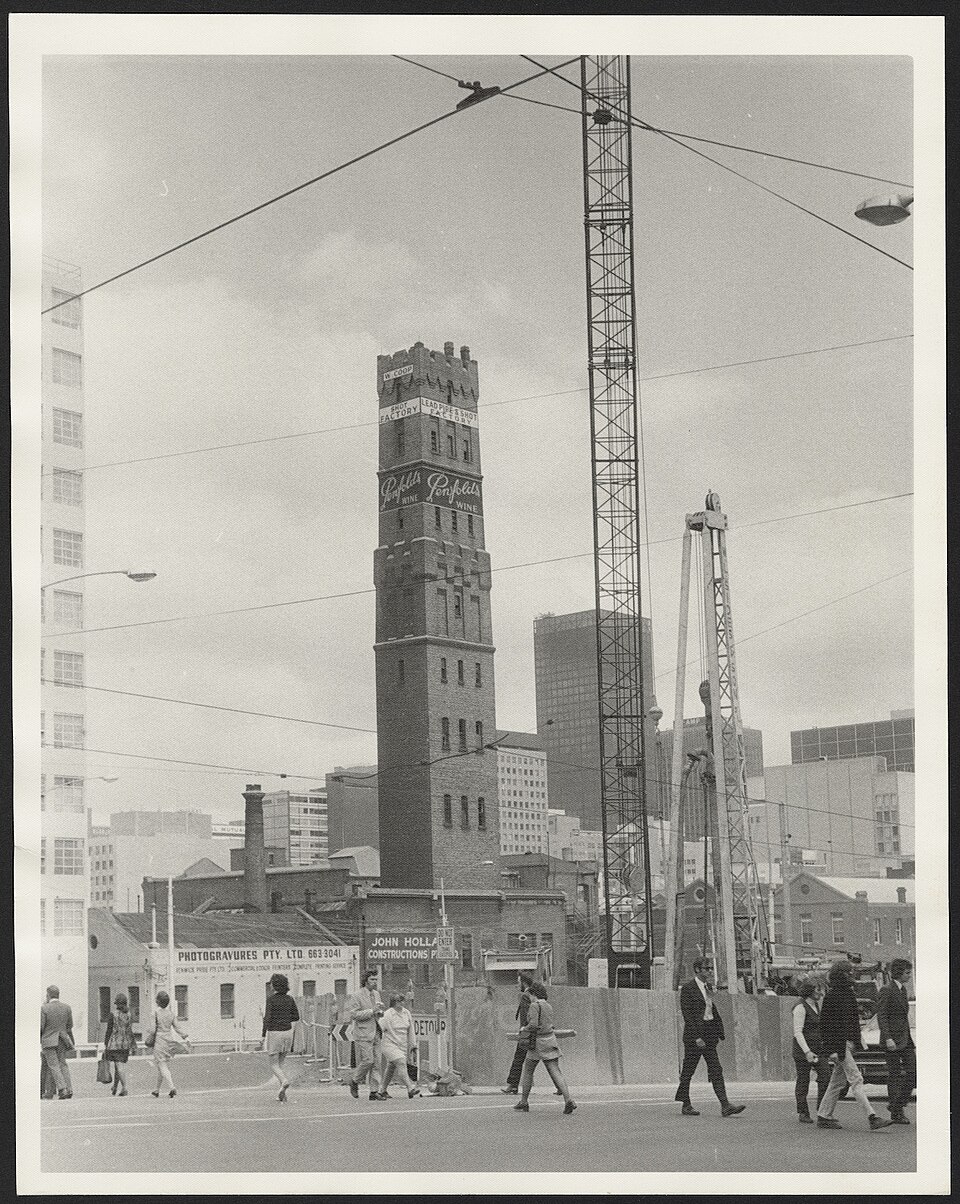
Look up. You are standing inside a shopping centre that was literally built around a fifty-metre-tall industrial chimney from eighteen eighty-eight. Coop's Shot Tower is one of the most unlikely survivors in Melbourne, a Victorian-era factory encased in a massive glass cone designed by Japanese architect Kisho Kurokawa. It is architecture as time travel: eighteen eighties brick wrapped in nineteen nineties glass. The tower was built for making lead shot. The process was brilliantly simple: you melted lead at the top of the tower, poured it through a copper sieve, and let the droplets fall fifty metres into a pool of water at the bottom. As the lead fell, surface tension pulled it into perfect spheres. The longer the fall, the rounder the shot. That is why shot towers had to be tall. This one produced ammunition for everything from hunting to warfare for nearly a century. When Melbourne Central was being developed in the late nineteen eighties, the plan was to demolish the tower. The community was outraged. Coop's Shot Tower was heritage-listed, and the developers were forced to find a creative solution. So Kurokawa designed the enormous glass cone that envelopes it, eighty-four metres at its highest point, one of the largest glass structures in the world at the time of its construction. The tower stands inside the cone like a relic in a museum case, surrounded by escalators and food courts. There is a working clock at the base that plays Waltzing Matilda on the hour. It is gloriously weird. A shot tower inside a cone inside a shopping centre, playing Australia's unofficial anthem to shoppers eating sushi.
Curtin House and Rooftop Cinema
252 Swanston St, Greek Quarter, Melbourne, 3000, Australia
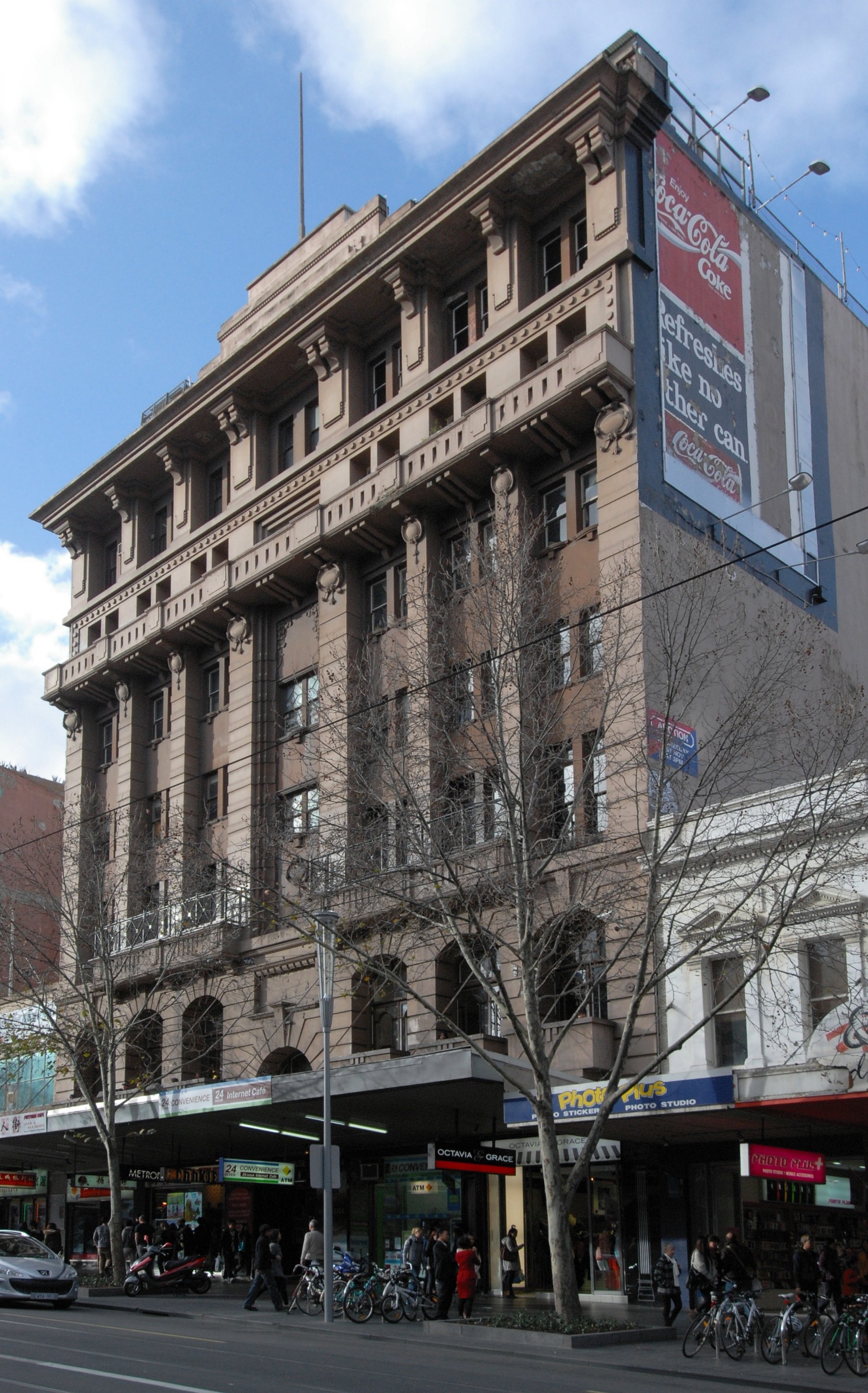
From the street, Curtin House looks like any other early twentieth-century office building. But this six-storey Commercial Palazzo building is what Melburnians call a vertical laneway. Each floor has been colonised by a different bar, restaurant, or creative venue, stacked on top of each other like layers of a cultural cake. And at the very top, open to the sky, is Melbourne's first rooftop cinema. The building was constructed in nineteen twenty-two for the Tattersalls Club, with offices to rent on the upper floors. The name commemorates wartime Labor Prime Minister John Curtin, who died in office in nineteen forty-five. For most of the twentieth century, it was just another nondescript office building. Then in the early two thousands, a group of creative operators saw the potential and transformed it into a vertical entertainment precinct. The Rooftop Cinema opened in two thousand and six, screening arthouse, classic, and recent-release films on summer evenings between November and March. Two hundred people in deck chairs, watching a movie under the stars, with the Melbourne skyline glowing behind the screen. In two thousand and seventeen, a renovation added a series of rounded, Art Deco-inspired metallic awnings that nod to the aesthetic of nineteen-fifties drive-in cinemas. Two of them retract to embrace the sun or provide shelter in less friendly weather. At night, glowing neon rings illuminate the awnings. The whole thing is a love letter to the idea that a city's best experiences are often hidden above street level. You would never know any of this was happening if you just walked past on Swanston Street. But that is Melbourne for you. The good stuff is always upstairs, downstairs, or down an alley.
Degraves Street
Degraves St, Collins Street Precinct, Melbourne, 3000, Australia
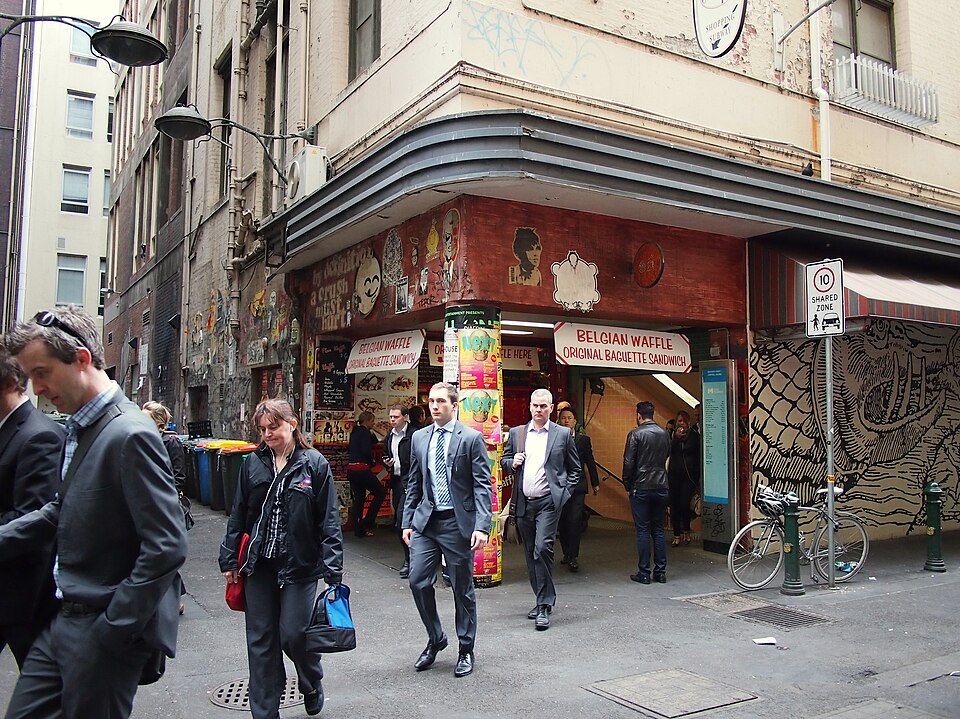
This narrow lane packed with cafe tables is probably where you got your first Melbourne flat white, and fair enough. Degraves Street is the postcard version of Melbourne laneway culture. But look beneath the surface, literally, because there is an entire hidden world down there. The Degraves Street Subway, an underground tunnel connecting the lane to Flinders Street Station, was built in the nineteen fifties just in time for the nineteen fifty-six Olympic Games, Melbourne's big moment on the world stage. The tunnel's interior was gorgeous: art deco design with black granite columns and soft pink mosaic tiles, with shops lining both sides featuring curved windows and handmade wooden fixtures. For decades, it was home to vinyl record shops, vintage clothing stores, and hairdressers. A quirky underground village. But the arrival of the City Loop train system in the early nineteen eighties took away much of the pedestrian traffic, and the subway slowly declined. The street itself is named after William and Charles Degraves, brothers who established a steam flour mill on the corner of Flinders Lane and Degraves Street in eighteen forty-nine. That gold rush-era flour mill still exists, and beneath it sits a gigantic underground bluestone cellar, a hidden vault from the eighteen fifties that most Melburnians have no idea is there. The lane is barely wide enough for two people to walk side by side in places, yet somehow the cafes manage to squeeze in tables, chairs, and the occasional busker. On a Saturday morning, it is standing room only, which is remarkable for an alley that started life as a service lane for a flour mill. The gold rush built this city, and the coffee culture finished the job.
Eureka Tower
7 Riverside Quay, Melbourne City, Southbank, 3006, Australia
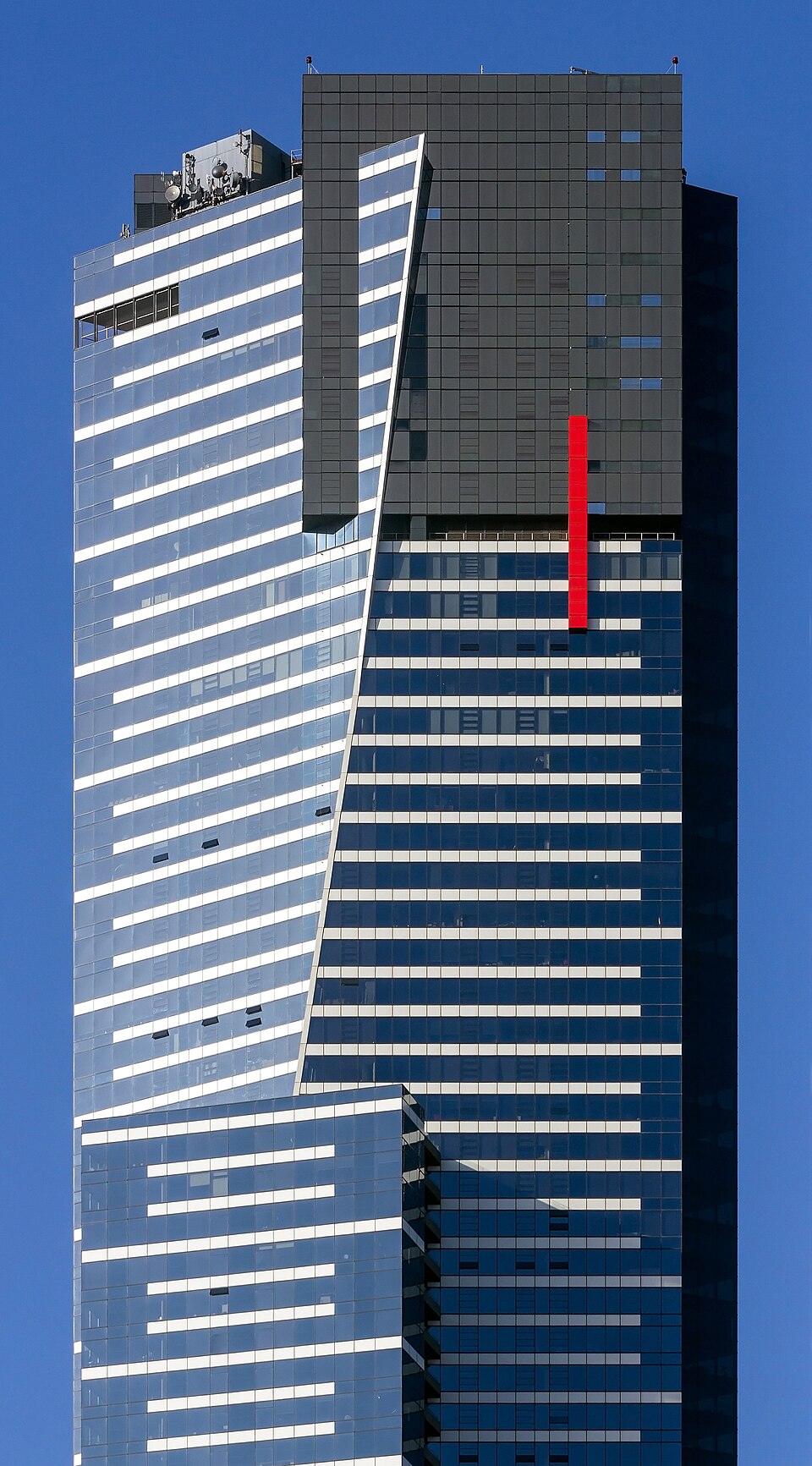
That skyscraper dominating the Southbank skyline is not just tall. It is telling you a story about rebellion, and most people walk past without reading it. Eureka Tower stands two hundred and ninety-seven metres high with ninety-one storeys, and every design element references the Eureka Stockade of eighteen fifty-four, the armed uprising of gold miners against colonial authorities in Ballarat that is considered a founding moment of Australian democracy. Read the building from top to bottom. The gold crown at the summit represents the gold rush itself. The red stripe running vertically down the building represents the blood spilt during the revolt. The blue glass cladding that covers most of the facade represents the blue background of the Eureka flag. And the white lines crossing the blue are the Southern Cross stars from that flag. The top ten floors have windows coated in twenty-four carat gold. Actual gold, layered onto the glass. When the afternoon sun hits those floors, they light up like a beacon. The observation deck on the eighty-eighth floor, branded as Melbourne Skydeck, is the highest public vantage point in a building in the Southern Hemisphere at two hundred and eighty-five metres. On a clear day, you can see the Dandenong Ranges, the You Yangs, and Port Phillip Bay stretching to the horizon. Construction began in August two thousand and two and the building was officially opened in October two thousand and six. There is also The Edge, a glass cube that slides out from the building and hangs over the void three hundred metres above the street. It starts opaque and turns transparent once you are out there. People scream. Every single time.
Federation Square
Flinders St, Hoddle Grid, Melbourne, 3000, Australia
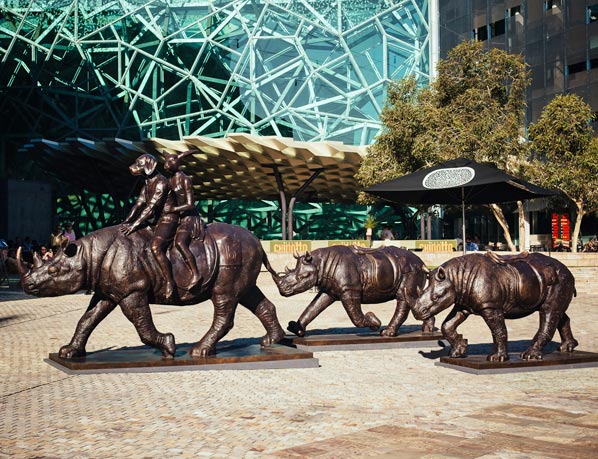
When Federation Square opened in two thousand and two, Melburnians absolutely hated it. The angular, fractured geometry designed by Lab Architecture Studio and Bates Smart was called everything from a bombed-out ruin to a pile of broken tiles. The Herald Sun ran letters comparing it to a war zone. But here is the twist: the building that everyone despised is now so beloved that when Apple tried to build a flagship store here in twenty seventeen, the public outcry killed the proposal. Melburnians had done a complete one-eighty. They went from hating the place to being willing to fight for it. The design is genuinely unusual. Those jagged panels are not random. They are based on a mathematical system called a pinwheel tiling, where five triangles fit together into a larger triangle, repeated at different scales across the entire facade. There are exactly five hundred thousand individual panels making up the exterior. The whole thing sits on top of a concrete deck over the old rail yards, which means you are standing on a platform above active train tracks right now. Before Fed Square existed, this was one of the ugliest corners in Melbourne: a brutalist car park called the Gas and Fuel Corporation buildings. Demolishing them was the one thing everyone agreed on. The square cost four hundred and sixty-seven million dollars, nearly double the original budget, and took eleven years from design to completion. But today, more than ten million people pass through it annually, making it one of the most visited public spaces in Australia. The National Gallery of Victoria's Ian Potter Centre sits underneath, housing the world's largest collection of Australian art. You are essentially standing on top of a world-class gallery.
Fitzroy Gardens and Cooks' Cottage
Wellington Pde, Melbourne City, East Melbourne, 3002, Australia
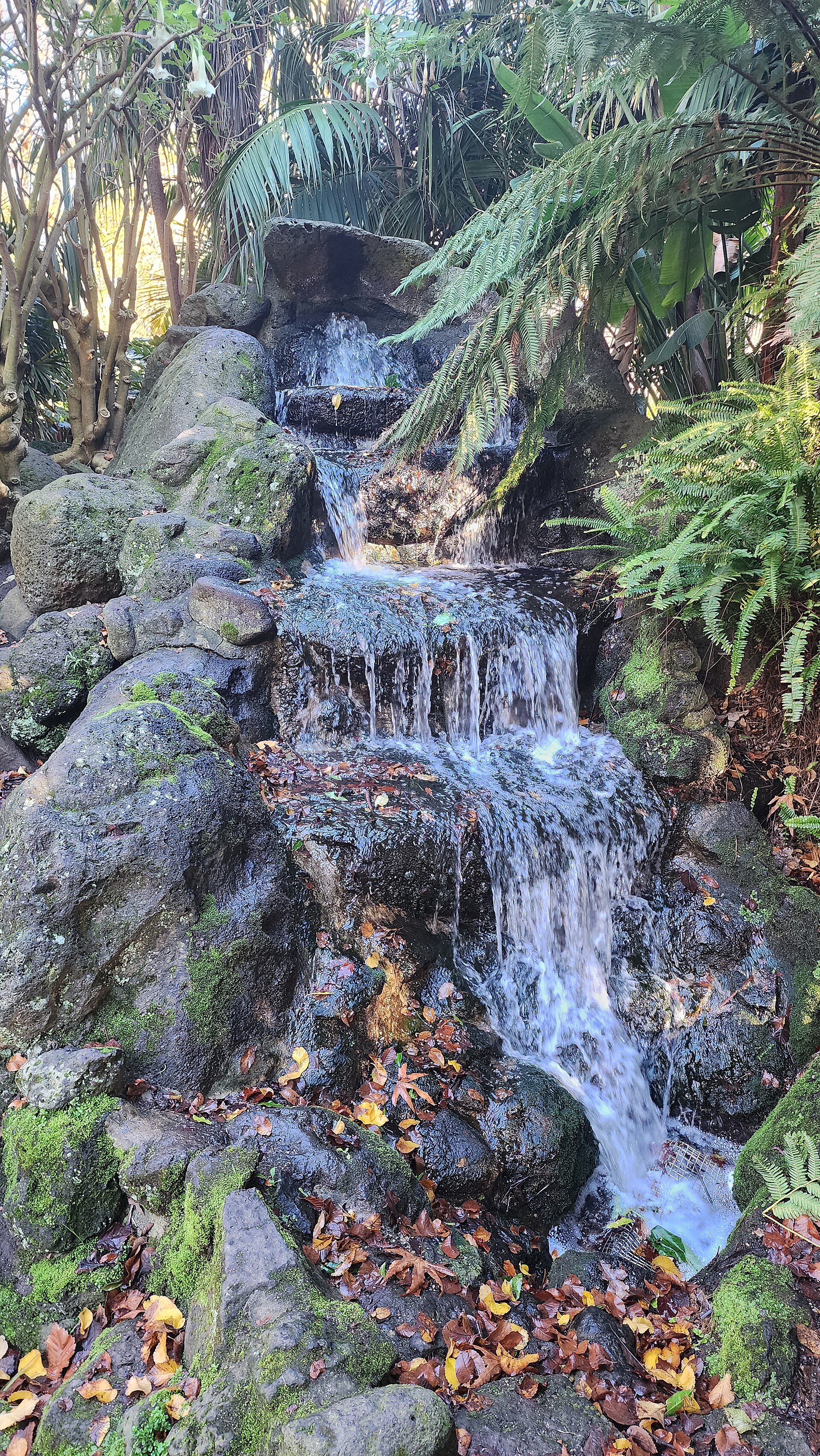
Deep inside the Fitzroy Gardens, there is a cottage that was shipped brick by brick from Yorkshire, England, in nineteen thirty-four. Each brick was individually numbered, packed into barrels, and transported halfway around the world along with cuttings of the original ivy. It took two hundred and fifty-three packing cases. The cottage was built in seventeen fifty-five in the village of Great Ayton, and it is marketed as Captain Cook's Cottage. But here is the thing: Captain James Cook almost certainly never lived in it. The cottage was built by Cook's parents, James and Grace Cook. By seventeen fifty-five, young James had already left home and joined the Royal Navy. He had been gone for about ten years when his father built the house. The official name is Cooks' Cottage, with the apostrophe deliberately placed after the S, because this was the cottage of the Cooks, plural, the parents. Not the Captain. The Australian philanthropist Sir Russell Grimwade purchased the cottage and donated it to Melbourne as a centenary gift in nineteen thirty-four. Whether Cook ever set foot inside is a matter of scholarly debate, but almost certainly he visited his parents here. Now find the Fairies' Tree. Artist Ola Cohn spent the early nineteen thirties carving a series of fairies, gnomes, koalas, kookaburras, and flying foxes into the stump of one of the garden's original red gum trees, which was over three hundred years old. In nineteen seventy-seven, when the stump was lifted for chemical treatment, workers discovered an immaculately preserved mummified brushtail possum inside the trunk, forty years dead and perfectly intact. The possum had apparently crawled inside and become trapped. It is one of the most unexpectedly eerie discoveries in Melbourne's history.
Fitzroy Pool and the Aqua Profonda Sign
160 Alexandra Pde, Nicholls Ward, Fitzroy, 3065, Australia
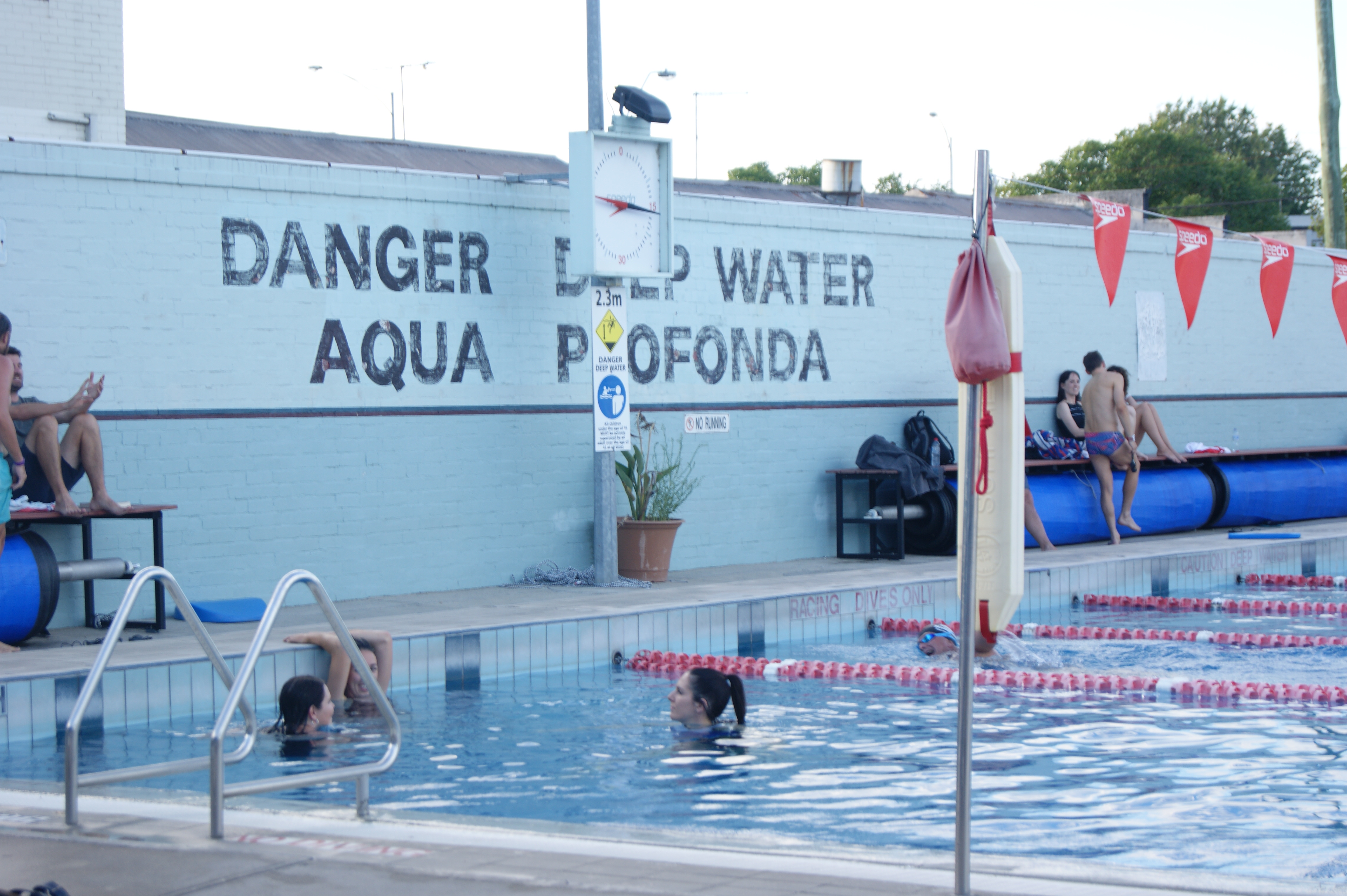
Painted in black letters on the brick wall at the deep end of this pool are two words that tell one of the most touching immigration stories in Melbourne. AQUA PROFONDA. Deep water. Except it is misspelled. The correct Italian would be acqua profonda, with a double C and an A at the end. But that misspelling is what makes it so perfectly human. In nineteen fifty-three or fifty-four, the pool manager James Murphy had a problem. He was constantly rescuing migrant children from the deep end. The post-war immigration boom had transformed Fitzroy into one of the most culturally diverse suburbs in Australia. By nineteen fifty-four, about twelve percent of Fitzroy's population was Italian-born. By nineteen sixty-six, a third were Italian or Greek-born. Many of the children arriving at the pool could not read English warning signs. So Murphy asked an Italian friend how to say deep water in Italian, and had it painted on the wall. The friend got the spelling slightly wrong, but the message got through. That sign is now heritage-listed. It is one of the only tangible, surviving examples of a public acknowledgement of the cultural impact of Australia's mass migration programme. A misspelled Italian phrase on a pool wall, and it is officially protected by Heritage Victoria. The sign became iconic after author Helen Garner used it as a recurring motif in her famous nineteen seventy-seven novel Monkey Grip, the book that defined bohemian Fitzroy for a generation. The pool itself opened in nineteen oh eight, with the men's pool described as the largest in Victoria at the time. It has been a community gathering place for over a century, and that misspelled warning is its soul.
Flinders Street Station
Flinders St, Batman's Hill, Melbourne, 3000, Australia
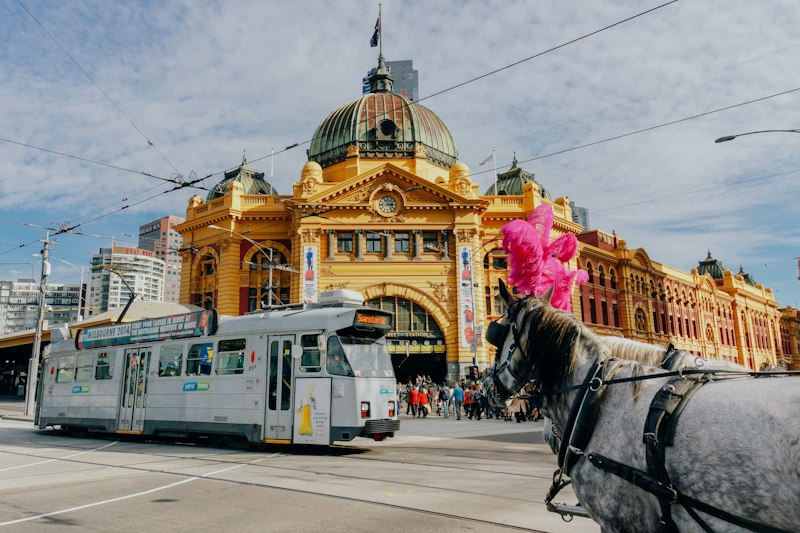
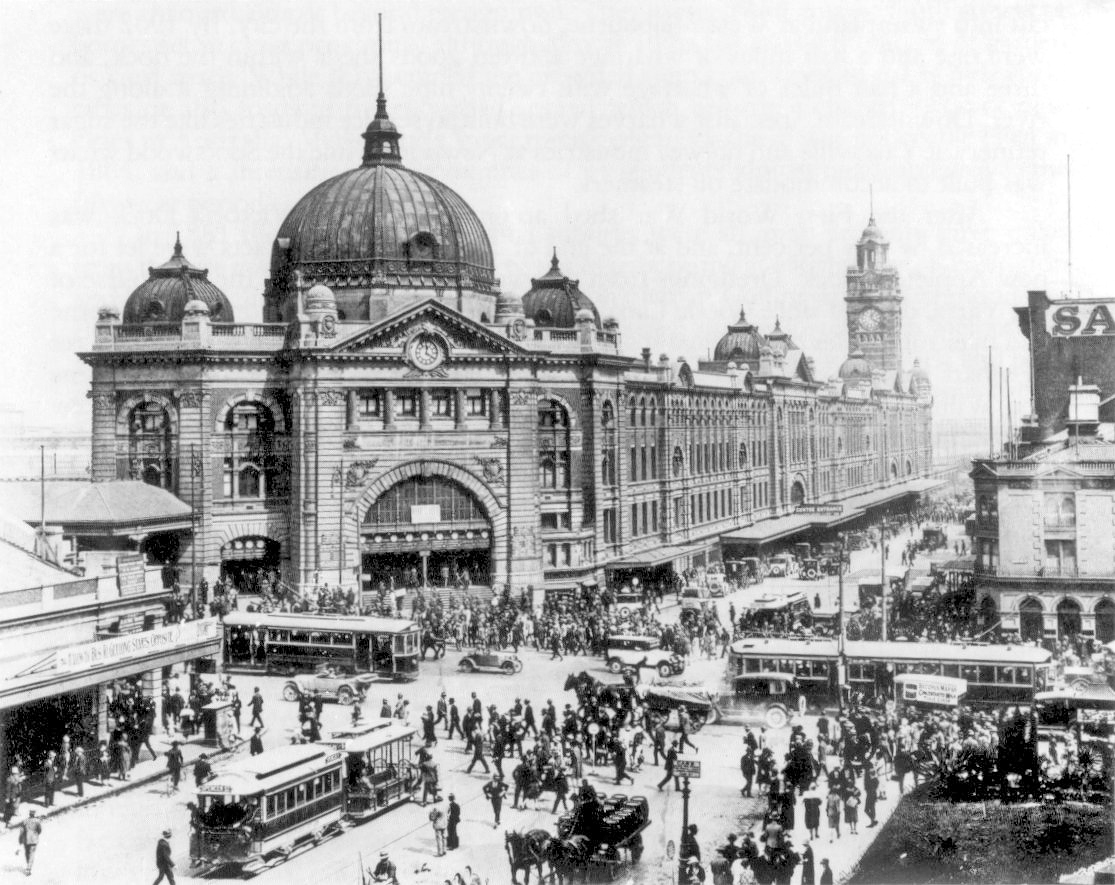
You are looking at the most recognised building in Melbourne. Flinders Street Station, with that famous yellow facade and those green copper domes, has been the beating heart of this city since eighteen fifty-four, when it became the first urban railway station in all of Australia. But here is the thing most people walk past without knowing: the upper floors are abandoned. There is a ballroom up there. An actual ballroom, sitting empty above Platform One since nineteen eighty-three, when the last dance was held. Before that, the Victorian Railways Institute ran a whole world up there for rail workers: a gym, a library, a billiards room, a fencing club, a debating society, and even a cat lovers club. There was a running track on the roof. An entire social universe, three storeys above the commuters, now gathering dust and peeling plaster. The station you see now was completed in nineteen ten, designed by James Fawcett and H. P. C. Ashworth, who won a competition that drew over seventeen entries. Their design beat a rival proposal for a cathedral-like Gothic building. The famous clocks under the entrance dome, where Melburnians have been saying "I'll meet you under the clocks" for over a century, still show departure times for each suburban line. During World War Two, American soldiers in Melbourne adopted the phrase too. The station handles over ninety thousand passengers every weekday, making it the busiest in the Southern Hemisphere. And somewhere above all those commuters, a chandelier hangs in a ballroom that nobody dances in anymore. Artist Rone briefly opened it for an exhibition in twenty nineteen, and the queues stretched around the block. Everyone wanted to see what time had left behind.
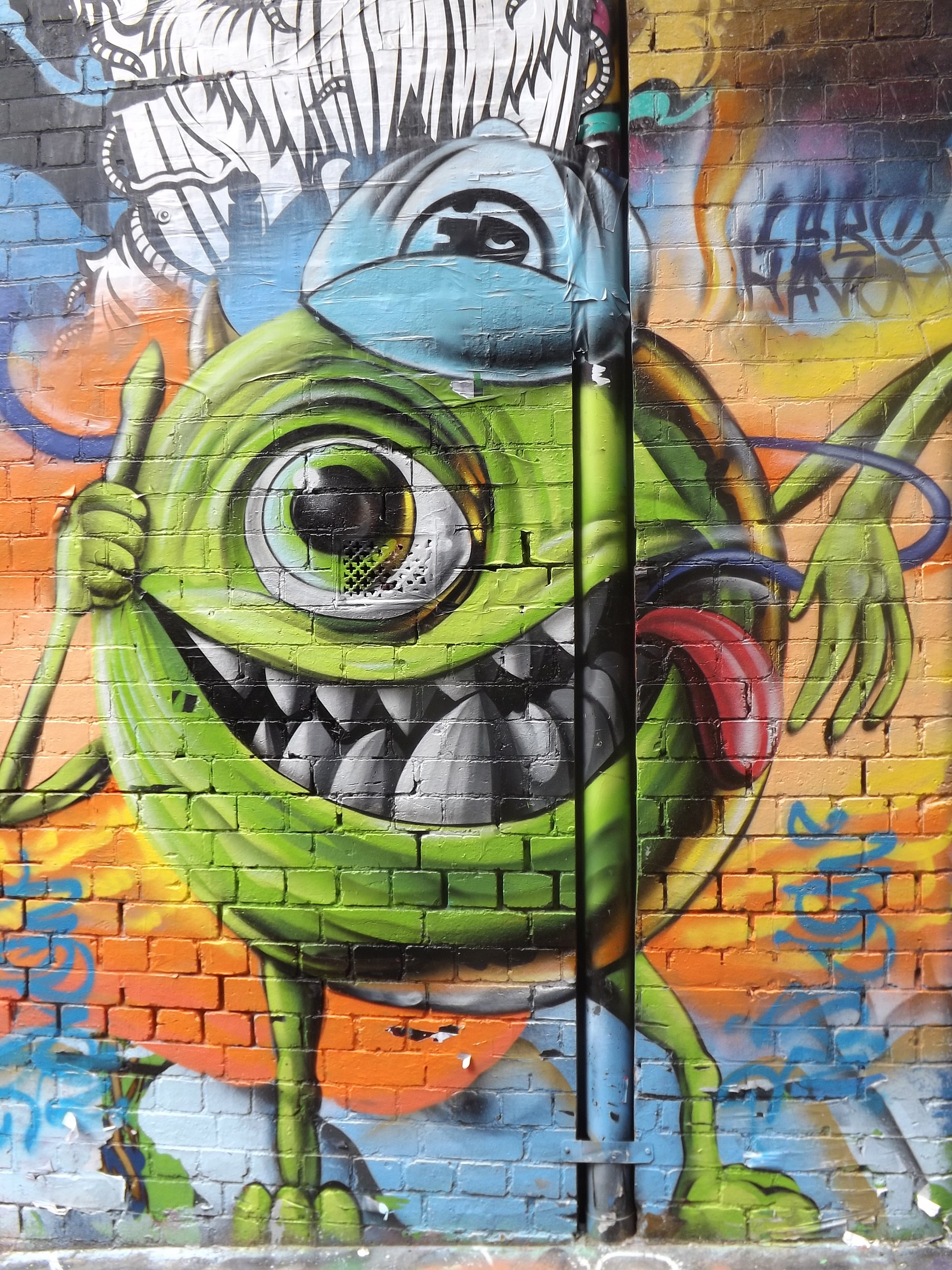
Hosier Lane
Hosier La, East End Theatre District, Melbourne, 3000, Australia
Welcome to what might be the most photographed laneway on the planet. Hosier Lane is Melbourne's street art ground zero, a narrow bluestone corridor where every single surface, from the cobblestones to the drainpipes, is covered in paste-ups, stencils, murals, and tags. But do not get too attached to any particular piece. The whole thing changes constantly. An artwork that is here today could be painted over by tomorrow morning. That is the point. It is a living, breathing canvas that rejects permanence. Melbourne's street art culture did not happen by accident. In two thousand and seven, the City of Melbourne officially designated certain laneways as legal street art zones, making it one of the first cities in the world to formally embrace graffiti as legitimate art. Hosier Lane became the flagship. Before that decision, the city had spent years playing whack-a-mole with graffiti artists, buffing walls only to see them covered again within days. The lane's fame has attracted artists from all over the world, including Banksy, who left several stencil works here in the early two thousands. Most of them have been painted over, which is both the tragedy and the beauty of the place. One Banksy piece was accidentally destroyed by council workers in two thousand and ten while they were removing tagging. The estimated value of that lost work? Over a million dollars. Right now, you are looking at art that is worth nothing on the market and everything to the culture. Walk slowly. Look at the layers. Some walls have dozens of paintings stacked on top of each other, years of creative archaeology compressed into centimetres of paint.
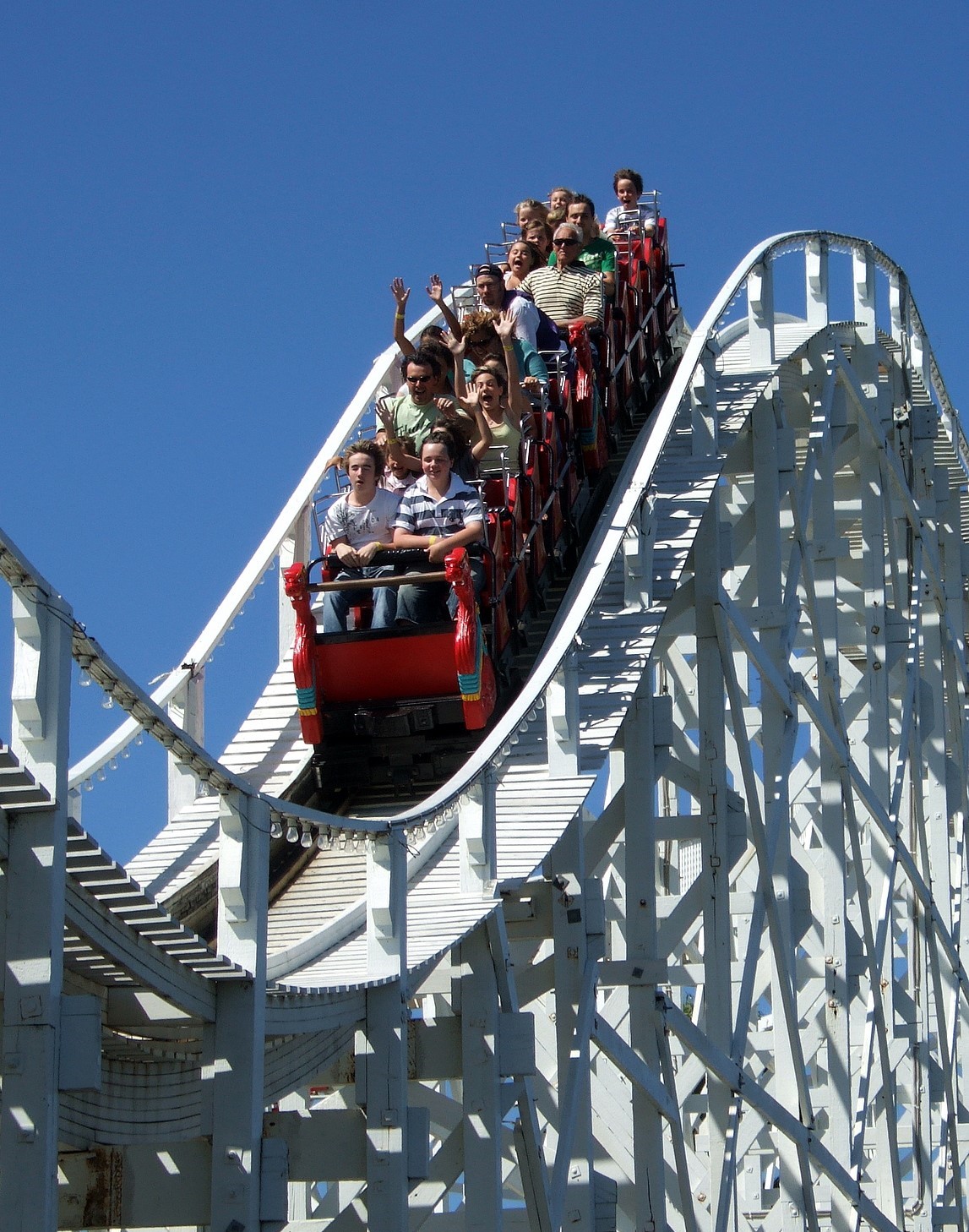
Luna Park Melbourne
18 Lower Esp, Lake Ward, St Kilda, 3182, Australia
That enormous grinning face you walk through to enter Luna Park is not just a quirky entrance. It is heritage-listed. The entire amusement park has been on this St Kilda foreshore site since nineteen twelve, making it one of the oldest continually operating amusement parks in the world. You enter through Mr Moon's mouth, a tradition that has not changed in over a century. The face has been repainted and redesigned over the decades, but you have always walked through a giant open mouth to get in. Luna Park was designed by showman J. D. Williams, who had also been instrumental in developing Luna Park in New York's Coney Island. The scenic railway roller coaster, that timber structure you can see rattling along the foreshore, is the oldest continually operating roller coaster in the world. It opened in nineteen twelve, the same year as the park, and it still requires a brakeman to ride on every single train, manually controlling the speed through each turn. There are only a handful of roller coasters in the world that still use this system. Here is a detail most visitors miss. Entry to Luna Park is free. You only pay if you want to ride. This was a deliberate decision to keep the park accessible to everyone, including the families who could not afford the rides but still wanted to enjoy the atmosphere. The park sits right on the beach, and on summer evenings the combination of the vintage rides, the fairy lights, and the bay stretching out behind creates a scene that looks like it has not changed in a hundred years. Which, honestly, it mostly has not. Melbourne has grown up around Luna Park, but the park itself has stubbornly refused to grow up at all.
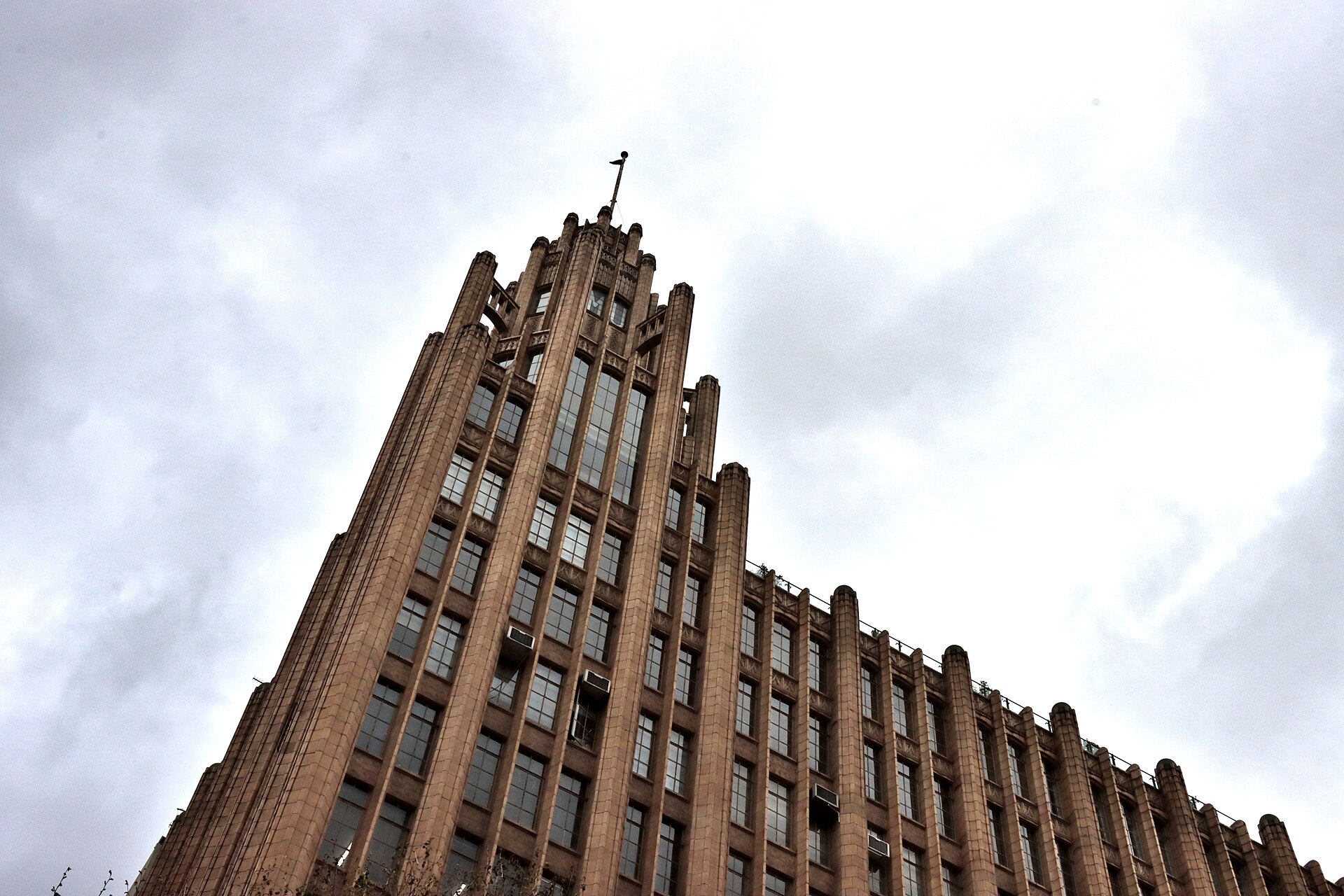
Manchester Unity Building
220 Collins St, Collins Street Precinct, Melbourne, 3000, Australia
Look up at the corner of Collins and Swanston streets. That ornamental tower with the flagpole rising above the roofline serves absolutely no purpose. It is completely empty inside. A void. And that is the genius of the whole thing. In nineteen thirty-one, Melbourne had a height limit of forty metres for buildings. But towers and flagpoles did not count. So the architects designed a decorative tower that soars twenty-four metres above the roof, more than half the height of the main building, and got away with it on a technicality. On Friday and Saturday nights, it was floodlit, making the Manchester Unity Building the most visible landmark on the skyline. This Art Deco Gothic masterpiece was built in eleven months and twelve days, which is astonishing for a building of this complexity. Site works started at midnight on the first of January, nineteen thirty-two. Floors went up at the rate of one per week. By late July, the roof was done and work started on that cheeky tower. The Premier of Victoria opened it before the end of the year. The building was commissioned by the Manchester Unity Independent Order of Oddfellows, a fraternal organisation, who purchased the prime corner site in nineteen twenty-eight for two hundred and fifty thousand pounds. Up on the twelfth-floor rooftop, there was once a Japanese garden and cafe, complete with a mosaic floor, graceful palms, Japanese maples, flower beds, a fountain, and a pond. It operated from nineteen thirty-two until about nineteen forty, when wartime sentiment toward all things Japanese rather killed the mood. The rooftop garden is long gone, but the building is now open for guided tours, and you can ride the original lift to the top for views that make you understand why Melbourne fell in love with Art Deco.
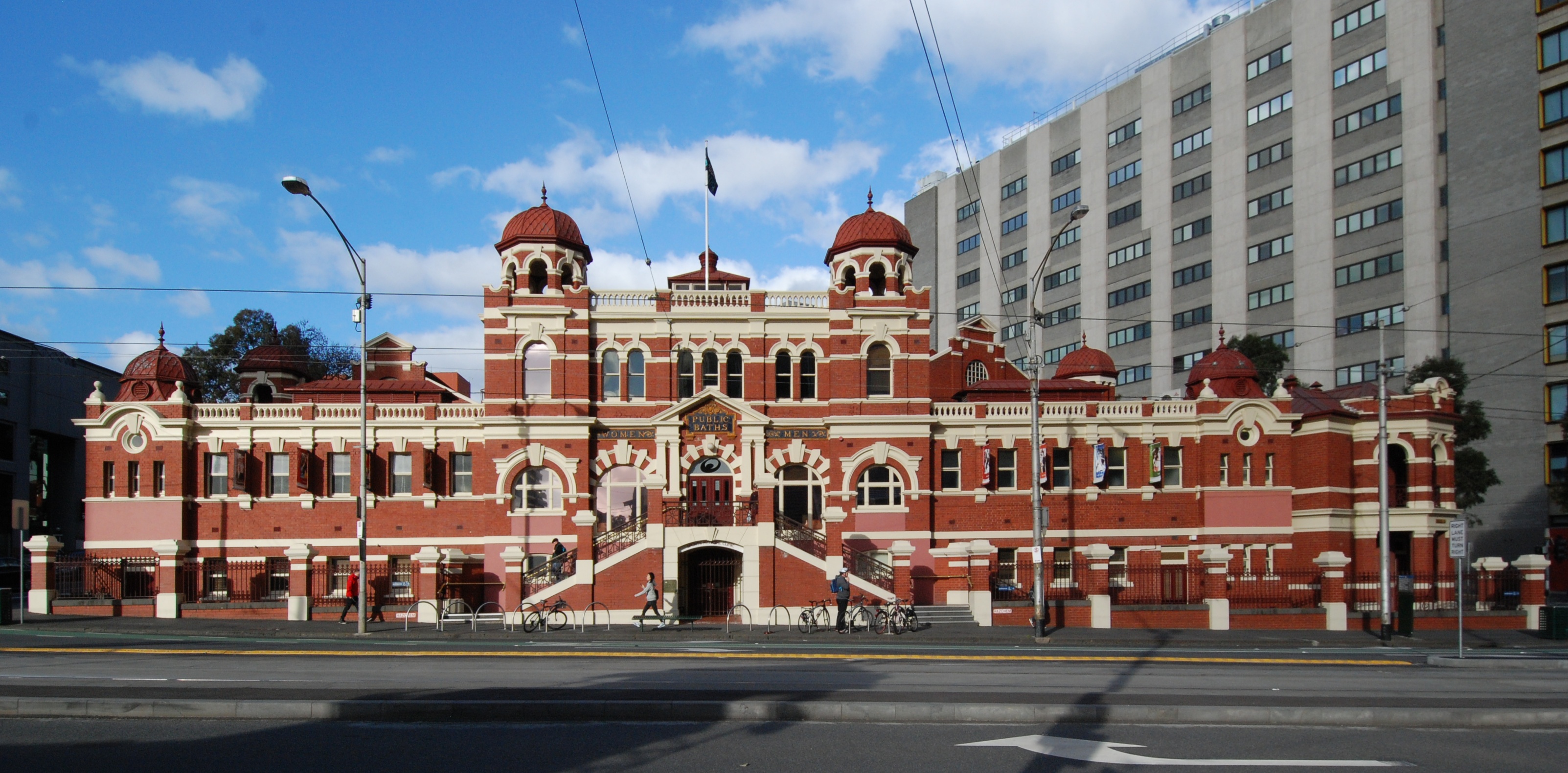
Melbourne City Baths
420 Swanston St, Carlton South, Melbourne, 3000, Australia
This beautiful Edwardian Baroque building exists because the Yarra River was so disgustingly polluted in the eighteen fifties that people kept getting typhoid from swimming in it. The solution? Build them somewhere clean to bathe. The site was reserved for public baths in eighteen fifty, and Melbourne City Council opened the first City Baths on the ninth of January, eighteen sixty. The objective was literally to stop people from bathing in a river that was killing them. Those first baths were leased to a private operator who let them fall apart so badly they were closed in eighteen ninety-nine. The building you see now was designed by J. J. Clark and his son E. J. Clark, built between nineteen oh three and nineteen oh four. It is one of the most significant examples of Edwardian civic architecture in Melbourne, combining red brick with cream-painted Baroque details. Inside, they provided two classes of facilities, because even bathing was stratified by wealth. Second-class cubicles with slipper baths were on the ground level. First-class baths were upstairs. There was a mikvah, a Jewish ritual bath, and Victorian-era Turkish baths. The first-class ladies' area with the mikvah has been retained as the modern spa. Today the baths house two swimming pools, a spa, sauna, squash courts, and a gym. But the heritage bones are still there. The original tiles, the wrought iron, the high windows that flood the pool with natural light. Most Melburnians who swim here treat it as just another gym. They probably do not know they are doing laps in a building that was built because a river was too dangerous to swim in.
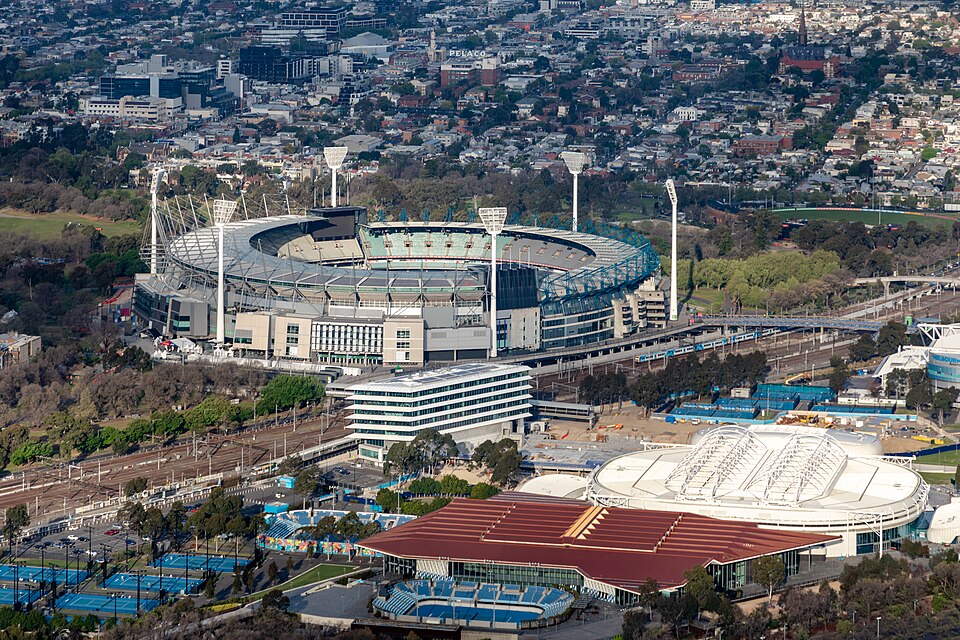
Melbourne Cricket Ground
Barassi Way, Melbourne City, Melbourne, 3000, Australia
You are looking at the spiritual home of Australian sport. The MCG, or simply The G as locals call it, has been hosting cricket here since eighteen fifty-three, making it one of the oldest continually used sporting grounds on Earth. It seats over a hundred thousand people, making it the largest stadium in the Southern Hemisphere and the tenth largest in the world. On AFL Grand Final day, every single seat is filled, and the roar can be heard kilometres away. But the MCG's history goes way beyond sport. This is where the first ever Test cricket match was played, between Australia and England in eighteen seventy-seven. This is where the nineteen fifty-six Olympic Games were held, the first time the Olympics left Europe and the Americas. The eighteen seventy-eight Melbourne Cup started from here. And during World War Two, the ground was commandeered by the military. American and Australian troops were quartered in the stands, and the oval became a training ground. The Members Pavilion was used as a military hospital. Here is a fact that will stop you in your tracks. In nineteen seventy, during a VFL match between Richmond and Collingwood, the attendance was a hundred and twenty-one thousand, six hundred and ninety-six people. That is more than the current capacity. They just kept letting people in until the terraces were dangerously packed. Modern safety rules mean that can never happen again. The light towers, by the way, are the tallest of any sporting venue in the world at seventy-five metres. And the famous Long Room in the Members Pavilion contains one of the world's great collections of sporting memorabilia, including the ashes themselves during certain years.
Naked for Satan
285 Brunswick St, Nicholls Ward, Fitzroy, 3065, Australia
The name of this bar is not a marketing gimmick. It is based on a real person and a genuinely wild true story. Around nineteen twenty-eight, a man named Leon Satanovich fled the Russian pogroms and made his way to Melbourne, where he found work as a cleaner and caretaker at the Moran and Cato building right here on Brunswick Street, Fitzroy. The neighbourhood quickly nicknamed him Satan. During the Great Depression in the nineteen thirties, part of the building was shut down. Satanovich, being resourceful, set up an illegal vodka distillery in the basement using copper boilers and water tanks he found abandoned in a warehouse. The heat generated by his distilling equipment was so intense that he had to work almost completely naked. And that is how the phrase let's get naked for Satan became the secret code among locals who wanted to buy his bootleg vodka. It was the Fitzroy speakeasy, Depression-era style. When the modern bar opened in two thousand and ten in the same Moran and Cato building, it took the name as a tribute. The owners, Max and Pat Fink, who also created popular Melbourne venues like Bimbo and Lucky Coq, embraced the story completely. They even distill their own gin and vodka on site, a direct nod to Satanovich's basement operation. The rooftop terrace, called Naked in the Sky, has some of the best views in Fitzroy, looking out over the rooftops toward the city. And the pintxos, those little Basque-style snacks on toothpicks, are legendary. You grab them from the bar and they charge you by counting the toothpicks at the end. The whole place runs on trust, which feels right for a bar named after a bootlegger.
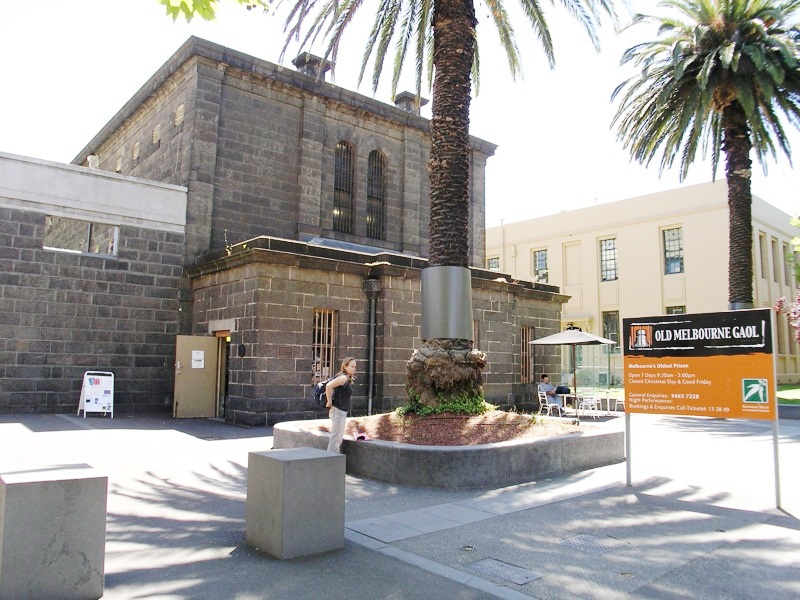
Old Melbourne Gaol
377 Russell St, Collins Street Precinct, Melbourne, 3000, Australia
You are standing outside the place where Ned Kelly was hanged. On the eleventh of November, eighteen eighty, the most famous bushranger in Australian history dropped through the trapdoor at the Old Melbourne Gaol and reportedly said his last words: Such is life. He was twenty-five years old. His death mask, made from a plaster cast of his face immediately after execution, is on display inside, along with the rough suit of homemade armour he wore at his last stand in Glenrowan. Between eighteen forty-two and nineteen twenty-nine, one hundred and thirty-three people were executed within these bluestone walls. Their death masks were also made, part of a grim Victorian obsession with phrenology, the pseudo-science that claimed you could read criminal tendencies from the shape of a person's skull. The collection of death masks inside is one of the most extensive in the world, rows of plaster faces staring out from the walls, each one belonging to someone who took their last breath in this building. The gaol was built in stages from eighteen forty-one, and at its peak held over three hundred prisoners in conditions that were deliberately harsh. The cells are tiny. The walls are thick bluestone that holds the cold. The exercise yard is a small, featureless space designed to crush the spirit. One of the more disturbing features is the set of winding metal stairs that lead up to the gallows platform. You can climb them yourself during a visit. At the top, you stand on the same boards where the condemned stood, looking down at the trapdoor beneath your feet. It is one of the most viscerally confronting experiences you can have in any Australian museum.
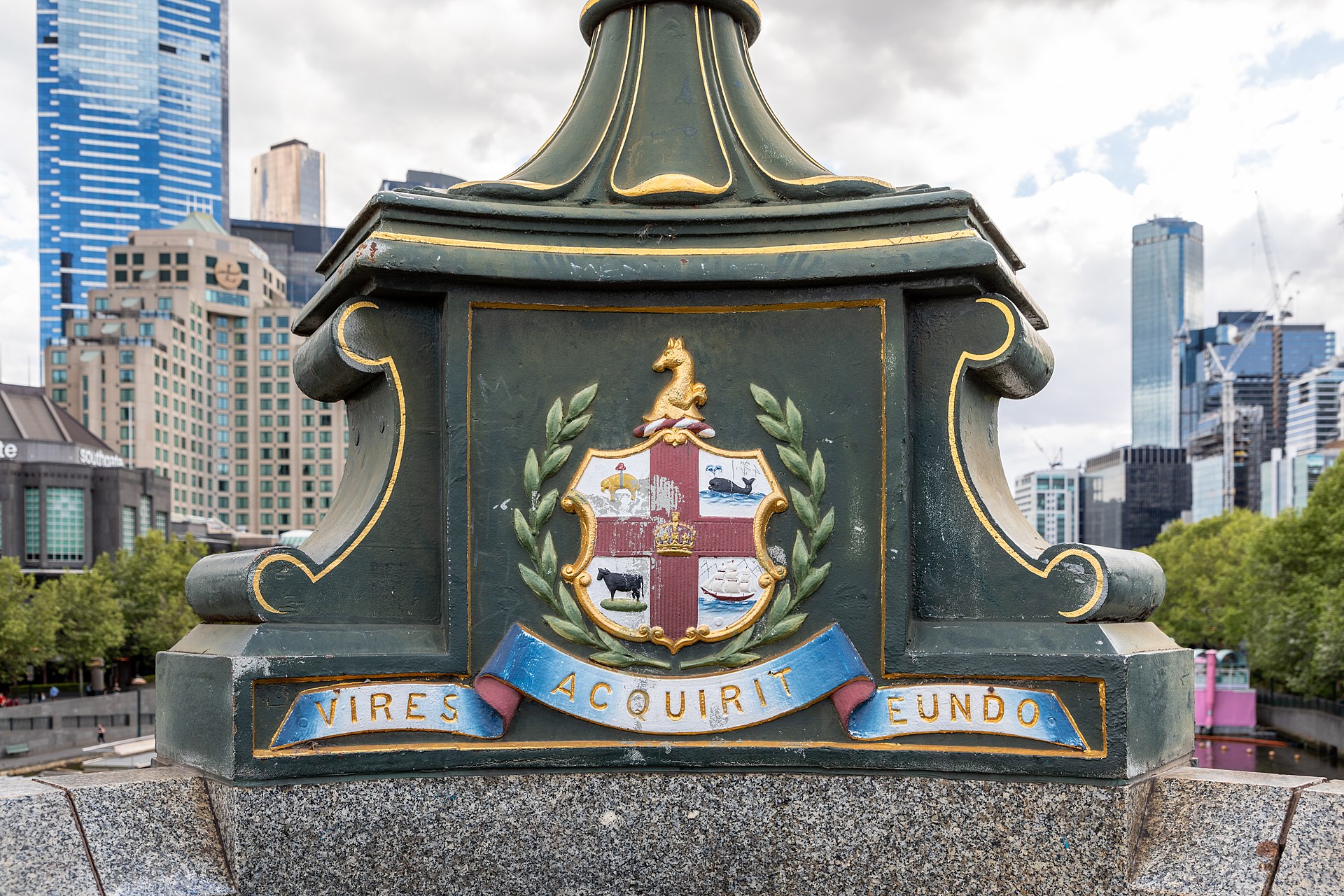
Princes Bridge
Swanston St, Greek Quarter, Melbourne, 3000, Australia
You are crossing one of the oldest river crossing points in Melbourne. When the first European settlers arrived in eighteen thirty-five, there was no way across the Yarra here except by punt or ferry. The first timber bridge went up in eighteen forty-four, a toll bridge named in honour of Albert, Prince of Wales. That bridge was replaced by a grand single-arched stone bridge in eighteen fifty, and then by the current structure, opened on the fourth of October, eighteen eighty-eight, just in time for Melbourne's second International Exhibition. This bridge was designed to impress. It is thirty metres wide and a hundred and twenty metres long, with squat Harcourt granite columns resting on bluestone piers supporting three iron girder arches. The design bears a deliberate resemblance to Blackfriars Bridge over the Thames in London, a fact noted and celebrated at the opening ceremony. Melbourne in the eighteen eighties was one of the richest cities in the world, thanks to the gold rush, and it wanted everyone to know it looked just as grand as London. The Yarra River flowing beneath you has a complicated reputation. Melburnians love to joke about it flowing upside down because it is so murky, but that brown colour is natural tannins from the vegetation upstream, not pollution. The Wurundjeri people called it Birrarung, meaning river of mists, and for thousands of years it was a rich source of eels, fish, and freshwater mussels. Stand here at dawn and you might see a cormorant diving for fish, completely unbothered by the trams rattling overhead. Because of its position connecting the city to St Kilda Road, Princes Bridge is the gateway to everything south: the arts precinct, the Botanic Gardens, and the Shrine.

Queen Victoria Market
Queen St, Collins Street Precinct, Melbourne, 3000, Australia
You are shopping on top of a cemetery. That is not a metaphor. Approximately nine thousand people are still buried beneath the sheds and car park of Queen Victoria Market. This was the Old Melbourne Cemetery, formally gazetted in eighteen thirty-nine as the burial ground for the entire founding population of Melbourne. Everyone from the city's first settlers to its first criminals ended up here. John Batman, the man who controversially claimed to have purchased Melbourne from the Kulin people, was buried on this site. The cemetery operated until eighteen eighty-four, by which point about ten thousand people had been interred. But Melbourne needed a bigger market, and the dead were, well, not complaining. Between nineteen twenty and nineteen twenty-two, nine hundred and fourteen graves with identifying monuments were exhumed and reinterred at Fawkner, Kew, St Kilda, and Cheltenham cemeteries. The rest were left where they lay. The market literally paved over them. The Queen Victoria Market officially opened in March eighteen seventy-eight and has been operating continuously ever since, making it the largest open-air market in the Southern Hemisphere. At seven hectares, it covers two full city blocks. The heritage-listed sheds date from the eighteen eighties and nineties, and the produce hall with its soaring roof trusses is one of the great market buildings of the world. There is a memorial sculpture called Passages on the corner of Queen and Therry streets, acknowledging the people who remain underground. It is a rare and rather uncomfortable example of a multi-denominational early colonial cemetery representing virtually the entire founding population of a state capital, and you are walking over it right now.
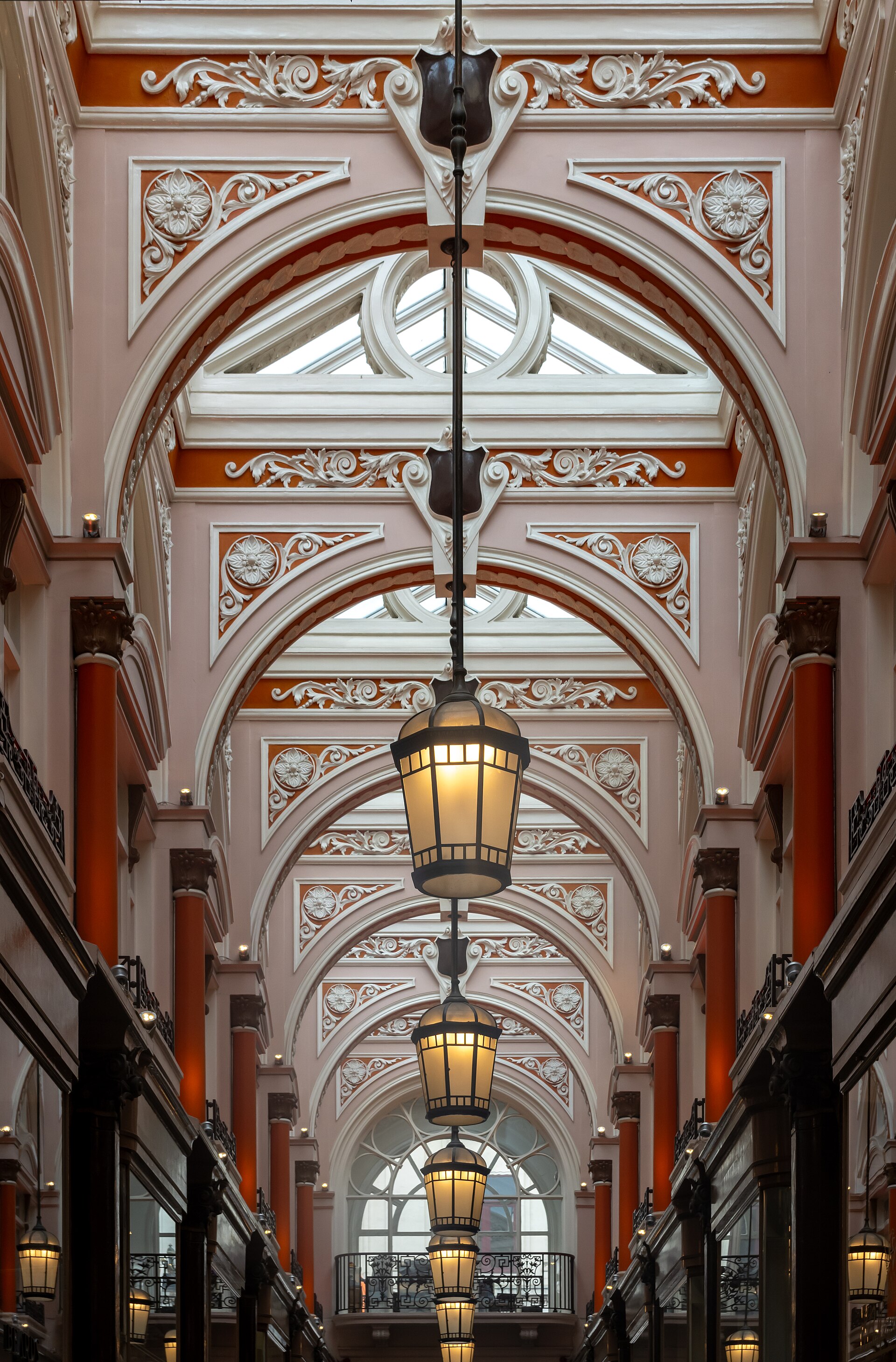
Royal Arcade
335 Bourke Street, Melbourne
Welcome to the oldest surviving shopping arcade in Australia. Royal Arcade opened in eighteen sixty-nine, and walking through it is like stepping into a Victorian time capsule. But look up at the south end, because that is where the real magic happens. Two giant carved figures, each about seven feet tall, stand on either side of an enormous clock. These are Gog and Magog, and every hour on the hour, their arms swing down to strike the bells. They have been doing this since eighteen ninety-two. One hundred and thirty-plus years of hourly bell-striking, and they have not missed a shift. The figures were carved from clear pine by a craftsman named Mortimer Godfrey, modelled on the Gog and Magog statues in London's Guildhall. Those London originals date back to seventeen oh eight and represent the mythical conflict between the ancient Britons and Trojan invaders. Why Melbourne has its own pair is a beautiful example of colonial cities trying to recreate the grandeur of the mother country. The clock itself was made by Johann Friedrich Wilhelm Ziegeler, a German-born clockmaker, for Thomas Gaunt, one of Melbourne's most prominent clock and instrument makers. Gaunt never actually saw the finished installation. He died in eighteen ninety, two years before Gog and Magog were put in place. The arcade itself is the work of architect Charles Webb, who also designed the Windsor Hotel. Notice the original iron lacework and the glass canopy. This is one of the few places in Melbourne where you can see exactly what Victorian-era shopping looked like: intimate, ornate, and absolutely dripping with ambition for a city that was barely thirty years old when this was built.
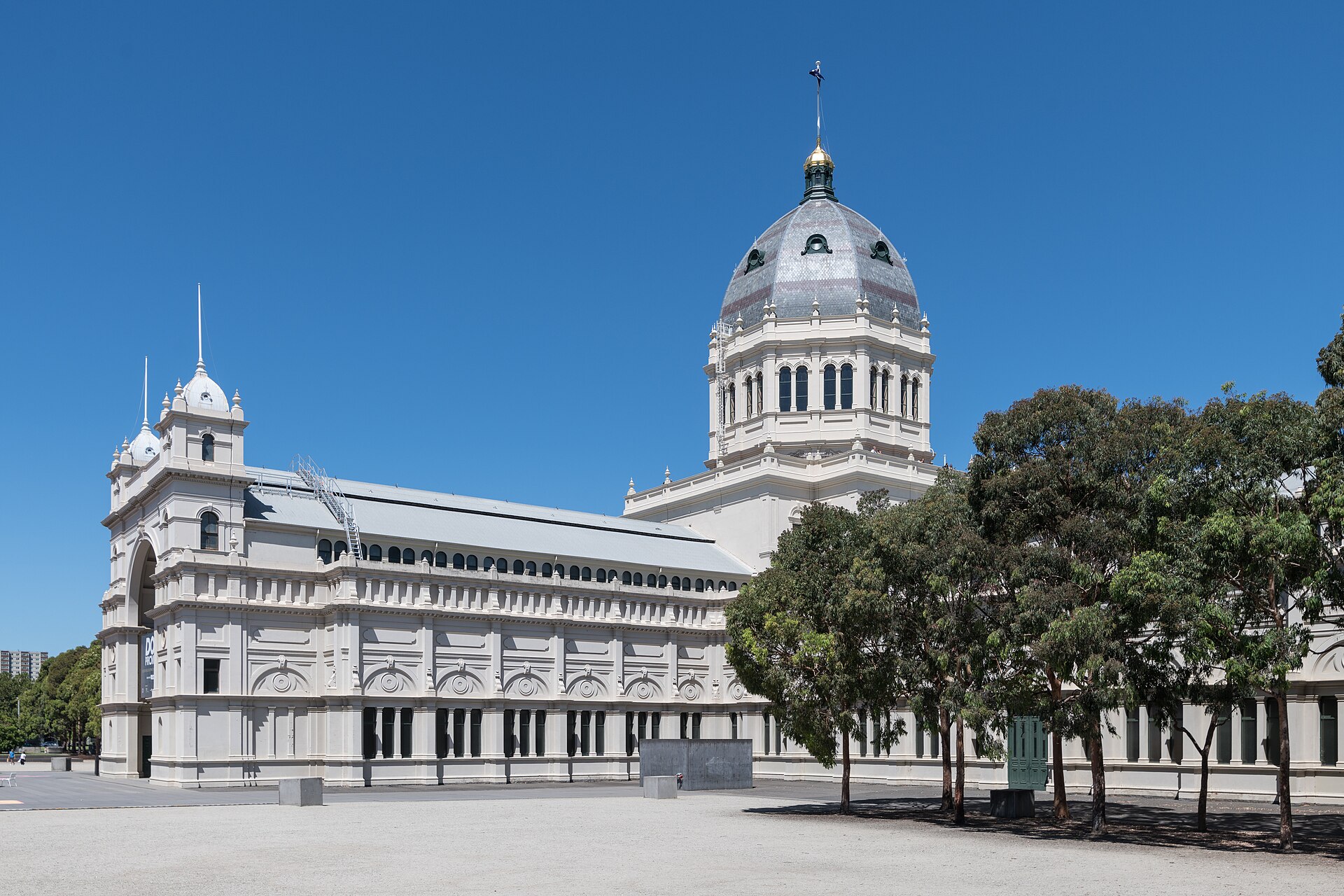
Royal Exhibition Building
9 Nicholson Street, Carlton
You are standing in front of a UNESCO World Heritage Site, the first building in Australia to receive that designation, and also the building where Australia itself was born. On the first of January, nineteen oh one, the Commonwealth of Australia was proclaimed inside this hall. The first federal parliament sat here. The nation's very first laws were debated under this dome. For the first twenty-seven years of Australian federation, before Parliament House in Canberra was built, this is where it all happened. The building was designed by Joseph Reed, the same architect behind the Melbourne Town Hall and the State Library, for the Melbourne International Exhibition of eighteen eighty. It was one of the great world's fairs, and Reed designed a building to match: a cathedral of commerce with a soaring dome modelled on the Florence Cathedral. Over one and a half million people visited that first exhibition. The building is the only surviving major exhibition hall from the great nineteenth-century world's fair movement. Every other exhibition palace from that era, London's Crystal Palace, Paris's Palais de l'Industrie, has been demolished or destroyed. This one endures. The Carlton Gardens surrounding it are equally World Heritage-listed, designed in a mix of Victorian, French, and English landscape styles. At dusk, the gardens come alive with wildlife: brushtail possums, tawny frogmouths, kookaburras, and even grey-headed flying foxes when the native trees are flowering. And here is a nice detail: the fountain in front of the building was manufactured by the same French foundry that made the fountains at the Place de la Concorde in Paris. Melbourne, even in the eighteen eighties, was not shy about its ambitions.
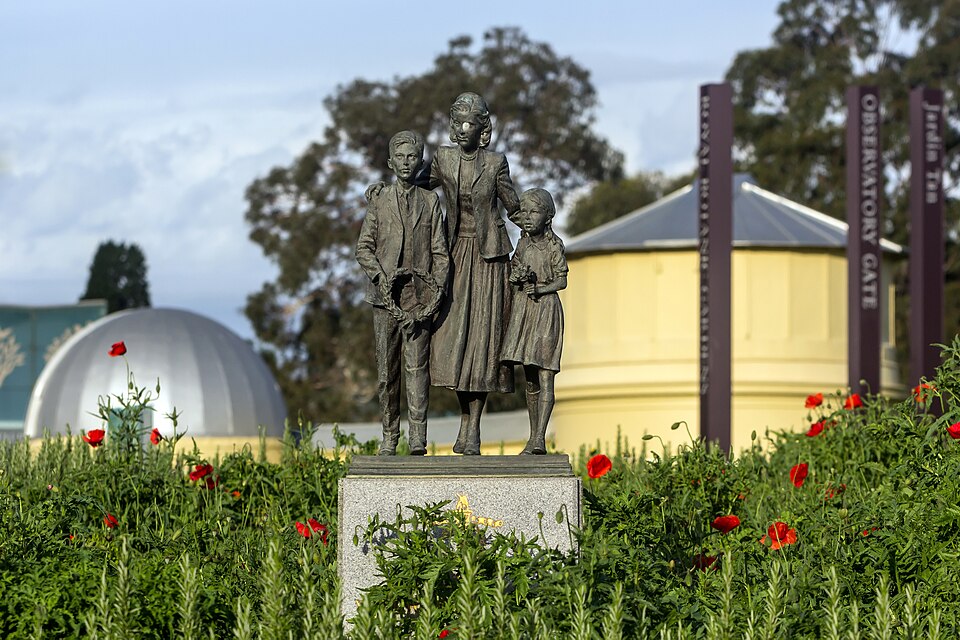
Shrine of Remembrance
Birdwood Avenue, Melbourne
This is one of the most ingenious pieces of architecture in Australia, and the reason why has nothing to do with how it looks. Inside the sanctuary, there is a marble Stone of Remembrance engraved with the words from the Gospel of John: Greater love hath no man. Once a year, at exactly eleven a.m. on the eleventh of November, a ray of sunlight shines through a carefully positioned aperture in the roof and illuminates precisely one word on that stone: Love. The eleventh hour of the eleventh day of the eleventh month. The exact moment the Armistice ended World War One. The architects Philip Hudson and James Wardrop designed this optical effect into the building from the very beginning. It is not an accident. It is not a later addition. The entire building was oriented and the aperture was placed so that astronomy and architecture would align on that one sacred moment each year. Here is the catch, though. When Victoria introduced daylight saving, the sun was suddenly in the wrong place at eleven a.m. So they installed a mirror to redirect the sunlight and preserve the effect. During the rest of the year, an artificial light demonstrates it every half hour. The Shrine was built between nineteen twenty-eight and nineteen thirty-four, modelled on the Mausoleum at Halicarnassus, one of the Seven Wonders of the Ancient World. It was designed as a memorial for the men and women of Victoria who served in World War One, but it has since expanded to honour all Australians who served in all conflicts. The building sits on an elevated position in Kings Domain, deliberately placed so that it commands a clear view down Swanston Street to the city. That sightline is heritage-protected. No building can ever block the view from the Shrine to the city.
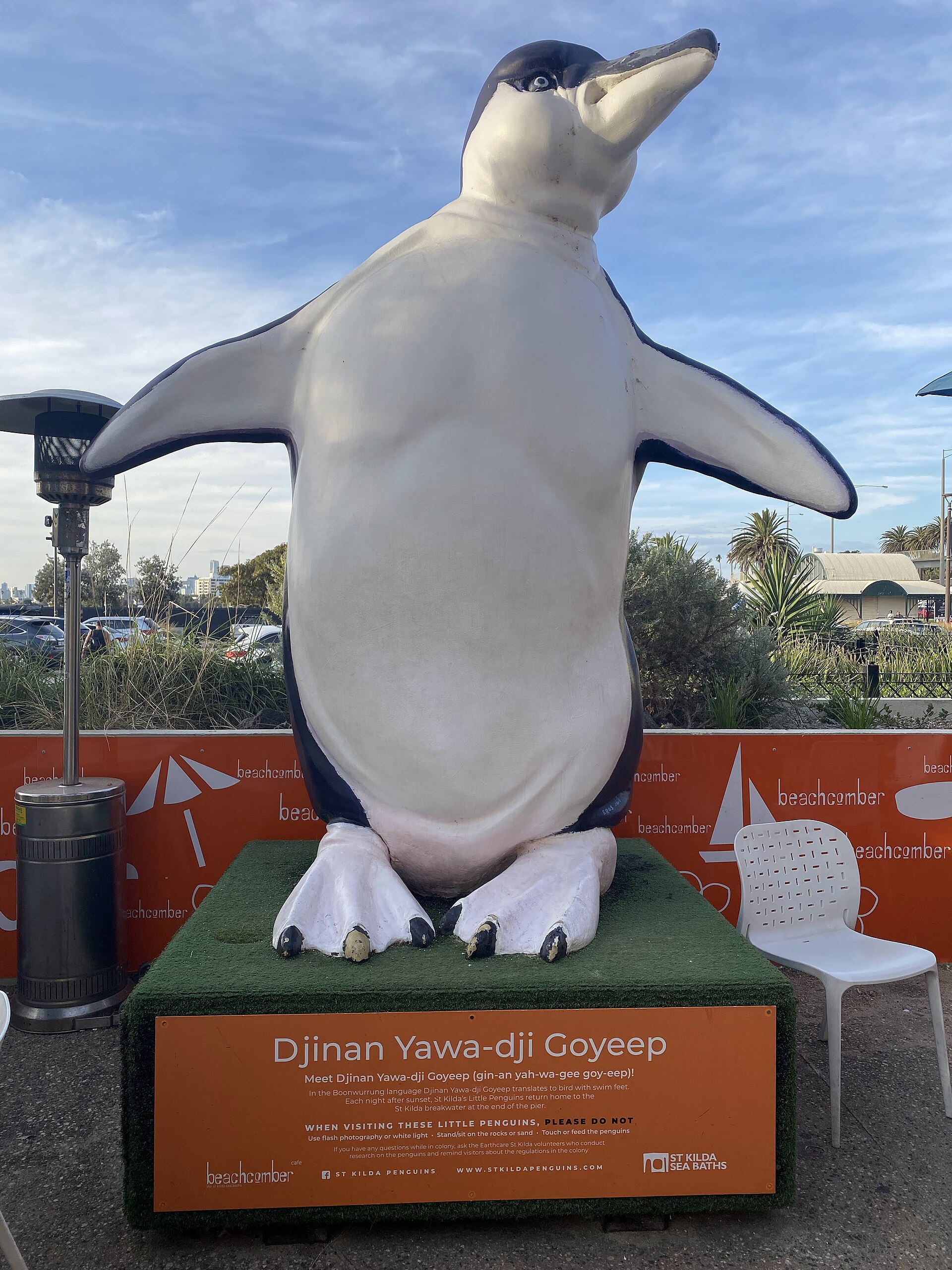
St Kilda Breakwater Penguin Colony
Pier Road, St Kilda
There are penguins in Melbourne. Real, wild penguins, living on a breakwater six kilometres from the CBD, and you can see them for free every single night. Around fourteen hundred little penguins, the smallest penguin species in the world, have made the St Kilda breakwater their home. They waddle out of Port Phillip Bay at sunset, scramble over the volcanic rocks, and settle into their burrows for the night. It is one of the most extraordinary wildlife experiences in any major city on Earth. The breakwater was constructed for the nineteen fifty-six Olympic Games, and nobody planned for penguins. But the volcanic rocks used in the construction turned out to be perfect burrow material. The penguins moved in, liked the rent, and never left. They have been studied continuously since nineteen eighty-six by Earthcare St Kilda, a volunteer organisation that monitors the colony. During the day, the penguins are out in the bay feeding on anchovies and other small fish. They can dive up to sixty metres and stay underwater for over a minute. As the sun sets, they return to the breakwater in small groups called rafts, porpoising through the shallows before hauling themselves up onto the rocks. A new pier design opened in December twenty twenty-four with a hundred-and-fifty-metre elevated boardwalk that gives you views down into the colony without disturbing them. Here is the rule that matters: no flash photography, no torches, no picking them up. These are wild animals in their natural habitat, and they bite. But watching them waddle past your feet at dusk, squeaking and squabbling, is genuinely magical. The fact that this happens in a major city is the no way moment.
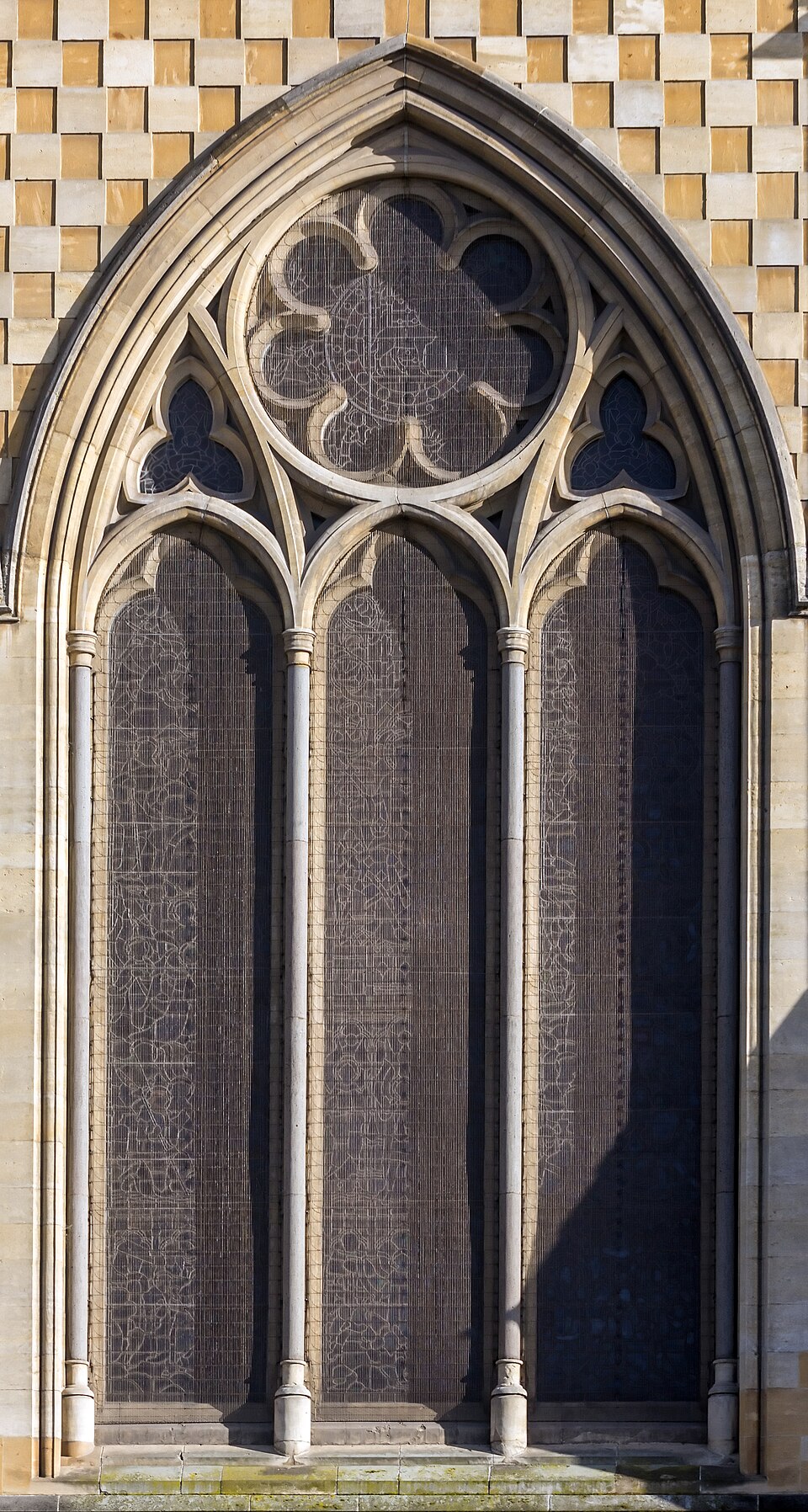
St Paul's Cathedral
209 Flinders Lane, Melbourne
This Gothic Revival cathedral stands on the exact spot where the first public Christian service in Melbourne was conducted in eighteen thirty-five, right at the founding of the settlement. But the building you see now was not the original. The first St Paul's was a modest bluestone church consecrated in eighteen fifty-two. It was demolished in eighteen eighty-five to make way for this far grander structure, designed by the English architect William Butterfield, one of the most important Gothic Revival architects of the Victorian era. Butterfield never actually came to Melbourne. He designed the entire cathedral from England, which led to some spectacular disagreements with the local builders. The original design called for a single spire, but Butterfield fell out so badly with the cathedral committee that he resigned from the project. The spires you see today were completed between nineteen twenty-six and nineteen thirty-two to a different design by the local architect Joseph Reed. So the top does not quite match the bottom, architecturally speaking. Step inside if you get a chance. The floor is paved with encaustic tiles imported from the English firm of Maw and Company, featuring intricate geometric patterns. The walls use alternating bands of cream Waurn Ponds limestone and dark local bluestone, creating those dramatic stripes that are Butterfield's signature polychromatic style. He used the same technique in churches across England. The organ is one of the finest in Australia, built by T. C. Lewis of London. And here is a detail most people miss: the cathedral sits slightly below street level because Swanston Street was raised around it over the decades. The city literally grew up around this building.
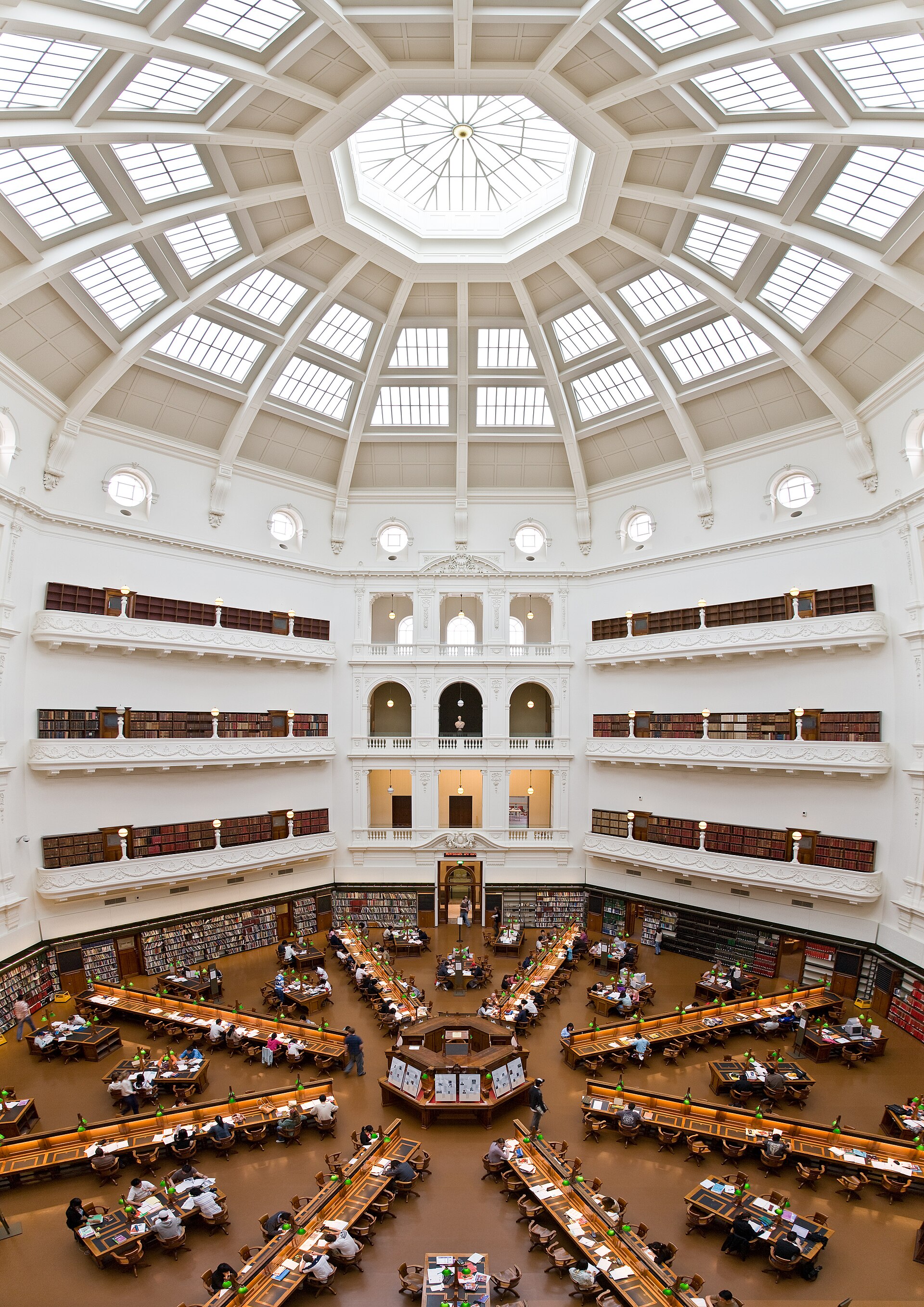
State Library Victoria
328 Swanston Street, Melbourne
Walk inside and look up. The La Trobe Reading Room is one of the great interior spaces of the nineteenth century: an octagonal dome six storeys high, modelled on the British Museum in London and the Library of Congress in Washington. When it was built in nineteen thirteen, the enormous reinforced concrete dome was the largest of its kind in the world. It can house thirty-two thousand books and three hundred and twenty readers at its radially arranged desks. But here is the unsettling part. The room was designed on a panopticon plan, the same layout used in prisons. A librarian sat on a raised dais at the exact centre of the room, from where they could survey every single desk without moving. Instead of a warden watching inmates, you had a librarian watching readers, ready to deliver stern admonishments to anyone who dared whisper. The architecture of surveillance, repurposed for silence. The library itself opened in eighteen fifty-six, making it one of the oldest public libraries in the world and the oldest in Australia. It was designed by Joseph Reed, the same architect who designed the Royal Exhibition Building. The dome's skylights were covered with copper sheathing in nineteen fifty-nine and the reading room slowly deteriorated. When the dome was refurbished and reopened in two thousand and three, the skylights were revealed again and literary quotations were inscribed around the upper galleries. The restoration cost ninety million dollars. But here is the truly democratic thing about this building: it is completely free. Anyone can walk in, sit down, and read. No membership, no fees, no judgement. And Melburnians do, in their thousands, every single day. The chess players on the front lawn are practically permanent fixtures.
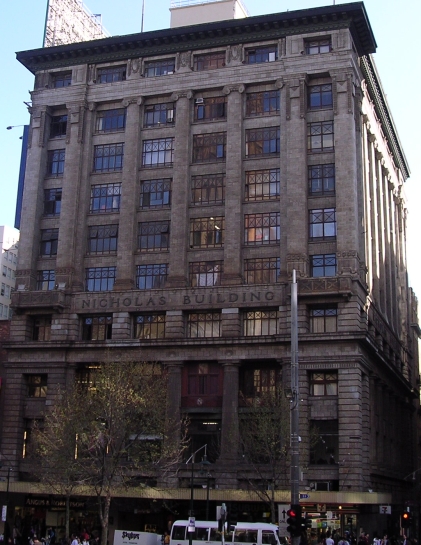
The Nicholas Building
37 Swanston Street, Melbourne
From the outside, the Nicholas Building looks like just another heritage office block. But step inside, ride the lift to any floor, and you will find yourself in Melbourne's most concentrated creative ecosystem. For decades, this nineteen twenty-six Commercial Palazzo building has been home to independent fashion designers, artists, jewellers, print studios, and every kind of creative misfit you can imagine. The corridors smell like paint and possibility. The building was designed by architect Harry Norris and completed in nineteen twenty-six. It is named after the Nicholas family, and here is where the money story gets interesting. The family fortune came from Aspro, the headache tablet. During World War One, the German-made aspirin became unavailable in Australia, so the Nicholas family created their own version and made an absolute fortune. That aspirin money built this building. The street-level arcade is the only remaining example of a leadlight-roofed and fan-lighted arcade in Melbourne. Before a modernisation in twenty twelve, the Nicholas Building was home to the last manually operated lift in Melbourne. A person sat inside and pulled a lever to take you up and down. The building has attracted remarkable tenants over the years. Vali Myers, the legendary dancer and artist who lived in a cave on the Amalfi Coast for decades, had a studio on the seventh floor from nineteen ninety-five until her death in two thousand and three. And the novel Shantaram, written by fugitive Gregory David Roberts, was reportedly written within these walls. It is a building where the walls have absorbed more creative energy than most galleries ever will.
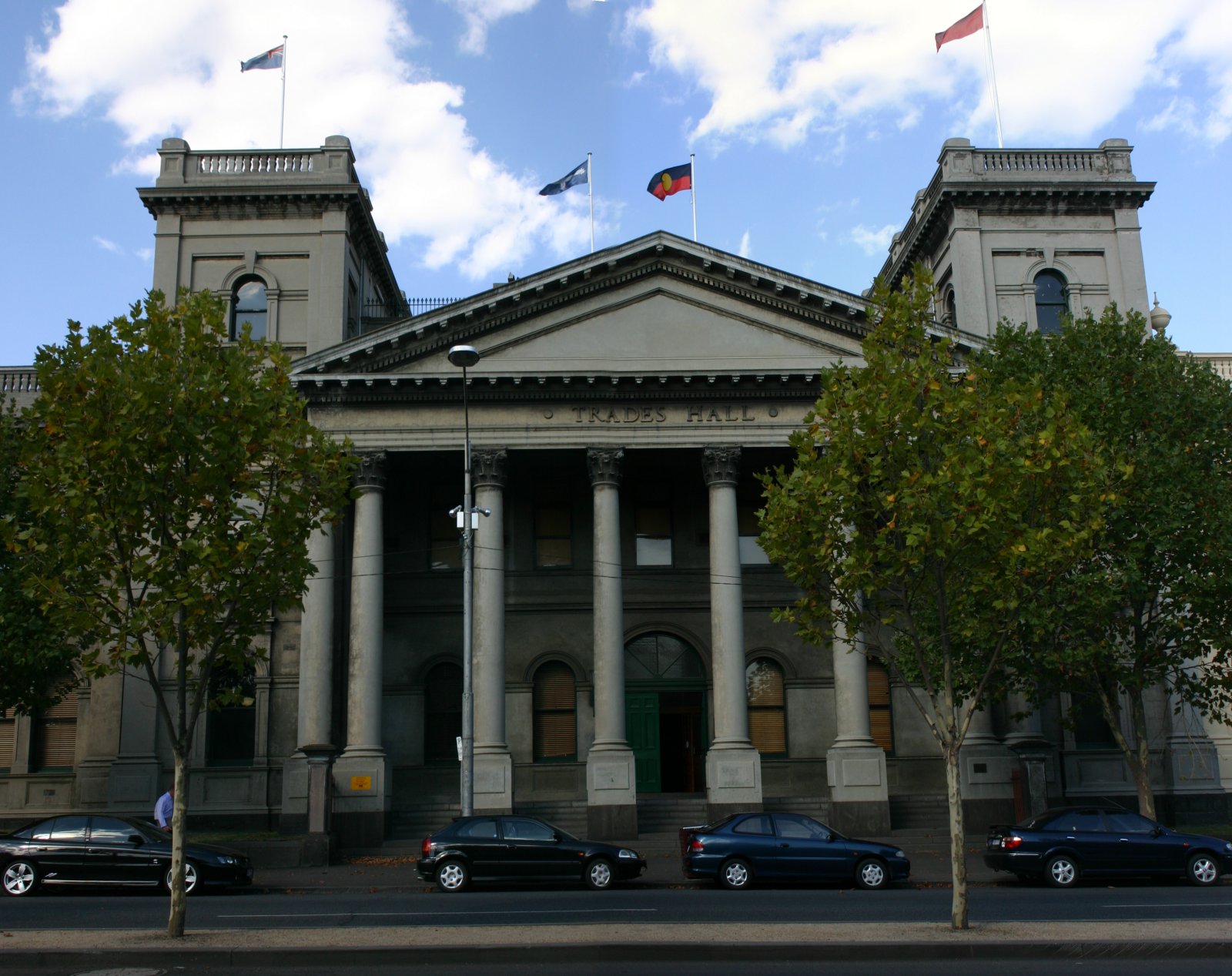
Victorian Trades Hall
54 Victoria Street, Carlton
You are looking at the oldest continually functioning trade union building in the world. That is not an exaggeration. The original Trades Hall opened in May eighteen fifty-nine, a modest timber building financed entirely by workers and built by their own labour. It is still in use by trade unions today, over a hundred and sixty years later. And the reason it exists traces back to one of the most significant labour victories in human history. In eighteen fifty-six, stonemasons working on buildings around Melbourne downed tools and marched to demand an eight-hour workday. They won. Melbourne became one of the first places in the world to achieve the eight-hour day, years before most of Europe or America. That victory directly led to the creation of this building as a permanent home for the labour movement. The workers needed a place to organise, educate, and gather, so they built one themselves. Between eighteen seventy-four and nineteen twenty-five, the hall was rebuilt and expanded by Joseph Reed, the same architect behind the Melbourne Town Hall, the Royal Exhibition Building, and the State Library. The current building is a layered history of over fifty years of construction, each wing added as the union movement grew. The Victorian Labor Party was born in this building. The Australian Council of Trade Unions was founded here. It is one of the most historically important sites in Melbourne, yet most tourists walk right past it. The building is classified by the National Trust and is on Australia's Tentative List for UNESCO World Heritage status as part of a nomination for Workers' Assembly Halls. If it gets the listing, it would be the first trade union building in the world to receive World Heritage recognition.
Webb Bridge
Capital City Trail, Docklands
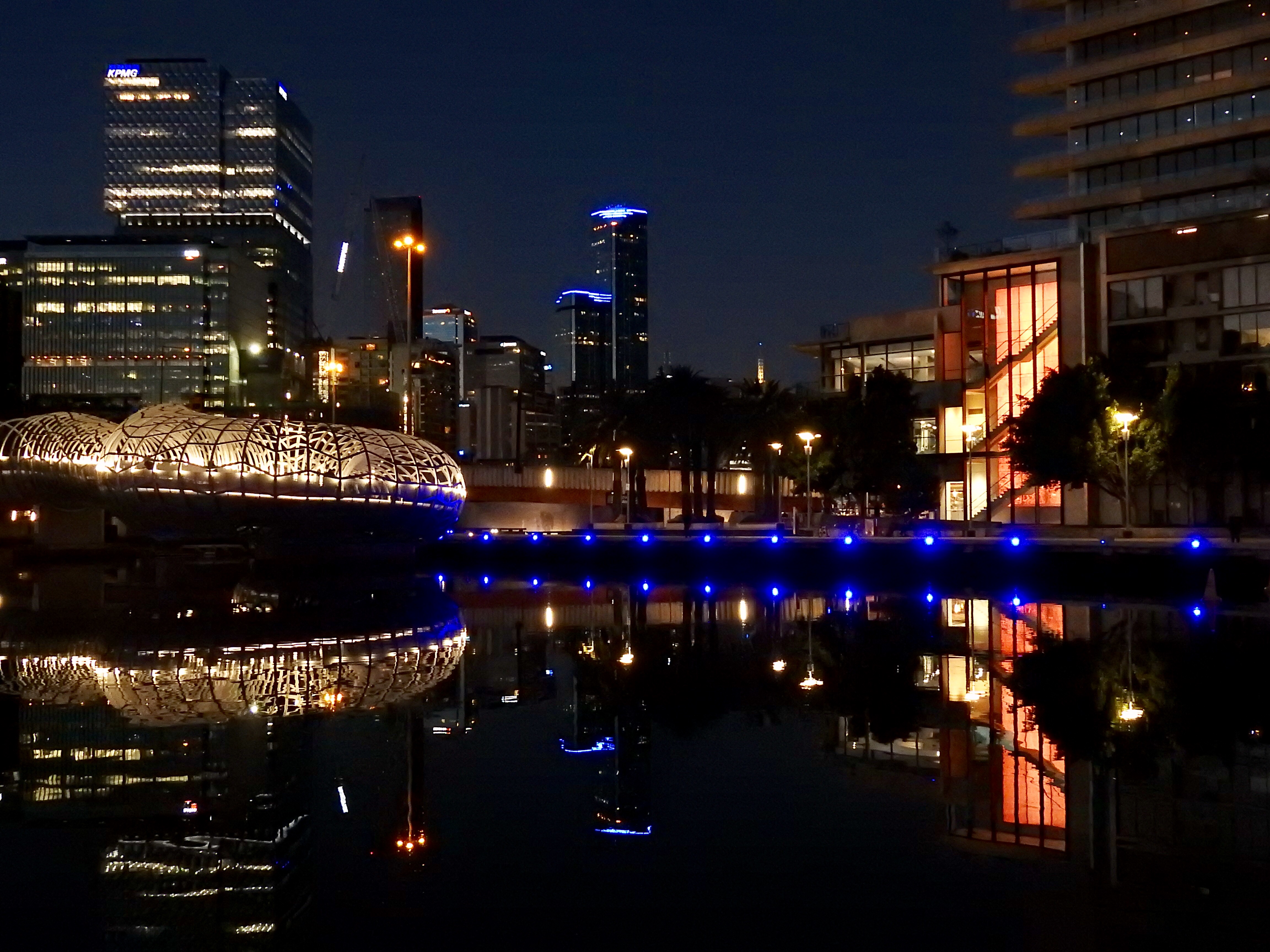
This is not just a bridge. It is an act of reconciliation shaped like a fishing trap. Webb Bridge, a pedestrian and cycling crossing over the Yarra in Docklands, was designed as a collaboration between architects Denton Corker Marshall and artist Robert Owen, and its most striking feature is the sculptural steel web that arches over the walkway. Those undulating curves are modelled on the traditional eel traps used by the Koorie people of this region for thousands of years. The Wurundjeri and Boonwurrung people were sophisticated aquaculturalists who engineered complex eel-trapping systems across Victoria. The most famous example is the Budj Bim eel traps in western Victoria, a six-thousand-year-old aquaculture system now recognised as a UNESCO World Heritage Site. Webb Bridge references that tradition, placing the shape of a woven eel basket at the end of a linear concrete deck, a symbolic acknowledgement that this waterway was a food source and meeting place long before the Docklands development arrived. The steel elements are connected to each other to form the eel trap shape, and the laser-cut perforated metal panels create patterns of light and shadow as you walk through. At night, the bridge is illuminated, and those perforations create a constellation effect on the path below. The design grew out of a desire for what the architects called a symbolic and poetic demonstration of reconciliation. In a precinct that is otherwise defined by corporate towers and apartment blocks, Webb Bridge is a reminder that the story of this waterfront stretches back thousands of years before the first apartment was sold off the plan.
Young and Jackson Hotel
1 Swanston Street, Melbourne
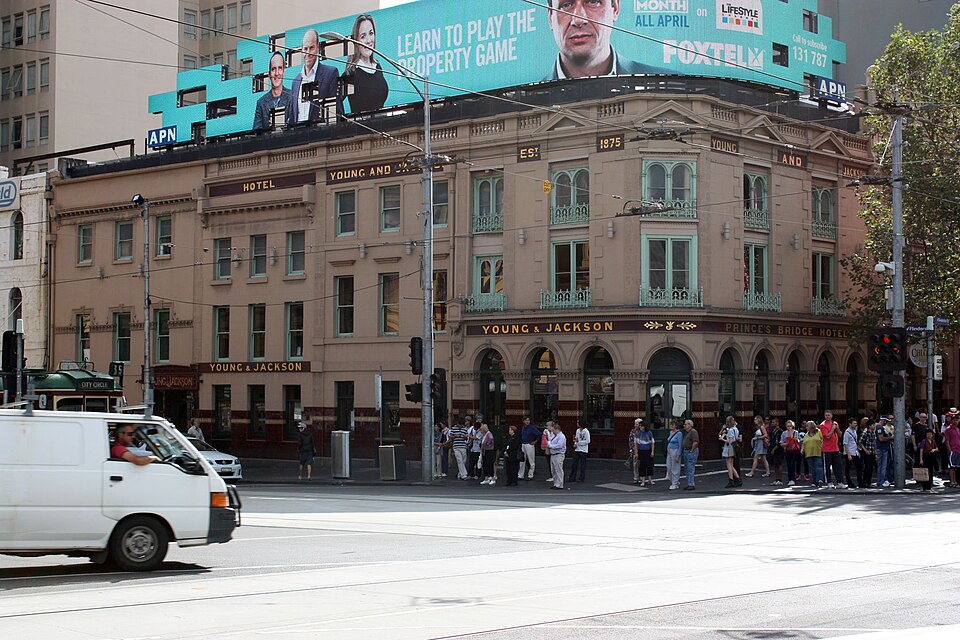
This pub on the corner of Swanston and Flinders has been pouring beers since eighteen sixty-one, but the real attraction is upstairs. In a room on the first floor hangs a painting called Chloe, a life-sized nude by French academic painter Jules Lefebvre. She has been watching over Melbourne drinkers since nineteen oh nine, and her story is one of the strangest love affairs between a city and a painting you will ever hear. Chloe debuted at the Paris Salon in eighteen seventy-five, where critics praised her. She came to Australia for the Sydney International Exhibition in eighteen seventy-nine and then the Melbourne International Exhibition. A local doctor named Thomas Fitzgerald bought her for eight hundred and fifty guineas. In eighteen eighty-three, Fitzgerald loaned Chloe to the National Gallery of Victoria, which had just started opening on Sundays. The painting of a naked woman on display on the Sabbath caused an absolute uproar. The press went wild. Public opinion split right down the middle. When Fitzgerald died in nineteen oh eight, Henry Figsby Young, the pub's owner, snapped Chloe up at auction and hung her in the saloon bar. And here is where it gets genuinely moving. During World War One, World War Two, Korea, and Vietnam, soldiers heading overseas would come to say goodbye to Chloe. They wrote letters to her from the trenches in Turkey, France, and Papua New Guinea, promising to come back. Many did not. In nineteen eighty-eight, the National Trust and Heritage Victoria declared that Chloe must remain part of the hotel forever. She is heritage-listed. She is not going anywhere. And neither, it seems, are the people who love her.