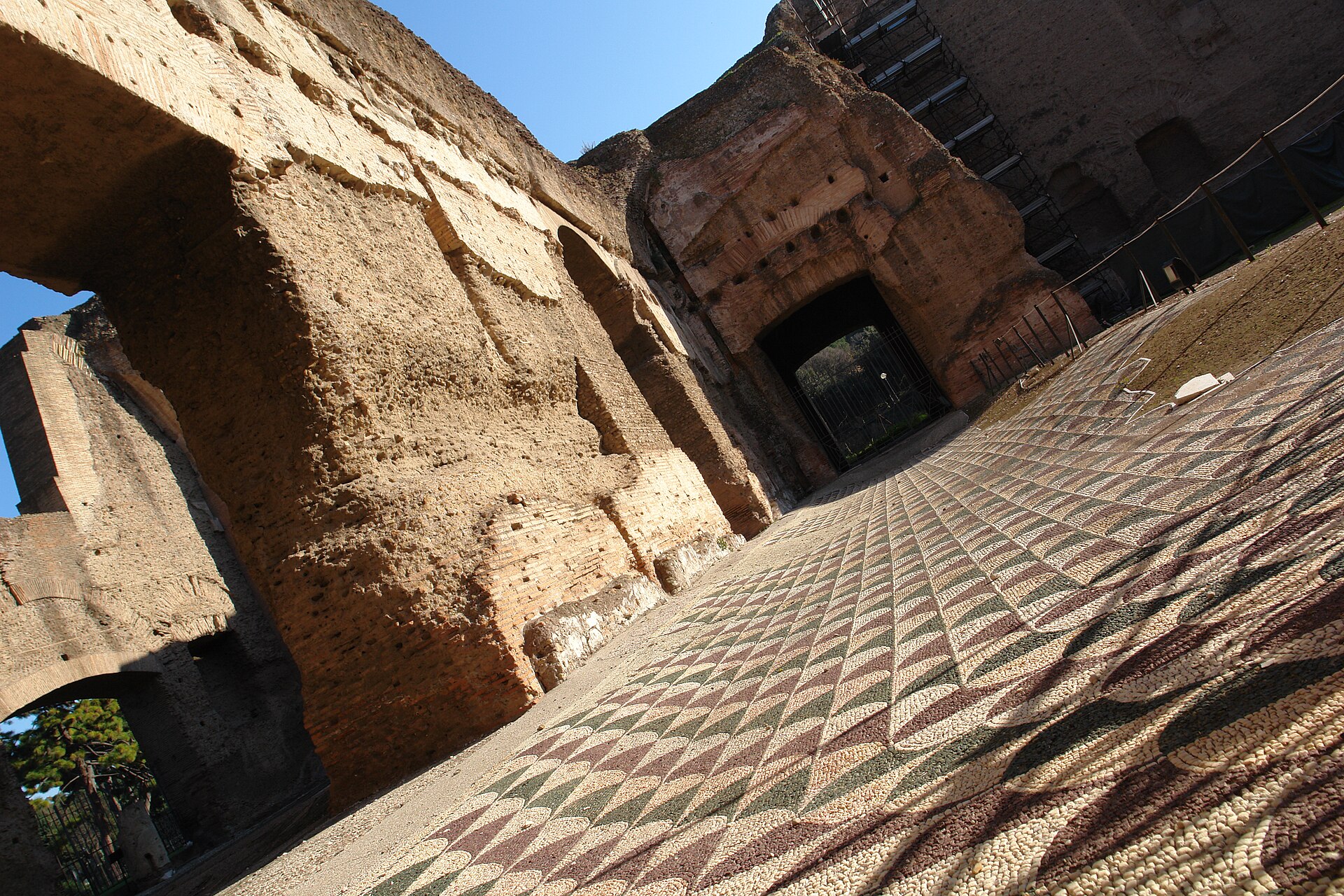
These were not baths. Not in any way you understand the word. The Baths of Caracalla were a leisure complex the size of six football fields, accommodating up to eight thousand people simultaneously, and admission was free or nearly free. Built between 212 and 216 AD, the complex included a swimming pool, hot rooms, warm rooms, cold rooms, two gymnasiums, a library with separate Greek and Latin sections, shops, gardens, and what may have been a art gallery. This was a Roman community centre with water features.
The engineering is staggering. Heating the baths required burning ten tonnes of wood per day in underground furnaces. The hypocaust system circulated hot air beneath raised marble floors and through hollow walls. Water was supplied by a dedicated branch of the Aqua Marcia aqueduct, stored in a massive cistern that still exists behind the ruins. The main hall — the frigidarium — had cross-vaulted ceilings thirty-three metres high, held up by granite columns from Egypt. When the architects of Pennsylvania Station in New York designed their main hall in 1910, they explicitly modelled it on this room.
The floor mosaics were extraordinary. The most famous — a series of muscular athletes in what appears to be boxing, wrestling, and ball-game scenes — were discovered in 1824 and now reside in the Vatican Museums. They are enormous, detailed, and strangely modern-looking. The athletes wear what look remarkably like modern bikinis, which has sparked decades of scholarly debate about Roman sportswear.
Percy Bysshe Shelley wrote Prometheus Unbound while sitting among these ruins in 1819. The opera season is now held here every summer — La Scala's rival in atmosphere if not acoustics. Watching Aida performed against thirty-metre walls of ancient Roman brick, under a night sky, with bats wheeling overhead, is one of the great cultural experiences available in any European city.
Verified Facts
The baths accommodated up to 8,000 people at once and included libraries, gyms, gardens, and shops — admission was free or nearly free
Heating required burning approximately 10 tonnes of wood daily in underground furnaces with a hypocaust system
Pennsylvania Station in New York (1910) was explicitly modelled on the frigidarium of the Baths of Caracalla
Shelley wrote Prometheus Unbound while sitting in these ruins in 1819
Get walking directions
Viale delle Terme di Caracalla, 52, 00153 Roma