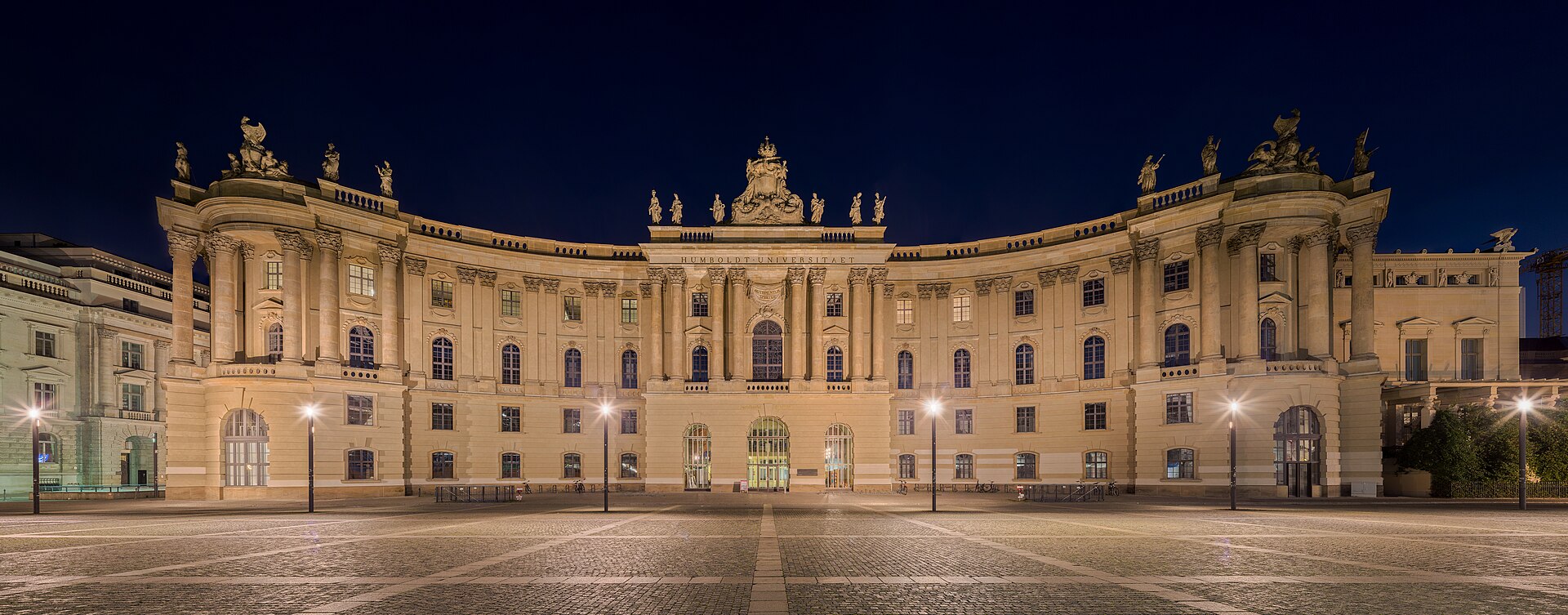
On May 10, 1933, Nazi students burned approximately 20,000 books in this square. Works by Einstein, Freud, Hemingway, Mann, Marx, Remarque, Kafka, and hundreds of others were thrown into a bonfire in front of the Humboldt University while Joseph Goebbels gave a speech declaring the 'end of the age of Jewish intellectualism.'
Look down. In the centre of the square, set flush with the cobblestones, there's a glass plate. Through it, you can see an underground room with empty white bookshelves — enough to hold 20,000 volumes. The memorial, designed by Israeli artist Micha Ullman, is called 'The Empty Library.' It's most visible at night, when the shelves are illuminated from below. During the day you might walk right over it without noticing, which is perhaps the most unsettling thing about it.
A plaque nearby quotes Heinrich Heine, who wrote in 1820 — more than a century before the Nazis: 'Where they burn books, they will ultimately burn people also.' Heine was one of the authors whose works were burned.
The square itself is architecturally beautiful — flanked by the Staatsoper (opera house), St. Hedwig's Cathedral (modelled on the Pantheon in Rome), and the old Royal Library, whose curved facade students call 'the chest of drawers.' Frederick the Great designed this square to be Berlin's cultural heart. For one night in 1933, it became something else entirely.
Verified Facts
Approximately 20,000 books were burned by Nazi students in Bebelplatz on May 10, 1933
Micha Ullman's 'Empty Library' memorial is an underground room of empty white shelves visible through a glass plate in the square
Heinrich Heine wrote 'Where they burn books, they will ultimately burn people also' in 1820, over a century before the Nazi book burnings
Heine's own works were among those burned in the 1933 book burning
Get walking directions
City Centre, Berlin, 10117, Germany