The Catacombs of Paris
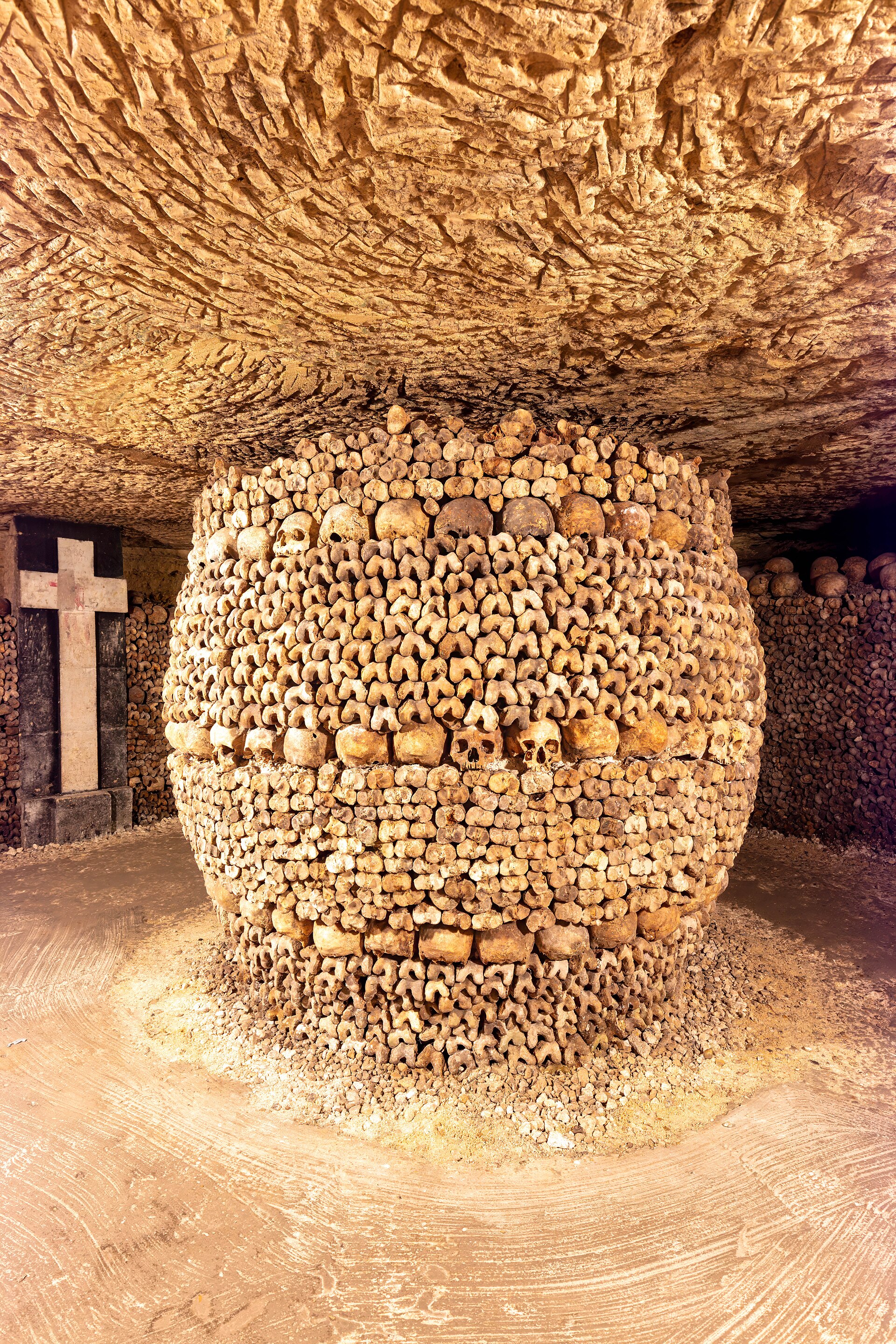
Twenty meters below the streets of the 14th arrondissement, the bones of six million Parisians are stacked along 1.5 kilometers of tunnels in arrangements that are equal parts macabre and oddly beautiful. Skulls form neat rows, tibias create decorative patterns, and the occasional femur-cross punctuates the walls like gothic wallpaper.
The story starts with a public health crisis. By the late 18th century, Paris's cemeteries — especially the massive Saints-Innocents near Les Halles — were so overfull that basement walls in neighboring buildings were collapsing under the weight of decomposing bodies. In 1786, the city began moving remains into abandoned limestone quarries that had been mined since the Romans. The transfer took twelve years and was conducted at night by torchlight, with priests chanting along the route.
The catacombs you visit today are just a tiny fraction of the tunnel network beneath Paris. The full system stretches over 300 kilometers, and an entire subculture of "cataphiles" — urban explorers — navigates the off-limits sections through secret entrances, hosting underground parties, film screenings, and even maintaining a fully functional cinema discovered by police in 2004, complete with electricity, a bar, and a screening room carved into the rock.
During World War II, the tunnels served both sides: the French Resistance used them as headquarters (their command center was directly beneath the building occupied by the German high command), while the Germans built bunkers in other sections. The liberation of Paris in August 1944 was partly coordinated from these tunnels.
Verified Facts
The Catacombs contain the remains of approximately six million people relocated from Parisian cemeteries
The transfer of remains from the Saints-Innocents cemetery began in 1786 and was conducted at night
In 2004, police discovered a fully equipped cinema in an off-limits section of the tunnels
The French Resistance used the catacombs as their headquarters during the liberation of Paris in 1944
Get walking directions
1 Avenue du Colonel Henri Rol-Tanguy, 14th Arr., Paris, 75014, France