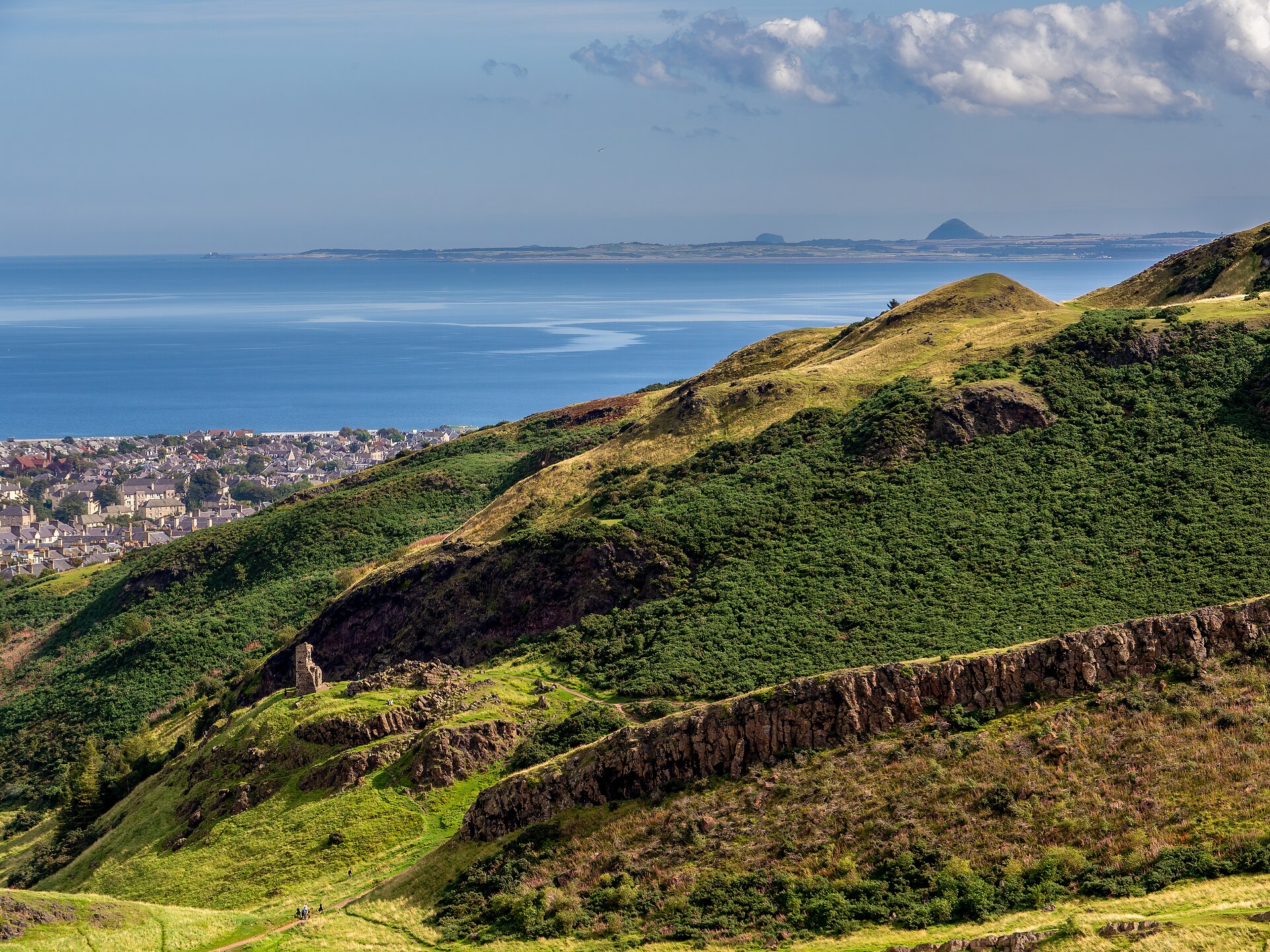
You can climb an extinct volcano without leaving the city centre. Arthur's Seat rises 251 metres above Edinburgh from the heart of Holyrood Park, and its lava solidified somewhere between 341 and 335 million years ago — making it older than the dinosaurs by a comfortable margin. The volcano erupted during the early Carboniferous period, and what you're climbing are the exposed remnants of its central vents, sculpted by glaciers that ground over them during the last ice age and carved the distinctive crag-and-tail formation that also shaped Edinburgh Castle's rock.
From certain angles, Arthur's Seat looks like a crouching lion, with two summits forming the "Lion's Head" and the "Lion's Haunch." The name's origin is debated — it may reference the legendary King Arthur, or it may be a corruption of the Gaelic "Àrd-na-Said" meaning "height of arrows." In 1836, a group of boys hunting rabbits on the hill discovered seventeen tiny coffins hidden in a cave, each containing a carved wooden figure. No one has ever explained them convincingly. Theories range from witchcraft to memorials for Burke and Hare's murder victims. Eight of the coffins survive in the National Museum of Scotland.
The Salisbury Crags, the dramatic cliff face on Arthur's Seat's western flank, were where the geologist James Hutton made observations in the 1780s that helped him formulate the theory of deep geological time — essentially proving that the earth was millions of years old, not thousands. A section of the crags is named "Hutton's Section" in his honour. His work, done while looking at these rocks, is considered the foundation of modern geology.
The climb takes about forty-five minutes from Holyrood and rewards you with panoramic views stretching to the Pentland Hills, across the Firth of Forth to Fife, and on clear days all the way to the Highlands. It's the only European capital where you can summit a proper mountain and be back in a pub within the hour.
Verified Facts
Arthur's Seat is an extinct volcano with lava dated to 341–335 million years old, from the early Carboniferous period
The summit stands at 250.5 metres (822 ft), making it Edinburgh's highest point
In 1836, seventeen miniature coffins with carved figures were discovered in a cave on the hillside; eight survive in the National Museum of Scotland
James Hutton made key geological observations at Salisbury Crags in the 1780s that helped establish the theory of deep time
Get walking directions
Holyrood Road, The Royal Mile, Edinburgh, EH8, United Kingdom