This place was built because London was literally drowning in its own dead. By the eighteen thirties, the city's churchyards were so overcrowded that coffins were stacking up and bursting open. Gravediggers would cram bodies in at night, sometimes cutting corpses apart to make them fit. The stench was unbearable, and the water supply was being poisoned by decomposing remains. Parliament's solution: build seven commercial cemeteries in a ring around London. They became known as the Magnificent Seven. Highgate, opened in eighteen thirty-nine, was the showpiece.
And they went all in on the drama. Walk through the Egyptian Avenue and you'll understand. It was originally an enclosed tunnel — not the open walkway you see now — designed to make visitors feel like they were entering a pharaoh's tomb. Sixteen vaults line either side, their stone doors sealed with iron. The Victorians were obsessed with Egypt after Napoleon's campaigns, and they brought that obsession to their cemeteries. Death as theatre.
The most famous resident is over in the East Cemetery — Karl Marx, buried here in eighteen eighty-three. His enormous bust draws visitors from around the world. What fewer people know is that someone tried to blow up his tomb. Twice. Once on the second of September nineteen sixty-five, and again in nineteen seventy. The damage is still visible on the plinth.
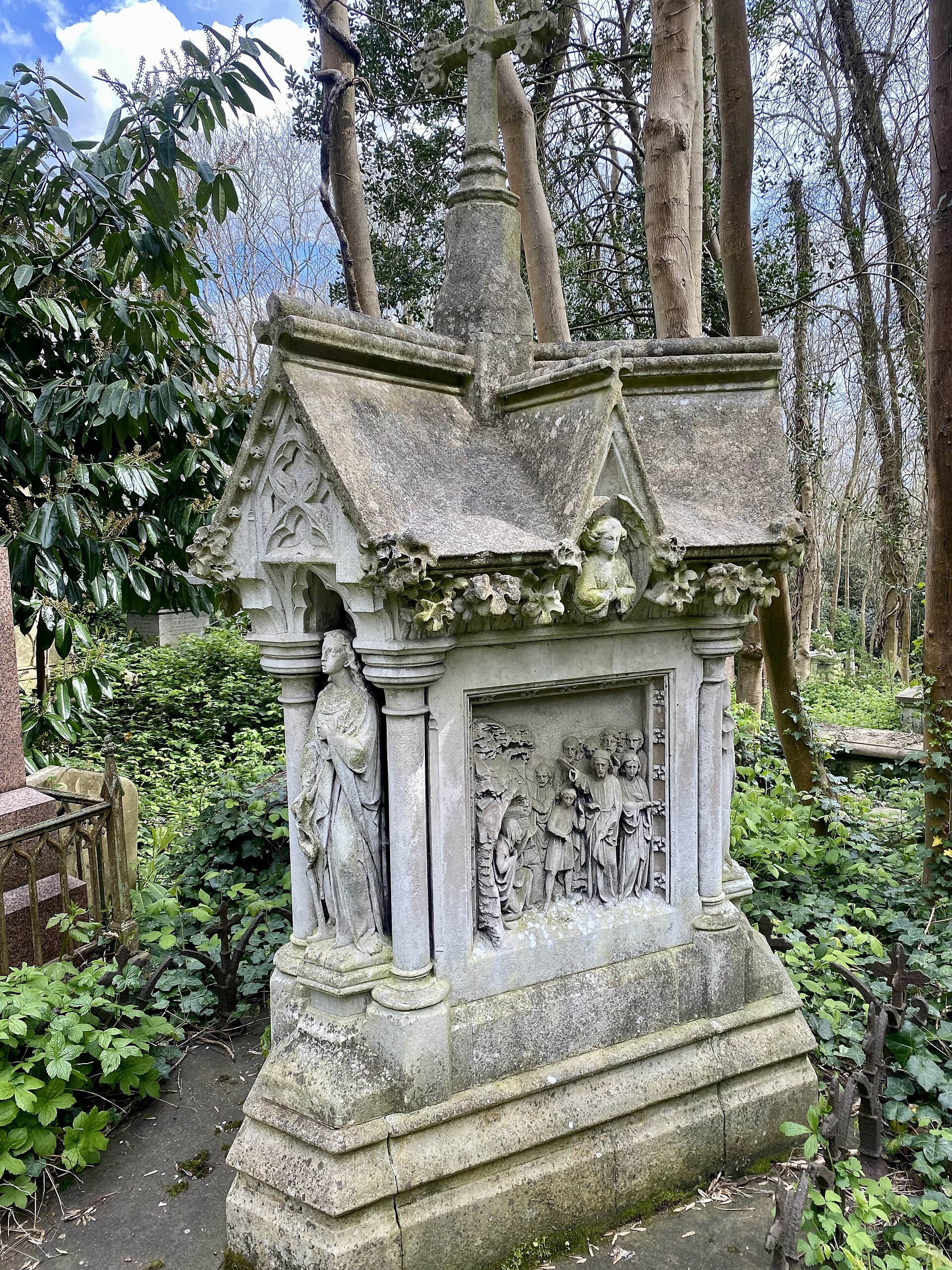
Over time, the West Cemetery was abandoned and nature took over. Trees split open mausoleums. Ivy consumed angels. Fox families moved into vaults. When restoration began in the nineteen seventies, volunteers had to machete their way through the undergrowth. It's controlled now, but they've deliberately left some of the wild overgrowth — the tension between Victorian grandeur and creeping nature is the whole point.
Verified Facts
One of the Magnificent Seven commercial cemeteries built in 1830s-40s because London's churchyards were overflowing with corpses
Egyptian Avenue was originally an enclosed tunnel with 16 vaults on either side, designed to feel like an Egyptian tomb
Karl Marx's tomb was targeted by explosions on 2 September 1965 and again in 1970
Opened in 1839 as the showpiece of the Magnificent Seven
Get walking directions
Swain's Lane, Camden, London, N6, United Kingdom