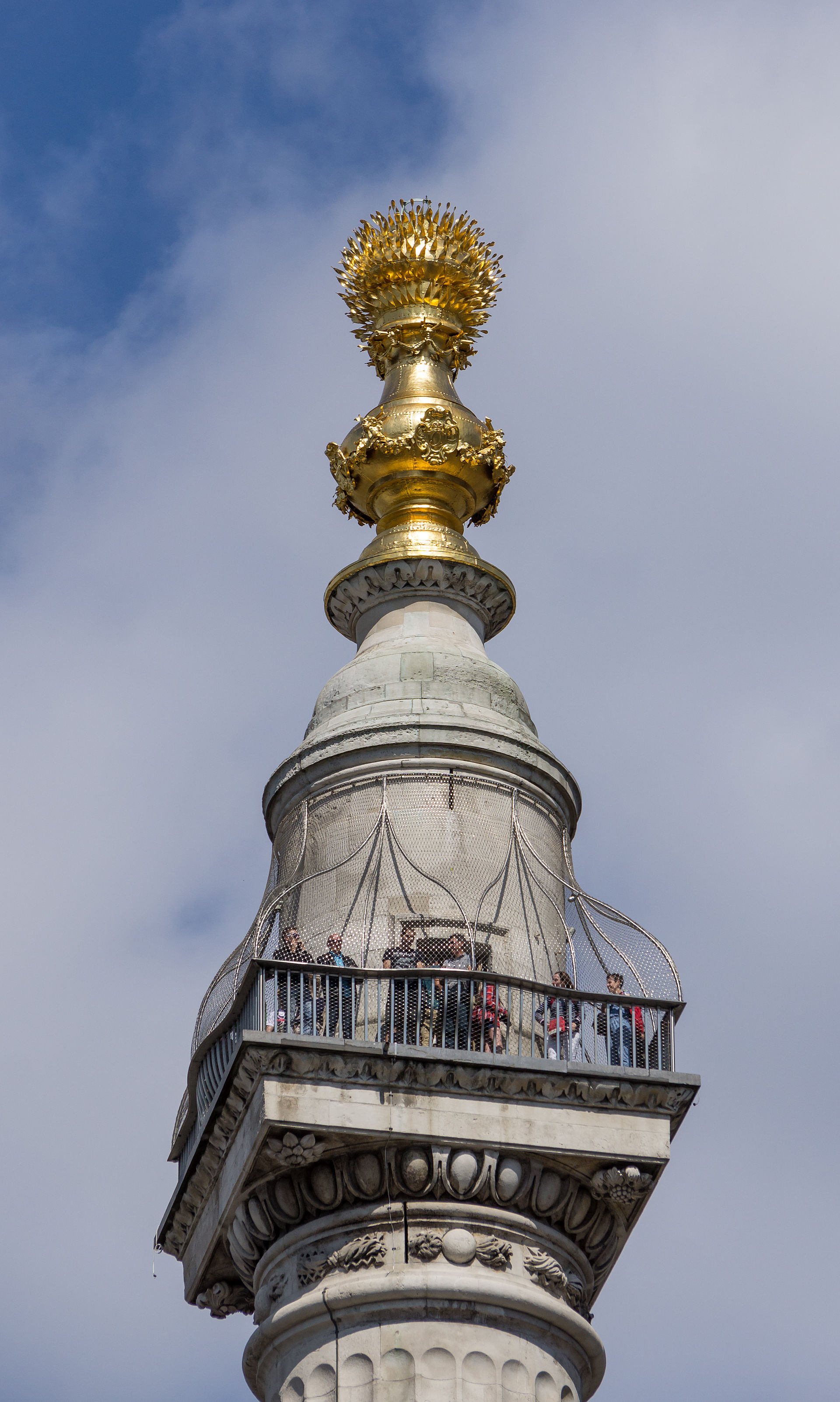
You're looking at one of the cleverest structures in London, and almost nobody knows the half of it. Yes, it commemorates the Great Fire of sixteen sixty-six. It stands exactly two hundred and two feet tall. And it sits exactly two hundred and two feet from the bakery on Pudding Lane where the fire started. If you tipped it over like a domino, the golden urn on top would land on the precise spot where Thomas Farriner's oven set London ablaze.
But here's what they don't tell you. This thing was designed by Robert Hooke — Christopher Wren gets the credit, but Hooke did the heavy lifting — as a dual-purpose structure. A memorial, yes. But also a giant zenith telescope. That hollow column was meant to be used for astronomical observations, with a hidden laboratory underneath for scientific experiments. The idea was to peer straight up through the column at the night sky. It didn't quite work — vibrations from traffic on Fish Street Hill ruined the readings — but the underground lab is still there.
There are three hundred and eleven steps to the top. The view is spectacular. But between seventeen eighty-eight and eighteen forty-two, six people died by suicide jumping from the viewing platform. After the sixth death, they finally added a safety cage.
The writer James Boswell climbed it in seventeen sixty-three. Halfway up, he had a full-blown panic attack. He described being terrified, shaking, and struggling to breathe. But he forced himself to the top, because apparently that's what you did in the eighteenth century. You had a panic attack and then kept climbing.
Verified Facts
Stands exactly 202 feet tall and 202 feet from the Pudding Lane bakery where the fire started
Designed by Robert Hooke as both a memorial and a zenith telescope with a hidden underground laboratory
Six people died by suicide jumping from the top between 1788 and 1842, prompting a safety cage
James Boswell climbed it in 1763 and had a panic attack halfway up the 311 steps
Get walking directions
Fish Street Hill, London EC3R 8AH