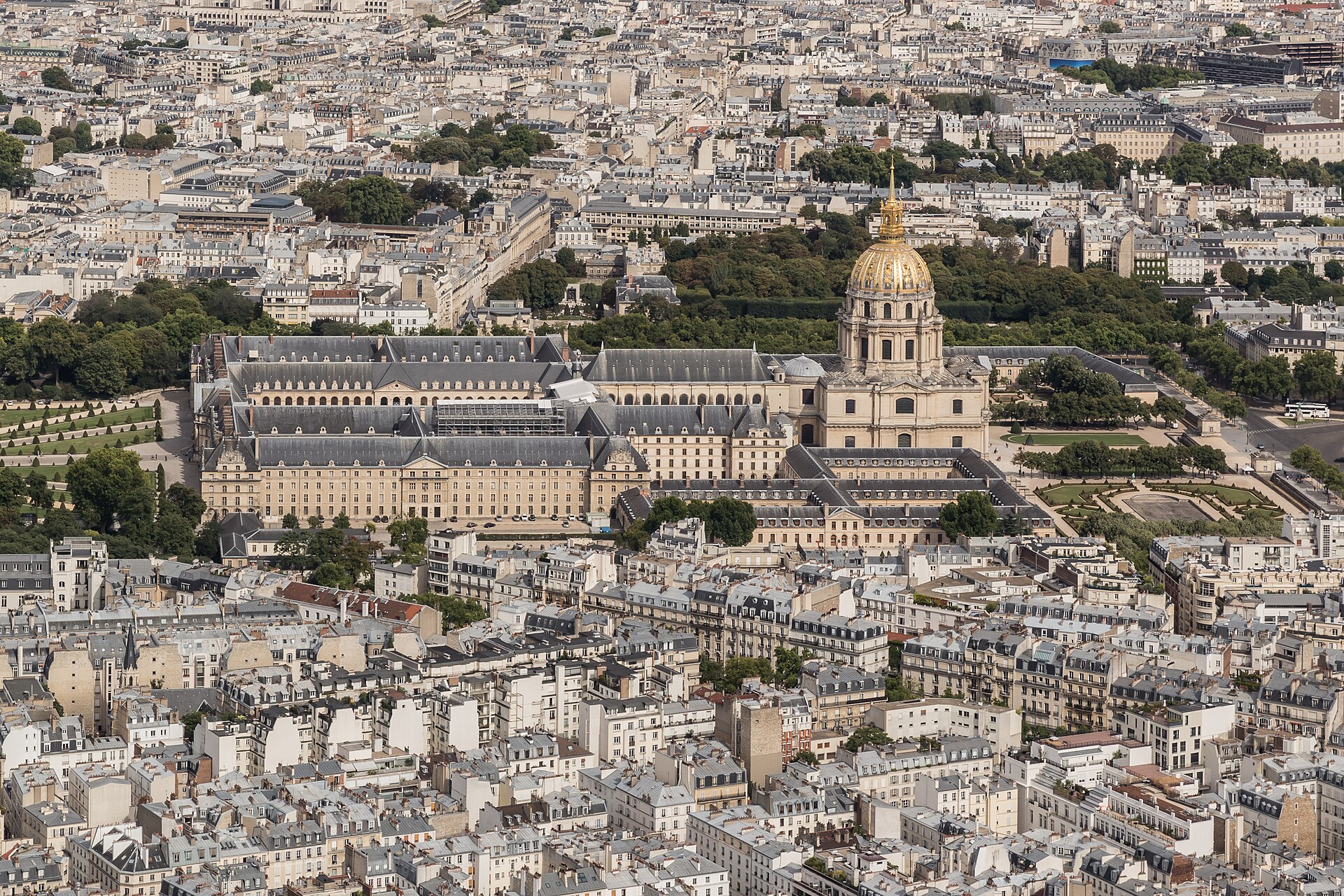
Louis XIV built this complex in 1670 as a hospital and retirement home for wounded soldiers, and it still serves that purpose today — making it one of the oldest veterans' institutions in the world. At its peak, it housed 4,000 soldiers. But most people come for what's downstairs: Napoleon Bonaparte's tomb.
Napoleon's remains rest in six concentric coffins inside a massive red quartzite sarcophagus, set into a circular crypt beneath the golden dome. The arrangement is calculated for maximum drama: you have to look down at the tomb from a gallery above, which means you literally bow your head to Napoleon. The floor around the sarcophagus is inlaid with the names of his greatest victories, and twelve enormous statues representing his military campaigns stand guard.
The dome church, designed by Jules Hardouin-Mansart, is one of the finest examples of French Baroque architecture. The dome itself is gilded with 12 kilograms of gold leaf, reapplied most recently in 1989 for the bicentennial of the Revolution. It's visible from across Paris, a beacon of gold among the gray zinc rooftops.
The complex also houses the Musée de l'Armée, one of the world's greatest military history museums. Its World War II collection is particularly powerful, covering the French experience from the humiliation of 1940 through the Resistance, D-Day, and Liberation with an honesty that doesn't flinch. The Charles de Gaulle memorial, a multimedia room that charts Free France's journey, is worth the visit alone.
Verified Facts
Louis XIV commissioned Les Invalides in 1670 as a hospital and home for wounded veterans
Napoleon's remains are enclosed in six concentric coffins inside a red quartzite sarcophagus
The dome is gilded with 12 kilograms of gold leaf, most recently reapplied in 1989
Les Invalides still functions as a veterans' facility, making it one of the oldest in the world
Get walking directions
129 Rue de Grenelle, 75007 Paris