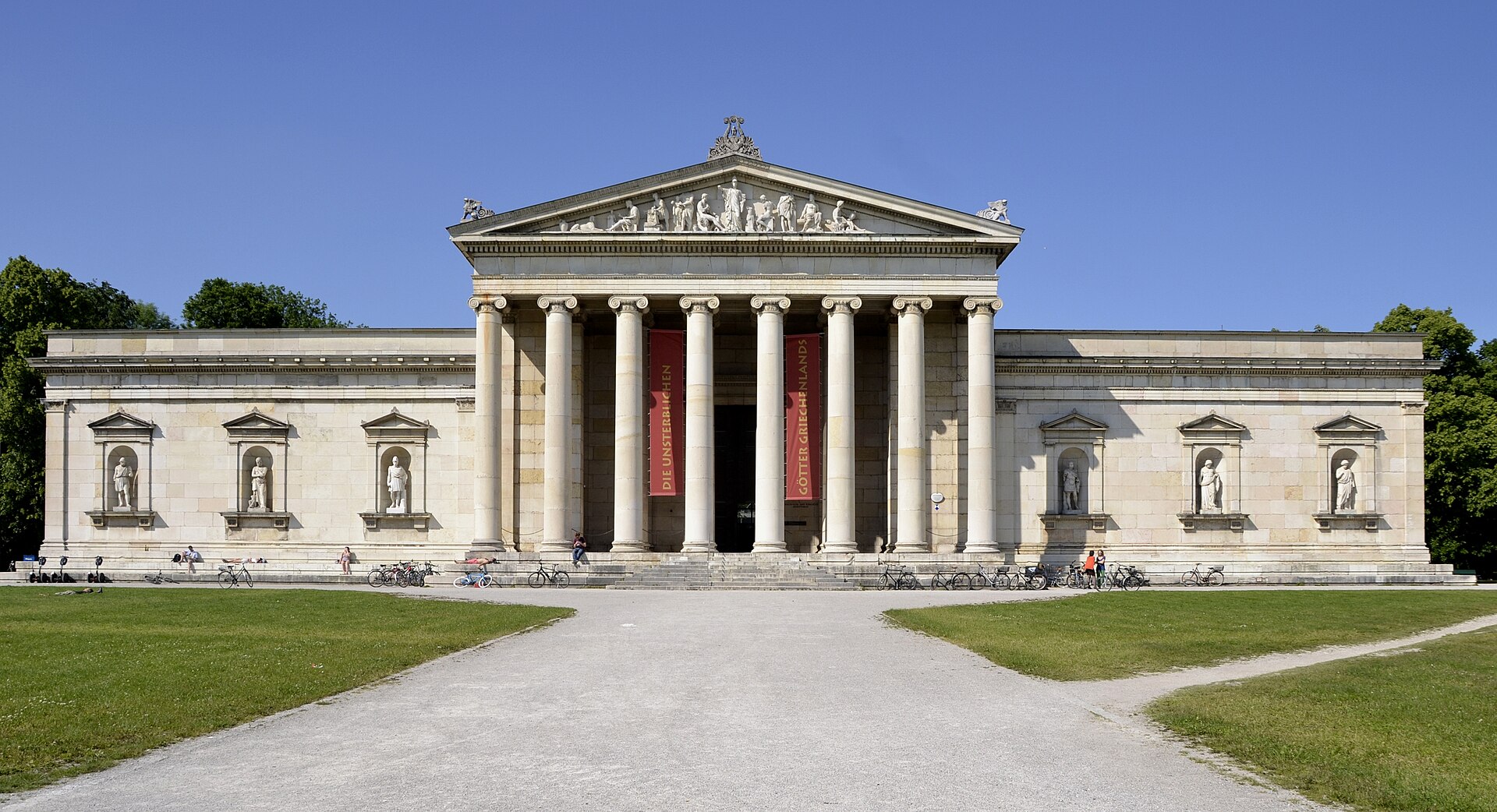
The name literally means "sculpture storage" in Greek — glyphein (to carve) plus theke (container) — which is the most honest museum name in the world. Commissioned by Crown Prince Ludwig and designed by Leo von Klenze between 1816 and 1830, the Glyptothek is Munich's oldest public museum and one of the finest collections of Greek and Roman sculpture anywhere outside Italy and Greece.
Ludwig was obsessed. Through agents stationed across Europe, he competed with the British Museum and the Louvre to acquire the best ancient sculpture money could buy. His greatest coup was the Aegina Marbles — pediment sculptures from the Temple of Aphaea on the Greek island of Aegina, purchased in 1813 and arguably the most important Greek temple sculptures in any collection outside Athens. The Barberini Faun, a stunning second-century BC marble of a sleeping satyr, was another prize acquisition. Ludwig bought it in Rome and shipped it to Munich with the care normally reserved for living royalty.
The museum's thirteen rooms are arranged around an open courtyard, each designed to evoke a different historical period. You walk from archaic Greek kouroi (c. 650 BC) through classical Athenian masterpieces to late Roman portraits, covering roughly 1,200 years of sculpture in an afternoon. The Ionic portico on the exterior holds eighteen original Roman and Greek statues in wall niches — sculptures that would be headline pieces in lesser museums, casually displayed on the outside of this one.
World War II bombed the interior to rubble. The reconstructed rooms, reopened in 1972, stripped away the ornate 19th-century decoration and left the walls as bare brick — a decision that puts all attention on the sculptures themselves. The result is unexpectedly powerful: ancient marble figures standing against raw masonry, the passage of time made visible in every surface.
Verified Facts
Designed by Leo von Klenze and built 1816-1830, it is Munich's oldest public museum
Ludwig I acquired the Aegina Marbles (Temple of Aphaea pediment sculptures) in 1813
The collection spans from archaic Greek (c. 650 BC) to late Roman era (c. 550 AD)
After WWII bombing, the 1972 reconstruction stripped away 19th-century decoration, leaving bare brick walls
Get walking directions
3 Königsplatz, Maxvorstadt, Munich, 80333, Germany