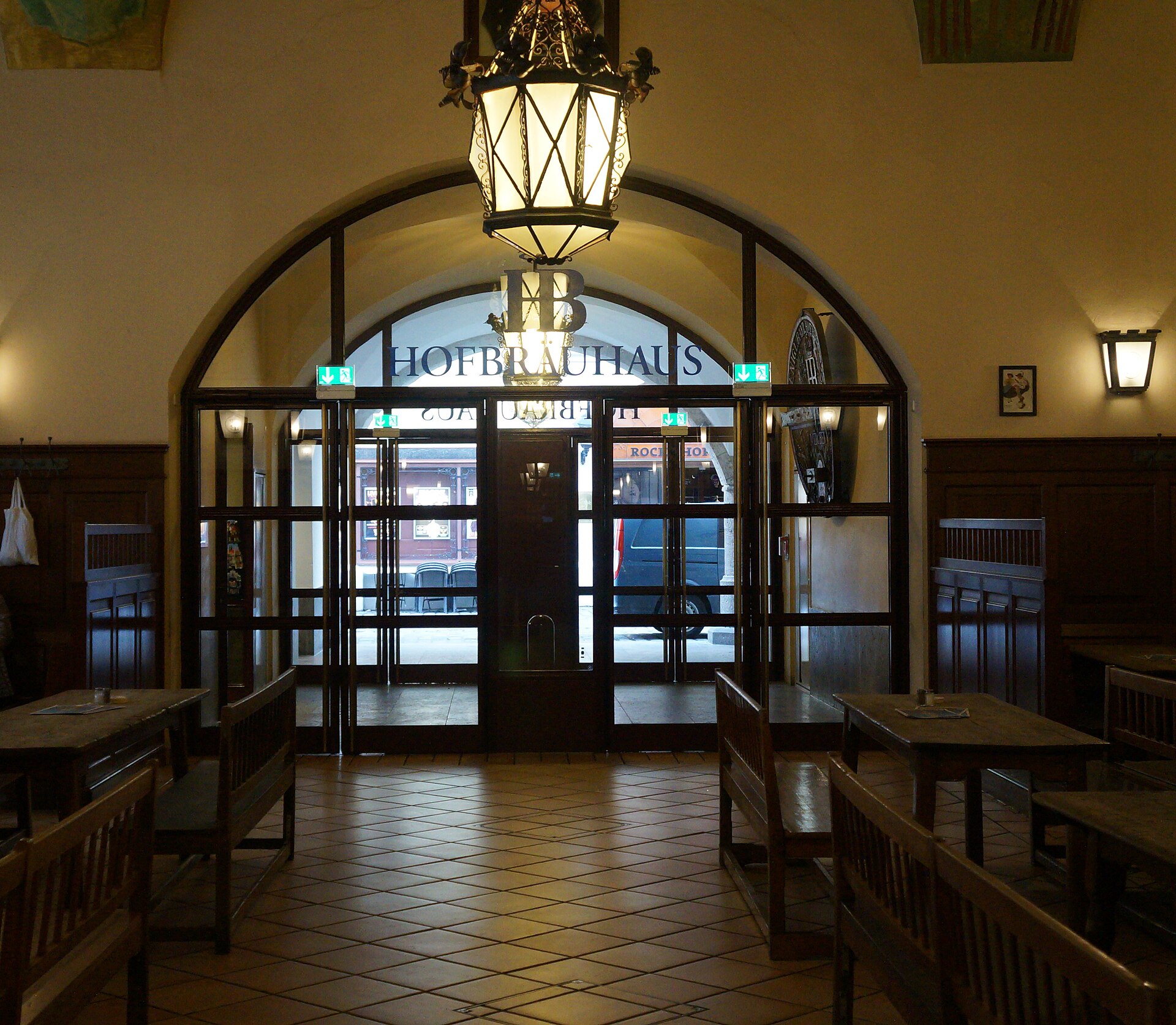
Duke Wilhelm V founded this place in 1589 because he thought Munich's beer was terrible. That's not a simplification — the Bavarian royal household was importing expensive beer from Lower Saxony, and the Duke decided it would be cheaper and better to brew his own. The result is the world's most famous beer hall, which started as a royal brewery that ordinary Münchners couldn't even enter for the first 239 years.
King Ludwig I finally opened the Hofbräuhaus to the public in 1828, and it quickly became the centre of Munich's social and political life. The regulars' table tradition runs deep here — some families have held the same reserved spot for generations, and the personal beer steins locked in the hall's storage cabinets number in the hundreds. Mozart lived around the corner and was a regular. Lenin reportedly spent time here plotting revolution while living in Munich in 1902. The building has attracted an astonishing range of people who had nothing in common except a taste for wheat beer.
The Schwemme — the ground-floor beer hall — is the only room that survived World War II bombing. Everything else was rebuilt by 1958, but the Schwemme's vaulted ceiling, painted with Bavarian folk scenes, is original 1897 architecture by Max Littmann, who redesigned the building when the actual brewery moved to the suburbs. On any given evening, the hall seats 1,300 people across rows of heavy wooden tables while an oompah band plays and litre-sized Mass steins crash together.
After World War II, American soldiers stationed in Munich adopted the Hofbräuhaus as their unofficial living room. They brought home thousands of "HB" beer steins as souvenirs, inadvertently turning a Bavarian state brewery into an international brand. The Hofbräuhaus now has licensed locations on six continents, but this one — the original, the noisy, beery, slightly chaotic one — remains irreplaceable.
Verified Facts
Founded in 1589 by Duke Wilhelm V as a royal brewery; not opened to the public until 1828 by King Ludwig I
The ground-floor Schwemme is the only room that survived WWII bombing; it was redesigned by Max Littmann in 1897
Mozart was a regular patron, and Lenin reportedly frequented the hall while living in Munich in 1902
Maximilian I created a wheat beer monopoly at the Hofbräuhaus in the early 17th century, banning all other breweries from producing it
Get walking directions
9 Platzl, Altstadt-Lehel, Munich, 80331, Germany