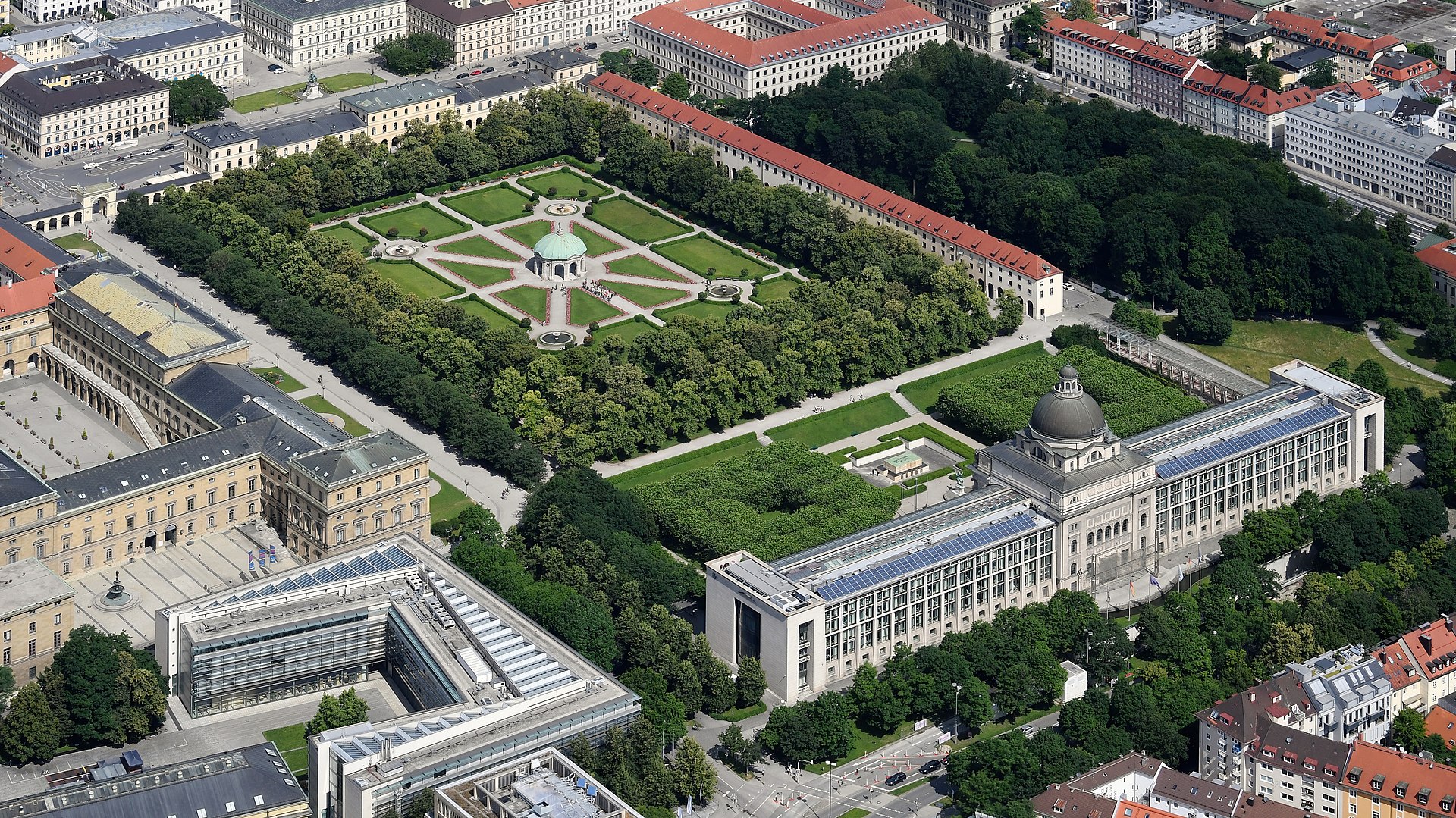
Between the Residenz and the Englischer Garten lies a Renaissance court garden that has survived four centuries of war, revolution, and one very destructive Frenchman. Maximilian I built the Hofgarten between 1613 and 1617 in the Italian Renaissance style — geometric paths radiating from a central pavilion, framed by arched galleries, the whole thing designed to make Bavarian royalty feel like they were strolling through a Tuscan villa.
The Diana Pavilion at the centre, built by Heinrich Schön the Elder in 1615, is an octagonal temple topped with a bronze figure of Bavaria — not the goddess Diana, despite the name. On any given afternoon, you'll find people playing boules on the gravel paths around it, a tradition so embedded in Munich's social fabric that the regular players have unofficial reserved spots. The arched walkways along the north and west sides display changing art exhibitions, turning the garden's perimeter into an open-air gallery.
Napoleon occupied Munich in 1806 and ordered part of the Hofgarten demolished to make room for his troops. After Waterloo, King Ludwig I restored and expanded the garden with fountains and sculptures, but the French-inflicted damage left a mark on the layout that never fully healed. Then World War II destroyed the garden almost entirely. The post-war rebuild compromised between the original 17th-century formality and the softer English landscape style it had acquired in the 19th century.
In 1780, Elector Karl Theodor opened the formerly private royal garden to the public — the same reformer who commissioned the Englischer Garten nine years later. Today the Hofgarten is one of Munich's most peaceful places: classical music drifts from the Residenz, elderly Münchners play cards under the linden trees, and the view north toward the Theatinerkirche dome is one of the city's quiet visual treasures. It's the sort of garden you find when you stop looking for attractions and start looking for shade.
Verified Facts
Built 1613-1617 by Maximilian I in Italian Renaissance style, it is one of Munich's oldest gardens
The Diana Pavilion at the centre was built by Heinrich Schön the Elder in 1615
Napoleon ordered part of the garden demolished in 1806 to make room for his troops
Elector Karl Theodor opened the formerly private garden to the public in 1780
Get walking directions
1 Hofgartenstraße, Altstadt-Lehel, Munich, 80539, Germany