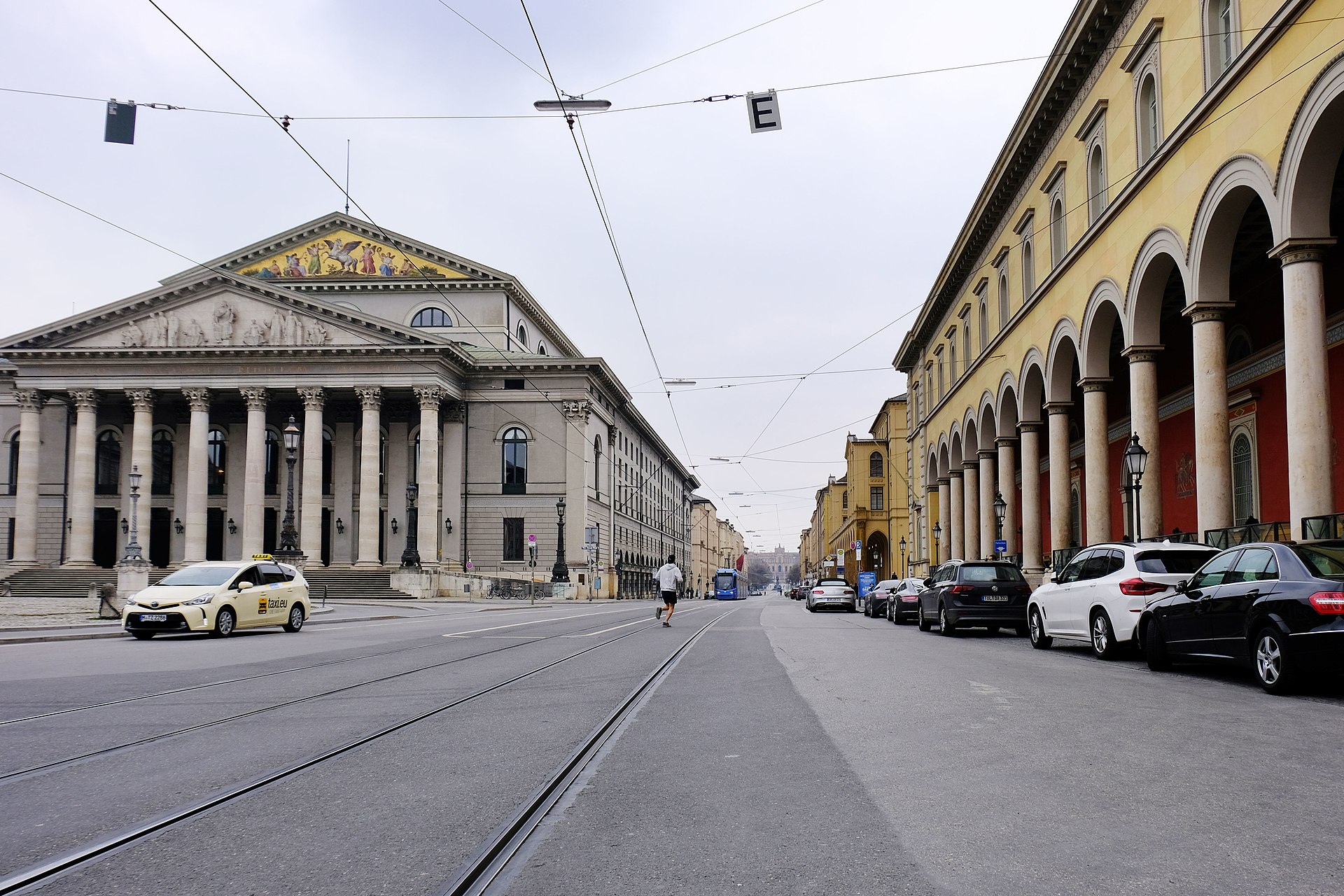
King Maximilian II had a problem with his father. Ludwig I had covered Munich in Greek and Roman architecture — the Glyptothek, the Propyläen, the Alte Pinakothek — and Maximilian wanted to build something that was distinctly his own. In 1850, he commissioned architect Friedrich Bürklein to create a boulevard in a style that didn't exist yet. The result was the "Maximilianstil" — a hybrid of neo-Gothic, Renaissance, and English Gothic influences that belonged to no particular era and no particular country. It belongs entirely to this street.
Maximilianstrasse runs east from the National Theatre at Max-Joseph-Platz, crossing the Isar river and terminating at the Maximilianeum — a palace that now houses the Bavarian state parliament. The Maximilianeum's foundation stone was laid in 1857, and Bürklein spent seventeen years on the project, dying before it was finished in 1874. The whole boulevard functions as an architectural thesis: a king's deliberate rejection of his father's classical obsession, expressed in stone, steel, and a style so unique it was never used anywhere else.
Today the western stretch of Maximilianstrasse is Munich's most exclusive shopping address. Every luxury brand with a German outpost is here — Chanel, Louis Vuitton, Bulgari, Cartier — along with the Hotel Vier Jahreszeiten, one of Europe's grand 19th-century hotels. The street transforms from luxury retail to cultural boulevard as you move east, passing the Museum of Ethnology and the Bavarian State Parliament before reaching the tree-lined Isar embankment.
Along with Brienner Strasse, Ludwigstrasse, and Prinzregentenstrasse, Maximilianstrasse is one of Munich's four royal boulevards — each built by a different ruler, each in a different style, each expressing a different idea about what Bavaria should look like. Walking all four is an architectural history of 19th-century ambition.
Verified Facts
Planned in 1850 by King Maximilian II; designed by architect Friedrich Bürklein in the unique Maximilianstil
The Maximilianeum at the eastern terminus, completed 1874, now houses the Bavarian state parliament
One of Munich's four royal boulevards alongside Brienner Strasse, Ludwigstrasse, and Prinzregentenstrasse
The Maximilianstil combines neo-Gothic, Renaissance, and English Gothic elements in a style unique to this street
Get walking directions
Maximilianstraße, Altstadt-Lehel, Munich, 80539, Germany