The Feldherrnhalle looks like it was stolen from Florence, and in a sense it was. King Ludwig I commissioned it in 1841 as a copy of the Loggia dei Lanzi, built to honour Bavaria's military commanders. Two bronze statues stand inside — Count Tilly, who commanded Catholic forces in the Thirty Years' War, and Prince Wrede, a Napoleonic-era general. Between them, a third monument honours the Bavarian army itself. It's a perfectly dignified 19th-century war memorial, which makes what happened next all the more disturbing.
On November 9, 1923, roughly two thousand Nazi supporters marched from the Bürgerbräukeller toward the Feldherrnhalle in an attempted coup led by Adolf Hitler. Police opened fire. Sixteen Nazis, four police officers, and one bystander were killed. Hitler was arrested, tried, and imprisoned — where he wrote Mein Kampf. When the Nazis took power in 1933, they turned the Feldherrnhalle into a shrine to their fallen, installing a permanent honour guard and requiring every pedestrian to give the Nazi salute when passing.
Many Münchners refused. They took a detour through the narrow Viscardigasse behind the hall, which locals nicknamed "Drückebergergasse" — Shirkers' Alley. This small act of defiance was hardly revolutionary, but it was persistent and widespread. In 1995, the city installed a trail of golden bronze cobblestones along the alley to commemorate those who chose the detour. It's one of Munich's most quietly powerful memorials — no grand statue, just a shining path that says: some people walked a different way.
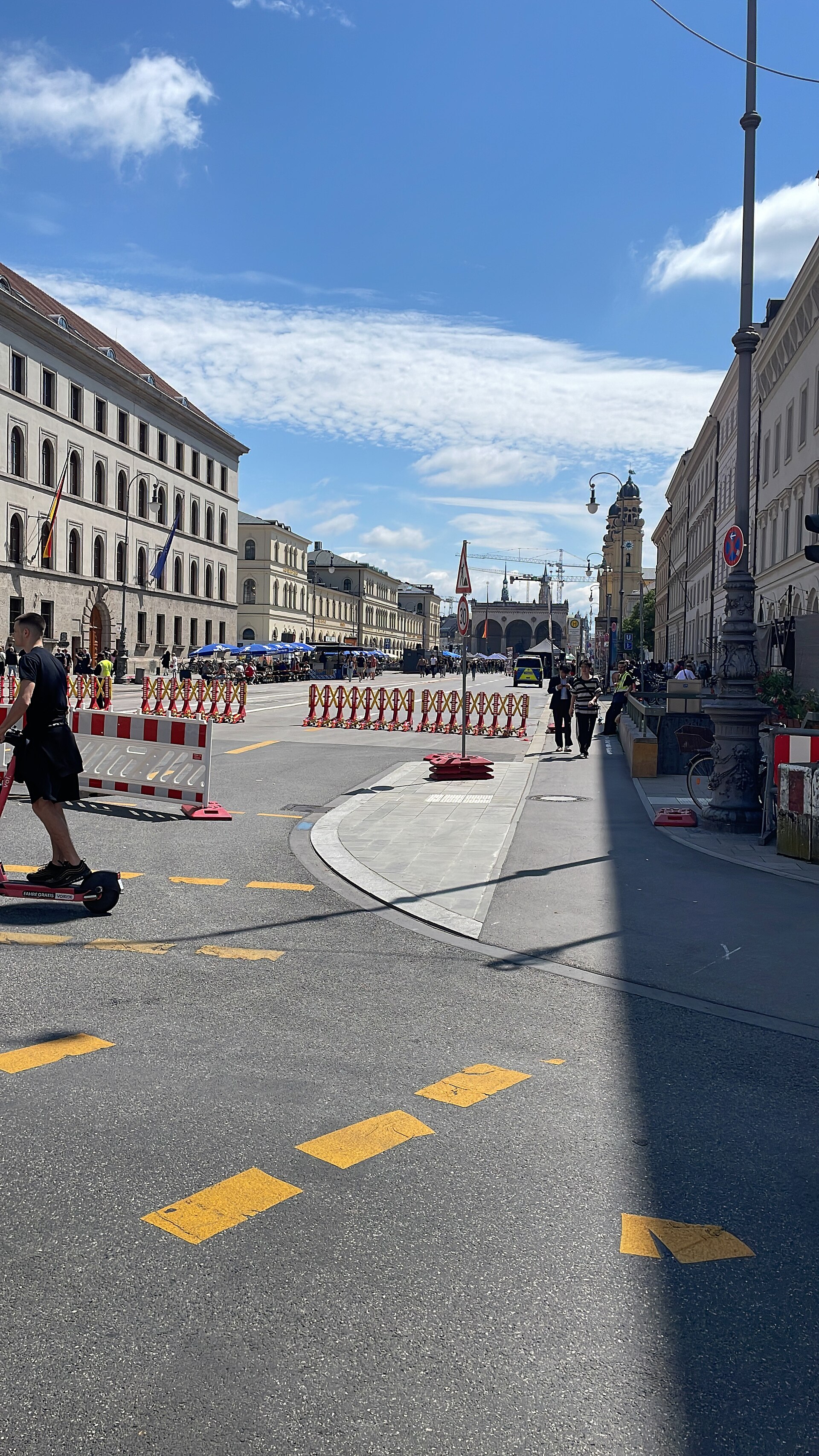
Today Odeonsplatz is a lively gathering point framed by the Theatinerkirche, the Hofgarten entrance, and the beginning of Ludwigstrasse. The dark history has been absorbed into the fabric of the square rather than erased, which feels like the right approach for a city that has learned the cost of forgetting.
Verified Facts
The Feldherrnhalle was built 1841-1844 as a copy of Florence's Loggia dei Lanzi, commissioned by King Ludwig I
The Beer Hall Putsch on November 9, 1923 ended at the Feldherrnhalle with 16 Nazis, 4 police, and 1 bystander killed
Locals nicknamed the nearby Viscardigasse "Drückebergergasse" (Shirkers' Alley) for those avoiding the Nazi salute
In 1995, bronze cobblestones were installed along Viscardigasse to commemorate passive resistance during the Nazi era
Get walking directions
Odeonsplatz, 80539 Munich