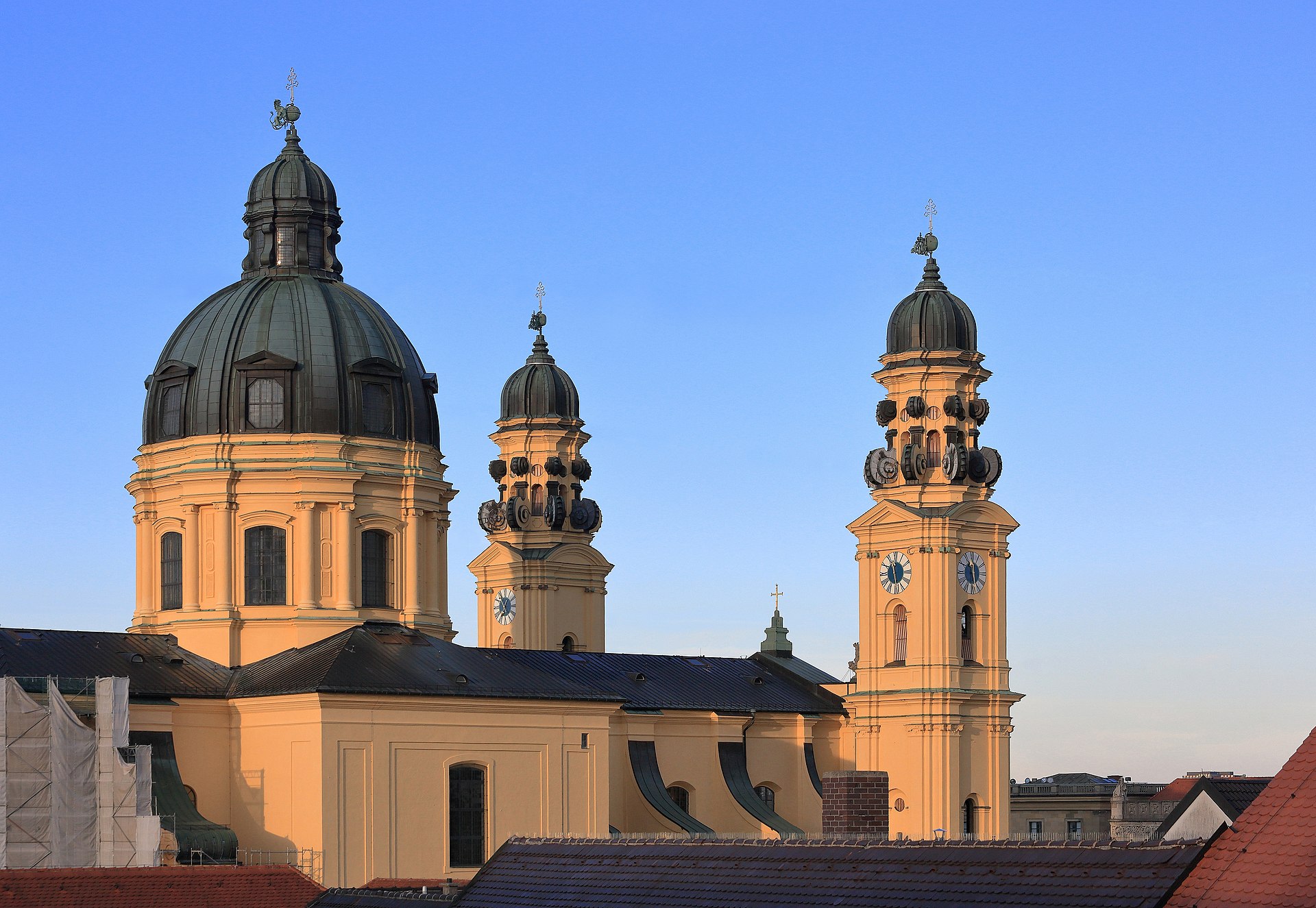
Like Nymphenburg Palace, this church exists because of a baby. When the long-awaited heir Max Emanuel was born in 1662, Elector Ferdinand Maria and his wife Henriette Adelaide commissioned both a palace and a church to celebrate. The Theatinerkirche — officially St. Cajetan — was designed by the Italian architect Agostino Barelli, modelled after Sant'Andrea della Valle in Rome, and built between 1663 and 1690. It brought Italian High Baroque to Bavaria with such conviction that southern German church architecture was never the same.
The yellow façade is the church's signature. Completed nearly a century after the rest of the building by François de Cuvilliés the Elder in a Rococo style his son later finished, it became such an iconic Munich image that it influenced Baroque architecture across all of southern Germany. The colour — a warm Mediterranean ochre — stands out against Munich's grey skies like a postcard from Henriette Adelaide's native Italy, which was almost certainly the point.
The twin towers rise to 64.6 metres, framing a dome that reaches 71 metres — dimensions that make the Theatinerkirche one of the most prominent silhouettes on the Munich skyline alongside the Frauenkirche. Enrico Zuccalli, who replaced Barelli after the Italian architect was dismissed mid-construction (church politics were as vicious then as now), added the towers that weren't part of the original plan.
Below the church lies the Fürstengruft — the Princely Crypt — containing the remains of 49 members of the Wittelsbach dynasty, including four electors, three kings, Emperor Karl VII, and Prince Regent Luitpold. It's one of the most significant royal burial sites in Germany, hidden beneath a church that most visitors admire only from the outside as they cross Odeonsplatz. The crypt is open to visitors and usually empty — the royals finally have the quiet they were promised.
Verified Facts
Built 1663-1690 to celebrate the birth of heir Max Emanuel; designed by Agostino Barelli
The Rococo façade was designed by François de Cuvilliés the Elder around 1765
The Fürstengruft crypt contains the remains of 49 Wittelsbach dynasty members including 4 electors and 3 kings
The dome reaches 71 metres; the twin towers 64.6 metres each
Get walking directions
Theatinerstraße 22, 80333 Munich