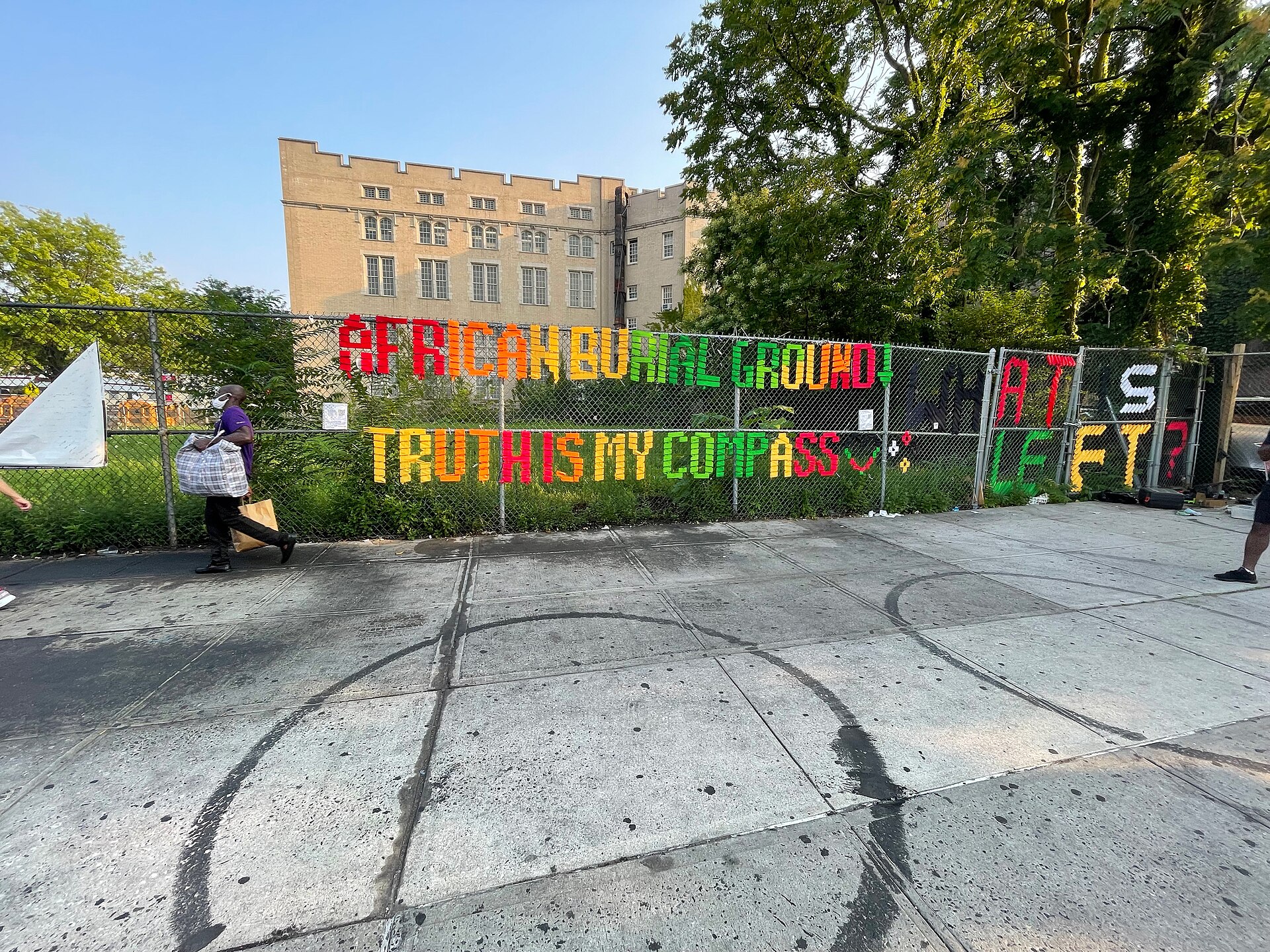
Beneath Broadway, near City Hall, lie the remains of an estimated fifteen thousand free and enslaved Africans. Nobody knew they were there for almost three hundred years.
In sixteen ninety-seven, Black New Yorkers were banned from burying their dead in the city's churchyards. They were forced to use a plot outside the city limits — a six-point-six-acre site that eventually disappeared under twenty-five feet of landfill as Manhattan expanded northward. The burial ground was forgotten. Streets were paved over it. Buildings were constructed on top of it.
In nineteen ninety-one, construction workers excavating for a new federal office building at 290 Broadway broke through to the original grade level and found human remains. Archaeologists eventually uncovered four hundred and nineteen individuals and over five hundred artifacts. The remains were sent to Howard University for study, which confirmed the brutal physical toll of enslaved labour — evidence of malnutrition, heavy muscular stress, and violent injury.
In two thousand and three, a series of ceremonies called the Rites of Ancestral Return brought the remains back from Washington. Hundreds of schoolchildren marched in the final burial procession down Broadway. The site was designated a National Monument in two thousand and six. The outdoor memorial and indoor visitor centre are free. Almost nobody visits.
Verified Facts
An estimated 15,000 free and enslaved Africans were buried at the site between the 1630s and 1795
In 1697, Black New Yorkers were banned from burying their dead in the city's churchyards
Construction workers discovered the burial ground in 1991 during excavation for a federal building at 290 Broadway
419 individuals and over 500 artifacts were excavated; remains were reburied in 2003 after study at Howard University
Designated a National Monument in 2006; the memorial and visitor centre are free
Get walking directions
290 Broadway, New York, NY 10007