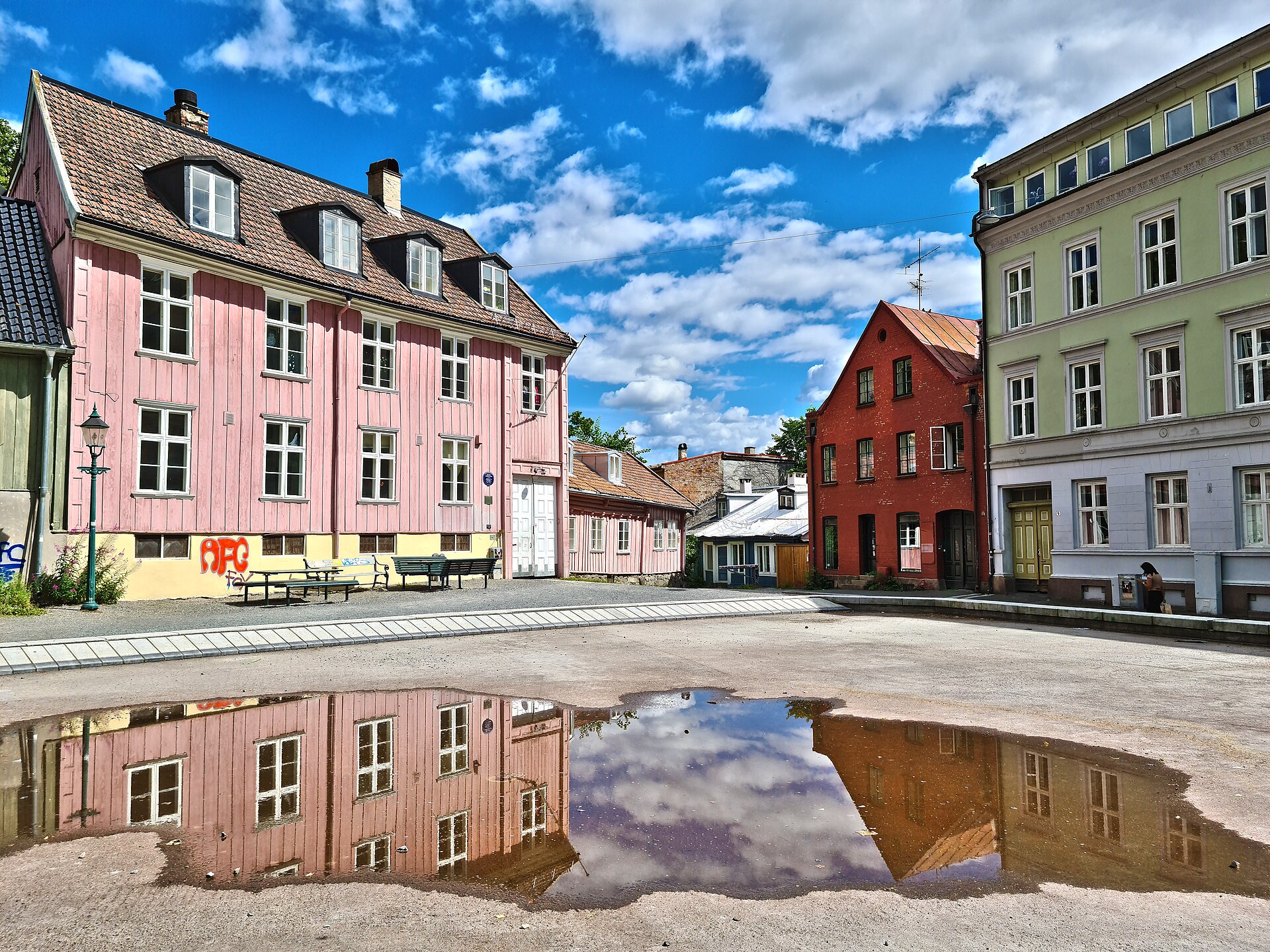
This 160-meter lane of painted wooden houses is the closest thing Oslo has to a time machine. While the rest of the city demolished its timber buildings and replaced them with brick and concrete, Damstredet somehow survived — a heritage-protected pocket of late-eighteenth and early-nineteenth-century Oslo where the facades must remain exactly as they were two hundred years ago.
The adjoining Telthusbakken — "Tent House Hill" — tells a sharper story. Built around 1755 as a military canvas storage site, the hill was considered so useless that only unprivileged people were allowed to build on it. By 1850, 231 people were crammed onto this tiny street. It was the main road between the desperately poor east side and the affluent west side of the city, and the people who lived here occupied the literal and social space between the two.
Henrik Wergeland, Norway's most celebrated poet and a fierce advocate for Norwegian independence from Danish cultural dominance, lived at the top of Damstredet — marked by a blue plaque. He was instrumental in pushing Norway toward its own written language, separate from Danish, and he died young at thirty-seven in the house up the hill. Walk a few more steps and you reach Our Saviour's Cemetery, where Henrik Ibsen, Edvard Munch, and sculptor Gustav Vigeland are all buried — three giants of Norwegian culture resting within meters of each other.
Nearby is Old Aker Church, built around 1100 AD and still in use — Oslo's oldest functioning building. Beneath it lies a twenty-eight-meter shaft that divers have explored. Legend says it leads to hidden silver mines and dragons. Neither has been found. Visit Damstredet for the wooden houses, stay for the cemetery, and wonder how a street this beautiful stayed under the radar this long.
Verified Facts
The street is 160 meters long with heritage-protected wooden houses approximately 200 years old
Poet Henrik Wergeland lived at the top of Damstredet, marked by a blue plaque
Our Saviour's Cemetery nearby contains the graves of Henrik Ibsen, Edvard Munch, and Gustav Vigeland
Old Aker Church nearby was built around 1100 AD and is Oslo's oldest building still in use
Get walking directions
0175 Damstredet, Grünerløkka, Oslo, 0177, Norway