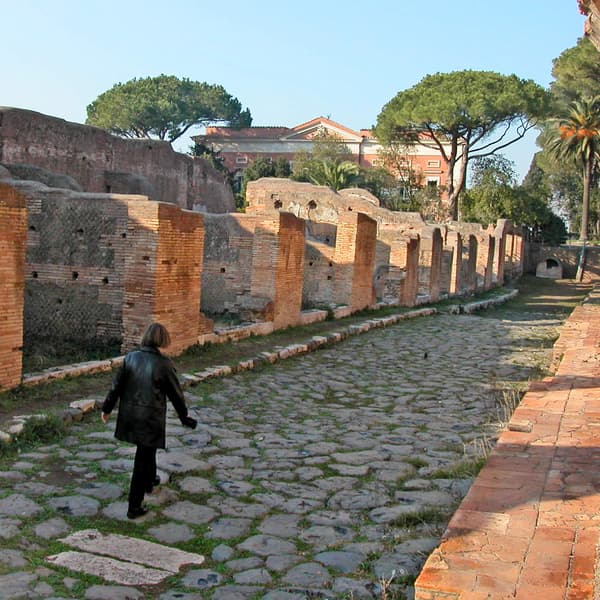
If Pompeii had not been buried by a volcano and marketed by centuries of tourism, Ostia Antica would be the most famous Roman ruin in the world. It is equally well-preserved, significantly larger, and a fraction as crowded. This was Rome's port city, the gateway for everything that entered the capital by sea: grain from Egypt, olive oil from Spain, wine from Gaul, marble from Greece, wild animals from Africa for the arena. At its peak, about one hundred thousand people lived here.
You can walk through complete apartment buildings — insulae — that still rise to two and three storeys. You can stand in taverns with their marble counters and built-in heating vessels. The latrines at the Forum Baths are communal, with stone seats arranged in a semicircle and a communal sponge-on-a-stick that served as Roman toilet paper (the stick was rinsed in a channel of running water — the origin of the phrase "getting the wrong end of the stick"). The mosaics on the Piazzale delle Corporazioni — the ancient business district — show advertisements for different trading companies, complete with images of their goods: elephants for the ivory traders, ships for the shipping companies.
The theatre, originally built by Agrippa and expanded to seat four thousand, is still used for performances in summer. Behind it, the commercial district has over sixty identified shops and offices, each with mosaic "business cards" set into the pavement advertising their trade. It is the closest thing we have to walking through a functioning Roman city, because unlike Pompeii, this was not frozen in a moment of catastrophe — it was gradually abandoned as the harbour silted up and the coastline moved, leaving the city stranded three kilometres from the sea.
Getting here takes about forty-five minutes by metro and local train from central Rome. It is the best half-day trip the city offers. Go early, bring water, and expect to be almost entirely alone with two thousand years of history.
Verified Facts
Ostia Antica was Rome's port city with a population of approximately 100,000 at its peak
The communal Roman sponge-on-a-stick (xylospongium) may be the origin of the phrase "getting the wrong end of the stick"
The Piazzale delle Corporazioni has mosaic advertisements for over 60 trading companies with images of their goods
The city was abandoned gradually as the harbour silted up and the coastline moved 3 km away, rather than by sudden catastrophe
Get walking directions
717 Viale dei Romagnoli, XIII Municipio, Rome, 00119, Italy