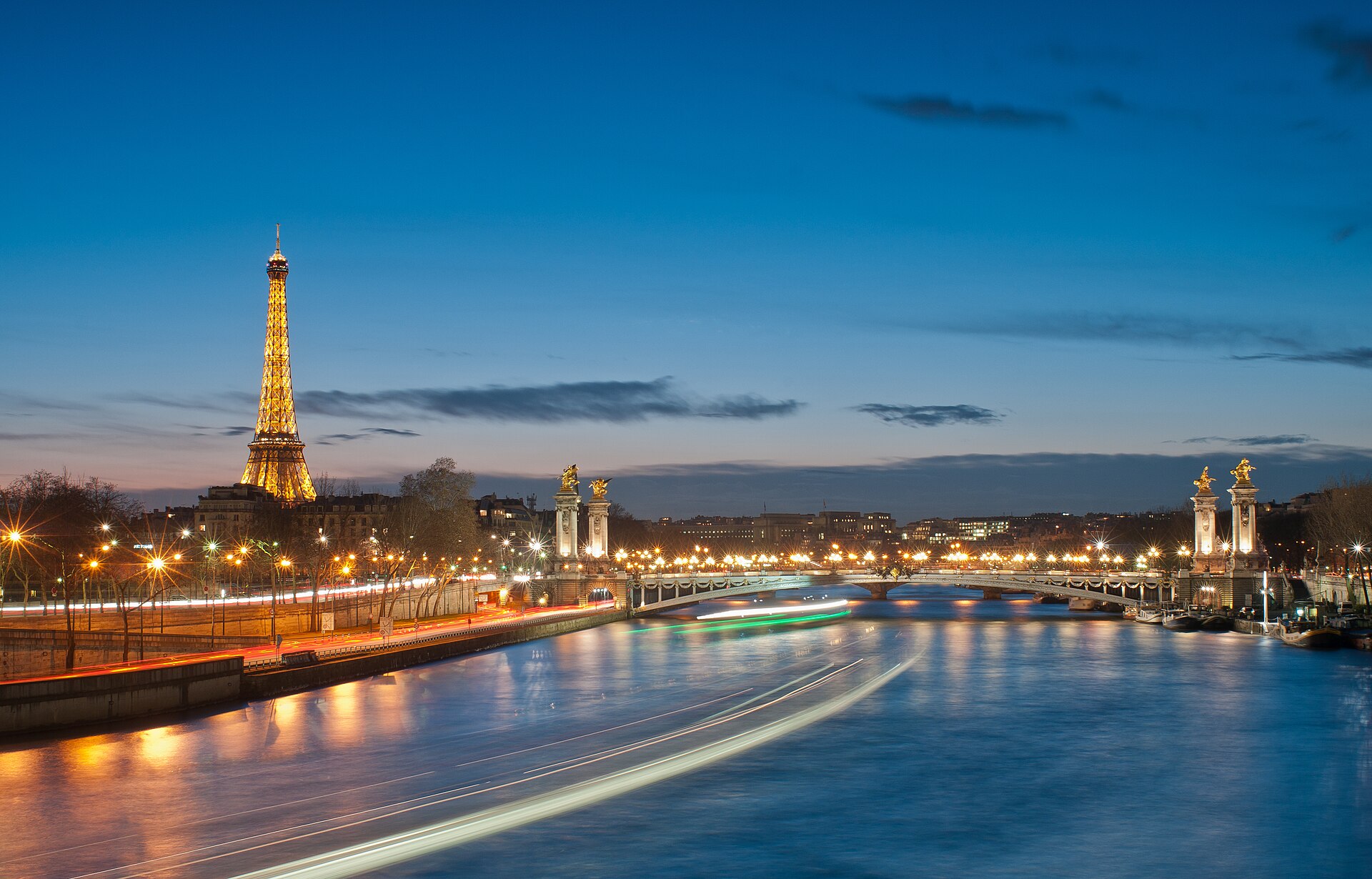
This is the most extravagant bridge in Paris, and possibly the world. Every square meter is covered in gilt bronze cherubs, nymphs, winged horses, garlands, and Art Nouveau lamps. It was built for the 1900 World's Fair, and its design had one strict constraint: the arch couldn't be high enough to block the view of the Invalides from the Champs-Élysées. So the engineers built it as a single steel span — 107 meters across, with an arch only 6 meters high — which was a genuine engineering achievement for 1900.
The bridge was named after Tsar Alexander III of Russia, who had signed the Franco-Russian Alliance in 1892. His son Nicholas II laid the foundation stone in 1896, in a ceremony meant to symbolize friendship between the two nations. The irony is thick: within two decades, Nicholas would be overthrown and executed, and the alliance would be swallowed by the chaos of World War I.
The four gilt-bronze Pegasus statues at the corners were the most expensive public sculptures ever commissioned in France at the time. The columns they sit on are 17 meters tall, and on clear days the winged horses catch the sunlight and blaze gold against the sky. At night, the Art Nouveau lampposts light up and the bridge becomes one of the most romantic spots in Paris.
Stand in the center of the bridge and you get one of the great Parisian views: the Invalides dome to the south, the Grand Palais and Petit Palais to the north, the Eiffel Tower to the west, and the Seine flowing beneath you toward Notre-Dame. It's the kind of view that makes you forgive Paris for all its crowds and expense.
Verified Facts
The bridge was built for the 1900 World's Fair and named after Tsar Alexander III of Russia
Tsar Nicholas II laid the foundation stone in 1896
The single steel arch spans 107 meters with a rise of only 6 meters to preserve sight lines to the Invalides
Get walking directions
Quai d'Orsay, 8th Arr., Paris, 75008, France