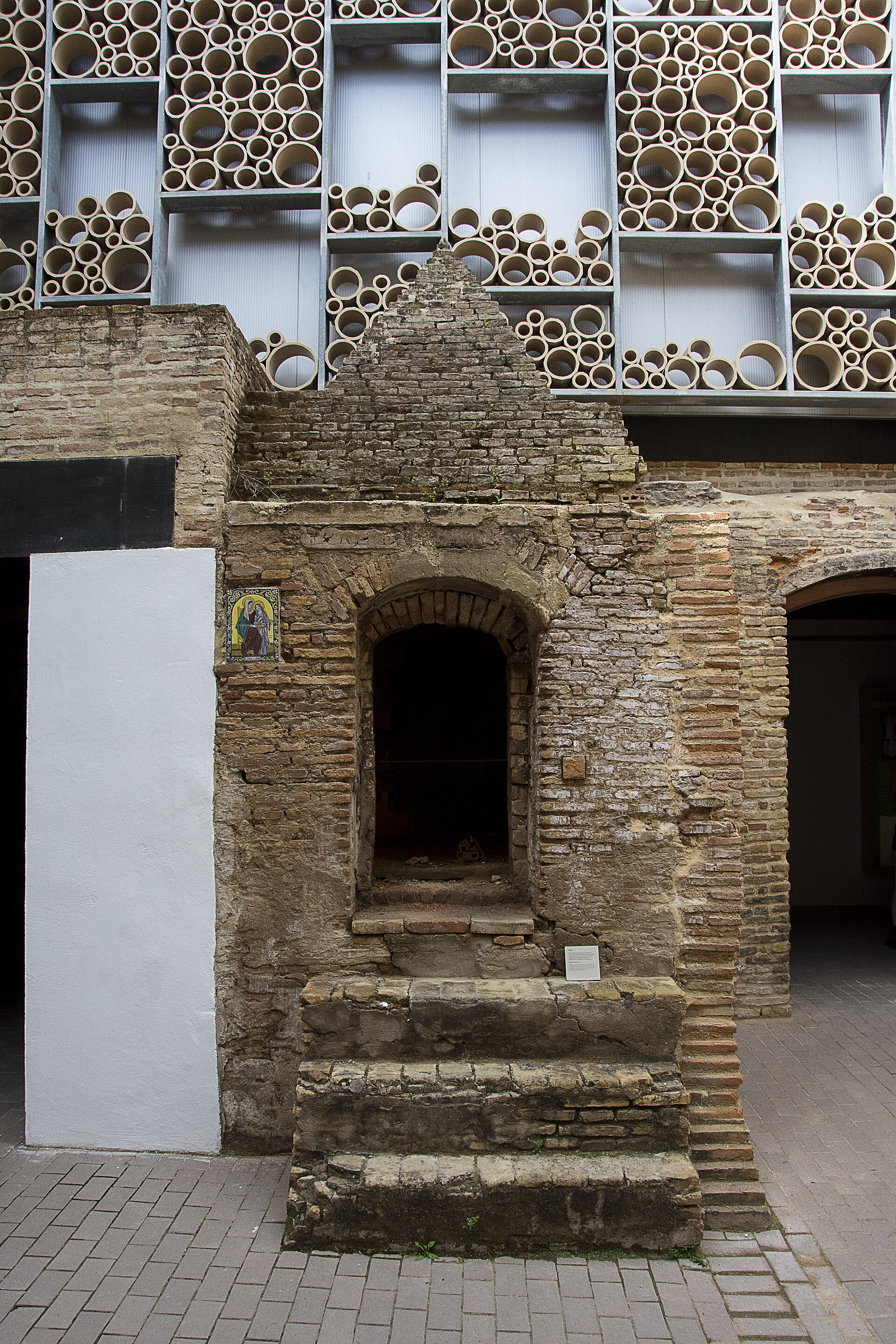
Every tiled bench in the Plaza de Espana, every azulejo facade on a church, every decorative ceramic panel in a Seville courtyard — many of them started life in the kilns of Triana. This neighborhood has been the ceramics capital of Andalusia since at least the fifteenth century, and the Centro Ceramico Triana preserves that tradition on the exact site of the former Santa Ana ceramics factory, one of the last working pottery workshops in the area before industrialization killed the trade.
The museum occupies the old factory buildings and the kilns themselves, several of which have been preserved in situ. You can see the bottle-shaped wood-fired ovens where tiles were baked at temperatures exceeding 1,000 degrees Celsius, and the clay-mixing rooms where artisans prepared the raw materials. The exhibition traces the evolution of Triana ceramics from the Moorish cuerda seca technique — where raised lines of manganese separate colored glazes — through the Italian-influenced maiolica style brought by Francesco Niculoso Pisano in the late 1400s.
What makes Triana ceramics distinctive is the combination of Moorish geometric patterns with Christian imagery and Renaissance naturalism. The result is a hybrid aesthetic that exists nowhere else in Europe: Islamic star patterns frame Catholic saints, and classical columns are wrapped in vine scrolls that owe as much to Damascus as to Rome. This blending happened naturally over centuries of cultural overlap, and the tiles are arguably the best physical evidence of Andalusia's multicultural history.
The museum shop sells contemporary pieces made by local artisans working in traditional methods. Outside, Calle Alfareria — Potter's Street — still has a handful of working studios where you can watch tiles being painted by hand.
Verified Facts
The museum occupies the site of the former Santa Ana ceramics factory with preserved original kilns
Italian craftsman Francesco Niculoso Pisano introduced maiolica tile techniques to Triana in the late 1400s
Calle Alfareria (Potter's Street) still has working ceramic studios producing hand-painted tiles
Get walking directions
16 Calle Callao, Triana, Seville, 41010, Spain