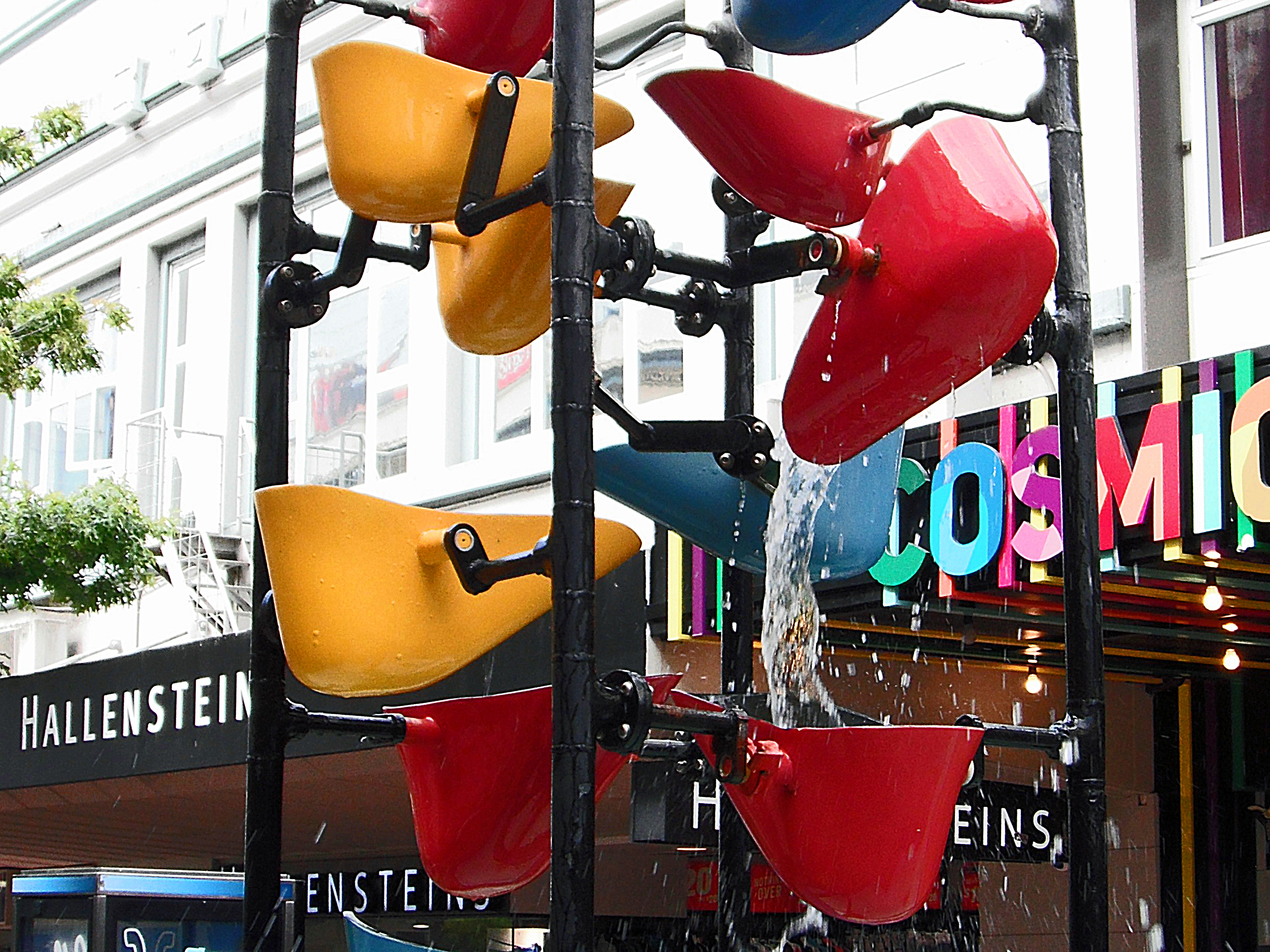
The Bucket Fountain — Wellington's most unlikely icon. Designed by Burren and Keen, erected in nineteen sixty-nine to mark the pedestrianisation of Cuba Street, and it cost two thousand dollars. Even in nineteen sixty-nine, that was basically nothing. The original name was the Water Mobile. Nobody calls it that.
The critics hated it. They called it a monstrosity, an engineering joke, an eyesore. The buckets — originally all painted yellow — are designed to fill with water, tip unpredictably, and splash everything within range. There's no pattern to it. You can't predict which bucket will dump next. It just does its thing, and if you're standing too close, you get wet. On a windy day — and this is Wellington — the spray goes everywhere.
But here's what happened. Over the decades, Wellingtonians fell completely in love with this ridiculous contraption. It became the unofficial heart of Cuba Street, then the unofficial symbol of the whole city. When it was damaged or threatened with removal, people protested. It showed up on T-shirts, in songs, in art. In Taika Waititi and Jemaine Clement's film What We Do in the Shadows — set and filmed in Wellington — the Bucket Fountain appears as a shrine and gateway to the underworld. Which, honestly, feels about right.
Every Friday and Saturday night, someone adds dish soap. The suds build up and spill across the mall in great foaming drifts. Nobody knows who does it. Nobody tries very hard to stop it. It's an open secret and a minor act of civic joy. The Bucket Fountain is, in the end, the most Wellington thing in Wellington. Cheap, impractical, slightly broken, windswept, and absolutely beloved.
Verified Facts
Designed by Burren and Keen (Graham Allardice), erected 1969
Cost $2,000, originally called Water Mobile
Buckets originally all yellow
In What We Do in the Shadows appears as shrine/gateway to underworld
Regular dish soap additions on Friday/Saturday nights
Get walking directions
Cuba St, Te Aro, Wellington, 6011, New Zealand