12 stops
GPS-guided
3.5 km
Walking
1 hour 15 minutes
Duration
Free
No tickets
About this tour
Downhill from Strahov Monastery — cursed crown jewels, the Defenestration window, Kafka writing studio, Lennon Wall, and crawling babies.
12 stops on this tour
Strahov Monastery & Library
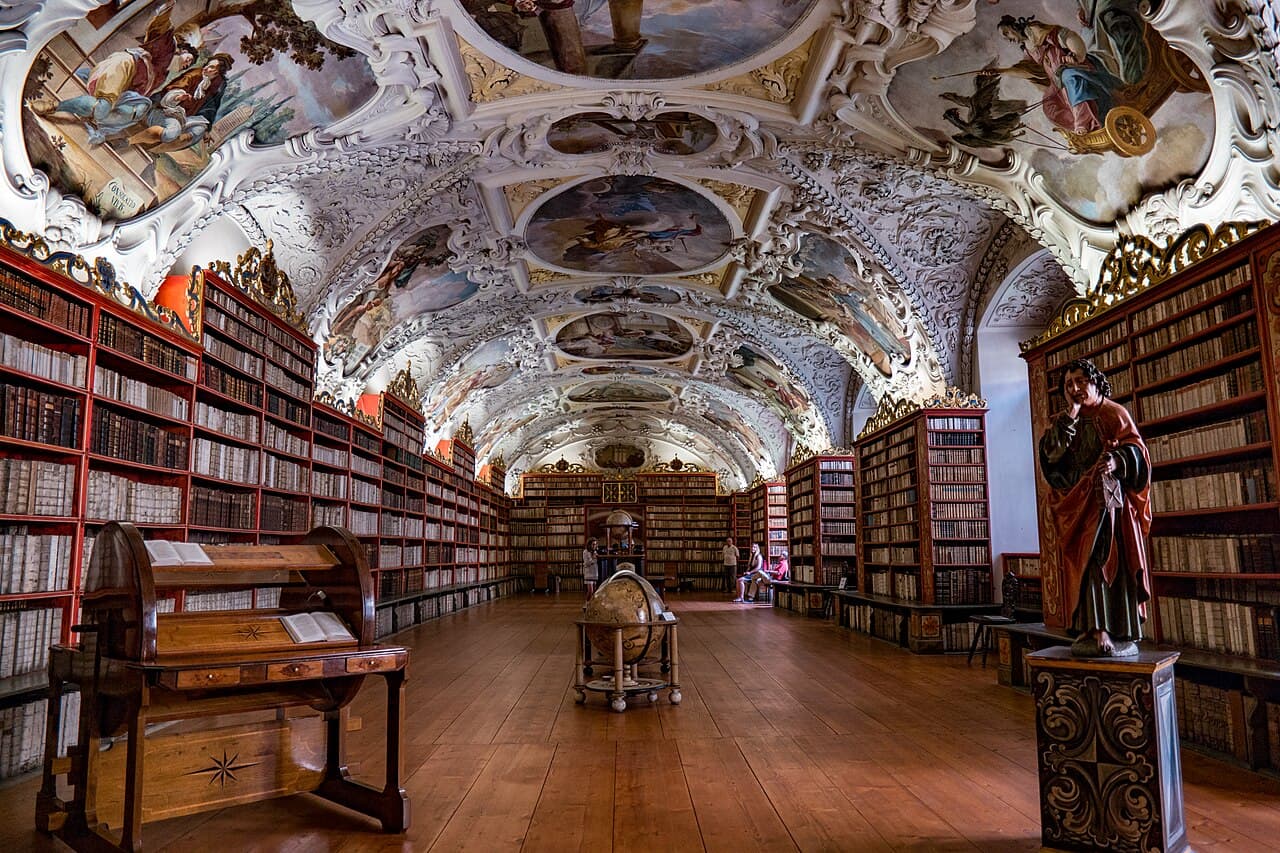
You've made it to the top of the hill, and honestly, that climb deserves a slow clap. But look where it got you. You're standing in the courtyard of Strahov Monastery, one of the oldest Premonstratensian monasteries in the world, founded all the way back in eleven forty-three. That's nearly nine hundred years of monks, manuscripts, and very, very quiet hallways.
The story starts with Jindrich Zdik, the Bishop of Olomouc, who went on a pilgrimage to the Holy Land in eleven thirty-eight and came home fired up to establish a monastery of canons in Prague. His first attempt in eleven forty flopped, so he called in the Premonstratensians from Steinfeld in the Rhineland. They arrived, liked the hilltop location with its commanding views over the Vltava, and got to work. The name Strahov actually comes from the Czech word "strazit" meaning "to guard" because this ridge was a strategic lookout point for the castle below.
Read more...Show less
But the real reason you're here is the library. Step inside and you'll find two jaw-dropping halls. The Theological Hall, built between sixteen seventy-one and sixteen seventy-four, is the older one. Its barrel-vaulted ceiling is covered in frescoes by Siard Nosecky depicting humanity's relationship with books, with Latin inscriptions pulled straight from the Bible. The shelves hold around eighteen thousand volumes, and the room still has its original seventeenth-century walnut cabinets. Imagine the monks in here, surrounded by globes and manuscripts, candles flickering off the gilded spines.
Then there's the Philosophical Hall, completed in seventeen ninety-four and it's twice the height. The ceiling fresco by Franz Anton Maulbertsch stretches the entire length of the room and illustrates the intellectual progress of mankind, from Adam and Eve all the way through to modern philosophy. You'll spot Alexander the Great, Socrates, Aristotle, and Moses, all swirling above over two hundred thousand volumes, including three thousand manuscripts and fifteen hundred first editions.
Here's a fun detail. When the Communists seized the monastery in nineteen fifty, they turned the library into a branch of the Memorial of National Literature. The Premonstratensians didn't get it back until after the Velvet Revolution in nineteen eighty-nine. Imagine being a monk and waiting forty years to get your books back.
Before you leave, do yourself a favour and walk through the courtyard to Klasterni Pivovar Strahov, the monastery brewery. Monks have been brewing beer here since around fourteen hundred. Today they pour three unfiltered house beers, including the Sv. Norbert IPA, which might be the best pint you'll have in Prague. Pair it with a roasted pork knuckle and you'll understand why monastic life had its perks.
Alright, when you're ready, head out through the monastery gate and walk east along Pohorelec. It's a wide square that opens up after about two hundred metres. You can't miss it.
Pohořelec Square
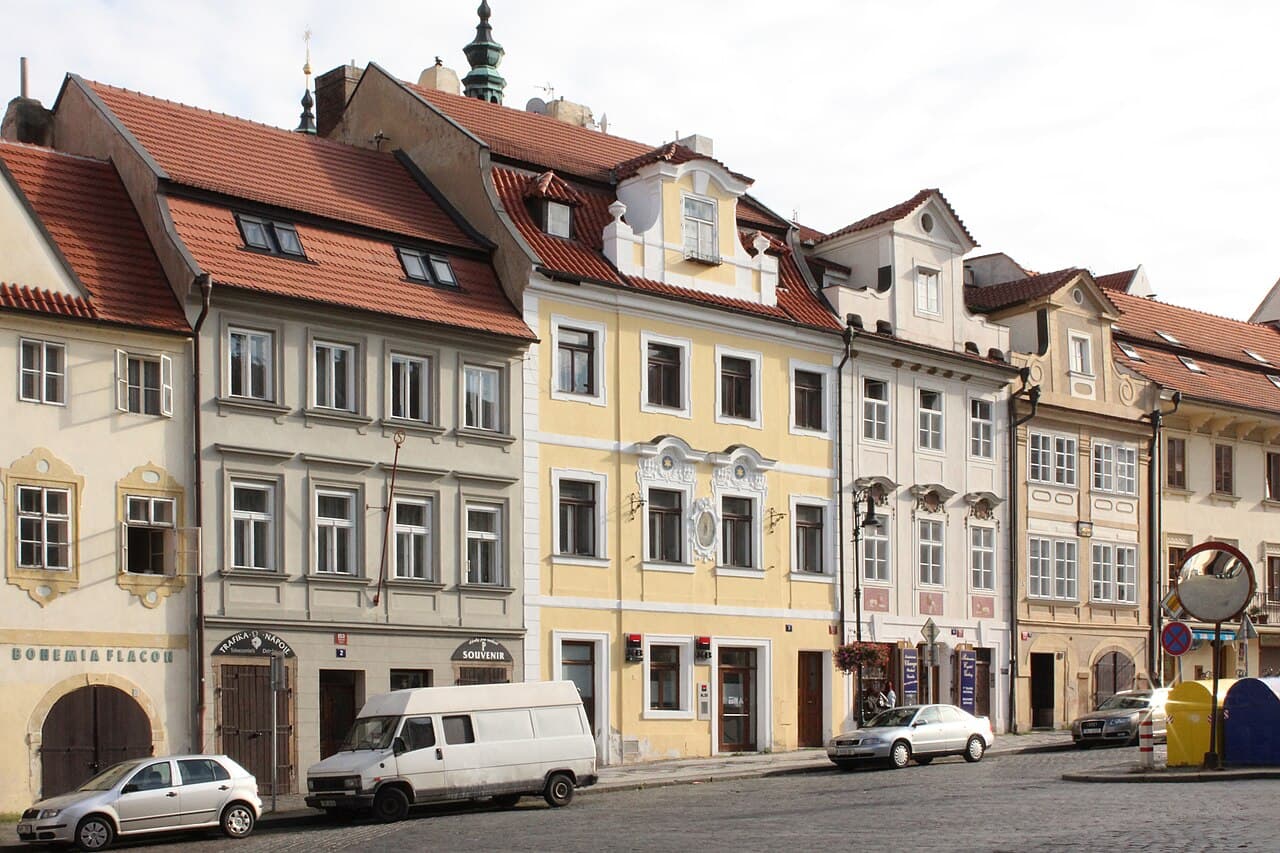
Welcome to Pohorelec, one of the oldest settlement areas in all of Prague, and a square with a name that basically translates to "the place that burned down." Cheery, right? The name comes from the Czech verb "horet" meaning "to burn," and this neighbourhood earned it the hard way.
A market settlement existed here as far back as the eighth century, perched along the long-distance trade route from western Bohemia. It was formally established as a suburb of Hradcany in thirteen seventy-five by the deputy burgrave Als of Malkovice. But fire kept finding this spot. It burned during the Hussite Wars in the early fourteen hundreds. It burned again in the catastrophic Great Fire of Prague in fifteen forty-one, which ripped through the Castle Quarter, Mala Strana, and Hradcany, destroying over a hundred homes in a single afternoon. And it burned yet again during the War of the Austrian Succession in seventeen forty-two, when French and Bavarian troops were besieged by the Austrians and artillery shells rained down on the rooftops.
Read more...Show less
Every time, the residents rebuilt. That kind of stubborn resilience is basically Prague's entire personality.
Stand in the middle of the square and look around. The baroque and renaissance facades you see today mostly date from the seventeenth and eighteenth century rebuilds. On the south side, notice the Hospital of St. Elizabeth with its elegant arcaded facade. And at the centre of the square, there's a sculpture of Saints John of Matha, Felix of Valois, and Ivan by Ferdinand Maximilian Brokof, dating from seventeen fourteen.
Imagine being here in the fourteenth century. This was the last stopping point before the castle gates. Traders, pilgrims, and diplomats would rest their horses, grab a meal, and prepare themselves for an audience with the king. The square was essentially Prague's front porch.
Here's a local tip. If you look to the west end of the square, you can catch a panoramic view that stretches across the terracotta rooftops all the way to Petrin Hill. On a clear morning, the light is absolutely gorgeous here. Photographers, take note.
Fun fact: Prague's Great Fire of fifteen forty-one started in Mala Strana when a pot of resin boiled over on the stove of a house near the Church of St. Thomas. The wind carried sparks uphill, and within hours, three hundred buildings were destroyed, including the castle itself and most of Hradcany. It was the worst fire in the city's history, and it permanently reshaped the architecture of this entire neighbourhood. Almost everything you see around you right now exists because of that single overturned pot.
If you need a quick bite, the restaurant at Hotel Questenberk, just off the southwest corner of the square, serves a solid Czech lunch with views over the city. Their svickova, a traditional Czech beef sirloin in cream sauce with bread dumplings and cranberries, is a proper introduction to Bohemian comfort food.
Now, from the eastern end of the square, take the narrow lane called Cerninska. After about a hundred metres, you'll hit a small street curving downhill to the left. Follow it. The lane gets quieter, the tourists thin out, and you'll find yourself in one of Prague's best-kept secrets.
Nový Svět — Hidden Street
And just like that, you've left the crowds behind. Welcome to Novy Svet, which translates to "New World," even though there's nothing new about it. This is one of Prague's most charming and least-visited streets, a cobblestone lane of tiny painted cottages that feels more like a village in the Bohemian countryside than the centre of a European capital.
Novy Svet came into existence in the sixteenth century as housing for servants who worked at Prague Castle. These weren't grand residences. They were small, functional homes for the people who kept the castle running, the cooks, the stable hands, the craftsmen. The street was devastated by fire in fourteen twenty during the Hussite Wars and again in fifteen forty-one during that same Great Fire that scorched Pohorelec. Most of the cottages you see today, with their pastel facades and creaky wooden doors, date from the seventeenth and eighteenth centuries.
Read more...Show less
But here's where it gets interesting. During the First Czechoslovak Republic in the early twentieth century, Novy Svet was one of the poorest areas in Hradcany. Residents used to hang their bedsheets on clotheslines strung across the narrow street, and the fluttering white fabric reminded people of the backstreets of Naples. In fact, locals nicknamed this "the Naples of Prague." Artists, writers, and bohemians moved in because the rent was dirt cheap, and the area developed a romantic, slightly rebellious atmosphere that persists to this day.
Now, here's the headline act. Walk to the corner of Novy Svet and U Brusnice and look for house number seventy-six. This is where the Danish astronomer Tycho Brahe lived in the late fifteen hundreds while serving as court astronomer to Emperor Rudolf the Second. Brahe was an extraordinary character. He lost part of his nose in a sword duel at age twenty and wore a prosthetic made of brass for the rest of his life. He kept a pet elk that reportedly died after drinking too much beer and falling down the stairs. You genuinely cannot make this stuff up.
Brahe died in Prague on the twenty-fourth of October, sixteen oh one, at age fifty-four. The traditional story is legendary and probably mostly true. He attended a banquet hosted by Peter Vok of Rozmberk, drank copiously, but refused to leave the table to relieve himself because it would have violated royal etiquette. He developed a bladder ailment and died eleven days later. Modern scientists exhumed his remains in twenty ten and confirmed he wasn't poisoned, though the exact medical cause is still debated.
For a coffee break, duck into Kavarna Novy Svet, a tiny family-run cafe with a balcony overlooking the Deer Moat. They do excellent coffee and homemade cake, and the setting is impossibly peaceful. It's closed Mondays, though, so plan accordingly.
When you're ready, continue east along Novy Svet until the lane ends, then turn right and walk uphill. After about two hundred metres, you'll emerge onto a grand open square dominated by a palace on one side and the entrance to Prague Castle on the other.
Hradčanské Square — Castle Gate
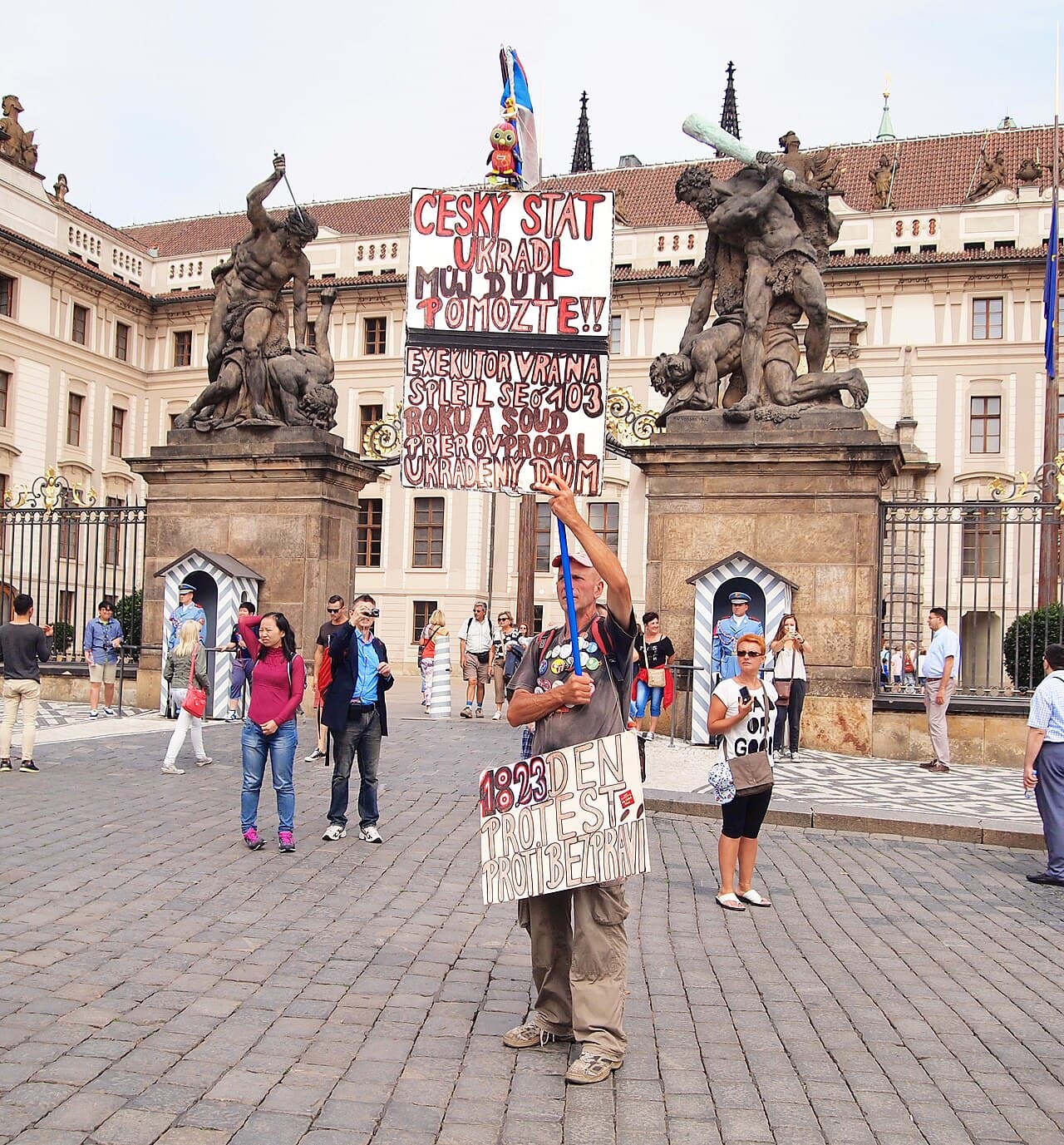
You've arrived at Hradcanske nasmesti, and the scene in front of you is pure theatre. Two stone sentries flank the main gate to Prague Castle, the famous "fighting giants" statues by Ignaz Platzer from seventeen sixty-eight, frozen mid-attack above your head. Below them, real soldiers in crisp blue uniforms stand at attention, rifles at their sides.
Those uniforms have a brilliant backstory. After the Velvet Revolution in nineteen eighty-nine, President Vaclav Havel wanted to replace the drab Communist-era military outfits with something that matched the spirit of the new Czech Republic. So he called Theodor Pistek, the costume designer who had just won an Academy Award for his work on Milos Forman's film Amadeus. Pistek designed the current uniforms, introduced on the fifteenth of March, nineteen ninety. The blue matches the Czech flag, and the whole ensemble has this elegant, almost cinematic quality. An Oscar-winning designer dressing the castle guards. That's so Prague.
Read more...Show less
The Changing of the Guard happens on the hour from seven in the morning to eight in the evening during summer. But the big ceremony, the one with the fanfare and the banner exchange, happens at noon every day in the First Courtyard just through the gate. It's free, it's short, and the brass fanfare echoing off the courtyard walls is genuinely stirring. If your timing works out, it's well worth catching.
Now, about the castle itself. You're about to walk into the largest ancient castle complex in the world, according to the Guinness Book of Records. Prague Castle covers nearly seventy thousand square metres, stretching five hundred and seventy metres in length and about a hundred and thirty metres wide. That's seven hectares of palaces, churches, gardens, towers, and courtyards. It's been the seat of Czech rulers since the ninth century, from Premyslid princes to Holy Roman Emperors to today's president. Over eleven hundred years of continuous power, concentrated on this one hilltop.
Take a moment to look across the square before you walk through the gate. The grand Archbishop's Palace faces you on the left, its rococo facade gleaming white. To the right is the Sternberg Palace, which houses part of the National Gallery's European art collection. And behind you, the square opens up to a panoramic view over Prague's rooftops and spires, all the way to the Old Town.
Head through the gate now, past the guards, through the Matthias Gate, and into the Second Courtyard. Cross it diagonally and continue through the passage into the Third Courtyard. When you step through, the entire south facade of St. Vitus Cathedral will hit you like a wall of stone and light.
St Vitus Cathedral
There it is. Every single time, it takes your breath away. St. Vitus Cathedral, soaring above you, its Gothic spires and flying buttresses reaching nearly a hundred metres into the sky. This is the spiritual heart of the Czech nation, and it took almost six hundred years to finish.
The first church on this spot was a modest Romanesque rotunda, founded around nine thirty by Duke Wenceslas the First, the "Good King Wenceslas" of the Christmas carol. Yes, he was a real person, a tenth-century Bohemian duke murdered by his own brother. But the cathedral you're looking at now began life in thirteen forty-four, when Prague was elevated to an archbishopric and King John the Blind decided the city deserved a church to match its new status.
Read more...Show less
His son, Charles the Fourth, took the project and ran with it. He hired French master mason Matthieu d'Arras to design a grand Gothic cathedral modelled on the great churches of France. When d'Arras died suddenly in thirteen fifty-two, the twenty-three-year-old German architect Peter Parler took over and brought a more inventive, daring style. Parler completed the magnificent chancel, the Wenceslas Chapel, and the Golden Portal on the south facade before his own death in thirteen ninety-nine. Then the Hussite Wars erupted in fourteen nineteen, and construction basically stopped for five centuries.
Five centuries. Let that sink in. The western facade, the twin towers, and the nave weren't completed until nineteen twenty-nine, designed by Josef Mocker and then Kamil Hilbert. That means the cathedral took five hundred and eighty-five years from groundbreaking to completion.
Step inside and look for the third window on the left in the north nave. That's the Mucha Window, designed by Art Nouveau master Alfons Mucha and installed in nineteen thirty-one. It depicts Saints Cyril and Methodius, who brought Christianity to the Slavic peoples, alongside the young Saint Wenceslas with his grandmother Saint Ludmila. Mucha's signature flowing lines and luminous blues, golds, and reds are unmistakable, a gorgeous contrast with the medieval Gothic architecture surrounding it.
Now, here's the part that gives me chills. Above the Wenceslas Chapel, behind a small door secured with seven locks, lies the Crown Chamber. Inside are the Bohemian Crown Jewels, among the oldest royal regalia in Europe. The Crown of Saint Wenceslas was created in thirteen forty-seven for Charles the Fourth's coronation. And the crown carries a curse. Legend holds that any usurper who places it on his head without rightful claim will die within a year. The most famous story involves Reinhard Heydrich, the Nazi Reichsprotektor who occupied Prague Castle during World War Two. He allegedly tried on the crown. Czech resistance fighters assassinated him in June nineteen forty-two. There's no hard proof he wore it, but Praguers believe the crown got its revenge.
The seven keyholders include the President, the Prime Minister, and the Archbishop of Prague, and they only open the chamber for public display once every five to eight years. Timing that takes some serious luck.
When you've taken it all in, exit the cathedral through the south door and turn right. The Old Royal Palace is directly ahead, across the courtyard.
Old Royal Palace — The Defenestration
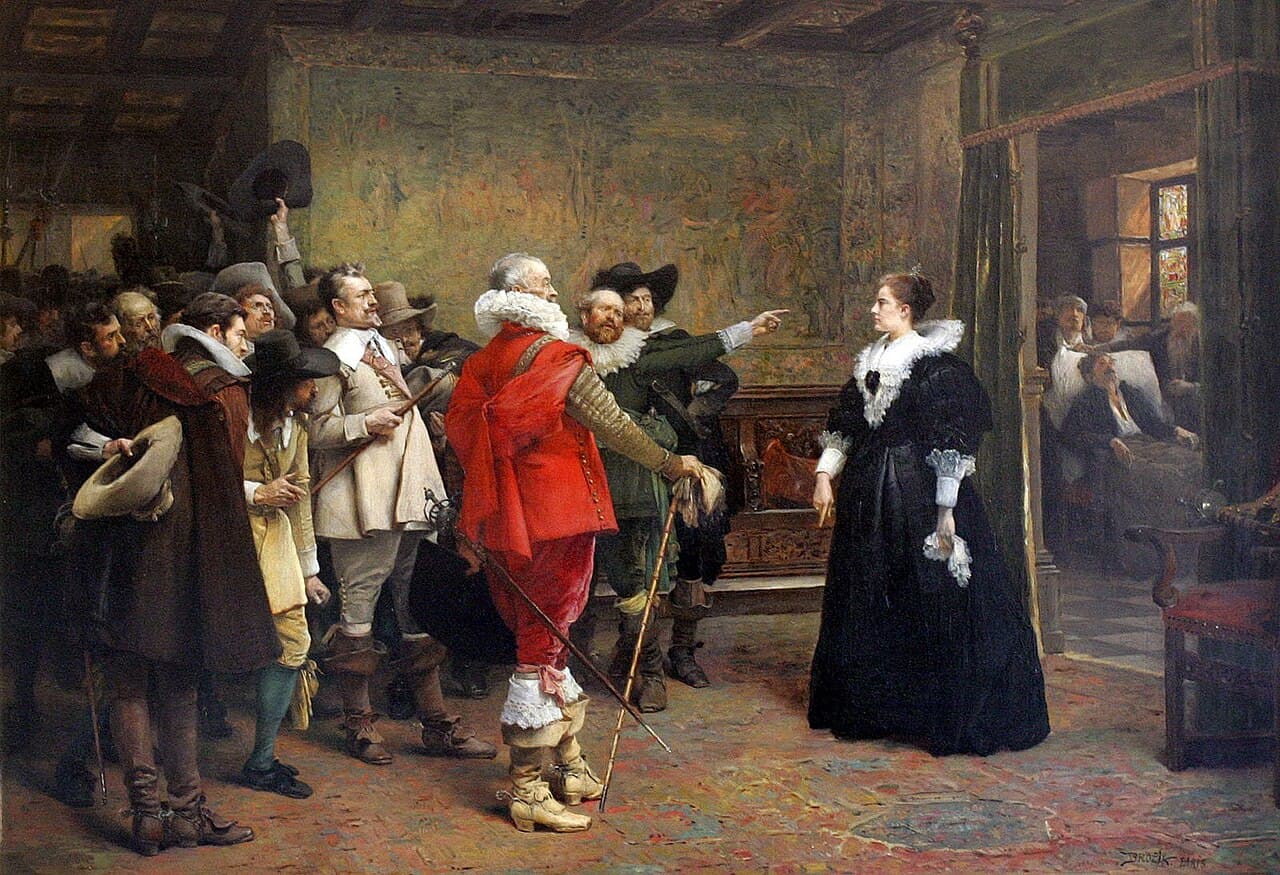
You're now standing in front of the Old Royal Palace, and I need you to look up at the windows on the upper floor. Specifically, the windows in the Bohemian Chancellery, in the Ludwig Wing on the south side. Because on the twenty-third of May, sixteen eighteen, a group of furious Protestant nobles marched into one of those rooms and threw three Catholic officials out the window. And that act of rage started the Thirty Years' War, the bloodiest conflict in European history until the twentieth century.
Here's what happened. In sixteen oh nine, Emperor Rudolf the Second had issued the Letter of Majesty, guaranteeing religious freedom to Bohemia's Protestants. But by sixteen seventeen, Catholic officials began violating those guarantees, closing Protestant chapels in the towns of Broumov and Hrob. Tensions boiled over. On that May morning, a delegation of Protestant Czech lords stormed into the palace for what was supposed to be a meeting with four Imperial Regents. It quickly became a trial. They found two of the regents, Jaroslav Martinic and Vilem Slavata, guilty of violating the Letter of Majesty.
Read more...Show less
Then they grabbed them and their secretary, Philip Fabricius, and hurled all three out the window. The drop was about seventeen metres, roughly five storeys. All three survived. Catholics claimed angels had caught them in midair, a divine miracle. Protestants had a more earthy explanation: the men landed in a pile of manure that had accumulated in the moat below. The truth is probably somewhere in between. A sloping embankment and some refuse likely broke the fall.
But the consequences were anything but soft. The Defenestration of Prague, as it became known, triggered an armed Bohemian revolt against the Habsburg Emperor Ferdinand the Second. That revolt spiralled into the Thirty Years' War, which raged from sixteen eighteen to sixteen forty-eight and killed an estimated eight million people across Europe. All because some officials went out a window.
Here's a detail I love. Prague has such a proud tradition of throwing people out of windows that the word "defenestration," from the Latin "fenestra" meaning window, was essentially coined for this city. The first Defenestration of Prague happened in fourteen nineteen, when Hussite protesters threw Catholic councillors out of the New Town Hall windows. Prague: where political disagreements get vertical.
If you can, step inside the Vladislav Hall, the vast late-Gothic ceremonial space with its stunning ribbed vault ceiling, designed by Benedikt Ried and completed around fifteen hundred. It's so large that medieval jousting tournaments were held inside it, with knights riding their horses up the wide Riders' Staircase.
Now, exit the palace and head east through the castle grounds. Follow the signs toward Zlata Ulicka, Golden Lane. It's about a three-minute walk along the castle's northern fortification wall.
Golden Lane — Kafka's House
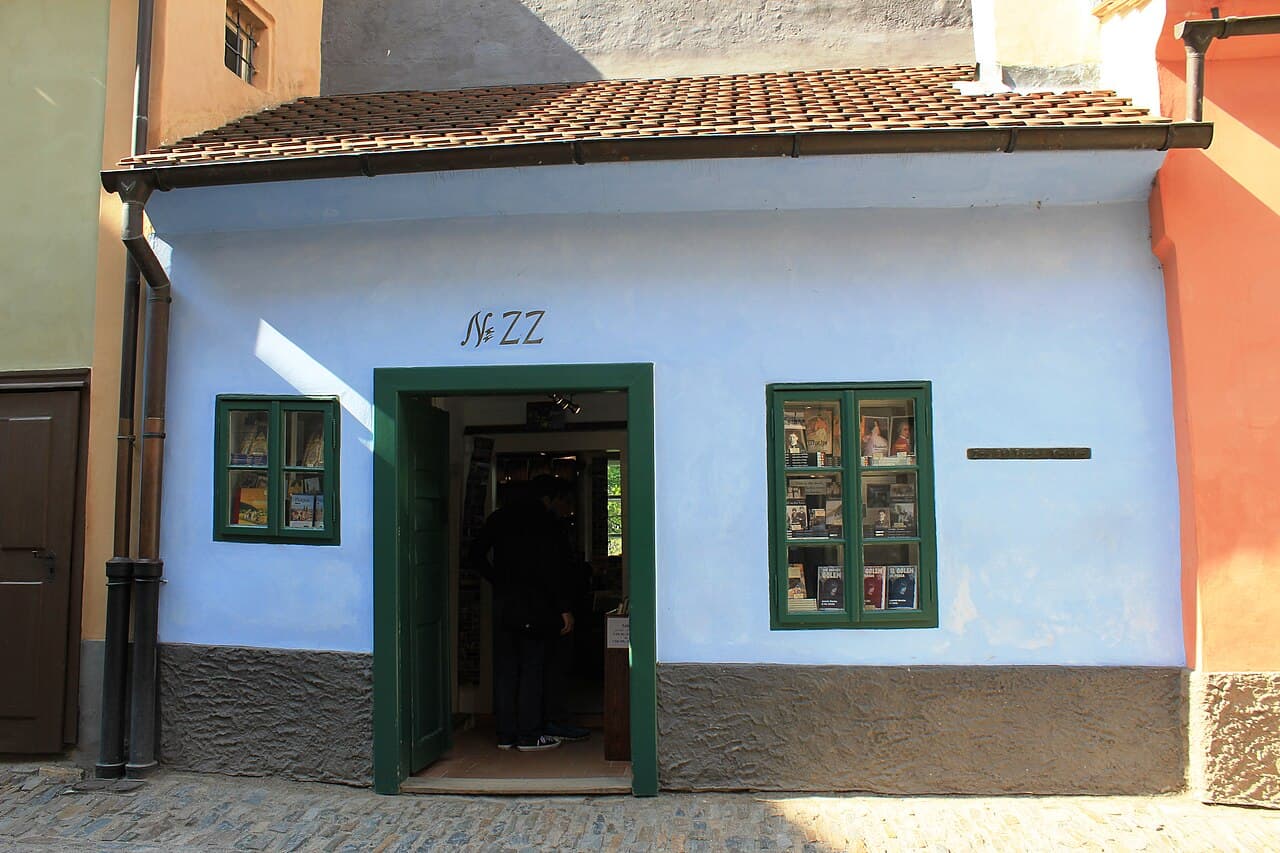
Welcome to Zlata Ulicka, Golden Lane, a street so tiny and colourful it looks like it was designed for a fairy tale. These miniature houses, painted in pastels and barely wide enough for a dining table, are wedged into the arches of the castle's northern fortification wall. And this little street has been spinning legends for five hundred years.
Golden Lane was built in the fifteen sixties to house Prague Castle's guards and their families. The houses are genuinely small. Duck your head going through most of the doorways. By the seventeenth century, goldsmiths had moved in, and that's where the street gets its name, from the Czech "Zlatnicka" meaning "of the goldsmiths." The romantic legend says Emperor Rudolf the Second installed alchemists here to pursue the philosopher's stone and turn lead into gold, but that's a myth. Rudolf's alchemists, including the famous English occultist John Dee and the dubious Edward Kelley, actually worked in laboratories in the Mihulka Tower and along Vikarska Street, not in these tiny cottages.
Read more...Show less
But here's the real literary magic. Walk to house number twenty-two, the one painted blue. In the summer of nineteen sixteen, Franz Kafka's sister Ottla rented this cottage for him as a writing studio. For several months, Kafka would walk here during the day, shut himself inside this minuscule room, and write. He never actually slept here. Every evening he'd walk back to his spacious flat in the centre of Prague. But in this cramped, silent space, he wrote stories from his collection "A Country Doctor," some of his most psychologically intense work.
Imagine Kafka hunched over a small desk in this room, the ceiling practically touching his head, crafting stories about alienation and absurdity in one of the most claustrophobic spaces in Prague. There's something almost too perfect about it.
Kafka wasn't the only literary giant here either. The Czech poet Jaroslav Seifert, who won the Nobel Prize in Literature in nineteen eighty-four and was one of the signatories of the dissident Charter Seventy-Seven, lived on Golden Lane in nineteen twenty-nine. This street attracted writers like a magnet.
The brightly painted facades you see today date from the nineteen fifties, when the lane was restored for tourists. Before that, it was genuinely run-down. The vivid blues, reds, and yellows are charming, but the original medieval lane was considerably grimmer.
Take your time wandering through the houses. Several have been set up as small museum exhibits showing how the residents once lived, including an armoury, an alchemist's workshop, and a herbalist's room.
When you reach the end of Golden Lane, exit through the gate by the Daliborka Tower and follow the path downhill. You'll arrive at the top of the Old Castle Steps, with one of the best views in all of Prague waiting for you.
Old Castle Steps Viewpoint
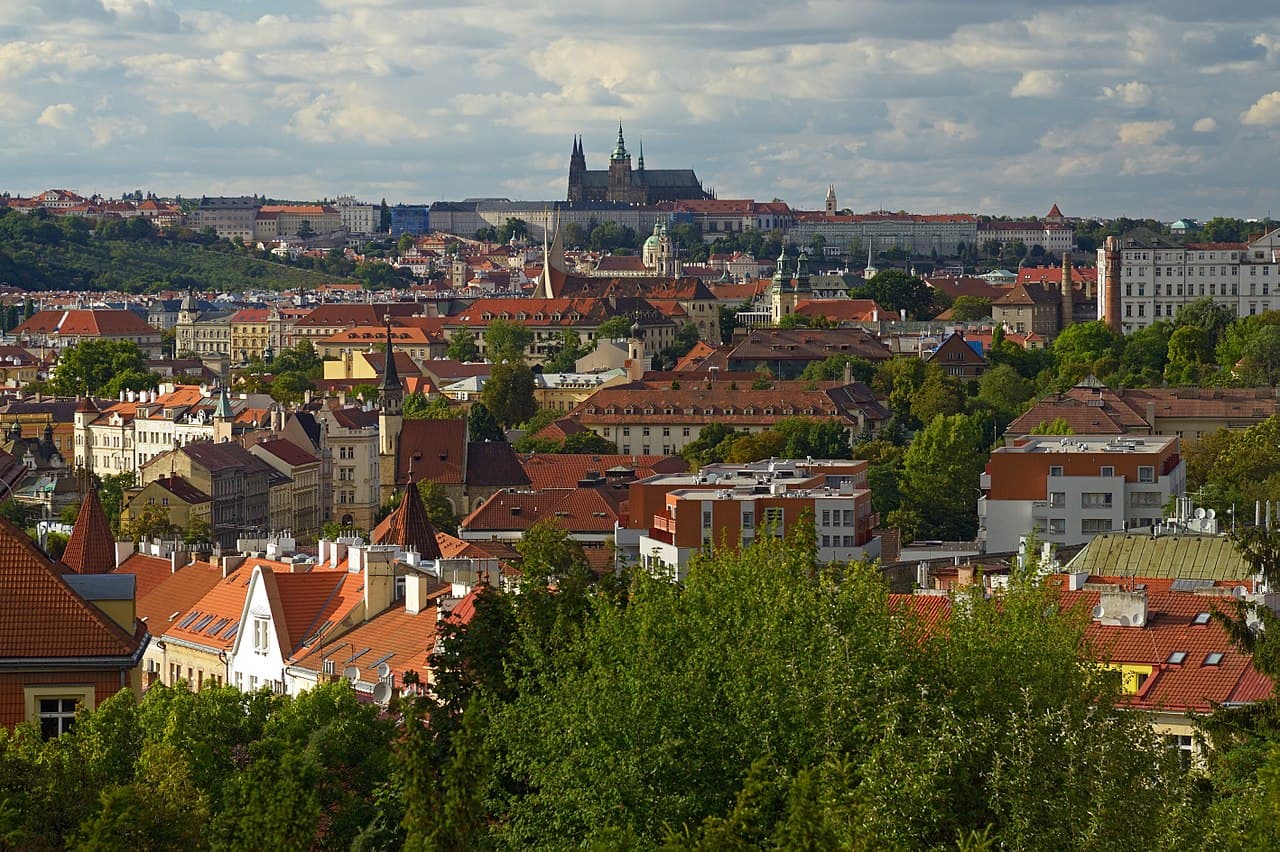
Stop right here and just look. I mean really look. This is the kind of view that makes you understand why Prague is called the City of a Hundred Spires. From this terrace at the top of the Stare zamecke schody, the Old Castle Steps, the entire city unfolds below you like a pop-up book.
Directly below, the terracotta rooftops of Mala Strana tumble down the hillside in a cascade of orange and rust. Beyond them, the silver ribbon of the Vltava River curves through the city, crossed by bridges that stretch like stone stitches holding the two banks together. You can pick out Charles Bridge with its procession of dark statues. Further east, the Gothic towers of the Old Town rise above the skyline, the twin black spires of the Tyn Church, the green dome of St. Nicholas in the Old Town Square, and the distant Television Tower in Zizkov with those surreal crawling baby sculptures by David Cerny clinging to its sides.
Read more...Show less
These steps have been here, in some form, since the ninth century. They were formalized in the seventeenth century and reconstructed in the eighteen thirties into the hundred and twenty-one stone steps and two hundred and thirty metres of descending pathway you see today. For centuries, this was one of the main routes between Prague Castle and the Lesser Town below. Kings, ambassadors, merchants, and monks all climbed these stairs.
The steps became famous in Czech culture through the songwriter Karel Hasler, whose song "Along the Old Castle Steps" became a beloved Prague anthem. If you listen carefully, you might hear a busker playing it. Street musicians love this staircase for the acoustics, the stone walls create a natural amplifier.
Look to your left and you'll catch glimpses of the Furstenberg Garden, one of the palace gardens that terrace down the south slope of the castle hill. These formal baroque gardens are hidden gems, usually much quieter than the castle grounds above.
Take a deep breath. You can smell it, that mix of old stone, linden trees, and if the wind is right, fresh bread from somewhere in Mala Strana below. This is the kind of sensory moment that no photograph can capture.
Now, start heading down the steps. Take your time, they're steep in places. At the bottom, you'll emerge near the Malostranska metro station. From there, walk south along Mostecka Street into the heart of Mala Strana. After about two hundred metres, the street opens into a grand square with an enormous green-domed church. That's where we're headed.
Malá Strana Square — St Nicholas Church
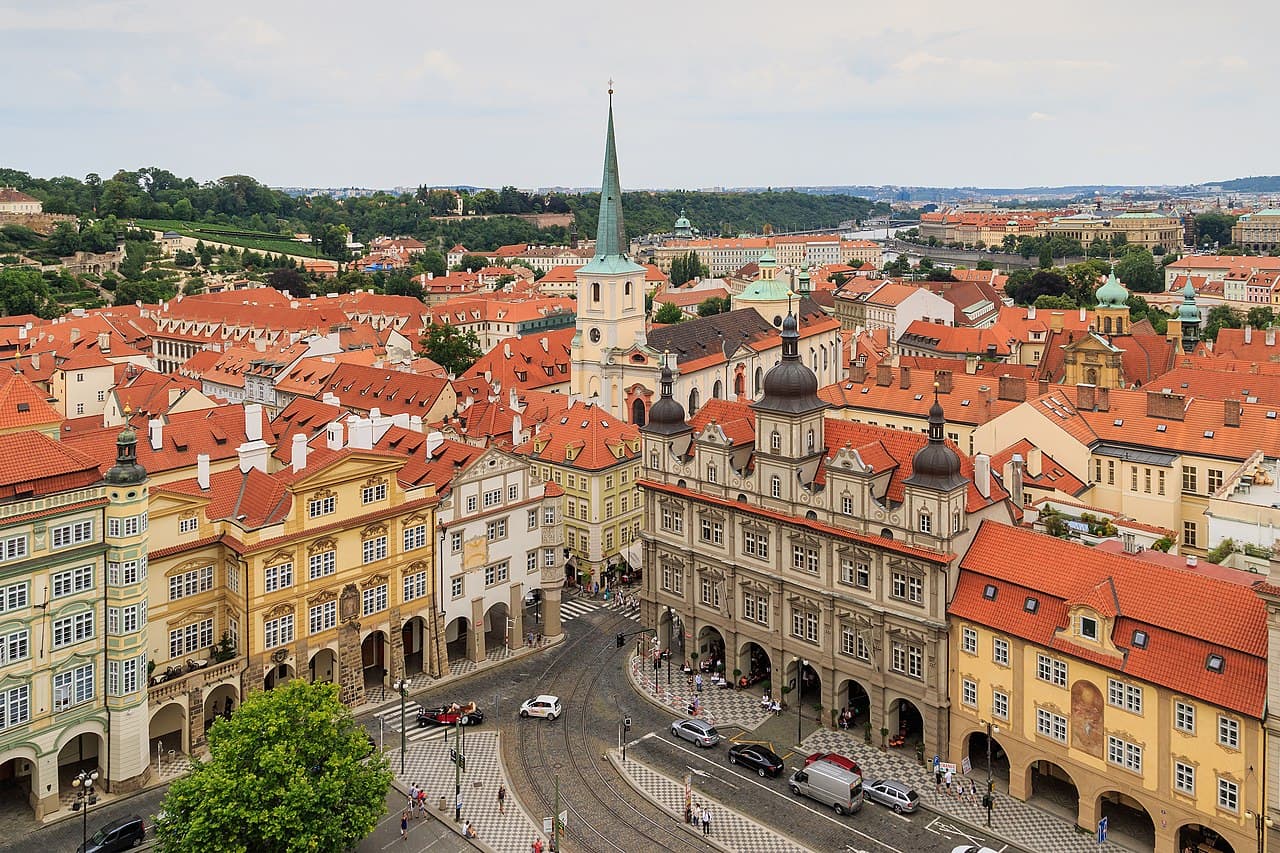
This is Malostranske namesti, the beating heart of the Lesser Town, and that extraordinary dome rising above everything belongs to the Church of St. Nicholas. It's considered the greatest Baroque church in Prague and one of the finest north of the Alps. And it has a secret life that involves the Communist secret police.
The church you see now was built between seventeen oh four and seventeen fifty-five, replacing a thirteenth-century Gothic church on the same site. It was a Jesuit project, and they didn't do anything by halves. The Jesuits established their first professional house here in sixteen twenty-six, and the new church became their masterpiece. The facade is pure Baroque drama, waves of concave and convex stone rolling across the front like a frozen ocean, designed by Christoph Dientzenhofer. His son, Kilian Ignaz Dientzenhofer, took over and built the chancel and that magnificent copper dome between seventeen thirty-seven and seventeen fifty-two. The dome alone is twenty metres in diameter, and the interior rises over forty-nine metres to the top of the lantern, making it the tallest interior space in Prague.
Read more...Show less
Step inside and look up. The ceiling frescoes by Johann Lucas Kracker cover over fifteen hundred square metres, making them some of the largest in Europe. They depict scenes from the life of Saint Nicholas, and the play of light on the painted figures creates an almost hallucinatory sense of movement, as if the saints and angels are actually floating above you.
And then there's the organ. Built between seventeen forty-five and seventeen forty-seven, it has over four thousand pipes, some up to six metres long. Wolfgang Amadeus Mozart played this very organ during his visit to Prague. He adored this city, and the feeling was mutual. Prague embraced him when Vienna grew cold.
Now, here's the spy story. After the Jesuit order was dissolved by Pope Clement the Fourteenth in seventeen seventy-three, St. Nicholas became the main parish church of Mala Strana. But during the Communist era, the secret police, the StB, set up an observation post in the church tower. From up there, they could surveil the American Embassy, the Yugoslav Embassy, and the access route to the West German Embassy. A church tower turned into a Cold War spy nest. Prague never does anything without layers of irony.
For a meal, I'd highly recommend Cukrkavalimonada on nearby Maltezske Square. The name means "sugar coffee lemonade" and their pastries and sandwiches are excellent in a gorgeous, cosy setting. For something more substantial, U Mecenase on the square itself is one of the oldest restaurants in Prague, housed in the last surviving purely Renaissance building on the square.
From the square, walk south down Karmelitska Street. After about two hundred metres, turn left onto Velkoprevorskenamesti, Grand Priory Square. You'll know you're in the right place when you see a wall completely covered in graffiti.
Lennon Wall
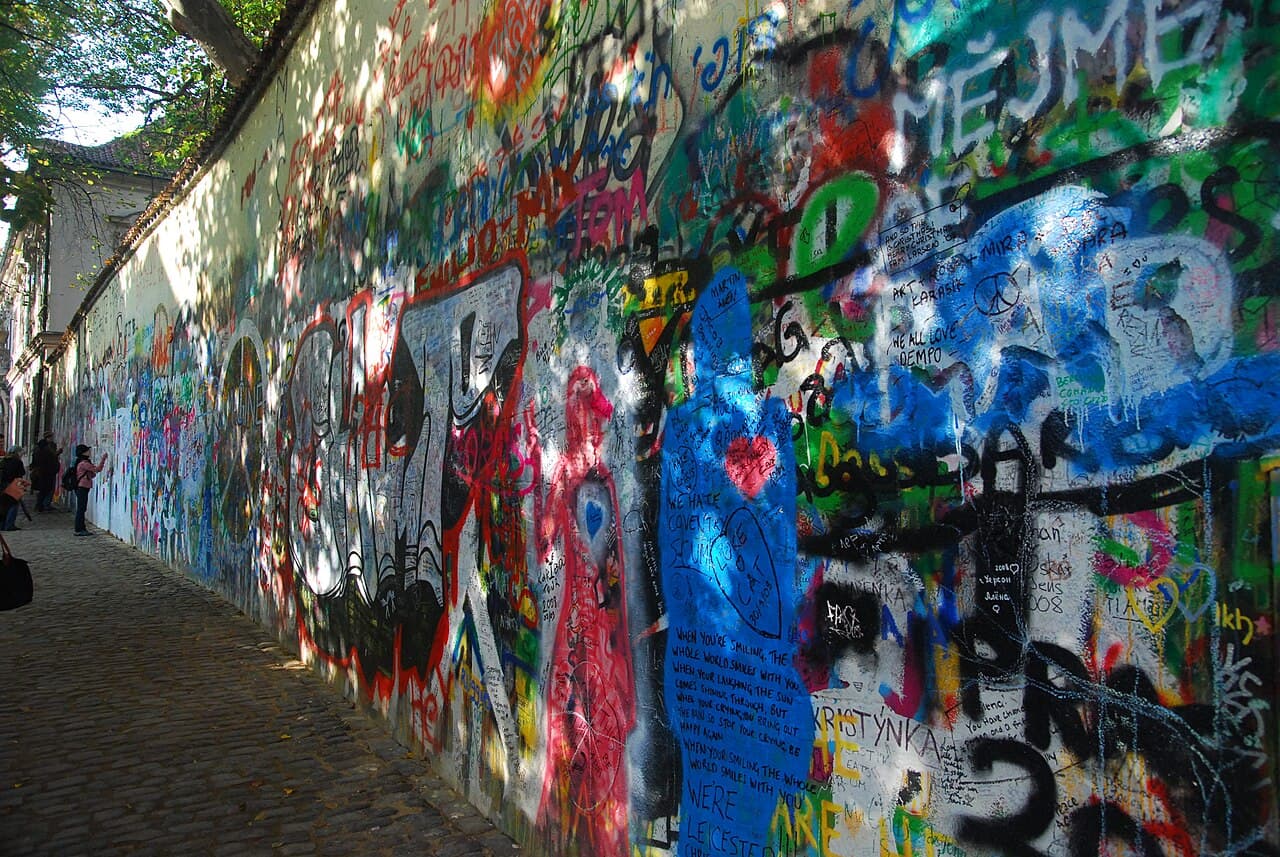
And there it is. A wall exploding with colour, lyrics, peace signs, and the face of John Lennon painted and repainted a thousand times over. The Lennon Wall is one of Prague's most photographed spots, but what makes it remarkable isn't the street art. It's the fact that this wall helped topple a dictatorship.
After John Lennon was murdered in New York on the eighth of December, nineteen eighty, a young Czech artist painted a portrait of him on this wall, which belongs to the garden of the Grand Priory of the Sovereign Military Order of Malta, the Knights of Malta. That anonymous portrait became a catalyst. In Communist Czechoslovakia, where Western music was suppressed and free expression was dangerous, young Czechs started adding Beatles lyrics, anti-regime slogans, and peace messages. The wall became a living, breathing act of defiance.
Read more...Show less
The Communist authorities were furious. They painted over it repeatedly. They called the young people who gathered here "lennonists" and accused them of being agents of Western capitalism. Police crackdowns were frequent. In nineteen eighty-eight, the tension escalated into a violent clash between hundreds of students and security police on the nearby Charles Bridge. The regime tried everything to kill the wall, but it kept coming back. Every time they whitewashed it, someone would repaint it overnight.
Then, in November nineteen eighty-nine, the Velvet Revolution swept through Czechoslovakia. The Communist government fell, and the Lennon Wall became a symbol of peaceful resistance. Lennon himself never visited Prague, but his music and his message of peace became a weapon that the regime couldn't confiscate.
Here's a fact that catches people off guard. The wall is owned by the Knights of Malta, a Catholic military order that dates back to the First Crusade in the eleventh century. Their Grand Priory sits directly behind the wall, along with the Church of Our Lady Beneath the Chain. A medieval religious order safeguarding a wall of countercultural graffiti. Only in Prague.
Today the wall changes constantly. Artists, tourists, and activists add new layers every day. Since twenty nineteen, the order and Prague's first district have managed the wall more carefully, banning spray cans and designating certain areas for public use. So bring a marker or paintbrush if you want to leave your mark, but leave the spray paint at home.
Take a moment to read the messages. Among the peace signs and selfies, you'll find some genuinely moving tributes, in Czech, English, Japanese, Arabic, and dozens of other languages.
When you're done, walk through the small square and cross the little bridge over the canal directly ahead. That narrow waterway is called Certovka, the Devil's Stream, and it leads to one of Prague's most magical hidden spots.
Kampa Island & Devil's Stream
You've just crossed the Devil's Stream, and you're now standing on Kampa Island, a slender sliver of land between the main Vltava River and this narrow canal. And if you're wondering why it's called the Devil's Stream, the answer is wonderfully Prague.
The canal's official name used to be the Rozmberk Race, named after Vilem of Rozmberk, who owned land along its banks in fifteen eighty-five. But locals started calling it Certovka, the Devil's Stream, in the nineteenth century, and the most popular explanation traces the name to a nearby house called "At the Seven Devils." Some say the "devil" in question was actually a notoriously bad-tempered washerwoman who lived on the bank. Either way, the name stuck.
Read more...Show less
The canal itself is much older than its nickname. It was likely dug in the twelfth century by the Knights Hospitaller, the Order of Malta, who needed a controlled water channel to power flour mills. Look over the railing of the bridge you just crossed and you'll see the large wooden mill wheel of the former Grand Priory Mill, which has stood here since around fourteen hundred. The gentle creaking of that wheel, when it's turning, is one of Prague's most evocative sounds.
Kampa Island was essentially a giant garden for most of the Middle Ages, used by locals to wash and bleach their linens. The flooding was so frequent that nobody dared build here until the fifteenth century, starting with mills and their adjacent gardens. The pottery markets that sprang up here at the turn of the sixteenth and seventeenth centuries became a beloved local tradition.
Now, look around the park for three enormous bronze babies crawling across the grass. These are by David Cerny, Prague's most provocative contemporary artist. Each sculpture is three and a half metres long and weighs eight hundred kilograms. Their faces have been replaced with barcode stamps, which Cerny says symbolises the seductive but slightly terrifying advance of technology. They're related to the ten fiberglass babies he stuck to the Zizkov Television Tower in two thousand, originally as a temporary installation, but the public loved them so much they became permanent.
Kampa Park itself is gorgeous. In autumn, the leaves turn the island gold and amber. In summer, locals sprawl on the grass with books and beers. It has the feeling of a secret garden, even though it's technically in the middle of the city.
If you're hungry, grab a trdelnik from one of the stands near Mostecka Street. These spiral chimney cakes are baked over hot coals and rolled in cinnamon and sugar. Look for one being made fresh in front of you, not sitting in a display case. The warm, crispy ones are heavenly. Pair it with a coffee for the perfect walking fuel.
Now, walk north through the park, following the river path. After about two hundred metres, you'll arrive at the foot of Charles Bridge. Look up. Those towers are your final stop.
Charles Bridge — Malá Strana Tower
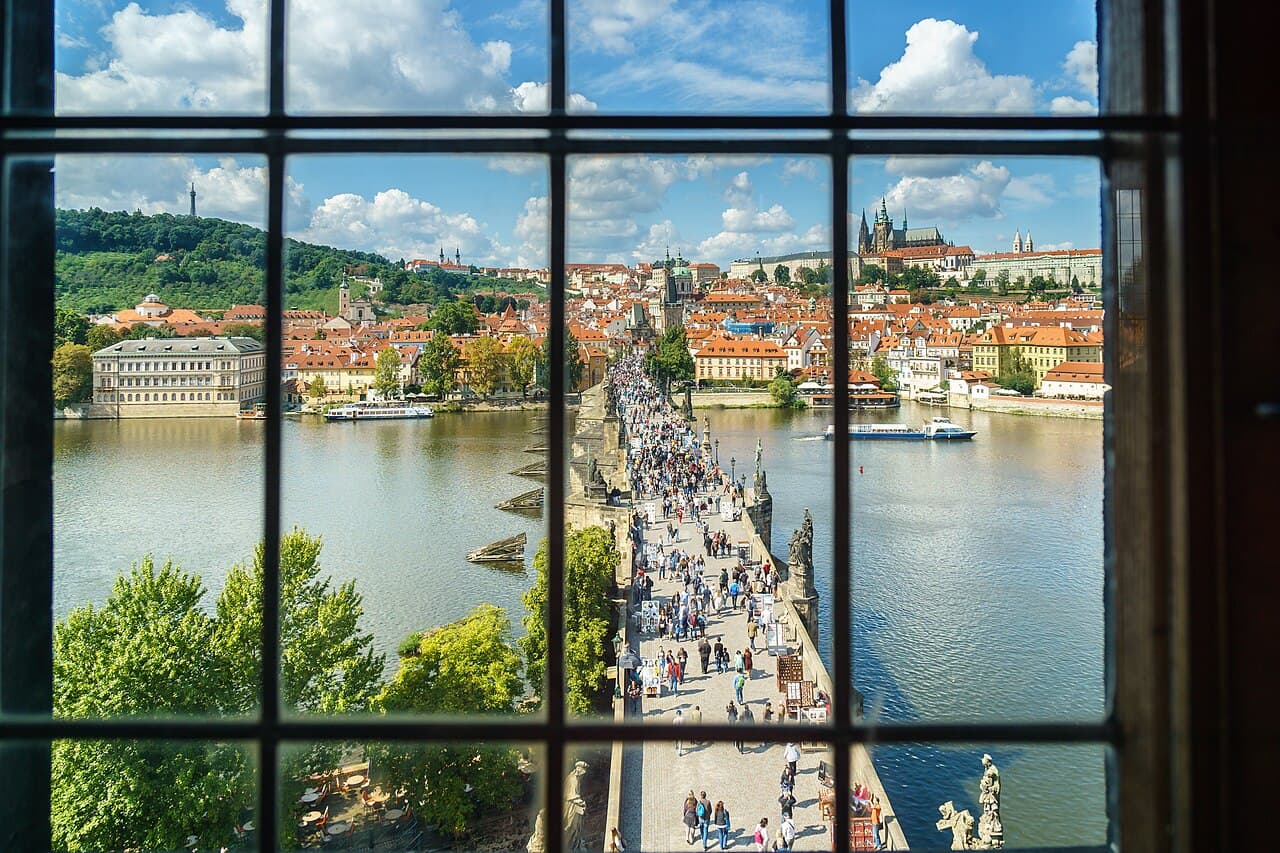
You've made it to the grand finale, and what a way to end. You're standing at the Mala Strana end of Charles Bridge, flanked by two towers that have guarded this crossing for centuries. The shorter one on your left, the Judith Tower, is Romanesque and dates from the twelfth century, a survivor from the original Judith Bridge that stood here before the current bridge replaced it. The taller Gothic tower on your right was built in the fifteenth century. Together, they form one of the most photographed gateways in Central Europe.
Charles Bridge itself was the brainchild of Emperor Charles the Fourth, and here's a detail that obsessive types will love. Construction began at five thirty-one in the morning on the ninth of July, thirteen fifty-seven. Charles chose this exact moment because he was deeply into numerology. Write out the date and time and you get a palindrome: one, three, five, seven, nine, seven, five, three, one. All the odd single-digit numbers ascending and descending. Charles believed this cosmic alignment would imbue the bridge with supernatural strength. He also noted that Saturn was in a favourable position and the Sun was ascending in Leo, the heraldic symbol of the Czech Kingdom. Whether or not you believe in astrological engineering, the bridge has survived over six hundred and sixty years of floods, wars, and millions of tourist footsteps, so maybe Charles was onto something.
Read more...Show less
The bridge stretches five hundred and sixteen metres across the Vltava, supported by sixteen arches. Its most striking feature is the avenue of thirty statues lining both sides, most of them Baroque masterpieces installed around seventeen hundred. The originals have been moved to museums and replaced by replicas, but the effect is still stunning, like walking through an open-air gallery of saints and sinners.
Find the statue of Saint John of Nepomuk, the oldest on the bridge, installed in sixteen eighty-three. He's the one with the five golden stars around his head. Nepomuk was a priest who heard the confession of Queen Sophie and refused to reveal her secrets to King Wenceslas the Fourth. The king had him thrown off this very bridge into the Vltava in thirteen ninety-three. Legend says five stars appeared above the water where his body surfaced, and the five letters of the Latin word "tacui," meaning "I kept silent," match those stars. Touch the bronze relief at the base of the statue and make a wish. Tradition says it will come true within a year and a day, as long as you never tell anyone what you wished for.
Walk out onto the bridge now. Take your time. Watch the light on the river, listen to the buskers, and let the city wash over you. You've just walked from the hilltop monastery where monks have prayed for nearly nine hundred years, through the seat of kings and emperors, past the window that started a continental war, and down through the winding streets of Mala Strana to this ancient crossing. Not bad for an afternoon stroll.
This is the end of the Prague Castle and Mala Strana walking tour. If you want to keep exploring, the Old Town is right across the bridge, and the best beer hall in Prague, U Zlateho Tygra, the Golden Tiger, is about a ten-minute walk from the far end. Vaclav Havel used to drink there with Bill Clinton. Grab a Pilsner Urquell and toast to the city that never runs out of stories. Na zdravi!
Free
GPS-guided walking tour
No account needed. Walk at your own pace.
Free
12 stops · 3.5 km