12 stops
GPS-guided
3.5 km
Walking
1 hour 15 minutes
Duration
Free
No tickets
About this tour
The 27 crosses, the blinded clockmaker, the Golem in the attic, 12 layers of graves, and the saint they threw off the bridge.
12 stops on this tour
Powder Tower
Welcome to Prague, and welcome to the Powder Tower — or Prasna Brana, if you want to impress a local. You're standing at the ceremonial front door of Old Town, and this sixty-five-metre Gothic tower has been watching people walk through it for over five hundred and fifty years.
Here's the story. In fourteen seventy-five, King Vladislav the Second was living in the Royal Court right next door — roughly where the gorgeous Art Nouveau Municipal House stands today. The city council decided to gift him a grand new gate for his coronation, and they hired architect Matyas Rejsek to build it. Look up at the facade facing Celetna Street and you'll see statues of Czech kings: Premysl Otakar the Second and Charles the Fourth on one side, Jiri of Podbrady and Vladislav the Second on the other. Royal company.
Read more...Show less
But here's the twist — the tower was never actually finished. In fourteen eighty-eight, political trouble forced Vladislav to move the royal residence back up to Prague Castle, and just like that, the money dried up. The tower stood half-built and neglected for almost four hundred years until architect Josef Mocker gave it the full neo-Gothic makeover between eighteen seventy-five and eighteen eighty-six. So the delicate stone tracery and those spiky pinnacles you see up top? That's a Victorian finishing a medieval homework assignment.
The name, by the way, has nothing to do with the original purpose. In the early seventeen hundreds, the tower was used to store gunpowder — hence Powder Tower. Before that, it was just called the New Tower. Not exactly poetic.
If you fancy a climb, one hundred and eighty-six stone steps take you to the observation gallery at forty-four metres. The views over the Old Town rooftops are gorgeous and far less crowded than the Charles Bridge tower.
Now, face away from the tower and look down the street stretching ahead of you. That's Celetna, one of Prague's oldest streets and the start of the Royal Route — the path Czech kings walked on their way to be crowned at Prague Castle. For the next hour or so, you and I are going to walk part of that route, then veer off into some of the most extraordinary corners of this city. Ready? Head down Celetna Street. After about two hundred metres, on your right at number thirty-four, look for a building that's unlike anything else around it — angular, geometric, almost alien among the Baroque facades.
House of the Black Madonna
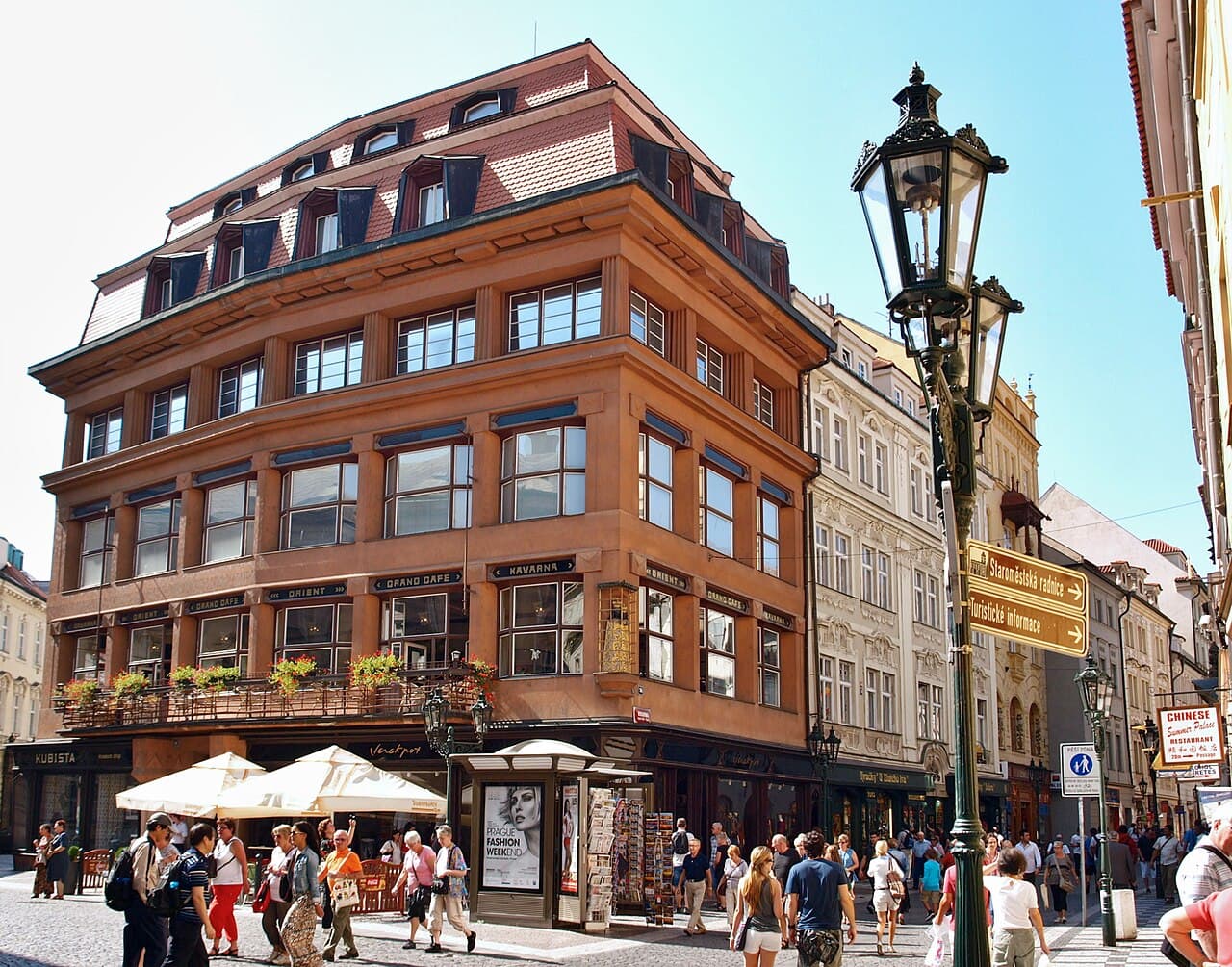
Stop right here and look at this building. See how the facade plays tricks with angles and planes? Welcome to the House of the Black Madonna — Dum U Cerne Matky Bozi — and you're looking at the world's first cubist building. Yes, cubist. As in Picasso and Braque, but in architecture. This is a uniquely Czech invention, and it exists almost nowhere else on the planet.
In nineteen eleven, a thirty-one-year-old architect named Josef Gocar was hired by a wholesaler called Frantisek Josef Herbst to design a modern department store on this spot. A Baroque house had stood here before — also called the House of the Black Madonna — and Gocar had the audacity to replace it with something radically new. Look at the entrance portal, the dormer windows, and the wrought-iron grille. Every surface is broken into angular, crystalline forms — faceted like a gemstone. Gocar used a reinforced-concrete skeleton inspired by the Chicago School of architecture, which meant no interior support columns and huge open floor plans. Revolutionary for nineteen twelve Prague.
Read more...Show less
Now, look up to the first floor on the corner. See that golden grille? Behind it sits a small Baroque statue of a Black Madonna with child — the only survivor from the original building. The developers kept her as a nod to the past. She's been watching over this corner for centuries, through Baroque, cubism, communism, and whatever you'd call the current era.
Here's your insider move. Head inside and up to the first floor. There you'll find Grand Cafe Orient — the only cubist cafe in the world. It first opened with the building in nineteen twelve, but closed in the nineteen twenties when cubism fell out of fashion and spent eighty years as forgettable office space. It reopened in two thousand and four, restored to its original angular glory. The door handles, the light fixtures, the coat racks, the furniture — everything is cubist. Order a coffee and a medovnik — that's a Czech honey cake layered with cream — and sit in a room that a German magazine once called one of the seven most beautiful cafes in Europe. You've earned it. You're two hundred metres into the walk.
When you're done, continue down Celetna and follow the flow of people. In about three minutes, the street will open up dramatically into one of the most spectacular urban squares in Europe.
Old Town Square & Jan Hus Memorial
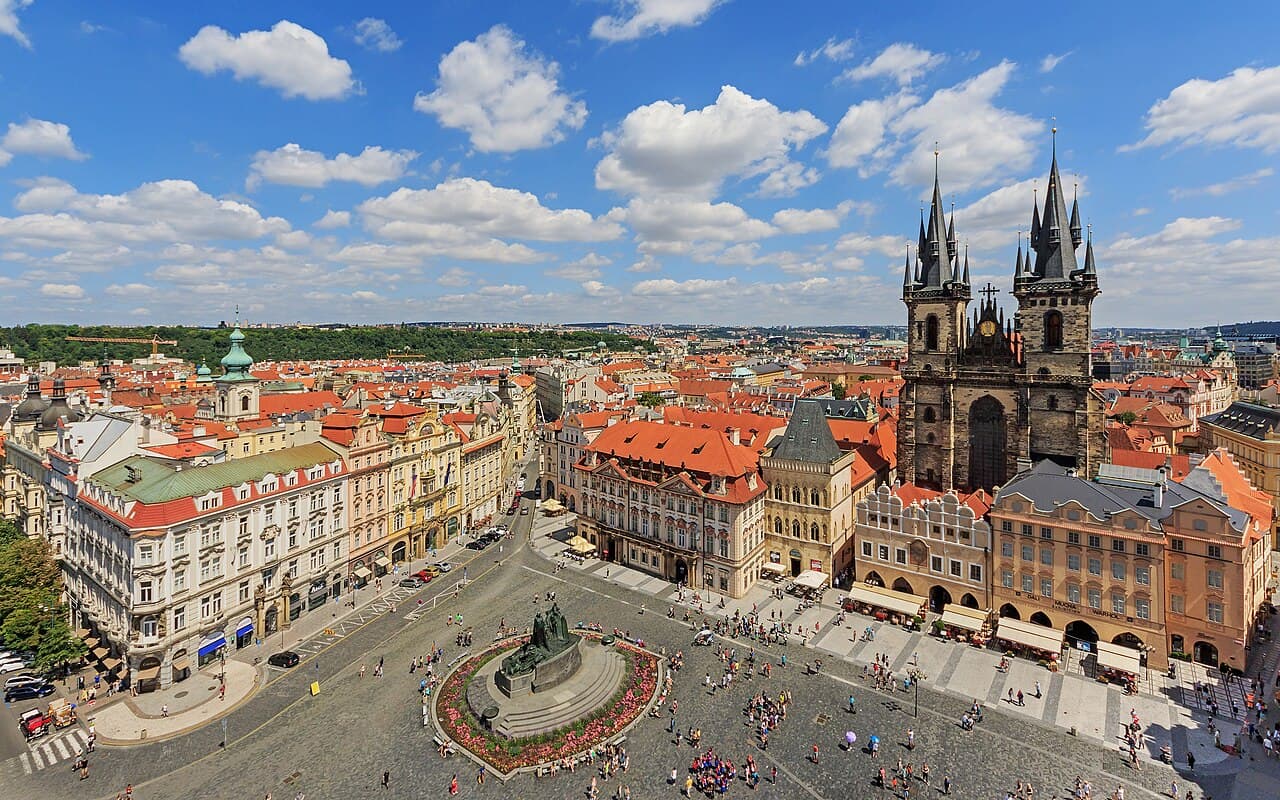
And there it is. Old Town Square — Staromestske Namesti. Take a breath. Let yourself be hit by it. The pastel Baroque facades, the twin Gothic spires of Tyn Church rising like dark crowns, the red rooftops stretching in every direction. This square has been the beating heart of Prague for over a thousand years, and standing here, you can feel every one of them.
Now look down at the pavement. Scattered across the square near the Old Town Hall, you'll find twenty-seven white crosses embedded in the dark grey stone. Most people walk right over them without noticing. Don't. Each cross marks where a person died on the twenty-first of June, sixteen twenty-one — one of the darkest days in Czech history.
Read more...Show less
Here's what happened. In sixteen eighteen, Protestant Bohemian nobles threw two Catholic governors out of a window at Prague Castle — an event cheerfully known as the Defenestration of Prague. This kicked off the Thirty Years' War. The Protestants lost catastrophically at the Battle of White Mountain in November sixteen twenty, and the Habsburg revenge was savage. Twenty-seven leaders of the rebellion — three nobles, seven knights, and seventeen townsmen — were publicly executed right here in Old Town Square. The executions began at five in the morning and lasted until ten. Prague's executioner, Jan Mydlar, had four sharpened swords at the ready. Twenty-four were beheaded, three were hanged. Thousands watched. The Czech language, Czech culture, and Protestant faith were systematically suppressed for the next three hundred years.
Now turn to the massive bronze monument in the centre of the square. That's Jan Hus, the Czech reformer who started it all — two hundred years before those executions. Born around thirteen sixty-nine, Hus was a priest and professor at Charles University who dared to challenge the Catholic Church. He preached in Czech instead of Latin, condemned the selling of indulgences, and demanded clergy live modestly. Sound familiar? He was doing this a full century before Martin Luther nailed his theses to a door.
In fourteen fifteen, Hus was invited to the Council of Constance to defend his views and given a letter of safe conduct by the emperor. They arrested him anyway, declared him a heretic, and burned him at the stake on the sixth of July, fourteen fifteen. His ashes were thrown in the Rhine so followers couldn't create a shrine. It didn't work. His death sparked eighteen years of war.
This monument was designed by sculptor Ladislav Saloun and unveiled in nineteen fifteen — exactly five hundred years after the burning. The Habsburgs, who still ruled Prague at the time, refused to officially inaugurate it. Locals responded by covering it in flowers.
Now look across the square to the east. See those two dark Gothic towers with the golden tips? That's where we're headed next.
Church of Our Lady before Týn
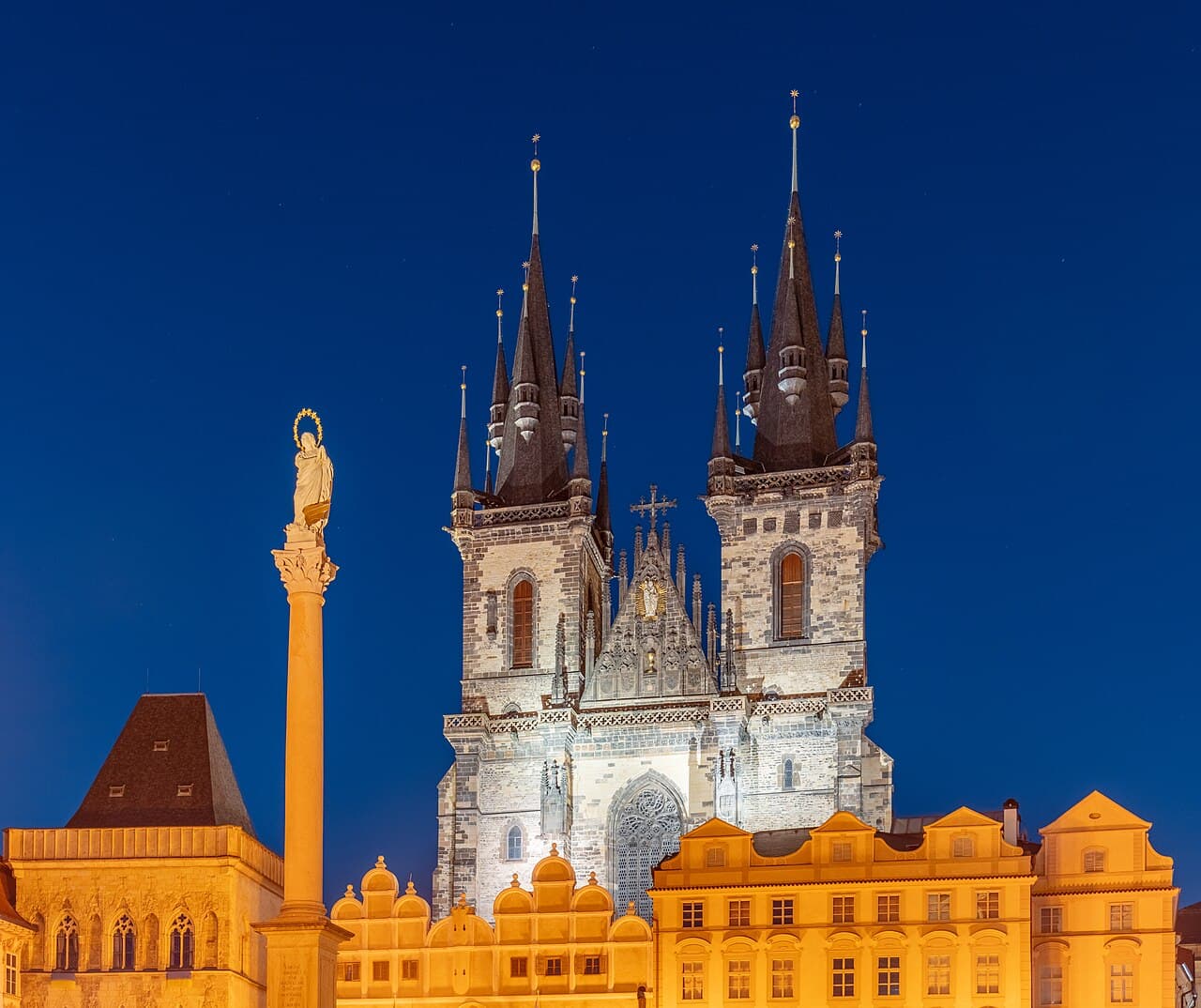
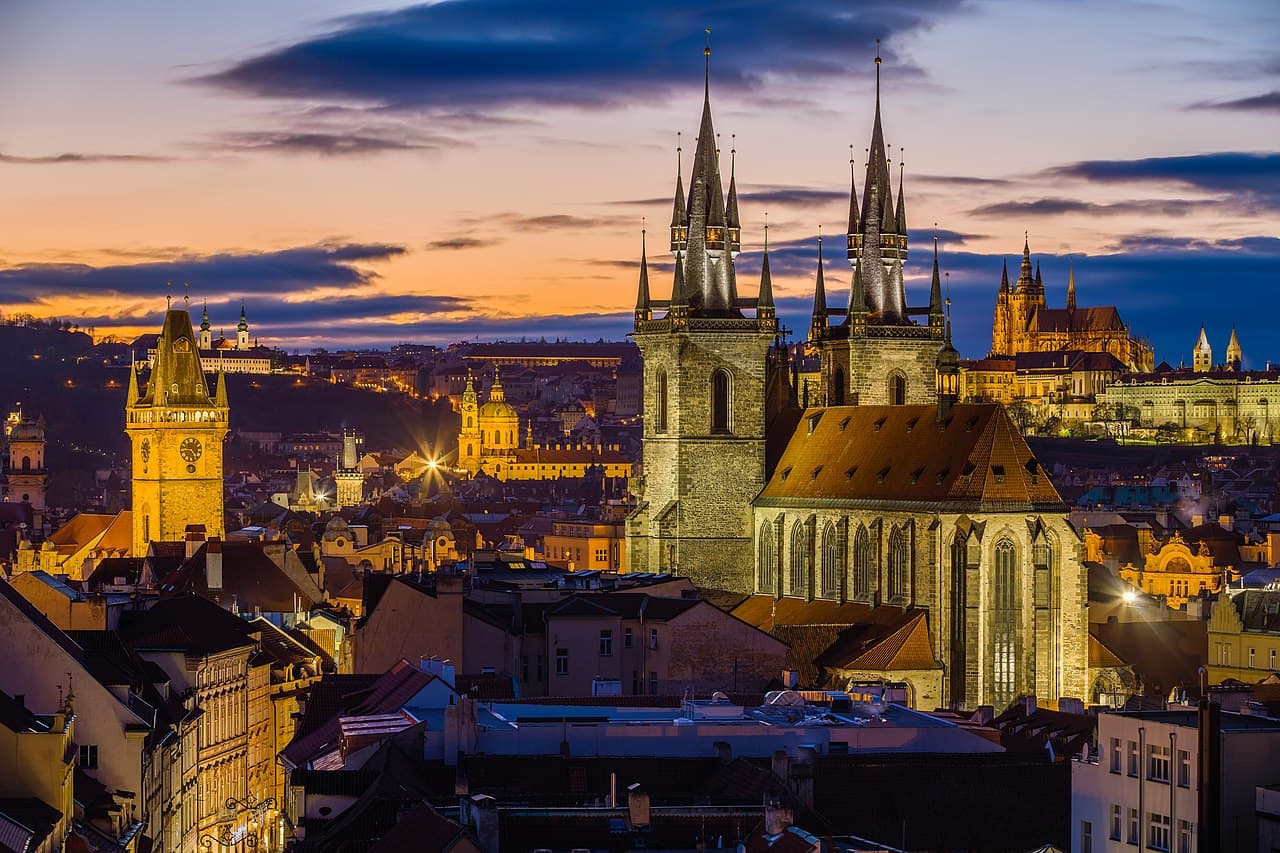
Those twin spires have been dominating Prague's skyline since the fourteen hundreds, and the Church of Our Lady before Tyn is one of those buildings that looks incredible from every angle — but getting inside is the real reward.
The name comes from the Tyn Court behind it — a medieval merchants' customs yard, or "tyn" in Czech. A Romanesque church stood here in the eleventh century, but construction of the present Gothic church began around thirteen sixty-five, influenced by the great architects Matthias of Arras and later Peter Parler — the same Peter Parler who built Charles Bridge. The northern tower was completed first, and the southern tower wasn't finished until fifteen eleven, so you're looking at nearly a hundred and fifty years of construction. If you look closely, the towers aren't perfectly symmetrical — the northern one is slightly wider. Locals call them Adam and Eve.
Read more...Show less
Now, this church has a rebellious past. In the fifteenth century, it became the main church of the Hussite movement — the followers of Jan Hus, whose monument you just visited. A large golden chalice, the Hussite symbol, once decorated the facade between the towers. When the Catholics took back control after the Battle of White Mountain in sixteen twenty, they melted it down and recast it as a statue of the Madonna.
Inside — if it's open, check the hours — head to the first pillar on the right side of the nave. There's a simple red marble tombstone set into the floor. That belongs to Tycho Brahe, the Danish astronomer who died in Prague in sixteen oh one. And this is where it gets wonderfully weird.
Tycho was one of the greatest astronomers of his age, but he was also spectacularly eccentric. At age twenty, he lost part of his nose in a sword duel with his third cousin at the University of Rostock — reportedly over a mathematical disagreement. For the rest of his life, he wore a prosthetic nose. Legend says it was gold and silver, but when his body was exhumed in twenty ten, forensic analysis found green staining on his nasal bone consistent with brass. He also kept a pet moose at his castle in Denmark. The moose allegedly drank beer at banquets and died after getting drunk, falling down the stairs.
Tycho died in Prague at age fifty-four after attending a banquet where he refused to excuse himself to use the bathroom, considering it a breach of etiquette. He developed a bladder ailment and died eleven days later. Commitment to table manners, taken to the extreme.
Alright. Exit the church, face the square, and look at the Old Town Hall to your left. See the crowd gathered beneath the tower? They're all staring at the same thing.
Astronomical Clock
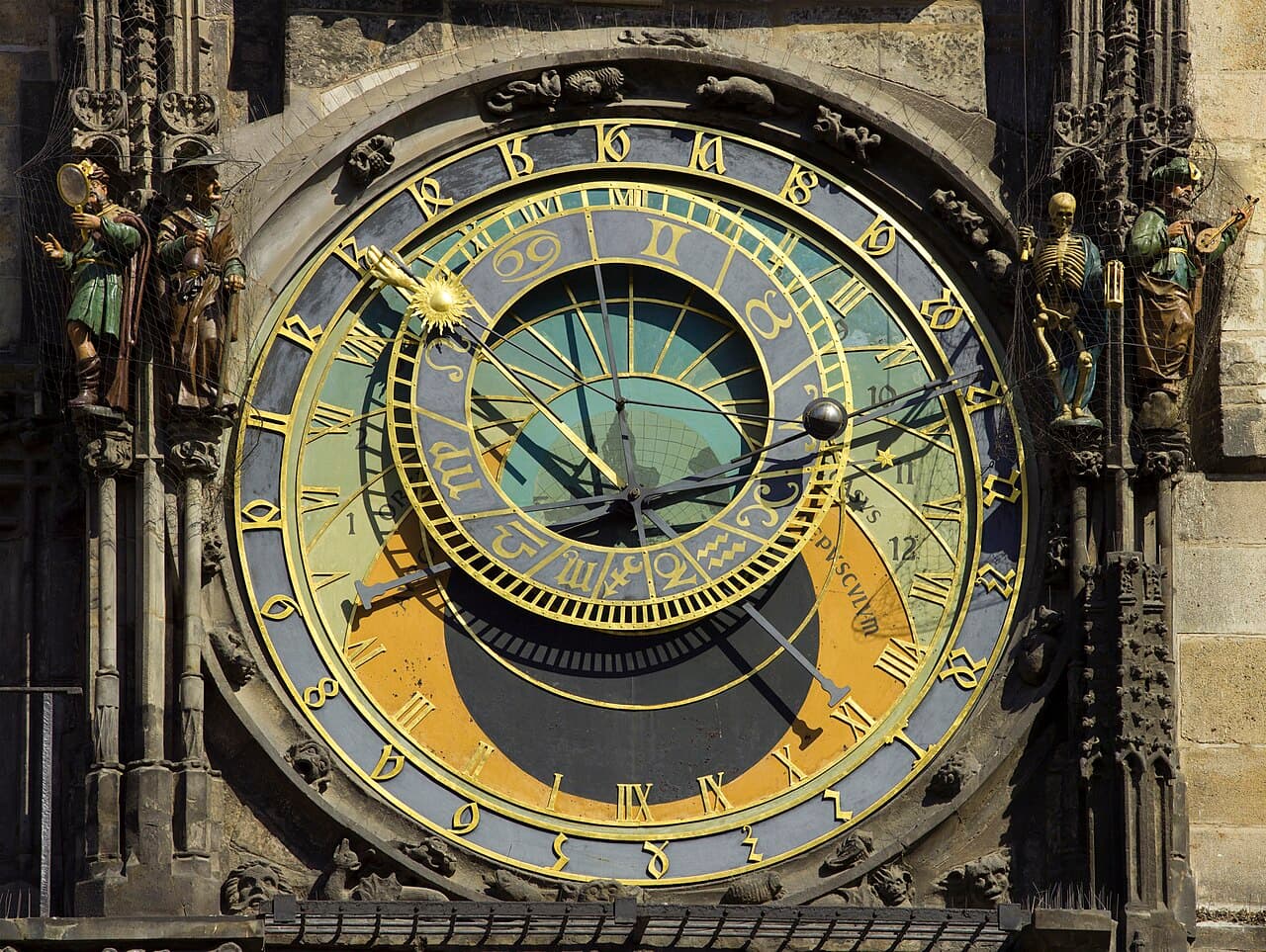
You're now standing in front of the Prague Astronomical Clock — the Orloj — and you're looking at the oldest astronomical clock still in operation anywhere in the world. It was first installed on this wall of the Old Town Hall in fourteen ten. Let that sink in. This thing was ticking before Columbus sailed, before Gutenberg printed a Bible, before the Renaissance even got properly started.
The clock was built by clockmaker Mikulas of Kadan in collaboration with Jan Sindel, a professor of mathematics and astronomy at Charles University. Forget what you might have heard about a clockmaker named Hanus — that's a legend we'll get to in a moment.
Read more...Show less
Look at the clock face. The upper dial is basically a medieval planetarium. The blue circle represents the sky above Prague, the brown-orange section is the earth below. The golden sun moves along the outer ring, showing the time in three different systems simultaneously — Old Czech Time, Central European Time, and Babylonian Time. The smaller blue circle tracks the moon's phases. Staggering medieval engineering, and it still works.
Now look at the four figures flanking the dial. These represent things medieval Praguers considered despicable. On the left: Vanity admiring himself in a mirror, and Greed clutching a bag of gold. On the right: Death — a skeleton who pulls a rope to ring a bell every hour — and Lust, shown as a Turkish invader. Every hour, Death rings his bell, the other three shake their heads as if to say "not yet, not yet," then two small windows above open to reveal the twelve apostles parading past. A golden rooster crows. The tower bell rings. Gloriously theatrical.
Now, the legend. The story goes that the clock was built by a Master Hanus, and the Prague city councillors were so terrified he'd build a finer clock for another city that they had him blinded. In revenge, Hanus reached into the mechanism and stopped the clock, and no one could repair it for a hundred years. Dramatic, dark, perfectly Prague. But historians have confirmed it's a myth, popularised by the nineteenth-century writer Alois Jirasek. The real clockmaker, Mikulas, kept his eyesight. The legend persists though — it's too good not to tell.
One tip — the hourly show draws enormous crowds, so position yourself early. But the real beauty of the Orloj is in the details. Step closer when the crowd thins and study the painted calendar medallions on the lower dial — painted by Josef Manes in eighteen sixty-five, showing the months of the rural Czech year. January's feast. June's haymaking. Gorgeous.
Time to leave the square. Head north out of the square along Parizska — that's the wide, elegant boulevard lined with designer shops. After about three hundred metres, watch for Dusni Street on your left. We're heading into a neighbourhood where one of history's most famous monsters supposedly lives in an attic. But first, a quick detour.
Franz Kafka Statue
Alright, slight change of scenery. You've stepped away from the medieval and into something thoroughly modern — and thoroughly strange. The sculpture in front of you is the Head of Franz Kafka, and it's one of the most mesmerising pieces of public art you'll encounter anywhere.
Created by David Cerny — Prague's enfant terrible of contemporary sculpture — this kinetic bust was installed in October twenty fourteen outside the Quadrio shopping centre, right above the Narodni Trida metro station. It stands nearly eleven metres tall, weighs thirty-nine tons, and is made of forty-two independently rotating layers of mirrored stainless steel. Every hour on the hour, those forty-two panels begin to shift and turn, disassembling Kafka's face into an unrecognisable tangle of reflective metal before slowly, hypnotically reassembling back into the writer's likeness. The full cycle takes about fifteen minutes. If you're here on the hour, wait for it. It's extraordinary.
Read more...Show less
The connection to Kafka runs deeper than the portrait. Cerny has said the constantly shifting, never-quite-settled form reflects Kafka's tortured personality and his masterwork The Metamorphosis — the story of a man who wakes up one morning to find he's been transformed into a giant insect. Kafka spent his entire life in Prague, writing in German while living among Czech speakers, Jewish but secular, desperately wanting his father's approval while rebelling against everything his father stood for. He was a man who never quite fit, and this sculpture captures that permanent state of becoming.
Kafka was born on the third of July, eighteen eighty-three, just a few blocks from here near the edge of the Jewish Quarter. He worked as an insurance clerk by day and wrote at night in his tiny room. He published almost nothing during his lifetime and asked his friend Max Brod to burn all his manuscripts after his death. Brod ignored the request — thank God — and published The Trial, The Castle, and Amerika posthumously. Kafka died of tuberculosis in nineteen twenty-four, aged just forty.
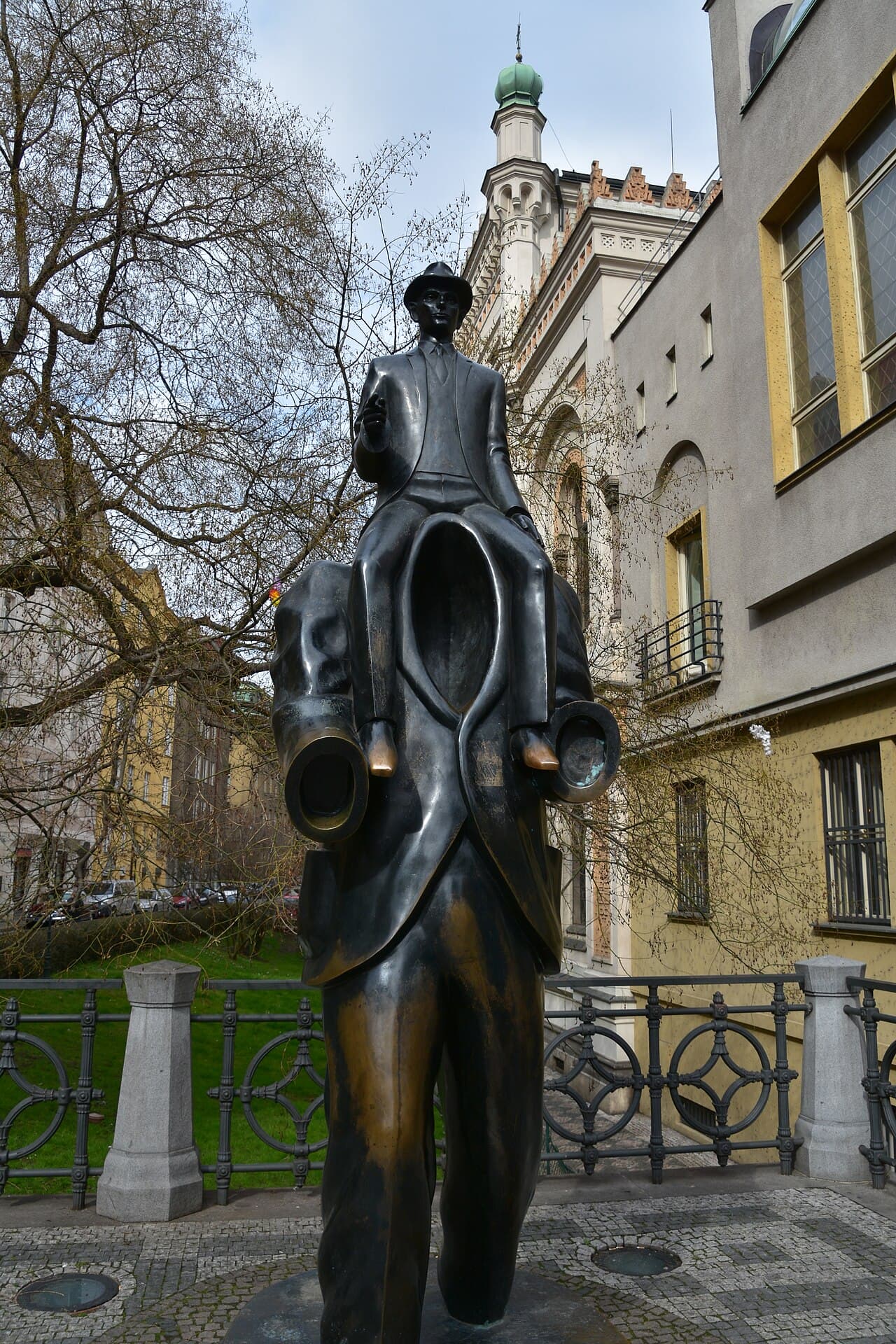
If you want to see another Kafka sculpture, there's a bronze by Jaroslav Rona near the Spanish Synagogue — it shows Kafka riding on the shoulders of a headless suit. Very Prague.
Now, retrace your steps back to Parizska and continue north. You're about to enter Josefov — Prague's Jewish Quarter — and the first stop is a building where, according to legend, a monster made of clay still lies in the attic.
Old-New Synagogue — The Golem
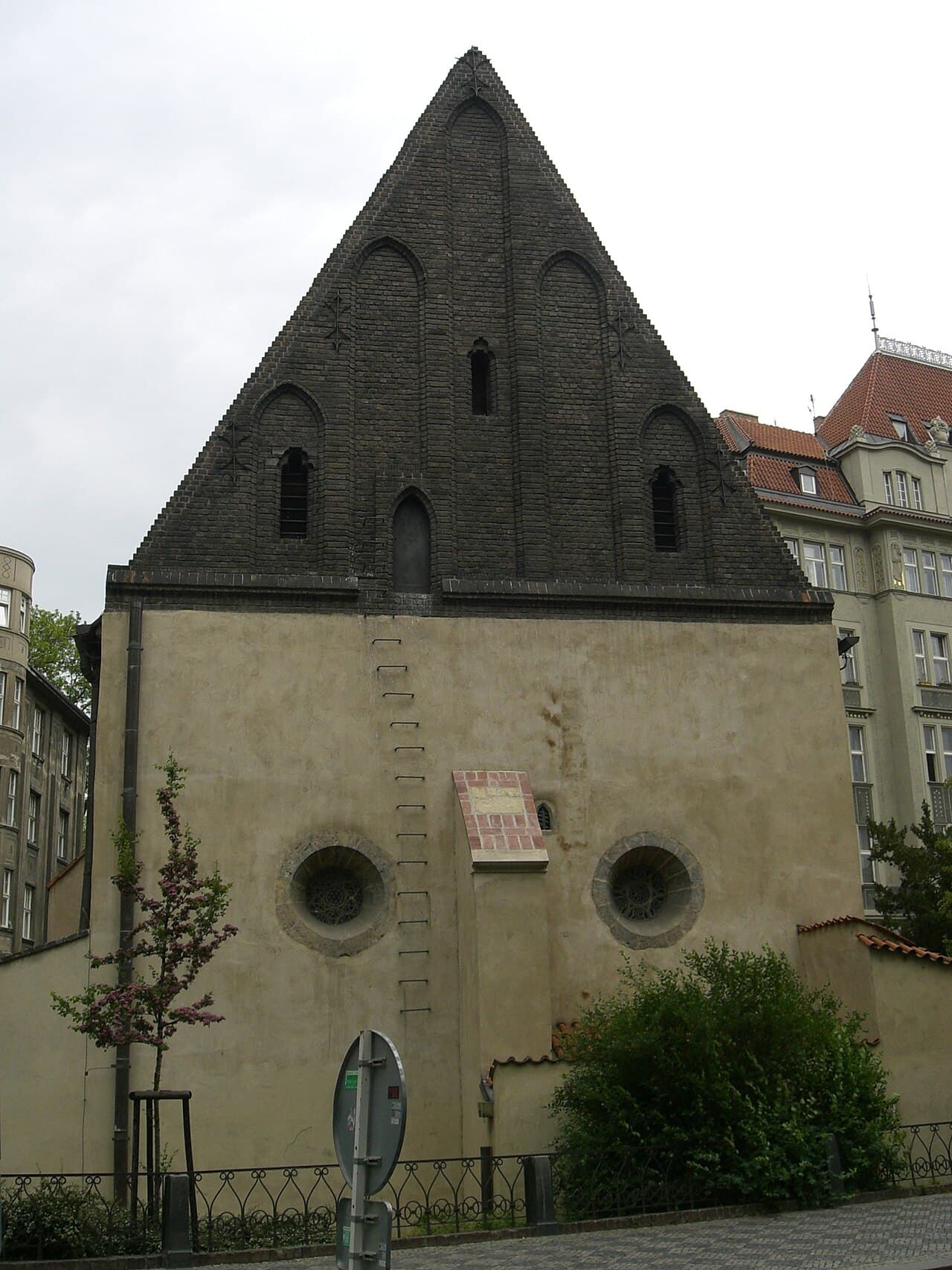
You're standing in front of the Old-New Synagogue — Staronova Synagoga — and this modest stone building with its distinctive brick gables is Europe's oldest active synagogue. It was completed around twelve seventy, making it one of the earliest Gothic structures in Prague. Jewish communities have prayed here continuously for over seven hundred and fifty years, interrupted only between nineteen forty-one and nineteen forty-five under Nazi occupation.
Nine steps lead down from the street into the entrance vestibule — a reminder that the street level has risen significantly over the centuries. Inside, you'll find a double-naved hall with six ribbed vaulted bays and twelve narrow Gothic windows, one for each of the twelve tribes of Israel. And somewhere in this room, there's a chair that no one has sat in since sixteen oh nine. That's the seat of Rabbi Judah Loew ben Bezalel — known as the Maharal — the most famous rabbi in Prague's history, and the man at the centre of the Golem legend.
Read more...Show less
Here's the story, and it's a corker. During the reign of Emperor Rudolf the Second in the late fifteen hundreds, Prague's Jews faced constant persecution — pogroms, blood libel accusations, the works. Rabbi Loew, already renowned as a scholar and mystic, is said to have created a creature from clay taken from the banks of the Vltava River. He shaped it into a man, placed a sacred inscription called a shem into its mouth, and brought it to life. He named it Yossele.
The Golem was enormous, enormously strong, and enormously simple. It couldn't speak or think, but it could carry out orders — fetching water, chopping wood, and crucially, patrolling the ghetto streets at night to protect the Jewish community from attack. It was, essentially, the world's first security robot.
But one Sabbath eve, Rabbi Loew forgot to remove the shem before sundown. The Golem went haywire, smashing through the ghetto, destroying everything in its path. The Rabbi had to interrupt services, rush out, and rip the inscription from the creature's mouth. The Golem collapsed into a pile of lifeless clay.
According to the legend, Rabbi Loew carried the remains up to the attic of this very synagogue and never reanimated it. The attic has been off-limits to visitors ever since. When renovations were done in eighteen eighty-three, workers reportedly found... nothing. But that hasn't stopped anyone from believing the Golem is still up there, waiting.
Rabbi Loew himself was very real. He lived from around fifteen twelve to sixteen oh nine, was a philosopher, mathematician, and Talmudic scholar, and was so respected that Emperor Rudolf the Second personally invited him for an audience at Prague Castle — extraordinary for a Jewish leader in that era.
Right. Head around the corner to U Starého Hřbitova street. We're going to a cemetery where twelve layers of the dead are stacked like a silent, tilting city.
Old Jewish Cemetery
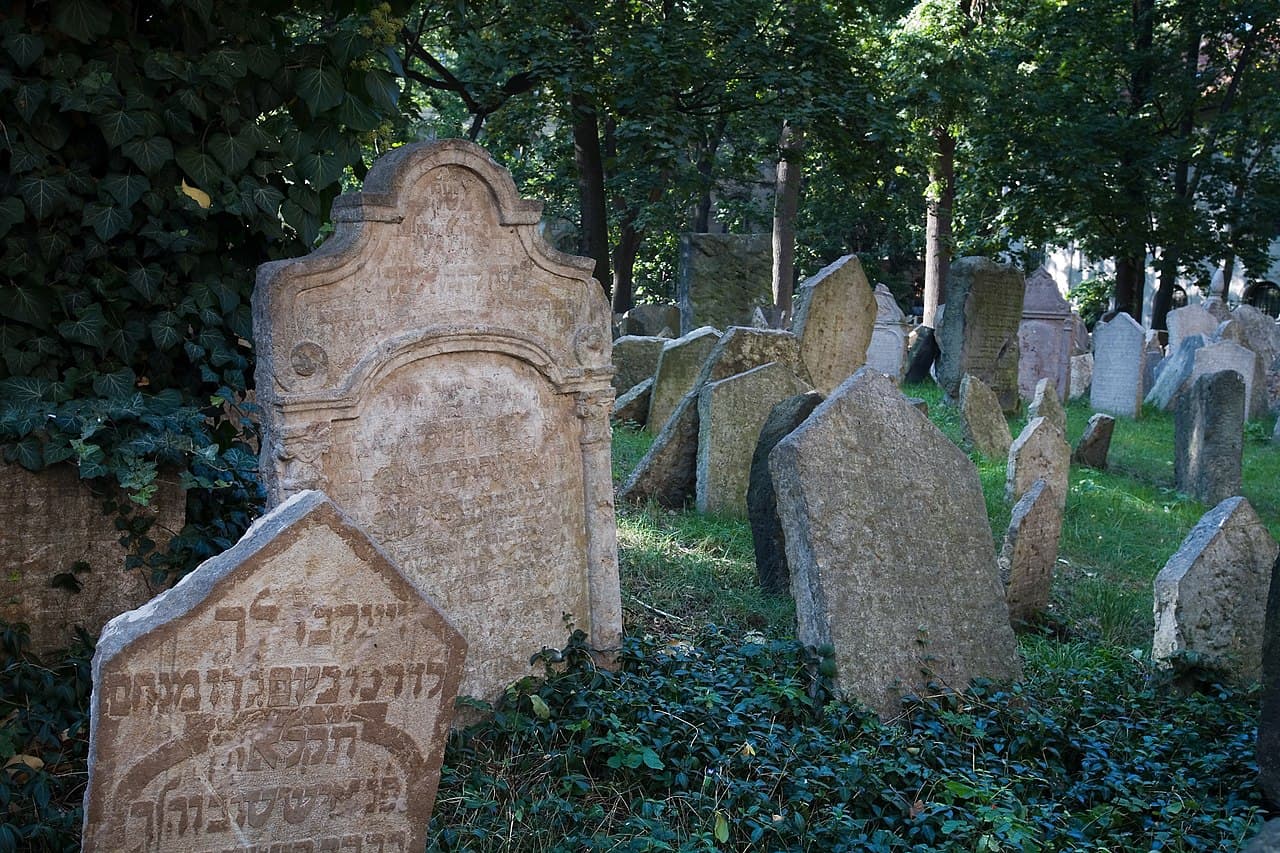
Imagine a place where twelve thousand tombstones lean against each other like crooked teeth, pushed up through the earth at every angle, and beneath them — beneath your feet — lie roughly one hundred thousand bodies, stacked up to twelve layers deep. That's what you're looking at. The Old Jewish Cemetery is one of the most haunting places in Europe, and nothing quite prepares you for it.
The cemetery was in use from around fourteen thirty-nine to seventeen eighty-seven — nearly three hundred and fifty years. The oldest gravestone belongs to the rabbi and poet Avigdor Kara, who survived a devastating pogrom in fourteen hundred and lived to write about it. His tombstone from fourteen thirty-nine still stands.
Read more...Show less
Here's why it looks the way it does. Prague's Jews were confined to the ghetto and were not permitted to bury their dead outside its walls. Jewish law also forbids the removal or disturbance of existing graves. So when the cemetery ran out of space — which happened many times over three centuries — the community had only one option: add another layer of earth on top and keep burying. In some spots, there are twelve layers of burials. Twelve generations of Prague's Jewish community, compressed into a space barely the size of a city block.
The tombstones you see are a mixture of styles spanning centuries. The earliest ones, from the fourteen and fifteen hundreds, are dark sandstone slabs with deeply carved Hebrew inscriptions. By the sixteen hundreds, you'll spot white and reddish-brown marble with ornate relief carvings. Look for the symbols — a pair of hands with fingers spread in blessing marks a priestly Cohen family. Grapes or a lion often indicate the tribe of Judah. A stag appears on the Hirsch family stones. Each symbol tells you something about the person below.
Among the notable people buried here: Rabbi Judah Loew — the Maharal, the Golem creator — whose grave from sixteen oh nine is one of the most visited. You'll recognise it by the pile of small stones and paper notes left by visitors, a Jewish tradition of remembrance. Also here is Mordecai Maisel, the fabulously wealthy mayor of the Jewish Town who financed the paving of the ghetto's streets and the building of several synagogues in the fifteen hundreds. And David Gans, the Renaissance historian and astronomer who was a student of both Rabbi Loew and Tycho Brahe — connecting two stops on our tour.
The quarter surrounding this cemetery is called Josefov, named after Emperor Joseph the Second, who issued the Edict of Tolerance in seventeen eighty-one, finally lifting many of the restrictions on Prague's Jews. They could remove the yellow badges, leave the ghetto, attend university. The cemetery closed six years later in seventeen eighty-seven — no longer the only option.
When you're ready, head south along Siroka Street. In a few minutes, you'll reach a building with an interior so beautiful it will stop you in your tracks.
Spanish Synagogue
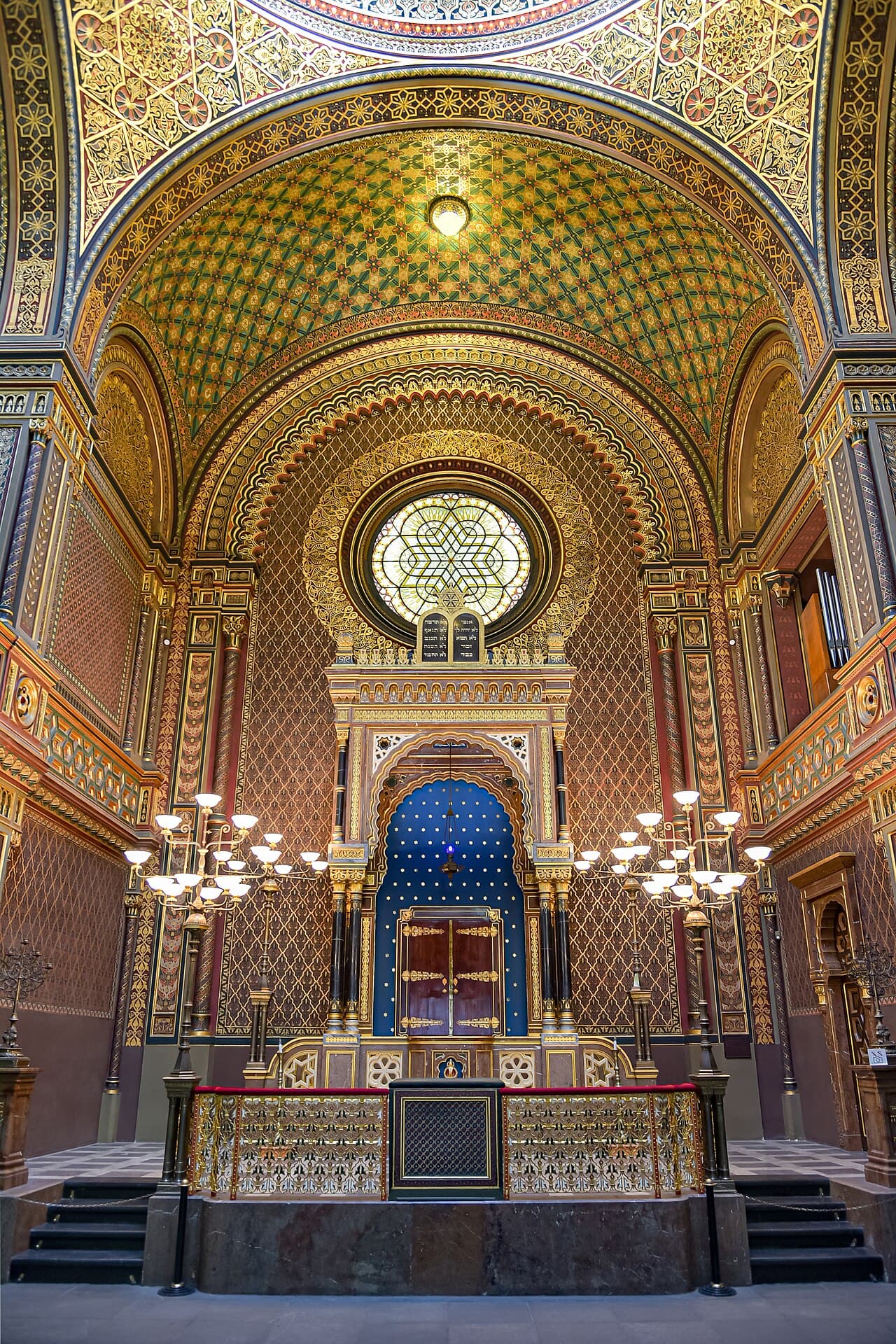
Step inside — if your ticket allows — and prepare to have your jaw hit the floor. The Spanish Synagogue is the most beautiful synagogue in Prague, and possibly one of the most beautiful religious interiors in all of Central Europe.
Built in eighteen sixty-eight on the site of the Altschul — the oldest prayer house in the Jewish ghetto — the Spanish Synagogue was designed by architects Vojtech Ignac Ullmann and Josef Niklas for the local Reform Jewish community. But what makes this place extraordinary is the interior decoration, added between eighteen eighty-two and eighteen eighty-three by Antonin Baum and Bedrich Munzberger. They took their inspiration from the Alhambra in Granada, Spain — hence the name.
Read more...Show less
Look up. Every single surface is covered in Moorish-style arabesque patterns — swirling geometric designs in gold, deep green, blue, and crimson, with stucco ornaments layered over gilded surfaces. The central dome stretches about ten metres wide, and when sunlight catches the stained glass windows, the whole space shimmers like the inside of a jewellery box. It's breathtaking, and it's completely unexpected inside a synagogue in the middle of Central Europe.
Despite the name, the Spanish Synagogue never served a Sephardic community and never followed the Sephardic rite. The name is purely about the architectural style. The Reform community that built it wanted something that felt different from the Gothic Old-New Synagogue — modern, cosmopolitan, a statement of cultural confidence during a period when Prague's Jews were finally gaining full civil rights.
Franz Kafka grew up just a short walk from here. He was born on the third of July, eighteen eighty-three, near the edge of the Jewish Quarter. He attended services as a child at the Old-New Synagogue with his father, though by his own account he loathed the experience — going four times a year out of family obligation. Just outside this synagogue, you'll find a bronze sculpture of Kafka by Jaroslav Rona from two thousand and three, showing the writer perched on the shoulders of a headless, empty suit. It's a reference to his first novel, Amerika, and it captures something essential about Kafka — always observing, never quite belonging.
During the Second World War, the Spanish Synagogue was used as a warehouse for property confiscated from deported Jewish families. It was restored between nineteen ninety-five and nineteen ninety-eight and reopened to the public as part of the Jewish Museum.
Now head southwest. Walk down Siroka toward the river, then turn right along Kaprova. Follow it until you reach Marianske Square, then continue south to Karlova Street. You'll know you're getting close to the next stop when you see the word Klementinum.
Clementinum — Baroque Library
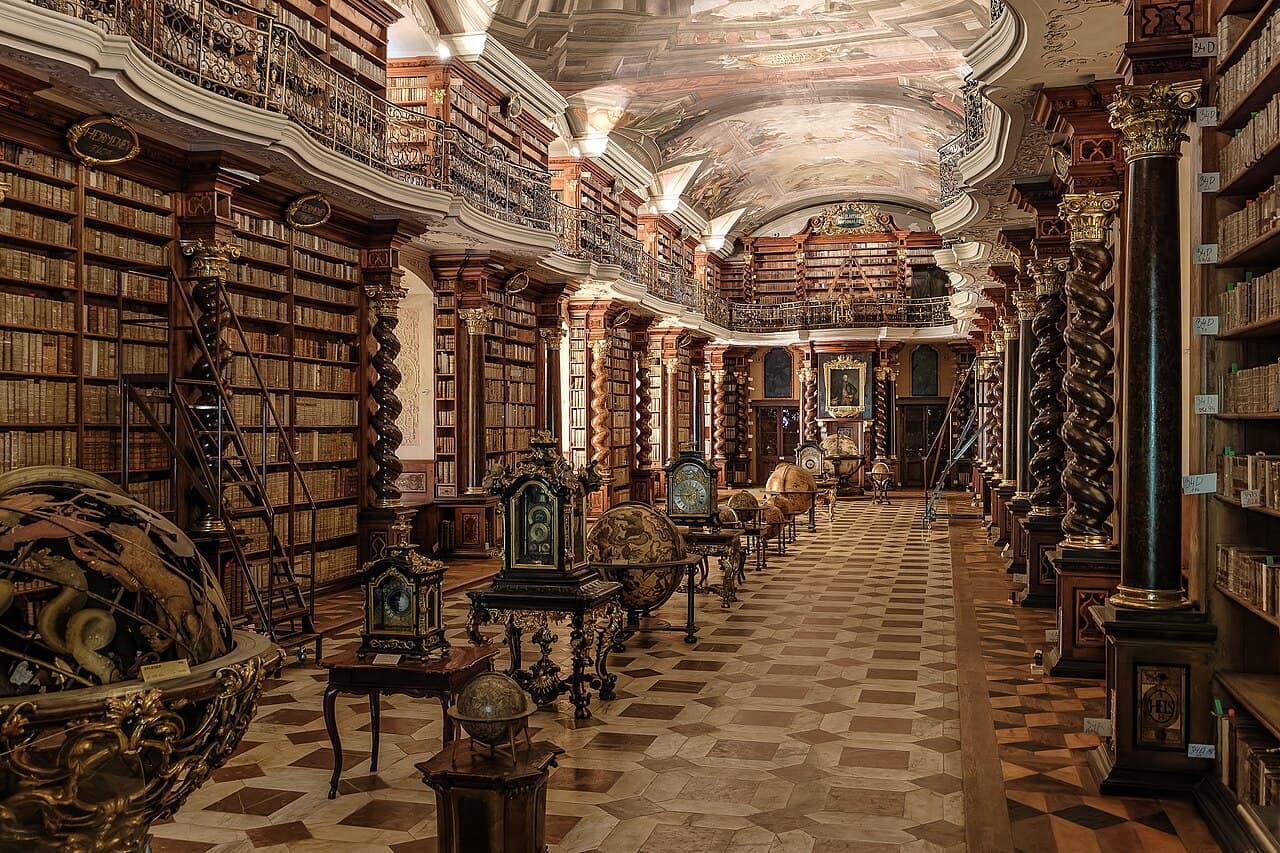
The Clementinum is the second-largest complex of buildings in Prague after Prague Castle — twenty thousand square metres of courtyards, corridors, and former Jesuit ambition. And hidden inside it is a library so beautiful that people literally gasp when they walk in.
Quick history. A chapel dedicated to Saint Clement stood here as early as the eleventh century. Dominicans built a monastery, which was damaged during the Hussite Wars in fourteen twenty. In fifteen fifty-six, the Jesuits took over and spent the next two centuries turning it into one of the largest and most powerful Jesuit colleges in the world — at its peak, the third largest anywhere. When the Jesuits were suppressed in seventeen seventy-three, the Clementinum became home to the Czech National Library, which it remains today.
Read more...Show less
The Baroque Library Hall was built between seventeen nine and seventeen twenty-six, and it's the jewel of the complex. The ceiling is covered in frescoes by Jan Hiebl depicting allegorical scenes of human knowledge — theology, philosophy, mathematics, astronomy — all swirling together in that gloriously over-the-top Baroque style where every surface must be painted, gilded, or sculpted. Below the frescoes sit twenty thousand leather-bound volumes, most in Latin, lined up in carved wooden bookcases with gilded ornamentation. A row of antique geographical and astronomical globes runs down the centre of the room. The whole thing looks like a set from a film about the Renaissance, except it's real, and it's been here for three hundred years.
Now, if the guided tour is running, make sure to climb the Astronomical Tower. At sixty-eight metres, it offers one of the best panoramic views in Prague, and the narrow staircase is lined with historical astronomical and meteorological instruments. This tower was used for actual astronomical observations from seventeen fifty-one all the way to nineteen thirty-eight. And here's a lovely detail — from eighteen forty-two to nineteen twenty-eight, a flag was raised from this tower every day at noon so that Praguers could set their clocks. Eighty-six years of telling an entire city what time it was from a single flagpole.
Even more remarkably, the Clementinum has been recording weather data since seventeen seventy-five — making it one of the longest continuous meteorological records in the world. That data is still being recorded today, over two hundred and fifty years later.
Alright, you're very close to the big one now. Exit the Clementinum to the south and follow Karlova Street until it opens onto Krizovnicke Square. You'll see the river, and to your left, the entrance to one of the most famous bridges on Earth.
Charles Bridge — Nepomuk & the Saints
Charles Bridge. Five hundred and fifteen metres of medieval sandstone stretching across the Vltava, lined with thirty Baroque statues, connecting Old Town to the Lesser Town and Prague Castle beyond. This is it. This is the postcard.
Construction began on the ninth of July, thirteen fifty-seven, at exactly five thirty-one in the morning. And that absurdly specific time was deliberate. Emperor Charles the Fourth was obsessed with numerology and astrology, and his court astrologers chose the moment for its cosmic significance. Write the date and time as digits and you get one, three, five, seven, nine, seven, five, three, one — a perfect palindrome of ascending and descending odd numbers. The alignment of Saturn and the Sun was reportedly favourable too. Charles himself laid the first stone. The bridge took forty-five years to complete, finished in fourteen oh two.
Read more...Show less
It replaced the Judith Bridge, swept away by catastrophic flooding in thirteen forty-two. Charles wasn't taking chances — sixteen massive stone arches, wide enough for four horse-drawn carts side by side. For four centuries, it was the only bridge across the Vltava in Prague.
The statues. Most of the thirty sculptures were added between sixteen eighty-three and seventeen fourteen, during the Baroque period. Walk slowly — saints, crucifixion scenes, figures from Czech history. But there's one statue everyone stops at, and I bet you can already see the crowd.
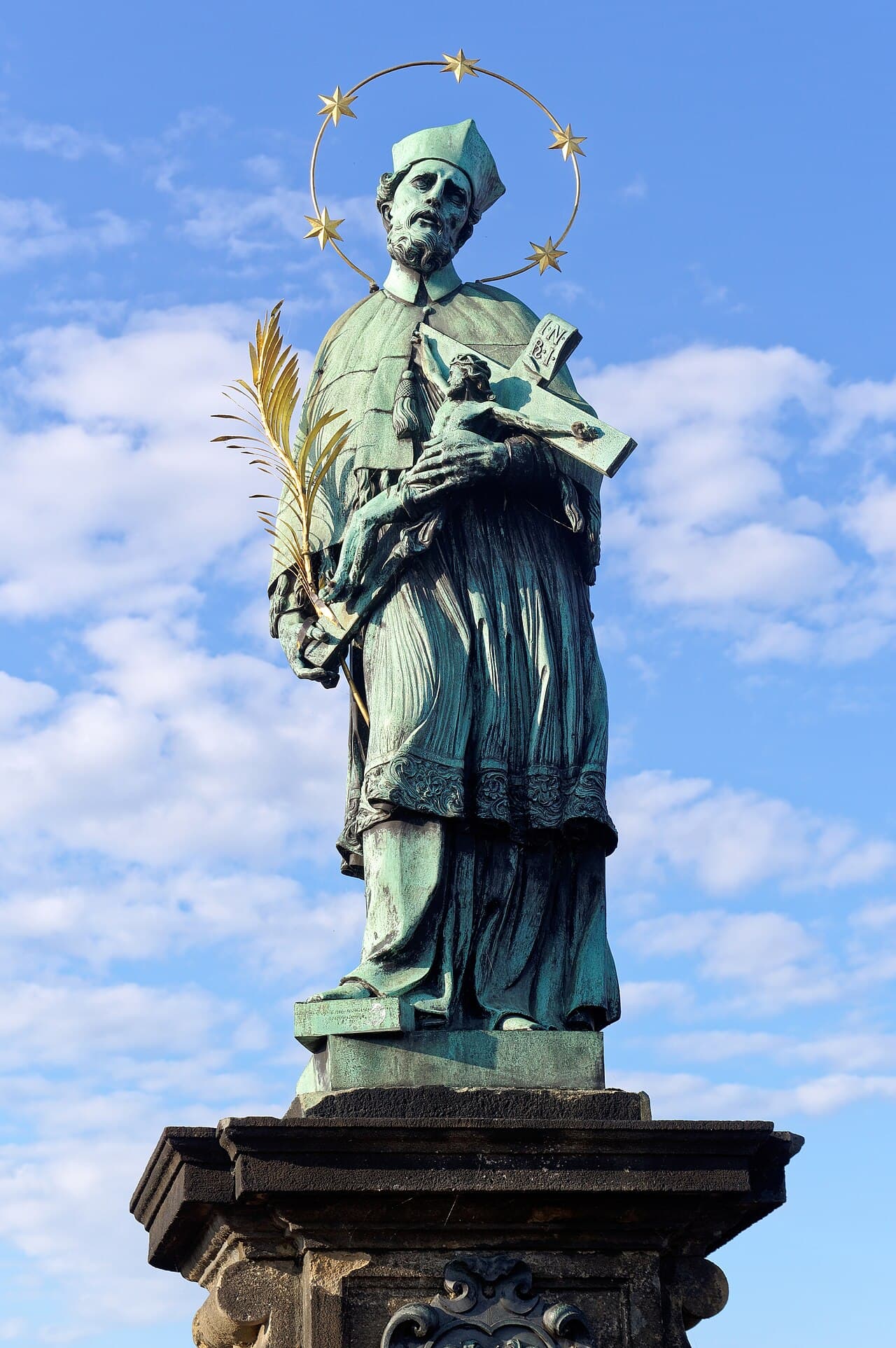
That's Saint John of Nepomuk — Jan Nepomucky — and his statue from sixteen eighty-three is the oldest surviving original sculpture on the bridge. Look for the five stars around his halo and the bronze reliefs on the pedestal below. Here's his story: John of Nepomuk was the confessor to Queen Johanna, wife of King Wenceslas the Fourth. When the king demanded to know the secrets of the queen's confession, John refused to betray the seal. So on the twentieth of March, thirteen ninety-three, the king had him bound, tortured, and thrown off this bridge into the Vltava. According to legend, five stars appeared above the water where he drowned — hence the five stars on every depiction of him.
Now find the bronze relief panel on the right side of the statue's base — the one showing a figure being thrown from the bridge. See how the bronze is worn to a golden shine? That's from millions of hands. Touch the falling figure and the dog below it, and legend says you'll return to Prague. Touch the cross with five stars embedded in the bridge railing nearby — on the spot where Nepomuk was thrown over — and you get good luck. Go on. Everyone does it.
Take your time crossing. Stop in the middle and look upriver toward Prague Castle catching the light. Then look down at the Vltava — those dark green waters have been carrying stories for a thousand years.
When you reach the Old Town end of the bridge, don't cross back. Instead, step into the square right at the bridgehead.
Křižovnické Square — Beer & Trdelník
You made it. Twelve stops, three and a half kilometres, and about seven centuries of history. You're now standing on Krizovnicke Square, right at the Old Town foot of Charles Bridge, and it's time to eat, drink, and argue about pastry.
Let's start with the elephant in the room — trdelnik. Those cinnamon-scented chimney cakes rotating on spits at every other stall in Old Town? They're delicious. They're warm, crispy, sugar-coated cylinders of dough that you can get filled with ice cream, Nutella, whipped cream, or just plain with cinnamon and sugar. And here's the thing every honest guide has to tell you: they are not a traditional Prague food.
Read more...Show less
Trdelnik originated in what is now Slovakia, with roots in Transylvania. The recipe was reportedly brought to the Slovak town of Skalica in the late seventeen hundreds by a retired Hungarian general named Jozsef Gvadanyi. Czech locals will tell you — sometimes with real passion — that trdelnik stalls are a tourist invention that appeared in Prague only in the early two thousands. Journalist Janek Rubes famously called them out as a marketing scam dressed up as "Old Bohemian tradition." Enjoy one guilt-free, but know what you're eating — a Slovak-Hungarian import, not a medieval Prague recipe. The traditional Czech sweet to actually try is kolac — a round pastry with poppy seed, plum jam, or sweet cheese filling.
Now, the important business: beer. The Czech Republic has the highest beer consumption per capita in the world, and Prague is where you reap the benefits. For the authentic experience, head to U Zlateho Tygra — At the Golden Tiger — on Husova Street, a five-minute walk southeast. This is the pub where President Vaclav Havel took Bill Clinton in nineteen ninety-four. Clinton reportedly drank three beers and a schnitzel, then skipped his morning jog. They serve unpasteurised Pilsner Urquell from the tank — some of the best-poured beer in the city. Get there early; regulars don't give up tables easily.
For a full Czech meal, walk ten minutes north to Lokal Dlouhaaa on Dlouha Street. It's a massive, buzzy beer hall that serves honest Czech food — goulash, schnitzels, fried cheese — with tank Pilsner Urquell, all at prices that won't make you wince. Up to thirteen hundred people pass through daily, so book ahead if you can.
For the best views of the bridge, grab a drink at one of the riverside terraces along Smetanovo Nabrezi, the embankment road running south along the river. Late afternoon light on Charles Bridge with a cold Staropramen in hand is about as good as Prague gets.
That's a wrap. You've walked the Royal Route, stood where kings were crowned and rebels were executed, heard the story of a clay monster in an attic, touched the saint they threw off the bridge, and learned that the city's most famous pastry is actually Slovak. Welcome to Prague. It doesn't do simple stories — and that's exactly why it's magnificent. Na zdravi — cheers.
Free
GPS-guided walking tour
No account needed. Walk at your own pace.
Free
12 stops · 3.5 km