15 stops
GPS-guided
63 min
Duration
Free
No tickets
About this tour
A 15-stop walking tour through the heart of France. Visit Champs-Élysées Walk, Approaching the Arc de Triomphe, Exploring the Base of the Arc, and Climbing the Arc de Triomphe — with narrated stories at every stop.
15 stops on this tour
Champs-Élysées Walk
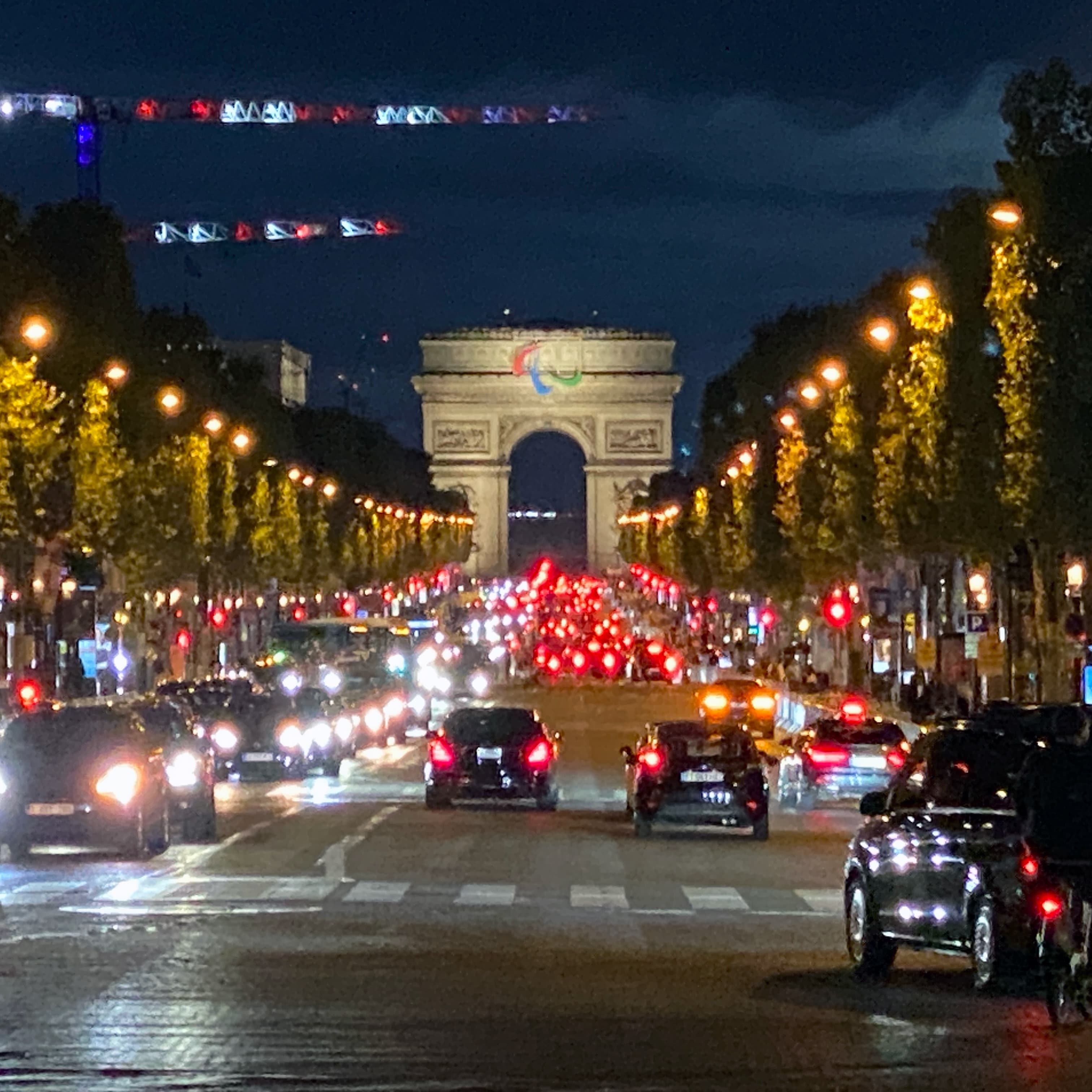
The Champs-Élysées Walk. The whole world seems to gather on Avenue des Champs-Élysées to strut down Europe's Grand Boulevard. This is Paris with its best face on, showing off the city of light to the rest of the world. Hey, I'm Rick Steves.
Thanks for joining me on this one-hour walk along Paris' most famous street. We'll start at the top with the monumental Arc de Triomphe. Then we'll stroll downhill, browsing stylish shops and dipping into elegant cafes while rubbing shoulders with proud Parisians on parade. Along the way, we'll see the many layers of Paris' illustrious past, from the days of Louis XIV to the Revolution to the Champs-Élysées' heyday during the Belle Époque of the late 1800s.
Read more...Show less
On this half-mile walk, we'll cover only the best stretch of the street, ending at the intersection called Ronde Pointe. This is a great walk by day or by night, though at night, don't count on every shop being open late. You'll have the option to buy a ticket and climb the Arc de Triomphe for a grand view. Or you can opt out, saving the time and money by just listening to my description of the view from the ground level.
Either way, this tour works great. Perhaps the best part of our tour is just seeing today's Paris, a global capital of high fashion, high cuisine, and the high-end. High life. To help us along the way, I've invited a good friend and virtual travel buddy.
Welcome, Lisa. Bonjour, Monsieur Rick. Lisa will give us helpful directions and sightseeing tips throughout the tour. And my first tip is to be sure to get our tour updates.
Just press the icon at the lower right of your device. You'll find any updates and helpful instructions unique to this tour, like closures, opening hours, and reservation requirements. There's also tips on how to use this audio tour and even the full printed script. Yes.
Pause for a moment right now to review our updates and special tips. It's okay. We'll wait. Now put on your cleanest shirt and get ready for an experience that's truly formidable. Paris' magnificent Champs-Élysées. Let the tour begin.
Tour Begins: Top of the Champs-Élysées
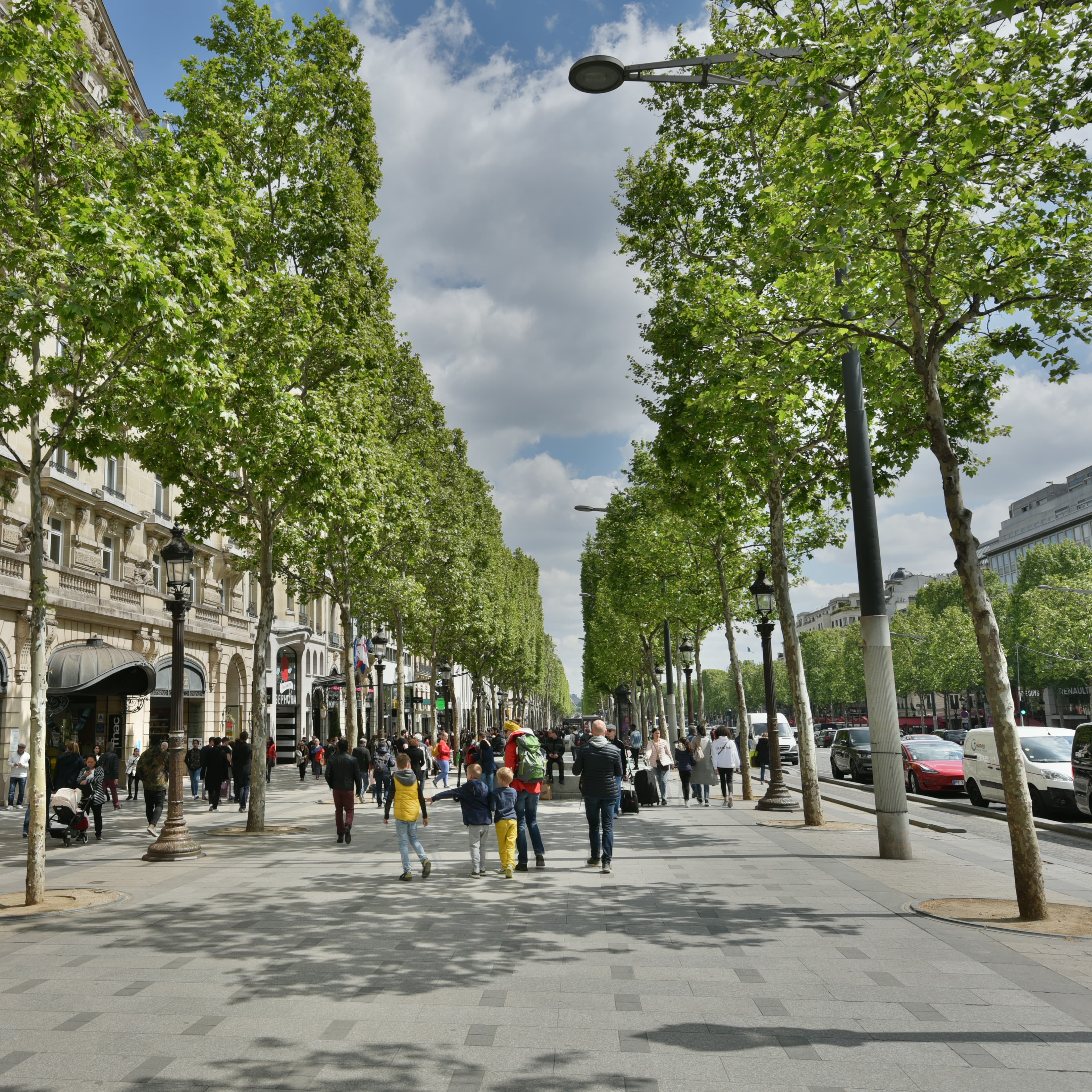
The tour begins at the top of the Champs-Élysées. We'll start at the top of the Champs-Élysées near the Arc de Triomphe at the metro stop Charles de Gaulle-Étoile. If you're arriving by metro, exit the Charles de Gaulle-Étoile metro station at the exit marked Sortie No. 1, Champs-Élysées, Arc de Triomphe.
You'll emerge on the sidewalk on the north side of the Champs-Élysées. You'll arrive on the north side of the Champs-Élysées with the Arc looming nearby and the boulevard stretched before you. Rick? Thanks, Lisa.
Read more...Show less
Start by taking in the scene. There's the massive Arc de Triomphe. Quite a sight in itself. There's the broad sidewalks, the elegant buildings, the cars, the people, and, of course, the long, tree-lined boulevard, the Champs-Élysées.
You're standing at the top of one of the world's grandest and most celebrated streets. The Champs-Élysées stretches over a mile from the Arc de Triomphe downhill to the vast square called the Place de la Concorde. The street is home to chic offices for big business, celebrity cafes, glitzy nightclubs, high-fashion shopping, and international people-watching. It's the place where today's French gather.
Every Bastille Day, the big national parade is held here. The Champs-Élysées is also the stage for spirited political protests with thousands of demonstrators. It's where the French celebrate World Cup soccer triumphs, the ends of wars, and, as we'll see in a bit, the finale of the Tour de France bike race. Feel the buzz.
The Champs-Élysées is the commercial heart of a city of more than 2 million. With the highest population density of any city in Europe, twice that of New York City, Paris has a powerful vibrancy day and night. And nowhere is that stronger than here, on the Champs-Élysées. On our tour, we'll be strolling downhill on the Champs-Élysées, mostly staying here on the left or north side of the street.
But for now, let's take a few steps uphill. From the metro entrance, go about 50 yards uphill in the direction of the Arc de Triomphe, to the very top of the sidewalk. As you walk, consider the Champs-Élysées' humble origins. It was begun around the year 1700 in the days of Louis XIV.
Back then, this was just an open space on the fringes of old Paris. They built a road lined with trees, designed by the same architect who laid out Louis' grand gardens of Versailles. The pastoral area acquired the same name as the mythological Greek paradise, the Elysian Fields, or Champs-Élysées. It soon became the elegant place where kings and nobles could take a lazy carriage ride.
Very different from what it's become today. I mean, look at all the crazy traffic, especially around the Arc de Triomphe. All those cars racing around the roundabout. Yes, but there's actually a method to that madness.
At this roundabout, cars entering the circle have the right-of-way. In fact, it's the only roundabout in France that has that rule. Cars already in the circle must yield. Also, Parisian drivers have a proven strategy to avoid collisions.
The trick is to make a parabola. Enter, get to the center, as soon as you can, and then begin working your way slowly back outward to your exit, starting about two avenues early. Still, even despite these rules, there are plenty of accidents here, many caused by oblivious tourists. Insurance companies, so tired of disputes, have learned to just split the fault and damages of accidents here 50-50.
Sounds smart, but how exactly did the area get from a sleepy country lane to a modern boulevard? Well, the Champs-Élysées really took off in the 1800s with the construction of what is still its grandest monument, the Arc de Triomphe. Let's turn our attention to the Arc. Approaching
Approaching the Arc de Triomphe
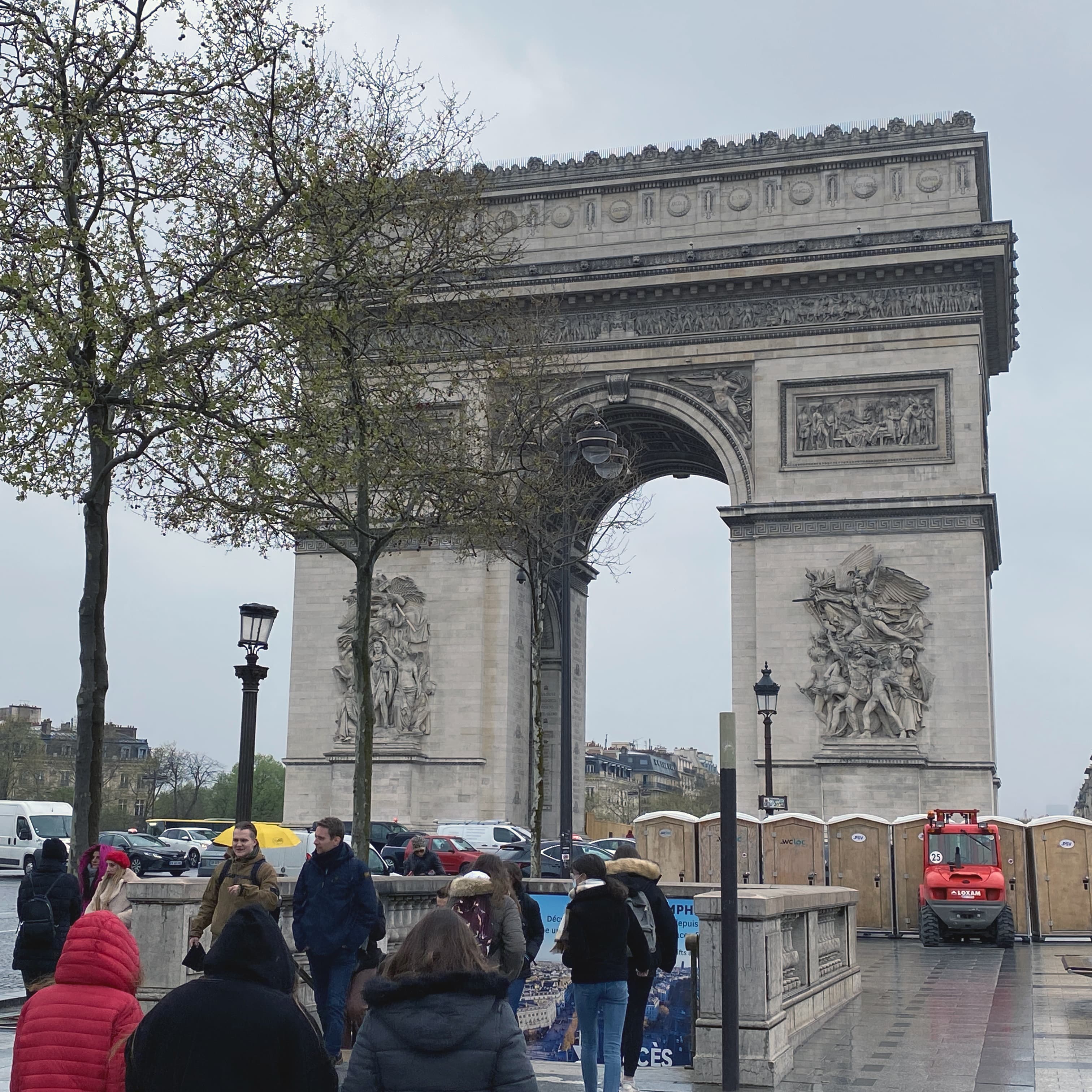
the Arc de Triomphe. The Arc de Triomphe is massive. 165 feet tall, 150 feet wide. It was patterned after triumphal arches from ancient Rome.
But I've seen some of those. This arch is more than twice that size. Construction began in 1809 at the absolute peak of France's revolutionary pride. They'd overthrown their king and queen, and now, under General Napoleon Bonaparte, they'd conquered most of Europe.
Read more...Show less
The Arc de Triomphe symbolized the triumph of the revolution. It was built to honor the people and to honor all those who died in the Revolutionary and Napoleonic Wars. Check out the relief sculpture on the Arc's right pillar. The Arc's most famous relief, known as La Marseillaise, remembers the 1789 Revolution.
There's Lady Liberty. It's like she's screaming, Freedom! It's this way! And she points the direction with her sword.
Beneath her are the revolutionaries. They're tired, naked, and stumbling, but she rallies them to carry on the fight against tyranny. Now, turn to the Arc's left pillar. That relief shows how the revolution was carried on by Napoleon.
It shows a toga-clad Napoleon posing like a Roman emperor. Kneeling at his imperial feet is an awestruck figure representing Paris, crowned by her city walls. The Arch was begun at the peak of Napoleon's power in 1809. It was finished in 1836, just in time to host an event for Napoleon's homecoming funeral when the procession passed beneath the Arch, carrying his remains home to Paris.
Now, let's actually go to the Arc de Triomphe. To get to the Arc, you can't cross the busy, traffic-filled roundabout. You must take the underground pedestrian tunnel. By the way, after we visit the Arc, we'll be returning to this exact spot to start walking down the Champs-Élysées.
That part of our walk begins on Track 6 if, for some reason, you want to go there. skip the Arc. But even if you don't go up the Arch, which requires a ticket, it's still well worth coming with us to the base of the Arch to see some sights. There's no cost for that.
Now, find the entrance to the underground pedestrian tunnel. The stairs down to it are located right here in the sidewalk at the very top of the Champs-Élysées. Once you find it, go downstairs and start walking through the tunnel. As you continue through the tunnel, you'll eventually come across the ticket booth and stairs leading up to the Arch.
If you're climbing the Arc and need a ticket, pause the audio tour and buy one. Otherwise, just climb the stairs, bypassing the ticket window. But before you leave the tunnel, side-trip a few steps further down to check out the long photo on the right wall. It's a nighttime view from the top of the Arc, showing all 360 degrees at once.
You can actually count all 12 avenues that surround the Arc. Now, return to the stairs up to the Arc. Go on up, where you emerge again into the open air. You're at the base of the Arc. Exploring the Base
Exploring the Base of the Arc
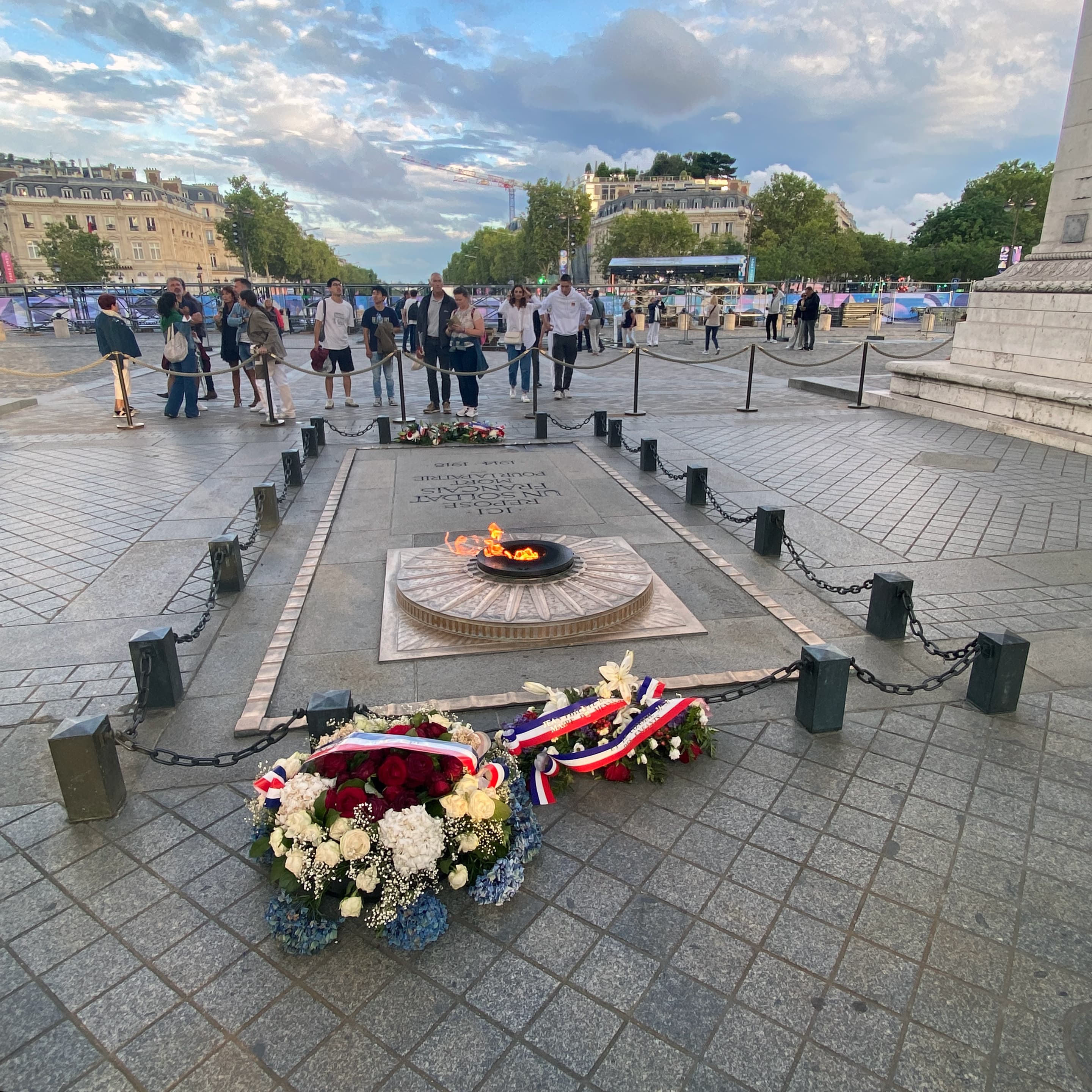
of the Arc de Triomphe By now, you should be at the base of the Arc. If you're planning on going up, scope out the entrance line. But for now, let's just explore the base of the Arc. Start making your way to the very center, where you can stand directly beneath the central Arc.
As you go, check out the names and places inscribed on the Arc. Remember, the Arc de Triomphe was built to honor revolutionary and Napoleonic soldiers. The inscriptions on the taller columns are lists of Napoleon's battles in Germany, Italy, Spain, Russia, all the countries Napoleon conquered before the rest of Europe finally teased him. He teamed up and defeated him.
Read more...Show less
Yeah, I noticed they didn't mention Waterloo. Tucked under the smaller side arches are lists of great generals from revolutionary and Napoleonic times. Underlined names are those who died in battle. When you reach the very center of the Arc, stand directly beneath it on the faded eagle.
You're standing at the center of French national pride. Today, the Arc de Triomphe is dedicated not just to soldiers of old, but to all French armies. That's why in the pavement beneath your feet you'll find remembrances to 20th century French battles as well. Check out the memorial lined with flowers, the Tomb of the Unknown Soldier.
This marks a crypt below that holds an anonymous soldier from World War I. France was devastated in that horrific war. The Unknown Soldier is one of more than a million French who lost their lives in the trenches of that war. A million plus.
More than a thousand thousand. Wow. Ever since then, every evening at 6.30, a solemn ceremony is held here. The monument's flame is rekindled and new flowers set in place.
The Arc had its place in World War II as well. During that war, after Paris fell to Germany, the Arc de Triomphe, like its Roman ancestors, served once again as a triumphal gateway. But this time, a large swastika was hung here as Nazis goose-stepped down the Champs-Élysées. Then, in 1944, Paris was liberated.
The French general, Charles de Gaulle, led Allied troops under this same arch in celebration. Even today, the Arc is a powerful symbol. Every national parade both starts and ends here with a minute of silence. Now, find a good spot where you can gaze directly down the Champs-Élysées.
Way at the far end is the Place de la Concorde. It's marked, if you can see it, by a white obelisk with a golden tip. Beyond that is the leafy Tuileries Gardens and the Louvre. That was once the center of Paris.
But once the Arc was built in the 1800s, the humble Champs-Élysées in between grew grander as Paris itself expanded. Think of it. Here at the Arc, you're standing at the very center of a line of Parisian monuments known as the Historical Axis. Locals also call it the Royal Perspective or the Triumphal Axis.
Triumphal way. You can hang a lot of history along this line. At one end is the Louvre, the former royal palace, which symbolizes the old regime of divine monarchs. Next is the Place de la Concorde, the place where they cut off the king's head, metaphorically ending the old regime.
The Champs-Élysées and Arc de Triomphe call to mind the rise of France under Napoleon. Next. Next, turn around 180 degrees. Facing directly away from the Champs-Élysées, you're looking up a grand extension of the boulevard.
It was laid out in the 1860s by the famous city planner Baron Haussmann. He helped renovate Paris into the world's most cultured city. This avenue leads way into the distance to La Défense, where a huge modern arch marks a business park of modern skyscrapers representing the global future. Globalization.
Next, we'll describe the view from the top of the Arc de Triomphe. While it's a great memory, you'll need to buy a ticket and there's often a line. If you choose not to go up, you can just listen to the next track describing the view from here on the ground. Or you can skip ahead to track six and pick up the tour from there. Whatever you choose, we'll see you at your next stop. Climbing the Arc de Triomphe
Climbing the Arc de Triomphe
for the view. The entrance to go inside the Arc and climb to the top is usually at the north pillar. Again, to go up requires either a ticket or a museum pass. And it's a hefty 284-step climb.
The elevators are only for the disabled. The Arc's main attraction is the view from the top, which is magnificent. Other than that, about two-thirds of the way up, you'll come across a small ho-hum exhibition area, a toilet, and, of course, a gift shop. There's no need for us to guide you to the top, so at this point, pause the audio tour and restart it once you reach the top.
Read more...Show less
Yep, pause the audio tour and we'll see you on top. Or, again, for the budget option, listen and watch from the ground level, where you are now. By now, you should be at the top of the Arc de Triomphe. From the top, you have an eye-popping view of Paris.
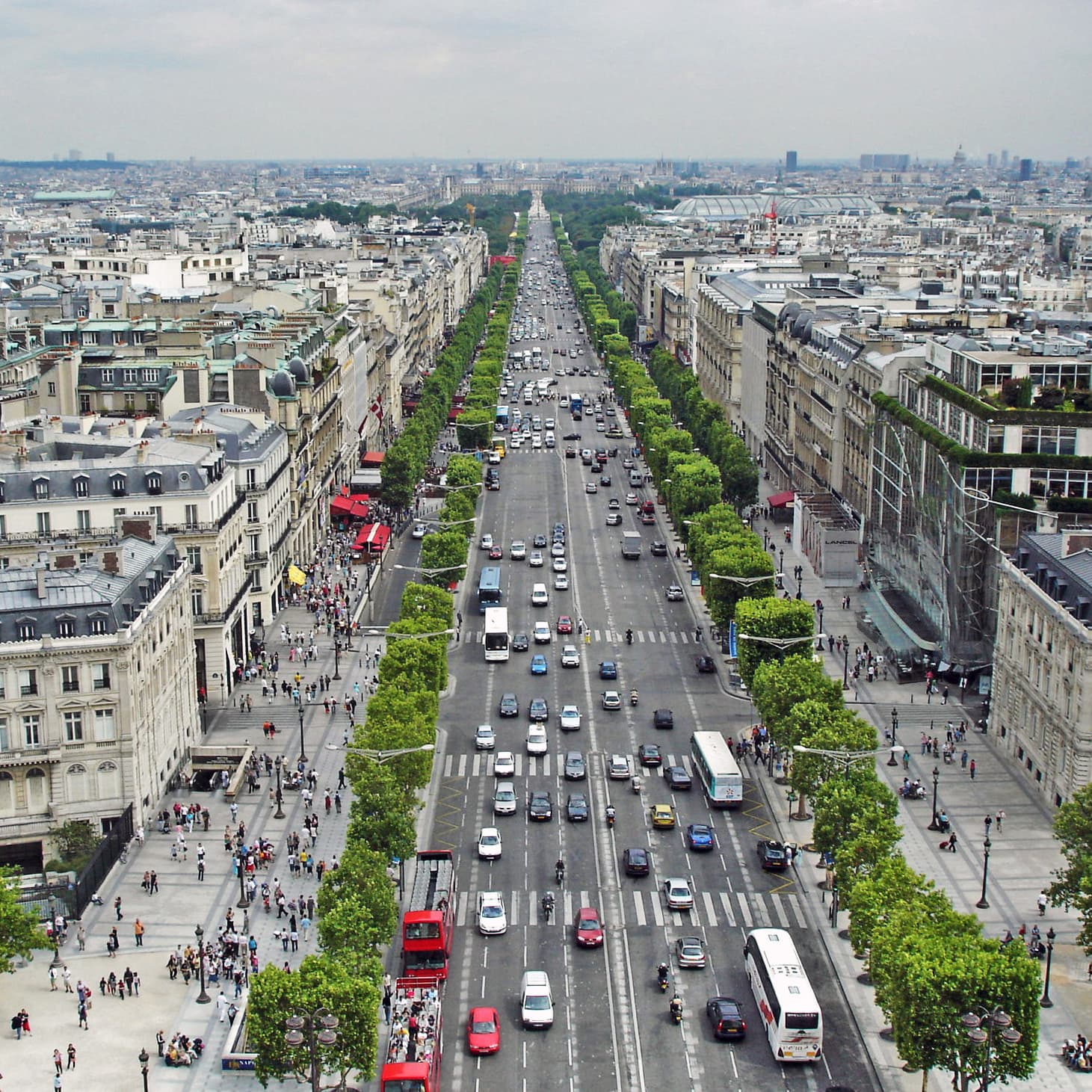
You're gazing at the home of 11 million people, who live in Greater Paris. The city center has about 2.3 million, packed into a relatively small space, about 40 square miles, a quarter of the size of, say, Denver. Start by looking east, down the Champs-Élysées. From here, you can really understand how the Champs-Élysées fits into the grand vision that is Paris.
The beauty of Paris, basically a flat basin with a river running through it, is man-made. Notice how there's a harmonious relationship between the city center and the width of this grand boulevard and the standard height and design of the buildings that line it. That's mirrored by so many other streets in the city. Now, look straight down at where the Champs-Élysées meets the Arc de Triomphe.
Notice the cemetery. Each corner building surrounding the Arc is part of an elegant grand scheme. We'll get a close-up look at the corner building on the left a bit later in our walk. Still facing east, scan the cityscape, dotted with well-known landmarks.
Pan left to right. To the left, that lonely hill in the distance is Montmartre, topped with the white dome of the Sacré-Cœur church. Until 1860, this hill town was a separate city. It became home to Impressionist painters and can-can dancers at the Moulin Rouge.
Now, pan a bit to the right. Find the bulky, pitched roof rising above other buildings. That's the historic Opera Garnier. Back in the late 1800s, the era of prosperity known as the Belle Epoque.
This opera house was as elegant as Montmartre was funky. Next comes the blue top of the Pompidou Modern Art Gallery, home of Picasso's and the cutting edge of today's art. Next, the Louvre and Tuileries Garden cap the end of the Champs-Élysées. Now, let your eyes move right to see the distant twin towers of a familiar-looking place, Cathedral Notre-Dame.
Next, the Dome of the Pantheon breaks the horizon. Continue right, past a block of small skyscrapers on a hill to the Golden Dome of Les Envelides. Beneath that dome lies the body of Napoleon. In 1840, his remains were paraded under the Arc de Triomphe down the Champs-Élysées to Les Envelides, where eventually he was buried in the grand tomb we see today.
Near Envelides is a lonely-looking skyscraper. This is the Montparnasse Tower, standing like the box the Eiffel Tower came in. When that was built in the early 1970s, it served as a wake-up call to city planners to enforce the building-height restrictions we see today. Finally, panning further right, you'll spot several small golden onion domes crowning a vast new Russian Orthodox cathedral.
Now, make your way to the opposite side of the Arc and look west. This is the area that grew up in the 18 and 1900s as Paris expanded. Way in the distance, three miles away, find the Forest of Skyscrapers, the office park called La Défense. Standing amid the buildings is the huge, white, rectangular arch called the Grande Arche.
A kind of modern-day Arc de Triomphe. Yes. Remember, this is the final piece of that grand historic axis from the Louvre up the Champs-Élysées to the Arc de Triomphe all the way to the Grande Arche. Back in the 1990s, after the fiasco of the Montparnasse Tower, Paris realized that all skyscrapers should be banished from the historic core, hence this distant mini-Manhattan.
Notice the contrast between the jagged skyscrapers of La Défense and the elegance of downtown Paris' more uniform building heights. Now, look below you. The wide boulevard angling to your left, lined with trees and grass, is Avenue Fauche. Named for the heroic general of World War I, Marshal Fauche.
Fauche, sure. Avenue Fauche is the best address to have in Paris, nicknamed the Avenue of Millionaires. It's been home to the likes of Aristotle Onassis, the last Shah of Iran, and many of today's fabulously rich Arabs. The boulevard ends at the huge Bois de Boulogne Park.
Within the park are the wavy, classy sails of a striking modern building. This is the Louis Vuitton Foundation, designed by the architect Frank Gehry, and offering contemporary art exhibits. Finally, gaze straight down to the circling traffic at the base of the Arc de Triomphe. Clearly, the Arc is a major traffic hub.
The 12 boulevards that radiate from the Arch form a star, or étoile. These were laid out in the mid-1800s as part of Baron Haussmann's master plan for Paris. He created a series of major boulevards intersecting at diagonals with monuments like the Arc de Triomphe as center points and centerpieces. Haussmann may have been a brilliant visionary, but he clearly didn't foresee the automobile.
I mean, look at the chaotic mess below. True, but as I pointed out earlier, Lisa, note how smoothly it functions. Remember, cars entering the roundabout have the right-of-way. Meanwhile, smart drivers know how to give themselves plenty of time to spin outward to reach their exit.
A perfectly Parisian solution. Our next stop is back down on the Champs-Élysées itself, right where this tour began. So whenever you're ready to move on, start making your way back down the stairs to planet Earth. We'll backtrack through the pedestrian tunnel bypassing all that crazy traffic overhead where you'll re-emerge at the Charles de Gaulle étoile metro stop. So pause the audio tour now and we'll see you there.
Strolling the Champs-Élysées
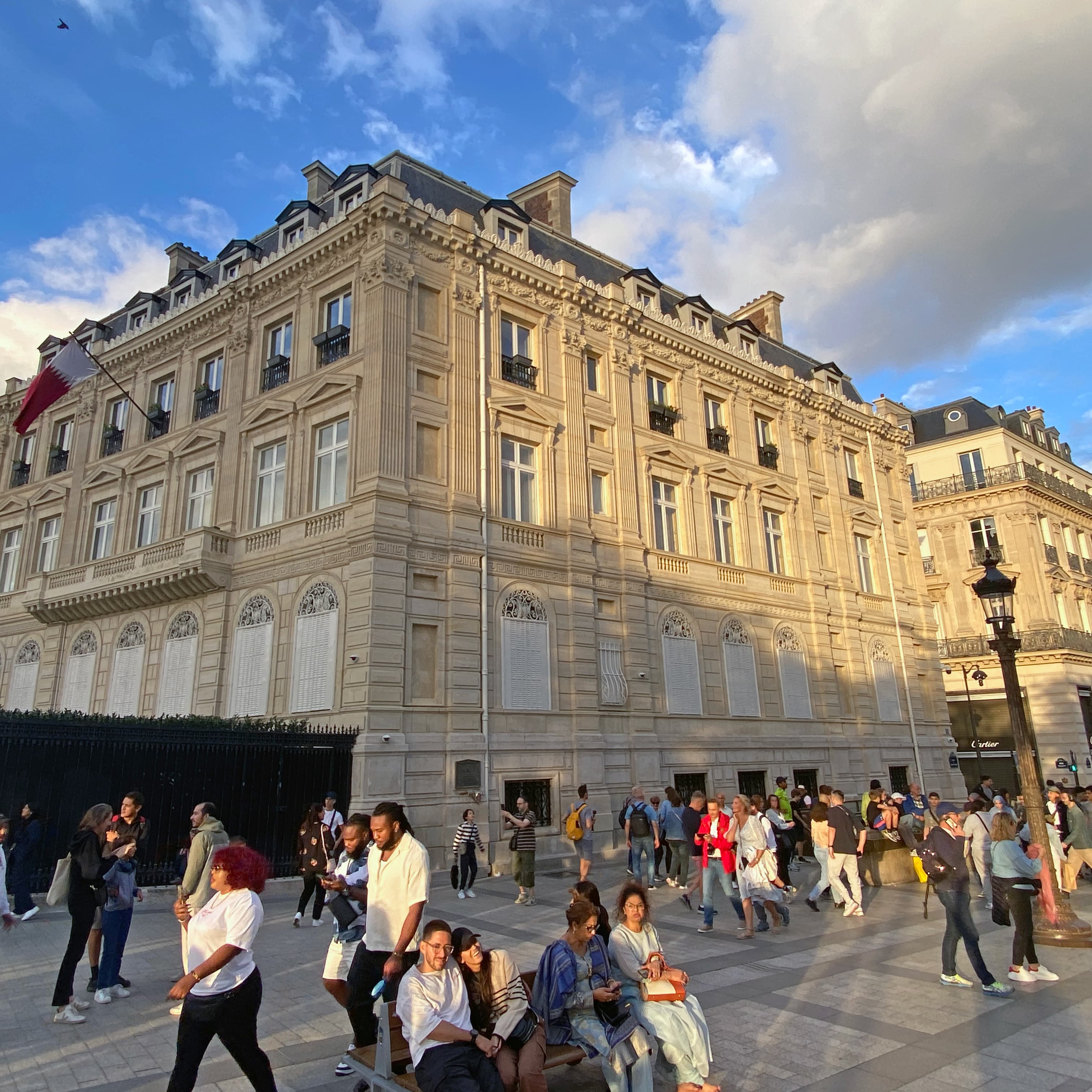
Strolling the Champs-Élysées. By now, you should be back at the Champs-Élysées near the Charles de Gaulle étoile metro stop where our walk began. From here, we'll be walking down the street seeing things both old and new. We'll mostly be staying here on this left side of the street which gets more sun and more pedestrians which means landlords can double the rent.
Start by focusing on the very first building. This simple but elegant brownstone mansion is a great look at the Champs-Élysées' original buildings. Let's get a closer look at the building from its downhill side. Start strolling down the Champs-Élysées heading one short block to the first tiny street you cross, Rue de Tilsit.
Read more...Show less
As you walk, remember that the Champs-Élysées was first opened around the year 1700 under Louis XIV but didn't come into its own until the mid-1800s when it was lined by buildings like this. This building was originally a private mansion complete with sophisticated classical-style touches like the windows topped by Roman-style arches and Greek-style triangular pediments. When you reach the first tiny cross street, Rue de Tilsit, turn left. Go a few steps to where you get a good view of the mansion's entrance.
As you'll see, the place now houses the Qatari Embassy. The building was built in the 1850s as part of the Grand Urban Renewal Project overseen by Baron Haussmann. It was one of the twelve U-shaped buildings that divide the twelve boulevards that converge on the Arc de Triomphe roundabout. Haussmann's stately buildings were perfect for Paris' wealthy bourgeoisie.
If not for the big black security fence, I can practically imagine the horse carriages pulling up for a soiree in its quaint courtyard. As you continue our walk, again, remember that the Champs-Élysées was once lined with mansions like this one. Even when stores moved in in the late 1800s, they took over space within these stately buildings. By the 1900s, the boulevard was pure elegance.
Parisians actually dressed up to come here, strut down the boulevard and gawk at the splendid mansions, ritzy hotels, and exclusive cafés. Let's start walking back to the Champs-Élysées. By the way, this tiny side street is part of a shadow ring road around the Arc de Triomphe. Savvy Parisian drivers know you can take this route to avoid the chaos of the roundabout.
It comes complete with stoplights. When you reach the Champs-Élysées, take a moment to gaze across the boulevard. On the far side of the Champs-Élysées is a modern office building. It's big, gray, and made of concrete and glass.
Yeah! Now, turn left and keep going down the Champs-Élysées for another hundred yards. By the 1960s, businesses in tasteless modern buildings like this were moving in, and venerable old buildings were being leveled to make way. Making matters worse, the government was pumping up the neighborhood's commercial metabolism.
They brought in the metro. Everyday commuters now had easy access. And, poof, there went the neighborhood. By the 1970s, things were looking very bad for the once elegant Champs-Élysées.
And then came the worst blow of all. Keep watching Our next stop is at number 140. At number 140, you'll come across a fine dining establishment that should look familiar to you. McDonald's.
McDonald’s
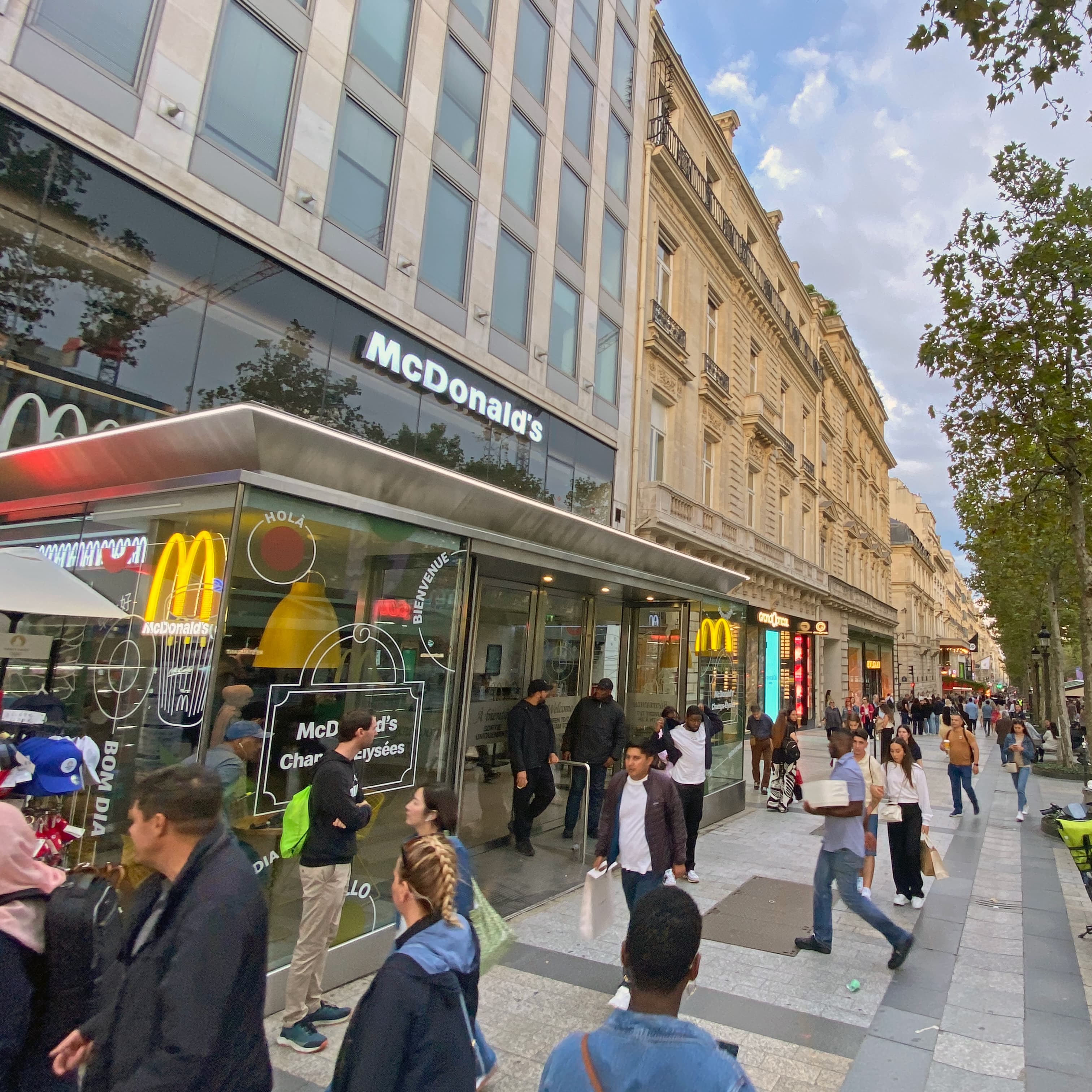
The arrival of McDonald's in the 1930s and 1970s was a shock to the boulevard and to the country. Think of it. For centuries, France had been the pinnacle of high culture. Art, fashion, cuisine.
Now the American Empire was encroaching. For a culture that prided itself on leisurely meals and intimate surroundings, the idea of fast food from a crass American chain restaurant was unthinkable. And on the ultra-chic Champs-Élysées, no less. Yeah.
Read more...Show less
At first, the place was not even allowed to show its famous golden arches. Just too gaudy. They could only paint white arches on the window. But over time, even the French were gradually won over by the allure of the Big Mac.
Check out the outdoor tables. Gotta say, pretty nice. A Big Mac here at a sidewalk table actually buys some pretty great people watching at a reasonable price. Let's pop inside and take a look.
It's clear the French have a taste for food. The French have adapted quite well. Notice how many of the happy clients are locals. Today, dining Chez McDo, as they call it, has become typically Parisian.
The popularity of Le Fast Food in Paris is a sign that the traditional two-hour lunch has become passé. These days, one of the most commonly ordered dishes in French restaurants, even in trendy gourmet restaurants, is the hamburger. The French must now compete in a global world, and if that means adopting a more American lifestyle, c'est la vie. By the way, France has more than a thousand McDonald's, and this branch on the Champs-Élysées is considered the most profitable in the world.
A questionable sounding factoid, but I'll take your word for it. Let's head back outside and move on, continuing another couple hundred yards down the Champs-Élysées. As you walk, you'll see a revitalized Champs-Élysées, and ironically, we can thank McDonald's for that. The arrival of McDonald's back in the 1970s was a huge wake-up call that spurred a revival.
A law was passed prohibiting the demolition of the old graceful building fronts. Any new business had to hide their modern stores behind these now-preserved facades. Then, in the 1990s, the Champs-Élysées got another much-needed makeover. Newer benches and lamps, and broader sidewalks, like you see today.
Messy street parking was sent out of sight to underground garages, and an army of green-suited workers was mobilized to drive motorized street cleaners. The result? If you blink away the modern elements, it's not hard to imagine that graceful Champs-Élysées of old. Keep going until you reach number 116.
Our next stop calls to mind both the Paris of the past and how it still carries on its traditions today. The famous Lido Theatre. The Lido.
The Lido
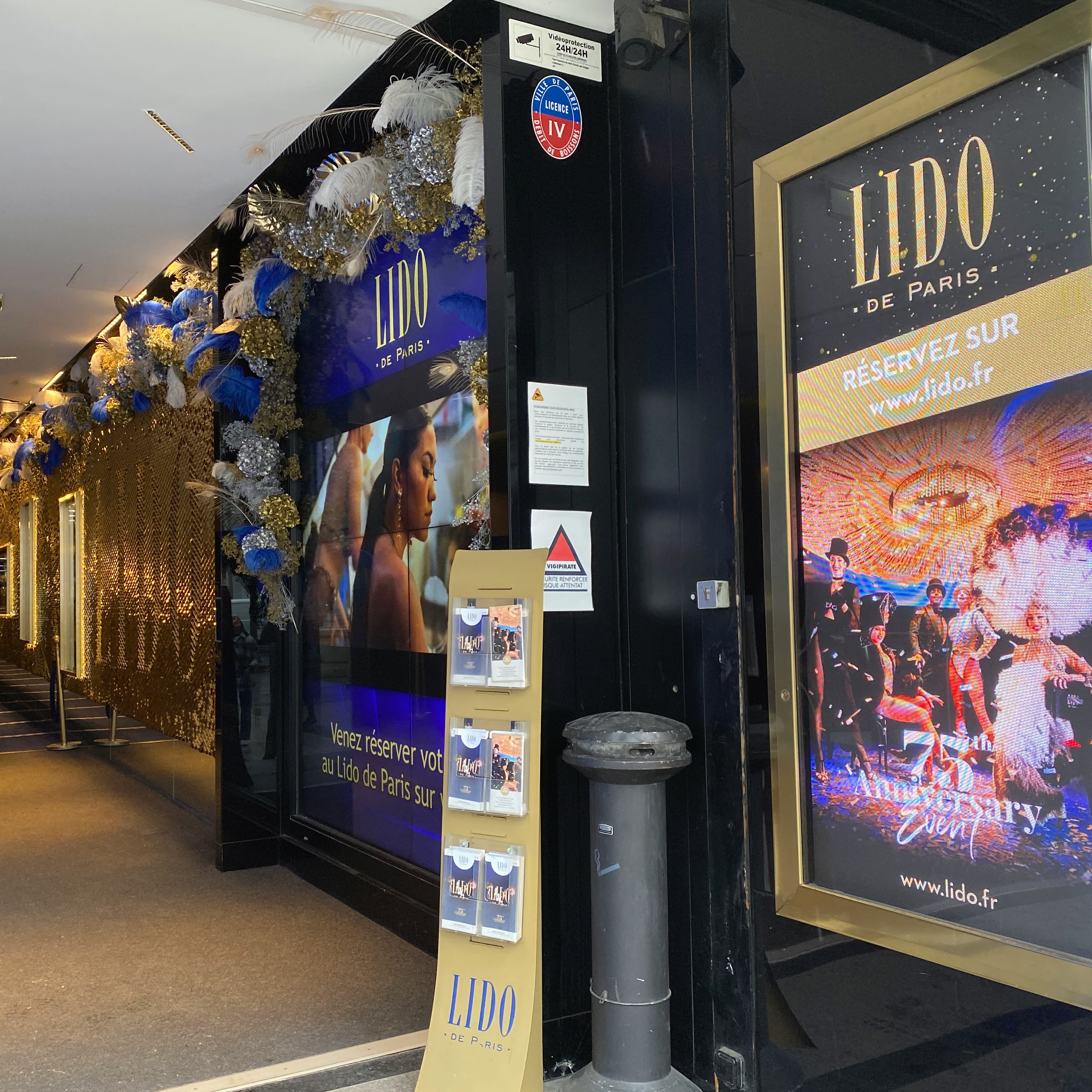
This is the site of the famous Lido, Paris' largest cabaret. It closed in 2022, and now it's the Lido II, a venue for grand musicals and theater. Opened in 1946, the original Lido picked up the torch of Paris' long tradition of cabaret shows, a tradition dating back to the Moulin Rouge of the 1800s. These kinds of variety shows featured a mix of singers, dancers, and vaudeville acts.
Over the years, the Lido hosted entertainers ranging from Edith Piaf to Elton John, from Maurice Chevalier to the rock-and-roll pioneer dubbed the French Elvis Johnny Halliday. The Lido's greatest claim to fame was its signature act, Dancers, a bevy of tall, beautiful, scantily-clad women dressed in sequins and feathers. Sounds like Vegas showgirls. Exactly.
Read more...Show less
In fact, it was the Lido show that, back in the 1950s, got imported to Las Vegas, setting the standard for all those showgirl acts. Vegas has largely abandoned showgirls, and now, the Lido has as well. These days, the Lido houses a multiplex cinema. Seeing a movie on the Champs-Élysées is a special Parisian experience.
These theaters show the very latest releases. Find the posted movie schedule, look for the showtimes, or in French, the séances. If it says VO next to the time, that indicates the film will be shown in its original language. Or, version original.
A VF stands for version Francaise. The French are film connoisseurs and purists, so it's unusual for a foreign film to be dubbed. Before we move on, check out the store two doors down from the Lido, Petit Bateau. This venerable children's clothing chain has dressed generations of French boys and girls.
Or, garçon and fille. The presence of a children's store on the Champs-Élysées is a testament to the fact that France's birth rate is well above the rest of Europe's. The French government offers generous subsidies, encouraging couples to have more babies. And it's apparently working.
Let's move on. From here, we'll be crossing the busy street to the other side of the Champs-Élysées. So find the nearby crosswalk. It's just a few steps backtracking uphill.
When the light lets you, start crossing the broad boulevard. As you cross, enjoy the views and feel the energy. If you're brave, you could even pause, perhaps for a photo, at the slender traffic island in the center. Glance up the street at the Arc de Triomphe with its rooftop bristling with tourists.
Notice the variety of architecture lining the street, old and new. Keep going across the street. The traffic is intense. A street built for clip-clopping carriages now has to accommodate thousands of cars.
It can be gridlocked even at midnight. The bike lanes constrict the cars even more. They say city politics here is divided as much by those who either own cars or don't as by conservative and liberal. Continue across the street to the big Louis Vuitton store.
By the way, the trees lining the street are plain trees. That's a kind of sycamore. With their peeling bark, they thrive even in big city pollution. These are a legacy of Baron Haussmann's 1850s urban renewal when some 600,000 of these trees were planted all across Paris.
When you reach the other side of the Champs-Élysées, head for the entrance to the big and proud Louis Vuitton store. Louis Vuitton.
Louis Vuitton
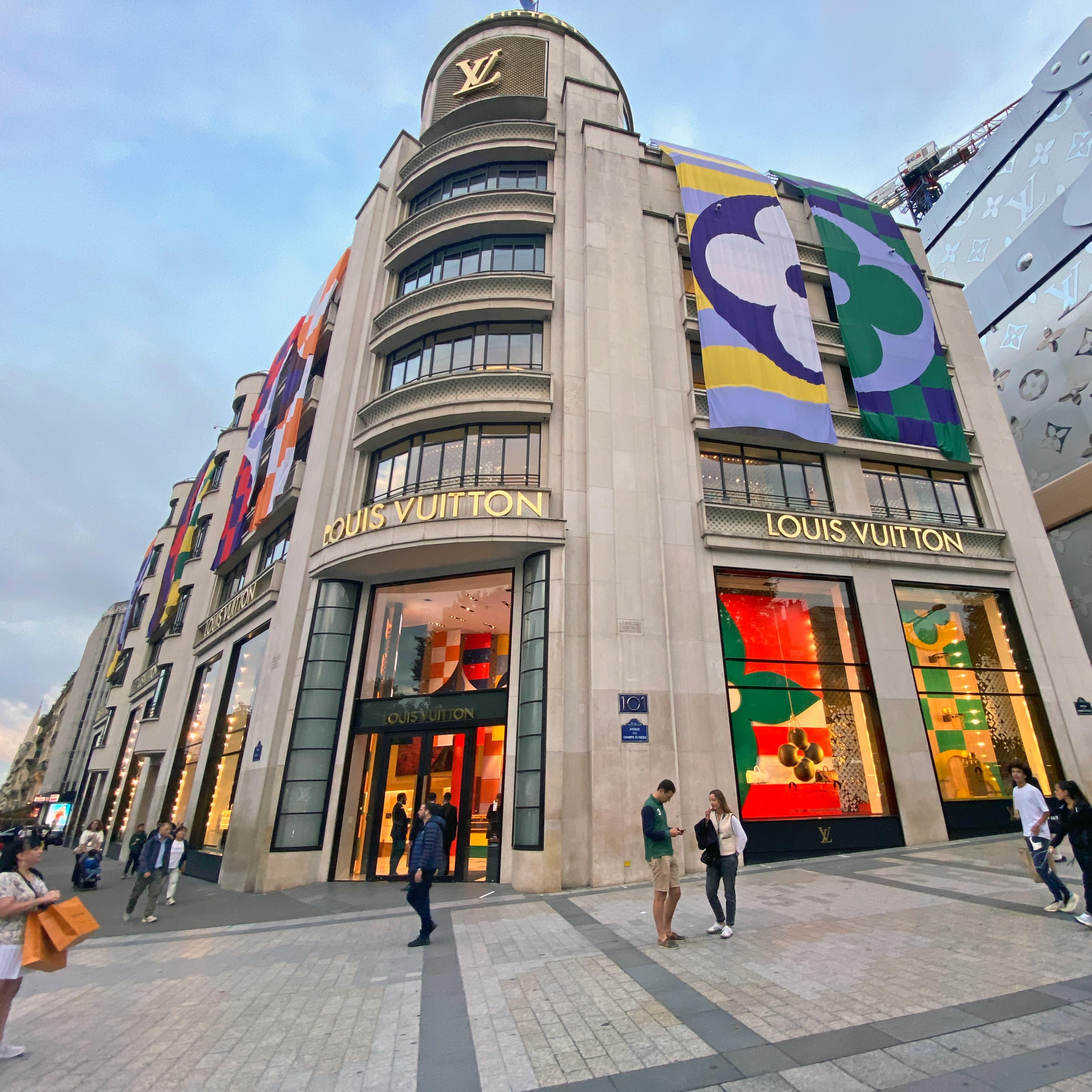
This is the flagship store of the famous producer of luggage, clothes, and accessories. It may be the largest single-brand luxury store in the world. It's a reminder of another of Paris' best-known claims to fame as perhaps the high-fashion capital of the world. By the way, if you want to step inside this or any store along the walk, feel free to pause the audio tour.
But expect a security check as you enter the store. As is common at Champs-Élysées stores. If there's a line to get in, it doesn't necessarily mean that the store's packed to the gills. It's that Louis Vuitton prides itself on treating each customer royally.
Read more...Show less
So, if there's a line, it probably means shoppers have outpaced the staff. Louis Vuitton began way back in the 19th century as a humble maker of steamer trunks. His innovation was suitcases with flat tops. So, unlike traditional treasure-chest-shaped steamers, steamer trunks, Louis' luggage was stackable.
Sounds like a no-brainer to me, but okay. Sales boomed. His luggage also became well-known for its distinctive checkerboard patterns and brand-name logo with the L and the V interlocking. These days, you'll find their brand on everything from handbags to perfume to sunglasses.
It's also on the countless knock-off items sold illegally on street corners throughout Europe. That's where I do my shopping. Louis Vuitton is marketed worldwide by celebrity promoters like actors, rock stars, and the Kardashians. Louis Vuitton is a major part of the city's big annual shindig, Paris Fashion Week.
That's when the eyes of the fashion world turn to Paris as runway models strut their stuff with the latest clothes and accessories. I like Louis Vuitton, but thank you. I'll stick with my Rick Steves carry-on backpack. Merci beaucoup.
Let's move on. When you're ready, let's continue downhill a few steps, staying on this right side of the street. At the cross street, Avenue George V, glance to the right. The white spire you see a few blocks down is the American Cathedral.
Even for the non-religious, it's a welcoming gathering place for English-speaking tourists and expats. Continue down the Champs-Élysées a few more steps to our next stop, Fouquet's, at number 99, under the famed red awning. Fouquet's. Fouquet's.
Fouquet’s
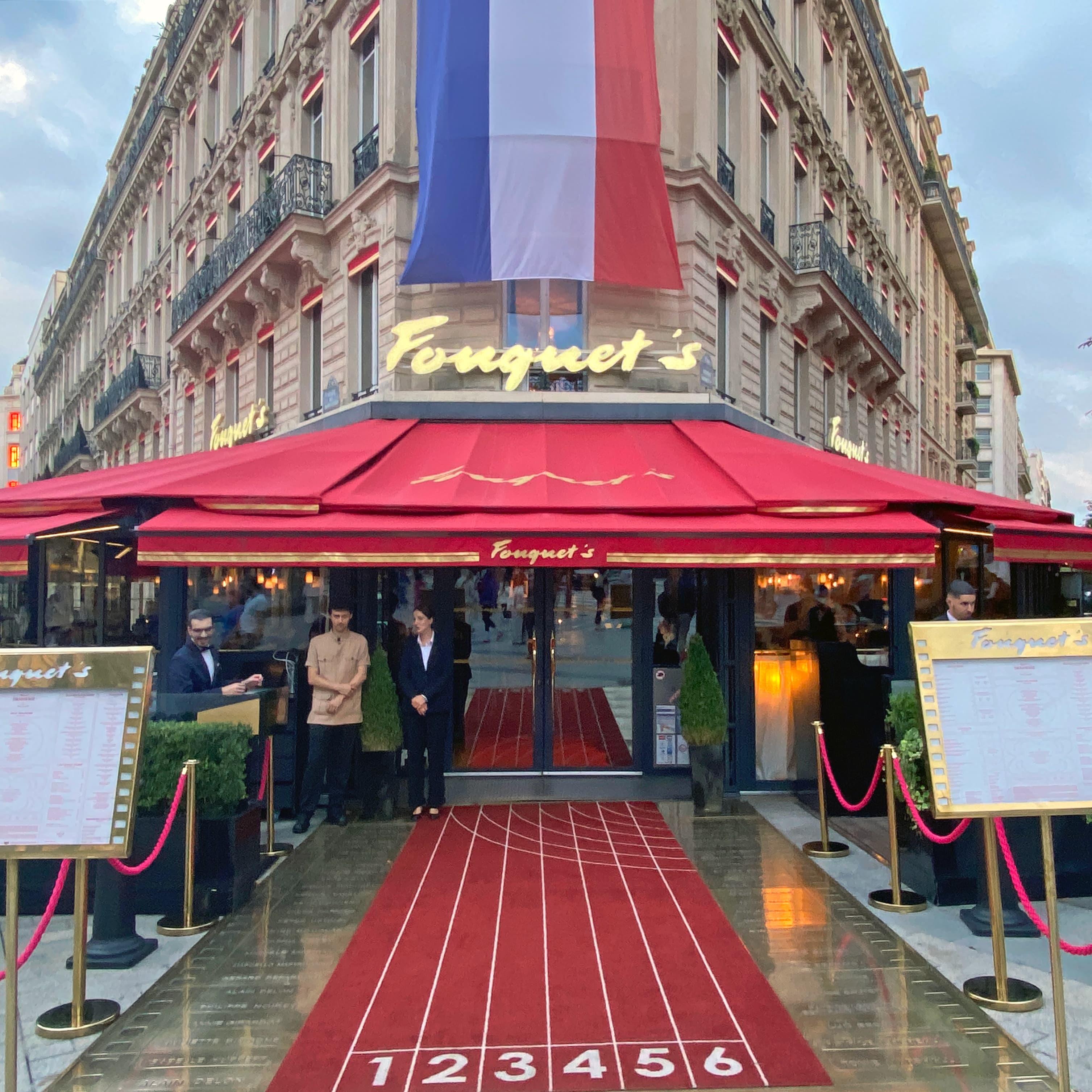
Fouquet's Café Restaurant is a Paris institution. It's the place to see and be seen while enjoying a leisurely, if pricey, cup of coffee on the Champs-Élysées. Opened in 1899 as a coachman's bistro, Fouquet's soon became the favorite hangout of French celebrities. The first were France's World War I biplane fighter pilots, those daring young men in their flying machines who became instant folk heroes.
In the 1920s, it was James Joyce's dining room, and since the 1930s, it's been the go-to place for movie stars. As we saw, the French are crazy about film. Yeah, check out the plaques on the ground near the entrance. These golden plaques honor winners of the French version of the Oscars, the Caesars.
Read more...Show less
You'll probably be able to find a few familiar names. I see some classic movie stars. There's Gene Kelly. Sean Connery.
Kirk Douglas. The other names are mostly French stars. You'd certainly know them if you love classic French cinema. I see the French director, Roman Polanski.
Who also did American films like Chinatown, Rosemary's Baby, and The Pianist. There's Gérard Depardieu. Who played everyone from Cyrano de Bergerac to Columbus to Rodin. And I see the elegant Catherine Deneuve.
Who was in The Last Metro with Depardieu. The sophisticated actor-singer Yves Montand. And there's Juliette Binoche. From The English Patient and Chocolat.
These plaques honor older stars. More recent winners are inside. Wait. There's no Jerry Lee.
There's a Louis plaque? Yeah, where's Jerry? You know, the French consider him a comic genius. Why are these plaques at Fouquet's anyway?
Well, every February, the Caesars are handed out in a lavish ceremony at a nearby theater and broadcast nationwide. Afterward, Fouquet's is the venue for the night's grandest red carpet event. Frances Glitterati converge here, emerge from their limos, and walk across these plaques to go inside. While the paparazzi swarm and the whole world is in awe.
The whole country looks on. Ooh, can we go inside? If you dare. For as little as the cost of an expensive espresso, you can enter and be guided to a table, either inside or out.
The hushed interior is at once classy and intimidating. And also, a grand experience. Let's move on. Continue walking down the Champs-Élysées to our next stop, another café called La Duree.
It's about two blocks downhill on this same side of the Champs-Élysées. On the way, you'll pass by Fouquet's sidewalk tables. See anyone famous? Everyone looks rich and famous to me.
Let's keep going. By the way, as you keep walking, one last word about Fouquet's. This venerable café was once almost purchased by foreigners and slated for destruction. Fortunately, the government stepped in and declared it a historic monument.
It's clear that the French respect their long traditions. Especially the traditions around the city. One of the most important aspects of the French way of life, food. Sharing a meal, a cup of coffee, or a drink at a leisurely pace in cozy surroundings is part of the everyday rhythm of French life.
France, of course, is renowned for its tradition of high cuisine, its Michelin-starred restaurants, celebrity chefs, and cordon bleu-type cooking schools. And Paris is saturated with eateries, from ritzy places like Fouquet's to humble brasseries. Some, for example, are even older than Fouquet's. Like La Procope, on the left bank.
Which has been in business since the 17th century. No sooner had the coffee bean entered Europe than Paris embraced the concept of a café. An entire culture was built up around these places, where Parisians gather to eat, drink, socialize, argue, and share ideas. A few of these classic places are still around today.
Ah, oui. Tradition. Our next stop has been a venerable part of that tradition for a century and a half. It's especially known for its high-quality desserts, and one dessert in particular, macarons.
Well, you've got my attention. And now, here we are, reaching our next stop, La Duree, at number 75. La Duree
Ladurée
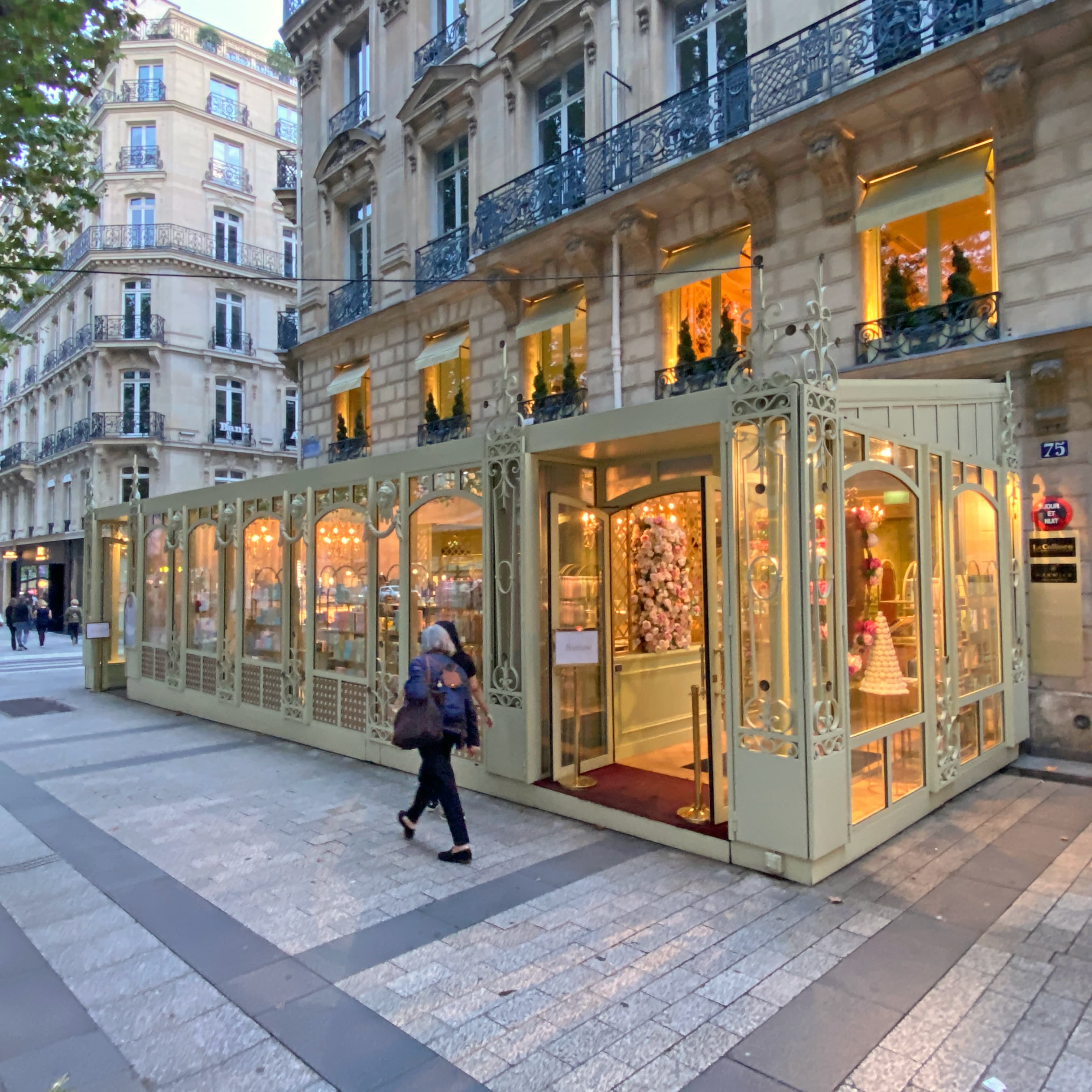
La Duree is a classic 19th-century tea salon-slash-restaurant-slash-bakery, or patisserie. Ooh, let's step inside. Yes, let's. At this place, even if you're not buying anything, you can wander discreetly around.
Though photos are not allowed. Explore. You'll find various sections on this floor and upstairs. Some are for a lavish sit-down meal.
Read more...Show less
Some are for a coffee or tea with pastries. In the rear of the store, there's a modern café bar for a cold drink or an ice cream treat. If you need a pick-me-up, a coffee at La Duree is très elegante and won't break the bank. There's inviting tables upstairs as well.
Keep wandering and checking out the scene. For many, the main attraction at La Duree is the bakery. They have counter service where you can buy their various products to go. They sell cute little cakes and, of course, the traditional macarons.
Tell me more. Macarons. These are the little round cookies with two sides and a filling in between. Not to be confused with the coconut-flavored cookie with a similar name, more popular in America.
Though some form of macarons have been around for a thousand years, it's the French that perfected and popularized them. And La Duree has been making them for more than a century. Let's move on. What?
I want my macarons. Then you can always pause the audio tour and buy some. All right. Then, once we're all good and ready, let's start making our way back outside.
By the way, we'll be passing another well-known, bigger, more modern, and less expensive macaron store in a moment. From La Duree, we'll be crossing back to the other side of the Champs-Élysées. So find the nearby crosswalk. And start crossing the busy boulevard again.
As we cross, let me switch gears a bit and talk about the Champs-Élysées during that historic event that changed everything, the French Revolution of 1789. As you cross the Champs-Élysées, glance to the right. Way in the distance is a white obelisk with a golden tip on Place de la Concorde. That obelisk marks the exact spot where the guillotine once stood.
It was there that revolutionaries sliced off the heads. It was the head of their king, Louis XVI, and Queen Marie Antoinette. Residents of the Champs-Élysées had an eyewitness view of the turbulent revolution. And, as we'll see, one of those residents was a well-known American.
Just a reminder to keep crossing the Champs-Élysées. Remember, America's Revolution of 1776 and France's Revolution of 1789 were intertwined. First, France helped spark America's revolutionary fervor. The ideas of French philosophers, like Voltaire and Rousseau, inspired America's Declaration of Independence.
And America was aided by France's brave General Lafayette. Then, a decade later, America returned the favor, inspiring the French to rise up. In fact, just as France's revolution was brewing, one of America's greatest revolutionaries was living right here on the Champs-Élysées. When you reach the other side of the street, turn left.
Go about 30 yards uphill to No. 92. Where a plaque on the wall marks the one-time residence of Thomas Jefferson. ♪ Thomas Jefferson's Home
Thomas Jefferson’s Home
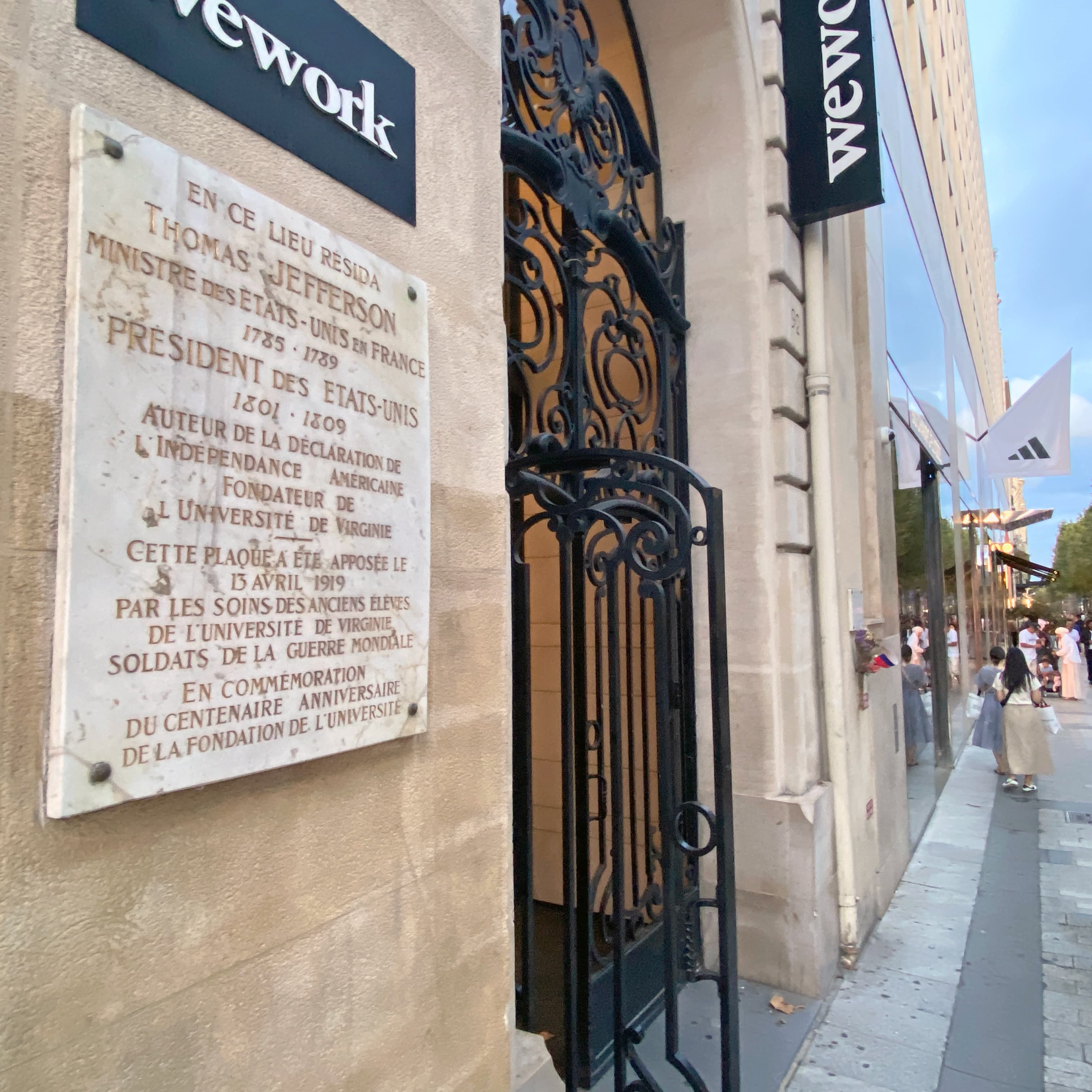
The United States' third president and co-author of the Declaration of Independence moved in here. In 1785, he was the young nation of America's ambassador to the France of King Louis XVI. Jefferson replaced Benjamin Franklin in the role and quickly made his own mark. Jefferson loved Paris.
The Champs-Élysées he knew was still a pastoral area in the backyard of the Royal Palace. Jefferson would venture down the boulevard to stroll through the Tuileries Gardens. He enjoyed art exhibits at the Louvre. He hung out with both aristocrats and budding revolutionaries.
Read more...Show less
Like Lafayette. Having lived through America's Revolution, Jefferson was able to explain it to the French. And it inspired them. In fact, many of Jefferson's own phrases and ideas from the Declaration of Independence would find their way into its French counterpart, the Declaration of the Rights of Man.
And when the Revolution finally broke out on July 14, 1789, Jefferson had a front-row seat. At the start, he was horrified by the violence of that first Bastille Day. But ultimately, he knew it was necessary in the fight for freedom. Shortly after the outbreak of the Revolution, Jefferson was called back to America for a new role.
And as Secretary of State under President Washington, he helped steer America on a course of supporting revolutionary France, establishing a deep friendship between the two nations that continues today. Let's move on. Let's. But first, to put a bow on the story, the Revolution brought Napoleon.
Napoleon had the Arctic... the Triomphe built. And that stimulated more construction, resulting in what we see today, a grand Champs-Élysées. Now, continue strolling down the Champs-Élysées, staying here on the left side.
We'll quickly come to three establishments that have taken the French tradition of high-quality food and adapted it to the modern world. The first is Pierre Hermé, where macaron lovers swoon. Ah! The eponymous Monsieur Hermé is a pastry chef who achieved rock star status in France, especially for his macarons.
Keep going. Next up are two good-value lunch options sitting side by side, Boulangerie Paul and La Brioche Dorée. Consider stopping here if you need a break. Both have great boulevard-side tables and good sandwiches and salads.
Dorée has toilets, air conditioning, and extra seating upstairs. But let's keep going a few more steps to number 76. By the way, establishments like Hermé, Paul, and Dorée are hardly quaint mom-and-pop places. They're all franchises of huge worldwide chains.
It's a testament to how the French are not only adapting to the global market, they are thriving in it. Soon, you'll reach our next stop at number 76, the entrance to the Arcade des Champs-Élysées. ♪♪♪ French shopping.
French Shopping: Arcades, Sephora
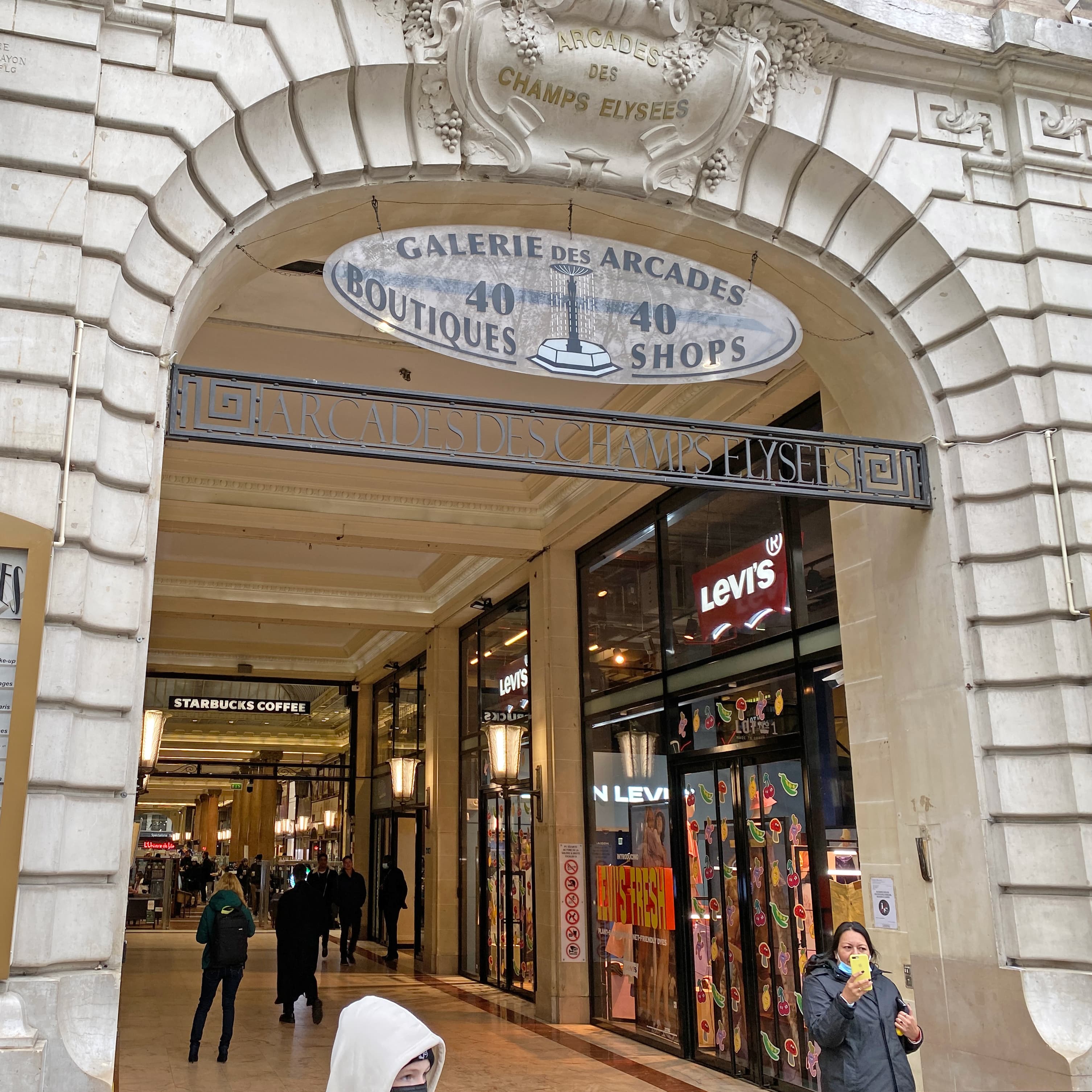
Arcades, Sephora, Guerlain, and Galeries Lafayette. Since the days of Thomas Jefferson, France has been on the cutting edge of luxury goods. Let's take a look at several establishments that are great for shopping or just window shopping. Start by going inside the Arcade des Champs-Élysées.
It's a small shop, but it's a great place to shop. It's a small shop, but it's a great place to shop. It's a small shop, but it's a great place to shop. It's a small shop, but it's a great place to shop.
Read more...Show less
It's a small mall. Feel free to explore deeper inside. The stores are certainly nice, but really the highlight here is the building itself. Take in that radiant glass skylight.
There are fancy lamps, mosaic floors, classical columns. In its day, a kind of temple to shopping. Yes, the French enjoy making the shopping experience first class. This particular mall from a century ago retains echoes of the so-called crazy years, as the Roaring Twenties were called here in France.
Look for a couple of surviving murals high in the walls that show a slice of Champs-Élysées life from those days. Architecture buffs can observe how the flowery Art Nouveau of the 1910s Like the lanterns. became the simpler, more geometric Art Deco of the 1920s. Like the geometrical patterns on the skylight.
Let's start making our way back outside. You know, the ambience is so great here, it even makes the Starbucks feel classy. Starbucks is another, another foreign invader that was once considered horrific. But even the French can't argue with a double latte served up fast when you really need it.
Once outside, continue down the Champs-Élysées a few steps further to the establishment next door at number 74, the Galerie du Clerige building. This is another little mall. Take a moment to admire this classic Champs-Élysées façade, the ironwork awning, the balconies, the putti. That is, the little baby.
And the sculpted fantasy faces. Let's poke our heads inside. Inside, it's not a classic old mall like the original façade may have suggested outside, but a totally new interior. This is the compromise needed to preserve the character of the Champs-Élysées.
If you can't save the whole building, at least keep the façade. Inside, one of the current tenants is a French favorite, Fanac, a large department store chain. Let's continue our shopping stroll a few steps further. Two steps further down to number 72, Sephora.
Mmm, I smell something good coming up. When you reach the huge perfume store, Sephora, venture inside. Yes, take your nose sightseeing and glide down the ramp into the largest Sephora in France. Sephora is now a worldwide chain, but this one is still impressive.
It's a noisy and fragrant commercial carnival of perfumes and a chance to sense the French passion for cosmetics. Note the label. Women's perfumes line the right wall and men's line the left. They're organized alphabetically by company, from Armani to Versace.
Let's try a few samples. Here's how it works. You grab a disposable white strip from a lovely clerk. Merci, madame.
Spritz it with a sample. Mmm, this perfume looks nice. And sniff. Ah.
Feel free to look around, and when you're ready, start making your way back outside. Sephora opened its first humble store in Paris back in 1970. Now there are some 2,000 stores all around the world, and this Champs-Élysées branch gets 5 million visitors a year. I think half of them are here right now.
Let's move on. For more nasal sightseeing, continue next door to another perfume shop, Guerlain. While Sephora seems to be going all out to attract the general public, Guerlain is tremendous. It's a great place to see the world.
It's a great place to see the world. It's a great place to see the world. It's a great place to see the world. It's a great place to see the world.
It's a great place to see the world. It's a great place to see the world. It's a great place to see the world. It's a great place to see the world.
It's a great place to see the world. It's a great place to see the world. It's a great place to see the world. It's a great place to see the world.
It's a great place to see the world. It's a great place to see the world. It's a great place to see the world. It's a great place to see the world.
It's a great place to see the world. It's a great place to see the world. It's a great place to see the world. It's a great place to see the world.
It's a great place to see the world. It's a great place to see the world. It's a great place to see the world. It's a great place to see the world.
It's a great place to see the world. It's a great place to see the world. It's a great place to see the world. It's a great place to see the world.
It's a great place to see the world. It's a great place to see the world. It's a great place to see the world. It's a great place to see the world.
It's a great place to see the world. It's a great place to see the world. It's a great place to see the world. It's a great place to see the world.
It's a great place to see the world. It's a great place to see the world. It's a great place to see the world. It's a great place to see the world.
It's a great place to see the world. It's a great place to see the world. It's a great place to see the world. It's a great place to see the world.
It's a great place to see the world. It's a great place to see the world. It's a great place to see the world. It's a great place to see the world.
It's a great place to see the world. It's a great place to see the world. It's a great place to see the world. It's a great place to see the world.
It's a great place to see the world. It's a great place to see the world. It's a great place to see the world. It's a great place to see the world.
It's a great place to see the world. It's a great place to see the world. It's a great place to see the world. It's a great place to see the world.
It's a great place to see the world. It's a great place to see the world. It's a great place to see the world. It's a great place to see the world.
It's a great place to see the world. It's a great place to see the world. It's a great place to see the world. It's a great place to see the world.
It's a great place to see the world. It's a great place to see the world. It's a great place to see the world. It's a great place to see the world.
It's a great place to see the world. It's a great place to see the world. It's a great place to see the world. It's a great place to see the world.
It's a great place to see the world. It's a great place to see the world. It's a great place to see the world. It's a great place to see the world.
It's a great place to see the world. It's a great place to see the world. It's a great place to see the world. It's a great place to see the world.
It's a great place to see the world. It's a great place to see the world. It's a great place to see the world. It's a great place to see the world.
It's a great place to see the world. It's a great place to see the world. It's a great place to see the world. It's a great place to see the world. It's a great place to see the world.
The International Champs-Élysées
It's a great place to see the world. It's a great place to see the world. It's a great place to see the world. It's a great place to see the world.
It's a great place to see the world. It's a great place to see the world. It's a great place to see the world. It's a great place to see the world.
Read more...Show less
It's a great place to see the world. It's a great place to see the world. It's a great place to see the world. It's a great place to see the world.
It's a great place to see the world. It's a great place to see the world. It's a great place to see the world. It's a great place to see the world.
It's a great place to see the world. It's a great place to see the world. It's a great place to see the world. It's a great place to see the world.
It's a great place to see the world. It's a great place to see the world. It's a great place to see the world. It's a great place to see the world.
It's a great place to see the world. It's a great place to see the world. It's a great place to see the world. It's a great place to see the world.
It's a great place to see the world. It's a great place to see the world. It's a great place to see the world. It's a great place to see the world.
It's a great place to see the world. It's a great place to see the world. It's a great place to see the world. It's a great place to see the world.
It's a great place to see the world. It's a great place to see the world. It's a great place to see the world. It's a great place to see the world.
It's a great place to see the world. It's a great place to see the world. It's a great place to see the world. It's a great place to see the world.
It's a great place to see the world. It's a great place to see the world. It's a great place to see the world. It's a great place to see the world.
It's a great place to see the world. It's a great place to see the world. It's a great place to see the world. It's a great place to see the world.
It's a great place to see the world. It's a great place to see the world. It's a great place to see the world. It's a great place to see the world.
It's a great place to see the world. It's a great place to see the world. It's a great place to see the world. It's a great place to see the world.
It's a great place to see the world. It's a great place to see the world. It's a great place to see the world. It's a great place to see the world.
It's a great place to see the world. It's a great place to see the world. It's a great place to see the world. It's a great place to see the world.
It's a great place to see the world. It's a great place to see the world. It's a great place to see the world. It's a great place to see the world.
It's a great place to see the world. It's a great place to see the world. It's a great place to see the world. It's a great place to see the world.
It's a great place to see the world. It's a great place to see the world. It's a great place to see the world. It's a great place to see the world.
It's a great place to see the world. It's a great place to see the world. It's a great place to see the world. It's a great place to see the world.
It's a great place to see the world. It's a great place to see the world. It's a great place to see the world. It's a great place to see the world.
It's a great place to see the world. It's a great place to see the world. It's a great place to see the world. It's a great place to see the world.
It's a great place to see the world. It's a great place to see the world. It's a great place to see the world. It's a great place to see the world.
It's a great place to see the world. It's a great place to see the world. It's a great place to see the world. It's a great place to see the world.
It's a great place to see the world. It's a great place to see the world. It's a great place to see the world. It's a great place to see the world.
It's a great place to see the world. It's a great place to see the world. It's a great place to see the world. It's a great place to see the world.
It's a great place to see the world. It's a great place to see the world. It's a great place to see the world. It's a great place to see the world.
It's a great place to see the world. It's a great place to see the world. It's a great place to see the world. It's a great place to see the world.
It's a great place to see the world. It's a great place to see the world. It's a great place to see the world. It's a great place to see the world.
It's a great place to see the world. It's a great place to see the world. It's a great place to see the world. It's a great place to see the world.
It's a great place to see the world. It's a great place to see the world. It's a great place to see the world. It's a great place to see the world.
It's a great place to see the world. It's a great place to see the world. It's a great place to see the world. It's a great place to see the world.
It's a great place to see the world. It's a great place to see the world. It's a great place to see the world. It's a great place to see the world.
It's a great place to see the world. It's a great place to see the world. It's a great place to see the world. It's a great place to see the world.
It's a great place to see the world. It's a great place to see the world. It's a great place to see the world. It's a great place to see the world.
It's a great place to see the world. It's a great place to see the world. It's a great place to see the world. It's a great place to see the world.
It's a great place to see the world. It's a great place to see the world. It's a great place to see the world. It's a great place to see the world.
It's a great place to see the world. It's a great place to see the world. It's a great place to see the world. It's a great place to see the world. It's a great place to see the world. It's a great place to see the world.
Rond-Point
It's a great place to see the world. It's a great place to see the world. It's a great place to see the world. It's a great place to see the world.
It's a great place to see the world. It's a great place to see the world. It's a great place to see the world. It's a great place to see the world.
Read more...Show less
It's a great place to see the world. It's a great place to see the world. It's a great place to see the world. It's a great place to see the world.
It's a great place to see the world. It's a great place to see the world. It's a great place to see the world. It's a great place to see the world.
It's a great place to see the world. It's a great place to see the world. It's a great place to see the world. It's a great place to see the world.
It's a great place to see the world. It's a great place to see the world. It's a great place to see the world. It's a great place to see the world.
It's a great place to see the world. It's a great place to see the world. It's a great place to see the world. It's a great place to see the world.
It's a great place to see the world. It's a great place to see the world. It's a great place to see the world. It's a great place to see the world.
It's a great place to see the world. It's a great place to see the world. It's a great place to see the world. It's a great place to see the world.
It's a great place to see the world. It's a great place to see the world. It's a great place to see the world. It's a great place to see the world.
It's a great place to see the world. It's a great place to see the world. It's a great place to see the world. It's a great place to see the world.
It's a great place to see the world. It's a great place to see the world. It's a great place to see the world. It's a great place to see the world.
It's a great place to see the world. It's a great place to see the world. It's a great place to see the world. It's a great place to see the world.
It's a great place to see the world. It's a great place to see the world. It's a great place to see the world. It's a great place to see the world.
It's a great place to see the world. It's a great place to see the world. It's a great place to see the world. It's a great place to see the world.
It's a great place to see the world. It's a great place to see the world. It's a great place to see the world. It's a great place to see the world.
It's a great place to see the world. It's a great place to see the world. It's a great place to see the world. It's a great place to see the world.
It's a great place to see the world. It's a great place to see the world. It's a great place to see the world. It's a great place to see the world.
It's a great place to see the world. It's a great place to see the world. It's a great place to see the world. It's a great place to see the world.
It's a great place to see the world. It's a great place to see the world. It's a great place to see the world. It's a great place to see the world.
It's a great place to see the world. It's a great place to see the world. It's a great place to see the world. It's a great place to see the world.
It's a great place to see the world. It's a great place to see the world. It's a great place to see the world. It's a great place to see the world.
It's a great place to see the world. It's a great place to see the world. It's a great place to see the world. It's a great place to see the world.
It's a great place to see the world. It's a great place to see the world. It's a great place to see the world. It's a great place to see the world.
Free
GPS-guided walking tour
No account needed. Walk at your own pace.
Free
15 stops ·