12 stops
GPS-guided
2.6 km
Walking
1 hour
Duration
Free
No tickets
About this tour
From the Moulin Rouge to Sacré-Cœur — Van Gogh's apartment, the studio where Picasso invented Cubism, and the bar where he traded a painting for drinks that later sold for forty million dollars.
12 stops on this tour
Moulin Rouge
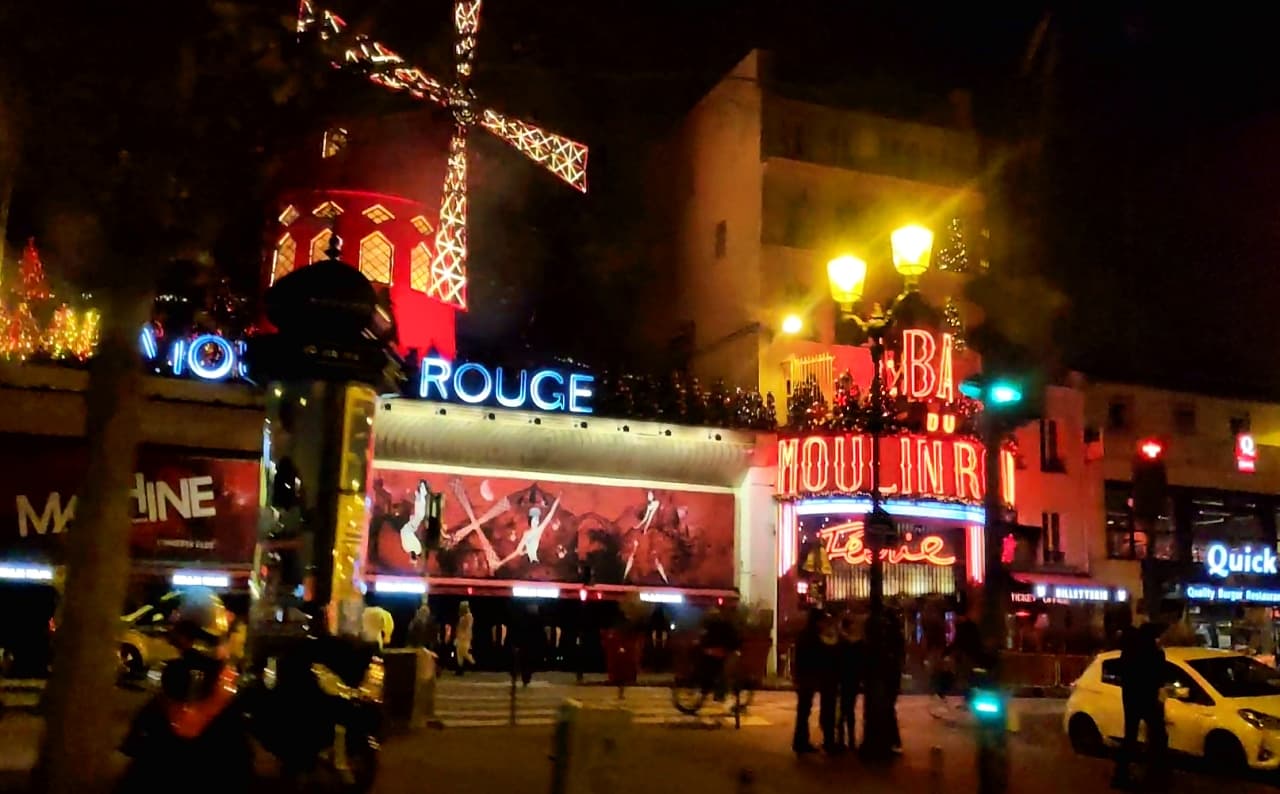
You're standing on the Boulevard de Clichy, right at the foot of Montmartre, and that enormous red windmill in front of you needs no introduction. This is the Moulin Rouge — probably the most famous cabaret in the world, and the building that turned this neighbourhood from a scruffy hilltop village into the entertainment capital of Paris.
The Moulin Rouge opened on the sixth of October, eighteen eighty-nine, just five months after the Eiffel Tower debuted at the World's Fair. Two showbiz hustlers — Joseph Oller and Charles Zidler — threw open the doors at eight pm sharp, even though the construction wasn't actually finished. They didn't care. They wanted a temple dedicated to women, dance, and spectacle, and that's exactly what they built. On opening night, this was the first building in Paris to blaze with electric lights — imagine the effect on a city still lit mostly by gas lamps. People came from across the river just to gawk at the glow.
Read more...Show less
But the real draw was the can-can. The dance had been kicking around Parisian ballrooms since the eighteen twenties, evolving out of the final figure of the quadrille, but it was here that it became the high-kicking, skirt-flying spectacle the world knows today. And the woman who made it legendary was Louise Weber, better known as La Goulue — "the glutton." She got the nickname as a teenager for swiping drinks off customers' tables while she danced. By the time she headlined the Moulin Rouge, she could kick a man's hat off his head with her foot and catch it. She was fearless, scandalous, and the highest-paid entertainer in Paris.
Then there was the artist who made all of this immortal — Henri de Toulouse-Lautrec. In eighteen ninety-one, Zidler hired the young painter to design a poster featuring La Goulue. Three thousand copies went up across Paris, and the bold, flat style was so striking that people literally peeled them off the walls to keep. Toulouse-Lautrec became famous overnight, and his posters basically invented modern advertising.
The original building burned down on the twenty-seventh of February, nineteen fifteen, and it took six years to rebuild, reopening in nineteen twenty-one. But the spirit never changed — it's still a working cabaret, still doing two shows a night.
Quick tip: if you're hungry, Bouillon Pigalle is a five-minute walk from here — a gorgeous Belle Epoque dining hall with old-school French dishes at surprisingly reasonable prices. Perfect fuel before the climb ahead.
Alright, let's start walking uphill. Head east along the Boulevard de Clichy, then turn left up Rue Lepic. This is one of Montmartre's most famous streets, and it winds its way up the hill like a corkscrew. After about two hundred metres, you'll see our next stop on your left.
Café des Deux Moulins
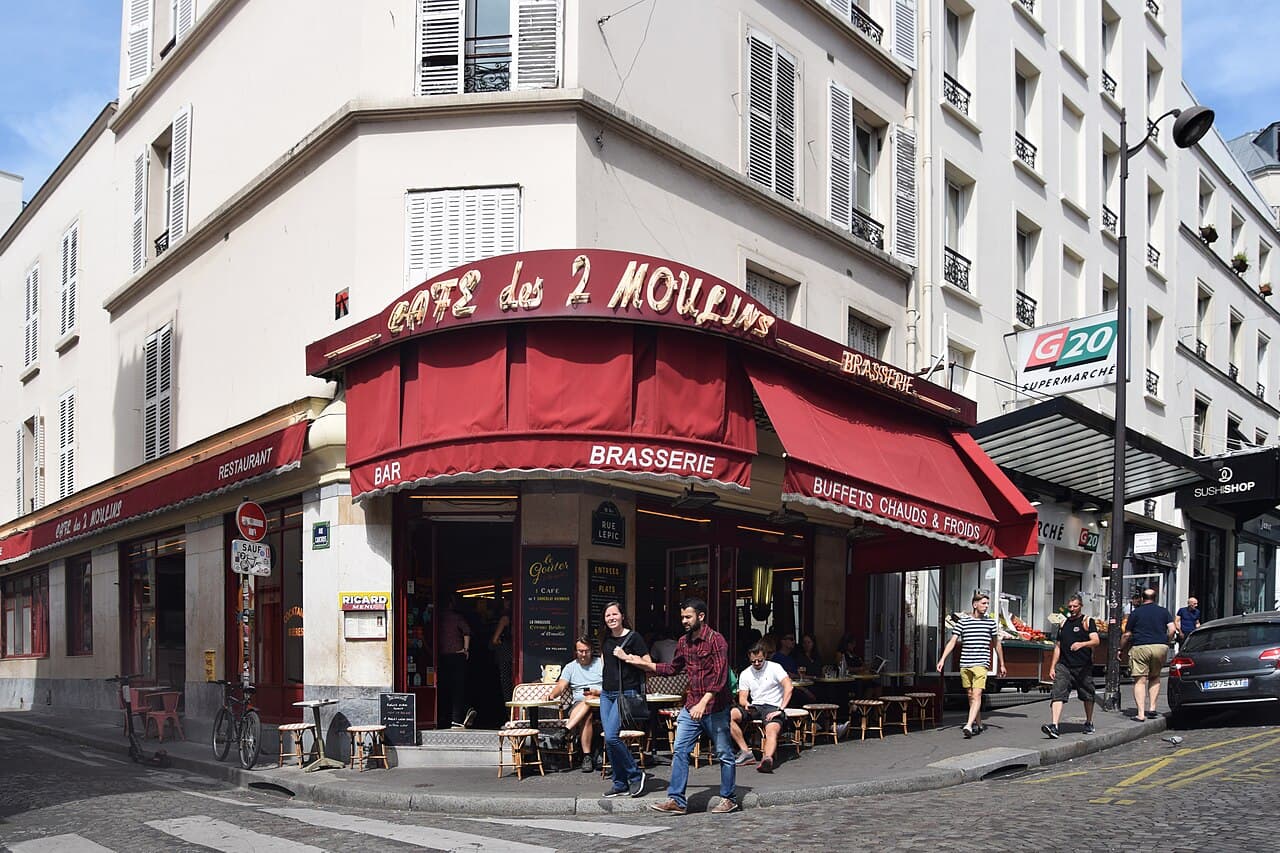
See that little corner cafe with the red awning and the zinc counter gleaming through the window? This is the Cafe des Deux Moulins — the Cafe of the Two Windmills — and if you've seen the movie Amelie, you already know this place. This is where Audrey Tautou, playing the shy, pixie-haired Amelie Poulain, worked as a waitress, cracking creme brulees with a spoon and quietly scheming to fix the lives of everyone around her.
The cafe takes its name from the two windmills nearby — the Moulin Rouge down the hill and the Moulin de la Galette up on the ridge, which we'll visit shortly. It's been here since nineteen eleven, more than a hundred years, and it's kept its zinc counter, its red banquettes, and that unmistakable Parisian bistro atmosphere through all of it.
Read more...Show less
Then in the spring of two thousand, director Jean-Pierre Jeunet showed up with his cameras and Audrey Tautou and transformed this corner into one of the most beloved locations in film history. Amelie was released in France on the twenty-fifth of April, two thousand and one, and it became the biggest worldwide hit in French cinema history, earning over thirty-three million dollars in the United States alone — in limited release, in a foreign language, with subtitles. That never happens.
Step inside and you'll see they've kept a few nods to the film — photos on the walls, maybe a small display — without turning the place into a theme park. The tobacco counter where Georgette, the hypochondriac colleague, fussed over her health was removed in two thousand and two when the cafe changed ownership, but the bones of the place are exactly the same. Order a cafe creme, sit at the counter, and you're basically on a film set that also serves very good coffee.
Here's what I love about this spot. Amelie wasn't just a movie — it was a love letter to Montmartre. Jeunet digitally removed graffiti and litter from the neighbourhood to make it look like a storybook version of Paris. The real Montmartre is scruffier, louder, and honestly better. But this cafe is the bridge between the two — real enough to feel authentic, charming enough to make you understand why the whole world fell for it.
If you're peckish, the croque monsieur here is solid, and yes, you can get a creme brulee. You'd be a monster not to.
When you're done, continue up Rue Lepic. The street gets steeper here, curving to the right. After about three hundred metres, look for number fifty-four on your right. There's no plaque — just a regular apartment building. But what happened inside changed the history of art.
Van Gogh's Apartment
Stop here and look up at this unassuming apartment building — fifty-four Rue Lepic. No museum, no gift shop, no queue. Just a Parisian residential building with shuttered windows and a wrought-iron balcony. But between eighteen eighty-six and eighteen eighty-eight, on the third floor of this building, two Dutch brothers shared a cramped apartment that would change the trajectory of modern art.
Vincent van Gogh moved in with his younger brother Theo, an art dealer, in the early spring of eighteen eighty-six. The apartment had three rooms, a small cabinet where Vincent slept, and a tiny kitchen. Vincent turned a room at the back into his studio. Imagine the scene — canvases everywhere, the smell of turpentine and linseed oil, and two brothers navigating the tension between a struggling painter and a patient sibling who was also his only financial lifeline.
Read more...Show less
Here's the thing that blows me away about this address. When Vincent arrived in Paris, he was painting dark, earthy scenes of Dutch peasants. When he left two years later, he was Vincent van Gogh — bold colour, swirling brushstrokes, the style that would define post-Impressionism and influence every artist who came after. What happened? Montmartre happened. In this neighbourhood, he met Toulouse-Lautrec, Gauguin, Pissarro, Signac, and Emile Bernard. He discovered Japanese prints. He absorbed Impressionism and Pointillism and then blew right past both.
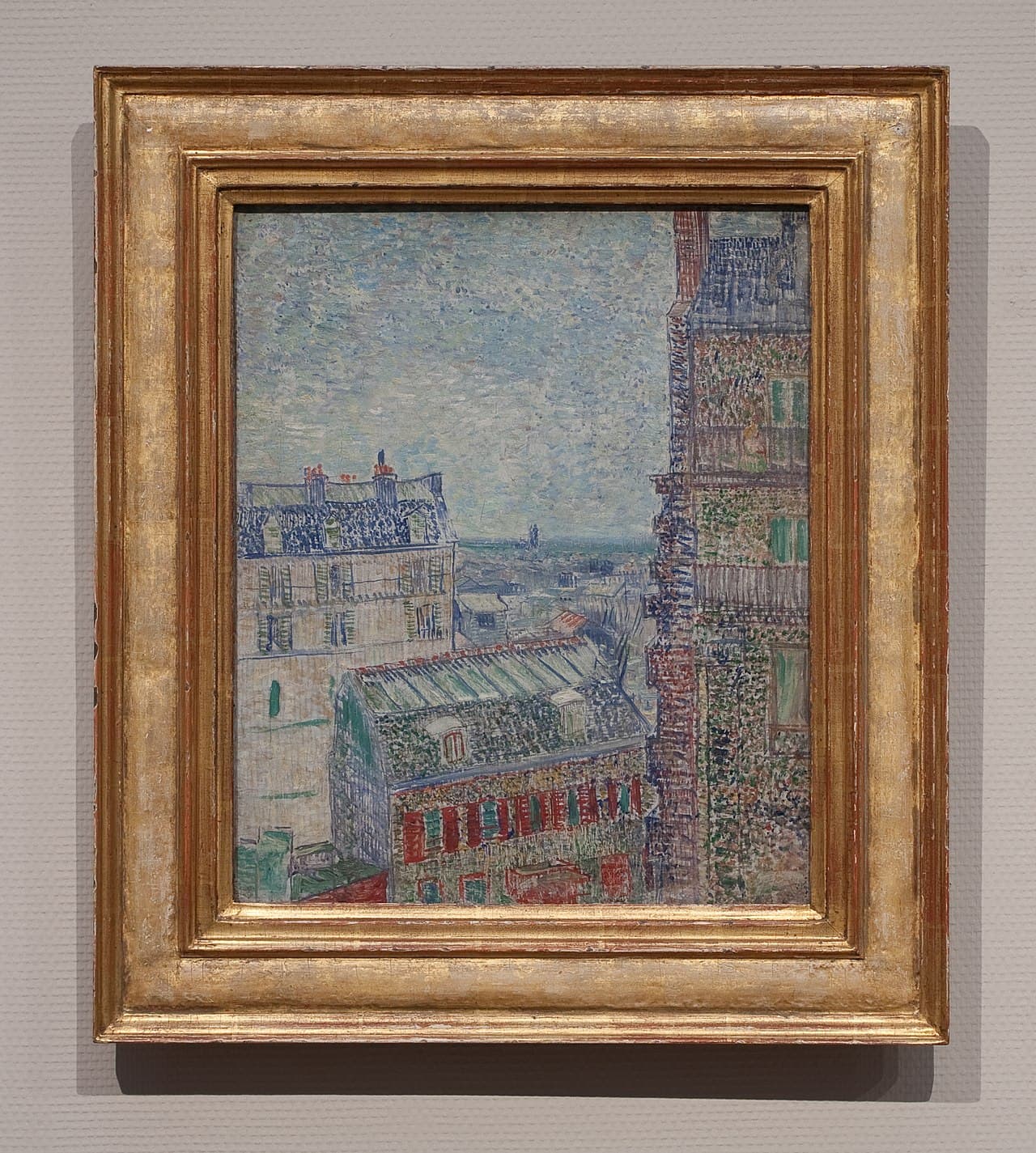
During his two years in Paris, Vincent painted roughly two hundred and thirty works — the most prolific period of his entire life. He painted the view from this very window multiple times, looking out over the rooftops of Montmartre. But he preferred being outside, painting the windmills, the vegetable gardens on the hillside, the cafes, and the people.
By February eighteen eighty-eight, Vincent was exhausted by city life. He craved brighter light and the peace of the countryside. On the nineteenth of February, he left this apartment for Arles, in the south of France, where the sun was fierce and the colours were even bolder. He never came back to Paris. He had two years and four months left to live.
Theo stayed in the apartment, continuing to support his brother financially and emotionally by letter. Those letters — over six hundred and fifty of them — are now one of the most important documents in art history.
Keep walking up Rue Lepic. The street bends sharply to the left ahead. Follow it around the curve and then take Rue Ravignan on your right. At the top, you'll find a small, sloping square called Place Emile Goudeau. Look for a building with a plaque on your left.
Le Bateau-Lavoir
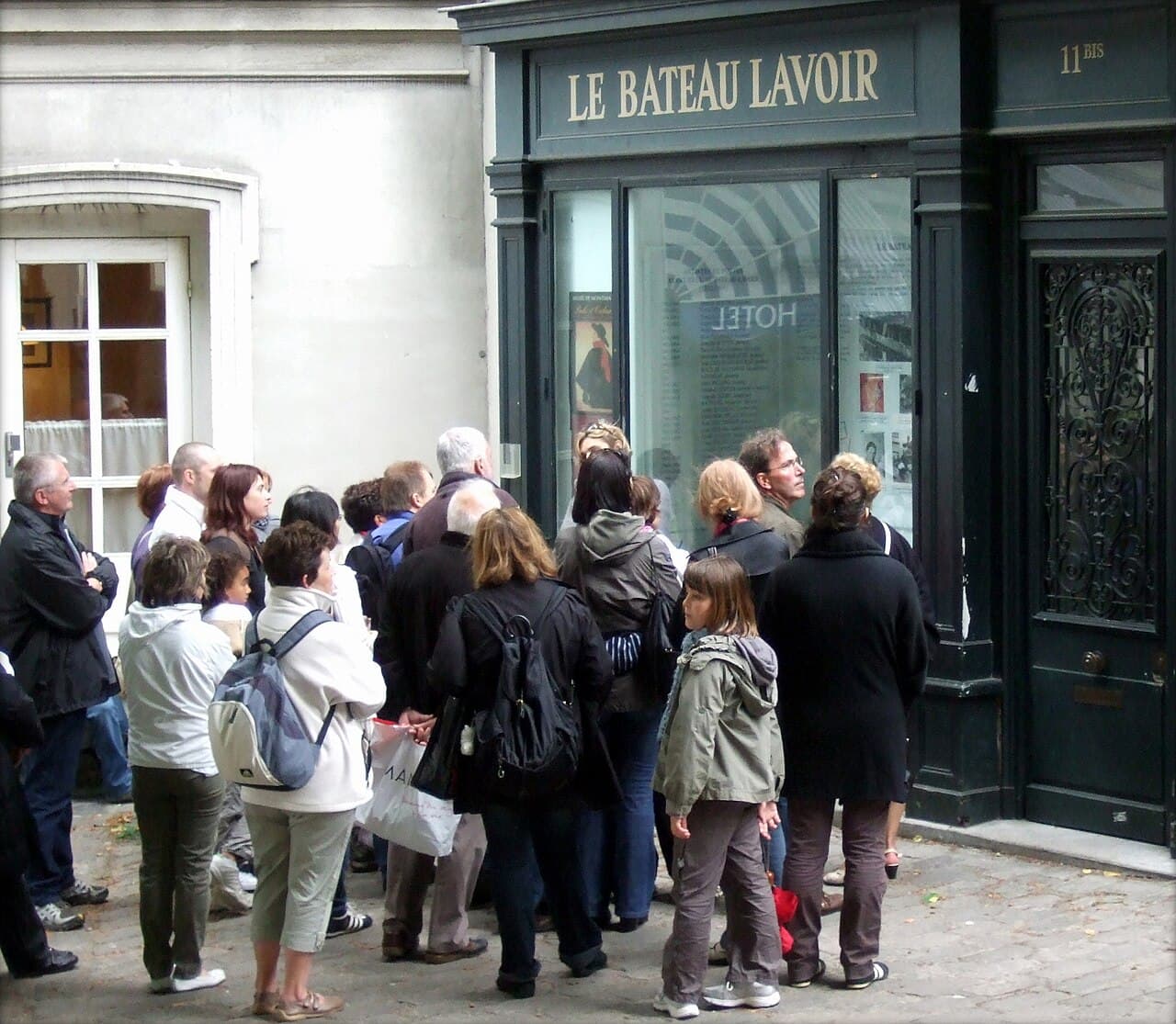
Welcome to Place Emile Goudeau, one of the most important squares in the history of modern art — and almost nobody knows it. That building on your left, at number thirteen Rue Ravignan, is Le Bateau-Lavoir, and what happened inside these walls is as significant as anything that happened in the Louvre.
The name means "the laundry boat," coined by the poet Max Jacob because the rickety wooden building swayed in the wind and reminded him of the floating laundry barges on the Seine. It was a warren of cheap studios divided by thin plaster and wood partitions — freezing in winter, suffocating in summer, and perpetually reeking of turpentine and unwashed artists. The rent was almost nothing, which was exactly the point.
Read more...Show less
In nineteen oh four, a twenty-three-year-old Spaniard named Pablo Picasso moved in. Over the next five years, he would work here in near-poverty, surrounded by a rotating cast of painters, poets, and troublemakers who would collectively reinvent what art could be. Amedeo Modigliani drifted through. Juan Gris lived here. The poet Guillaume Apollinaire was a regular. Gertrude Stein sat for her portrait in Picasso's studio in nineteen oh six — eighty or ninety sittings, she claimed, and in the end Picasso painted her face from memory after scrapping the version she'd posed for.
But the masterpiece created here — the painting that cracked open the twentieth century — was Les Demoiselles d'Avignon, finished in nineteen oh seven. Five nude women, their faces fractured into angular planes inspired by African masks and Iberian sculpture. It was so shocking that even Picasso's friends hated it. He rolled it up and didn't show it publicly until nineteen sixteen. Today it hangs in the Museum of Modern Art in New York, and art historians call it the first truly modern painting. It was painted right here, in a studio you could barely stand up straight in.
The original building was mostly destroyed by fire in May of nineteen seventy. Only the facade survived, and it was completely rebuilt in nineteen seventy-eight. So what you're looking at is a reconstruction — but the ground beneath your feet is the real thing.
Now, from this square, take Rue Ravignan uphill, then turn left onto Rue Norvins. After a short walk, turn right onto Rue Lepic again. You'll see the sails of a windmill peeking above the rooftops. That's our next stop.
Moulin de la Galette
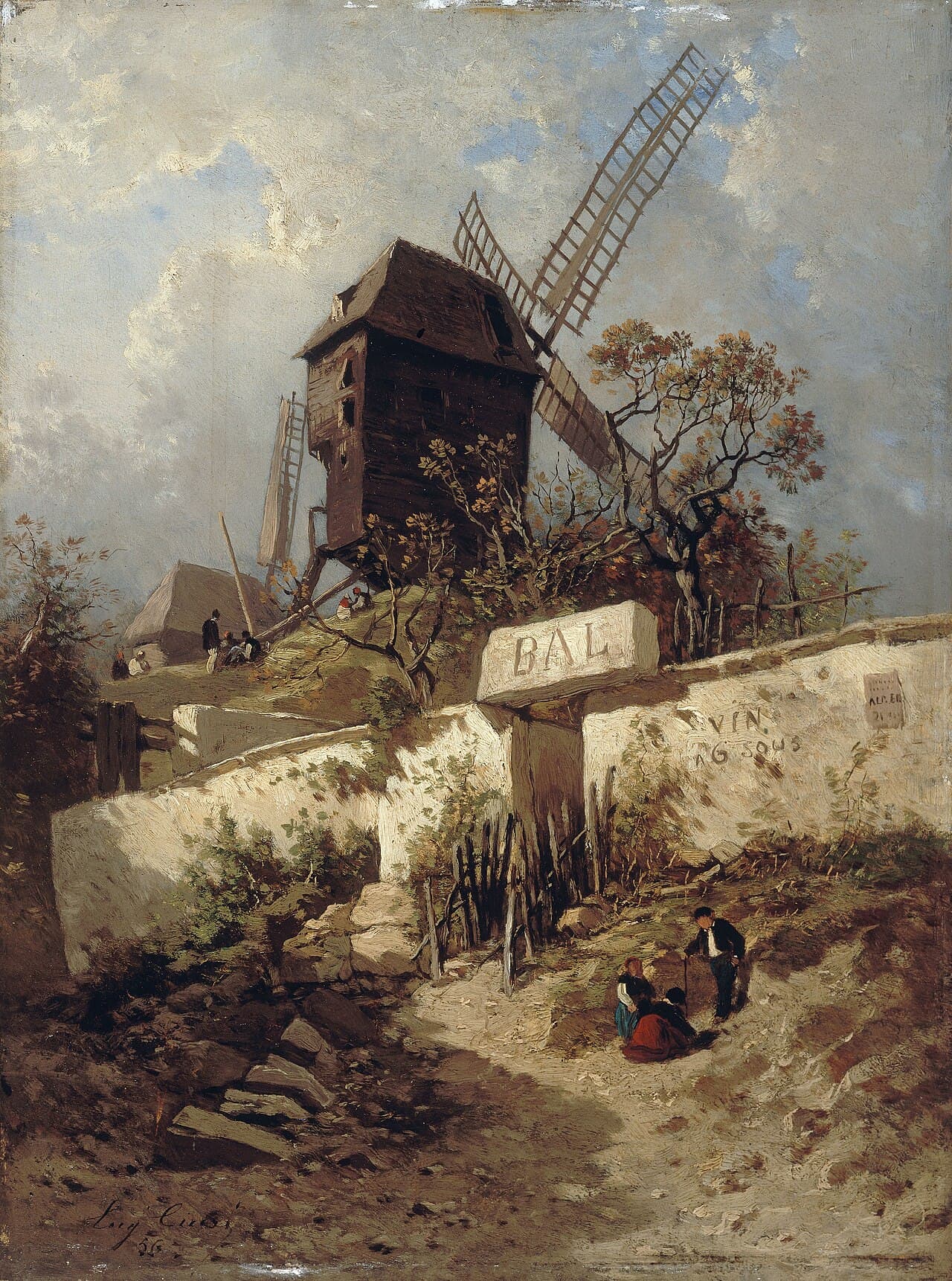
Look up. Those wooden sails turning gently above the rooftops belong to the Moulin de la Galette — one of the last surviving windmills in Paris, and the subject of one of the most joyful paintings ever made.
There were once more than thirty windmills on this hill, grinding grain and pressing grapes. By the time you got to the late eighteen hundreds, only two were left — the Blute-fin, built in sixteen twenty-two, and the Radet, built in seventeen seventeen. The Debray family bought both in eighteen oh nine and used them for milling flour. They baked the flour into galettes — small, dense brown breads — and the galettes became so popular that the windmill itself took on the name. Moulin de la Galette. The Bread Mill.
Read more...Show less
But the Debrays were smart. They realised they could make more money from dancing than from flour. By the eighteen sixty, the grounds around the windmill had become an open-air dance hall — a guinguette — where working-class Parisians came on Sundays to dance, drink cheap wine, and forget about Monday. It was Montmartre's great social equaliser: laundresses dancing with students, seamstresses flirting with clerks.
And in the summer of eighteen seventy-six, a young painter named Pierre-Auguste Renoir rented a studio in a nearby cottage on Rue Cortot and set up his easel right here, in the middle of the Sunday crowd. The result was Bal du moulin de la Galette — a canvas shimmering with dappled sunlight, swirling dancers, and the pure, uncomplicated happiness of a Sunday afternoon. It's now one of the most treasured paintings in the Musee d'Orsay, and it has never left France. A smaller version of the same scene sold at Sotheby's in nineteen ninety for seventy-eight million dollars. That's how much the world values a Montmartre Sunday.
Van Gogh painted this windmill too, during his time on Rue Lepic. So did Toulouse-Lautrec. And Utrillo. And Picasso. This one spot has been immortalised on canvas more times than almost anywhere else in Paris.
Today, the windmill is a private residence — you can't go inside — but the view of it from here, with its wooden sails against the Paris sky, is exactly what those painters saw.
Head along Rue Girardon now. It's a pretty, tree-lined street. After about a hundred metres, you'll come to a small open space where two streets meet. Look for the bronze bust.
Place Dalida
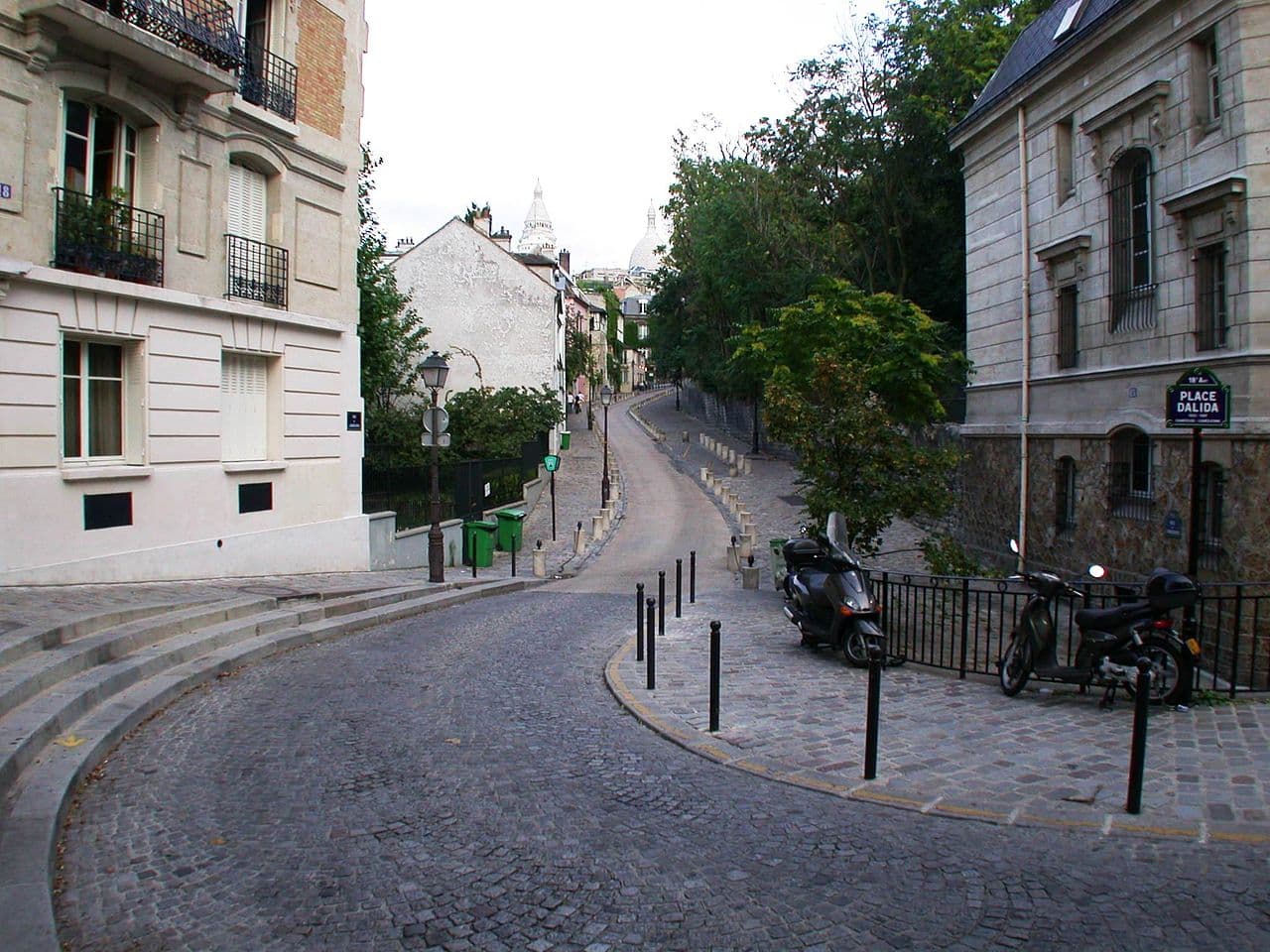
You've arrived at a quiet little square where Rue Girardon meets Rue de l'Abreuvoir, and there she is — a golden bronze bust of a woman with big hair and even bigger cheekbones, gleaming in the light. This is Place Dalida, dedicated to the Italian-French singer who was one of the most beloved entertainers in European history.
Born Yolanda Cristina Gigliotti on the seventeenth of January, nineteen thirty-three, in Cairo, Egypt, to Italian immigrant parents from Calabria, she moved to France and became Dalida — a singer who performed in more than ten languages, sold over a hundred and seventy million records, and lived right here in Montmartre for the last twenty-five years of her life. Her house was at eleven bis Rue d'Orchampt, just a short walk from where you're standing. She bought it in the summer of nineteen sixty-two and it remained her home until her death.
Read more...Show less
The bust was sculpted by the artist Aslan and unveiled on the twenty-fourth of April, nineteen ninety-seven, to mark the tenth anniversary of her death. Look closely at the bronze — you'll notice certain areas are shinier than others. There's a superstition that rubbing the bust brings good luck, and thousands of visitors have polished certain parts to a golden gleam. I'll let you decide which parts.
Dalida's story is extraordinary and heartbreaking in equal measure. She was a massive star across France, Italy, the Middle East, and much of the developing world — far bigger than most English-speaking audiences realise. She won eighty gold records. She sang in Arabic, Italian, French, German, Spanish, Greek, Japanese, Hebrew, Dutch, and English. But her personal life was marked by devastating loss. She struggled with depression for years, and on the third of May, nineteen eighty-seven, she died in her Montmartre home. She was fifty-four.
Montmartre adored her, and she adored Montmartre. This square was created by decree of Paris City Hall on the fifth of December, nineteen ninety-six. It's a tender tribute in a neighbourhood that has always had a soft spot for artists who lived their art a little too intensely.
Now take Rue de l'Abreuvoir downhill. This is one of the most picturesque streets in all of Paris — cobblestoned, narrow, with ivy climbing the walls. After about fifty metres, you'll see a small pink building on the corner. You absolutely cannot miss it.
La Maison Rose
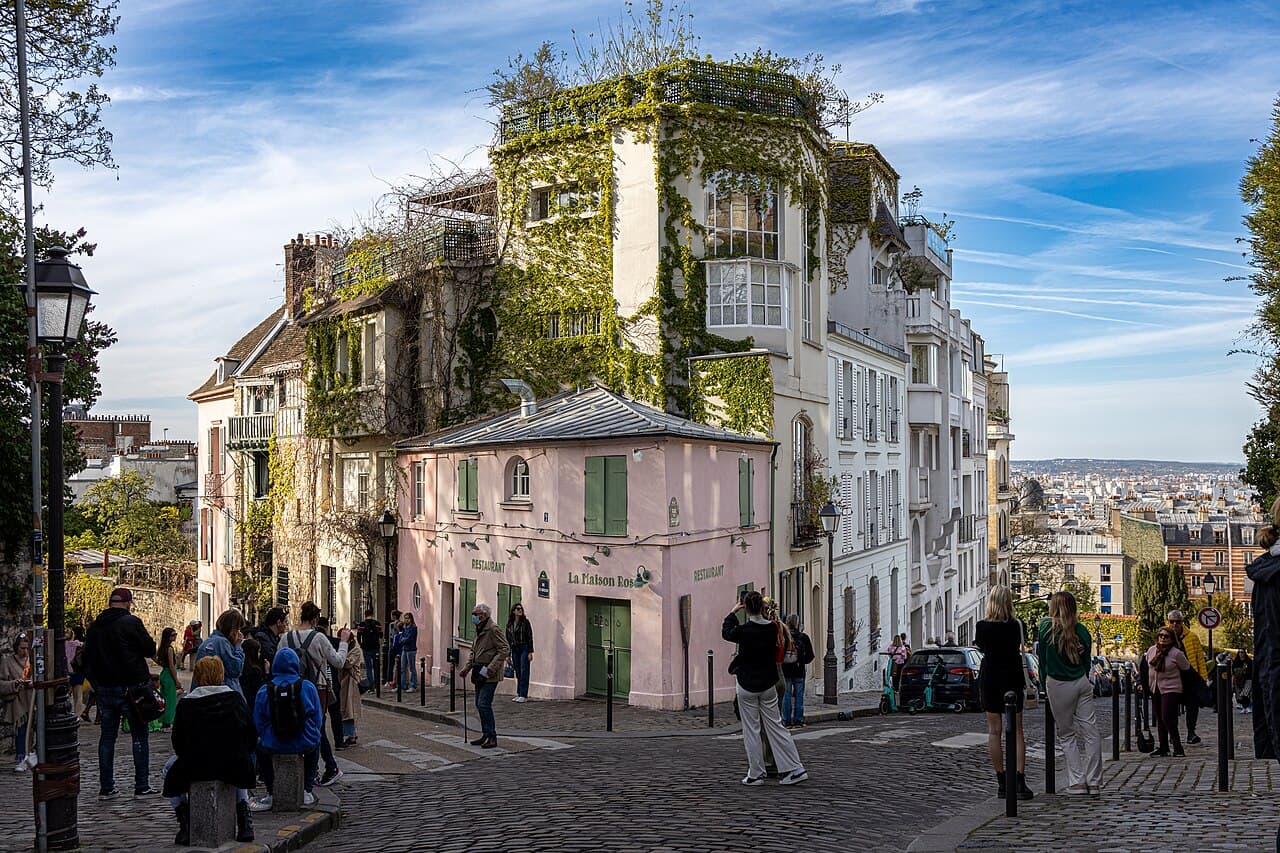
And there it is — the most photographed house in Montmartre, and quite possibly in all of Paris. La Maison Rose — the Pink House — sitting right on the corner of Rue de l'Abreuvoir and Rue des Saules, painted in the exact shade of pink that makes every person who walks past reach for their phone.
This little building was opened as a cafe and boarding house in the early nineteen hundreds by a woman named Germaine Pichot and her husband Ramon, a Catalan painter. The couple had visited Catalonia in Spain and were inspired by the brightly coloured houses they saw there, so they painted their Montmartre cottage pink. It was a bold choice — this is Paris, after all, where the default building colour is "elegant grey" — and it stuck.
Read more...Show less
Germaine and Ramon were at the centre of the Montmartre art scene. Picasso was a regular here. So was the writer Albert Camus, and the painter Suzanne Valadon, who lived just up the street. But the artist most associated with La Maison Rose is Maurice Utrillo, Suzanne's son, who painted this building obsessively through the nineteen twenties and thirties. His painting La Maison Rose a Montmartre turned this corner into an icon. Though in fairness, it was actually his friend Elisee Maclet who painted it first — but Utrillo's version is the one the world remembers.
The building nearly didn't survive. In the early nineteen thirties, a construction project planned for this site would have required the Pink House to be demolished. Somehow, it was saved. It sits on a triangular plot of land, wedged into the corner where two streets meet, and it has remained virtually unchanged on the outside for over a century.
Today it's a restaurant and cafe — go inside if you can. The food is decent French bistro fare, and eating lunch in a room that Picasso and Utrillo used to stumble through is a pretty good flex. The terrace out front, when the weather cooperates, is one of the most charming spots in Paris for a glass of wine.
From La Maison Rose, continue down Rue des Saules. In about thirty metres, look to your right and you'll see something deeply unexpected behind a metal fence — grapevines. Actual grapevines. In the middle of Paris.
Clos Montmartre Vineyard
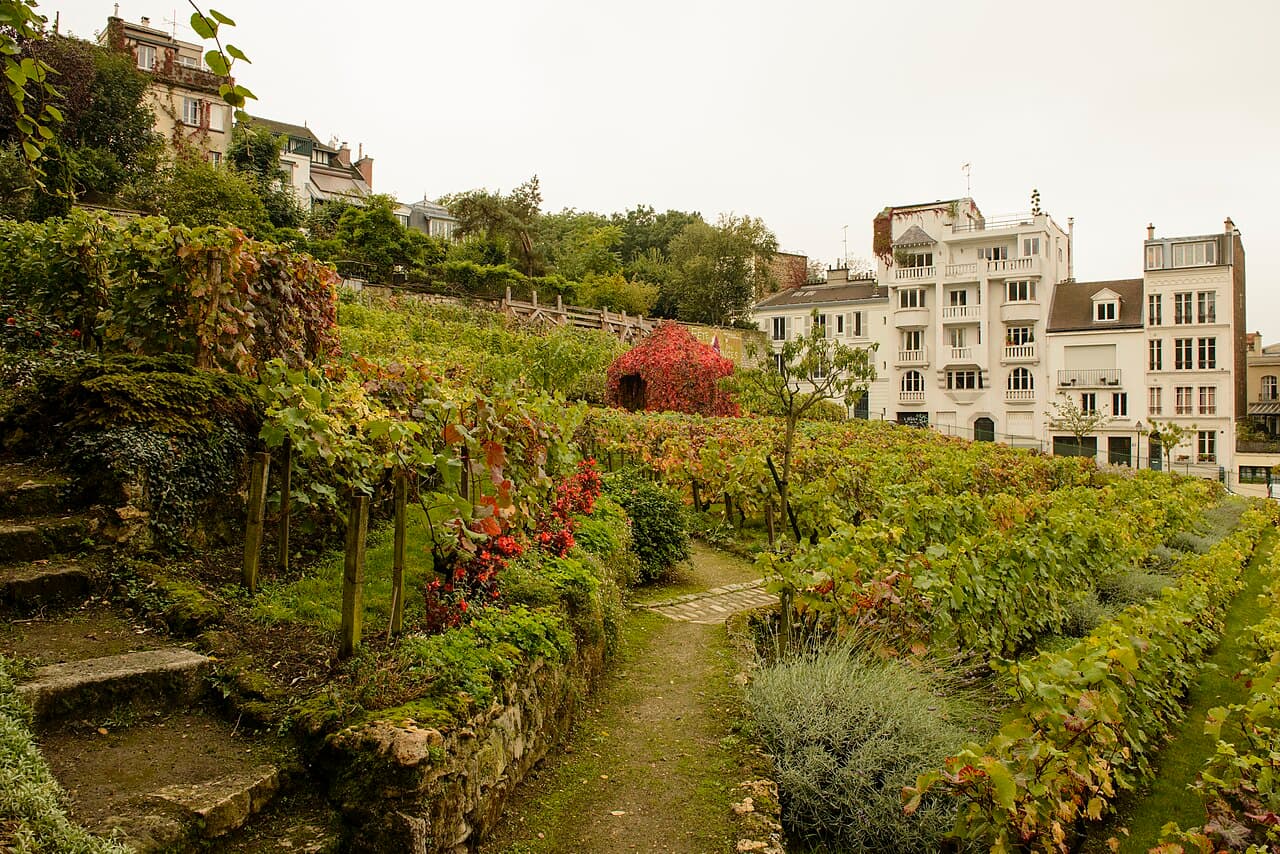
Yes, those are real grapevines. You're looking at the Clos Montmartre — the last remaining vineyard in central Paris, and one of the most delightfully absurd things in this city.
The history of wine on this hill goes back to the twelfth century, when the nuns of the Montmartre Abbey planted the first vines on these slopes. Before the city swallowed the countryside, three-quarters of this hilltop was covered in vineyards. The wine was apparently pretty decent too — appreciated since Gallo-Roman times. But urbanisation did what urbanisation does, and by nineteen twenty-eight, the last vines had been ripped out.
Read more...Show less
Then, in nineteen thirty-three, a group of local artists and activists decided to plant new vines and reclaim a small piece of Montmartre's rural past. The ringleaders included Francisque Poulbot — the illustrator famous for his drawings of cheeky Montmartre street kids — and Adolphe Willette, the artist who designed the original Moulin Rouge facade. They were fighting against developers who wanted to build apartments on this slope. The vines won.
Today, this tiny vineyard covers about fifteen hundred and fifty-eight square metres and is home to more than seventeen hundred and sixty vines planted with twenty-seven different grape varieties. They produce fewer than two thousand bottles a year, and here's the honest truth — the wine is not great. Locals will tell you with a grin that it takes four people to drink a glass: one to pour, one to drink, and two to hold the drinker up. It's a running joke that the Clos Montmartre proves that not all French wine is good French wine.
But that's not the point. Every October, the neighbourhood throws the Fete des Vendanges de Montmartre — the Grape Harvest Festival — and it has been going since nineteen thirty-four. Around four hundred thousand people flood the streets for wine tastings, food stalls, live music, parades, and an elaborate grape-picking ceremony. The wine is auctioned at about forty-five euros a bottle, and every cent goes to social programmes in the eighteenth arrondissement.
So the wine is mediocre, but the cause is excellent. Only in Montmartre.
Keep walking down Rue des Saules. In just a few steps, you'll see a small, rustic-looking building on your left with a painted sign of a rabbit. That's our next stop, and its story is one of the best in Paris.
Au Lapin Agile
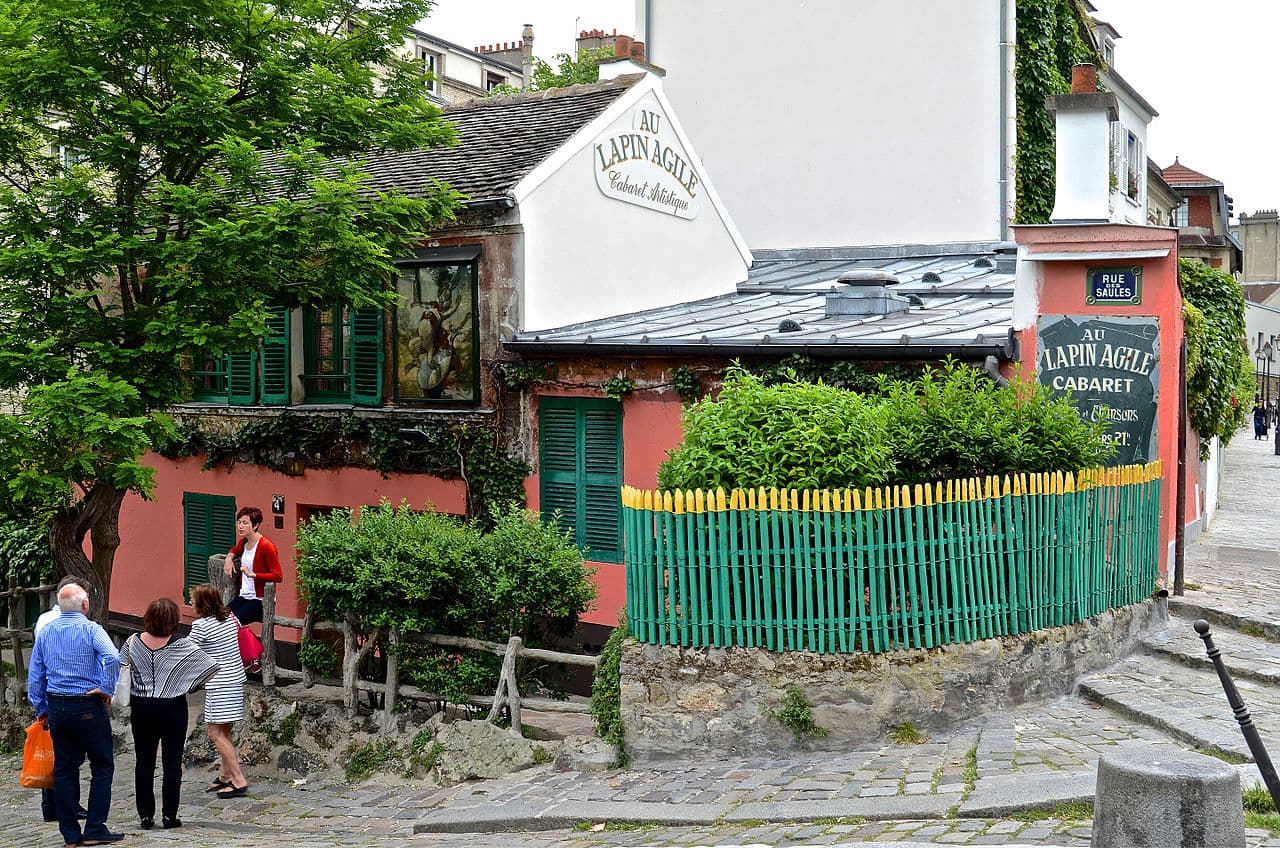
That little stone cottage with the acacia tree out front is Au Lapin Agile, and if Montmartre had a soul, this would be it. It's the oldest surviving cabaret in Paris, and the stories that have come out of this place are absolutely bonkers.
The building has been here since around eighteen sixty. It started life as a rough drinking den called Au Rendez-vous des Voleurs — "the Thieves' Meeting Place." Charming. By the eighteen eighties, its walls were decorated with portraits of famous murderers, and it was rechristened the Cabaret des Assassins. Even more charming. Then, in eighteen seventy-five, the artist Andre Gill painted a sign for the place — a picture of a rabbit leaping out of a cooking pot. Locals started calling it Le Lapin a Gill — "Gill's rabbit." Over time, that slurred into Lapin Agile — the "nimble rabbit." And the name stuck.
Read more...Show less
In the early nineteen hundreds, the singer and cabaret impresario Aristide Bruant bought the place to save it from demolition and handed management to a guitar-playing bon vivant named Frederic Gerard, known as Frede. Under Frede's watch, Au Lapin Agile became the living room of bohemian Montmartre. Picasso drank here. Modigliani drank here. The poet Guillaume Apollinaire held court here. And in nineteen oh five, Picasso painted a self-portrait set inside this very room — a melancholy scene called At the Lapin Agile, with Frede playing guitar in the background. Frede had commissioned it, probably to settle Picasso's bar tab. The painting hung on these walls until nineteen twelve, when it was sold to a German collector. In nineteen eighty-nine, it sold at Sotheby's for forty point seven million dollars. Forty million dollars for a painting that was originally worth a few rounds of drinks.
But wait — the best story here involves a donkey. In nineteen ten, the writer Roland Dorgeles decided to play a prank on the pretentious art world. He borrowed Frede's donkey, Lolo, tied a paintbrush to her tail, and fed her carrots. Every time she munched, her tail wagged, and the brush swiped across a canvas. Dorgeles titled the resulting painting Sunset Over the Adriatic, signed it "Joachim-Raphael Boronali" — an anagram of Aliboron, the French word for a foolish donkey — and submitted it to the Salon des Independants. It was accepted, exhibited, praised by critics, and sold for four hundred francs. Then Dorgeles revealed the truth, and Paris nearly died laughing.
Au Lapin Agile is still a working cabaret. Shows run Tuesday through Sunday evenings, with French chanson, poetry, and folk music performed in a room that hasn't changed much since Picasso's day. It costs about thirty-five euros and includes a drink. Honestly, it's one of the most authentic experiences left in Montmartre.
Head back up Rue des Saules and turn right onto Rue Norvins. Follow it until you reach a busy, crowded square filled with easels and portrait artists. You've arrived at the tourist epicentre of Montmartre.
Place du Tertre
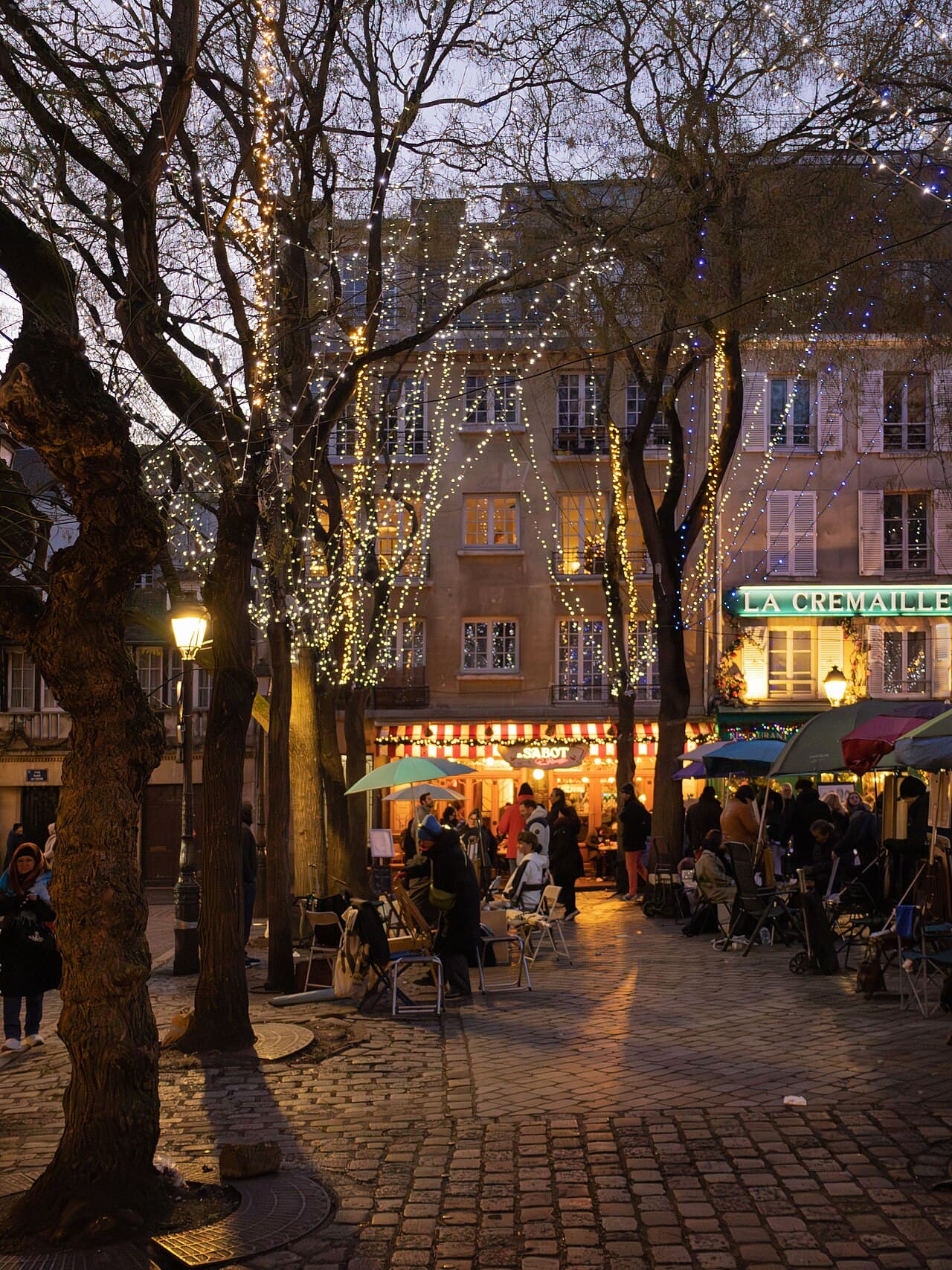
Welcome to Place du Tertre — the Artists' Square — and yes, it is absolutely heaving with people. Easels everywhere, portrait artists calling out to you, watercolours of Sacre-Coeur drying in the sun, and the gentle sound of a hundred tourists being overcharged simultaneously. But don't let the circus put you off. This square has real history, and underneath the tourist veneer, it still has real charm.
This was the central square of the old village of Montmartre, and it has been a public gathering place since sixteen thirty-five, when it was opened by the Benedictine nuns of the Montmartre Abbey — an abbey founded all the way back in eleven thirty-three by King Louis the Sixth. For centuries, this was just a sleepy village square on a hilltop above Paris.
Read more...Show less
Then the artists arrived. From the late eighteen hundreds through the Belle Epoque, Montmartre was the cheapest neighbourhood in Paris, and that attracted every broke painter, songwriter, and poet in the city. Toulouse-Lautrec worked nearby. Utrillo painted these buildings obsessively. Van Gogh walked through here on his way home to Rue Lepic. Picasso was steps away at the Bateau-Lavoir. This little square was surrounded by genius.
Today, around a hundred and forty licensed artists work the square, and every one of them earned their spot through a jury selection process. Some are genuinely talented portrait artists who can sketch your face in fifteen minutes flat. Others sell mass-produced paintings of the Eiffel Tower. The quality varies wildly, but the spectacle is constant.
Here's my tip: don't get your portrait done right away. Walk the square first. Watch the artists work. The ones who are actually good tend to be quieter — they don't need to shout for customers. And if you do sit for a portrait, agree on the price before the first pencil stroke. Montmartre has been separating tourists from their money since La Goulue was kicking hats off heads at the Moulin Rouge. It's practically a local tradition.
Grab a table at one of the cafes on the square if you can. A glass of Cotes du Rhone and some people-watching from this spot is one of the great pleasures of Paris. Le Cadet de Gascogne on the corner has been here forever and serves a decent onion soup.
When you're ready, leave the square heading east on Rue du Mont-Cenis. After a very short walk, you'll see the enormous white dome of our next stop rising above you. You've been seeing it all day. Now it's time to stand beneath it.
Sacré-Cœur Basilica
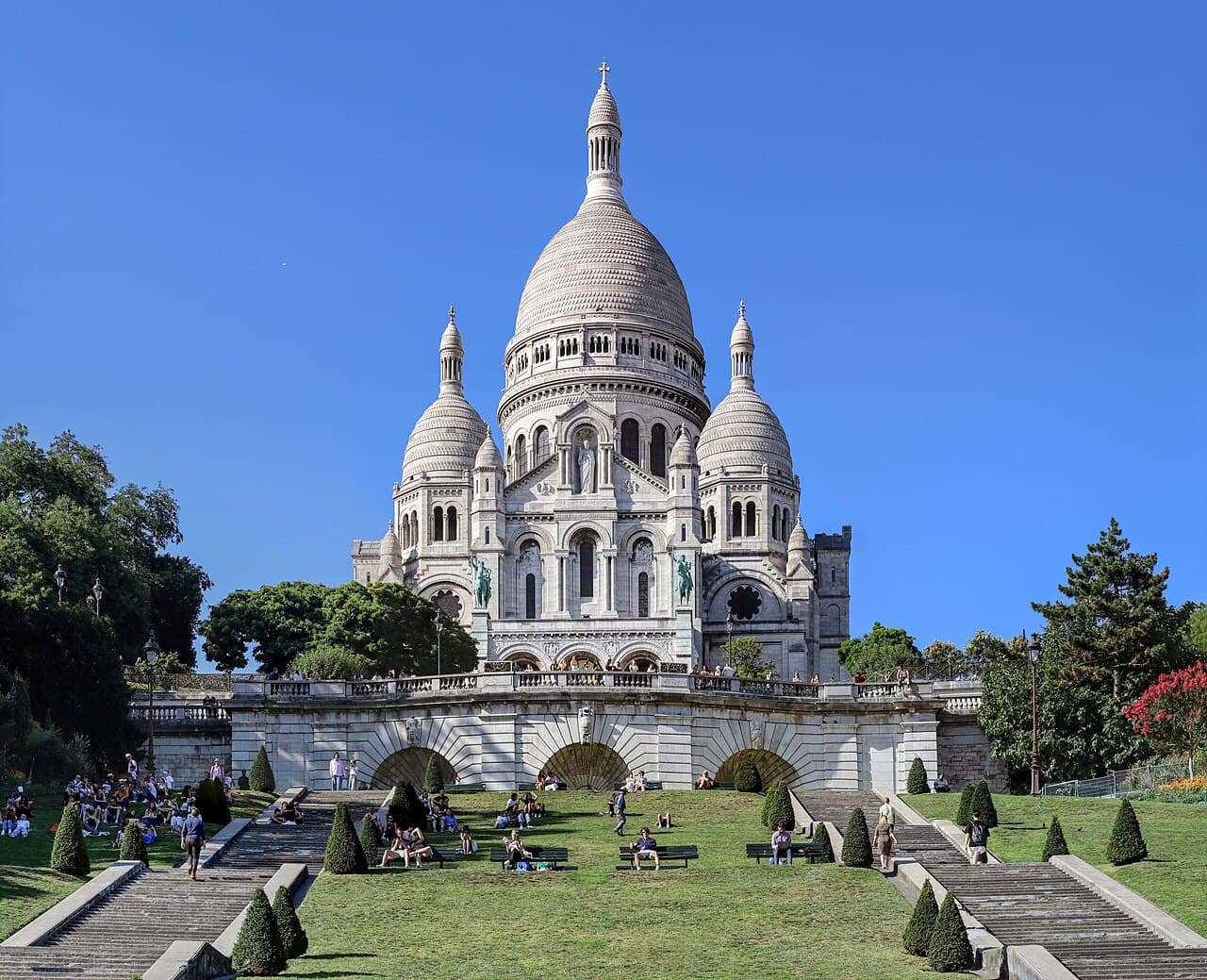
And here it is. The Basilique du Sacre-Coeur — the Basilica of the Sacred Heart — crowning the top of the Butte Montmartre like an enormous white wedding cake. Turn around for a moment before we talk about the building. Look at that view. On a clear day, you can see thirty kilometres in every direction — the Eiffel Tower to the west, the Pantheon to the south, Notre-Dame to the southeast, and the glass towers of La Defense shimmering on the horizon. You are standing at one of the highest points in Paris, a hundred and thirty metres above the Seine.
Now turn back to the basilica. That blinding white stone is the first thing everyone notices, and here's the secret: Sacre-Coeur actually gets whiter with age. The building is made from Chateau-Landon travertine, a limestone quarried in Souppes-sur-Loing, about eighty kilometres south of Paris. When rain hits this stone, it releases calcite, which recoats the surface in a fresh layer of white mineral. While Notre-Dame and the Louvre gradually darken with pollution, Sacre-Coeur just keeps bleaching itself clean. Every rainstorm is a free power wash.
Read more...Show less
The architecture is Romano-Byzantine — a deliberate departure from the Gothic style that dominates Paris. The architect, Paul Abadie, won the competition in eighteen seventy-four, beating out seventy-seven other proposals. His design was inspired by the Hagia Sophia in Istanbul and the Cathedral of Saint-Front in Perigueux. Those four smaller domes clustered around the central dome, the arches, the white stone — it's meant to look ancient and eternal, like something that has always been here.
But the real story of Sacre-Coeur is political, and it's complicated. Construction began in eighteen seventy-five, in the aftermath of two national traumas — France's humiliating defeat in the Franco-Prussian War and the bloody Paris Commune of eighteen seventy-one, when Montmartre itself was the flashpoint of a workers' uprising that ended in a massacre. The basilica was conceived as an act of national penance — the French parliament officially declared in eighteen seventy-three that it was necessary "to efface by this work of expiation the crimes which have crowned our sorrows." Many Parisians, especially on the political left, saw it as an insult — a giant thumb in the eye of the working-class rebels who had died on this very hill. That tension has never fully gone away. To this day, some locals love Sacre-Coeur and others resent it.
Construction took thirty-nine years, five different architects, and a world war. The basilica was completed in nineteen fourteen and finally consecrated on the sixteenth of October, nineteen nineteen.
Step inside if you can. The apse mosaic — Christ in Majesty — covers four hundred and seventy-five square metres, making it one of the largest mosaics in the world. Twenty-five thousand pieces of enamelled and gilded ceramic, all shimmering with gold. Entry to the basilica is free. If you want the full panoramic view, you can climb three hundred steps to the dome for a few euros. It's worth every step.
From the front of the basilica, head downhill via the steps or the funicular. At the bottom of the hill, make your way to the Abbesses Metro station. Just beside it, in a small garden called Square Jehan Rictus, you'll find our final stop — a wall covered in dark blue tiles.
Le Mur des Je T'aime
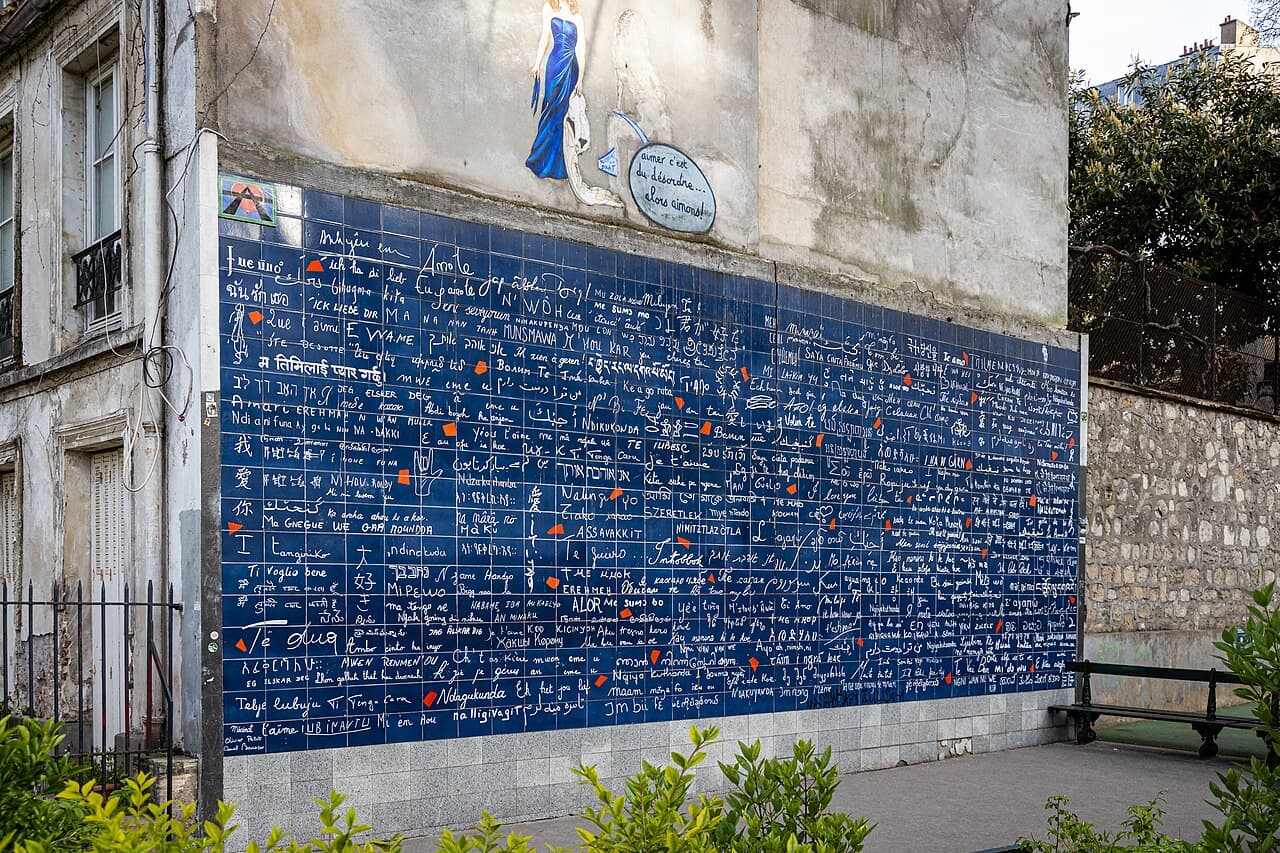
You've made it to the last stop, and it's a love letter — literally. You're standing in the Square Jehan Rictus, a small garden just off Place des Abbesses, and in front of you is Le Mur des Je t'aime — the Wall of I Love You.
This wall was created in the year two thousand by two artists: Frederic Baron, a musician and calligrapher, and Claire Kito, a mural artist. It's made of six hundred and twelve tiles of dark blue enamelled lava stone, and written across them, in white lettering, is the phrase "I love you" — three hundred and eleven times, in two hundred and fifty languages and dialects.
Read more...Show less
Baron started the project in a beautifully low-tech way. He asked his neighbours — Paris being Paris, they came from everywhere — to write "I love you" in their native language on scraps of paper. Then he went further, reaching out to embassy workers, travellers, linguists, anyone he could find. He collected the phrase in over three hundred languages, from French and Mandarin and Arabic to Navajo, Inuit, Bambara, and Esperanto. Claire Kito then assembled all of these declarations onto the lava tiles, and the wall was installed right here in this garden.
Look closely at the tiles. See the splashes of red scattered across the blue surface? Those represent the fragments of a broken heart — the idea being that humanity has been torn apart by conflict and misunderstanding, and this wall is trying to piece us back together, one "I love you" at a time. It's sentimental, sure. But standing in front of forty square metres of declarations of love in every language humans speak — something about it gets past your defences.
The wall attracts about a million visitors a year, and it's become one of the most popular proposal spots in Paris. If you're here with someone special, find "I love you" in your language. If you're here alone, find it in a language you've never heard of and learn something new. The wall is free and open to everyone, always.
And that, my friend, is Montmartre. You've walked from the neon glow of the Moulin Rouge to the sacred silence of Sacre-Coeur, past the studios where Picasso shattered the rules and the apartment where Van Gogh found colour. You've seen a donkey's painting career, a vineyard that makes terrible wine for a wonderful cause, and a pink house that has survived a century of Parisian real estate developers. Not bad for two and a half kilometres.
The Abbesses Metro station is right here — it's on Line twelve, and the entrance is one of only two original Art Nouveau glass canopies designed by Hector Guimard that are still in their original location. One last beautiful thing on your way underground.
Merci, and enjoy the rest of your time in Paris.
Free
GPS-guided walking tour
No account needed. Walk at your own pace.
Free
12 stops · 2.6 km