16 stops
GPS-guided
58 min
Duration
Free
No tickets
About this tour
A guided tour of Père Lachaise Cemetery in France with 16 stops. Highlights include Père Lachaise Cemetery, The Columbarium, and Oscar Wilde.
16 stops on this tour
Père Lachaise Cemetery
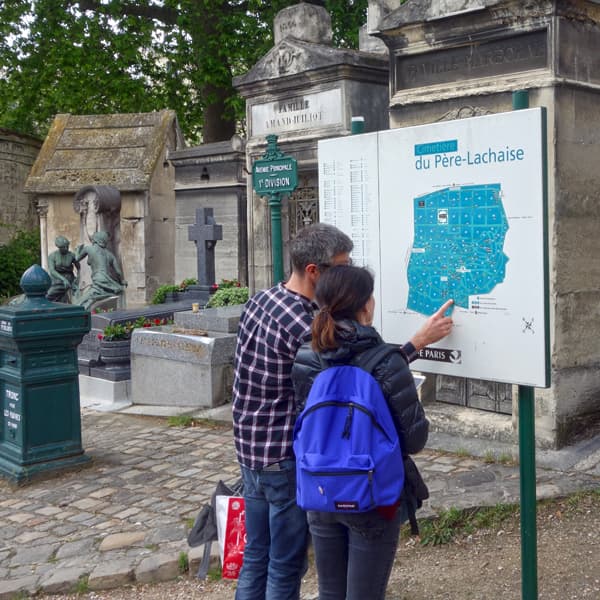
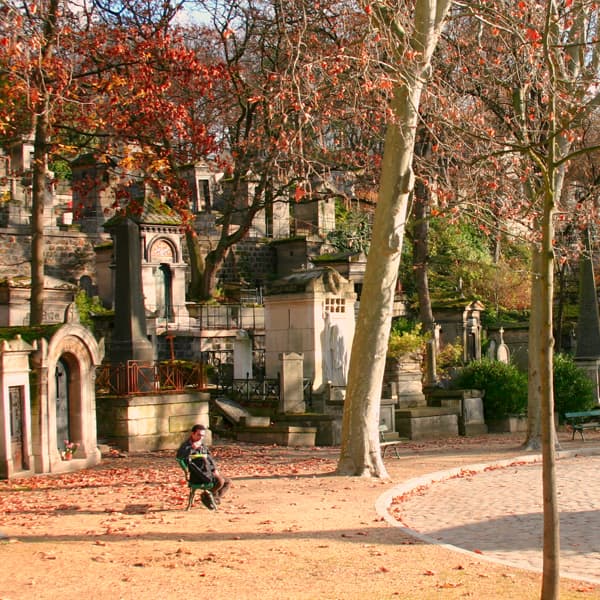
Père Lachaise Cemetery. Enclosed by a wall and dotted with 5,000 trees, Père Lachaise Cemetery is a peaceful oasis in the busy city of Paris. With its narrow streets lined with stone structures, it's almost a city unto itself, a city of a million souls who reside here for eternity. Hi, I'm Rick Steves.
Thanks for joining me on a walk through Père Lachaise Cemetery. Many famous people are buried here. We'll pass by the graves of writers like Oscar Wilde, Gertrude Stein, and the great playwright Moliere. There's the flower-covered memorial to the composer Frédéric Chopin.
Read more...Show less
And we'll see more recent cult icons like the Chantus' Edith Piaf and rock legend Jim Morrison of the Doors. Along the way, we'll enjoy the peace and quiet, the 100-year-old trees, and the elaborate stone monuments. Our walk laces together a dozen big-name graves as we make our way from one end of the cemetery to the other. It's easy to take the bus or metro to the start of our walk.
Then, when you're done, you can catch a bus or metro back to central Paris. Allow at least an hour for the walk, plus more time if you want to seek out other graves. Now, let's get started as we stroll through the car-free streets of this peaceful city of the dead. We'll get up close and personal with some of the best-known citizens of Père Lachaise Cemetery.
To help us along the way, I've invited a good friend and virtual travel buddy. Bonjour, Lisa. Bonjour, Monsieur Steeves. Lisa will give us helpful directions and sightseeing tips throughout the tour.
And my first tip is to be sure you get our tour updates. Just press the icon at the lower right of your device. You'll find any updates and helpful instructions unique to this tour. Things like closures, opening hours, and reservation requirements.
There's also tips on how to use this audio tour and even the full printed script. Yes, so pause for just a moment right now to review our updates and special tips. It's okay, we'll wait. And then... Let the tour begin! The tour begins
Tour Begins: Porte Gambetta
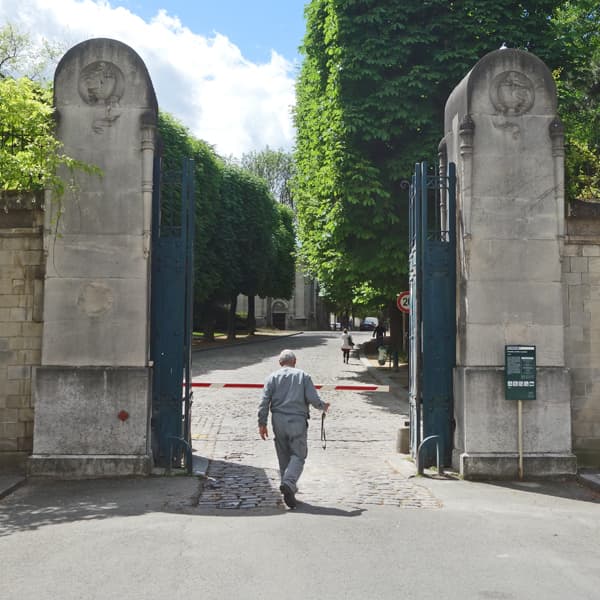
entering at Port Gambetta. Start the tour at the Port Gambetta entrance. It's at the northeast edge of the cemetery. You can get there by taking the metro to the Gambetta stop or bus number 69 to Place Gambetta.
From Place Gambetta, it's a two-block walk past McDonald's and up Avenue du Père Lachaise to the cemetery gate. Near the entrance, you can buy maps that have more detail than ours. And there's a rare WC just inside the entrance. On our walk, we'll enter here at Port Gambetta, sightsee downhill, and exit at Port Principal, which is near bus and metro stops.
Read more...Show less
Now, let's enter through the Port Gambetta gate. Walk straight up the lane called Avenue des Combattants Étrangers. Rick? As you pass through the gate, you enter a different world.
Paris' noisy boulevards give way to quiet lanes. They're lined with trees, graves, and memorials. As we'll discover, many different kinds of people are buried here. This street, for example, is lined with memorials dedicated to foreigners who fought for France in its two world wars.
Armenians, Poles, Italians, and Russians. Keep going uphill. We're headed for the first cross street where there's a big stone building on the corner. When you reach the cross street, don't turn.
Just continue straight ahead on Avenue des Combattants. Straight ahead. Gotcha. I recommend following Lisa's directions very carefully and using the GPS.
And using our map. This is a huge cemetery with thousands of graves and countless streets and little paths. The street names can be confusingly similar. Though you'll be tempted to explore, it's easy to get lost.
And they bury you where they find you. Rick! As you pass the building on your left, look to the left. You'll get a nice view of an impressive white-striped stone building topped with a dome. This is our first sight, the Columbarium. The Columbarium.
The Columbarium
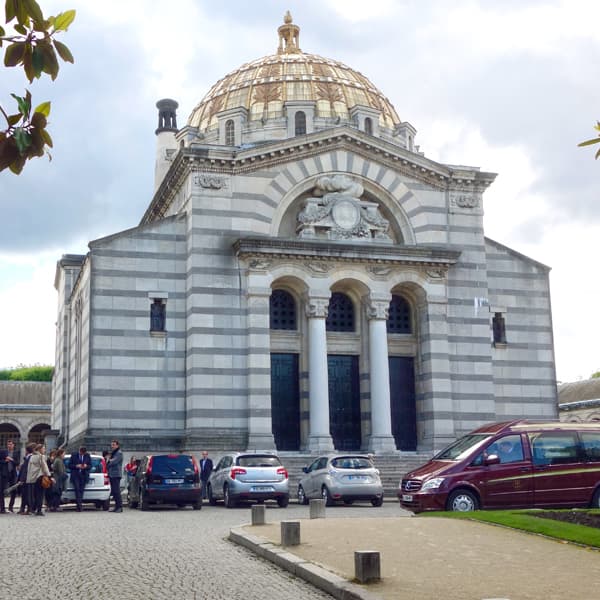
This complex of buildings consists of a crematorium That's where bodies are burned to ash. and a columbarium where urns with the ashes are stored. The main building is marked by a dome with a gilded flame. The chimneys on top are still used in cremation.
To the right and left of it are rows of arcades. These have old buildings, and they have over 1,000 cubicles for housing the urns with cremated remains. Underground, beneath the courtyard, there are about 12,000 more niches. Each cubicle has a plaque with the name of the deceased.
Read more...Show less
They're often decorated with flowers, real or artificial, left by loved ones. A couple of famous American-born artists lie here. The free-spirited dancer Isadora Duncan has a niche to the right. And underground, you'd find Maria Callas, the opera diva known for her flair for drama.
Both onstage and off. Let's move on to our next site, the tomb of Oscar Wilde. To get to Wilde, start by backtracking the way you came. As we'll see on our walk, the columbarium may be the most impressive structure in Père Lachaise, but it's hardly the most typical.
When you reach that cross street, turn right. So, to repeat, retrace your steps and turn right at the street called Avenue Transversal No. 3. Got it.
Start heading about 100 yards down the avenue. As you walk down Transversal No. 3, you'll get an idea of the variety of graves we'll see here at Père Lachaise. There are cremated remains like we just saw, but cremation was rare and frowned upon by the Catholic Church.
More common was what's around you now, the basic burial in the ground topped with a headstone with an epitaph. Just a heads-up on directions. We'll be turning left. Not at the first street, but the second left.
The most distinctive kind of grave here at Père Lachaise is the mausoleum. It's also called a sepulcher or vault or tomb or funeral chapel. A mausoleum is a small, above-ground structure like a little house where the dead person's remains are placed. A family might build one of these small chapels to house several generations of loved ones.
By now, you should be approaching the street where we'll turn left. So, turn left on Avenue Carrette. Go about a half block down Avenue Carrette Père Lachaise Cemetery was opened in 1804 by Napoleon. It was part of Napoleon's grand plan to locate cemeteries outside of the city limits for hygienic reasons.
The cemetery was named for a well-known priest who once lived here, Father, or Père, François Lachaise. His job had been listening to King Louis XIV's sins. He must have been a good listener. What began as just another humble cemetery would soon become home to some of the world's most famous, and infamous people.
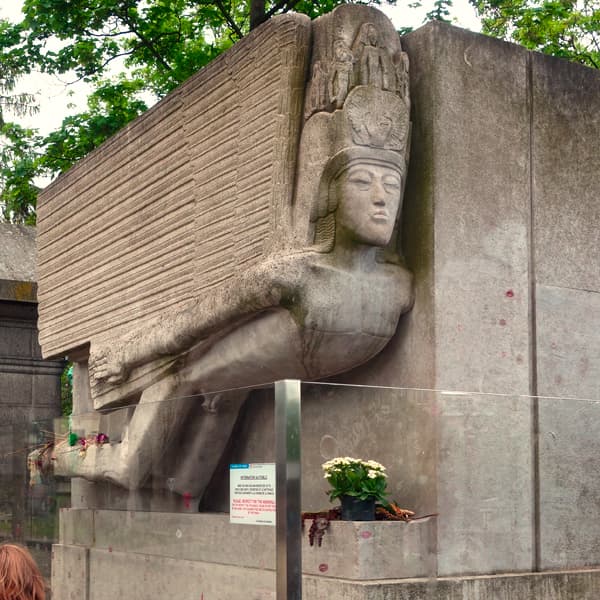
Including the man coming up next. On the left-hand side of Avenue Carrette is a rectangular, gray, block-of-stone monument. It's adorned with heavy-winged angels trying to fly. The tomb of Oscar Wilde.
Oscar Wilde
While the famous novelist and playwright Oscar Wilde was Irish, he's buried here because he spent his final years in Paris. Back in the 1890s, Wilde was the toast of London. His novel, The Picture of Dorian Gray, was a bestseller. His play, The Importance of Being Earnest, was playing on the West End.
He'd even toured America, speaking to packed houses. He was known everywhere for his flamboyant clothes and outrageous wit. Be yourself, Wilde once said. Everyone else is taken.
Read more...Show less
He also said, I can resist everything except temptation. In 1895, at the peak of his fame, a scandal broke. It was discovered that Wilde had been having a secret homosexual love affair with an English aristocrat. Wilde was arrested, tried, and sentenced to two years in prison on the charge of gross indecency.
Wilde's wife abandoned him, even refusing to let him ever see their children again. After he'd served his time in prison, Wilde was exiled from England and settled in Paris. He was a poor and broken man, living in a shabby hotel on the left bank. There, he caught an ear infection, and his health declined rapidly.
Alas, he joked to a friend, I am dying because of you. Beyond my means. He died in the year 1900, age 46. Among his last words in the run-down hotel, Either this wallpaper goes, or I do.
Today, Wilde has become a kind of martyr to homosexuality. His grave is now a gathering place. As the inscription on the tomb says, Wilde is mourned by outcast men. Fans come from all over the world to kiss the tomb, leaving heavy lipstick marks.
But these days, it's behind protective glass. Check out the backside of the tomb. There's a short resume of his life. Despite his ordeal, Wilde remained true to his Christian faith.
An inscription on the tomb affirms that, quote, he died fortified by the sacraments of the church. Maybe so, but I like another of his quotes. I don't want to go to heaven, he said. None of my friends are there.
Let's continue our walk. Next up is another writer, Gertrude Stein. It'll take a few minutes to get there. Lead us, Lisa.
Aprevu. From Wilde, continue ahead along Avenue Carrette to the end of the block. By the way, when Wilde was buried in this cemetery in the early 1900s, Père Lachaise was still just another cemetery. When it opened back in 1804, it was a common graveyard, too far from the city and not even sanctified by the church.
No one wanted to be buried here. Then the cemetery owners came up with a brilliant marketing plan. They dug up famous Parisians from elsewhere and reburied them here. It worked.
It sure did, and by the late 1800s, Paris' rich were just dying to be buried here alongside other famous Parisians. Eventually, it would attract even international celebrities. At the end of the block, turn right. This puts you heading down Avenue Circulaire.
The cemetery has expanded several times. Adding the columbarium and crematorium made it possible for more people to be buried here. Families, added bunk bed shelves to their mausoleums to squeeze more people in. Today, the cemetery has about 70,000 tombs, houses a million souls, and covers 100 acres.
Bigger than Disneyland. Keep going down Avenue Circulaire. Père Lachaise has become a kind of national cemetery to remember important events. For example, on your left, keep an eye out for several monuments that remember French airline tragedies.
The memorial with four statues standing slabs marks the Sharm el-Sheikh crash of 2004. That's when a plane went down in Egypt killing 135 people, mostly French tourists. Keep walking. You'll pass by other airline monuments.
A crash in Venezuela in 2005 took the lives of 152 French citizens. Another remembers a flight that blew up over Niger in 1989, killing 54 French. Tragedies like these seared themselves into the French consciousness. Père Lachaise has become a place where people from all across France can come to remember the tragedies and try to heal.
Keep going down Avenue Circulaire. Today, Père Lachaise is still a working cemetery, but space is tight, so real estate prices are sky high. A 20-square-foot plot might cost more than 10,000 euros. Yes, but the atmosphere is lovely.
And the neighbors are quiet. Next stop, is the grave of Gertrude Stein on the right side of the street. It's unadorned and easy to miss, so keep an eye out. Her tombstone is immediately before a beige-yellow stone structure.
Okay, I see the beige-yellow stone structure. Hers is just before it, the headstone with the pebbles on top. If you reach Avenue Pactode, you've overshot it by about 30 yards. Stop at the grave of Gertrude Stein. © BF-WATCH TV 2021
Gertrude Stein
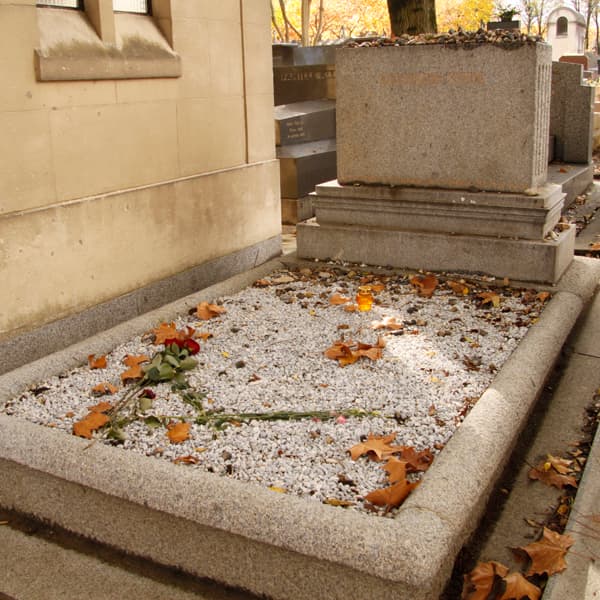
Just a couple of blocks west of Luxembourg Garden. She shared the flat with her life partner, Alice B. Toklas. Alice is also buried here, as you'll see on the gravestone's flip side.
In the 1920s and 30s, Paris was the world's literary center, and number 27 was the center of Paris. Every Saturday night, the city's brightest artistic lights flocked to Stein's apartment to eat, drink, and share ideas. F. Scott Fitzgerald, Henri Matisse, the list goes on and on.
Read more...Show less
The poet Ezra Pound, writer Sinclair Lewis, the painter Henri Rousseau. Pablo Picasso painted a famous portrait of Stein. Ernest Hemingway brought her his latest manuscript, hoping for her approval. She was the matron of the bohemian set known as The Lost Generation.
In fact, it was Stein who supposedly coined the phrase. Stein was a writer herself, though she's better known for her soirees. And for her wit. I like this observation she made.
We are always the same age inside. Her most famous quote is, A rose is a rose is a rose. Which means what? Well, it's hard to say.
It was from a line of one of her poems. She likely meant that a rose is just what it is. It's red, it's beautiful, it smells nice, and when she uses the word rose, we all understand that those other things automatically go along with it. She doesn't have to go on and on for us to catch the drift.
Fair enough. I'll buy that. In the 1930s, America discovered Gertie. That's what the papers loved to call her.
She wrote a memoir entitled The Autobiography of Alice B. Toklas, and it hit the bestseller list. She visited the States for a triumphant lecture tour. Still, she always returned to Europe.
As she often said, America's my country, but Paris is my hometown. Take a moment to ponder Stein's grave. A tomb is a tomb is a tomb. Let's move on.
Keep walking ahead on Avenue Circulaire. You'll pass by Avenue Pactode. Keep going straight on Avenue Circulaire another 50 yards to where the avenue curves to the right. As you go, you'll pass by emaciated statues.
These remember victims of the concentration camps and Nazi resistance heroes. Remember that during World War II, hundreds of thousands of French people were rounded up and sent east to Nazi concentration camps. Some 200,000 never returned. Many victims were Jewish.
You may see tombstones of Jews with pebbles placed upon them. These represent prayers. It seems like Père Lachaise is more than just a cemetery with a few famous graves. Yes, it's become a kind of Westminster Abbey of France, a place where the nation comes to remember its history.
About 50 yards past Avenue Pactode, Veer left off the road. It's near where you see a green street sign for Avenue Circulaire. Go down five steps off the road. Here you'll find a wall marked Aux Morts de la Commune. The Mur de Federais.
Mur des Fédérés
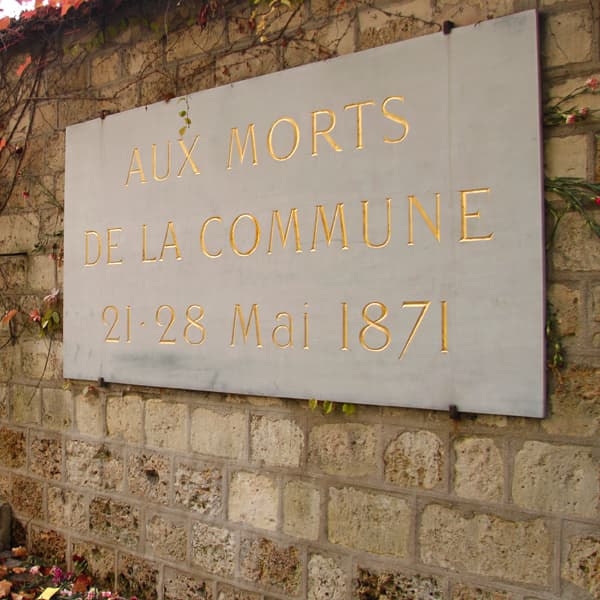
This is the so-called Communard's Wall. It marks the place where the quixotic Paris Commune came to a violent end. In 1870, mighty Prussia invaded France. The French quickly surrendered, all except the city of Paris.
For six months, through a bitter winter, while the Germans laid siege to the city, Paris held out. Meanwhile, the official French government was collaborating with the Prussians. A few patriotic Parisians formed an opposition government. It was revolutionary and socialist.
Read more...Show less
They called it the Paris Commune. In May of 1871, French government soldiers descended on Paris to retake the city from the Commune. It was French soldiers against French citizens. An estimated 10,000 people died during a bloody week of street fighting.
The final resistors holed up right here inside the walls of Père Lachaise. Here they made their brave Alamo-type last stand. But here they were finally overcome and the ringleaders were arrested. At dawn on May 28, 1871, the last 147 communards were lined up against this very wall and shot.
They were buried in a mass grave where they fell right here in a trench at the base of this wall. With them, the Paris Commune died. But the spirit lives on. Ever since, this wall has become a rallying point for workers and unions fighting for workers' rights.
They gather here to march, wave flags, and shout the motto of the resistance. Vive la Commune! Let's head for our next grave, Edith Piaf. It's a few minutes away, so follow Lisa's directions carefully.
Return to the street. So, backtrack the way you came and head up those five steps to the road. Turn left and continue down Avenue Circulaire. Follow it as it curves to the right.
We'll be going about 100 yards. As you walk, let's listen to a bit of music. This might help set the mood. Let's set the mood for our next stop, the grave of Edith Piaf.
Ah, Paris! By now, you should be approaching a street that turns right. Though the street may be unmarked, this is Avenue Transversal No. 3.
On the right corner, you'll pass by a memorial to victims of the Mauthausen concentration camp. Turn right on Transversal No. 3. Walk about a half block uphill.
That Mauthausen memorial we're passing by is a reminder of the horrific years France went through during World War II. We're headed now for the grave of a woman who played a significant role in the war. We're looking for the grave of Edith Piaf. It's on the right-hand side, about halfway up the block.
It's not right along the street, but one grave off the street. It's near a white tombstone with a small gray cross, the Salvador family. Piaf's grave is behind that white tombstone. Her tombstone reads Edith Gassion Piaf. Her grave is often adorned with photos, fresh flowers, and love notes. Edith Piaf
Édith Piaf
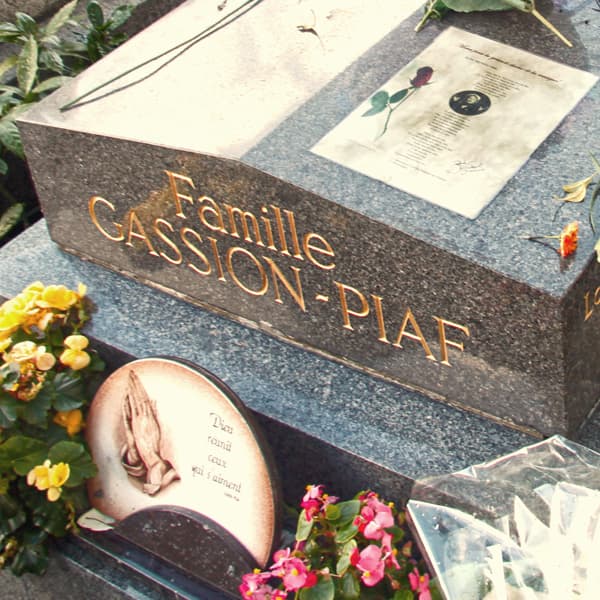
In the 1940s and 50s, Edith Piaf was France's most popular singer. Her songs and vibrant personality made her beloved throughout the world. Piaf was literally born in the streets of Paris. She was raised in dire poverty in her grandmother's bordello and in her father's traveling circus.
As a teenager, Piaf sang for spare change in the streets of Paris. She performed in the cheap cabarets of Montmartre. Physically, she was tiny and waif-like, and she always dressed in black. With her petite frame and warbling voice, she earned the nickname La Momme Piaf, the Little Sparrow.
Read more...Show less
As the graves inscription indicates, she was born Edith Gassion, but she added the nickname Piaf. Soon she was singing at all the Parisian hotspots, the Moulin Rouge, the La Panne Agile in Montmartre, and the Cabaret Lido in the Champs-Élysées. She kept performing even when the Nazis occupied Paris. With her strong stage presence and defiant lyrics, she lifted people's spirits.
By the time Paris emerged from the gloom of war, Piaf was the toast of the town. Her most famous song, La Vie en Rose, seemed to capture the joy of post-war Paris, like seeing the grim reality through rose-colored glasses. It's clear from all the flowers on her tomb that Piaf's music still touches people today. Yes, many are also drawn to her personal struggles.
You see, Piaf's offstage life was messy. It included a teenage pregnancy resulting in a daughter named Marcel. That must be Marcel buried along with her. The grave marked Marcel Dufour, Marcel Dupont, 1933 to 1935.
So she died at age two. Tragic. Piaf had many romantic affairs and they all seemed to end in tragedy. One boyfriend was a pimp.
Another was murdered. Some even suspected Piaf was involved. She had a heartbreaking affair with her co-star at the Moulin Rouge, Yves Montand. Then, when she finally found true love with the middleweight boxing champion of the world, he suddenly died in a plane crash.
And the hits just keep coming. Piaf struggled with alcohol, painkillers, and poor health. But those experiences only seemed to make her performances seem richer and more authentic. And every night she got on stage and sang the song that summed up her tragic but optimistic spirit.
The chorus went, No, je ne regrette rien. No, I do not regret anything. My only regret is that we have to be moving on. From Edith Piaf's grave, return to the street and continue uphill.
We'll be going up Avenue Transversal No. 3, about 150 yards, where we'll be making a left turn. Don't worry, just keep walking uphill and Lisa will alert you to the turn as we get closer. You know, Rick, you were right about this cemetery being a kind of Westminster Abbey that brings all of France together.
There's pop singers like Piaf, war heroes, victims of national tragedies, It's become a place of healing and national remembrance, like the next grave we'll see. But that's still a ways ahead. Keep going. You'll pass by a cross street, Avenue Pactode.
We will not be turning here. Nope, keep going straight. Keep going straight ahead up Transversal No. 3.
We'll be taking the next left turn another 100 yards further. As you walk, let's hear a little more music from the woman who helped bring France through the trauma of World War II, The Little Sparrow, Edith Piaf. Depart sous coupe tasse de thé A la terrasse du grand café Dans le regard non identifié D'un type sorti comme ça D'un vrai conte de fées Il est tombé là dans ma vie Un peu vite comme un ovni Avant que je ne réalise Ma vie Enlevée dans un tourbillon Légère comme un papillon Coup fruit de la passion Plus fort que tous les types du monde Qui roulent de l'art mécanique Pour des amours sans surprise J'ai préféré me laisser voler Dans les cieux Dans les cieux Dans les cieux Dans les cieux Dans les cieux Dans les cieux Continue up Avenue Transversal No. 3.
When you reach the cross street Avenue Greffulhe, turn left. That's left on Greffulhe. Follow Avenue Greffulhe straight for roughly 80 yards, almost to the end of the block. We're headed to the grave of another artist who's become a symbol of the proud French spirit in the wake of tragedy.
As you know, France has been rocked in recent years by a series of horrific terrorist attacks. One of the worst occurred in Paris back in 2015, and one of those victims lies buried just ahead. Keep going down Avenue Greffulhe, keeping an eye out on the left-hand side. As you approach the end of the block, you'll see a grave with a huge cylindrical statue on it.
Our grave is just beyond that, so it's a shiny black grave on the left, just beyond the cylindrical statue. It's often adorned with flowers and other decorations. The grave of Bernard Verloc. Bernard Verloc.
Bernard Verlhac
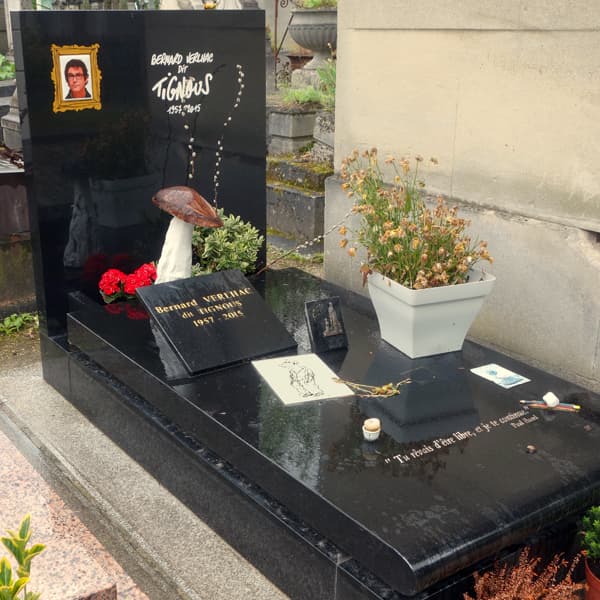
Verloc was a cartoonist for the French satirical magazine called Charlie Hebdo. As you can see from the grave's inscription, Verloc had a nom de plume, tineus. He and his magazine gained a reputation for biting satire about politics and social issues. Charlie Hebdo printed several controversial cartoons depicting the Islamic prophet Mohammed.
In January 2015, the magazine's offices in Paris were attacked by Islamic terrorists. Verloc was one of 12 people killed in the gunfire. You can tell from all the flowers that people still come here to remember the attack and the ongoing struggle against terrorism. You may also see some of Verloc's old cartoons.
Read more...Show less
Others leave notes for him and for the Charlie Hebdo staff. You'll likely see the slogan of solidarity that came to be expressed around the world. Je suis Charlie. I am Charlie.
Let's move on. Continue up Avenue Greffulhe. Cross Avenue Transversal number 2. Keep going straight ahead up Avenue Greffulhe.
We're leaving one of Père Lachaise's newest graves, Verloc, to visit one of the cemetery's oldest. As we'll see, the two men, though from very different eras, had a lot in common. They both carried on the long French tradition of using biting satire as a weapon. We're headed for the grave of the great playwright and wit named Moliere.
Continue up Avenue Greffulhe, even when it starts to narrow. Rick, how can Moliere be buried here? He died, in the 17th century, and Père Lachaise wasn't founded until the 19th century. Well, as you recall, when Père Lachaise was first started in 1804, it struggled financially.
Moving the remains of Moliere to be reburied here was a publicity stunt. It gave instant prestige to the new cemetery. I bet Moliere was glad to be a marquee attraction. Keep going until Avenue Greffulhe dead ends.
It's at the cross street called Avenue Transversal number 1. Cross Transversal and keep going straight ahead. Really? There's no real road here.
Yes. Keep going straight ahead. Go a few steps down a dirt section that veers slightly to the right. Okay, I'm with you.
Then, make a hard right onto another dirt lane. It's called Chemin Moliere et la Fontaine. Okay. Now I'm on that dirt lane called Chemin Moliere or whatever.
Keep going. Moliere lies 30 yards ahead on the right side of the street. He's just beyond the highest point of this lane. Moliere's tomb looks like a stone coffin atop four stone columns. Moliere.
Molière
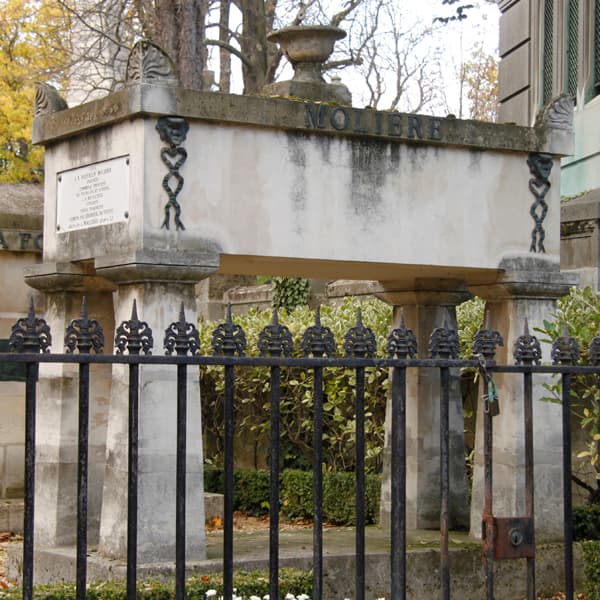
Moliere was the greatest French playwright of the 17th century, the age of Louis XIV. Moliere was born here in Paris. He was not of noble blood. But he had connections.
He was the son of the man in charge of the king's furniture. When he was 21, Moliere left his father's business and joined a troupe of humble actors touring the French countryside. Back then, actors ranked very low on the social ladder. After 12 long years on the road, Moliere and his troupe returned to Paris.
Read more...Show less
They landed a gig performing for Louis XIV. Moliere was by now a very funny comedian. He cracked the king up. The king's brother was an even better man.
He was an even bigger fan. And just like that, Moliere was instantly famous. Soon, he was writing, directing, and even starring in his own plays. Moliere's plays poked fun at the aristocrats of Louis XIV's court, the egotistical nobles, the hypocritical priests, and the quack doctors.
Moliere was at the height of his fame, hobnobbing with royalty and performing in chandeliered palaces. But now, he's here. I'm told it's a fascinating story how Moliere died. Yes, by 1675, Moliere was in his 50s and in poor health.
But the show had to go on. So one night, Moliere went on stage as the star of his latest comedy. It was called The Imaginary Invalid. Moliere's role was as the title character, a hypochondriac.
So Moliere, in character, faked a few coughs. The audience loved it. But as the play went on, Moliere got sicker and sicker, and his fake coughs turned to real coughs. The crowd didn't know the difference.
He had them rolling in the aisles. Moliere was the ultimate trooper, and he carried on to the final scene. He delivered his final line and then collapsed on stage, coughing up blood. The audience thought it was all part of the act, and they roared hysterically.
And so Moliere died. Now he rests here in Père Lachaise eternally. I love Moliere's quote about death. We die only once, he said.
Yes, and for such a long time. With that thought, let's move on. Our next stop, the grave of rock star Jim Morrison, is a few minutes' walk from here. And there are some twists and turns to get there.
So on the next track, Rick and I will lead you while Rick tells us a bit more about the celebrities of Père Lachaise. From Moliere
From Molière to Jim Morrison
to Jim Morrison. From the grave of Moliere continued downhill on Chemin Moliere et La Fontaine. You know, Rick, Moliere's death seems like the ultimate irony. Yes, irony upon irony.
Moliere was playing a hypochondriac. In real life, Moliere's own doctors thought he was a hypochondriac. But he was really sick. And then he goes on stage and dies playing a well man who's only faking it.
Read more...Show less
And the audience thinks he's just acting. But he was really dead. I bet Moliere, who is a master of comic satire, would have appreciated the many layers of irony that marked his final performance. Keep following Chemin Moliere et La Fontaine.
When you reach the cross street, just keep going straight. Chemin Moliere eventually changes names and becomes a cobbled street called Chemin du Bassin. Keep going downhill on Bassin. Keep following it even as it gets steeper and bends to the right.
Let's see. We've seen Moliere, Oscar Wilde, Edith Piaf, the cartoonist for Charlie Hebdo. It's clear that Père Lachaise is a worldwide magnet for artists and writers. That's why our next person, the American Jim Morrison, ended up here.
Morrison was a mere pop star, but he told his friends that he wanted to be buried in Père Lachaise among the great poets and artists. So after he died, Jim's friends approached Père Lachaise. At first, the director absolutely refused to admit such a notorious rock and roller. Then they mentioned that Jim was also a writer.
A writer, said the director, and he found a spot. Bassin Street comes to an end at an intersection. Here we'll make a turn left on Avenue de la Chapelle. So that's left on Avenue de la Chapelle.
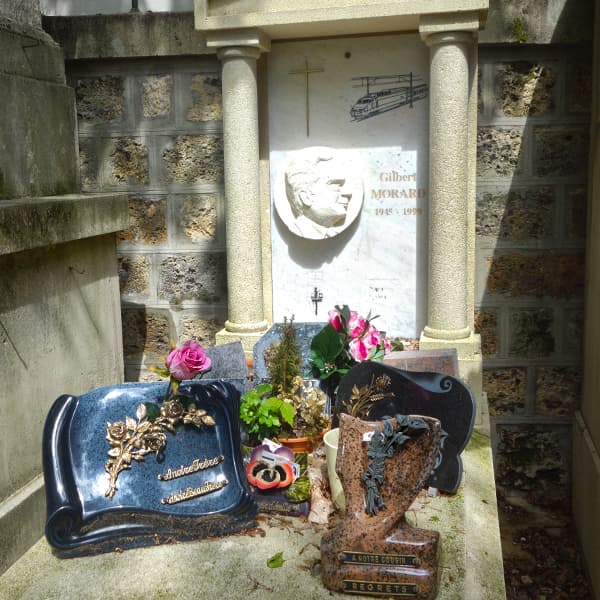
Twenty steps down Avenue de la Chapelle on the left is a grave that's often littered with metro tickets. This is the grave of Gilbert Morard, the father of the Paris Metro. If you appreciate the metro, add a spent metro ticket to the pile left here by other fans. And let's keep going.
Continue straight down Avenue de la Chapelle another 50 yards. By the way, Morard also helped pioneer France's high-speed railway, the TGV. Think of it. Morard was just a humble bureaucrat, but the things he did in his life have completely transformed the everyday life of the people.
The lives of the French people. Avenue de la Chapelle spills out into a roundabout intersection. It's called Ronde Point. Or Round Point, as we'll call it.
Keep going straight ahead as you cross Round Point. We're getting close to Jim Morrison's grave, but there are some tricky turns up ahead, so follow Lisa's directions closely. Once on the other side of Round Point, exit the roundabout directly opposite where we entered. This puts you on a street that's probably unmarked, though the official name is Chemin de la Berriere.
Start heading downhill. Just a few steps along, turn right onto Chemin Loriston. So that's right on Loriston. Got it.
Keep following Loriston downhill. You'll soon reach a fork in the road. At the fork, keep to the left. So, take the left fork.
This puts you on the street called Chemin de la Seppe. Immediately start looking on the right side of the street. Find what looks like a temple with three wreaths. Hmm.
On the right, a temple with three wreaths. Ah, there it is. This isn't Jim Morrison's grave. Hmm.
Darn. But Jim lies just behind this temple. Yeah. There it is.
You'll know it when you see it. His grave generally has a small crowd. It's often watched over by a personal security guard. You can't miss the commotion. You made it. You made it. Jim Morrison.
Jim Morrison
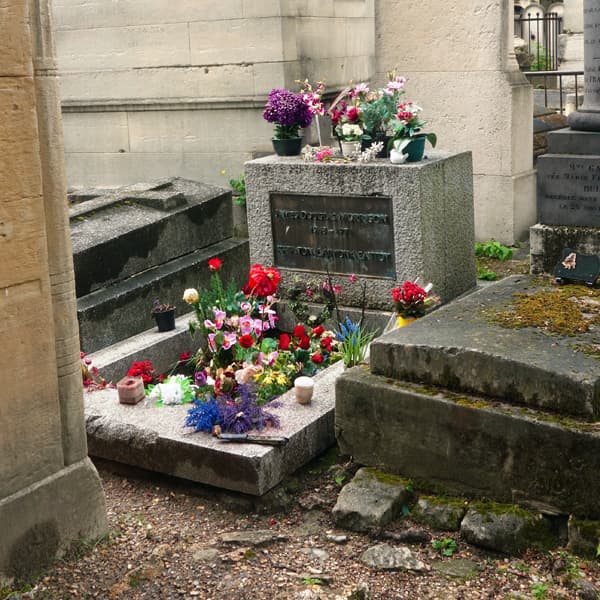
This is perhaps the most visited tomb in the cemetery. It belongs to an American rock star, the lead singer for the popular band from the 1960s called The Doors. The band was named for the doors of perception that their music was meant to open for the listener. They made it big with a number of hits like Light My Fire.
Come on, baby, light my fire. They also did the song Hello, I Love You. Hello, I love you. Won't you tell me your name?
Read more...Show less
And Touch Me. Come on, come on, come on, come on, now touch me, babe. Easy, rock star. We are in a cemetery.
Oops. Jim Morrison became notorious for his illicit drug use and for his performances. He was even arrested for doing things on stage that authorities considered obscene. Check out the scene around the grave.
Yeah, there's usually a crowd of Morrison faithful here. You may see graffiti where fans write references to the Doors songs. Things like You Still Light My Fire. Or Ring My Bell at the Dead Rock Star Hotel.
If you see the phrase Mr. Mojo Risen, that's referring to a legend many of his fans still cling to that Jim actually faked his death and still lives today. He'd be, what, 75, 80? He'd be old.
Check out the gravestone. It's sure an interesting one for a rock star. Yes, originally, there was a bust of Jim adorning the grave, but that got stolen by some fanatic fans. It's been replaced with the headstone you see today.
It has an inscription in Greek. The Greek translates to the divine spirit within. Yes, but others have translated those same Greek words to the demon inside. Jim sure had his demons.
Rick, tell us how he ended up here in Père Lachaise. Well, by the 1970s, the Doors were one of the biggest acts in the world, but they were also burned out. Morrison needed a break. He came to Paris.
When he arrived in the winter of 1971, he was famous, loved, and hated. He was also an alcoholic. Paris was to be his chance to leave celebrity behind, get healthy, and get serious about what he always wanted to be, a writer. He took an assumed name and moved into a nondescript apartment.
It still exists today. It's near Place de la Bastille. Jim spent his days as a carefree bohemian. He scribbled in notebooks at venerable literary cafes like Café de Flore and Les Deux Megots.
Over on the left bank, he watched the sunset from the steps of Sacré-Cœur. Atop Montmartre, he visited the homes of famous writers and jammed with street musicians. He also drank a lot and took other drugs. He gained weight and his health kept declining, and then...
This is the end, my only friend, the end. In the wee hours of July 3rd, Jim Morrison died. It happened in his apartment, in the bathtub. The official cause was a heart attack, but more likely, it was from an overdose of heroin.
Any police investigation was thwarted by Morrison's fellow drug addicts, thus leading to the wild rumors that he may not have even died. Nevertheless, that was the end. My only friend, the end. Jim was only 27.
Now he lies here in Père-Lachaise, among the pantheon of great artists he so admired. Writers, poets, rebels, and musicians. Our next grave is another visionary musician who also died young, the classical composer Frédéric Chopin. Ooh, let's go.
To reach the grave of Chopin, we'll need to return to that roundabout we were at earlier, the circular intersection called Round Point. So, start backtracking the way you came, back up Chemin de Lesseps. As you make your way back uphill to Round Point, let's listen to a little music. It's by the great pianist and composer Chopin.
We'll see you back at Round Point. piano plays softly piano plays softly piano plays softly piano plays softly piano plays softly Manifique. By now, you should be back at the round intersection called Round Point. Once you're there, find the statue in the center.
That statue remembers a man named Casimir Perrier. He was the shortest-serving French president ever, only six months. But he's still got a big monument. Focus on the statue and look at the direction the statue is facing.
Casimir is looking directly through a forest of tombstones. He's basically looking right at the tomb of Frédéric Chopin, which is about 50 yards from here. Start heading the direction that Casimir is facing. That means you'll have to leave the roundabout at the tomb of the family de Valois.
Really? There's no road there? No. To reach Chopin, you'll need to make your way through a few grave sites.
Okay. Tiptoe through the tombstone. Come tiptoe through the tombstone with me. Ah.
You'll soon hit a cobbled lane. A cobbled lane. Got it. Turn right on the lane.
Then keep an eye out for a tomb on the right that's always decorated with flowers, the tomb of Chopin. piano plays in bright rhythm Frédéric Chopin.
Frédéric Chopin
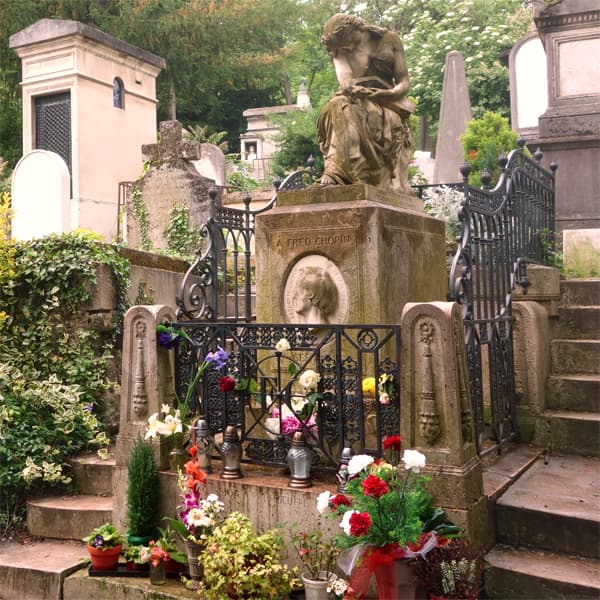
The fresh-cut flowers and geraniums on the gravestone speak volumes about the emotional staying power of Chopin's music. Chopin still connects with romantic souls across the centuries. His tomb is topped with the statue of a muse. She once inspired Chopin, but now she's left mourning over his tragic death.
A carved relief shows Chopin in profile. It captures the delicate features of this sensitive artist. Chopin was only 21 when he arrived in Paris in the 1830s. He was not French, but Polish.
Read more...Show less
In fact, Chopin never quite mastered the French language. I can relate. Nevertheless, Chopin fell in love with Paris. He never again returned to his homeland.
In Paris, Chopin could finally shake off that child prodigy label he'd lived with since age seven. He was burned out from years of performing on the road. Chopin was cursed with stage fright. He once said, I don't like concerts.
The crowds scare me. Their breath chokes me. I'm paralyzed by their stares. Nevertheless, Chopin was a brilliant pianist, but his touch was always a little delicate for big venues.
Instead, he preferred playing at private parties for the elite of Paris. They were wowed by his ability to make a piano sing and by his melodic compositions. Soon, the brooding genius was famous as a great pianist, composer, and teacher. He ran in aristocratic circles with fellow artists.
There was his fellow pianist, Frantz, and the opera composer, Rossini. There was the painter, Delacroix, and the novelist, Victor Hugo, who wrote The Hunchback of Notre Dame and Les Mis. Chopin composed nearly 200 pieces, almost all for the piano. He wrote in many different styles, from waltzes to the Bach-like counterpoint of his preludes to his moody, romantic nocturnes.
When he composed, he was often inspired by memories of his beloved homeland, Poland. While you soak up the ambiance here at Chopin's grave, let's listen to another short selection of Chopin's music. piano plays softly piano plays softly piano plays softly piano plays softly I love that piece. In 1837, Chopin's life changed dramatically.
He met the love of his life, the writer George Sand. They were polar opposites. Chopin was quiet, sensitive, refined, and dreamy-eyed. Sand was assertive and stormy.
She had recently left her husband and written a scandalous novel about love and marriage. She dressed like a man, wearing men's suits and slicked-down hair. She changed her girlish name to the masculine name, George. Sand was swept away by Chopin's music.
She pursued him. Sparks flew. They entered into a passionate relationship. But it was always both bitter and sweet, a kind of love-hate relationship.
Chopin developed tuberculosis, and Sand nursed him for years. Chopin complained she was killing him. Finally, Sand left him. Chopin was devastated.
He was left to face death alone. On his deathbed, among his last words were these, The earth is suffocating. Swear to make them cut me open so that I won't be buried alive. Chopin was only 39 years old when he died.
The grave here contains Chopin's body, but his heart still lay in Poland. Literally. Chopin's heart is preserved and embedded in the column of a church in Warsaw. Chopin's funeral was held here in Paris in the Madeleine Church.
It was attended by thousands of people. As they carried his casket, the organist played what is perhaps Chopin's most famous piece, the Funeral March. That's kind of the soundtrack for this whole tour. And there's more graves to come.
On the next track, Rick and I will direct you to our next stop. Tum, tum, tum, tum. From Chopin to Haussmann
From Chopin to Haussmann
and other famous graves. To get to our next stop, the grave of Haussmann, start by facing Chopin. As you face the grave, turn left. Start walking up here.
Keep walking uphill about 100 yards until the lane dead-ends. As you go, remember that there are many other famous graves here in Père-Lachaise. You could seek them out on your own after our tour is over. Some are listed on the map that accompanies this tour.
Read more...Show less
For example, there are great painters like David, who did the huge coronation of Napoleon in the Louvre. There's Delacroix, who painted the iconic Liberty Leading the People. George Seurat, who spent Sunday afternoons in the park with his easel, painting the scene with tiny dots. There's Géricault, the master of romanticism, who did the raft of the Medusa.
In fact, Géricault and David are both buried just ahead, not far from where this road dead-ends. They're on your map. You could detour a few yards off our path to visit them. But we won't be going there on this tour.
Keep walking. Elsewhere in Père-Lachaise, there are great writers like Marcel Proust. There's Sarah Bernhardt, the dynamic 19th century actress who conquered both Paris and America. There's Yves Montand, who co-starred with both Edith Piaf and Marilyn Monroe.
Finally, there's the oldest residents of all, the medieval lovers from the 12th century, Heloise and Abelard. By now, you should be reaching the end of the lane. The lane dead-ends at Avenue Lateral du Sud. We won't be turning here.
No. Keep going straight ahead, trespassing over three grave sites to the next lane. Tiptoe through the tunnel, through the tombstones with me. When you reach that next lane, head left, downhill.
Downhill. I'm with you. The lane soon meets a road called Avenue Principale. Our next grave is about 20 steps down that road.
It's on the right with the green door, the grave of the Famille Haussmann. piano plays softly baron george eugene haussmann
Baron Haussmann
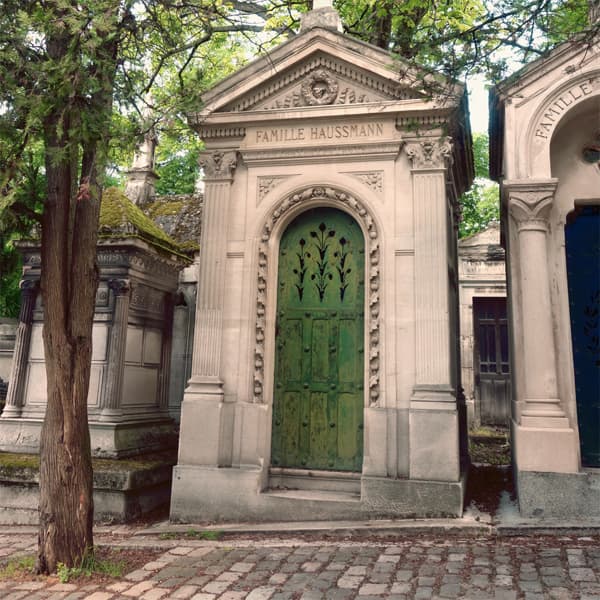
love him or hate him, baron haussmann made paris into the city we see today. Back in the 1850s, paris was still a dirty city of narrow medieval lanes. Haussmann, a brilliant engineer, transformed paris into a city of broad boulevards lined with grand five-story buildings. Haussmann oversaw the entire operation, and for decades, paris was a construction zone.
They renovated sewers, bridges, and water systems. Haussmann created parks and public squares. On the other hand, many charming historic buildings were torn down. Even the quaint Latin Quarter was split in two when Haussmann rammed the Boulevard Saint-Michel right through its center.
Read more...Show less
That was intentional. It was part of the government's plan to prevent revolutionaries from barricading narrow streets. By the way, if you want to take a look inside a mausoleum, here's your chance. You can squint through Haussmann's green door.
Haussmann's grand scheme impacted 60% of Paris. The Opera Garnier, the Bois de Boulogne Park, the avenues around the Arc de Triomphe, all of these were part of his grand vision for the city of Paris. Wow. How did he finance it all?
Well, that's what the next government wanted to know. They investigated him and essentially told him, you're fired. Let's move on. Our next grave is just four doors down here. Downhill from Haussmann. The Grave of Rossini. Giacchino Rossini.
Gioachino Rossini
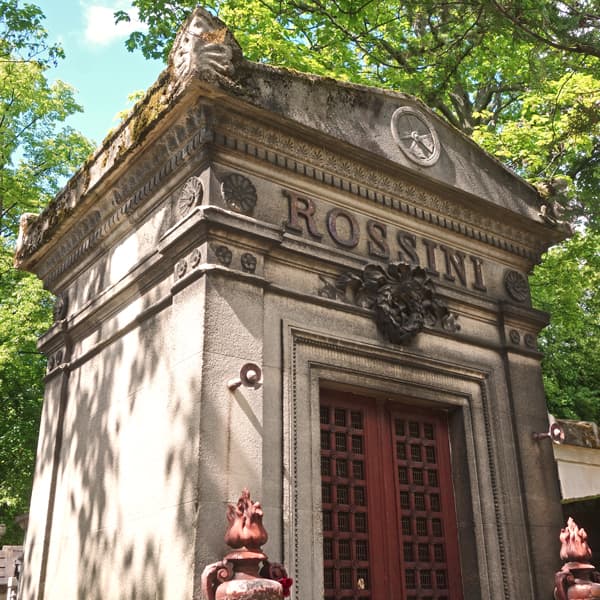
Yes, it's the William Tell Overture. Also known as the Lone Ranger theme, Rossini was the composer of that and lots of other well-known music. Rossini was Italian, but in 1823, he moved to what was becoming the center of European culture, Paris. Rossini's comic operas were an immediate hit in the City of Light.
Rossini was extremely prolific. He could crank out a three-hour opera in mere weeks. He wrote the highly successful Barber of Seville. Which was based on a French play by Pierre Beaumarchais, who's also buried here in Père Lachaise.
Read more...Show less
Rossini mingled with Paris' British opera, Bright Lights. He met Chopin, and Chopin wrote a well-known piece based on a Rossini melody. In 1829, Rossini's opera William Tell debuted. Rossini was at the peak of his career, the toast of Paris.
He was 38 years old and had written 38 operas. Then he stopped. For the next four decades, he barely composed anything. He moved back to Italy and went through a stretch of bad health.
Finally, he returned to Paris, where his spirits revived, and he wrote a little music. Then he died. He died and was buried here. But Rossini's sepulcher, though it's impressive, is empty.
You're right. Years later, his remains were moved to Florence. Our tour is nearly over, and our final grave is nearby. Great.
But first, Lisa, give us a quick orientation. All right. Look downhill on Avenue Principale. That's the exit gate that leads back to the land of the living.
To reach the Père Lachaise metro stop from here, you'd exit and turn right on Boulevard de Menilmontant. To catch bus number 69 heading west to downtown, you'd exit and continue straight ahead, walking downhill on Rue de la Roquette. The stop is four blocks down on the right-hand side. And Rue de la Roquette has several nice cafés also on the right-hand side.
But for now, we've got one more grave to visit. From Rossini, continue downhill just a few steps, turn right at the corner, and finally, find the second gravesite. As the inscription on the grave says, here lies Colette. Colette.
Colette
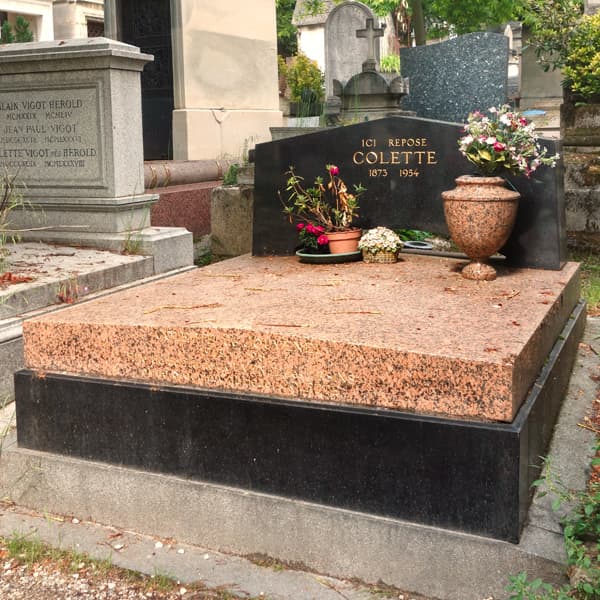
Colette is France's most honored female writer. She led an unconditional, unconventional life. She was married three times. She was also linked romantically with other women.
She wrote about her relationships in novels that were thinly-veiled tales from her own life. Her first novels were about the misadventures of a naughty teenager named Claudine. In her 30s, Colette went on to a second career as a music hall performer. She scandalized Paris twice, once by kissing her female lover on stage and once by burying her breasts.
Read more...Show less
For many Americans, Colette's claim to fame is the novel she wrote later in life, Gigi. It's the story of a teenage girl groomed to be a professional mistress. But instead, she blossoms into independence. The book became a play starring Audrey Hepburn, who Colette personally chose for the role.
It was later turned into a musical starring Leslie Caron and Maurice Chevalier. Ah, yes. Sang heaven for little girl Yeah, that's the one. As our tour nears its end, here's a quote from Colette.
I think it's appropriate for Paralichez. She said, The only curiosity that's misplaced is trying to find out here, on this side, what lies there beyond the grave. That's wise. But the immediate question is, what lies beyond this tour?
And your answer? The rest of Paris. Go in peace. We hope you've enjoyed this walk through Paralichez.
Thanks to Jean Openshaw, the co-author of this tour. This tour was excerpted from the Rick Steves Paris Guidebook, co-authored by Steve Smith and Jean Openshaw. For more self-guided walks and details on eating, sleeping, and sightseeing in Paris, refer to that guidebook. We also have other Paris audio tours, including a historic Paris walk, the Louvre Museum, the Orsay Museum, the Palace of Versailles, and a stroll down Rue Claire.
For more free audio tours and podcasts, and for information about our TV shows, bus tours, and travel gear, visit our website at ricksteves.com. This tour was produced by Cedar House Audio Productions. Merci. Au revoir. And bon voyage. Thank you.
Free
GPS-guided walking tour
No account needed. Walk at your own pace.
Free
16 stops ·