19 stops
GPS-guided
51 min
Duration
Free
No tickets
About this tour
A 19-stop walking tour through the heart of France. Visit A Rue Cler Walk, Café Roussillon, Petit Bateau, and Au Bon Jardinier — with narrated stories at every stop.
19 stops on this tour
A Rue Cler Walk
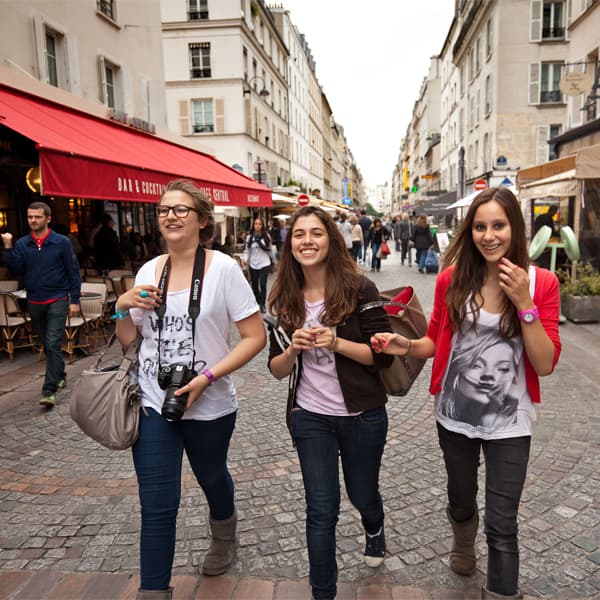
A Rue Claire walk. For those learning the art of fine Parisian living, Rue Claire provides an excellent classroom. With its market stalls, casual cafes, happy shoppers, and traffic-free ambiance, Rue Claire is quintessential Paris. Hi, I'm Rick Steves.
Thanks for joining me on this walk down a Parisian street that's both traditional and modern. It's where locals come to shop for groceries, meet friends for a drink, and catch up on the latest. On our walk, we'll step inside timeless shops like bakeries, butchers, and cheesemongers. And in this upscale neighborhood, we'll also see gourmet food shops, smart boutiques, and stylish eateries.
Read more...Show less
Most of all, we'll get insights into the everyday life of Parisians today, where they buy their daily baguette, how workers spend their lunch breaks, what all that cheek-kissing's about, and the fascinating... French obsession with cheese. This walk is short, about two blocks long. Give yourself an hour for the walk, plus more time to browse the shops and relax at a café.
The walk is best when the markets are open and lively. That means roughly Tuesday to Saturday, 8.30 to 1, and from about 3 until 7.30 in the evening. They're also open Sunday morning, but remember, the street is dead on Monday. And if you want to assemble the ultimate French picnic, there's...
You could use this walk to buy a little at each stop and end the walk with an atmospheric picnic in the park with a view of the Eiffel Tower. The Rue Claire walk is the only tour you should start while hungry. Even if you don't buy anything, this walk is a wonderful excuse for that time-honored French pastime of window shopping. Or as the French call it, Now let's get started.
As we shop our way from one end of the street to the other, on that inviting slice of everyday Parisian charm, Rue Claire. To help us along the way, I've invited a good friend and virtual travel buddy. Welcome, Lisa. Bonjour, monsieur.
Bonjour, madame. Lisa will give us helpful directions and sightseeing tips throughout the tour. And my first tip is to be sure you get our tour updates. Just press the icon, at the lower right of your device.
You'll find any updates and helpful instructions unique to this tour. Things like closures, opening hours, and reservation requirements. There's also tips on how to use this audio tour and even the full printed script. Yes, so pause for just a moment right now to review our updates and special tips. It's okay, we'll wait. And then... Let the tour begin!
Tour Begins
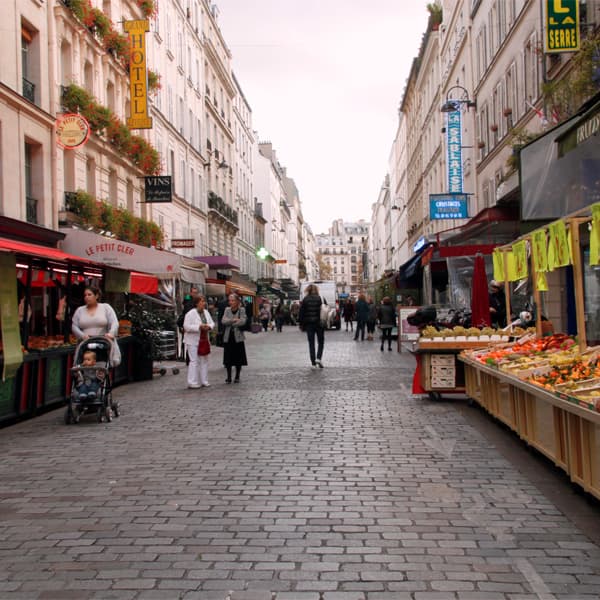
The tour begins, gazing down Rue Claire. Start your walk at the intersection of Rue Claire and Rue de Grenelle. This puts you at the northern end of the pedestrian section of Rue Claire. There's a stop for bus 69 nearby.
That's the handy east-west route across the city. And Metro Stop Ecole Militaire is also not far. Rick? Merci, Lisa.
Read more...Show less
Start by... Just gazing down Rue Claire and taking in the scene. It's a narrow street paved with classic cobbles. If you're here at the right time, Rue Claire is lined with stalls of fresh produce spilling out into the street.
The buildings are made of warm stone and are decorated with potted plants and colorful awnings. The place bustles with locals. For a city of over 2 million people, this is a pretty small-town scene. It is.
One that plays out every day in neighborhoods like this all across the city. Paris is a patchwork of small, village-like neighborhoods. Most are centered around market streets like this one, though not always so charming. Rue Claire is actually a wealthy district wedged in between the Eiffel Tower and the high-powered government district.
The street has all the basic shops of modern life — banks, post office, and so on. Because of its popularity with tourists, you'll also see plenty of Americans. But ever since it was made traffic-free back in 1984, Rue Claire has also retained its traditional everyday charm. It still has those essential shops that a civilized society simply cannot do without.
Shops for wine, cheese, bread, and chocolate. These shops are run by welcoming people who found their niche. Girls who grew up knowing a good wine and boys who were raised on quiche. Let's explore.
Before heading up Rue Claire, start by checking out some sites closer to you. Find the classic bar on the corner of Rue Claire and Rue de Grenelle called Café Roussillon. Café Roussillon.
Café Roussillon
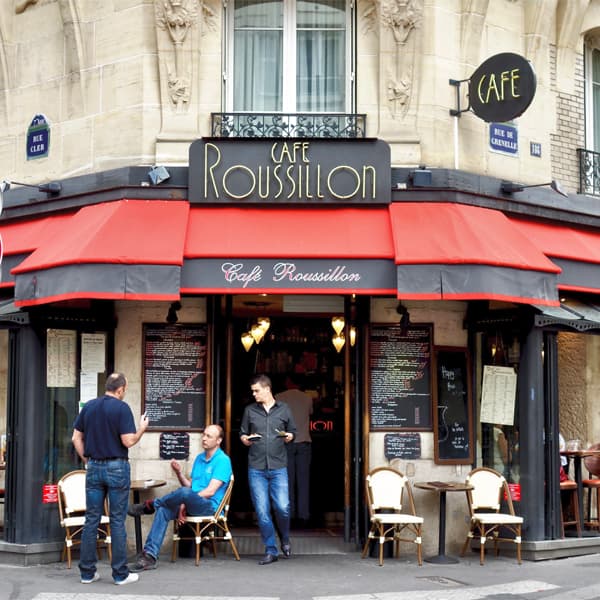
There's no better way to get the feel of a Parisian neighborhood than from one of its traditional cafés. This place is a neighborhood fixture where locals come for a no-nonsense meal or a casual drink. Like all cafes, all French cafés, the Roussillon must display a sign required by law making it clear that drinks served at the bar are cheaper than drinks served at the tables. The blackboard lists wines sold by the glass along with other drinks.
You may also see a decal on the door saying something like restaurant ticket. This means they accept lunch coupons here. In France, an employee lunch subsidy program is an expected perk. Thanks to strong tax incentives designed to keep people and keep the café culture vital, employers issue coupons for each day an employee works in a month, typically about half off for a daily special or plat du jour.
Read more...Show less
Sack lunches are rare since a good lunch is sacred. And subsidized. Here at Roussillon, you can get many of the classic French beverages, coffee, wine, aperitifs. One of the most popular drinks is a café crème.
It's similar to a café au lait, but with less milk. As the day proceeds, Parisians drink less and less milk with their coffee. They say it can upset the digestion. So, if you order a café crème after midday and your server gives you a funny look, now you know why.
A more typical choice later in the day might be a noisette. That's an espresso with just a dollop of milk. The bar is always busy. This lists the type of wine sold by the glass.
There's reds and whites, blancs, rouges. They serve a small 7-centilitre portion. That's about half a standard glass. Café Roussillon has plenty of other drinks typical of France.
For beers, France's best known are from the region of Alsace. I like Cronenberg or the heavier Pelfor. I like champagne. I see they have that.
And they have a refreshing before-dinner drink called Acure. Acure is a white wine mixed with black currant liqueur. Sounds très délicieux. But let's move on.
First, just stand for a second and survey the neighborhood. In all four directions, you'll see the same Haussmann-designed buildings with their uniform height, balconies, and iconic slanted mansard roofs. With ground floors devoted to retail and upper floors housing people, there's a vitality here you just don't find in many big American cities. Feel the community.
People walking dogs, pushing carriages, dragging shopping carts, and tourists with their roller bags coming and going. Motorbikes, electric scooters, and quick-rent bicycles take up space previously dedicated to parked cars. Electric wires buried underground are nowhere to be seen. Paris is a city of neighborhoods.
And it's clear that this is a real neighborhood where real people live. Exactly. People from all walks of life live side by side. In fact, look down Rue Claire, past Café, away from the pedestrian part.
Halfway down the block on the right at Rue Claire No. 15 is where the night-shift receptionist at one of my favorite Rue Claire hotels lives. And above him on the seventh floor was another Parisian who lived there until recently. His name was Emmanuel Macron, who went on to become the president of France. Our next site is right across the street from Café Roussillon, a boutique called Petit Bateau. Petit Bateau.
Petit Bateau
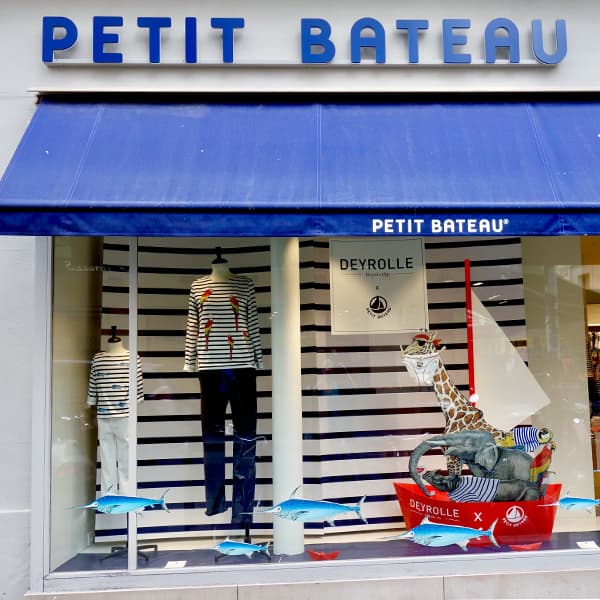
This place sells baby clothes. Designer baby clothes. The French spoil their kids as much as they do their dogs. This store, called The Little Boat, is part of a popular chain.
Wow, look at the window displays. French kids must be really sophisticated. Yeah. I hear they even have and speak French.
Read more...Show less
So parents and grandparents buy them designer jammies, upscale underwear with sailor stripes, and much more. As France's population ages and declines, a serious economic problem, babies are treasured. The government encourages having kids with big tax incentives. The French get big tax deductions for their first two kids, then it doubles after that.
Child care is also subsidized, and public school starts at age three, so most new moms get back into the workforce quickly. Here in France, making babies is good business. And revered. I've noticed how locals give pregnant women priority seating on the metro, and they go straight to the front of any line.
Babies are trendy, and as a result, France now has one of Europe's biggest baby populations. In fact, where the rest of Europe averages 1.6 kids per family, the fertile French are now averaging two. A much nicer round number. By the way, you're welcome to go inside Petit Bateau.
In fact, all along our walk. Don't be intimidated. But if you do go inside, either here or at any of the shops on our walk, remember a few basic tips. Always be prepared to greet the clerk as you enter.
Say, Bonjour, Monsieur. Bonjour, Madame. Or, if the woman is under 30, Bonjour, Mademoiselle. Remember your polite words.
Merci, Madame. Thank you. And, S'il vous plaît. Please.
If you're just looking and not buying, that's okay. But don't get in the way of actual customers. If a clerk asks if they can help you, you can tell them you're just looking. Je regarde.
That means, I'm just looking. Je regarde. Merci. And as you leave, it's always polite to say, Au revoir, Madame.
Let's start up Rue Claire. Stop at the very first place on the right. It's a colorful market of fresh produce. Oh, bon jardinier.
Au Bon Jardinier
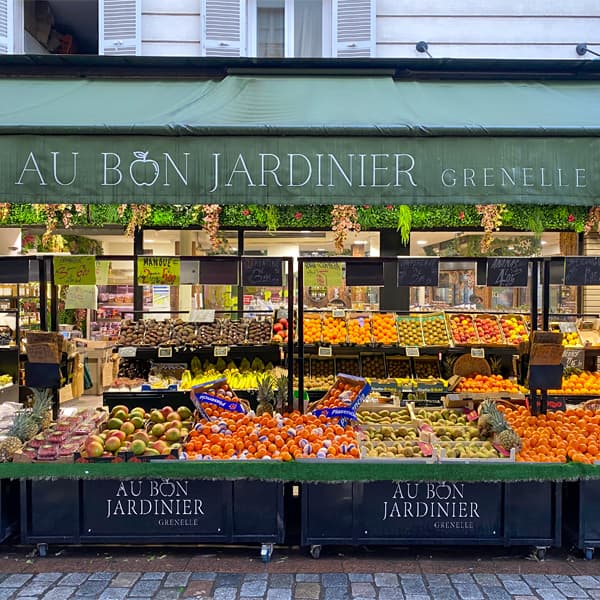
Fruits and vegetables. This grocery store called The Good Gardener is small inside, but their stand spills out into the street. What a variety. Berries, apples, melons, carrots, whatever's in season.
And it's all fresh. That's absolutely essential for Parisians. Early each morning, much of what you see here is trucked in from the surrounding farms. It goes first to a huge distribution center located near Orly Airport.
Read more...Show less
It's Europe's largest. Then it gets dispatched to small merchants like this. And it's all done with Federal Express-like speed and precision. Surely not everything here is grown locally.
No, but the French learn to tell what's local and what's not. They read the fine print on the labels to find the country of origin. It must be posted. That's the law.
For example, if there are melons here when they're not in season, they're likely from Guadeloupe. You'll find products from Italy, Morocco, Tunisia, Spain, and more. Many Parisians buy only local products and eat only with the season. They shop with their noses.
Give it a try, Lisa. Smell the strawberries. I can't smell anything. Must be foreign-grown.
Locals call those plastic strawberries, red on the outside, white on the inside. Now, take a sniff of the torpedo-shaped French strawberry. Ah, magnifique! Much better.
Let's explore more of the store. Head inside. Make your way towards the back of the store. Find the herbs for sale in the back.
See if today's delivery's in. The herbs they sell here aren't just dried herbs in a little jar. People want their parsley-sage-rosemary-in-time fresh. I'm also enjoying checking out our fellow shoppers.
Discreetly, of course. Yes, in Paris, shopping for groceries is the backbone of daily life. Parisians go shopping almost every day. Why don't they just do it once a week like Americans do and get everything they need?
Well, first off, because fine food is essential to the French existence, they insist that their produce has to be absolutely fresh. And since they live in small apartments with tiny kitchens and tiny refrigerators, they don't have much storage space. Finally, shopping is considered more than just a daily chore. It's a social event.
This is their chance to hear about the butcher's vacation plans, to see photos of the florist's new grandchild, and meet up with friends for coffee or lunch. The market street of Rue Claire offers a chance to do all of that. By the way, if you're using this walk to buy a picnic, pace yourself. There's certainly some great stuff here, but we'll be visiting a lot of great stores along this walk.
I recommend window shopping for now, and then coming back later to do your buying. I like buying a little at each store. You get your berries here, your baguette at the boulangerie, some cheese at the fromagerie. You can get a main course like a quiche or a cooked dish at a deli.
You buy your wine at the wine store and dessert at the patisserie. Good luck finding a free shopping bag to carry it all. You'll have to buy one. Locals are very eco-conscious and they hate excessive packaging.
They bring their own shopping bags or use a little two-wheeled shopping cart. Start making your way back out to the street. We're moving on. Across the street is a more modern-type grocery store called Franprix.
Though it lacks charm, it's actually an authentic slice of French life today. It's a small outpost of a popular supermarket, and it's a great place to get a chain found all across France. But for now, we're moving on. Start heading up Rue Claire.
Our next stop is just a few steps along. It's on the left, a small café called La Petite Claire. La Petite Claire.
Le Petit Cler
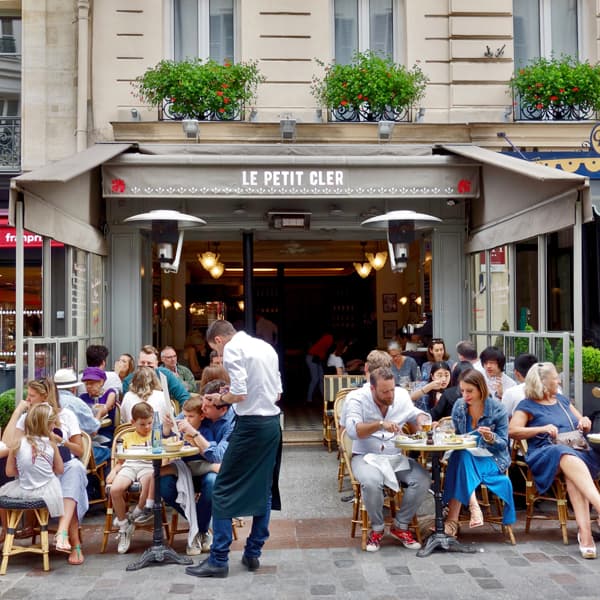
This small café is a fine choice for lunch or dinner, but it's also a good example of how life is changing here on Rue Claire. This place used to be a tabac or tobacco shop. It was a typically French shop where locals bought cigarettes, metro tickets, and much more. In fact, we'll see a tabac later in our walk.
As Rue Claire has gotten wealthier, utilitarian shops like tobacco shops are getting transformed into trendy cafés like this one. Some locals regret the loss of shops that address their practical needs. There's another sign of changing times here, the outdoor seating. Yes, in times past, the street's cafés were almost all indoors.
Read more...Show less
But cafés like Petite Claire have followed the demand and spilled out into the street. Now it's the norm. There's yet another example of changing times just across the street. It's an eatery labeled Traiteur Asiatique.
This place sells fast Asian food to go. It's hardly traditional, but places like this are now as common in Paris as bakeries. Times change, and traditional eating habits in Paris change with the times. Let's keep going.
Our next stop is just a few steps further, on the left. It's a shop called Le Repair de Bacchus. ¶¶ Wine Bacchus
Wine Bacchus
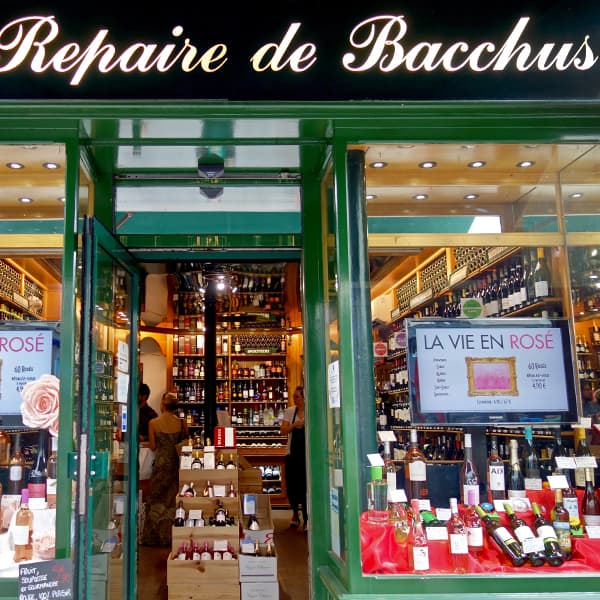
Step inside. Remember your greeting. Bonjour, monsieur. Bonjour, madame.
And your polite words. Merci, s'il vous plaît, and all that. And if you're just looking, it's je regarde. Let's browse around.
Read more...Show less
The walls are covered with different wines and spirits, with more in baskets on the floor. The wines are classified by the region of France from where they come from. Where they originate. Burgundy, Bordeaux, and so on.
A visit here is a quick tour of France. You won't see much from the region around Paris. Called Ile-de-France. Because they don't produce a distinctive wine of their own.
Each region has a unique mix of climate and soil. Called its terroir. And that produces the wine's distinct personality. Keep looking around.
You'll notice a locker for the most expensive wines. There's one section for foreign wines. It's pretty small. And a shelf for craft beers.
France is not traditionally beer country, so many of these beers come from Belgium. Famous for its beers. But more and more you'll see French-made micro-brews, as this is a popular trend. Back to the wines.
I'm checking out some of the prices. Not bad. Nope. Most wines here are under 20 euros and somewhere as low as 5.
You can get a fine bottle for 10 or 12 euros. Notice the stacks in the center of the store. These are usually specials. Wines of the month.
And you can find great deals. If you're not really a wine connoisseur, all the choices can be pretty overwhelming. True. That's why the wine store is always the last stop on any grocery shopping trip.
Only after you've assembled your meal can you know what wine will go well with it. The clerks are very helpful. They're like counselors. They work with your tastes, your budget, and your menu.
They think of what kind of wine pairs well with what. Vin blanc goes with fish, vin rouge with beef, and so on. Then they get more specific. Do you like your wine dry or sweet?
Sec or doux? Light or full-bodied? Legere or robust? While Americans tend to favor big, full-bodied wines, French wines are subtler.
They don't want the wine to overpower the food. Another difference, unlike much of America, rosé wine, is respected. The French appreciate a chilled rosé on a hot summer's day. If you're buying for a picnic, Bacchus has you covered.
Need a chilled bottle of rosé or white right away? They can pop that baby into Le Chiller and have it cooled in three minutes. Though drinking wine in public places is taboo in the United States, here in France, it's no problem at all. Pas de problème.
Rick, what kind of wine pairs well with an aged Valençay goat cheese, from the Vallée de la Loire? Uh, come again? Well, I'm asking because our tour is moving on to our next stop, the cheese store. It's right next door. Well, then, let's head there now. La fromagerie.
La Fromagerie
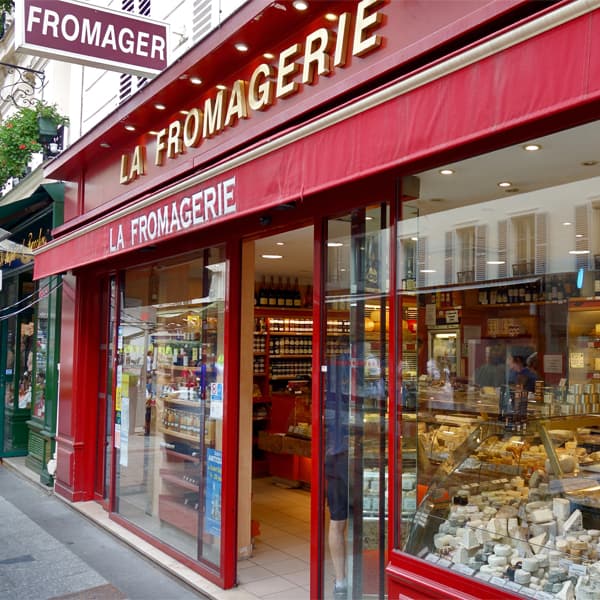
Start with the long, narrow, canopied table that brings the fromagerie right out into the street. Check out the incredible variety of cheese. The shop sells some 200 different types of French cheese. You'll see two basic types of cheeses.
Cheese from cow's milk. That's vache. And goat cheeses. Chevre.
Read more...Show less
The cheeses come in all shapes and sizes. Wedges, cylinders, balls, miniature hockey pucks. All powdered white, gray, and burnt marshmallow. It's a festival of mold.
The shape of the cheese and the packaging is actually very important. It tells locals in the know where that cheese came from. For example, that Valençay goat cheese Lisa was asking about from the Loire Valley. It always has the distinctive shape of a pyramid with the top lopped off.
One of my favorite cheeses called Epoisse, a cow cheese from Burgundy, is always round. The region is crucial. Like with wine, each region has a different terroir. That's the magical union of sun, soil, and gender.
There are generations of farmer love that gives the cheese its unique personality. For many French, the terroir is not just the science. There's an almost mystical element to that particular farm that makes the cheese what it is. Let's go inside.
As you do, remember, bonjour monsieur, bonjour madame. Near the door, notice the 1950s-era photo. It shows this very shop back when it was named simply Butter and Eggs. They still sell butter and eggs as well as cheese.
So this shop is technically what they call a B-O-F for beurre, oeuf, and fromage, butter, eggs, and cheese. But it's more commonly called a crèmerie. The waitstaff here is friendly, but they're also lab coat serious. They're cheese technicians.
They know exactly how a cheese must be handled to bring it to maturity. Like wines, quality cheeses need to be aged. The affineur, or finisher, is in charge. He makes sure the cheese rests in a cool, humid environment called a cave or cellar.
This process can take weeks or even months. The staff can squeeze a cheese and tell you exactly when it's mature enough to eat. They also know which cheeses are in season. In season?
Really? Well, the milk they make the cheese out of tastes different from season to season according to what the animal eats during those months. Looks like the shop has a back room. It does.
That's where they keep the moule. Those are the big wheels of cheese. Each wheel weighs about 170 pounds. That's more than you.
And made from 250 gallons of milk. These are the hard cheeses. You don't eat the skin of hard cheeses from those big wheels. Well, no.
They've been rolled on the floor. But the skin on the smaller cheeses, the brie, the camembert, that's part of the taste. As a Frenchman once told me, it completes the package. The French seem to be as serious about their cheese as they are about their wine.
Yes. It's said that there are 365 different types of cheese. That's one for every day of the year. No fine dining experience is complete without the cheese course.
You can have it either just before dessert or instead of dessert. You can choose a sampler of three, four, five different types. I like to get one hard cheese like a comté, one soft cow's milk cheese like brie or camembert, one goat cheese, and one cheese. One blue cheese like Roquefort.
Ah, yes, cheese. Glorious cheese. Lisa, get up close and take a whiff of this one. Ah.
If you like it, say ooh-la-la. Ooh-la-la. If you really like it, add greater excitement with more la's. Ooh-la-la-la-la.
And so on. I remember a Parisian friend of mine. She held the stinkiest cheese to her nose, took a breath, and said, ooh-la-la-la-la. Yes, she said, it smells like ze feet of angels.
Everybody now, inhale. Ooh-la-la-la-la. Time to move on. Our next stop is even stinkier. Across the street, find the fish shop, known as the poissonnerie. Ooh-la-la-la-la-la. The poissonnerie.
Poissonnerie
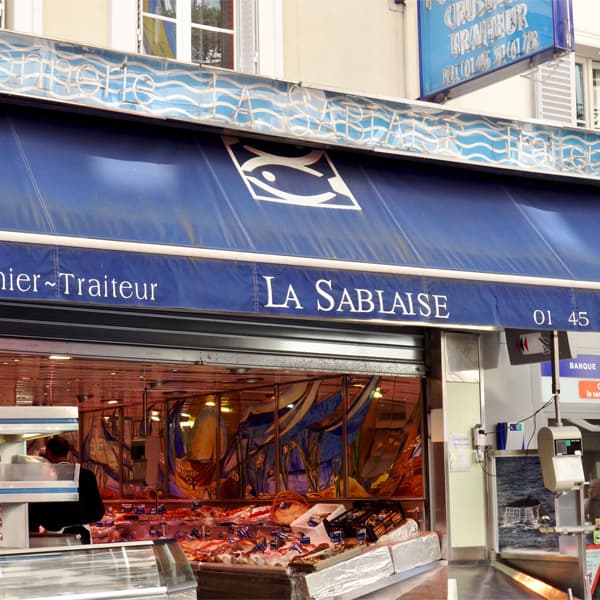
The seafood here is top-notch. The French demand that their seafood be fresh, so fish is brought here every day from ports on the English Channel 100 miles away. Because Paris is the central hub for seafood distribution, the fish you see here may even be fresher than in some coastal towns. Because fishermen don't fish on Sunday, this shop here on Rue Claire doesn't even bother to open on Monday.
No one would buy. This poissonnerie is very typical and traditional, but it's also state-of-the-industry. Like all the food shops on this street, it's been upgraded to meet Europe-wide hygiene standards set by the European Union. There seem to be a couple of running themes on this walk.
Read more...Show less
One is the importance of food in French life. The other is how that lifestyle is changing with the times. We'll see both themes at play at our next stop. Head next door. A Historic Storefront
Historic Storefront
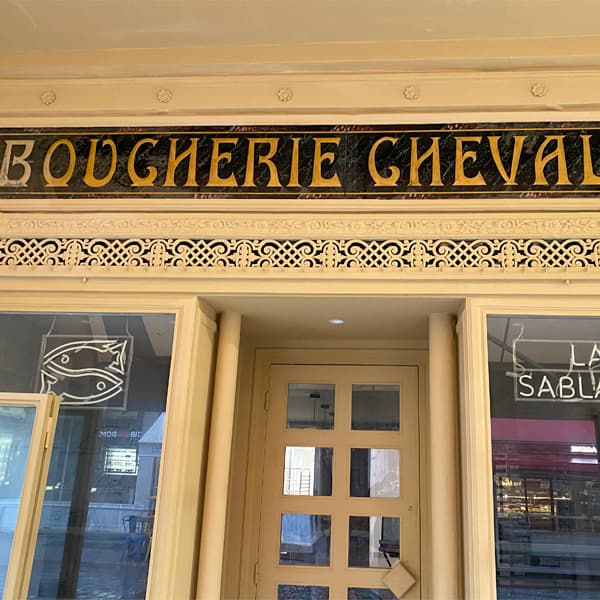
No More Horse Meat While this place is just another little business, there's more here than meets the eye. First, get up close to the storefront and look under the awning. Check out the store's stone-and-glass façade. Pretty classy.
It dates from the 1930s. It's even signed by the artist, and is a work-of-art fit for a museum. When this was done, the place was a butcher shop. Notice what the sign over the doorway advertises.
Read more...Show less
Boucherie Chevaline. Horse meat! That was once a French delicacy. But times are changing.
It's rare to find horse meat dishes on a restaurant menu. This shop is changing, too, as the neighborhood grows more affluent and tourist-oriented. But plenty of traditional businesses survive. Even thrive.
Continue just a few steps further up Rue Clair and across the street to our next stop, a la Mer de Famille Confectionery. A la Mer de Famille Confectionery.
A la Mère de Famille Confectionery
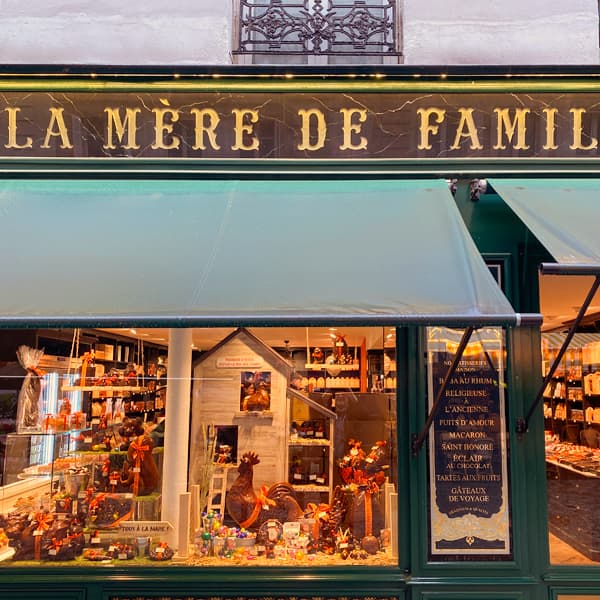
This shop has been in the neighborhood for 30 years. It's still very traditional. Until a few years ago, the chocolate was dipped and decorated right on the premises. And, as was the tradition of many Rue Clair shops back then, the merchants lived and worked in the back and sold in the front.
You can step inside and check out the candies. The owner sells modern treats as well, but she makes sure to keep the traditional candies, too. She told me, the old ladies, they want the same sweets that made them so happy 80 years ago. You can also get chocolate by the piece.
Read more...Show less
You're welcome to assemble a small assortment of your dreams. Many treats are less than a euro apiece. Lisa, grab your bonbon and let's move on on. Our next stop is just a few steps farther, at number 37. The street's oldest building
Oldest Building, Charcuterie
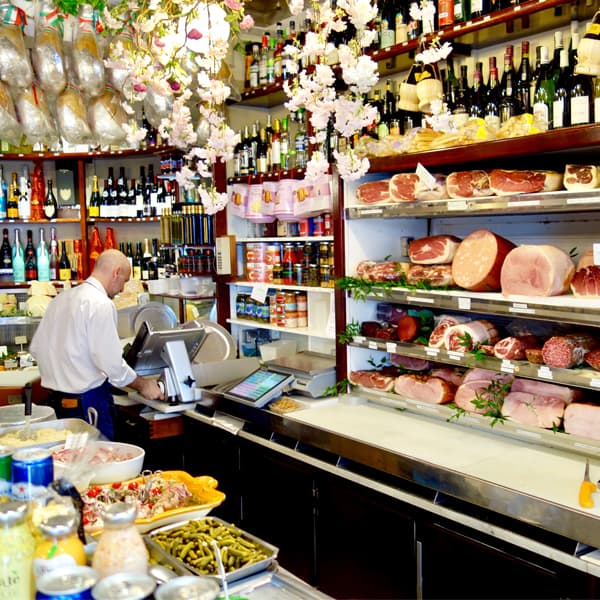
and charcuterie Traiteur Juscelin. Start by focusing not on the shop, but the building it's housed in. It's got two garages and two garret windows jutting up from the top of the roof. This is Rue Claire's oldest building.
It dates from the early 1800s. Back then, Rue Claire was part of a humble village located on the outskirts of Paris. The street was lined with structures like this one. Over the years, as Paris grew, it engulfed the surrounding villages and new buildings sprouted up.
Read more...Show less
Only this one remains. On the building's ground floor is a deli shop, Charcuterie Traiteur Juscelin. Notice that directly across the street is a similar business, the photogenic Italian charcuterie trattour called Davoli. Each day, these two places go tête-à-tête, competing for customers' business.
Both of these places are charcuteries, that's butchers. By definition, a charcuterie means a butcher of pork. They specialize in deli meats, sausage, pâtés, and ham. But with changing times, many charcuteries like these have had to expand their service so they're now what's called traiteurs.
They cook and prepare dishes to go. Basically, they're gourmet delis. Step inside Juscelin and check out their wares. It's good stuff.
They sell cooked dishes and a variety of different salads. There are sliced meats, roast chickens on the spit, little quiches, and pastries to go. Check out the various pâtés and sausages. Traiteurs are an essential part of the cuisine scene.
As Parisians, become ever busier, quality takeout food is increasingly popular. And because Parisian kitchens are so small, even those who cook at home need help. They can concentrate on the main course themselves and then supplement it with beautifully prepared side dishes from the neighborhood traiteur. On the back wall, notice their awards.
The traiteur business is fiercely competitive. There are countless cooking contests where they can show off their skills. Juscelin is obviously top-notch. If you're paying for a meal, or picnic shopping, a traiteur like this makes it easy.
The food comes in handy takeout boxes. They can heat it up for you and supply a plastic fork. The best quality dishes tend to come out around 11 a.m. or 5 p.m., just before lunch and dinner.
Note the system. Order, take your ticket to the cashier to pay, and return with the receipt to pick up your food. Whatever you do, be adventurous. Try the smelly cheeses, ugly pâtés, and sissy quiches.
Go ahead. I dare ya. Or, if you're not into picnicking, you might like our next stop. It's just a few doors down at the intersection. It's the café on the corner, Café du Marché. ¶¶ Café du Marché.
Café du Marché
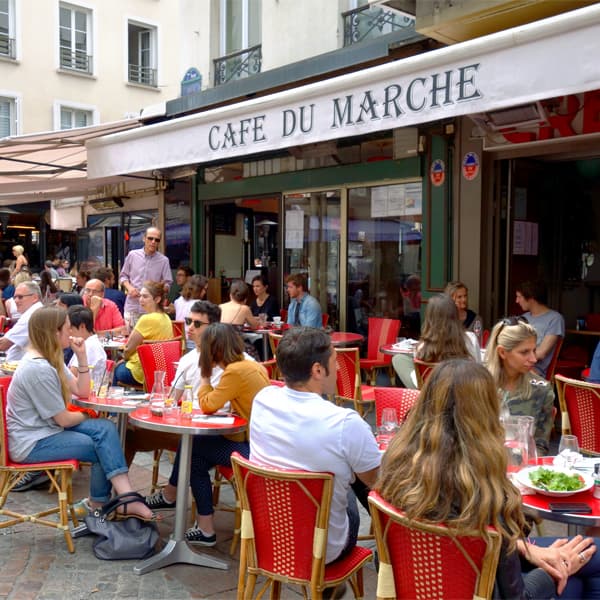
Café du Marché appears to be ground zero for enjoying the action. It boasts the best seats on Rue Claire in the center of the two-block pedestrian zone. It's Rue Claire's living room. Locals rendezvous at cafés like this for lunch or after work before heading home.
The owner has priced his menu for regulars, and it works. Many eat here several times a week. Notice how popular outdoor seating is. France's laws prohibiting smoking indoors have encouraged people to sit outside.
Read more...Show less
Generally, at a café or brasserie, if the table's not set, it's fine to seat yourself and just have a drink. However, if it's set with a placemat and cutlery, you should ask to be seated and plan to order a meal. If you're unsure, ask the server before sitting down. Check the chalk menu listing the plat du jour, the daily special.
There's a limited selection. The owner's philosophy here is simple. This is a brasserie on speed They crank out good enough food at a good price to appreciative locals and savvy tourists. The service is high energy, and young waiters barely have time to smile.
Très Parisienne. On the other hand, look how relaxed the diners are. The French eat long and well. People here don't scarf a sandwich in front of a computer.
Convivial lunches with a chilled rosé, three-hour dinners, endless hours of sitting in outdoor cafés. Those are the norms. Here, celebrated restauranteurs are as famous as great athletes, and mamas hope their babies will grow up to become great chefs. Across the street is another restaurant, Café Central.
It's pretty similar. Rue Claire's eateries tend to cater to residents. They're not fancy destination spots, but they do have intimate atmosphere and everyday charm. Rue Claire isn't really known for its nightlife.
The restaurants and bars here are busy, but more for quiet dinners or drinks. And the neighborhood is great for just strolling and checking out the floodlit monuments nearby. Nearby, check out the modern grocery store. This sells groceries and non-perishable items, things like paper towels at discount prices.
It's kind of a tiny Costco. However, because storage space is so limited in Parisian apartments, bulk purchases have not really caught on. If anything, people stock up on non-perishables online. Then they shop for fresh items like produce almost daily, and then they shop and buy their fresh bread every day.
Compare the modern sterile storefront with the elegance of the other shops on this street. Locals suspect somebody greased somebody's palm to get around the building permit. Things are carefully controlled here. Normally, any building modification on Rue Claire has to go through miles of red tape to get a permit.
Nearby, check out the Veilie bike racks. City Hall is enthusiastic about making Paris bike-friendly. People can check out bikes here nearly for free. Tourists can, too.
Let's move on. Before we do, take a moment to just stand here and survey the scene. You're right in the heart of Parisian neighborhood life. Shoppers, businessmen, students, parents with kids, and old friends meeting for a drink.
Notice how they greet each other. They don't shake hands. They kind of kiss. They faire la bise, literally, do the kiss.
So, when Paris and two friends meet, they don't hug, American style. That's far too aggressive for the French. Instead, it's a kind of pecking on the cheek. Observe.
First, they touch their cheeks together. Then they pucker and make a kissing noise. But note, the lips don't actually touch the cheek. You start by kissing the left side, then the right, then back to the left, or even more.
The number of kisses varies with how well you know the person, what the situation is, regional customs, and so on. In Paris, two kisses is the norm. Parisians faire la bise in social settings, but rarely in the workplace. If they're being introduced to someone for the first time, women may kiss women, and men may kiss women, but two men will shake hands.
If you happen to be greeted with la bise, go for it with confidence. Touch one cheek. Touch the other cheek. Is there a third kiss coming?
My recommendation is hover and wait. I say, let's kiss this street corner goodbye and move on. Good idea. From Café du Marché, turn right on Rue de Chambre de Mars.
We'll side trip just a couple of doors down Rue de Chambre de Mars to visit a shop called La Pizzerie Fine. La Pizzerie Fine
L’Epicerie Fine
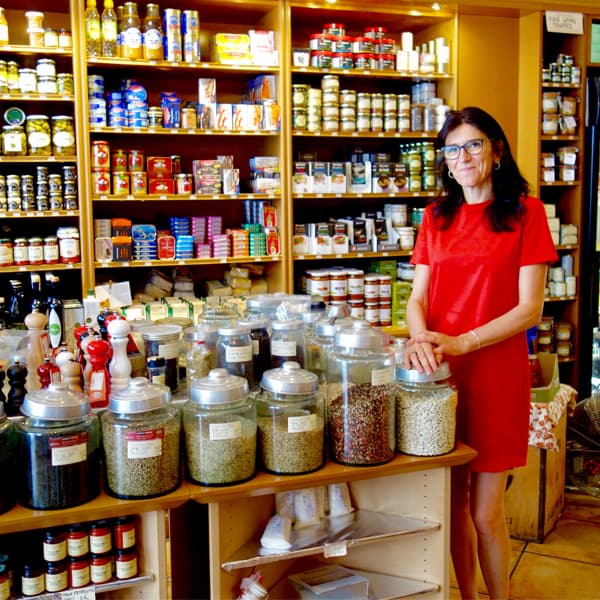
We've seen several excellent fine foods boutiques like this, but this one stands out because of its gentle owners, Pascal and Nathalie. Their mission in life is to explain to travelers what the French fuss-over food is all about. And they do it in fluent English. If you decide to go in, they'll tempt you with fine gourmet treats.
They sell the famous Bertillon ice cream. They give generous tastes of balsamic vinegar, and olive oil, both French and Italian. And if you're shopping for souvenirs, their salted caramels from Normandy and jars of mustard work great. When you're ready, it's time to be moving on.
Read more...Show less
Across the street, find the real estate agency. The advertisements in the window are for condos and apartments for rent or sale. Check out the addresses. You'll know what arrondissement or neighborhood it's in by the number after Paris in the address.
It tells you whether it's an apartment for rent or a condo for sale. And how many square meters. Twenty-five square meters is about the size of a spacious hotel room. And of course, they list the monthly rent or sales price.
Ooh-la-la-la-la-la-la! That's pricey! Let's move on. Return to Rue Claire. Our next stop is the neighborhood bakery on the corner. The Artisan Boulangerie.
Artisan Boulangerie
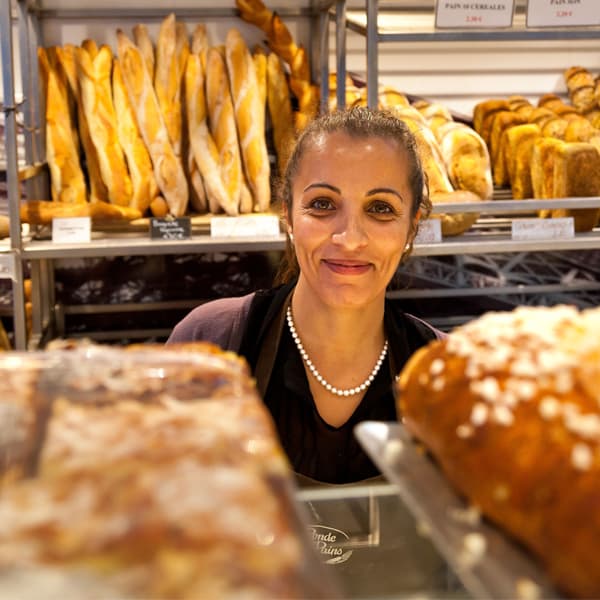
This is a bakery or boulangerie. This one's really popular. There's often a line of people waiting to pick up their daily bread. It's been a ritual here in Paris since earliest times.
You don't buy day-old bread or buy a loaf of bread meant to last a week. You get today's bread today. Most hotels won't even serve breakfast until the day after. Until the corner bakery opens and they can buy their baguettes and croissants fresh for their guests.
Read more...Show less
Check out the various types of breads on sale. The most common loaf is the long, tube-shaped bread called a baguette. The word literally means wand or stick. Bread is so essential to daily life that ever since the days of the French Revolution, the government has regulated the cost of a basic baguette to keep the price affordable and to keep the working masses happy.
By law, a baguette must weigh 250 grams. It must consist of only four ingredients, flour, yeast, salt, and water. Parisians can specify their preferences when they buy their baguette. Some like them well done, others like it doughy.
Some people make not one trip, but two trips to the bakery every day because even the best baguette can become stale in a matter of hours. To keep it fresh, they say you should wrap it in a cloth, never a plastic bag. The baguettes come in different forms. There's plain baguettes, wheat bread, whole grain with seeds, rye, and so on.
Locals constantly debate which boulangerie is the best in their neighborhood. Many people are fiercely loyal to their local bread maker. By law, a boulangerie must make its bread right on the premises. Otherwise, they can't call themselves a boulangerie.
Each spring, the city hosts a competition for the best baguette of Paris. It's like the Michelin star system, but for baking, The top prize can be thousands of euros. Even more prestigious, the winning baker has the honor of providing the French president with baguettes for the coming year. Besides baked goods, this boulangerie also serves pastries.
They have my favorite, eclairs. Those are the long pastries with cream fillings. There are fruit tarts, ooh, and macarons, meringue cookies with a cream filling. It's said that a baker cannot be good at baking, both bread and pastry.
In fact, at cooking school, students generally major in one or the other. A boulangerie diploma covers only baked goods like bread, croissants, and pain au chocolat. A patisserie diploma covers things like macarons, cream cakes, and chocolate creations. Here at Artisan Boulangerie, they happen to be good at both, top-quality breads and delicious pastries.
Let's continue on. You're kidding, right? I haven't tried all the eclairs yet. Don't worry, we're nearing the home stretch of our walk, so you can always come back when we're done.
I'm coming back for a pan au chocolat. All right. For now, head back outside and continue up Rue Claire a few steps to our next stop, Mephisto Shoes.
Mephisto Shoe Store
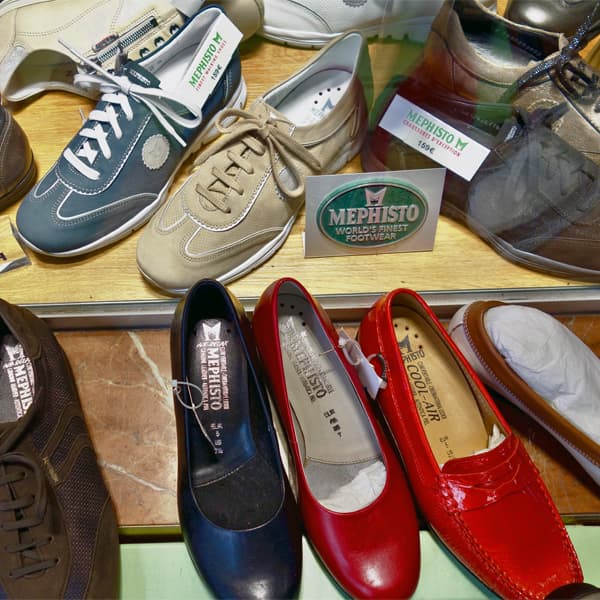
Mephisto Shoe Store Shoe stores are almost as popular as bakeries in this city of footwear-loving fashionistas. Mephisto is a French brand that's now available throughout the world. During your time in Paris, don't be surprised to see locals checking out your shoes. They check out everyone, and to them, yours look foreign.
In a city where many people don't have cars, good shoes matter. The average Parisian's daily life is active. They wear shoes when they walk to the metro, walk to lunch, and to the shops after work. When they get home, they probably climb several flights of stairs.
Read more...Show less
No need for the gym with this routine. That's true. In fact, gyms here are rare. They're expensive and often not well-maintained.
Yet, as you may have noticed, the people of Paris are trim and fit. Curse you, automobile, for making us all fat! Let's move on. Our next stop is right across the street, a flower store. ♪♪♪ Claire Fleur.
Cler Fleurs
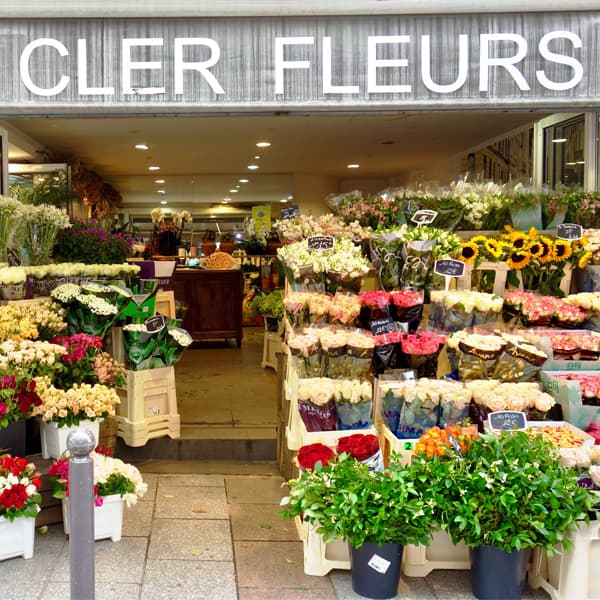
Flowers are especially treasured in Paris. You see, most Parisians live in small apartments or condos. They have no lawn, no backyard, few windows, and no gardens. How do they get their fix of Mother Nature?
Flowers. Parisians are willing to spend a small amount of their fortune to bring a little slice of nature into their homes. They put potted plants in their flower boxes. You'll see them on some of the apartment balconies.
Read more...Show less
And they love fresh-cut flower arrangements. When visiting friends in Paris, it's polite to bring the hostess a gift of flowers. Better yet, have them delivered before you show up. But avoid chrysanthemums.
They're for funerals. Thank you for sparing me an awkward faux pas. We're headed for our final stop at the end of the street. As you make your way there, check out the butcher shop.
For Americans raised on beef and chicken, this place can be a real eye-opener. It's a traditional butcher selling the kinds of items found on traditional French menus. There's rabbit, lamb, duck, veal. And is that pigeon?
Could be. You may also see steak tartare. Basically, hamburger mixed with spices and served raw. Look around.
You may see gizzards, pig's feet, liver, brain, tripe. All very photogenic. And for many French people, very tasty. Unfortunately, traditional butchers are increasingly hard to find in France.
The younger generation just no longer considers it a desirable career option. I'd rather be a florist. And you'd find me at Bacchus Wines, working the chiller. Continue on to our final stop.
It's at the end of Rue Claire, where it hits a bigger street, flooded with cars and buses. City Info Post
City Info Post and a Tabac
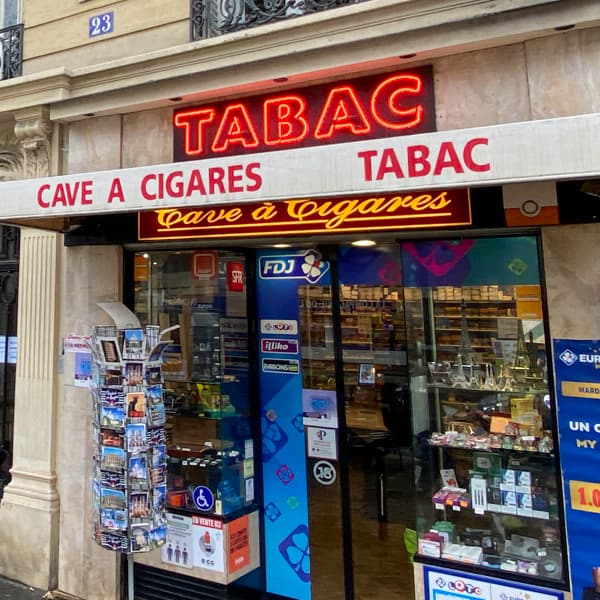
and a Tabac Here is where neighborhood Paris meets the wider Paris of busy boulevards and modern city life. Start by finding the electronic signpost. It's at the very end of Rue Claire, right next to the busy boulevard. This reader board gives out information to Rue Claire residents.
It alerts them to changes in bus routes and metro closures. It lists job openings and community events and so on. Near the sign, notice the big glass recycling bin. Parisians try to be very green.
Read more...Show less
Also, along the streets, you may see some trash cans. Well, they're not exactly cans. They're see-through plastic garbage sacks. Yes.
Paris suffered a rash of trash can bombings. Bad guys hid bombs inside the metal cans, which exploded into deadly shrapnel. The city responded by replacing metal cans with these see-through bags. Now direct your attention across the busy boulevard.
Find a small shop with a red sign that reads Tabac. Just as the U.S. has liquor stores licensed to sell booze, the only place to buy tobacco legally in France is at a Tabac. People over 18 can buy cigarettes here.
They can get pipe tobacco even though they're not that fine Cuban cigar. French people smoke more than Americans do. That's in spite of strict European laws that require cigarette makers to put big, bold warnings on the package. Here in France, it says very bluntly, fumetou, smoking kills.
Despite the graphic warnings, many French people cling to this traditional lifestyle. By the way, we won't be actually going to the Tabac on our walk, but it's interesting to do on your own even if you don't buy anything. Tabacs are much more than just a place to buy cigarettes. They've long been a neighborhood necessity.
Locals come here for all kinds of services. Tabacs might sell stamps or metro tickets. They sell lottery tickets. Like in America, the lotto is a big deal.
It's a lucrative way for the government to raise funds. And our last stop is just next door. ¶¶ ¶¶ The Pharmacy
The Pharmacy
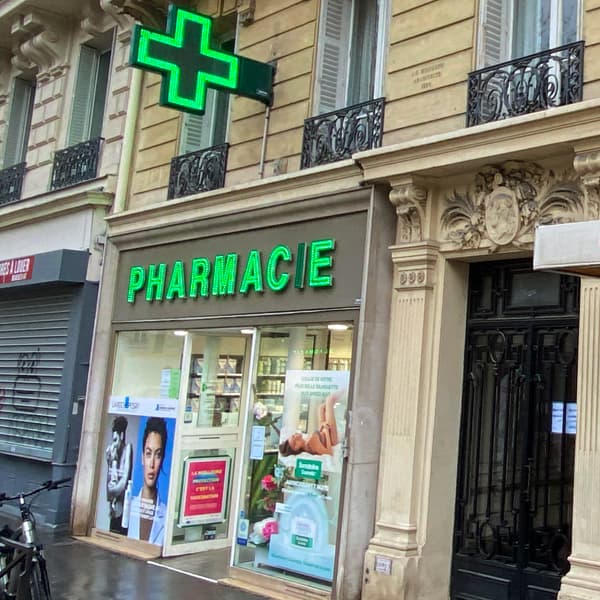
In France, as in much of Europe, the pharmacist, not the doctor, is the first person you go to when you're sick. Pharmacists here are trained to make the first diagnosis. They can prescribe certain drugs. If it's out of their league, they'll recommend a doctor.
I've seen customers handing over a green ID card. This is the Carte Vitale, the French health insurance card. It has a photo and is embedded with a security chip. France's national health care system has generous benefits.
Read more...Show less
It pays about 75% of pharmacy, doctor, and hospital bills. Many prescriptions are 100% covered. Many people supplement their national health care with private insurance they can get through their employer. The French are proud of their health care.
It ranks very high on the World Health Organization list. But budget shortfalls are threatening cutbacks. France's social safety net. So if you happen to come across a workers' strike somewhere during your trip, it's likely about protecting benefits like these.
Our walk is nearly done. Note that the métro stop École Militaire is just a block away. You're just a 15-minute walk to the Eiffel Tower, Anne Valide, the Rodin Museum, and the Seine. If you bought a picnic, there are several picnic spots nearby.
The Eiffel Tower has the grassy Champs-de-Mars, lined with benches. At Anne Valide, there are small parks at both the front and back side. And there are pleasant spots along the River Seine. From here, Paris awaits.
Or you could just linger at a Rue Claire Café over a glass of wine or a café crème and watch the world go by. Now, finish your walk by just taking in the scene around you. Look all around. Marvel at how Paris, a city of more than 2 million people, can combine a vibrant present with an ever-present past.
History is everywhere. And crammed into all this history, the modern world somehow finds a way to thrive. Parisians proudly maintain the refined culture that defines 21st-century France. Cars politely give way to bikes and pedestrians.
The busy boulevards are lined with trees and stately buildings that still honor the traditional eight-story limits of the past. With apartment owners above and shop owners below, the neighborhood maintains the high-density population that keeps things vibrant both day and night. This is the way of life that has characterized Rue Claire for generations. And Rue Claire is just one neighborhood, part of the vast tapestry of neighborhoods that make up Paris, a city that's as vital today as ever.
We hope you've enjoyed this walk along Rue Claire. Thanks to Jean Openshaw and Steve Cooley. And Steve Smith, the co-authors of this tour. This tour is excerpted from the Rick Steves Paris Guidebook, co-authored by Steve Smith and Jean Openshaw.
For more self-guided walks and details on eating, sleeping, and sightseeing in Paris, refer to that guidebook. We also have other Paris audio tours that includes a historic Paris walk, the Louvre Museum, the Orsay Museum, the Palace of Versailles, and Père Lachaise Cemetery. For more information about Rue Claire, our TV shows, bus tours, and travel gear, visit our website at ricksteves.com. This tour was produced by Cedar House Audio Productions. Merci. Au revoir. And bon voyage.
Free
GPS-guided walking tour
No account needed. Walk at your own pace.
Free
19 stops ·