19 stops
GPS-guided
57 min
Duration
Free
No tickets
About this tour
A guided tour of The Orsay Museum in France with 19 stops. Highlights include The Orsay Museum, Ingres: The Source, and Cabanel: The Birth of Venus.
19 stops on this tour
The Orsay Museum
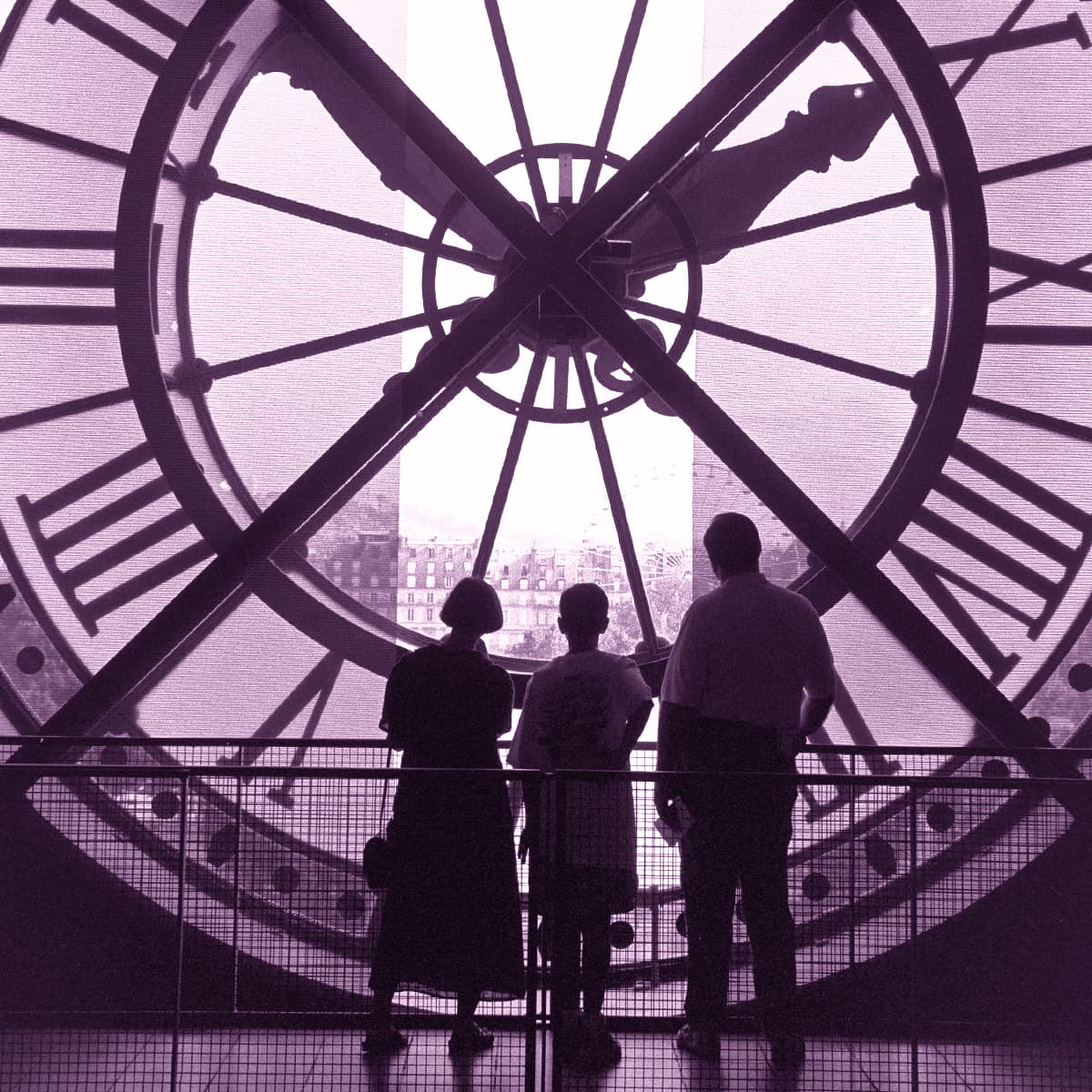
The Orsay Museum, or Musée d'Orsay, houses French art of the 1800s starring the Impressionists. It's the art of sun-dappled fields, bright colors, and crowded Parisian cafes. Hi, I'm Rick Steves. Thanks for joining me on a guided tour through the best general collection anywhere of Manet, Monet, Renoir, Degas, Van Gogh, Cezanne, and Gauguin.
If you like Impressionism, visit this museum. If you don't like Impressionism, visit this museum. I personally find it a more enjoyable and rewarding place than the Louvre. Sure, you gotta see the Mona Lisa and Venus de Milo, but after you get your goddess out of the way, enjoy the Orsay.
Read more...Show less
Allow about 90 minutes to do justice to this audio tour. Once at the Orsay, be sure to pick up their free map to get the current layout. Because the Orsay rotates its collection frequently, think of this less as... as a painting-by-painting tour and more as a pleasant stroll through Impressionist art.
Keep the big picture and let the colors and images dazzle. This is one of Europe's most pleasant art experiences. The Orsay Museum. To help us along the way, I've invited a good friend and virtual travel buddy.
Welcome, Lisa. Bonjour, Rick. Lisa. Lisa will give us helpful directions and sightseeing tips throughout the tour.
And my first tip is to be sure you get our tour updates. Just press the icon at the lower right of your device. You'll find any updates and helpful instructions unique to this tour. Things like closures, opening hours, and reservation requirements.
There's also tips on how to use this audio tour and even the full printed script. Yes, so pause for just a moment right now to review our updates and... Special tips. It's okay.
We'll wait. And then... Let the tour begin. Let the tour begin. The tour begins.
Tour Begins: Main Floor Statues
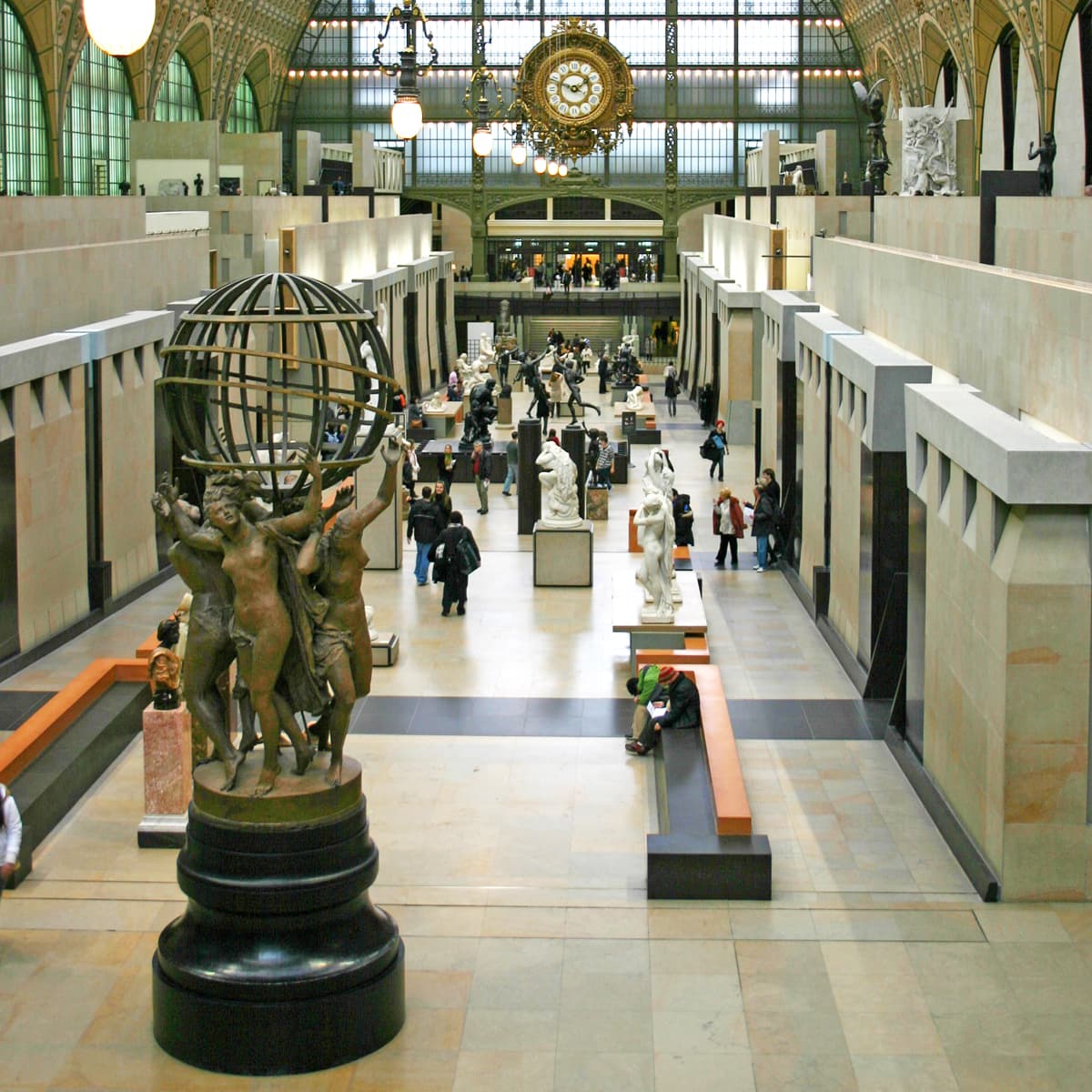
The main floor statues and the Orsay's 19th century. Start your tour inside the Orsay, overlooking the vast main gallery. Be sure to pick up a free English map to get the latest layout because the museum's collection changes frequently. Now, belly up to the stone balustrade overlooking the main floor and take it all in.
Rick? The main floor stretching before you has early 19th century art. Conservatives on the right, realism on the left. Upstairs, not visible from here, is the core of the collection, the Impressionist rooms.
Read more...Show less
We'll start with the conservatives and early rebels here on the ground floor, then head upstairs to see how a few visionary young artists bucked the system and revolutionized the art world, paving the way for the 20th century. Let's go. Walk down the steps to the main floor into the main gallery filled with statues as Rick introduces us to the art of the 19th century. The 19th century was a mix of old and new, side by side.
Europe was entering the modern industrial age with cities, factories, rapid transit, instant communication, and global networks. At the same time, it clung to the past with traditional, rural, almost medieval attitudes and morals. So, the Orsay shows art that's also both old and new, conservative and revolutionary. Wander among the main floor's gallery of gleaming white statues.
No, this isn't ancient Greece. These statues are from the same era as the theory of relativity. It's the conservative art of the French schools that was so popular throughout the 19th century. People loved this stuff because it's beautiful.
With the balanced poses, perfect anatomy, sweet faces, curving lines, and creamy stone, it's all very appealing. I'll be bad-mouthing it later, but for now, appreciate the exquisite craftsmanship of this pretty and very conservative art. Think of the times that produced these statues. The Orsay's collection spans the period from 1848 until 1914.
It began with democratic and socialist revolutions. Marx wrote his Communist Manifesto during this period and ended in 1914 with the pull of an assassin's trigger, which ignited World War I and ushered in the modern world. This was the century of Geronimo and Einstein, Abraham Lincoln, and Karl Marx. The train, the bicycle, the horse and buggy, the automobile, and the balloon, Freud and Dickens, Darwin's Origin of the Species, and the Church's Immaculate Conception, Louis Pasteur and Billy the Kid, Vladimir Lenin and Ty Cobb.
Let's enter some of the rooms flanking the statue gallery. Enter the small Room 1, the room closest to the entrance. Look for a painting of a nude woman with a pitcher of water. But remember, many of the paintings along our route may be temporarily removed, temporarily out on loan, or displayed somewhere else.
So stay flexible, and be prepared to enjoy other works by the same artist. Enter Room 1, with works by Angra. Jean-Auguste Dominique Angra,
Ingres: The Source
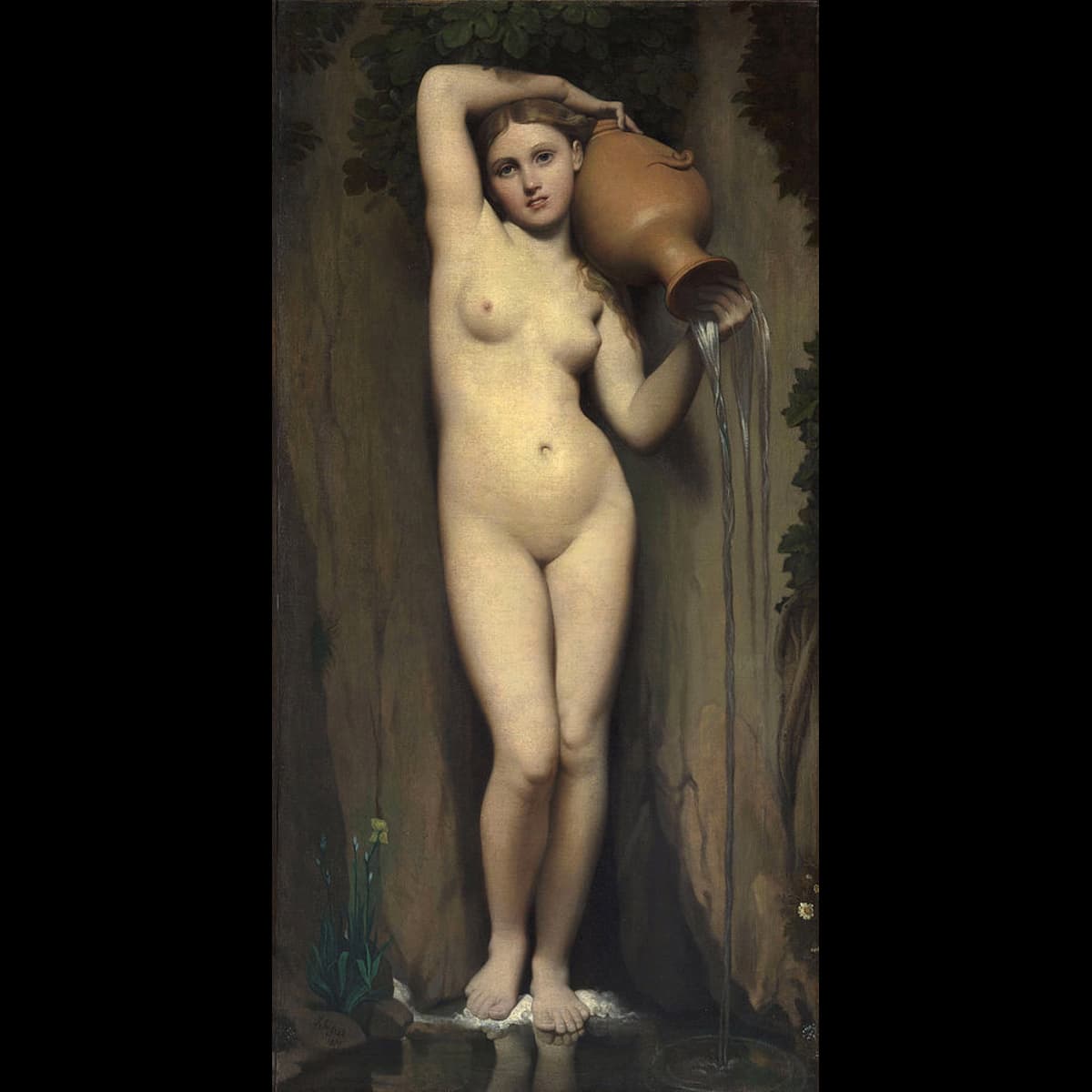
The Source, 1856. Let's start where the Louvre left off. Angra, who helped cap the Louvre's collection, championed a neoclassical style. The Source is virtually a Greek statue on canvas.
Like Venus de Milo, she's a balance of opposite motions. Her hips tilt one way, her breasts the other. One arm goes up, the other down. The water falling from the pitcher matches the fluid curve of her body.
Read more...Show less
Her skin is porcelain smooth, painted with seamless brushstrokes. Angra worked on this for over 35 years and considered it his image of perfection. Famous in its day, The Source influenced many artists whose classical statues and paintings are in this museum. Start walking uphill through Room 2 and into Room 3.
As you go, you'll see more of these visions of idealized beauty, nude women in languid poses, episodes from Greek myths, dreamy landscapes. Scenes like these were totally at odds with the gritty reality of the Industrial Revolution that was transforming 19th century Europe. When you reach Room 3, the paintings are equally dreamy. Look for one specific painting, a pastel blue-green work of a reclining goddess. © transcript Emily Beynon
Cabanel: The Birth of Venus
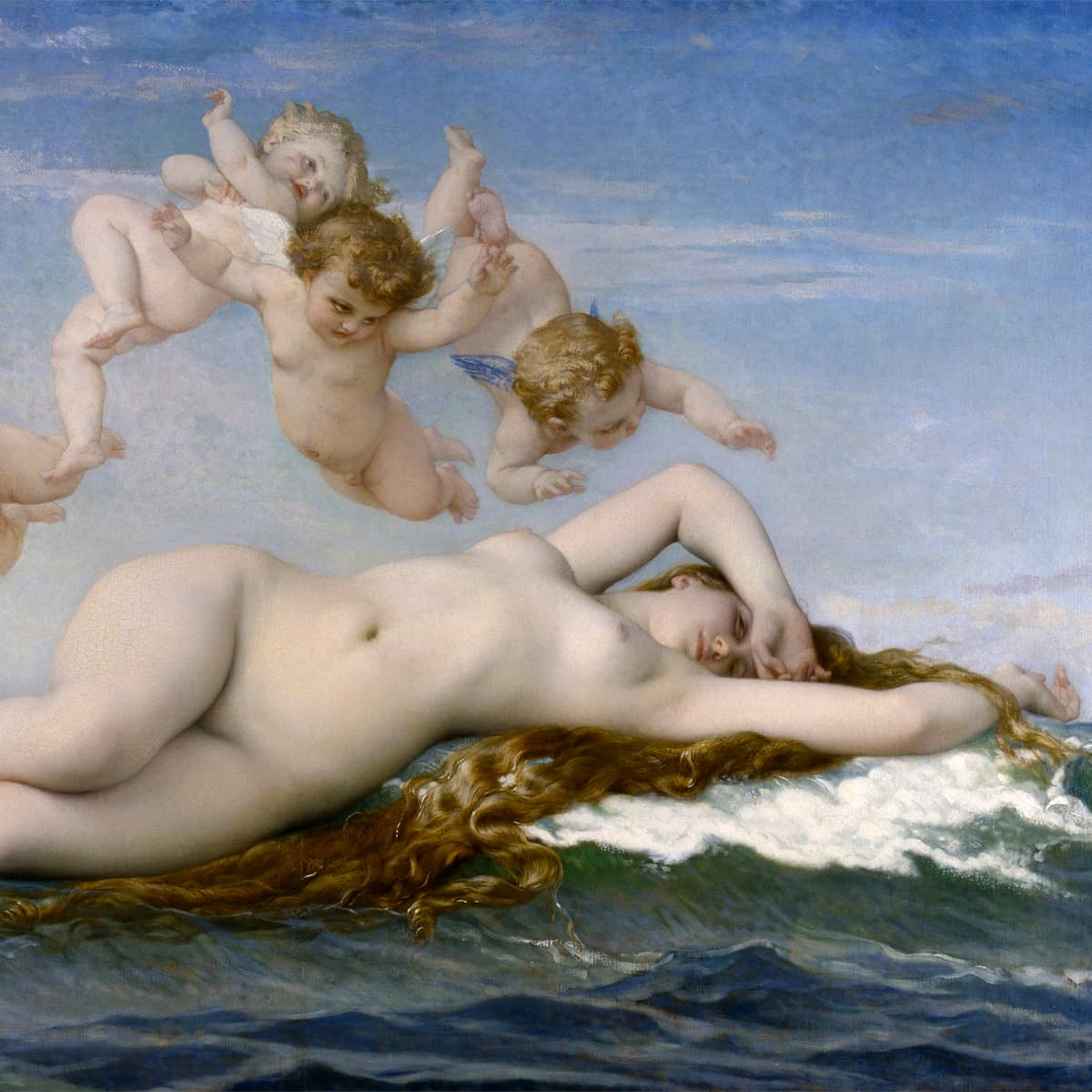
Alexander Cabanel The Birth of Venus from 1863 Cabanel lays Angra's The Source on her back. This goddess is a perfect fantasy, an orgasm of beauty. The love goddess stretches back seductively, recently birthed from the ephemeral foam of a wave. This is art of a pre-Freudian society when sex was dirty and mysterious and it had to be exalted into a more pure and divine form.
The sex drive was channeled into an acute sense of beauty. French folk would literally swoon in ecstasy before these works of art. The art world of Cabanel's day was dominated by two conservative institutions, the Academy, which was the state-funded art school, and the Salon, where works like these were exhibited to the buying public. The public loved Cabanel's Venus.
Read more...Show less
In fact, Napoleon III purchased it. Get a feel for the ideal beauty and refined emotion of these works of art. © transcript Emily Beynon © transcript Emily Beynon © transcript Emily Beynon © transcript Emily Beynon
Daumier: Celebrities
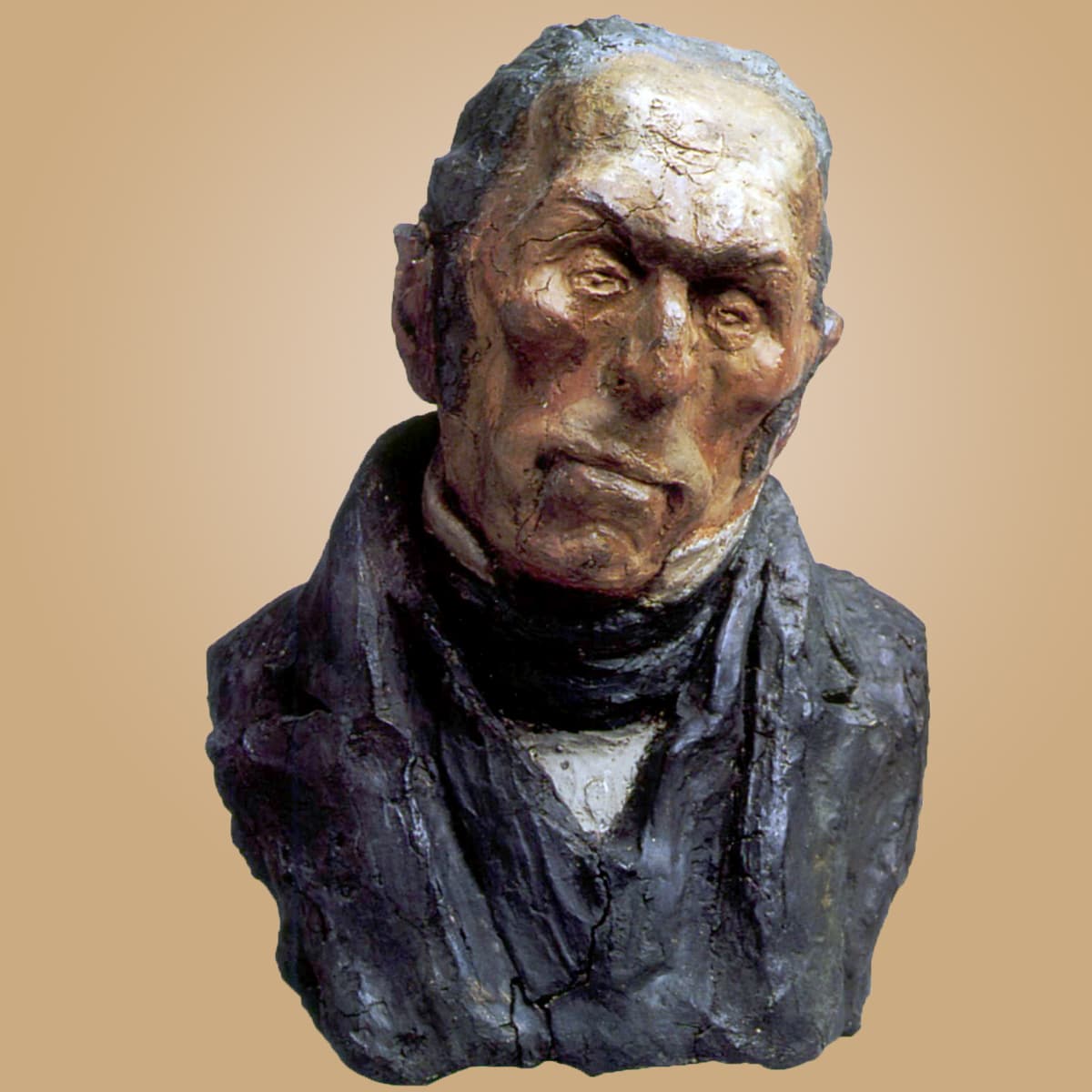
© transcript Emily Beynon © transcript Emily Beynon © transcript Emily Beynon © transcript Emily Beynon © transcript Emily Beynon
Millet: The Gleaners
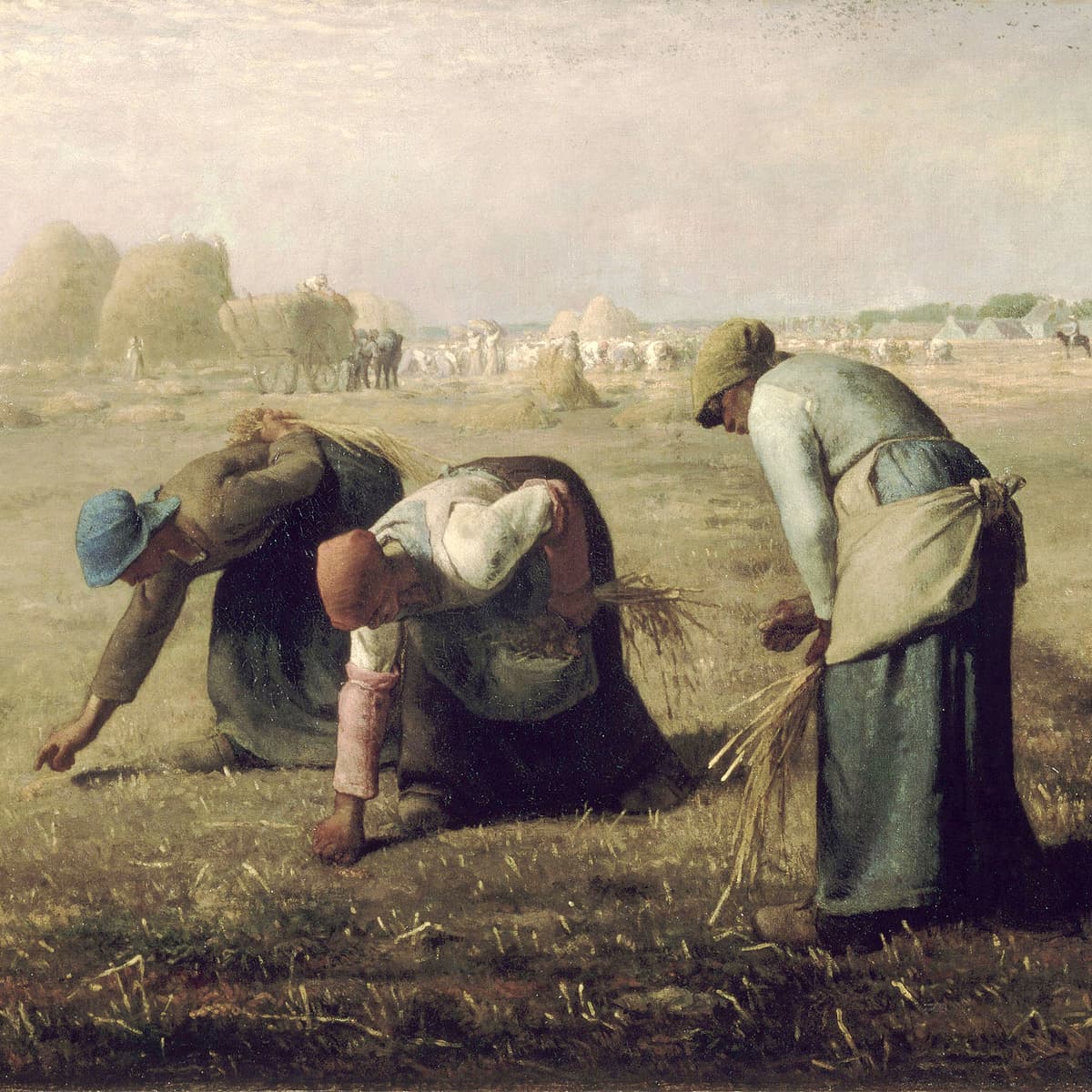
© transcript Emily Beynon © transcript Emily Beynon © transcript Emily Beynon Manet. Manet is better known as an early impressionist, but his foundation was in realism. The painters called realists were the first to reject the saccharine beauty of the academy and the salon. They focused on scenes from everyday life.
They sketched in cafes, train stations, and busy Paris streets. They didn't gloss over the rough edges. Now let's see a realist's take on the traditional Venus. Find Manet's Olympia in room 14.
Read more...Show less
Edward Manet, Olympia, 1863. This brunette is thoroughly ugly. Her face is stupid. Her
Manet: Olympia
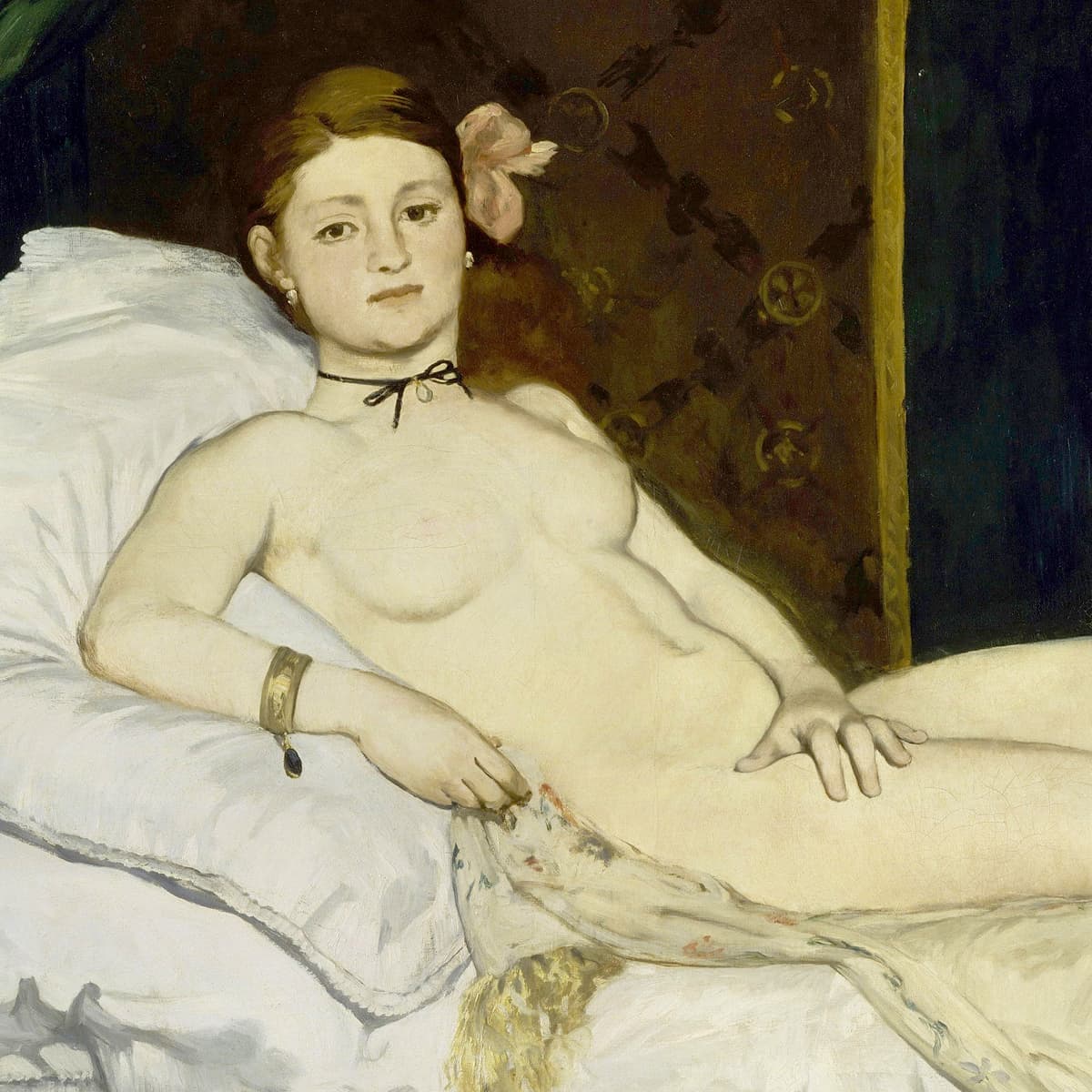
skin, cadaverous. All this clash of colors is stupefying. So wrote a critic when Edward Manet's nude. Manet hung in the salon.
The public hated it, attacking Manet in print and literally attacking the canvas. Think back to Cabanel's painting The Birth of Venus, an idealized pastel, Vaseline-on-the-lens beauty. Softcore pornography, the kind you see selling lingerie and perfume. Manet's nude doesn't gloss over anything.
Read more...Show less
The pose is classic, used by Titian, Goya, and countless others. But this is a realist's take on the classics. The sharp outlines and harsh, contrasting colors are new and shocking. Her hand is a clamp, and her stare is shockingly defiant, with not a hint of the seductive, hey-sailor look of most nudes.
This prostitute, ignoring the flowers sent by her last customer, looks out at us, as if to say, next. Manet replaced softcore porn with hardcore art. Edward Manet had an upper-class upvote. He had a beautiful upbringing and some formal art training.
His work had been accepted by the salon. He could have cranked out pretty nudes and been a successful painter. Instead, he surrounded himself with a group of young artists experimenting with new techniques. With his reputation and strong personality, he was their master, though he learned equally from them.
Upstairs, that revolution is in full bloom. But first, step back out into the main gallery and continue to the far end. The next exhibit is a reminder that paintings and statues weren't the only art forms of 19th-century Paris. The city became one of Europe's great music capitals.
In fact, Paris itself was a work of art. Let's get a glimpse. At the far end of the gallery, you'll walk on a glass floor over a model of Paris. The Opera Exhibit
The Opéra Exhibit
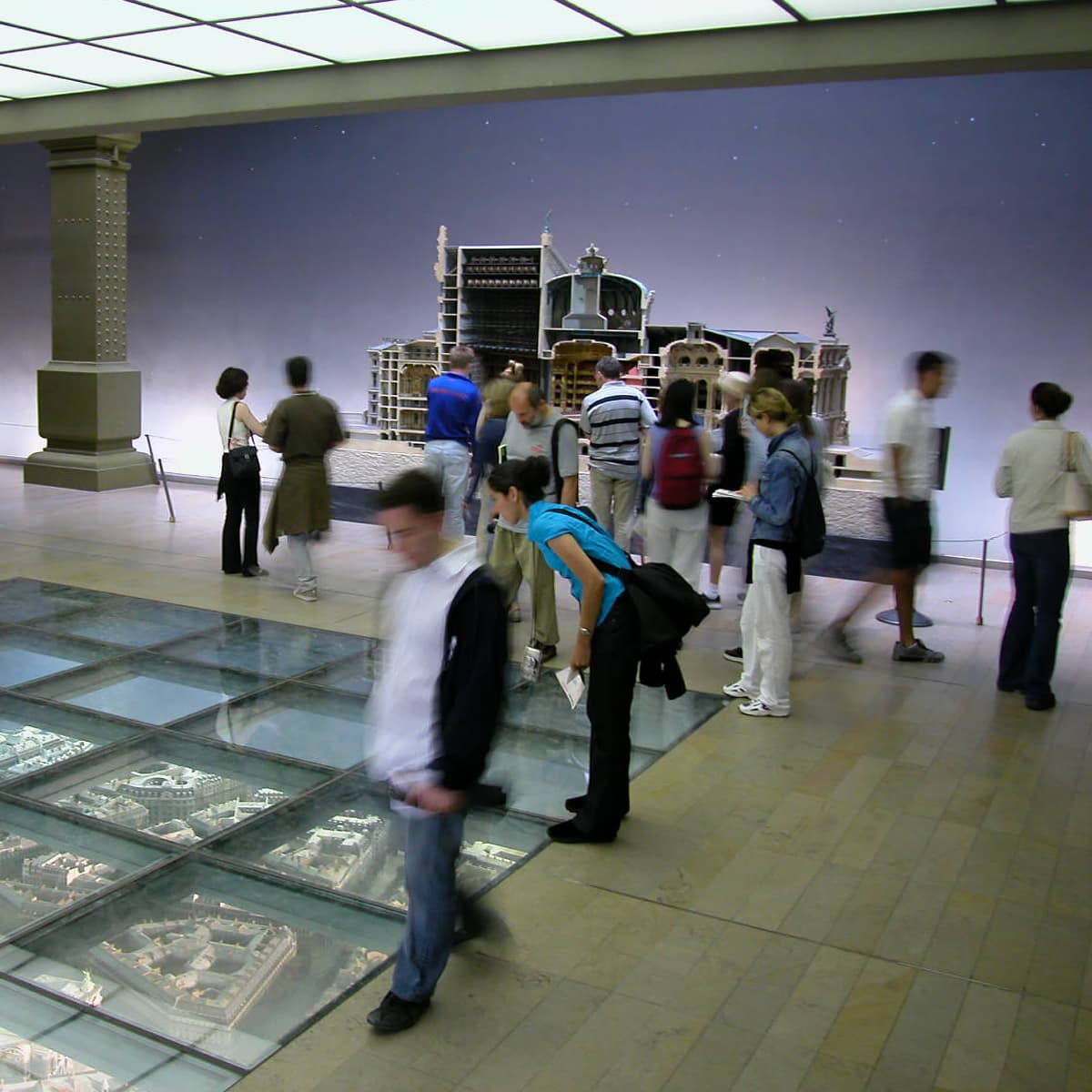
Hover over this scale-model section of Paris. This is the neighborhood around the Garnier Opera House. Find the opera house in the center with its green-domed roof. Notice the wide straight boulevards and the uniform height of the buildings.
This was state-of-the-art in the 19th century. This part of Paris had recently undergone an urban renewal that cleaned out its tangle of medieval lanes. The centerpiece was the opera house. Explore some of the other exhibits nearby.
Read more...Show less
Find the cross-section model of the opera house itself. Get close. You can see the inner workings. Start your virtual tour at the main entrance, at the far right end of the model.
You'd enter through the glorious front door. This would spill into the foyer, where you'd buy your ticket. Next, you'd proceed into the main entrance. This is the main entrance hall, with its grand staircase.
This is where you could see and be seen by all of Paris. At curtain time, you'd find your seat in the red and gold auditorium, topped by a glorious painted ceiling. The current ceiling, done by Marc Chagall, is even more wonderful than the one in the model, and makes a visit to the actual opera house a real treat. Notice that the stage, with elaborate riggings to raise and lower scenery, is as big as the seating area itself.
Nearby, you'll see models of set designs from some famous productions. This building hosted the opera until the 1980s. These days, Parisians get their Verdi and Gounod fix at Paris' new opera house at Place de la Bastille. From here, we head upstairs to the top floor to see the Impressionists.
So, near the opera exhibit, find an escalator. The escalator is just steps away, but it's far from obvious. To find it, face the opera cross-section model. We're headed to the fifth floor, Impressionism.
So, start riding that series of escalators to the top floor. As you ascend, think of Paris during the 19th century. The opera house we just saw was perhaps the single best symbol of 19th century Paris. The time is known as the Belle Epoque, or Beautiful Age.
Paris was a global center of prosperity, new technology, opera, and music. Paris was a global center of prosperity, new technology, ballet, painting, and joie de vivre. This was the glittering world captured by the artists from the Academy and the Salon. They depicted Paris as if it were a new Athens in its beautiful age.
Keep going up, up, up on the escalators until you reach the top. Paris of the Belle Epoque certainly was glorious. But behind its gilded and gas-lit exterior, things were not so pretty. The world was changing fast.
The Industrial Revolution was in full swing, bringing smoke-belching factories and inner-city slums. Revolutionaries battled in the streets. We want labor unions. We demand the right to vote.
Among Paris's artists, a counterculture simmered. We've already seen how realist painters captured scenes of a grittier Paris. Meanwhile, there was a new generation of painters, the Impressionists. They also chafed against middle-class tastes.
These young artists rejected conformity. They refused to follow careers mapped out for them and followed their artistic dreams instead. When you reach the top of the series of escalators, pause and look around. Take a few steps ahead and find a place where you can make a left turn onto a walkway.
Make your way down the street to the Grand View overlooking the vast interior of the Orsay. Grand View of the Orsay
Grand View of the Orsay
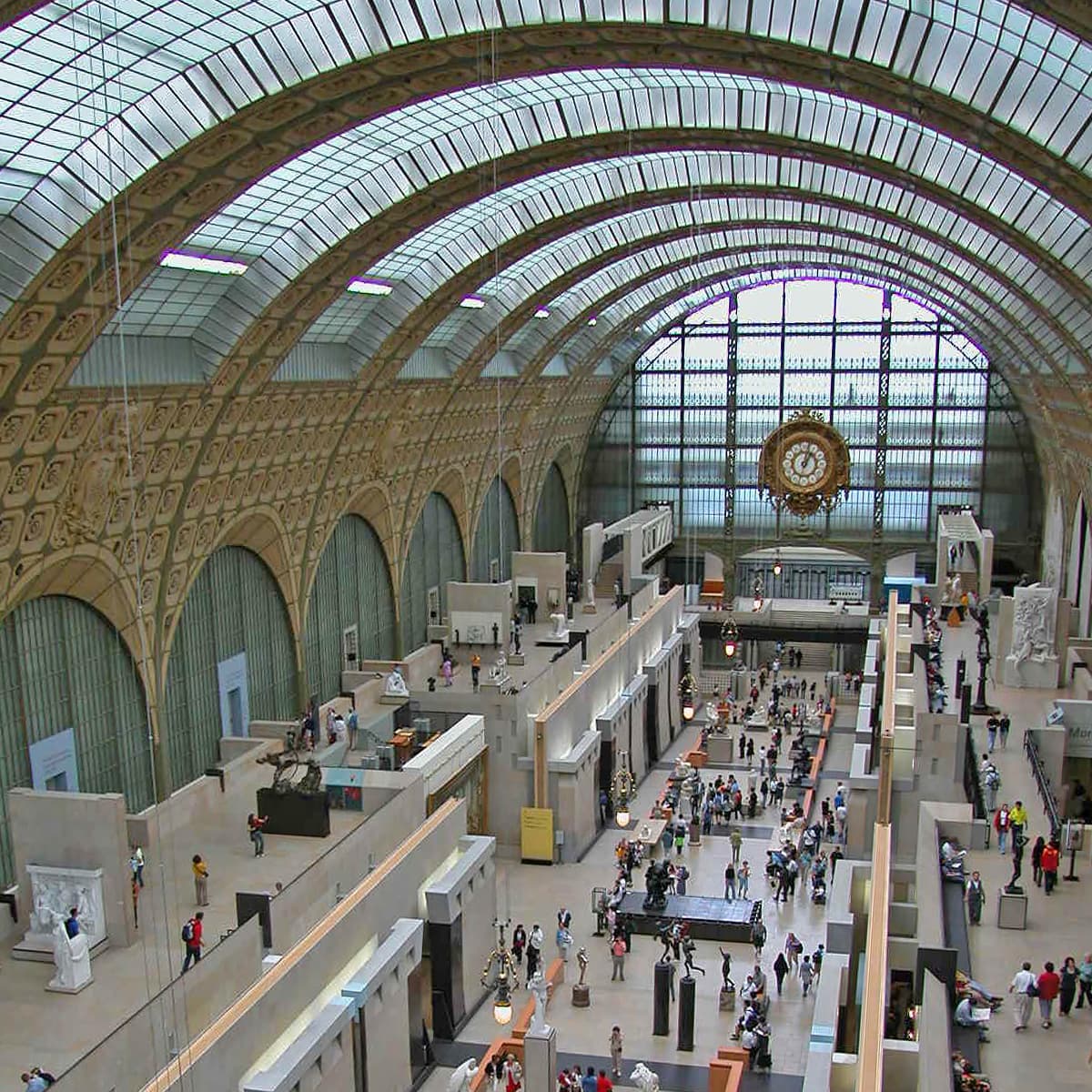
Survey what was once an immense train station. Trains used to run right under our feet down the center of the gallery. At the far end, Parisians bought their tickets, glanced up at the big clock, and had a great time. The train hustled down the steps to the platforms.
This former train station barely escaped the wrecking ball in the 1970s, when the French realized it'd be a great place to house the enormous collections of 19th century art that were scattered throughout the city. To reach the Impressionist rooms, backtrack a bit, then follow the flow of the crowds. You'll pass by a bookshop. You'll also see a giant backwards clock with great city views.
Read more...Show less
You finally arrive in Room 29, where the art begins. As you approach the Impressionist rooms, be aware that the collection is displayed somewhat randomly. You'll see Monet hanging next to Renoir, Manet sprinkled among Pissarro, a few Degas here, a few Degas there. Be flexible and keep the big picture.
While I'll point out a few especially notable canvases, for the most part, feel free to just browse freely, taking it all in. When you're in the Impressionist rooms, you'll see a lot of art. You'll see a lot of art. You'll reach the first of the rooms, Room 29.
Stop. Enjoy the array of works currently on display in Rooms 29 and 30, while Rick gives a general introduction to Impressionism. The Impressionists. Light. Color. Vibrations.
The Impressionists
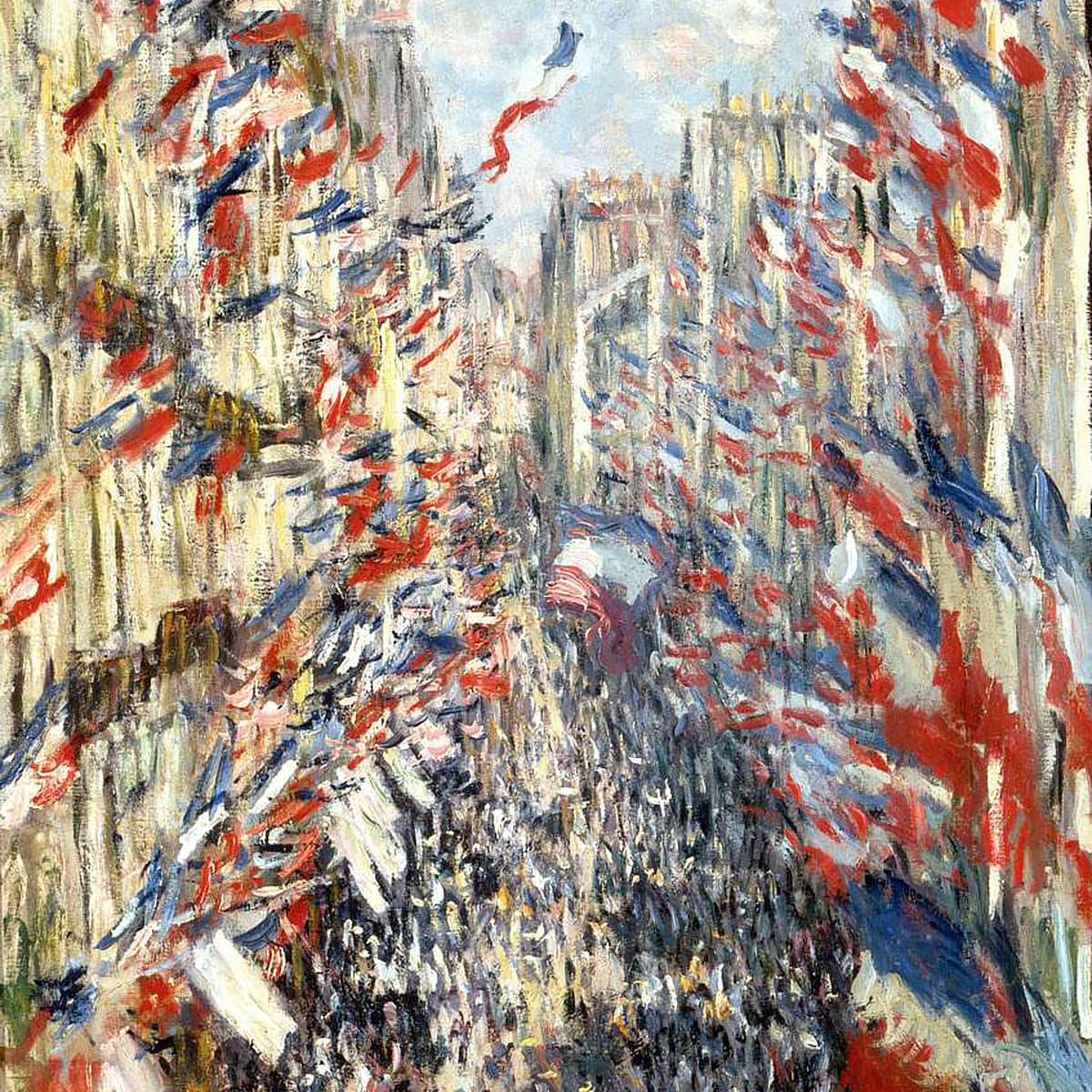
You don't hang an Impressionist canvas. You tether it. Impressionism features bright colors, easygoing open-air scenes, spontaneity, broad brushstrokes, and the play of light. The Impressionists made their canvases shimmer by using a simple but revolutionary technique.
Here's what I mean. Find a painting that catches your eye. Almost anyone will do. Now, get in close.
Read more...Show less
Really close. Close enough to where you can see the actual brushstrokes of paint. Think of how this canvas was painted. Let's say you mix red, yellow, and green together.
You'll get brown, right? But Impressionists didn't bother to mix them. They'd slap a thick brushstroke of yellow down, then a stroke of green next to it, then red next to that. Up close, all you see are three messy strokes.
But as you back up, voila! Brown. The colors blend in your eye at a distance. But while your eye is saying, bland old brown, your subconscious is shouting, wow, red, yellow, green, yes!
There are no lines in nature. Yet someone in the classical tradition, Angra, for example, would draw an outline of his subject and then fill it in with color. But the Impressionists built a figure with dabs of paint, a snowman of color. The camera threatened to make it look like a snowman, but the Impressionists built a figure with dabs of paint, obsolete.
Now, a machine could capture a better likeness than the finest painter, faster than you could say Etch-a-Sketch. But of course, true art is more than just painting reality. It gives us reality from the artist's point of view, with the artist's personal impressions of the scene. Impressions are often fleeting, so you have to work quickly.
The Impressionist painters rejected camera-like detail for a quick style more suited to capturing the passing moment. As you survey these rooms, notice the variety of subjects. Landscapes, cafe scenes, train stations, Parisian boulevards. Feeling stifled by the rigid rules and stuffy atmosphere of the Academy, the Impressionists took as their motto, out of the studio and into the open air.
They grabbed their berets and scarves and their newly invented tubes of country, where they set up their easels on riverbanks and hillsides. Impressionists also enjoyed sketching in cafes and dance halls. Gods, goddesses, nymphs and fantasy scenes were out. Common people and rural landscapes were in.
The quick style and everyday subjects were ridiculed and called childish by the so-called experts. Rejected by the Salon, the Impressionists held their own exhibition in 1874. They brashly took their name from an insult thrown at them by a critic, who laughed at one of Monet's impressions of a sunrise. During the next decade, they exhibited their own work independently.
The public, opposed at first, was slowly won over by the simplicity, the color, and the vibrancy of Impressionist art. Now, let's focus on a few individual artists. First up, the mentor of the Impressionists, Edouard Manet. His most famous piece is usually found in Room 29, a large canvas called Luncheon on the Grass.
But if it's not on display here, no worries. Just continue browsing around these first few rooms, enjoying other works by Manet and the Impressionists he inspired. Edouard Manet, Luncheon on the Grass, 1863.
Manet: Luncheon on the Grass
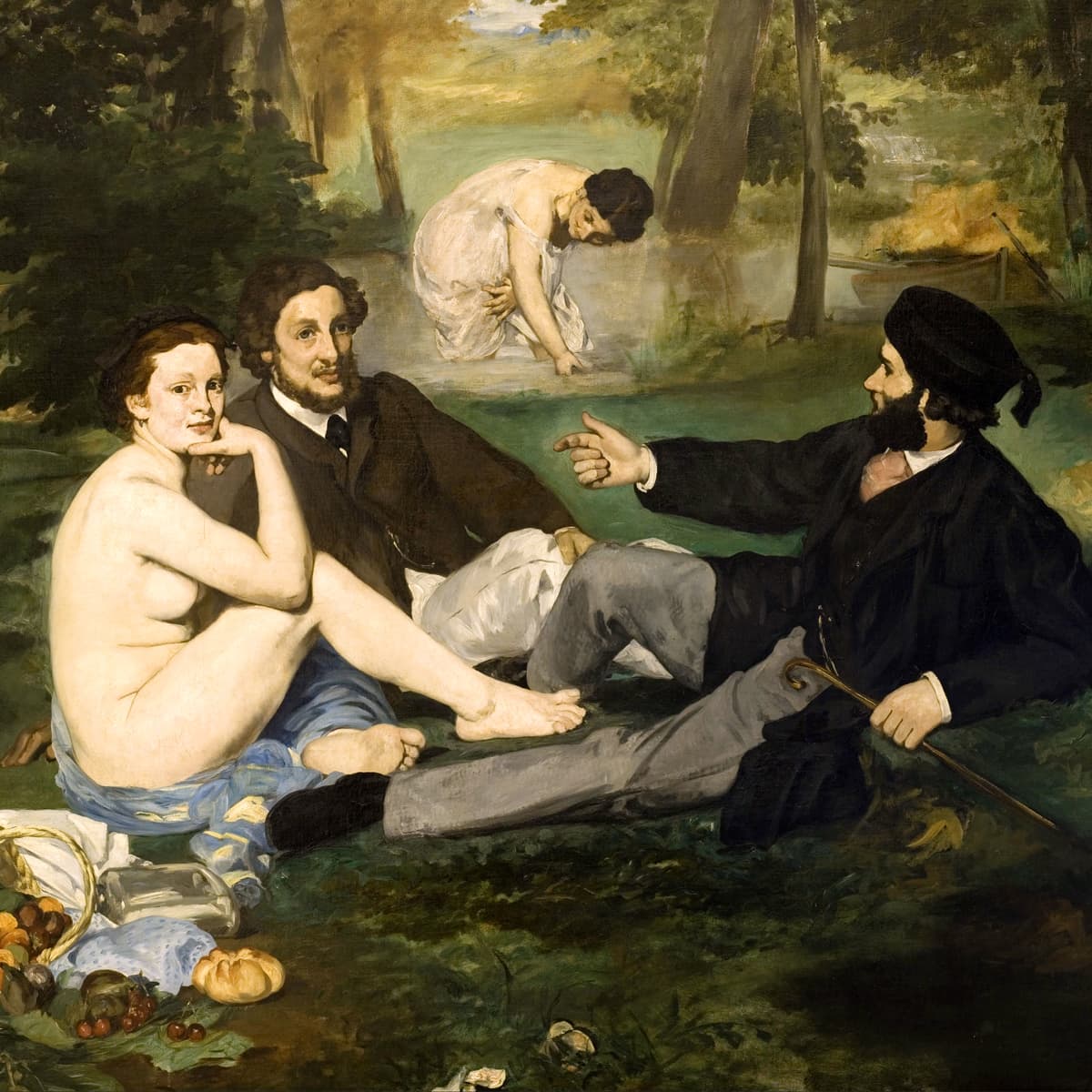
Edouard Manet's life story followed an arc that was typical of almost all the Impressionists. Like Manet, they all rejected a normal career, banker, lawyer, grocer, and so on, to become artists. They got classical art training. They had some success and exhibited in the Salon.
But they soon grew tired of the Salon's dogmatism and were fascinated by realist subjects. They gradually found each other in the avant-garde. Edouard Manet, Luncheon on the Grass, 1874. Edouard Manet's life story followed an arc that was typical of almost all the Impressionists.
Read more...Show less
Like Manet, they all rejected a normal career, banker, grocer, and so on, to become artists. They gradually found each other in the Salon. But they soon grew tired of the Salon. But they soon grew tired of the Salon.
Edouard Manet's life story followed an arc that was typical of almost all the Impressionists. Like Manet, they all rejected a normal career, banker, grocer, and so on, to become artists. They gradually found each other in the Salon. But they soon grew tired of the Salon.
Edouard Manet's life story followed an arc that was typical of almost all the Impressionists. Like Manet, they all rejected a normal career, banker, grocer, and so on, to become artists. They gradually found each other in the Salon. But they soon grew tired of the Salon.
Edouard Manet's life story followed an arc that was typical of almost all the Impressionists. Like Manet, they all rejected a normal career, banker, grocer, and so on, to become artists. They gradually found each other in the Salon. But they soon grew tired of the Salon.
Edouard Manet's life story followed an arc that was typical of almost all the Impressionists. Like Manet, they all rejected a normal career, banker, grocer, and so on, to become artists. They gradually found each other in the Salon. But they soon grew tired of the Salon.
Edgar Degas
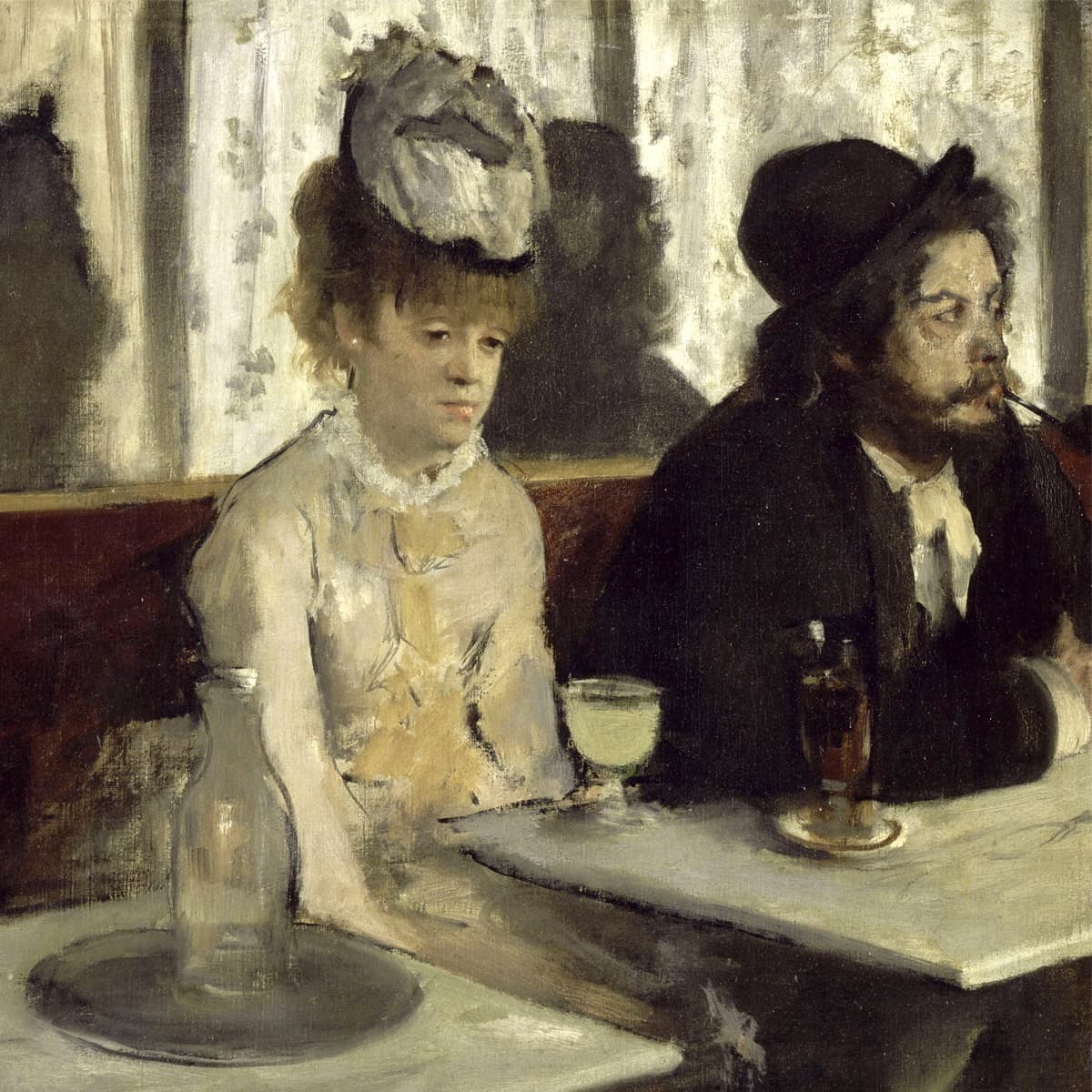
Degas blends classical lines with Impressionist color, spontaneity, and everyday subjects from urban Paris. Degas loved the unposed snapshot effect, catching his models off-guard. Dance students, women at work, and café scenes are seen from odd angles. While these angles are not always ideal, they make the scene seem more real.
Clearly, Degas loved dance and theater. His well-known statue, Titus, was a symbol of that. Degas, a tiny dancer, 14 years old, is in the glass case. Paintings catch the play of stage lights off the dancers, especially the halos of ballet skirts.
Read more...Show less
They seem made to order for an Impressionist. In the painting, dance class, bored, tired dancers scratch their backs restlessly at the end of a long rehearsal. And look at the bright green bow on the girl with her back to us. In the Impressionist style, Degas slopped green paint onto her dress and didn't even say, Edgar Degas was a rich kid from a family of bankers who got the best classical style art training money could buy.
He adored the pure lines and cool colors of the academic style. His work was exhibited in the Salon. He gained success and a good reputation, and then he met the Impressionists. He hung out with these outcasts, discussing art, love, and life in the cheap cafés and bars of Montmartre.
Degas participated in the Impressionist exhibitions, but his approach to painting was different. He looked down on open-air painting and preferred to work in the studio. He rarely painted landscapes, focusing instead on people. And he created his figures not as a mosaic of colorful brushstrokes, but with a classic technique, outline filled in with color.
Degas' snapshots captured the highs and lows of Parisian landscape painting. In his work In a Café, also known as The Glass of Absinthe, a weary lady of the evening meets morning with a last, lonely, coffin-nailed drink in the glaring light of a four-in-the-morning café. The pale green drink forming the center of the composition is that toxic substance, absinthe. That's the drink that fueled many artists and burned out many more.
At their peak, Monet and Renoir. Their canvases are mingled together. In fact, Monet and Renoir were good friends who worked together pioneering open-air painting in the 1860s. Let's start with Claude Monet. Yeah, baby. Show me the Monet. Oh, brother.
Monet: Rouen and Giverny
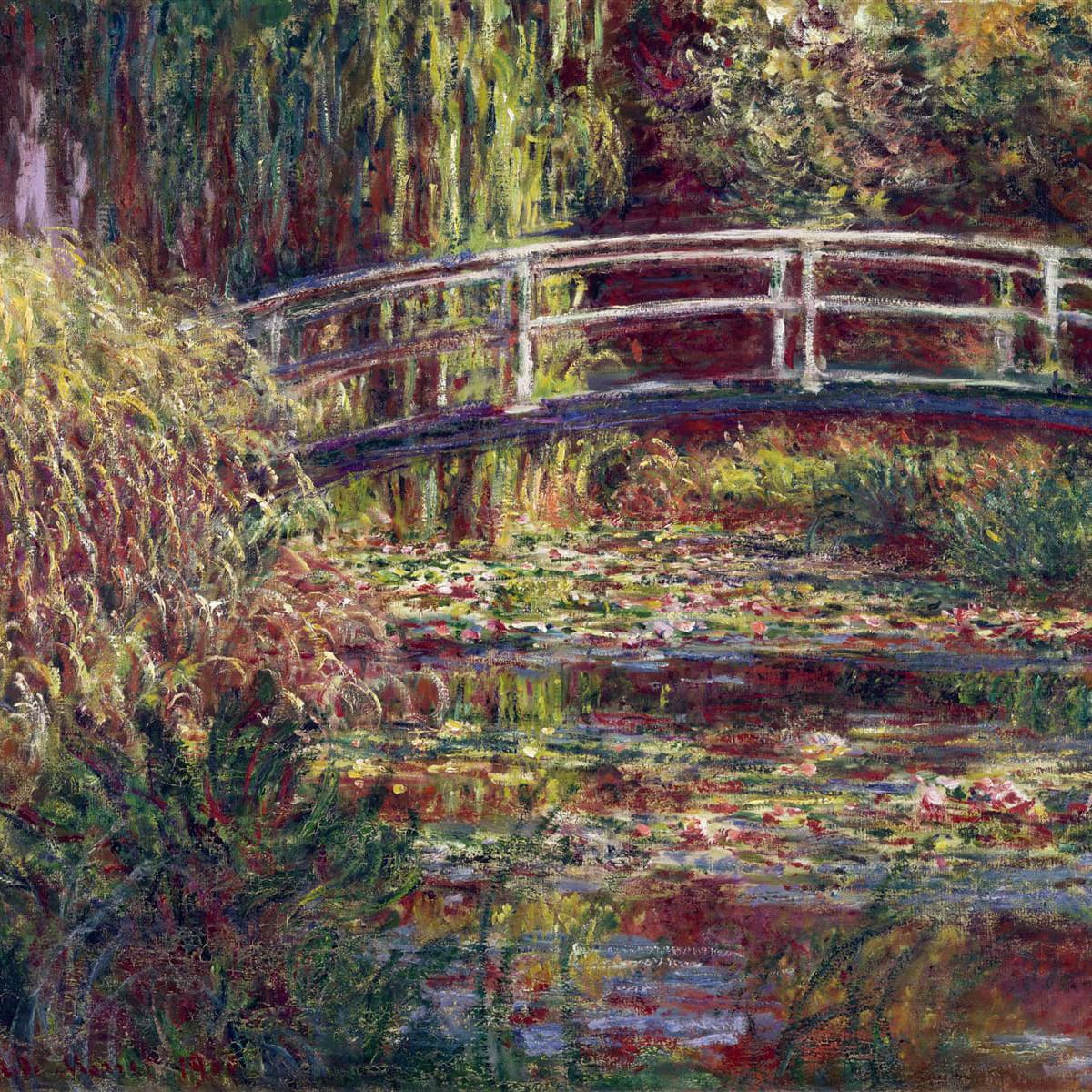
Claude Monet is the father of Impressionism. He fully explored the possibilities of open-air painting and tried to faithfully reproduce nature's colors with bright blobs of paint. In the 1860s, Monet, along with Renoir, began painting landscapes in the open air. Browse through Monet's paintings.
You won't see many urban scenes. He was always most at home in the countryside, painting farms, rivers, trees, and passages. Claude Monet was a great photographer. He studied optics and pigments to know just the right colors he needed to reproduce the shimmering quality of reflected light.
Read more...Show less
The key was to wait until the light was just right, at the golden hour, to use a modern photographer's term. Then he'd work furiously, creating a fleeting impression of the scene. In fact, it was one of Monet's canvases of an impression that gave the movement a different meaning. Claude Monet's name was Impressionism.
Throughout his long career, more than any of his colleagues, Monet stuck to the Impressionist credo. His goal was not painting things. He was painting studies in color and light. Look around for canvases showing scenes from Monet's home in Giverny.
A bridge over a pond, a rose trellis, and Monet's best-known subject, water lilies. One of his favorite subjects to paint was the garden he landscaped at his home in Giverny, west of Paris. The Japanese bridge and the water lilies floating in the pond were two of his favorite subjects. As Monet aged and his eyesight failed, he made bigger canvases of smaller subjects.
His final water lilies were monumental smudges of thick paint surrounded by paint-splotched clouds reflected on the surface of the pond. By the way, Monet fans enjoy side-tripping out to his home in still-picturesque Paris. In Paris, you can see much more Monet at the Mamartan Museum. And Monet's most famous water lilies are at the Orangerie, just across the river from this gallery, in the Tuileries Garden.
Monet is also known for his series of works on the same subject. In these rooms, you may see several similar-looking canvases hung side-by-side. One of his most famous series shows the Cathedral of Rouen at different times of day. Monet went to Rouen, rented a room across from the cathedral, set up his easel, and waited.
His goal? To catch a series of differing impressions of the cathedral façade at various times of day and year. He often had several canvases going at once. In all, he painted 30 versions of the cathedral.
And each is unique. The time-lapse series shows the sun passing slowly across the sky, creating different colored light and shadows. The labels next to the art describe the conditions. In gray weather, in the morning, morning sun, full sunlight, and so on.
As Monet zeroes in on the play of colors and light, the physical subject, the cathedral, is dissolving. In fact, to the impressionist, the actual object is no longer the subject. It's now only a rack upon which to hang the light and color. Later artists would take things even further, boldly throwing away the rack itself.
And leaving purely abstract modern art in its place. In these same rooms are works by Monet's friend, Renoir. Pierre-Auguste Renoir. Dance at the Moulin de la Galette. 1876.
Renoir: Dance at the Moulin
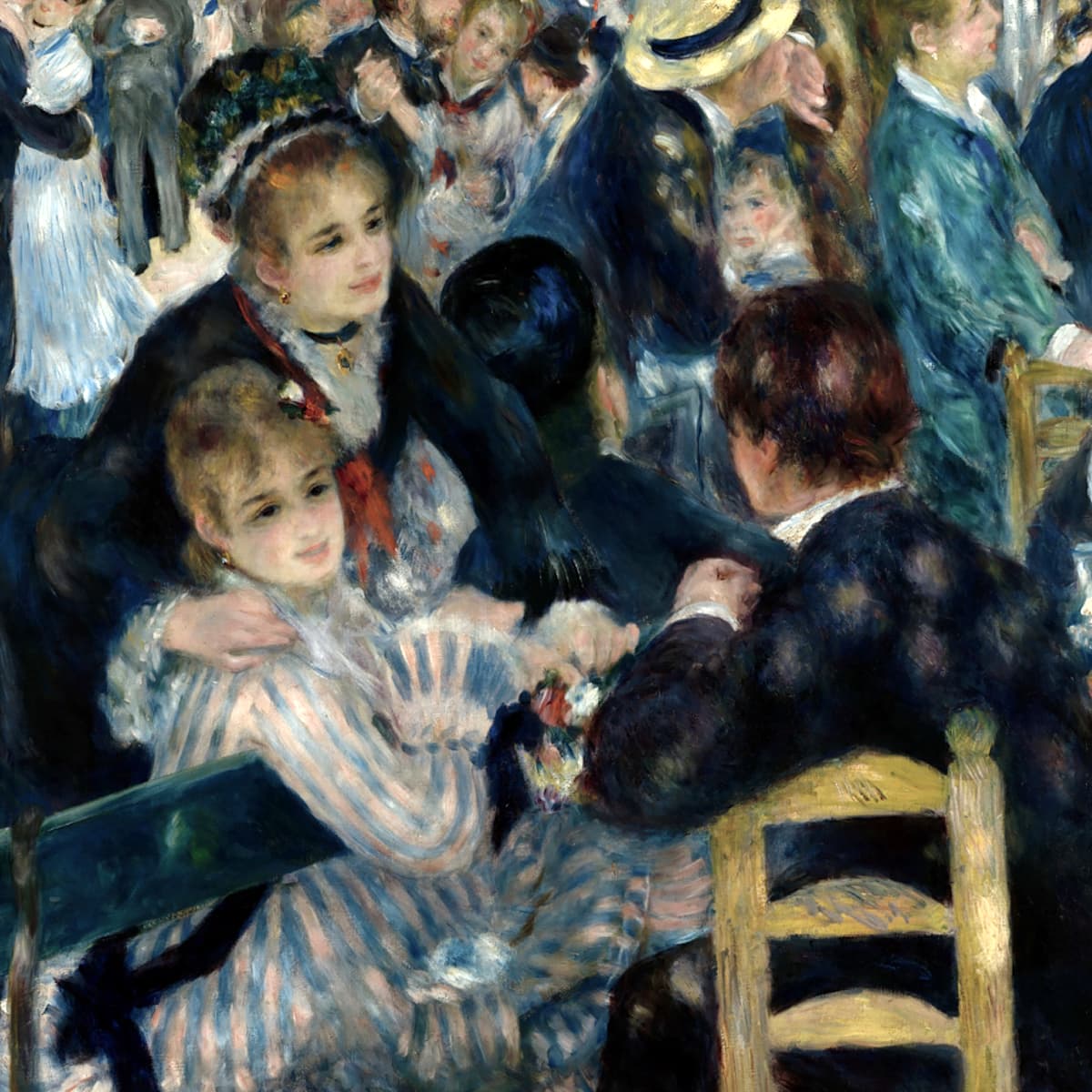
Renoir started out as a painter of landscapes, along with Monet. But later, he veered from the impressionist philosophy and painted images of the cathedral. He created images that were unabashedly pretty. He populated his canvases with rosy-cheeked, middle-class girls, performing happy domestic activities, rendered in a warm, inviting style.
He often did portraits of his friends. You may see a bearded Monet. Or his own kids, including his son, Jean Renoir, who grew up to make the landmark film Grand Illusion. But Renoir's specialty was always women and girls.
Read more...Show less
Renoir's light-hearted work uses light colors, no brown or black. The paint is thin and translucent. The outlines are soft, so the figures blend seamlessly with the background. He seems to be searching for an ideal, a kind of pure beauty.
One specific painting by Renoir is worth seeking out. Look for a large canvas of a crowd of happy dancers. The dance is a work of art. On Sunday afternoons, working-class folk would dress up and head for the fields on a hill overlooking Paris called Montmartre.
It's near the Sacré-Cœur Basilica. Here, they'd dance, drink, and eat little crepes called galettes until dark. Renoir liked to go there to paint the common Parisians living and loving in the afternoon sun. The sunlight filtering through the trees creates a kaleidoscope of colors, like a 19th-century painting.
Renoir captures the dappled light with quick blobs of yellow dancing on the ground, the men's jackets, and the sun-dappled straw hat. It's just to the right of center. Smell the powder on the ladies' faces. The painting glows with bright colors.
Even the shadows on the ground, which should be gray or black, are colored a warm blue. Like a photographer who uses a slow shutter speed to show motion, Renoir paints a waltzing blur. In his last years, Renoir was confined to a wheelchair with arthritis. He continued to paint.
He introduced more and more red tones, as if trying for even more warmth, more beauty. As Renoir himself said, there are enough ugly things in life. We're nearing the end of the Impressionist rooms, and there's a café just ahead. But before taking a break, let's get a quick taste of the next generation of art, Post-Impressionism.
Post-Impressionism is the style that employs the Impressionists' bright colors while branching out in new directions. Works are scattered all over the museum, but start here on the top floor with Paul Cézanne, who many consider to be one of the founders of modern art. Paul Cézanne
Paul Cézanne
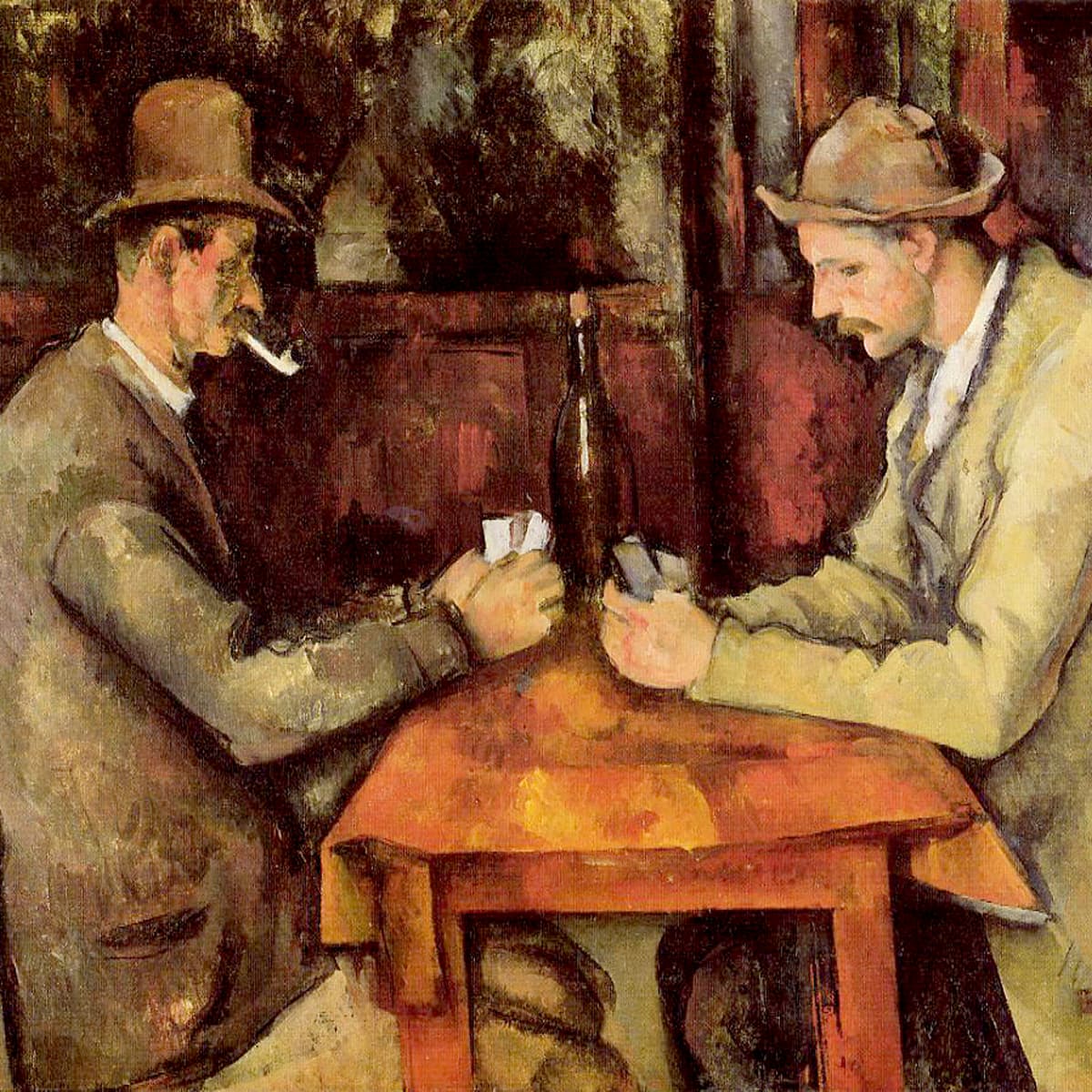
Paul Cézanne Paul Cézanne brought Impressionism into the 20th century. After the color of Monet, the warmth of Renoir, and the passion of Van Gogh, Cézanne's rather impersonal canvases can be difficult to appreciate. Bowls of fruit, landscapes, and a few portraits were Cézanne's passion. But it wasn't what he painted that was important.
It was how. Because of his innovative techniques, he's often called the first modern painter. Cézanne was virtually unknown and unappreciated in his lifetime. He worked alone, lived alone, and died alone, ignored by all but a few revolutionary young artists who understood his genius.
Read more...Show less
Cézanne's brush was a blunt instrument. With it, he'd bludgeon reality into submission, drag it across a canvas, and leave it there to dry. But Cézanne, the mediocre painter, was a great innovator. Cézanne often painted landscapes of his native Provence.
To paint a rocky brown cliff, for example, he'd use chunks of green, tan, and blue paint as building blocks. Where the Impressionists built a figure out of a mosaic of individual brushstrokes, Cézanne used blocks of paint to give it a more solid, geometrical shape. A block of paint forming part of a rock in the foreground is the same size as one in the background, flattening the scene into a wall of brushstrokes. These chunks are like little cubes.
It's no coincidence that his experiments in reducing form to their geometric basics inspired the Cubists. Exit to the café and consider a well-deserved break. There are toilets nearby, a few steps down the hallway past the café. When you're ready to continue our tour, start the next track, which has directions to our next artist, Vincent van Gogh. Vincent van Gogh.
Vincent van Gogh
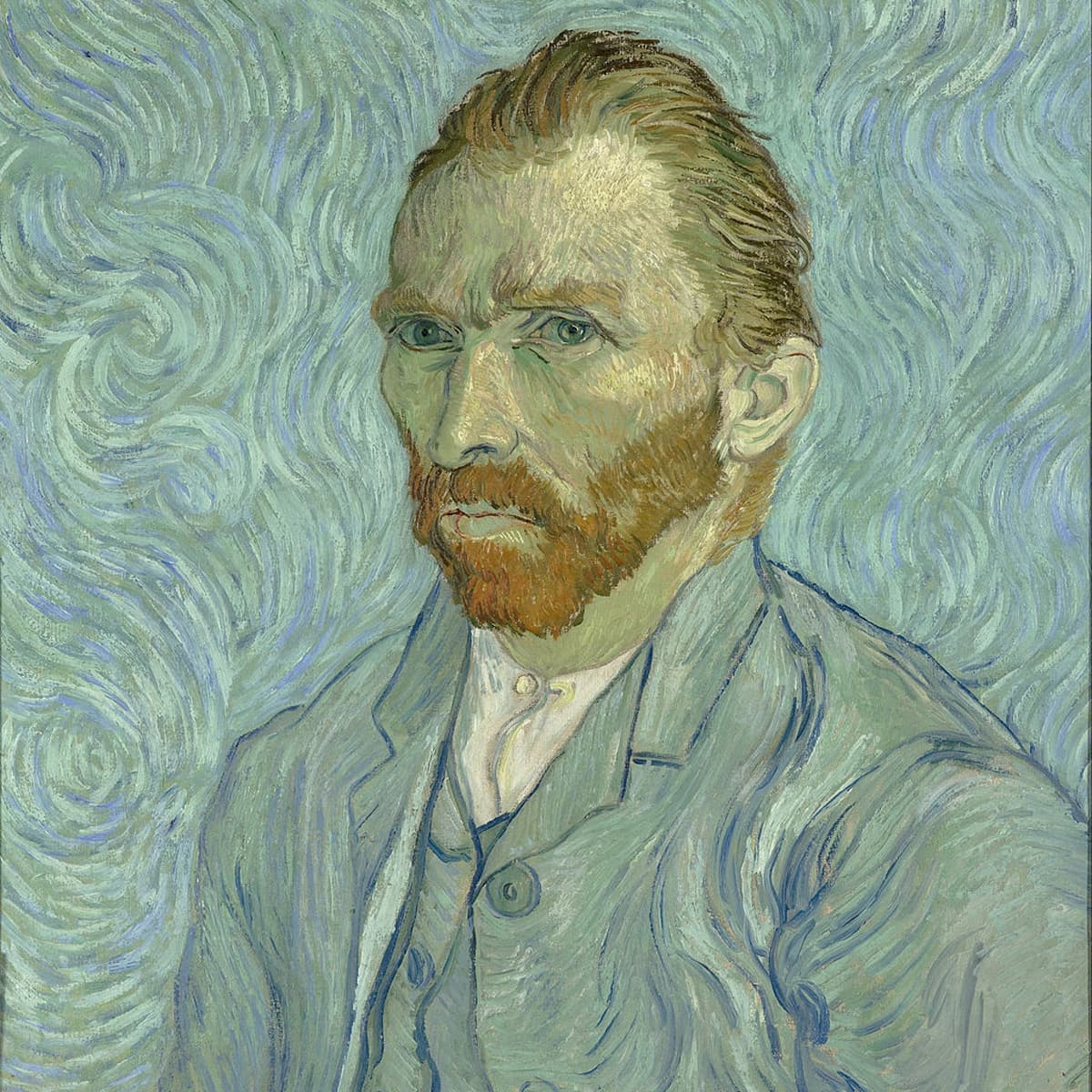
To reach Van Gogh, continue past the café and follow signs to Vincent van Gogh. Enter rooms 43 and 44, the first of several rooms with works by Van Gogh and Gauguin. As you browse through Vincent's art, don't worry so much about finding specific paintings. Just enjoy the bright colors and everyday scenes while Rick gives some background.
Impressionists have been accused of being lightweights. The colorful style lends itself to bright country scenes, gardens, sunlight on the water, and happy crowds of simple people. It took a remarkable genius to add profound emotion to the Impressionist style. Vincent van Gogh, or Van Gogh, as the Dutchman himself would have pronounced it, like Michelangelo, Beethoven, Rembrandt, Wayne Newton, and a select handful of others, put so much of himself into his work that, art and life became one.
Read more...Show less
Vincent was the son of a Dutch minister. He, too, felt a religious calling, and he spread the gospel among the poorest of the poor, peasants and miners in overcast Holland and Belgium. He painted these hardworking, dignified folks in a crude, dark style, reflecting the oppressiveness of their lives and the loneliness of his own as he roamed Northern Europe in search of a calling. Encouraged by his art diaries, Van Gogh moved to Paris, and voila, the color.
He meets Monet, goes out drinking with Gauguin and Toulouse-Lautrec, and soaks up the Impressionist style. At first, he paints like the others, but soon he develops his own style. By using thick, swirling brushstrokes, he infuses life into even inanimate objects. Van Gogh's brushstrokes curve and thrash like a garden hose pumped with wine.
The social life of Paris becomes too much for the solitary Van Gogh. He moves to the south of France. At first, in the glow of the bright spring sunshine, he has a period of incredible creativity and happiness. He's overwhelmed by the bright colors, landscape vistas, and common people.
It's an Impressionist's dream come true. But being alone in a strange country begins to wear on him. An ugly man, he finds it hard to get a date. A painting of his rented bedroom in Arles shows a cramped, bare-bones, He invites his friend, Gauguin, to join him.
They paint side-by-side and even take turns working on each other's canvases. In fact, here at the Orsay, you'll often see their works displayed side-by-side. They both have a similar style, featuring bold colors and thick paint. At first, Van Gogh and Gauguin get along great, drinking, carousing, arguing passionately about art.
But after two months, nerves get raw. Van Gogh threatens Gauguin with a knife, which drives his friend back to Paris. In crazed despair, Van Gogh cuts off a piece of his own ear. The people of Arles realize they have a madman on their hands and convince Van Gogh to seek help.
He enters a mental hospital. Van Gogh's paintings, done in the peace of the mental hospital, are more meditative. Fewer bright landscapes, more closed-in scenes with deeper, almost surreal colors. Van Gogh, the preacher's son, saw painting as a calling, and he approached it with a spiritual intensity.
In his last days, Van Gogh wavered between happiness and madness. He despaired of ever being sane enough to continue painting. His final self-portrait shows a man engulfed in a confused background of brushstrokes that swirl and rave. But in the midst of this rippling sea of mystery floats a detached island of a face.
Perhaps his troubled eyes know that in only a few months, he'll take a pistol and put a bullet through his chest. In the next room, you'll find work, including a self-portrait, by Vincent's comrade in art, Paul Gauguin. Paul Gauguin.
Paul Gauguin
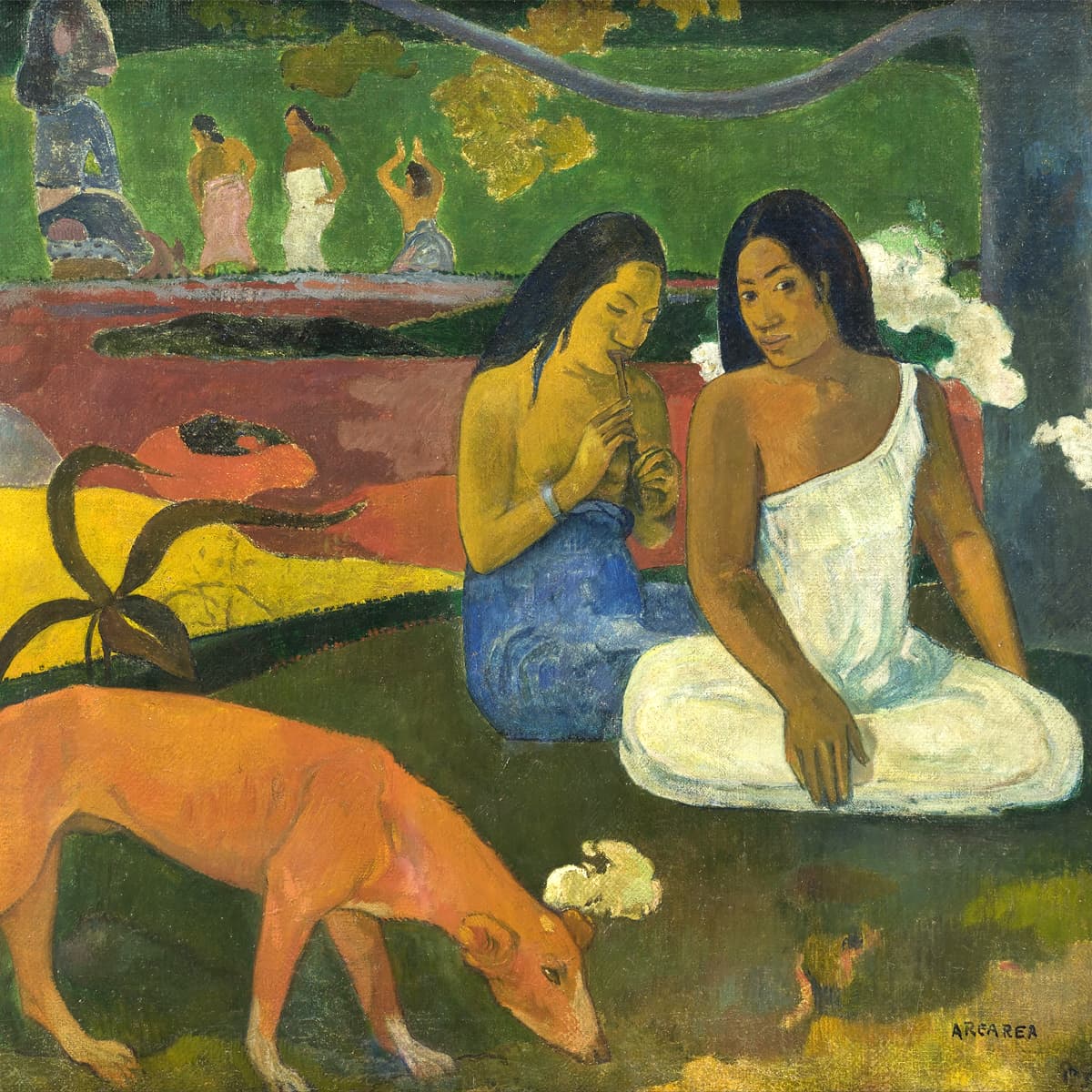
Gauguin got the travel bug early in his life. in childhood and grew up wanting to be a sailor. Instead, he became a stockbroker. In his spare time, he painted and was introduced to the Impressionist circle.
He learned their bright, clashing colors, but took a different path just about the time Van Gogh waved a knife in his face. At the age of 35, he got fed up with it all, quit his job, abandoned his family —his wife's stern portrait bust may be nearby— and took refuge in his art. Gauguin traveled to the South Pacific in search of the exotic, finally settling in Tahiti. On the island of Tahiti, Gauguin found his Garden of Eden.
Read more...Show less
He simplified his life into a routine of eating, sleeping, and painting. He simplified his painting still more to flat images with heavy black outlines filled in with bright, pure colors. He painted the native girls in their naked innocence, so different from Cabanel's seductive Venus. But this simple style had a deep undercurrent of simplicity.
Gauguin's fascination with indigenous peoples and primitive art had a great influence on later generations. Matisse loved Gauguin's clashing colors, and Picasso imitated Gauguin's carved tribal statues. Gauguin's primitive style sent a message to his civilized colleagues back home that he'd found the paradise he'd always dreamed of. Step into the next room, filled with paintings and pastels, by Toulouse-Lautrec. His art takes us back to turn-of-the-century Paris. Henri de Toulouse-Lautrec.
Henri de Toulouse-Lautrec
Just browse around and immerse yourself in the sensual, glittering, and decadent world that Toulouse-Lautrec lived in and chronicled. Henri de Toulouse-Lautrec was the black sheep of a noble family. At age 14, he broke both legs, which left him with a normal-sized torso but dwarf-sized limbs. Shunned by his family, a freak to society, he felt more at home in the underworld of other outcasts.
Prostitutes, drunks, thieves, dancers, tour guides, he settled in Montmartre, where he painted the life he lived. He sketched the low life in the bars, cafes, dance halls, and brothels he frequented. He drank absinthe and hung out with Van Gogh. He carried a hollow cane filled with booze.
Read more...Show less
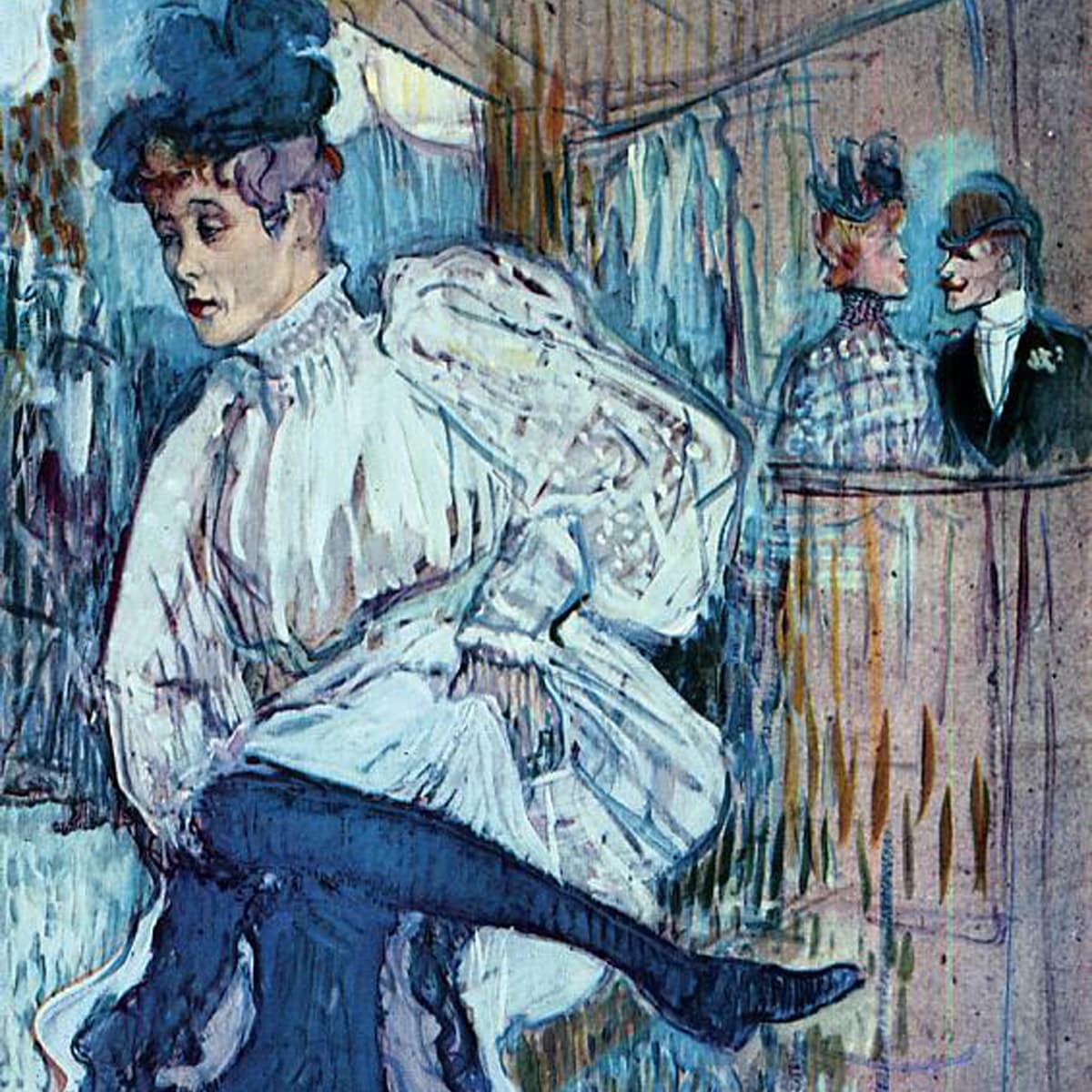
When the Moulin Rouge nightclub opened, Henri was hired to do its posters. Every night, the artist put on his bowler hat and visited the Moulin Rouge to sketch the crowds, the can-can dancers, and the backstage action. Toulouse-Lautrec's painting style captured realist scenes with strong, curvaceous outlines. He worked quickly, creating sketches and paint that serve as snapshots of a golden era.
Hey, I really like this painting. It's of a dancer in a white dress kicking up her black-clad legs. Jane of Real Dancing. Toulouse-Lautrec gave performers like this a dignity denied them by the rest of society.
Here, it's a painting of a dancer and it's the well-known dancer, slim, graceful, elegant, and melancholy, who stood out above the rabble. It's like her legs keep dancing while her mind is far away. Yes, Toulouse-Lautrec, an aristocrat, might have identified with her noble face, sad and weary of the nightlife, but immersed in it. Not surprisingly, Toulouse-Lautrec died at age 36 of syphilis and alcoholism.
On that cheery note, we turn to the final artist on our Essential Orsay Tour, the sculptor Rodin. His work is found downstairs a few floors on the mezzanine. That's Level 2 on your map. So exit the Toulouse-Lautrec room where you'll find an escalator.
Descend to Level 2. It'll take a little while. Follow signs to Sculpture 1880-1910. Level 2 is an open-air mezzanine, overlooking the huge main hall. Now pause your audio tour and restart it when you reach the mezzanine, Level 2. Auguste Rodin
Auguste Rodin
Start strolling down the Level 2 mezzanine looking for statues by Rodin. The mezzanine has a long parade of statues by many dentists, and many different artists. You'll have to search for works by Rodin. Some may be near the start of the long mezzanine, others way down at the far end.
While you browse around looking for your first Rodin, let Rick give a little background. The sculptor was born of working-class roots and was largely self-taught. He labored in obscurity for decades. He supported his family by making knick-knacks and doorknobs for a construction company.
Read more...Show less
Finally, by age 40, he started to gain recognition. Rodin's subject was always the human body. He depicted people in unusual poses that expressed their inner emotion. Hopefully by now, you've found one of his works.
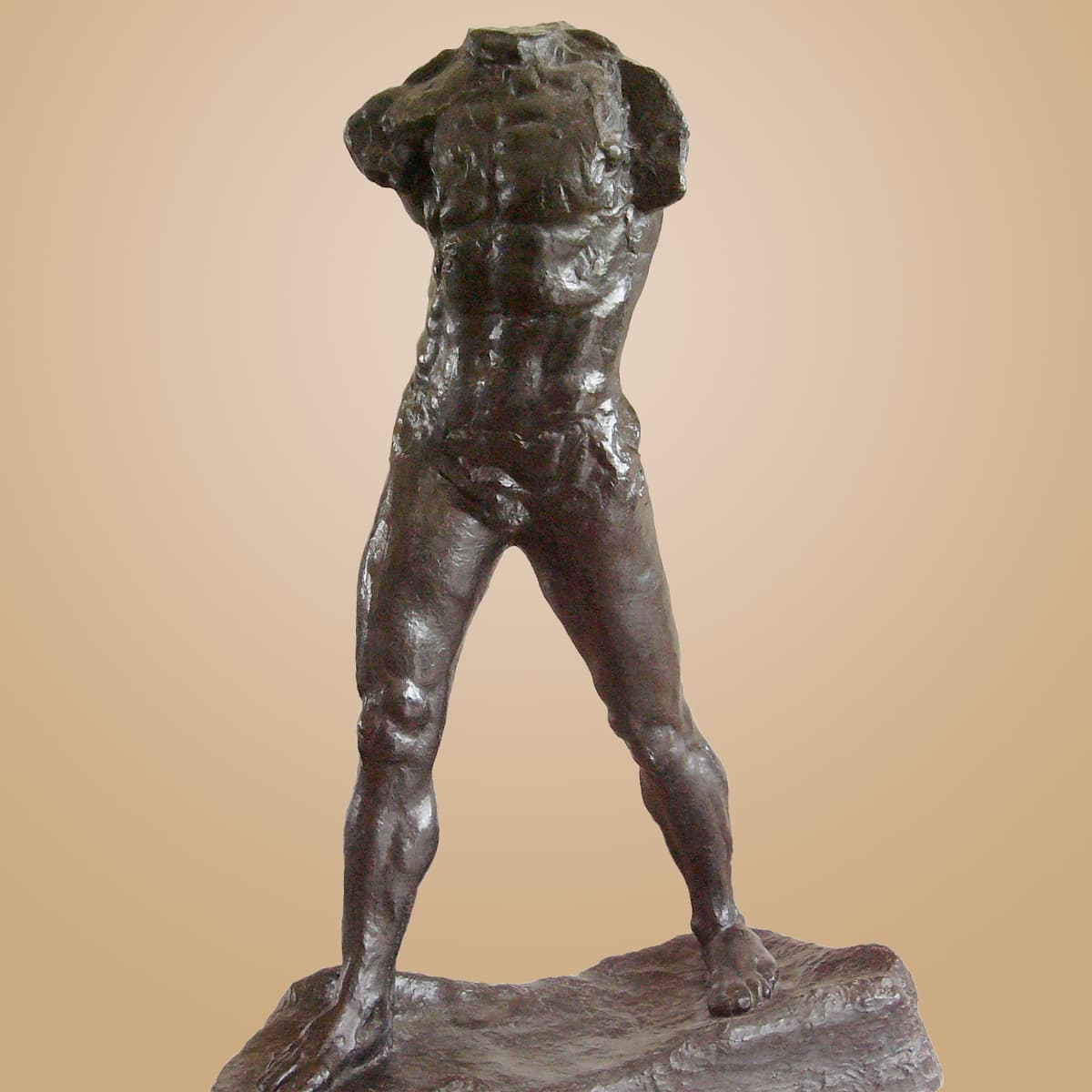
Get close to a Rodin statue. You'll see that the surface is alive, rippling with frosting-like gouges. Combining Impressionist surfaces with classical solidity, Rodin became the greatest sculptor since Michelangelo. As you go, you may find a Rodin statue of a man missing everything but his legs, the Walking Man.
Like this statue of the Walking Man, Rodin had one foot in the past and one stepping boldly into the future. This muscular, forcefully striding man could be a symbol of the Renaissance man with his classical power. With no mouth or hands, he speaks with his body. Get close to a Rodin statue and look at the statue's surface.
This rough, unfinished look reflects light like the rough, Impressionist brushwork. And that makes the statue come to life, never quite at rest in the viewer's eye. Make your way to the far end of the mezzanine, which has a few final works by Rodin. As you walk, think of Rodin's work process.
Rodin made his bronze statues not by hammering sheets of metal. He used the classic lost-wax technique. It all started with a simple sketch. Rodin hired models to run, squat, leap, and spin around his studio however they wanted.
When he saw an interesting pose, he'd yell, Freeze! Like the game Statue Maker? Exactly. Then he'd get out his sketch pad.
From a small sketch, he'd grab a hunk of clay and start turning it into a statue. Rodin worked quickly. He used his powerful thumbs to make a small figure in clay. Then he and his friends and his assistants would reproduce it as a full-scale model, a statue in clay or wet plaster.
This model was then covered with a form-fitting mold. Then he poured molten bronze into the narrow space between the mold and the model. He let it cool and harden. Then removed the mold, and voila!
Rodin had a hollow bronze statue ready to be polished. Using the same model, Rodin could produce multiple copies. This is why, there are many authorized bronze versions of the same Rodin masterpiece all over the world. Toward the end of the gallery, you may come across a black horizontal sculpture that looks kind of like a Rodin, but isn't.
It's a small bronze statue group of three figures called Maturity by Camille Claudel. Claudel was Rodin's student, model, and muse. She eventually became his lover. Claudel, may have portrayed their doomed love affair in this statue.
A young girl desperately reaches out to an older man who's led away reluctantly by an older woman. The center of the composition is the empty space left when their hands are drawn apart. In real life, Rodin refused to leave his wife, and Camille ended up in an insane asylum. At the far end of the mezzanine, head toward the large, ornamental, doorway studded with statues.
It's the Gates of Hell. Yikes! Do we have to? Rick, it's just art.
Okay. Rodin worked for decades on these doors, depicting what Dante saw on his trip through Hell. In this one work, Rodin did 186 different figures, exploring the entire range of human experience. The door contained some of Rodin's greatest hits.
These are small versions of statues he later did in full size. Start at the top, where you'll find the three shades. These three forlorn figures point down, right to where we're headed, Welcome to Hell. Beneath them is the door's most famous statue, the Thinker.
He sits, squatting above the doorway, contemplating man's fate. This two-foot-tall figure was the inspiration for the large-scale version that has become one of the most celebrated statues in the world. The Thinker was meant to represent Dante himself, pondering the poor souls down in Hell. Rodin so identified with this figure that he chose it to stand atop his own grave.
Finally, find what some say is a tiny self-portrait of Rodin himself. It's at the very, very bottom, just inside the right doorjamb. Look close to where it starts to jut out. Rodin's the guy with the long beard, kneeling.
It's a humble signature for this epic work. To complete our tour, turn from Rodin's statues to once again survey the Orsay's main floor. Look out at all those classical statues between you and the big clock and realize how far we've come, not in years, but in style changes. Rick?
Many of the statues below, beautiful, smooth, balanced, and idealized, were done at the same time as Rodin's powerful and haunting works. Rodin is a good place to end this tour. With a stable base of 19th-century stone, he launched art into the 20th century. We hope you enjoyed our Orsay Gallery walk.
Thanks to Gene Openshaw, co-author of this tour. Remember, this tour was excerpted from the Rick Steves Paris Guidebook. For more details on eating, sleeping, and sightseeing in Paris, refer to the most recent edition of that guidebook. For more free audio tours and podcasts, and for information about our guidebooks, TV shows, bus tours, and travel gear, visit our website at ricksteves.com.
This tour was produced by Cedar House Audio Productions. Thanks. Au revoir. And goodbye for now. © transcript Emily Beynon Thank you.
Free
GPS-guided walking tour
No account needed. Walk at your own pace.
Free
19 stops ·