15 stops
GPS-guided
63 min
Duration
Free
No tickets
About this tour
A 15-stop walking tour through the heart of Germany. Visit St. George’s Fountain, Old Town Hall, St. Jakob's Church: Exterior, and St. Jakob's Church: Interior — with narrated stories at every stop.
15 stops on this tour
Welcome to Rothenburg
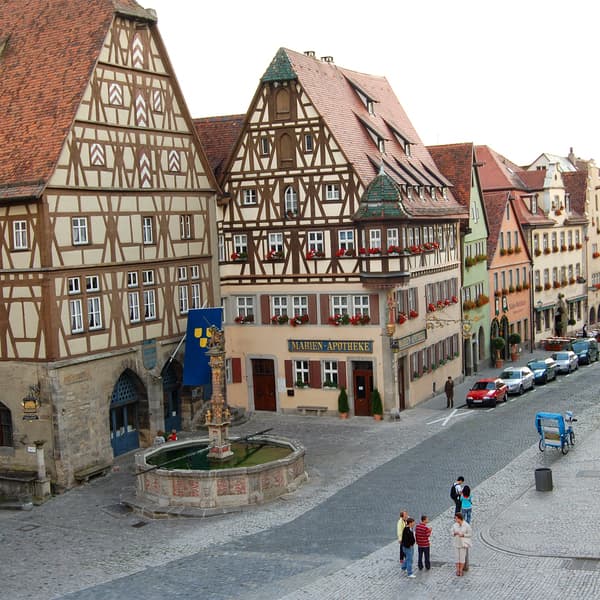
Welcome to Rothenburg. Back when Berlin and Munich were just wide spots in the road, the town of Rothenburg-Obder Tauber was one of Germany's greatest cities. And today, it's one of the best-preserved medieval towns anywhere. Hi, I'm Rick Steves.
Thanks for joining me on this tour of Rothenburg. It's a place of unmatched medieval atmosphere, old half-timbered homes, cobbled streets, stone towers all surrounded by a nearly intact town wall. On this one-hour walk, we'll start on the main square, traverse some back streets, and return right back to the center of town. Along the way, we'll visit the town's main church with its magnificently carved altarpiece.
Read more...Show less
We'll enjoy some pleasant gardens away from the tourists and get great views of the countryside. We'll even see a few oddities, like a foot-long measuring rod that's literally a zoom. It's as long as a foot and a place where it's Christmas 365 days of the year. We'll trace the town's thousand-year history, its rise from obscurity, the dramatic events that triggered its downfall, and how it's been reborn in modern times as a major tourist destination.
Now, let's get going as we visit a 14th-century town still thriving in the 21st century, Rothenburg. To help us along the way, I've invited a good friend and virtual travel buddy. Welcome, Lisa. Guten Tag, Herr Steves.
Lisa will give us helpful directions and sightseeing tips throughout the tour. And my first tip is to be sure you get our tour updates. Just press the icon at the lower right of your device. You'll find any updates and helpful instructions unique to this tour.
Things like closures, opening hours, and reservation requirements. There's also tips on how to use this audio tour and even the full printed script. Yes, so pause for just a moment right now to review our updates and special tips. It's okay, we'll wait. And then... Let the tour begin! The tour begins.
Tour Begins: Market Square
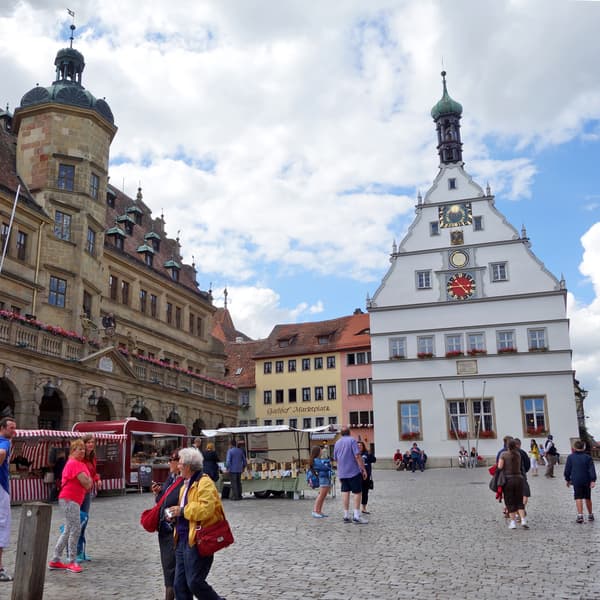
Market Square, Town Hall, and the Meistertron. Start on the main square in the heart of town. Market Square. Stand in the middle and take it all in.
Look at this great scene. The colorful facades, the soaring towers, and the crowds of happy tourists. You're at the center of town, where the two main streets meet. For nearly a thousand years, this has been the center of a bustling town.
Read more...Show less
Picture the scene back in Rothenburg's medieval heyday around the year 30. 1300. It's one of Germany's biggest cities, population 6,000. Horses and carriages clatter over the cobbles.
Farmers pour in from the countryside to sell their produce here on the Market Square, just as fruit sellers do today. Rich burgers hustle through on their way to a city council meeting. Commoners draw water from the fountain, dressed in their Robin Hood-style tights. Ladies parade through in long dresses cinched with a belt and a hat tied on with a bow.
And a scarf. Rothenburg was a trading town. Everyone stopped here because it was on the main highway from Würzburg to the Alps, what tourists today call the Romantic Road. Traveling salesmen passed through with the local specialty, cloth.
And religious pilgrims stopped here to marvel at a miraculous holy relic, a drop of Christ's blood. That relic is still here today, and we'll see it a bit later. For now, check out the buildings surrounding the square. Start with the New Town Hall.
That's the massive brown stone building that takes up the entire long side of the square. The New Town Hall dates from the 1570s. The style is Renaissance. There's a row of Roman-style arches at ground level.
Over the central doorway is a Greek-style pediment, and domes top the towers rather than steeples. Though the building dates from the 1500s, the proud people of Rothenburg have governed themselves from this spot for more than 700 years. You see, in 1274, the ruler of the German lands, the Holy Roman Emperor, proclaimed Rothenburg a free imperial city. This was a high honor.
Most people lived under the thumb of a prince, duke, or bishop. But Rothenburg governed itself, beholden only to the emperor himself. City council members gathered at the town hall to set policy. Technically, they were elected, but in practical terms, they were from the rich, the richest families, known as burghers.
Some things never change. Many of the rich lived right here, on Market Square. Their mansions stand to this day opposite the town hall. Admire the colorful facades and the variety of roof lines.
I especially like the step cables on a couple of them, and the doorways. Notice how big some of them are, originally wide enough for a horse and carriage. Now, turn your attention to the top end of the square. There sits the big white building with a clock, known as the Counselor's Tavern.
The Counselor's Tavern, built in 1466, is where the city council members met after work for a drink. Today, it's the Tourist Information Office. But what everyone wants to see here is the building's clock. This clock becomes the focus of what seems like every tourist in town at the top of the hour.
Every hour between 10 a.m. and 10 p.m., the bell chimes, and it's the time of the day. It puts on a little show. The windows on either side of the clock open, and some wooden figures appear.
They reenact the defining moment in Rotenberg's history, the Meistertrunk. Let me set the scene. The year is 1631. Rick, don't oversell it.
It's really just a cheesy little show. The year, 1631. Oh, brother. Germany is in the middle of the horrendous Thirty Years' War.
Catholics are fighting Protestants, and mercenary armies are roaming the land. Rotenberg, a Protestant town, is surrounded by a Catholic army. The citizens of Rotenberg brace themselves for the inevitable rape, pillage, and plunder thing. But first, as was the etiquette, the conquering commander paid a visit to the town mayor.
That's where the clock picks up the story. At the top of the hour, the two clock windows open, and two figures appear. In the left window is the conquering general, the Count of Tilly. He wears a dashing Three Musketeers hat and holds his military baton.
In the right window appears Rotenberg's mayor, Mayor Neusch. He holds a big stein. As the story goes, the mayor gave the conquering general a welcoming drink. It was a huge tankard of good local wine.
Tilly drank it down. Now feeling pretty good, his heart softened. He told the mayor, Hey, if you can drink this entire tankard of wine, in one gulp, I'll spare your town. The tankard held three liters.
That's more than six pints of wine. Back to the clock. The clock begins to chime. Dong, dong.
The figure of Mayor Neusch grasps his stein. Slowly, slowly, slowly, he raises the stein to his lips. Then he drinks, and drinks, and drinks. As the legend says, the mayor amazed everyone by drinking the stein.
Drinking the entire three liters in one long gulp. Locals call it the meister trunk, the master draft. The big gulp. Rotenberg was saved.
As the clock's little show comes to a close, Mayor Neusch lowers his stein, and the windows shut. I'll say it again. The story is fascinating, but the clock show, not so much. Unless you've had three liters of wine yourself.
For the best show, I don't watch the clock. I turn around and watch all the tourists go, ooh, ah, as the windows flip open. At night, the square flickers with camera flashes. While the meister trunk is a nice story, it's pure fiction.
It was actually dreamed up in the late 1800s for a theatrical play. The clock's wooden figures date from 1910. The whole thing was designed to promote a romantic image of the town and bring on the tourists. It sure worked.
But while the story is fiction, the history behind the meister trunk is true. Rothenburg actually did have a defining moment in 1631. The town really was conquered by Tilly, and it really was spared from Tilly's army, but probably because it bribed its way out of the situation. Unfortunately for Rothenburg, in actual fact, the town never survived the rest of the Thirty Years' War.
It was occupied and ransacked several times, then in 1634, the Black Death, bubonic plague, swept through and killed still more. The town never recovered. They were too poor to ever rebuild or modernize. That's why it's such a well-preserved time capsule today.
The meister trunk story captures the last great moment of glory before the town's decline. For the next three centuries, the town slumbered like sleeping beauty. Now it's been reawakened. Tourists from around the world come here to stare at the clock and remember that moment when, in a strange sort of way, the town of Rothenburg actually, eventually, was saved.
Okay, then. Let's go see more of this town. Start by strolling to the bottom of the square. Pause and look downhill, down the main north-south street.
Remember, this area was the best address in town, and one of the finest homes is just down the street on the left. It has an ornate step-gable renaissance façade. It's called the Baumeisterhaus, or House of the Master Builder. It was the home of the man who built the town hall.
Notice the statues on the façade. There's the seven traditional virtues and the seven vices, all mixed together. Hmm. I think I recognize that one.
That must be Gluttony, the guy with the big belly on the lower level. You got it. Now gaze further down the street. Check out all the ornate, wrought-iron shop signs.
In keeping with medieval tradition, each sign has a symbol showing what's sold inside. Now, let's move on. Our next stop is just a few steps to your right, still on the market square. Head for the Big Fountain.
It's the stone structure filled with water that's decorated with a column with a statue on top. St. George's Fountain.
St. George’s Fountain
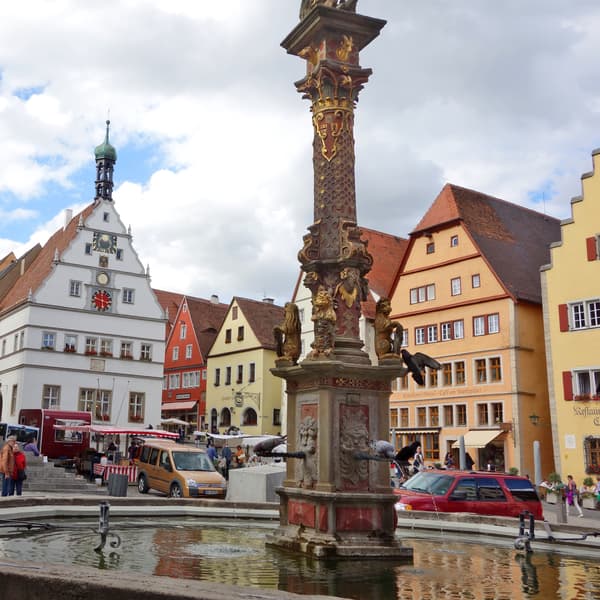
This is where villagers once got their drinking water. It's not a well, per se, because it doesn't have its own water source. It's a reservoir or fountain built to supply the neighborhood with fresh water. Notice the long metal thingies attached to the fountain.
People would attach their buckets to one end and maneuver the other end to the water. The water would then flow down the metal gutter and into the bucket. This particular structure dates from the early 1600s. It has a structure that's called a colorful column topped with a statue.
Read more...Show less
That's St. George on horseback slaying the dragon. The basin holds about 25,000 gallons, about as much as a good-sized swimming pool. This is just one of about 40 fountains around town that survived from the Middle Ages.
Rotenburg had an ingenious water system. As it was built on a rock, the town had no actual wells, so they had to pipe in water from nearby hills. The water came from a source above the level of town. It flowed downhill, serving a series of fountains like this one.
Besides drinking water, the fountains provided water for fighting fires. That's one reason why the town never burned entirely, as so many medieval towns did. Some fountains were sometimes even stocked with fish on market days or during times of siege. As you can imagine, the neighborhood fountain was always a gathering place, and this is where the town's gallows and pillory were set up.
Now, check out two fine old buildings that tower above the fountain. These are typical half-timbered German buildings. That is, they're made of a framework of timbers filled in with rubble and finished with white plaster. And in medieval times, the rubble included dung.
True. Notice also that way up on the top floors, there are big wooden doors. These were storage lofts. See the pulleys sticking out from there way on the top?
These were for hoisting up goods. All over town, homes had lofts that were always filled with grain. In fact, the city required a year's supply so they could survive any siege. By the way, today one of these buildings is a free art gallery.
The other is a pharmacy. It combines traditional alchemist ambiance with modern medicine. All over Rotenburg, you'll encounter that fascinating mix of old buildings with new uses. Let's move on.
First, look down Herrengasse, Rotenburg's main east-west street. At the end of our tour, we'll be returning up Herrengasse to this very spot. But for now, our next stop is right across the street from the St. George Fountain.
It's the big white building topped with the tallest tower in town, the Old Town Hall. The Old Town Hall.
Old Town Hall
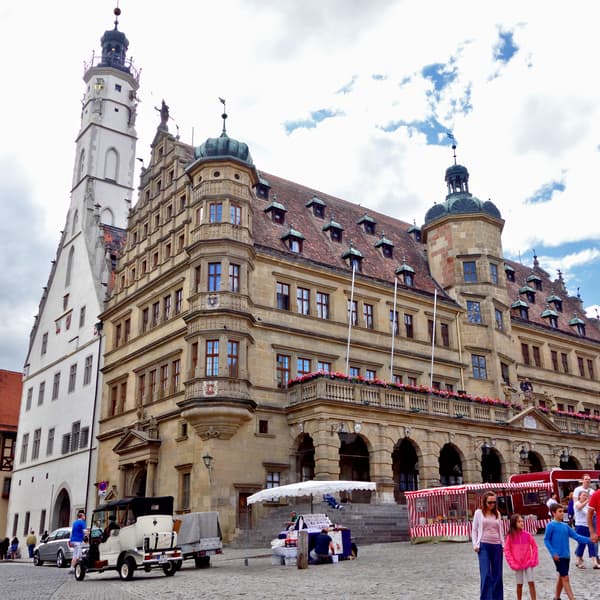
This is Rotenburg's original town hall dating from about 1250. After a fire in 1501 burned down part of it, they built a replacement, the New Town Hall. Standing here, you can compare the two halves, the simple white Gothic style of the Old Town Hall on the left and the fancy Renaissance style of the step-gabled New Town Hall on the right. Now, look up.
Rotenburg's tallest spire rises up 200 feet above the Old Town Hall, You'll likely see tourists enjoying the best view in town from its black iron crow's nest. To get up there, it'll cost you a few euros and a few calories as you climb 200 tight steps to the top. The tower entrance is around the corner on the market square through the middle arch of the New Town Hall. By the way, I'd like to point out something on the New Town Hall.
Read more...Show less
Adorning the bay windows on the corner are two small relief panels. It's the best place to see the double eagle insignia, the symbol of Germany's Holy Roman Emperor. You'll see these symbols all over town, reminding everybody that Rotenburg enjoyed the Emperor's blessing as a free imperial city. Now, approach the Old Town Hall.
Stop when you reach the arched entrance of a passageway into the courtyard. Look on the wall to the left of the entrance. You'll see some metal bars. These are the town's official measuring rods.
It's a reminder that medieval Germany was made of 300 independent little countries. And many had their own standard weights and measures. These were Rotenburgs. The longest is a rod, a little over four yards long.
The so-called shoe was roughly the length of a human foot. And the L was like the ancient cubit. It stretches from the elbow to the fingertip. Try it, Lisa.
It's sure longer than mine. They must have been real knuckle-draggers back then. Now let's enter the passageway through the arch. But as you do, notice the protruding cornerstone down on the left.
These are all over town, originally to protect buildings from reckless horse carts. In German, if you're driving like a maniac, they say you're scratching the cornerstone. Let's careen around that stone and enter a passageway into a courtyard. Here you'll find the entrance to an eclectic museum called the History Museum.
Historical Town Hall Vaults. We won't go inside, but if you do visit, you'll find wax dummies that bring to life Rotenberg during the Thirty Years' War. What year was that again? The year 1631.
Oh, yeah. There's a replica of the Meistertrunk tankard, an alchemist workshop, and a dungeon complete with three dank cells and some torture lore. Continue a few steps deeper into the passageway. You'll pass an atmospheric old door that's been much sketched and photographed.
By the way, this was the door pictured on the title page of my very first book, Europe Through the Back Door. First published in 1631? Hey, Grandpa. Funny.
A few steps further, you'll find a posted copy of a centuries-old map. This painting shows a bird's-eye view of the territory of Rotenberg in 1537. In the center, sits the walled town of Rotenberg. Surrounded by the countryside, it ruled.
Rotenberg actually ruled a little country, one of the 300 petty dukedoms of long-ago Germany. It stretched 12 by 12 miles, about the size of Denver. It had 180 villages and a population of 14,000. Remember, Rotenberg was a self-ruling imperial city.
You'll see the imperial eagles proudly emblazoned on the map. In 1562, the city sold off some of this land. This revenue raised financed the new town hall and other beautiful Renaissance buildings that embellish the town to this day. Let's head to our next stop, St.
Jacob's Church. To get there, continue through the courtyard. You emerge into a small square. Directly ahead, you'll see the church.
Start walking there while Rick points a few things out. This small square is called Green Market because it was once a produce market. These days, there's a free public toilet on your left. And to the right is the Freeze Gift Shop, friendly and family-run now for 50 years.
As you continue walking toward the church, notice the clay tile roofs on buildings all around the square. They're called beaver tail tiles because, well, that's what they look like before they're placed in their overlapping pattern. Clay tiles like these became the standard after thatched roofs were outlawed to prevent fires. Today, they're on buildings all over town.
And what are those little fences at the base of the roofs? Those are to protect people from snow falling off the roof in the winter. Oh, clever. Soon, you reach the church. Pause here at the back end of the church and take it all in.
St. Jakob's Church: Exterior
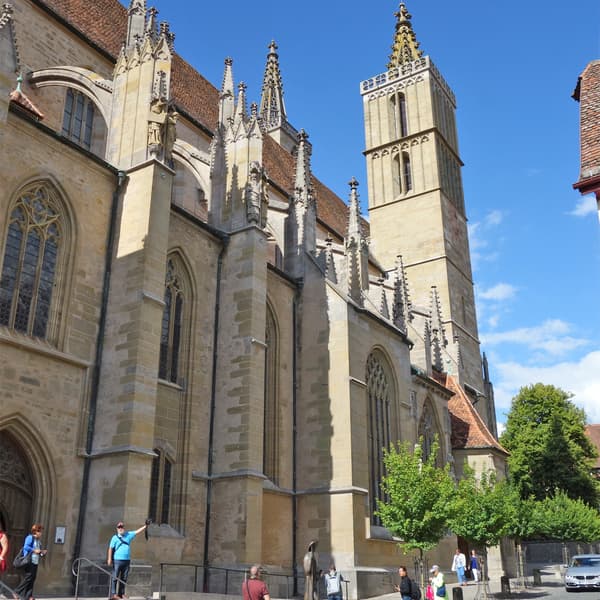
St. Jacob's Church, the exterior. This massive structure has been the people of Rotenburg's main church for nearly seven centuries. It's a big church because Rotenburg was an important town.
The church was begun in the 14th century. It's in the Gothic style, stained-glass windows, pointed arches, and two soaring towers topped with steeples. Between the stained-glass windows, notice the pillar-like buttresses that reinforce the church. Notice also how the steeples have prickly decoration.
Read more...Show less
This was the flamboyant or flame-like style of late Gothic. It was meant to symbolize the flickering flames of the Holy Spirit. Now turn your attention back to ground level, to the base of the tower. There's a little roofed-over chapel with statues inside.
These statues are some of the church's very oldest, dating from the 14th century. You'll see some of Jesus kneeling in prayer in the Garden of Gethsemane. This agonizing scene was a common one during harsh medieval times. The artist is anonymous because in the Gothic age, artists were just nameless craftspeople working only for the glory of God.
Now take a few steps to your left, past the chapel. On the church wall is the nub of a sandstone statue. It's all that remains of a rare original. It looks pretty eroded after 500 years of weather and, more recently, pollution.
Most original statues are now in the city museum, which I'll point out a little later on this walk. The better-preserved statues you see here on the church are copies. Start strolling downhill to the church entrance. First, you'll pass by the non-tourist entrance.
If it was your wedding day, you'd enter here. Appropriately, it's marked by statues of the world's first couple. There's a very fertile Eve and, around the corner, Adam, showing off an impressive six-pack. Keep walking downhill to the main entrance.
Before going inside, pause at the modern bronze statue at the base of the stairs. This is St. James. It's only one of several statues of St.
James that decorate the church because James is the patron saint of this church. James, in German, is Jacob. James was one of Christ's disciples. You can always recognize him by his traditional attributes.
James has a big floppy hat, a walking stick, a gourd on his hip to hold water, and he carries a scallop shell. It looks like he's fitted out for a hike. Exactly. It's said that James walked all the way from Jerusalem to Spain to preach the gospel.
Since then, many Christian pilgrims have followed in James' footsteps. They hike all the way to Spain to venerate James' remains in the cathedral of Santiago de Compostela. Santiago is Spanish for St. James.
In medieval times, pilgrims followed a standard pilgrimage route called the Camino de Santiago, or the Way of St. James. They wore the scallop shell as a symbol of their destination, the place where James supposedly found these shells. Along the way, pilgrims made rest stops at important Christian sites.
One of those stops was Rodenburg and St. Jacob's Church. By the way, the Santiago pilgrimage has recently come back into vogue, and you may see pilgrims bound for Spain in parkas and hiking boots with shells dangling from their rucksacks. Notice that James' statue has a smile on his face.
This gives pilgrims encouragement. Only 1,400 miles to go. The reason St. Jacob's Church was so popular on that pilgrimage route is that it held a very important relic, a miraculous drop of the blood of Jesus.
Wow! Let's go see it. Let's enter the church. It cost a couple euros, but you won't want to miss it.
The church is generally open daily from mid-morning to 5 p.m. The highlight inside is a marvelous carved wooden altarpiece that holds the Holy Blood. Once inside, we'll start by seeing a few of the church's other sites, then finish up with the altarpiece of the Holy Blood. The Holy Blood St. Jacob's Church
St. Jakob's Church: Interior
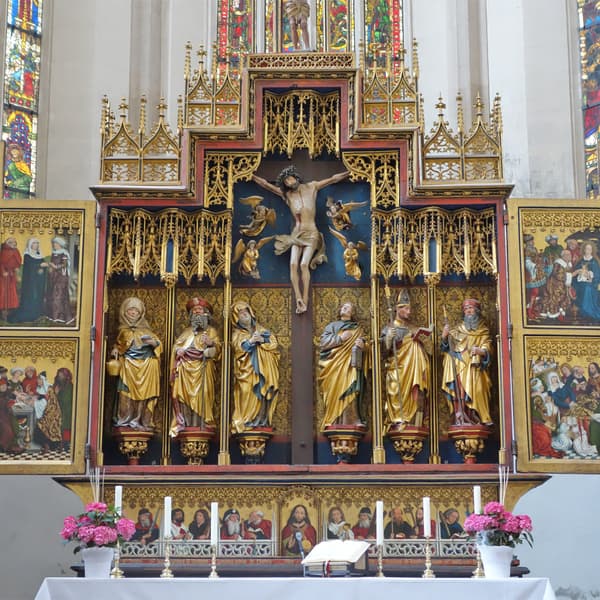
The Interior Stand in the spacious nave and take in the inspiring atmosphere. The soaring arches, the whitewashed walls, and the glowing stained glass. The windows behind the altar, which are most colorful in the morning light, are originals from the 13th century. The church was built in the 1830s.
Admiring this church, consider the town's priorities. For a town of just a few thousand people, this is a huge and rich church. St. Jacob's is a Lutheran church, but in medieval times, it was Catholic.
Read more...Show less
It was home to a religious order called the Teutonic Knights. These were warrior monks who dressed like knights in armor with a cross on their chests. Their original mission was to aid crusaders traveling to the Holy Land. Later, they aided pilgrims like those going to Santiago.
Then came Martin Luther and the Protestant Reformation that swept through Germany. In 1544, St. Jacob's Church and the entire town of Rothenburg became Lutheran. The simple, Gothic-looking interior you see today actually dates from the late 19th century.
Romantics of the period stripped away years of fancy Baroque fittings. They added new features with a neo-Gothic style, like the pulpit there on the left wall and the baptismal font up ahead. Approach the main altar. You pass through the carved wooden stalls of the choir.
Above the choir stalls, you'll see portraits of Rothenburg's leading families and church leaders, the people who financed this church. Directly ahead is a marvelous altarpiece of statues, paintings, and gilding. The main altarpiece is historic and unique. Impressive, especially with its backdrop of stained-glass windows.
To be clear, this isn't the more famous Holy Blood altarpiece. We'll be seeing that one shortly. This altarpiece is from around 1466. The paintings are by Friedrich Herlin.
The carved wooden statues are by anonymous Bavarian artists. The central statue is an evocative Christ being crucified. See the blood pouring from his wound and remember that soon we'll be seeing a supposed dropout of that holy blood. Below Christ are the statues of six saints.
I recognize one of them. It's our old friend James. Yes, St. James is second from the left with his red hat, scallop shell, and pilgrim's walking stick.
Now, take a look at the painted panels to the left and right. They tell scenes from the life of Mary who always appears in her blue robe. It starts in the upper left with the Annunciation. Then, baby Jesus enters the scene.
The story ends in the lower right of the altarpiece. There you see Mary on her deathbed surrounded by crowds of mourners. There are a few oddities in this medieval work. Check out the row of painted saints below the statues.
Hey, is that St. Peter wearing spectacles? Yeah, and there's another guy wearing glasses, too. It's in one of the painted panels over there on the left.
Oh, yes. That's the scene of baby Jesus being circumcised. The guy doing the circumcision is wearing glasses. Good idea.
Now, turn your attention to the big stone monument to the left of the altarpiece. This is the Tabernacle of the Holy Eucharist. See the wooden doors up in the center? That's where they stored the wine and bread for Holy Communion.
There is another quirky thing here. Find the colorful statue of the Trinity. The Father and Son are literally bridged by the dove representing the Holy Spirit. Now, step back.
You can see that Jesus is standing on a skull, clearly overcoming death. Now, let's circle around to the backside of the altarpiece. The backside shows the scenes worshipers would see when the altar doors were closed. In the upper left, you'll see a painting of the Rothenburg skyline.
It depicts the town hall and market square, circa 1466. It looks much like it does today, except it shows the old Gothic town hall as it was before the big fire of 1501. Now, look down. At the bottom edge of the altarpiece, find the face of Christ painted onto the veil of Veronica.
Now, walk a few steps side by side. See how the eyes follow you? Weird. Yes, it must have given the faithful the religious heebie-jeebies four centuries ago.
Now, let's go see something even more marvelous, the altar of the Holy Blood. It's at the other end of the church, you can't see it from this end, because it's in the loft up behind the pipe organ. Start heading there. As you walk back through the nave, check out the impressive pipe organ with some 5,500 pipes.
Though the world's biggest organs have upwards of 30,000 pipes, this one is significant by European church standards. Besides, it's not the size of the organ that matters, but the music it makes. Rick. If you get a chance, attend an organ concert here.
They're wonderful, and there's a schedule by the door. Now, as pilgrims did centuries ago, climb the stairs that lead up behind the pipe organ. You soon reach a loft-like chapel, glowing with stained glass. This is the impressive setting for the church's main site, the altar of the Holy Blood. The altar of the Holy Blood
Altar of the Holy Blood
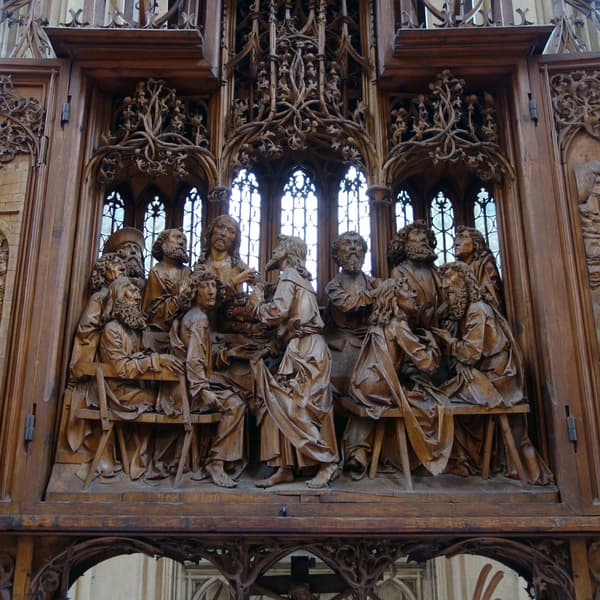
by Tilman Riemenschneider. This carved wooden altar piece is the artistic highlight of Rothenburg and perhaps the most wonderful wood carving in all of Germany, the glorious altar of the Holy Blood. It was carved by Tilman Riemenschneider, the Michelangelo of German woodcarvers from 1499 to 1504. Coincidentally, those were the years Michelangelo was working on his David in Florence.
The entire structure stands 35 feet tall. On the top is a statue of a naked Christ with a crown of thorns. At the bottom is a carved panel that depicts the Last Supper. In 1499, the city of Rothenburg hired Tilman Riemenschneider to create this as a new setting for the jewel of the town's possessions, a drop of Christ's Holy Blood.
Read more...Show less
Find the title Tiny Relic of the Holy Blood. It's about in the middle of the whole monument. Look for a small cross situated above the Last Supper but below the crown of Thorn's Christ. It's a cross supported by two carved angels.
In the center of that cross is a transparent rock crystal capsule. Inside that rock crystal is a tiny red mark that believers think is a drop of Christ's blood. The cross dates from about 1270. It housed the relic that drew so many pilgrims that they needed a bigger church to display it in.
So they built the church you're in now. Then they wanted a more glorious altarpiece to show the relic off. So the city fathers hired Riemenschneider. They were very specific about which scenes his carving would depict.
It's all about Christ's blood. Riemenschneider tells the story of the Passion. That's the days leading up to Christ's death. It begins with Christ arriving in Jerusalem.
That's the scene in the panel to the left of the Last Supper. Jesus rides in on a donkey while his followers cheer. Next comes the main scene, the Last Supper. The twelve disciples are gathered to share one last meal together.
They sit on benches crowded around a long table set with food. Jesus stands up to make an announcement. He's in the back row, the third figure from the left, facing directly out. He gives out bread and wine, saying, This is my body, and this is my blood.
Tillman freezes, the moment right as Christ is handing a piece of bread to the disciple that stands dead center in the scene. It's the traitor Judas. Jesus tilts his head and eyes Judas warily with a sideways glance. He tells the disciples, One of you will betray me.
The disciples turn to their friends and ask, Is it I? Their faces are somber as they wonder if they'll be the one who will betray their master. One disciple, John, leans his head lovingly on his master's lap. The story continues on the panel to the right.
There, Jesus prays in Gethsemane, where Judas brings soldiers to arrest him. The authorities whip Jesus and mock him. That's the crown of thorns statue way up at the top of the altarpiece. And then comes the final scene.
Jesus is crucified. You'll find that depicted at the very bottom of the altarpiece. Beneath the Last Supper, you'll see a tiny crucifix. Think of it.
Pilgrims would kneel here before this altar. They'd ponder the story of Jesus' passion, how he sacrificed his own blood to save them, his holy blood, the blood displayed on this marvelous altarpiece. And as they took communion, they'd contemplate the sacrifice of Christ's holy blood that was shed for them. Now, step back and just admire Tillman's mastery of the medium.
He wasn't just a backwoods whittler. He was a sculptor in wood. Look close at the Last Supper scene. The disciples' curly locks and beards with the deep-carved ringlets, the sharp folds of their robes, their expressive faces, the weathered hands and feet, the delicate vines intertwining above their heads.
Christ's expression is both accusing and tender. Riemenschneider's realism and attention to detail are astonishing. In the left panel, the one with Jesus on a donkey, he even shows the nails on the horseshoe. On the other hand, it's clear Tillman, a high Gothic artist, hadn't fully mastered Renaissance three-dimensionality.
In the Last Supper, notice how the tabletop is way too skinny and unnaturally tilted in a crude attempt at 3-D. Riemenschneider carved the altarpiece out of linden wood. It's durable, but soft enough to easily sculpt. Linden trees are all over Rothenburg and Germany.
They're much beloved in Germany since 1910, and many live for centuries. Riemenschneider chose not to paint over the wood, unlike many other artists of the day. He treated it only with a highlighting glaze. Finally, notice how Tillman used theatrical elements to bring the message of Christ's sacrifice home.
For example, Judas, with his big bag of cash, was a freestanding statue. This figure could be removed from the scene. This was the tradition for the four days leading up to Easter. To see how it looked with Judas out of the picture, see the photos on the wall nearby.
Riemenschneider's altarpiece has inspired the faithful for five centuries. Even today, it realistically brings to life the story of Jesus. Believers can come here, relive Christ's agony, and appreciate the Holy Blood, the sacrifice of which brings them eternal life. Let's move on.
From here, we'll be headed to our next stop, which is about a couple hundred yards away. On the next track, Rick and I will give you plenty of directions and information as you go. So when you're finished enjoying the church, we'll meet you back outside. By the way, check out the list of upcoming concerts posted at the door. The Walk to the Klingentor Viewspot
Walk to Klingentor View Spot
Leaving the church, make a U-turn right. Start heading north through the arched passageway. This is the street called Klingengasse. You're actually walking right underneath the western end of the church.
This part of the church is a later extension, as you can tell from the newer-looking stonework. It was purpose-built in the 1450s and 60s to house the Riemenschneider altarpiece and accommodate all those pilgrims. Continue down Klingengasse. We're headed two blocks to the intersection with the street called Klosterhof.
Read more...Show less
Walking down Klingengasse, you can see typical homes of today's citizens. Though they're equipped with all the modern conveniences, they don't look all that different from homes in medieval days. Each is unique with different rooflines, doors, and interesting gables. In medieval times, nothing was standard, and everything was built to order.
You may see dormer windows, that is, a window built into the roof that projects out the side. It's a common feature, in buildings all around Rothenburg. Houses crowd close together. That's because there was no way to expand outward.
The city was enclosed by a wall. The wall was begun in the 13th century to protect the village from marauders. There were only a few entry points to the city, and these entry points were heavily protected with tall guard towers. One of the most impressive of these towers is just ahead.
When you reach the intersection where Klingengasse is crossed by the city, by Klosterhof, stop. Stand here at the intersection and gaze farther ahead down Klingengasse. In the distance, you can see the tower called the Klingentor. But don't go there.
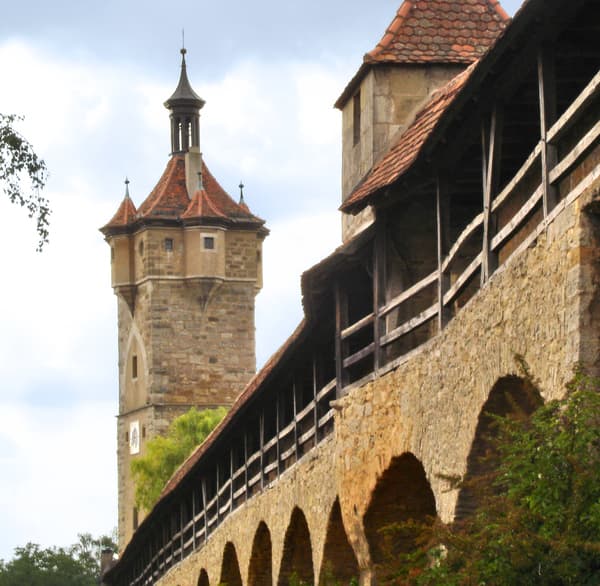
No, we won't be actually going to the Klingentor on our walk, but view it from here. The Klingentor is one of the city's most picturesque towers. It has distinctive medieval-looking turrets bulging out from the top. This tower guarded a gate at the north end of the city.
It also served as a water reservoir. High in the tower sat a 240-gallon copper tank. This was continually replenished with fresh spring water pumped up by river power. It provided water to Rothenburg's most privileged citizens from 1595 until 1910.
To the right of the Klingentor is the high city wall. To the left, the wall is low and simple because that side of the city is built on a cliff and needs no protective wall. By the way, one of the great things to do in Rothenburg is to walk along the elevated ramparts of the town wall. Though it sounds precarious, it requires no special sense of balance.
You're walking along the sentry paths where guards kept watch. The best stretch of the wall runs between Klingentor here in the north and Spittletor in the south. You get upon the ramparts by a few entry points like one found at the Klingentor. Let's move on from the intersection to the Klingentor.
Turn left on Klosterhof. But first... There's always a but first. But first, here at the intersection, find a scallop shell.
The shell is decorating a building on the street corner. Remember, that's the symbol of St. James, indicating that this building is associated with the church. Let's continue our own pilgrimage.
The next stop is the Imperial City Museum. To get there from the intersection, turn left, heading west, down Klosterhof. To the Imperial City Museum.
Imperial City Museum
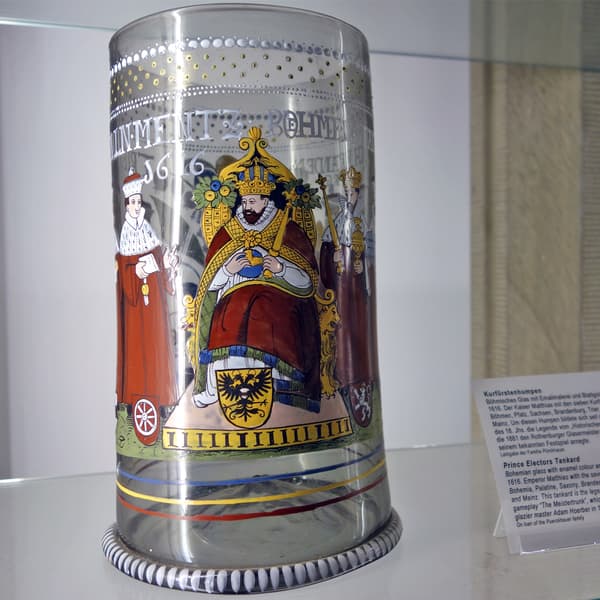
The museum is just up ahead. As you walk there down Klosterhof Street, you'll pass an interesting pub. It's at number 7, on the right. The Alte Frankische Weinstube am Klosterhof.
It's a colorful place. Every Wednesday evening, beginning at 6 o'clock, it hosts an English-language conversation club. It's a rare chance to practice your German or just mix it up with locals who aren't selling anything. Bring your favorite slang and tongue twisters and join regulars like Herman the German and his sidekick, Wolfgang.
Read more...Show less
As the evening wears on, the beer starts to sink in and everyone seems to speak that second language a bit more fluently. Continue on. Stop for a moment when you reach the entrance to the Imperial City Museum. Although our tour won't go inside the Imperial City Museum, this is the most important museum in town.
It gives a vivid sweep through Rothenburg's history. It's housed in a former Dominican convent. Look closely at the entrance door. Just to the right is a Lazy Susan-type contraption embedded in the wall.
Cloistered nuns used this to give food to the poor without being seen. If you choose to visit the museum, you'll enjoy a fascinating grab bag of historic artifacts. There's the wine tankard from 1616 that inspired the Meistertrunk legend. A model of the city traces the town's growth through the centuries.
You'll see the original statues from St. Jacob's Church, suits of armor, antique furniture, and old paintings. You'll also see what was once the dormitory of this former convent. But we'll carry on with our walk, which takes us to another part of the convent.
Facing the museum, turn left and continue walking. Just past the museum, you'll see a gateway on the right, which leads into a garden. Enter that gateway. If it's locked, as it might be at night, you'll have to skip the garden.
You'd pick up the next track by continuing straight to the T-intersection and turning right. But we'll enter and enjoy the peaceful convent garden. ¶¶ The Convent Garden
Convent Garden
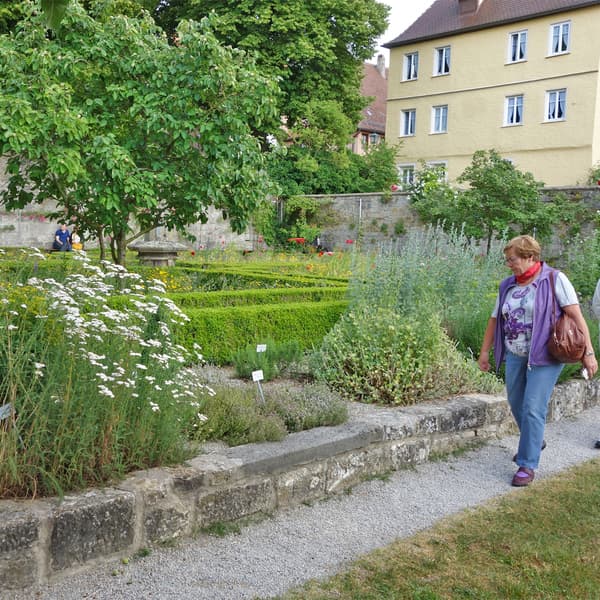
Appreciate the setting, a walled-in garden surrounded by fine architecture. It's a rather expansive oasis within the city walls where land was at such a premium, and that's a reminder of the importance and the wealth of the church in former days. This spot is a nice place to work on your tan or mix up poison potion. Notice the herb garden.
Monks and nuns who lived here started their lives here. ¶¶ ¶¶ ¶¶ They followed the tradition of a garden. In medieval days, they were the town's most educated people. Their job was creating herbal concoctions, things that might cure the sick, disinfect the town, or disguise the taste of rotten food.
Read more...Show less
Wander through the hedgerow paths and smell the herbs, but don't pick. In fact, don't even smell the plants marked with crosses. They're poisonous. The number of crosses shows how potent they are, like the stars of spiciness in a Thai restaurant.
¶¶ Hmm, I recognize some of these names. This label says Pfefferminz, peppermint. That's right. This one's Heidewacholder.
That's juniper, which has the berries used to make gin. This says rosmarin. That's gotta be rosemary. Yeah, I bet you're right.
And lavendel? That would be? Lavender? You got it.
The tallest plant in the garden was a very important one in olden days. It's hopfen, or... Hops! Yeah.
The monks' other high-tech duty was brewing beer. Back then, beer served as an easy-to-store source of nutrition, kind of like liquid bread that would never go stale. I hate to leave this place, but I guess we should move on. Exit the garden at the far left end.
That is, exit opposite from where you entered. You leave through an arch in the far wall. As you emerge from the arch, turn right and go downhill a few steps. Then follow the street as it turns, and it turns to the left. You're now walking down the street called Trumpetergashen. On your right is the town wall. The town wall.
Town Wall
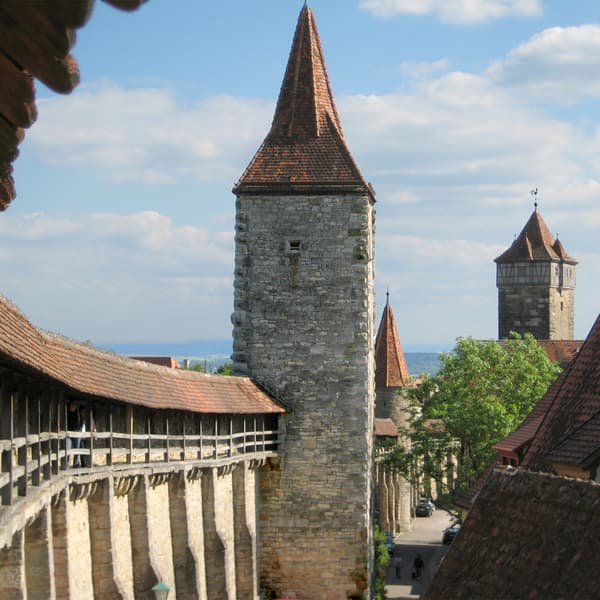
As you walk down the street, the town wall is on your right. The entire town wall is about a mile and a half around. This part of the wall is much shorter than the ramparts I mentioned earlier, the ones you can walk on top of. A tall wall was unnecessary here because there was the natural fortification of the cliff.
You can actually see the cliff if you peek through the bars and look to the far right. Keep walking until you hit the intersection with Rothenburg's main street, Herrengasse. At the intersection, look to the right. You'll see the tall, fortified gate called the Burgtor.
Read more...Show less
We'll pass through this gate in a few minutes. But first... But first, we'll keep going straight, cross Herrengasse, and continue downhill on Burggasse. Along Burggasse, you'll pass a couple of nice, old, half-timbered homes.
Hmm. Burg. Burggasse. Burgtor.
Rothenburg. The German word Burg means castle or fortress. Many German towns began with a castle, which was crucial for surviving the chaos of the feudal age. We're heading now to the place where Rothenburg built its first castle.
And where, a thousand years ago, the town was born. Continue to the end of the block, where you run into the town wall. At the wall, turn right. You'll pass through a small tower gate.
You emerge into a spacious and pleasant garden. The Burggarten. Park yourself along the wall and take in the town's finest viewpoint. Castle Garden Viewpoint.
Castle Garden Viewpoint
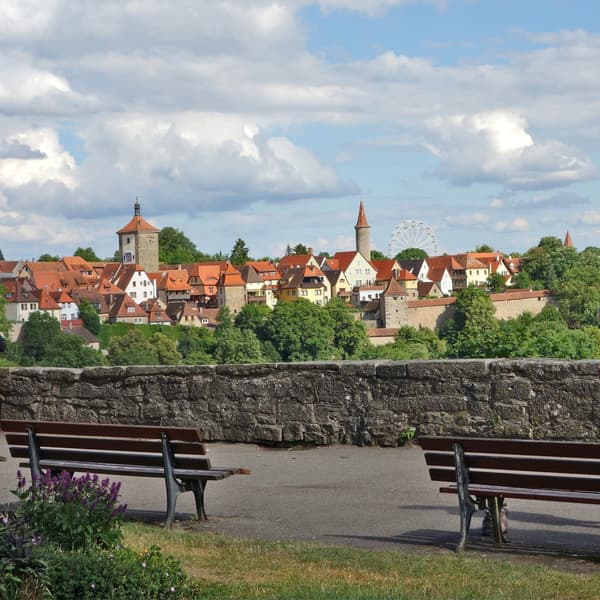
From here, enjoy a fine view of the medieval skyline of Rothenburg and the lush countryside below. In the distance, amid all the red roofs, find a tower poking up. It's called the Siebersturm. It sits about in the middle of the skyline, It's the rectangular clock tower with the red roof.
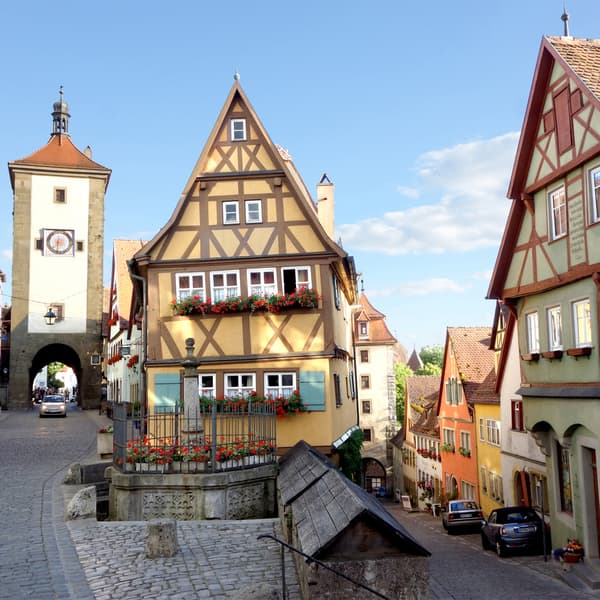
The area around Siebersturm is a great part of town to explore after our tour. At the base of the tower is a little square called Plonlein that's probably the most photographed spot in all of Rothenburg. It's a collection of half-timbered buildings that's practically become the symbol of the city. Keep gazing into the distance.
Read more...Show less
Panning to the right of Siebersturm, find the big building with ten dormer windows in the roof. That droopy-eyed building at the far end of town is today's youth hostel. Formerly, it was a horse mill where horses turned to millstone to grind grain. This mill was a backup source of energy for the town in case the main generator, a water mill, was out of commission due to drought or siege.
That water mill is located on a river in the valley below. Look down into the valley. Amid the greenery runs the Tauber River. Because of the trees, you may not actually see the river.
Locals call this park the Tauber Riviera. Looking down at the Tauber Riviera, think of how the town got its official name, Rothenburg-Ober-Tauber. As you can see, the town sits on a bluff above the river valley. That is, it's over the Tauber, Ob-der-Tauber.
As for where the word Rothenburg comes from, well, let's go straight to the source. Explore deeper into the park. A few steps further in is a small church. Through the castle garden
Through Castle Garden to Burg Tower
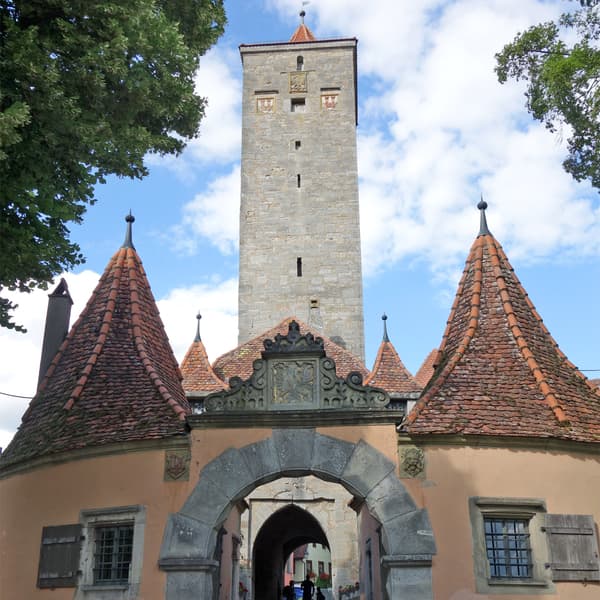
to the Berg Tower. The city was born here in what is today's castle garden around the year 950. That's when a small fortress or berg was built on this promontory. In 1142, it was replaced with a proper castle.
That castle was destroyed in 1356. This small chapel is the only bit of the original castle to survive. In front of that building is another reminder of Rothenburg's medieval past. It's a memorial to local Jews slaughtered here in 1298.
Read more...Show less
From the chapel, make your way across the garden to the opposite wall. As you walk, going uphill to the opposite wall, look to your left toward the far end of the garden. Although we won't go there on our walk, if you explored in that way, you'd find a delightful grapevine trellis that makes a fine picnic spot. At the garden's far, far end is another great viewpoint.
It's well past the tourists. Locals consider this the best make-out spot in town. Ach du lieber! When you reach the north wall, turn right.
Start heading toward the tall tower, the berg tor. As you walk, enjoy the view of the surrounding countryside. It's easy to take a walk outside the town walls. There's a trailhead here in the berg garden over by the chapel.
You can explore the river, a covered wooden bridge, the cute little 600-year-old toppler castle, and the peaceful village of Detfong. But we're focusing on the tall stone tower up ahead, the berg tor. At its base is an arched gateway flanked by two cone-shaped turrets. Pause here for a second.
Imagine being an attacker circa 1400, trying to penetrate the town walls. You'd have to make it through a whole series of defenses. First came this outer gateway. Now, step through.
Whew! We made it! But now there's this wooden drawbridge that could be raised. See the chain slits up above?
As you approach the next gateway, pause and look up above the arch. Notice the pitch-nose mask designed to pour boiling pitch or oil on the enemy. Ouch! Poached in their own armor.
Now look higher, way up near the top of the tower. There are two reliefs. These are the town's coat of arms. They depict a castle with twin red towers.
This symbolizes that first castle that was built here that started the town. Many historians think this is where Rotenberg got its name. It was the red castle, the Rotenberg, that stood above the Tauber River. The Rotenberg ob der Tauber.
Ah, mystery solved. Let's continue our assault. Charge through the gate and study the next line of defense, the big wooden door. Notice that it has a tiny door cut into it.
It's so small that even if an attacker could squeeze through, their sword or spear would be temporarily rendered useless. Note also the square holes on either side and imagine the massive timber that once barricaded this gate. Locals called the small door the Eye of the Needle. Suppose you weren't an attacker, but an ordinary citizen who happened to get locked out of town after curfew.
You could always bribe the guard and he would slip you in through this tiny door. Quick, the guard's not looking. Let's go through the gate. Phew, we made it.
On the other side continues straight, climbing up the big street. We're back on Herengasse. From here, it's a straight shot up Herengasse to the end of our route. Our tour, the Market Square, where we started. Herengasse.
Herrngasse
Walk up Herengasse back to the main square. This street dates back centuries. It's Herengasse, the street where the heron lived, that is, the richest patricians and merchants. Many old German towns have a main road called Herengasse.
Herengasse. It's a very old town. It's a very old town. It's your best chance to see some of the town's finest old mansions.
Read more...Show less
You'll see grand, half-timbered homes and other buildings with loft windows and pulleys for hauling up and storing goods. On the right-hand side, you pass the Franciscan Church. Keep on walking as Rick recaps Rotenberg's history. The Franciscan Church is the oldest in town from 1285.
1285! Think of it! But even then, that isn't all that old by Rotenberg's standards. Remember, Rotenberg was founded three centuries earlier, in 950, as a small fort in the Berggarten.
Then, in 1142, they built the Red Castle, the Rotenberg. The town grew with its commercial center at the market square. They built a wall for protection. By the time this Franciscan Church was built, Rotenberg was already a thriving trade town of 5,000 people.
Excuse me, Rick, but you should point out this great, great house up ahead. Ah, yes. On the left is a mint-green house at number 18. It's the biggest patrician house on the street.
The same family has lived here for three centuries. Notice the door. It's big enough to allow a carriage in, but with a little human-sized door cut into it. Notice also the four old-time doorbells.
Ooh! Let's go ring them! Well, because of people like you, today's family decided to disconnect those bells. Okay.
Then let's carry on up Herrengasse with our walk and with the history. For four centuries, from roughly 1200 to 1600, Rotenberg was one of Germany's leading cities. As a free imperial city, it was a major textile-trading town on a major north-south route. Franciscans, Dominicans, and Teutonic knights settled here.
Pilgrims passed through on their way to Spain. They stopped at St. Jacob's to venerate the relic of the Holy Blood, the town thrived. And it's still thriving.
Check out this gift shop on the right at number 11. We'll stop here. Step inside the gift shop. Browse around, noticing the architecture.
This gift shop is housed in a former mansion. Just poking around lets you imagine what patrician life was like centuries ago. Picture how this structure worked in former days. You'd enter through doors big enough for a carriage.
This admitted you to the living quarters, located in the front of the complex. Go in deeper. Here you'd find the courtyard out back. This back part of the complex functioned as garage, stables, as warehouse, and servant quarters.
They even had a private well. Start making your way back out to the street. We're on the home stretch. Go back out to Herengasa and turn right.
As you walk up Herengasa, Rick, bring us up to date on Rotenberg's story. All right. After four centuries of prosperity, we reach that fateful moment. The year is 1631.
Here we go again. Germany is in the midst of the Thirty Years' War. A Catholic army conquers Protestant Rotenberg. Fortunately, the town is temporarily spared, according to a made-up story, because of the Meistertrunk.
But, in fact, the town was devastated, first by the war, then by the war. Then it went into two centuries of hibernation. Finally, in the late 1800s, the town was rediscovered, perfectly preserved. Romantic artists and poets came to be inspired by its medieval ambience and sketch its landscape.
Soon, the tourists followed. Today, the town welcomes two million visitors a year. Most of the town's 2,000 residents are employed serving you. It's a delightful mix of old historic buildings housing fancy hotels, quaint eateries, and cutesy shops.
Coming up on the right are two places that exemplify the touristy Rotenberg of today. First, Hotel Eisenhut. This is Rotenberg's fanciest hotel. It's worth a peek inside, but not now.
Wait until our tour's over. Up next, the Katie Wolfart Christmas Shop. It's also worth a look inside. In fact, let's take a peek in right now.
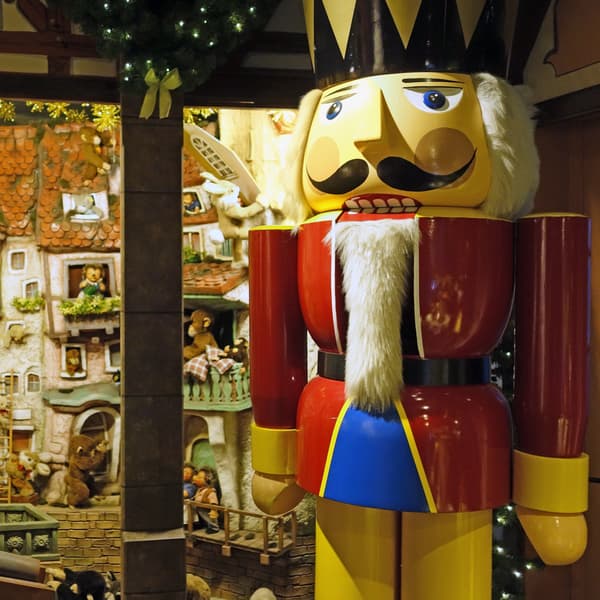
Go on in. Inside this huge store, it's Christmas 365 days a year. It's a winter wonderland of fake snow, Christmas lights, piped-in carols, countless tree ornaments, and nutcrackers. There's even an excellent Christmas museum upstairs.
Though it costs a few euros, the museum's worth it. But let me guess, it's 80 degrees outside, and this whole Christmas atmosphere just feels kind of weird. Yeah, let's jingle all the way back outside. Come on, Santa Steves.
Okay, but if we were here in December, it actually is Rotenberg's busiest tourist month. The entire town cranks up the medieval cuteness with concerts and costumes and shops with schnapps. The squares are filled with Christmas stalls, there's hot-spiced wine, giddy nutcrackers, and mobs of ear-muffed Germans. By the way, this Katie Wolfart store is the flagship of several that are scattered all around Germany.
They were started by Katie right here in Rotenberg in 1977. We'll finish our tour back outside a few steps to the right back on the main square. The tour ends
Tour Ends: The Rest of Rothenburg
and the rest of Rotenberg. And just like that, we're back where we started on Rotenberg and Rotenberg's main square. There's the old town hall and the new town hall. There's the Meistertrunk clock.
Remember, that glockenspiel plays at the top of every hour from 10 till 10. From here, the best of Rotenberg's sites are all within a 10-minute walk. You can climb the tower of the old town hall for great views. The best history museum in town is the Imperial City Museum, the one we passed earlier.
Read more...Show less
The next best museum is probably the medieval crime and punishment museum. Its main focus is implements of torture. Hey, if you want torture, go back to the Christmas store. It's free.
Yes, but the medieval museum also gives some thoughtful insights into life long ago. It's located a five-minute walk downhill or south of the main square. What if I just want to go shopping? Well, then you'd enjoy strolling down the main north-south street in town, Schmiedgasse.
Here, you'll find no end of Rotenberg's most popular souvenirs. Prints of Rotenberg scenes, wood carvings, wine glasses, Christmas tree ornaments, and beer steins. You might be tempted to sample the local pastry called Schneeballen, or snowballs. These are round balls of pie dough sprinkled with sugar.
They look great, taste so-so, and crumble in your hand when you take a bite. Schmiedgasse leads down to the most atmospheric corner of all Rotenberg, the place, I mentioned earlier. Just before the medieval tower called Siebersturm, you'll find a cute half-timbered scene on a picturesque street corner. It's called Plunlein.
Images like this have inspired films from Disney's Pinocchio to Chitty Chitty Bang Bang to Harry Potter. A couple hundred yards further, you reach Spittletor at the far end of town. There, you can climb onto the ramparts and walk the best stretch of the wall, 180 degrees around Rotenberg, all the way back to the city. Back up to Klingentor.
Ooh, that's a lot of stuff to do. Then there's one final option. Rotenberg abounds in atmospheric eateries. You could just take a seat in a traditional woody interior or tree-shaded terrace and kick back.
Enjoy local Franconian specialties like Bavarian ravioli or the local herb-seasoned bratwurst. Or sample Franconia's signature white wine, a fruity Gruner Silvaner that comes in a jug-shaped bar. Do I have to drink it all in one gulp? Nope.
You can just sip it. Or you can keep things really casual. Just grab a brat and kraut to go and have a picnic in the Berggarten. Now you're talking.
Wherever you go, soak in and enjoy the ambiance. You're in Germany's best-preserved medieval town, Rotenberg. We hope you've enjoyed our walk through Rotenberg. Thanks to Jean Openshaw, the co-author of this tour.
If you're doing more sightseeing in Germany, we have similar audio tours for Munich, Berlin, and the Romantic Rhine River. This tour was excerpted from the Rick Steves Germany Guidebook. For more details on eating, sleeping, and sightseeing in Rotenberg, refer to the most recent edition of that guidebook. For more free audio tours and podcasts, and for information about our guidebooks, TV shows, bus tours, and travel gear, visit our website at ricksteves.com.
This tour was produced by Cedar House Audio Productions. Thanks. Auf Wiedersehen. And goodbye for now.
Free
GPS-guided walking tour
No account needed. Walk at your own pace.
Free
15 stops ·