20 stops
GPS-guided
61 min
Duration
Free
No tickets
About this tour
A guided tour of Athens — National Archaeological Museum in Greece with 20 stops. Highlights include National Archeological Museum, Cycladic Figurines, and Mycenaean Treasures.
20 stops on this tour
National Archeological Museum
The National Archaeological Museum. Ancient Greece set the tone for all Western art that followed. At the National Archaeological Museum, you can trace the evolution of Greek art from its roots to the flowering of the Golden Age and beyond. Hi, I'm Rick Steves.
Thanks for joining me on this walk through what is far and away the top ancient Greek art collection anywhere. Statues, vases, and paintings span the whole range of Greek culture. We'll see prehistoric Barbie dolls, the gold mask of Agamemnon, stately Kouros statues, the perfectly posed Artemisian bronze, and the buck and bronco exuberance of the age of Alexander the Great. The treasures here are top-notch.
Read more...Show less
In fact, better than what you'll find at the archaeological sites themselves. Their sheer beauty helps bring the country's dusty ruins to life. Now, allow about two hours to explore the Archaeological Museum. As we travel through 7,000 years of Greek art, all beautifully displayed and in air-conditioned comfort.
To help us along the way, I've invited a good friend and virtual travel buddy. Welcome, Lisa. Hi, Rick. Lisa will give us helpful directions and sightseeing tips throughout the tour.
And my first tip is to be sure you get our tour updates. Just press the icon at the lower right of your device. You'll find any updates and helpful instructions unique to this tour. Things like closures, opening hours, and reservation requirements.
There's also tips on how to use this audio tour and even the full printed script. Yes, so pause for just a moment right now to review our updates and special tips. It's okay. We'll wait. And then... Let the tour begin! The tour begins.
Tour Begins: Historical Overview
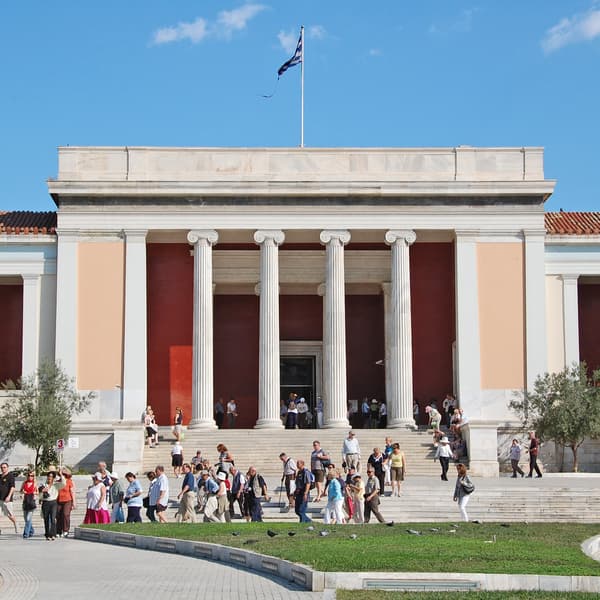
Historical Overview. Start in the entrance lobby, which the museum labels Room 1. Pause here and get the lay of the land. The collection is delightfully chronological and the rooms flow naturally in numerical order.
We'll start in Room 3, found directly ahead of you. Then we'll circle clockwise through the rooms around the building's perimeter. Before we start, relax here in the entrance lobby while Rick gives an historical overview of early Greece. Thanks, Lisa.
Read more...Show less
We'll see the rise and fall of Greece's various civilizations. We'll start back in the mists of time with mysterious figurines carved by the Cycladic people of Greece's islands. Next, we'll see the gold armor of the warlike Mycenaeans who dominated the mainland around 1300 AD. The time of the legendary Trojan War.
When they fell, Greece entered several centuries of dark ages, and little art remains from that period. As Greece emerged from darkness around 800 BC, they carved crude but noble statues in the archaic style. By 450 BC, Athens had become the wealthiest and most powerful of the city-states. Greece entered its golden age.
Art from this age, balanced, realistic, and human-centric, set the standard of beauty in Europe. By 330 BC, Greek culture was spread abroad by the conquests of Alexander the Great. This Hellenistic era produced highly emotional works capturing the thrill of victory and the agony of defeat. The Hellenistic Empire was eventually swallowed up by the Romans who conquered Greece but also ultimately preserved Greek culture.
Our tour zeroes in on a few choice pieces from each era. We'll watch Greek sculpture evolve from stiff and crude to the balance of the golden age to Hellenistic melodrama to Roman statues in the Greek style. This tour sweeps quickly through the collection offering an almost time-lapse effect. You may want to come back to browse afterwards using the excellent English information posted in each room.
Ready? Let's begin our journey 7,000 years ago, starting in Room 3. Lisa? To find Room 3 from the entrance lobby, go straight ahead into the large central hall.
That's Room 4. Turn right and find the small side room. This contains Rooms 3 to 6. The display cases have stiff stone figures with large heads called Cycladic Figurines. Start with the first glass case, directly to the right as you enter.
Cycladic Figurines
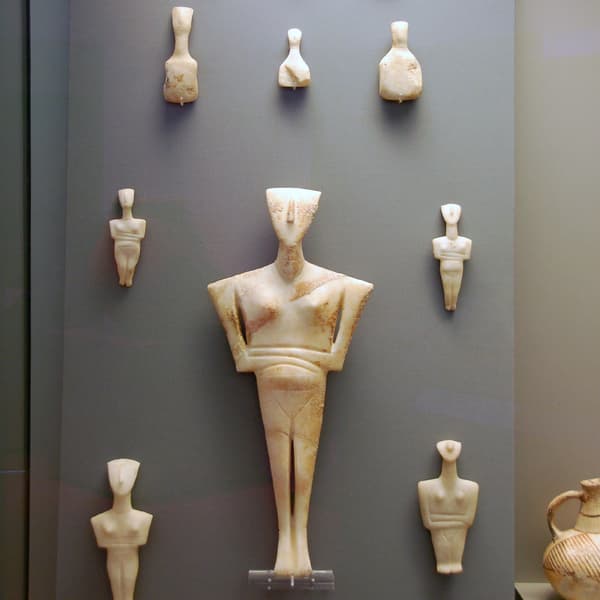
Cycladic Figurines These small marble statuettes of females, most with their arms folded, are older than the Egyptian pyramids. You have to wonder what the prehistoric people who made these meant them to be. A goddess? Corpse?
Fertility figure? Good luck amulet? Spirit guide? Beloved ancestor?
Read more...Show less
Neolithic porn? No one knows for sure what their purpose was. The earliest Greeks may have worshipped a great Mother Earth goddess long before Zeus and company. She's variously known as Gaia, Gi, Rhea, and other names.
But it's not clear what connection Gaia had, if any, with these statuettes. The ladies are always naked, usually with arms folded. The figures evolved over the years from flat-chested, around 5,000 B.C., to violin-shaped, to skinny supermodels by 3,000 B.C. There is evidence that they originally had faces, eyes, lips, and ears painted on.
Statuettes like these were found all over Greece, particularly in the Cyclades, the Cycladic Islands. The map on the wall, straight across from the entry, shows the Cycladic region, with the sacred island of Delos at the center. It forms a circle, or cycle, formed by the Cycladic Islands. As these islands were in close proximity, there was plenty of trade and contact between them.
For a look at some of their popular export items, explore deeper into the long, dead-end Cycladic Hall, that's rooms 3 through 6, You'll see more figurines, painted vases, and tools. The black knives and spears are made of obsidian. That's a hard, shiny black volcanic glass. Notice the finely painted bathtub on the left.
It's obvious that the Cycladic society was a relatively peaceful culture with an artistic sense of style. You'll see carved marble bowls, so thin and delicate that light shines through. And notice the bronze blades, tweezers, and needles. All of these artifacts are from around 2500 B.C.
That's roughly a thousand years before the next Greek civilization we'll look at, the treasures of Mycenae. Return to the long central hall, room 4. It's one big hall divided into four sections. Here you'll find many display cases of armor, jewels, and much more, all from the Mycenaean civilization.
We'll focus on the room's second section, that is, second from the lobby entrance. But start by just browsing the array of objects while Rick gives some background on what you're seeing. ¶¶
Mycenaean Treasures
¶¶ ¶¶ ¶¶ ¶¶ ¶¶ ¶¶ ¶¶ ¶¶ ¶¶ ¶¶ ¶¶ These were all found buried alongside bodies in Mycenaean graves. They were excavated from the coffins of 19 bodies found in a circular tomb, a cemetery archaeologists call Grave Circle A. The various objects all around you make up 30 pounds of gold. Their intricately carved hammered detail points to the sophistication of this early culture.
The Mycenaeans ruled southern Greece for 400 years, from about 1600 to 1200 B.C. That's 1,000 years before the Greek Golden Age. Exactly where they came from is a mystery, and little is known of their culture or what became of them. It's speculated that sometime around the year 1200, the aggressive Mycenaeans launched an attack.
Read more...Show less
Their target was Troy, a rich city on the northwest coast of Asia Minor. That's present-day Turkey. After a long siege, Troy fell. This actual historical event was embellished in the legends of the Trojan War found in the famous poems of Homer, the Iliad, and the Odyssey.
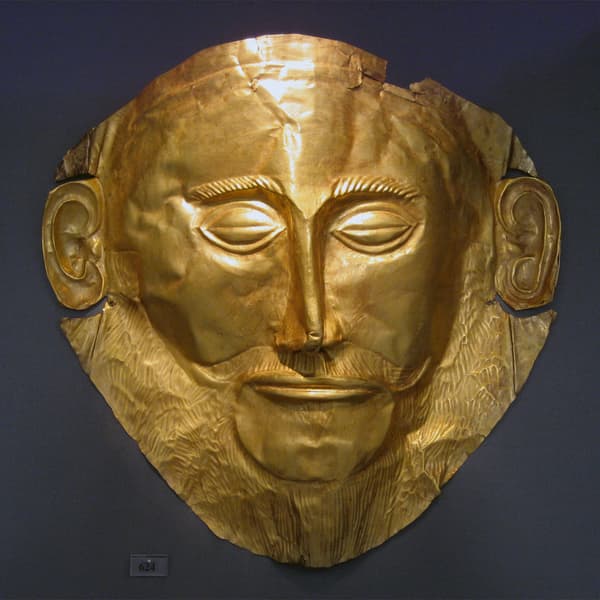
That's where the Mask of Agamemnon comes in. Find the Mask of Agamemnon in the second section of Room 4. It's in the middle of the second section, in a glass case, display item number 624. The mask is one of the most remarkable objects unearthed at Mycenae.
The mask is made of gold and shows a man's bearded face. It was meant as a funeral mask, to be tied over the face of one of the dead men buried at Mycenae. Notice the tiny ear holes for the string. The dead were embalmed, fitted with burial masks, like this, and buried in rectangular holes called shaft graves, which were cut into the rock up to 20 feet deep.
They were placed lying on their backs alongside their most precious belongings. Their heads faced east toward the rising sun. This indicated a belief in an afterlife. No one knows who really was the man behind the mask.
Its fanciful name comes from the 19th century, when archaeologists unearthed the ruins of Mycenae, The German archaeologist Heinrich Schliemann was kind of an Indiana Jones of his era. Having recently discovered the ruins of Troy, Schliemann was convinced that it was the Mycenaeans who conquered Troy. That much may be historically true, but Schliemann went on to declare this funeral mask to be that of King Agamemnon, who appears in the Trojan War legends and supposedly burned the city of Troy. Could this mask really be Agamemnon's?
No. First, Agamemnon was likely a fictional character. And second, the mask dates from around 1550 B.C. That makes it more than three centuries before the fall of Troy.
Now, circle around to the backside of the Mask of Agamemnon case. Find the knife and sheath. Look closely at the detail work to see a scene of warriors fighting lions. The Mycenaean society was both warlike and sophisticated, They poured much of their artistic energy into decorating their weapons and burying their heroes.
Continue browsing your way down the long hall called Room 4. In the next section of Room 4, you'll find more Mycenaean artifacts. More Mycenaean artifacts.
More Mycenaean Artifacts
Start with the model of the Acropolis of Mycenae. It's on the left side of the room. The model shows the dramatic hilltop citadel or fortress city that was the capital of the Mycenaean Empire. Located just a couple hours' drive west of Athens, its ruins are worth a visit today.
Mycenae was the spot where many of the objects found in this museum were unearthed. Looking closely at the model, find the entrance to the walled city. It's number one, the famous Lion Gate. Above the doorway, two lionesses symbolically protect the city.
Read more...Show less
The lions sit atop a massive lintel or crossbeam which weighed 18 tons. That's as much as a B-17 bomber. The exterior walls of Mycenae were about 40 feet high, 20 feet thick, and over half a mile long. They were built with an estimated 14,000 boulders weighing 5,000 tons.
That's up to 10 tons each. Next, find the round cemetery known as Grave Circle A. It's number two on the model. This was where the 19 royal bodies were unearthed by Schliemann that yielded the Mask of Agamemnon and other treasures displayed in this room.
Near the top of the hill, number eight on the model, are the ruins of the king's royal palace. Here sat the king on his throne, the very center of power of the Mycenaean Empire. The walls and floors of the palace were once painted in bright colors. You'll see some of these colorful frescoes on display nearby.
Now, continue browsing elsewhere in room four. You'll see display cases with clay tablets. These show the Mycenaean written language known as Linear B. It's a syllabic script.
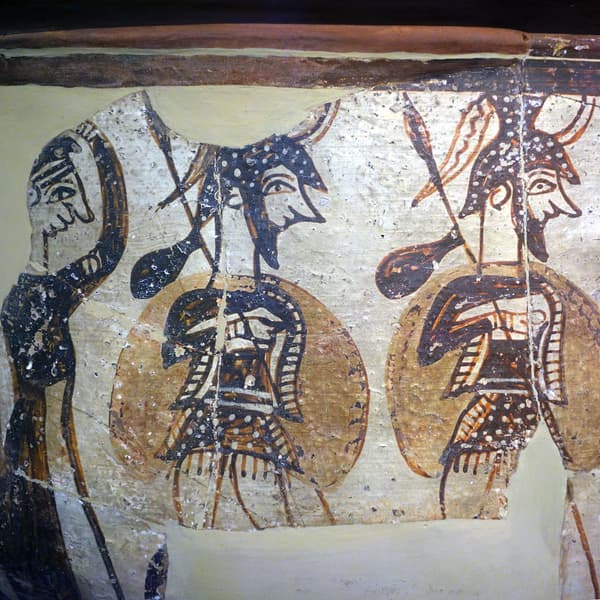
That means each mark stands for a syllable, like in Japanese. The script of the mysterious palace, Mycenaeans, was decoded only 50 years ago. Now, find the display case in the center of this section. On its backside is exhibit number 1426, the warrior crater.
A crater is a two-handled vase. This was Schliemann's favorite find. Look closely at the detail. A woman at the far left waves goodbye to a line of warriors.
They're heading off to war with their fancy armor and duffel bags hanging from their necks. They're heading off to war with their fancy armor and duffel bags hanging from their spears. This provided the world with its first glimpse of a Mycenaean soldier. It's also a timeless scene with its yellow-ribbon sentiment echoing across the centuries to this day.
Now, continue down room four to the final section. In the center of the section is a glass case displaying the Vafio cups, exhibit number 1758 and 1759. The Vafio cups from around 1600 B.C. are exquisitely detailed.
They show the artistic influence of the Minoans, the sophisticated and peace-loving Greeks who preceded the Mycenaeans. On cup number 1758, look closely at the intricate metal-worked detail. It shows a charging bull sending a guy head over heels. Bull jumping was a popular Minoan sport.
Minoan culture flourished from about 2000 to 1400 B.C. in the late 19th century. It was centered on the Isle of Crete. In contrast with the warlike Mycenaeans, the Minoans were peaceful and business-savvy.
They built a prosperous empire through trade, not war. They decorated their palaces with happy frescoes of colorful landscapes and athletic bulljumpers. When the Mycenaeans came to rule Greece, they hired talented Minoan artists to fresco their palaces and decorate their dinnerware in the Minoan style. Now look at the other cup, number 1759.
You'll see a bull and a cow making eyes at each other. Meanwhile, the hind leg of another bull gets tied up by one good-looking cowboy. These realistic and joyous scenes are the product of the two very different civilizations that made 15th-century B.C. Greece the wonder of Europe, the Mycenaeans of the mainland, and the Minoans of Crete.
Then, quite suddenly, both cultures simply disappeared from history's radar screen, plunging Greece into centuries of chaos. We'll continue our walk through Greek culture in Room 7. It's located back near the entrance lobby. Start backtracking through Room 4 to the lobby.
So, Rick, what happened to the Mycenaeans and the Minoans? We don't really know. There are various theories. Invasion, famine, internal strife, maybe a disastrous volcanic eruption.
Whatever the reason, the Minoan civilization collapsed by 1400 B.C., and Mycenae was abandoned after 1200. That began 400 years of the Greek Dark Ages, from roughly 1200 to 800 B.C. Little survives from that chaotic time. But Greek culture kicks back into gear during the 8th century B.C.
in Room 7. When you reach the entrance, turn right and enter Room 7. Look for the tall vase on your right, the Dipylon Vase, exhibit number 804.
The Dipylon Vase
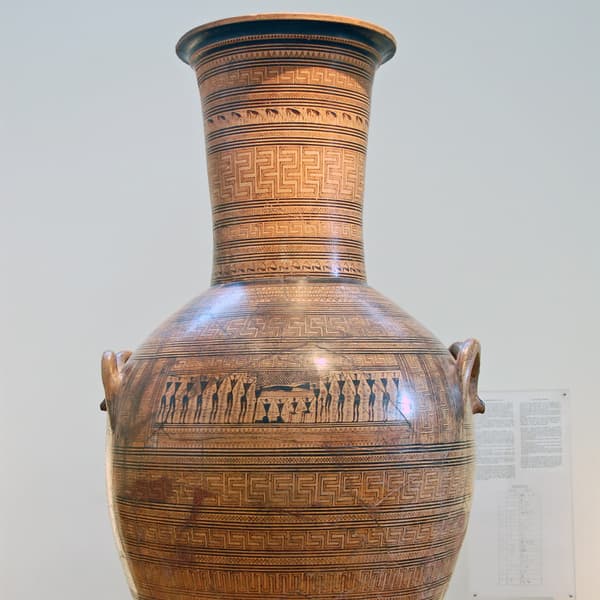
The Dipylon Vase, labeled Monumental Attic Grave Amphora. This ochre and black vase, nearly four feet tall, is painted with a funeral scene. In the center, a dead man lies on a funeral bier, flanked by a line of mourners who pull their hair in grief. It's far from realistic.
The people have triangular torsos, square arms and circular heads, all basic geometric shapes. Add to that the bands of geometric patterns, and the vase epitomizes the style of the Geometric Period, from around 750 B.C. The vase was discovered in Athens' Keramikos Cemetery. It gets its name from the nearby Dipylon Gate, the ancient city's main entrance.
Read more...Show less
This stunning object signals the beginning of Greece's emergence from its Dark Age. We can see the raw emotions of the grief-stricken mourners. Near the top of the vase, there are some rather lifelike antelope grazing. After four centuries of Dark Ages and war, the Greeks of the 8th century B.C.
were finally settling down. There's a map on the wall near the vase showing how the Greeks were establishing cities and expanding abroad. They'd founded colonies in Western Turkey that was Ionia, Southern Italy that was called Magna Graecia, and Sicily. They were developing a written language and achieving the social stability that could afford art.
The Dipylon vase is a baby step in that progression. Next came large-scale statues in stone. In rooms 7 through 14, we'll get a look at some of these giant statues called Cori and Kouros. Start here in room 7. Facing the vase in the middle of room 7 is a crude statue labeled Female Statue, Exhibit Number 1.
Early Greek Statues
Early Greek statues, Cori and Kouros. Rooms 7 to 14 feature life-size, and larger-than-life statues of clothed young women called Cori and naked young men called Kouros. They date from between the years 700 and 500 B.C. As we walk through these rooms, we'll see how, as Greek culture developed, the statues became increasingly natural and realistic.
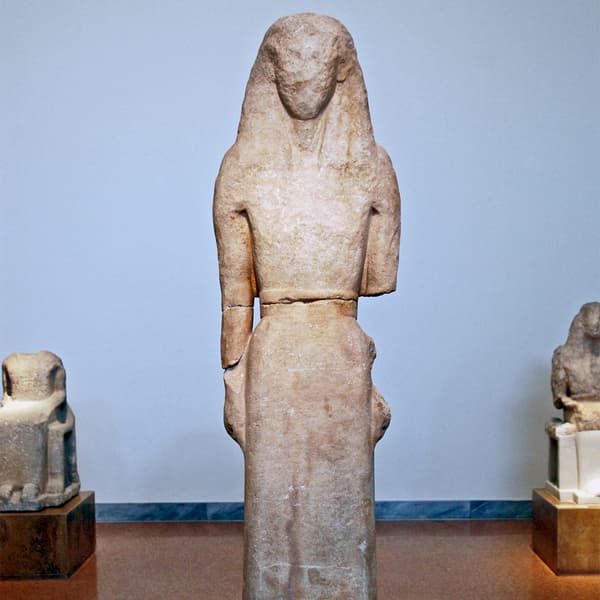
Here in room 7, the Female Statue Number 1 is one of the oldest examples, dating from around 650 B.C. This Cori looks as much like a pillar as a woman. She has a rectangular shape with a skinny figure. The hands are stiffly at her sides, and she's dressed in a full-length robe that conceals her natural curves.
Read more...Show less
Her lion mane hairstyle resembles an Egyptian headdress. The writing down her left leg says, This girl's dedicated to Apollo. Stroll around room 7 and check out the other statues. The Egyptian influence is clear.
Like statues of Egyptian pharaohs, the earliest Greek statues are big and stiff, with triangular faces and arms at their sides. Now head for the next room, room 8. We'll start to see how the statues become more realistic and natural in their movements, with more personality breaking out of their rigid shells. In room 8, your eyes go right to a very nice pair of knees that belong to a statue of a naked young man.
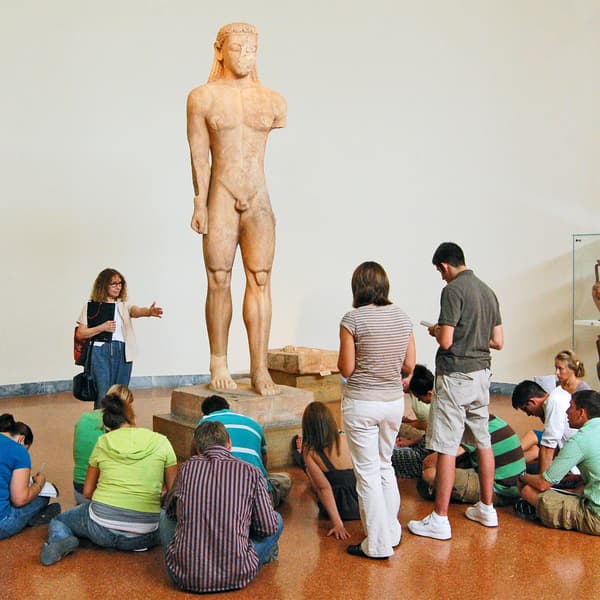
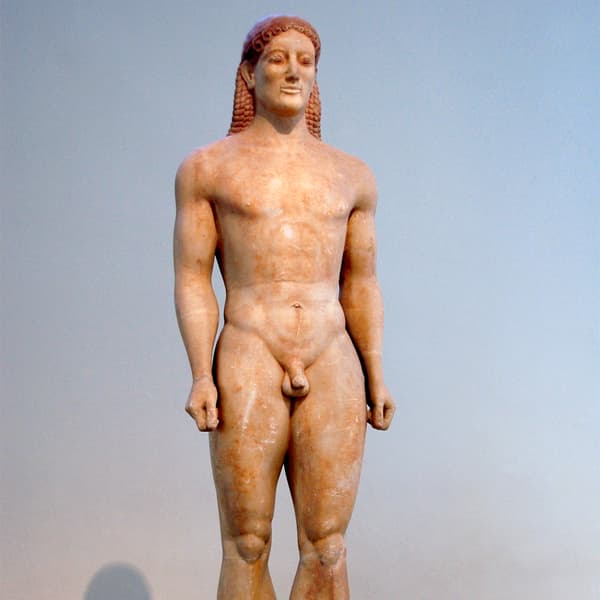
The Kouros from Sunion, Exhibit 2720, was sculpted around 600 B.C. It has many of the typical features from the Archaic period between 800 and 500 B.C. He has braided dreadlocks and a stable, forward-facing pose. He steps forward slightly with his left leg, and his fists are clenched at his sides.
His anatomy is strongly geometrical and stylized. Almond-shaped eyes, oval pecs, an arched rib cage, cylindrical thighs, and a too-perfect symmetry. The overdeveloped muscles, I mean, look at those quads, and the narrow waist resemble those of an athletic teenager. His scarred face obscures what's known as an archaic smile, a placid smile typical of this period.
It suggests the inner secret of happiness. Rather than strict realism, Kuro statues capture a geometric ideal. The proportions of the body parts follow strict rules. For example, most statues are precisely seven heads tall.
Although this Kuro steps forward slightly, his hips remain even. Think about it. The hips of a real person would shift forward on one side as he steps. The Greeks didn't quite have natural realism nailed.
But they were obsessed with the human body. And remember, these statues were of humans, not gods. Standing naked and alone, these statues represented a microcosm of the rational order of nature. While these statues are white today, they were originally painted in vivid, lifelike colors.
Notice that the rough surface of the marble lacks the translucent sheen of classical-age statues. That's because archaic period chisels weren't good enough to avoid shattering the crystalline marble. Kuro statues were everywhere. Presented as gifts to a god at a temple or to honor the dead in a cemetery.
This one was dedicated to Poseidon, and it stood at the entrance to the temple at Sunion, south of Athens. As a funeral figure, a Kuros represented the deceased in the prime of his youth and happiness, forever young. Continue into the next room, Room 11. On the left, holding a flower, is a female statue, or kori, number 4889.
More Kore and Kourous Statues
More kori and kuros statues. Where the male kuros was either life-size or larger-than-life and naked, emphasizing masculine power, a female kori was often slightly smaller-than-life and modestly clothed, capturing feminine grace. This petite kori, from around 550 B.C., stands with feet together, wearing a pleated robe belted at the waist. Her hair is braided and held in place with a wreath, and she wears a necklace.
Her right hand tugs at her dress, indicating motion. A nice trick if the artist lacked the skill to actually show motion. Her left hand holds a flower. Like most ancient statues, she was painted in lifelike colors, including her skin.
Read more...Show less
Her dress was red. You can still see traces of the paint, adorned with flower designs. You'll also see a band of swastikas down the front. In ancient times, the swastika was a harmless good luck symbol, representing the rays of the sun.
In the 19th century, the German archaeologist Schliemann rediscovered and popularized it, and later, Hitler and the Nazis appropriated it. Browse around Room 11. All the statues in this room have similar archaic features. That distinct archaic smile, the graceful avatar-like builds, and rigid, braided hairdos.
When you're ready to move on, continue into the next room. It's a long hall labeled Room 13. Directly ahead are more Kuro statues of naked young men. These once decorated the tombs of hero athletes, perhaps famous Olympians.
Notice that these young men are slightly more relaxed and realistic, with better-formed thighs and bent elbows. These statues date from the late archaic period, around 500 B.C. In this room, we see Greek artists are clearly beginning to master natural movement. For a glimpse at the artistic sophistication to come, head a little further down Room 13.
On the left side of the room, you'll find a display called Basis for Funerary Kuri. Exhibits 3476, and 3477. These two square marble pedestals once held Kuro statues adorning Greek tombs. The statue would have represented an idealized version of the dead man.
While the statues are gone, the carved reliefs on the bases are worth a close look. The first base shows wrestlers and other athletes. Perhaps this was an excuse for the artist to show off a new ability to depict the body in a twisting pose. Notice the cute dog and cat fight.
The second base features a game of field hockey. Each of these scenes reflected the vigor of the deceased man in his prime. Before moving on, check out the map of the Greek world. It's posted back near where you entered Room 13.
The map shows the continued progression of Greek civilization through the 6th century B.C. Greece was prospering, growing, trading, and colonizing the Mediterranean. And we've seen a similar progression of Greek art. The smiles on those archaic statues capture the bliss of a people settling down and living at peace.
But in 480 B.C., Persia invaded, and those smiles suddenly vanished. Exit Room 13 at the far end. You'll pass through Room 14 and into Room 15. As we enter Room 15, we're also entering a new era.
We're passing from archaic to what's called the Severe Style between 500 and 450 B.C. Those five decades were a bitter time. Greece had to knuckle down, man up, and fight off the Persians in two devastating wars. As you enter Room 15, the large room is dominated by one of the jewels of the collection, the perfectly posed bronze statue of a god at war.
Bronze Statue of Zeus or Poseidon
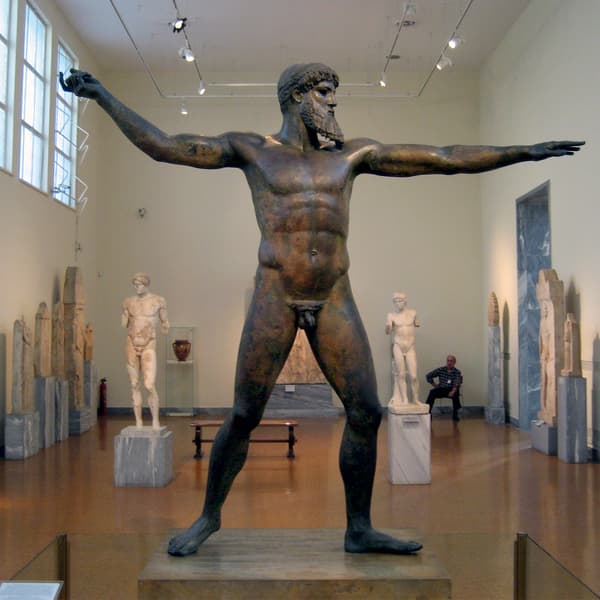
Bronze statue of Zeus, or Poseidon, called the Artemisian bronze. The god steps forward, raises his arm, sights along his other arm at a distant target, and prepares to hurl his weapon. If the statue was meant to be Zeus, he'd be throwing a thunderbolt. If Poseidon, a trident.
This statue was discovered in a shipwreck off Cape Artemisian in 1928. Since the weapon was never found, no one knows for sure who the statue represents. For simplicity, I'll just call him Poseidon and hope jealous Zeus doesn't strike me down with a thunderbolt. The god, Poseidon, stands 6 feet 10 inches tall and has a physique like, well, like mine.
Read more...Show less
In your dreams. Come on, he's trim, graceful, and muscular. Rick. Okay.
His hair is curly and tied at the back. His now hollow eyes were once white, made with inset bone. He plants his left foot and pushes off with the right. Even though every limb moves in a different direction, the whole effect is one of balance.
The statue's dimensions are a study in Greek geometry. His head is exactly one Greek foot in length. He stands 6 Greek feet tall, or exactly one Greek fathom. The entire figure has an X shape that would fit into a perfect circle, his navel at the center and his fingertips touching the rim.
The figure is fully three-dimensional, but it's most impressive from the front. Later Greek statues seem fully alive from every angle, including the three-quarter view. The statue of Poseidon, sculpted around 460 B.C., is an example of the so-called severe style, describing statues between 500 and 450 B.C. Historically, this is when Greece battled the Persians.
During this time of horrific war, the Greeks made art that was serious, no more archaic smirks. It was unadorned and expressed naked, muscular strength. Severe statues celebrate the nobility of the human form and the heroism of the individuals who carried them through these tough times. Eventually, the Greeks emerged victorious from their wars.
It was also the era when ordinary men shook off tyrants at home and controlled their own destiny through democracy. The statue shows Greece poised at the dawn of a new era of prosperity and enlightenment called the Golden Age. With the statue of Poseidon, the artist has frozen his movements in time, and we can examine the wonder of the physical body. He's natural yet ideal, twisting yet balanced, moving while at rest.
With his geometrical perfection and godlike air, this figure sums up all that's best about the art of the ancient world. Browse the rest of the art in Room 15 all from this generation. Just to the right of the Artemisian bronze, you might find a mini-Zeus with a thunderbolt and a sacred eagle. Elsewhere in the room are painted vases and funeral monuments.
By the way, you may notice museum guards scolding tourists with, no posing, no posing. They stop anyone trying to take pictures of themselves mimicking the pose of an ancient statue. The Greek museum board is very serious about this, considering it disrespectful of ancient culture. Hmm, that makes me think of something.
Hey, Lisa, doesn't Poseidon look like he's about to serve a tennis ball? Uh, no. How about pounding a nail? No.
I know, he's riding a surfboard. Rick, we're about to enter the era of the Golden Age, so try to show at least a little class. Let's go surfing now, everybody's learning how. Come to the Agora with me.
Ahem. Ahem. When you're ready to continue, exit Room 15 at the far end into Room 16. Our destination is Room 20, but we'll pass through several rooms to get there.
The next exhibits are from the Golden Age, the era of prosperity and enlightenment from about 450 to 400 B.C. In Room 16, you'll pass through big, tall vases made of marble labeled Attic Funerary Monuments. These gravestones are in the shape of actual ceramic urns used to bury people. Continue through Room 16 and into Room 17.
Notice that the WCs and café are out the door and downstairs in the courtyard. Now, from Room 17, turn right into Rooms 19 and 20. Once inside Room 19, turn right again, then turn left. Continue to the dead end, and you'll come face to face with a statuette. Exhibit number 129. This small-scale Athena recalls one of the supersized marvels of the Golden Age.
Statuette of Athena
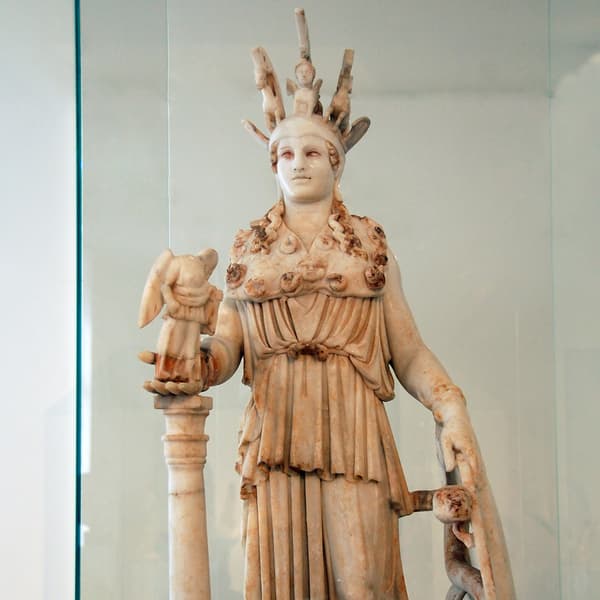
Statuette of Athena, called the Athena Varvakion. This is the most famous copy of the most famous statue of Golden Age Athens, the 40-foot statue of Athena that once stood in the Parthenon atop the Acropolis. That huge, golden-ivory statue was the focal point of ancient Athens. Athenians climbed the Acropolis to visit Greece's greatest temple and worship the goddess who'd founded the city and given it its name.
That mega-statue of Athena was created around 438 B.C. The sculptor was Phidias, the man who also helped design the Parthenon and the other great structures atop the Acropolis that sum up the Golden Age. Phidias' original statue was carried off in late antiquity and is now lost to history. But this miniature copy, about 1 12th the size, made of marble and sculpted around 250 A.D., is a faithful representation.
Read more...Show less
Look close. Athena is dressed as a warrior in flowing robes with a shield in her left hand and a helmet on her head. Athena's helmet sprouts plumes with winged horses and a sphinx. Athena loved snakes, which shed their skin representing renewal.
There's a big one next to her shield. Also, she wears a snake belt and bracelet, and coiled snakes decorate her breastplate. On the center of her body, on the center of her chest, is an image of a snake-headed medusa, a monster whom Athena helped Perseus slay. In Athena's upturned right hand, she holds a small figure of Nike, the goddess of victory.
As protector of Athens, Athena literally holds victory in the palm of her hand. To give a sense of scale, the tiny Nike that Athena held in her hand would have been six feet tall in the original. Imagine seeing the Athena statue 40 feet tall in its original setting. Ancient visitors would have stepped into the Parthenon's inner sanctum and gazed up at Athena towering up to the ceiling, nearly as high as the surrounding columns.
Her image was reflected in a pool on the temple's floor. Once every four years, in a grand procession and festival, Athenians draped the statue with a huge wool robe. The Parthenon Athena was sculpted at the height of the Golden Age. You'll hear various definitions of exactly when the Golden Age was, but its peak was probably from 450 to 400 B.C., when Athens dominated the Greek world.
It was a period of unprecedented prosperity and enlightenment. After defeating the Persians, Athens celebrated by building the Parthenon and other structures atop the Acropolis. This was the era of the philosophers Socrates and Plato, of the far-sighted leader Pericles, the playwrights Sophocles and Aristophanes, and sculptors such as Phidias. Their works inspired thinkers and artists for the next hundred generations.
Though many great works of art now lie in ruins, we're fortunate to have this statuette, a small-scale copy of Phidias's awe-inspiring original and a snapshot of Greece's Golden Age. Backtrack to Room 17. Once you reach Room 17, turn right. We're continuing our clockwise circuit around the museum. Enter Room 18, which is filled with tombstones from the Golden Age.
Funeral Steles
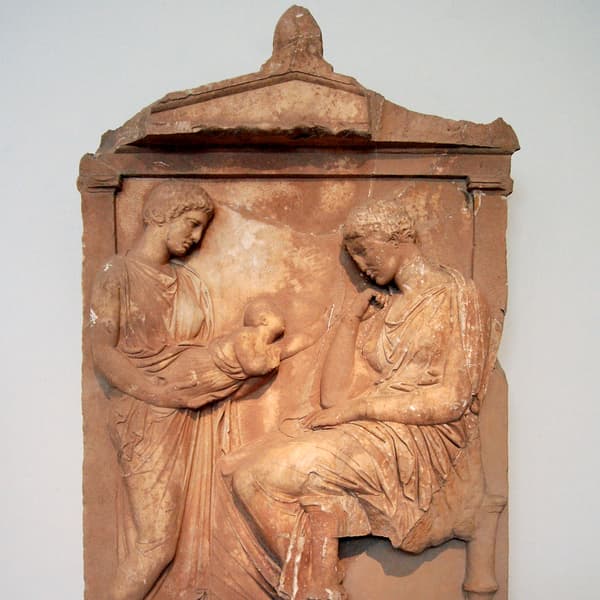
Funeral Steleys. The tombstones that fill this room remember the dead with carved reliefs. The dead are usually shown seated. They shake hands with loved ones who bid them a sad and poignant farewell.
Check out the tombstone opposite the window. It's one that rises above the generic and depicts a personal meaning. It shows a woman who died in childbirth. She looks at her baby held by a servant as it reaches for its dead mother.
Read more...Show less
Check out some others. This steley features a beautiful young woman who died in her prime, narcissistically gazing into her mirror. Servants are often shown taking part in the sad event, as part of the family. In the center of the room, a rich and powerful woman ponders her jewel box, as if trying to decide which of her treasures to take with her into eternity.
These steleys, all from the 5th century BC, are good examples of Golden Age Greek art. Though the reliefs are shallow, the artists are skilled enough to effectively depict realistic three-dimensional space. They show a mastery of the body, relaxed and naturally posed, with realistic movements. Finally, they have one more trait of the Golden Age.
They depict human emotion, but never too much. It's always understated. There's a timeless melancholy in this room. A sense that no matter who you are, or how powerful or rich your family is, when you go, you go alone.
And shrouds have no pockets. Pass into Room 21, a large central hall. The hall is dominated by a large bronze statue of a horse and rider. They're galloping like mad, about as unbalanced and overstated as a statue can be.
But what ever happened to Golden Age balance and restraint? Good call, Lisa. This statue's not from the Golden Age at all. We'll take a short break from our chronological walk and see this work from a later era. Okay. Turn your attention to the horse and jockey statue.
Bronze Statue of Horse and Jockey
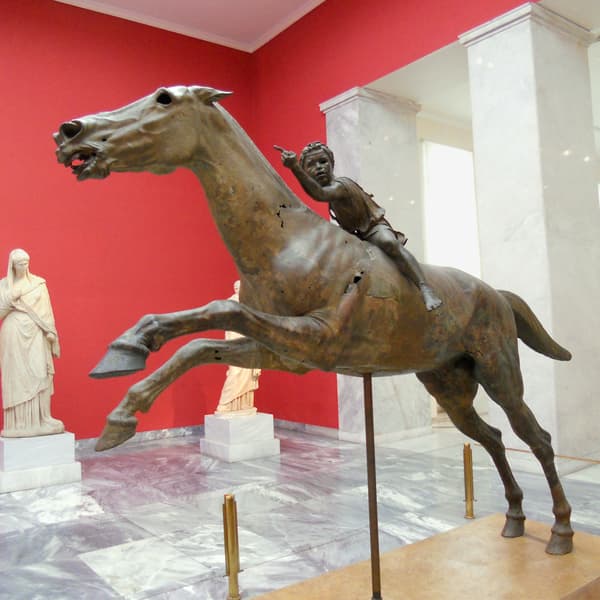
Bronze statue of a horse and jockey, Artemisian. Yee-haw! The race is on. The horse is in full stride, and the young jockey hangs on for dear life.
He looks over his shoulder to see if anyone's gaining on him. In his left hand, he holds the reins, now missing. With his right hand, he whips the horse to go even faster, maybe too fast, judging by the look on his face. Greeks loved their horse races.
Read more...Show less
This statue may have celebrated a victory at the Olympics or one of the other Pan-Hellenic Games. The jockey wears the traditional uniform, a short tunic. He once had eyes made of some inlaid material. He has the features of a non-Greek.
His skin was originally painted black. He was probably a mixed-race Ethiopian. The statue from around 140 B.C. is very high quality.
The Greeks were masters of making statues out of bronze. It wasn't made by hammering sheets of metal, but by using the classic process known as the lost-wax technique. Here's how it worked. The artist would make a full-size version of the statue out of clay.
Then you'd cover it with a layer of wax. Next, cover that with another layer of clay, which hardened to make an outer mold. Then they'd heat the whole thing in a furnace. The wax would melt or be lost.
This left a narrow space between the inner clay model and the outer mold. Then they'd fill this space by pouring in molten bronze. The metal cooled, and voila! You have a hollow bronze statue.
The horse and jockey statue was actually cast in pieces, which were then welded together and polished smooth. Then the artist could add a few last touches, like the delightful detail on the rider's spurs, which were lashed to his bare feet. Before we continue on, linger a while here in Room 21 and admire the other statues. These are excellent Roman copies of Greek originals.
In fact, throughout Europe today, when you see a Greek statue, it's likely a Roman copy. Thanks to the Romans, we know what many otherwise lost Greek masterpieces looked like. Hey, Lisa, you know how to tell a Roman copy? It says, Made in Italy on it?
Nope. When the Romans turned Greek bronzes into marble copies, they often needed extra support. So if you ever see a tree trunk buttressing a statue, it's a Roman copy. Really?
Very clever. But hold on. With all this talk of the Romans, we're getting way ahead of ourselves. Let's back up to where we left off, the Greek Golden Age.
It's the year 400 B.C., and Golden Age Athens is cranking out exquisite, balanced art in the realistic style. Now, let's go see some of the best. Lisa, get us back on track. Our next stop is several rooms away, in Room 28.
To get there, head into Room 22. Here, you'll pass by pediment reliefs that once decorated the Temple of Asklepios at Epidaurus. The relief on the right depicts the Greeks sacking the city of Troy. On the left, it's Greeks battling Amazons.
Continue on. Pass through a couple of rooms displaying funeral monuments. As you walk, notice how the monuments get progressively bigger and more monumental in scale. The stone is carved in deeper and higher relief.
This is Greek art in its prime. Continue on until you reach the long Room 28. Here, you'll come face to face with a large relief depicting a horse. It's exhibit number 4464.
Grave Relief of a Horse
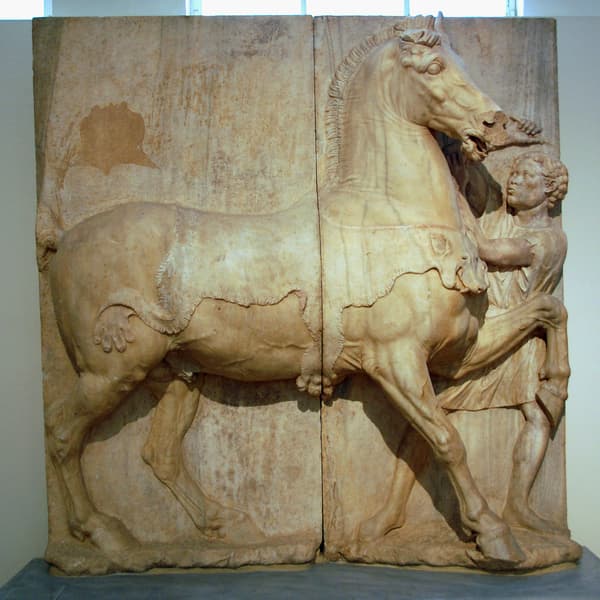
Grave relief of a horse. The scene shows a spirited horse and his keeper. The horse steps lively and lets out a whinny. Meanwhile, the Ethiopian boy struggles with the bridle and tries to calm him with a bite to eat.
Look at the detail. It's clear the Greeks were mastering reality. The horse's muscles and veins are astonishing, offset by the panther-skin blanket. The horse's head seems to pop right out of the relief like a 3-D movie.
Read more...Show less
The boy stands slightly off balance, an unposed snapshot. The artist even captures the inner emotions, a nervous horse and a boy who's a bit overmatched. The two opposites combine to create a harmonious, natural scene that freezes a moment in time. Farther down Room 28 is an impressive statue that's slightly larger than life size.
It's called the Bronze Statue of a Youth. He stands with his hand reaching out. The exhibit number is X-13396.
Bronze Statue of a Youth
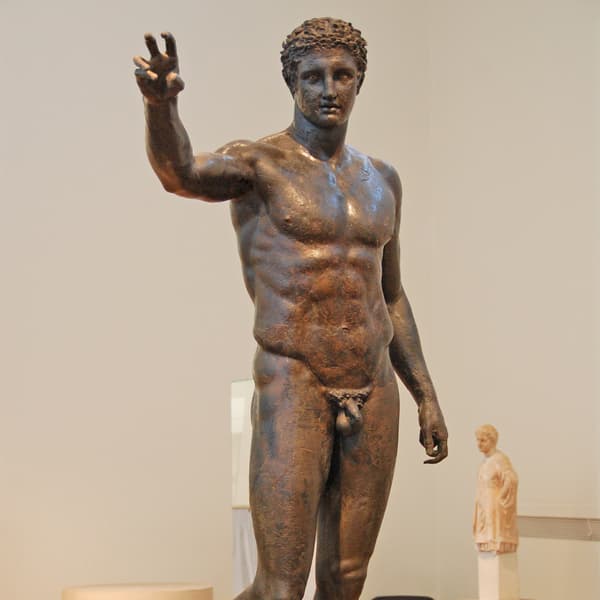
Bronze Statue of a Youth. Scholars can't decide if this statue is reaching out to give someone an apple or demonstrating a split-finger fastball. Oh, Rick, it's clearly a spitball. Most likely, it's meant to be Paris, the mythical Prince of Troy.
According to legend, Paris was chosen to judge a beauty contest between equally beautiful goddesses. Paris's agonizing decision eventually sparked the jealousies that started the Trojan War. The statue shows Paris right as he's finally made up his mind. He steps forward, reaches out, gazes intently at the winning goddess, and hands her the prize of a golden apple.
Read more...Show less
Paris's pose is classic. Split the body vertically down the middle. His left foot is stable while the right steps out. This is what's known as contrapposto.
It's the stance seen in so many classical statues. This slight movement sets his whole body in motion. His hips shift. His right arm tenses while the left hangs loose.
These subtle motions go in different directions, but are all in perfect balance around the statue's vertical axis. Stand and admire the beauty of the face, the perfection of the muscles, the balance of elegant grace and brute power. All these represent the full ripeness of the art of this age. Before moving on, enjoy the many beautiful statues in this room.
Think of what we've seen so far on our tour. We started with prehistoric Cycladic figurines in Mycenaean gold. We've walked through rooms of statues from stiff archaic to restrained severe. This room contains balanced art representing Greece in its prime.
Whether scholars call this era the Golden Age or the Classical Age isn't important. Greek culture of the 4th century B.C., epitomized in statues like these, astounded the known world. Then, around the year 330 B.C., Greek society and its art was about to take another dramatic turn. Continue into the small Room 29.
Once in Room 29, look across the room to the left of the door. Find the black bronze head in a glass case. Exhibit number X-13400. Gaze into the inlaid eyes of this unknown philosopher. We are entering the Hellenistic era, which followed the conquests of Alexander the Great.
Portrait Head of a Philosopher
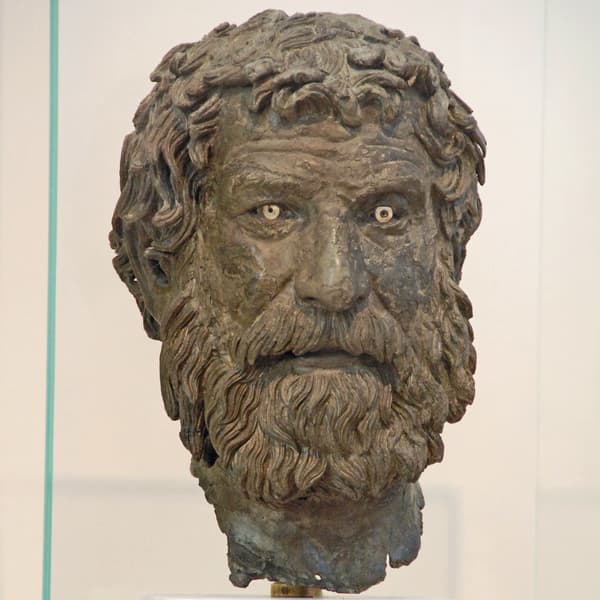
Portrait head from a statue of a philosopher. This philosopher's untamed hair and wild expression mark him as part of the Hellenistic era. Rather than the noble features of a Golden Age statue, we see the personality of a distinct individual, a wrinkled face, intense expression, bulbous nose, and tangled beard. The artist doesn't Photoshop out these eccentricities.
He celebrates them. For the first time in history, Hellenistic artists presented human beings in all their gritty human glory. With male pattern baldness, saggy boobs, and middle-aged spread, all captured in less than noble poses. They replaced Golden Age restraint with Hellenistic exuberance.
Read more...Show less
Hellenism is the name scholars give to the roughly two centuries from Alexander the Great's conquest of Greece around 323 B.C. to the Roman conquest of Greece in 146 B.C. Alexander the Great was a great admirer of Greek culture. So, after conquering Greece, and continuing his conquests, he established Greek values across much of the Mediterranean and far beyond.
Greece found itself at the center of a cosmopolitan empire showered with new influences. The Hellenistic society was characterized by a me-generation individualism and a questioning of Golden Age traditions. This particular portrait, from around 240 B.C., is of a philosopher known as a cynic. Cynics were the original hippies, non-materialist, non-conformists that rejected traditional values and social conventions.
They lived lives that were simple and carefree, thumbing their noses at wealth and status. This head was found by archaeologists amid an ancient shipwreck off the coast of the tiny island of Antikythera. It's near the southern tip of the Peloponnesian Peninsula. There, they also found the bronze statue of a youth, which we just saw.
Now, let's explore more statues from the Hellenistic era. Lisa? Continue into the long Room 30. Head to the far end of Room 30 and find the statue of a fallen warrior.
Statue of a Fighting Gaul
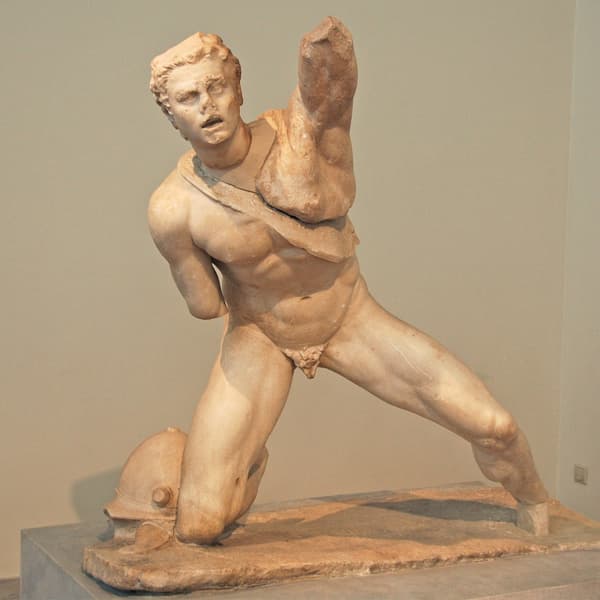
Statue of a Fighting Gaul. The soldier drops to one knee, having been wounded in the thigh. Notice his gash. But he's not defeated, yet.
He reaches up to fend off the next blow. This warrior is not a Greek. Because of the armaments, we know he's a Gaul from Galatia, in western Turkey. The artist catches the exact moment when the tide of battle is about to turn.
Read more...Show less
Look at his face. This Fighting Gaul is afraid he may become the Dying Gaul. This statue from around 100 B.C. captures the Hellenistic style.
Think of it. In the Classical Age, statues reached their peak of natural realism and balanced grace. During the following Hellenistic period, sculptors added to that realism, injecting motion and drama. Statues like the Fighting Gaul are fully three-dimensional, interesting from every angle.
Their poses are less rigid than those in the Archaic period, and less overtly heroic than those of the Severe. The statue sums up many of the features of Hellenistic art. He's frozen in motion, in a wild, unbalanced pose that dramatizes his inner thoughts. The pose is diagonal, running up his left leg and out his head and outstretched arm.
Rather than a noble, idealized god, this is an ordinary soldier, caught in an extreme moment. His arms flail. His muscles strain. His eyes bulge.
And he cries out in pain. This statue may have been paired with others, creating a theatrical mini-drama that heightens the emotion. Like emotional Baroque follows composed Renaissance 2,000 years later, exuberant Hellenism follows the more poised Golden Age. Hellenism, the Baroque of ancient Greek art, shows us the thrill of victory and, in this case, the agony of defeat.
Directly to the right, is a group of statues starring a nude Aphrodite with Pan and Eros. Exhibit number 3335.
Statue of Aphrodite, Pan, Eros
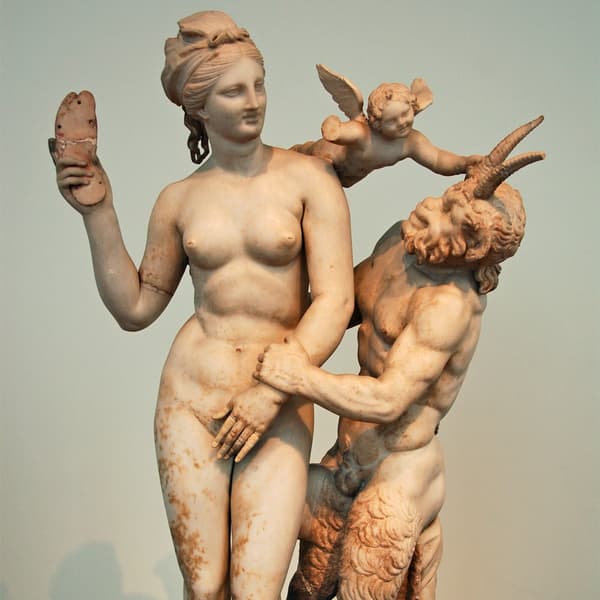
Statue of Aphrodite, Pan, and Eros. This playful ensemble, dated around 100 B.C., is from the sacred island of Delos. Aphrodite's being sexually harassed by Pan, a mythical creature who's literally horny. Aphrodite raises her sandal to give him a whack.
She's telling Pan, Don't! Stop! But from another perspective, she might actually be saying, Don't stop! Don't stop!
Read more...Show less
Pan can also be interpreted two ways. His left arm is forceful, but his right is gentle, holding her more like a dance partner. Hovering between them is baby Eros. Like an omnipresent Tinkerbell, he comes to Aphrodite's aid.
Or does he? Eros has the power to save her if she wants help. But with a hand on Pan's horn and a wink, Eros seems to say, Okay, Pan, this is your chance. Come on, man, go for it.
Pan can't believe his luck. Walk around this delightful statue and enjoy the detail, from the pudgy baby feet to the traces of red paint on the sandal. Aphrodite is seen here totally nude. That's rare among female statues.
She strikes a classic contrapposto pose with most of her weight on one foot. This makes her voluptuous body more revealing than modest. The marble is finer than that used in earlier statues, and it's been polished to a sheen with an emery stone. All these details, the high-quality marble, and the way the three figures work together to tell a story, help to create a cohesive vignette.
The other statues in this large room are also typical of the Hellenistic style. The Hellenistic Empire, first forged by Alexander the Great, created a string of thriving, Greek-speaking cities all around the Mediterranean. This Greek-friendly world was absorbed into the next great empire, the Romans. Continue into Room 31 with artifacts from the Roman era. Find the upper half of a statue, a portrait of a famous Roman in a toga. Exhibit number X-23-322.
Statue of Emperor Augustus
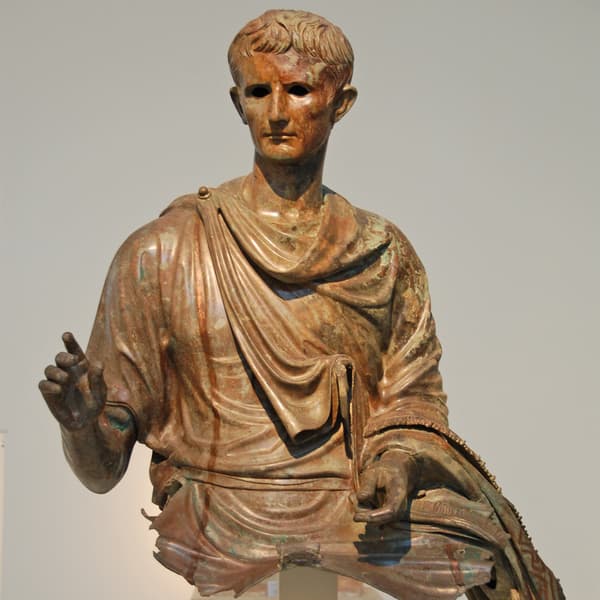
Statue of the Emperor Augustus. The Roman emperor rides commandingly atop his horse, now missing. In his left hand, he once held the reins, also missing. Although Greece was conquered by the Romans in 146 B.C., Greek culture ultimately conquered the Romans.
While the Romans were great warriors, engineers, and administrators, they had an inferiority complex when it came to art and high culture. Upper-class Romans made a point of learning the Greek language as a sign of sophistication. They imported Greek statues to Italy to beautify their villas. As demand exceeded supply, making copies of Greek originals became a huge industry, and the Romans excelled at it.
Read more...Show less
Romans, who loved the ultra-realism of Hellenistic statues, made portraits that were instantly recognizable. One look at the statue in this room, with his ears sticking out, high forehead, and combed-down bangs, and everyone knew that's Emperor Augustus. Augustus admired Greek culture. When he rebuilt the city of Rome around the time of Christ, he did it using Greek-style columns and crossbeams.
This gave a veneer of sophistication to the more no-nonsense Roman culture. Step into Room 32 for more Roman-era works. In the center of the room lies a beautiful woman asleep on a rock.
Coffin Lid with a Sleeping Maenad
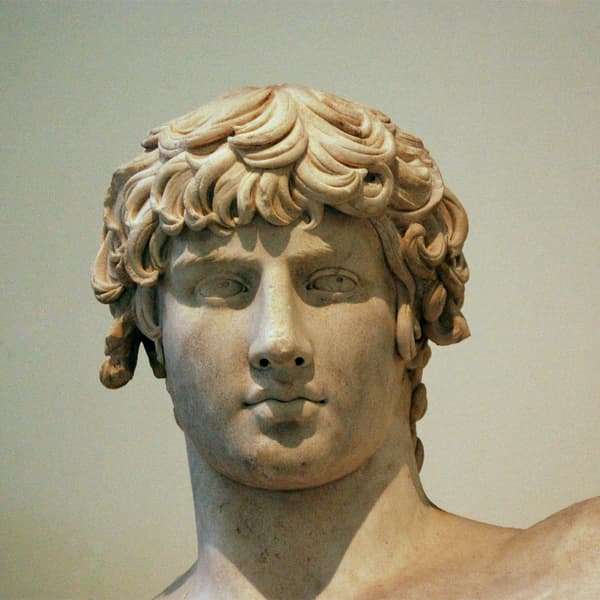
Coffin lid with a sleeping maenad, and other statues. Like a sleeping beauty, this maenad, a female follower of the god Dionysus, lies exposed atop a rock on the soft skin of a panther. She seems to be mooning a neighboring statue on the nearby wall, a bust of the Roman emperor Hadrian. The maenad statue is a Roman copy of a Greek original made during Hadrian's reign around 120 A.D.
Hadrian adored Greek culture. He even wore a Greek-style beard. He was a Greco-phile in two senses. He loved Greek culture, and he had a young Greek boyfriend.
Read more...Show less
Just to Hadrian's left is a fine portrait bust of Antinous. Look into his disarmingly beautiful eyes. After the young man drowned in the Nile in A.D. 130, the depressed Hadrian had him deified.
He commissioned statues of him throughout the empire. Find another statue standing at the foot of the maenad. This is the Greek god of medicine, Asklepios, from the famous sanctuary of Epidaurus. By his side is his staff with a snake winding around it.
Back then, a snake's venom was considered to have mysterious healing powers. The staff and snake later became the symbol of modern medicine. This statue is a Roman copy of a 4th-century Greek original. It dates from A.D.
160. Again, as we admire these high-quality copies of ancient Greek statues, we have to thank the Romans. It's largely due to the Romans and their respect for Greek culture that so much of this ancient art survives today. Continue into room 33 to see a row of heads.
Various Busts from the Late Empire
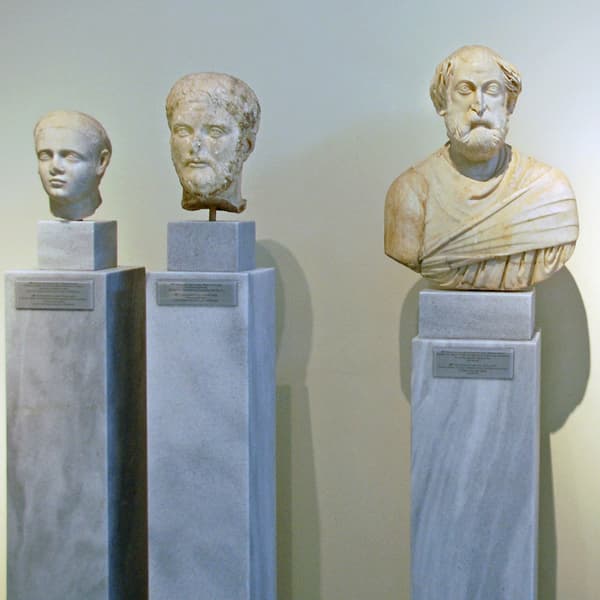
Various busts from the late empire. These portrait busts, ranging from 300 to 500 A.D., capture the generic features and somber expressions of the late Roman Empire. By 476 A.D., Rome had decayed and fallen to the barbarians. This plunged Western Europe into a thousand years of darkness, poverty, and ignorance.
But while the West fell, the eastern half carried on. This was the so-called Byzantine Empire. It was an empire which included Greece and had its capital at Constantinople, modern-day Istanbul. For the next thousand years, the Byzantine Empire thrived, enlightened, Christian, and Greek-speaking.
Read more...Show less
While Greek culture survived in the East, it was lost to the West. Then, around the year 1500, the wonders of classical Greece were rediscovered by Western Europe during the Renaissance. These wonders were cleaned up and repaired. Greek culture was revived in all its glory, inspiring us to this day.
I hope you've enjoyed our tour of the National Archaeological Museum. You've seen the core of this museum and its highlights. Exit into the entrance lobby and you're back where you started. If you have more time and energy, head upstairs, where there's much more.
Highlights include the sumptuous wall paintings and the world-class ceramics collection, starting in Room 49. And it's worth tracking down the amazing 2,000-year-old proto-computer. It's called the Antikythera Mechanism in Room 38. And if you're doing more sightseeing in Athens, we also have audio tours for the Acropolis, the Agora, and the Athens City Walk.
Remember, this tour was excerpted from the Rick Steves Greece Guidebook. For more details on eating, sleeping, and sightseeing, refer to the current edition of that guidebook. For more free audio tours and podcasts, and for information about our TV shows, bus tours, and travel gear, visit our website at ricksteves.com. Thanks to Jean Openshaw, the co-author of this tour.
This tour was produced by Cedar House Audio Productions. Thanks for joining me, and enjoy the rest of Athens. Transcription by CastingWords
Free
GPS-guided walking tour
No account needed. Walk at your own pace.
Free
20 stops ·