17 stops
GPS-guided
90 min
Duration
Free
No tickets
About this tour
A 17-stop walking tour through the heart of Ireland. Visit Dublin City Walk: Part One , Walking to Mansion House, Grafton Street, and More Grafton Street — with narrated stories at every stop.
17 stops on this tour
Dublin City Walk: Part One
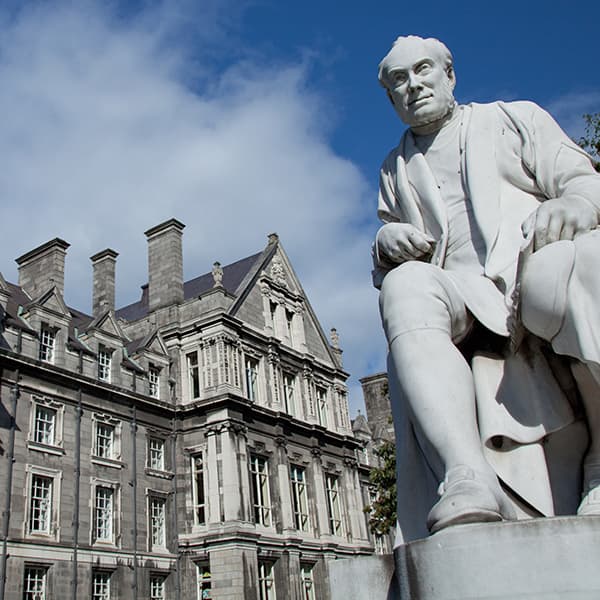
Dublin City Walk, Part 1. As Ireland's number-one city and the heart of the Emerald Isle, Dublin is the perfect introduction to Ireland and its charms. Hi, I'm Rick Steves. Thanks for joining me on a walk through the historic center of Dublin.
On this walk, we'll hit just one half of the city, the sites on the south bank of the River Liffey. When you're done, you can easily link up with my companion tour, Dublin City Walk, Part 2, to do the north part of town. These two walks are great to take at the beginning of your Dublin visit to get the lay of the land physically, culturally, and historically. On this first half, we'll stroll past stately old buildings, wander the campus of Trinity College, and explore the city's origins at Dublin Castle.
Read more...Show less
Along the way, we'll experience the vibrant city of today. We'll walk the popular, pedestrian-only Grafton Street with its trendy shops and cheery buskers. There are the atmospheric lanes of Temple Bar, home to traditional Irish music, high-spirited nightlife, and the photogenic Haypenny Bridge. And, of course, we'll pass plenty of characteristic old pubs, perfect for a pint, a bite, or a chat with the locals.
Allow about two hours to do Part 1 of this walk. It's a substantial walk, so pace yourself. It's not just an introduction to Dublin, but also to Ireland, and its rich history. The walk is best during normal business hours when everything's open, but it also has its charms after hours.
Now, let's get started as we explore the lively and historic city of Dublin. To help us along the way, I've invited a good friend and virtual travel buddy. Welcome, Lisa. Hi, Rick.
Lisa will give us helpful directions and sightseeing tips throughout the tour. And my first tip is to be sure you get our tour updates. Just press the icon at the lower right of your device. You'll find any updates and helpful instructions unique to this tour.
Things like closures, opening hours, and reservation requirements. There's also tips on how to use this audio tour and even the full printed script. Yes, so pause for just a moment right now to review our updates and special tips. It's okay, we'll wait. And then... Let the tour begin! The tour begins.
Tour Begins: St. Stephen's Green
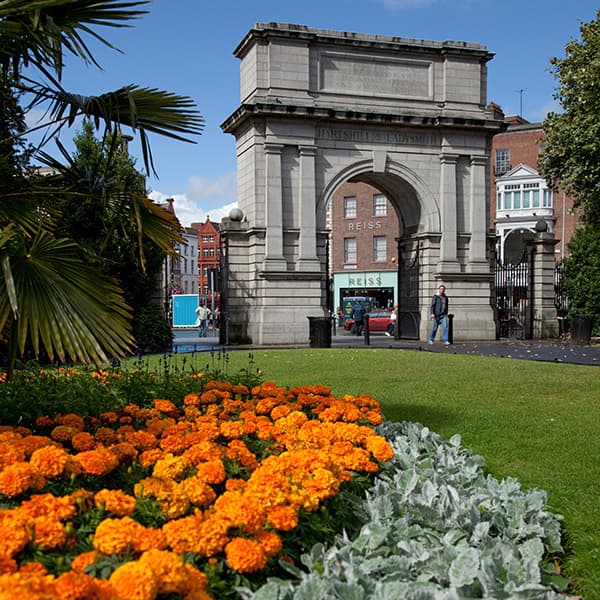
St. Stephen's Green. Start at St. Stephen's Green.
That's the large park at the southern edge of the city center. You can't miss it. It's the big green patch on your Dublin map. We'll begin at the park's...
Read more...Show less
northwest corner, where it meets Grafton Street. There you'll find a big arch at the entrance to the park. Stand at the arch and prepare to enter the park. Rick?
Thanks, Lisa. Let's start our Dublin walk by taking a short stroll through St. Stephen's Green. It's a true oasis in the busy city and is always populated with cheery locals out for a stroll.
As we go, we'll get a pleasant introduction to this big city. So, enter the park through the arch. Keep going straight ahead about 30 yards. You'll run straight into a small lake.
Let's circle that lake. So, facing the lake, go left. We'll walk clockwise around the lake. Take the path that keeps you closest to the lake.
If you get disoriented, don't worry. Just keep circling the lake, which will eventually return you to where you started by the arch. As we walk through all this greenery, it's hard to imagine we're in the middle of a city of half a million people. And Dublin is the capital and largest city of a nation of 5 million Irish.
With reminders of Ireland's heritage everywhere, Dublin is also the de facto capital of Irish culture. This park we're walking through, lush, flat, and watery, with 50 shades of green, looks much like the rest of the Emerald Isle with its green pastoral landscape. In fact, this park was once a marshy bog for grazing animals, just as so much of Ireland still is today. As you continue up the path along the lake, keep an eye out for a footbridge over the lake.
We'll be crossing that. Dublin has always been at the heart of Ireland's 5,000-year history. The island's first prehistoric inhabitants built their burial mounds at Newgrain's, just a couple dozen miles north of here. Also just north of Dublin, at the Hill of Terra, is where, in Dark Age times, the Celtic High Kings first introduced the idea of an Irish nation.
And when Ireland became a Christian land, monks of the 9th century settled at a monastery near Dublin with their famed Book of Kells. When you reach the footbridge, cross it. On the other side, you'll emerge into a vast, grassy space. On sunny days, this is a popular place for office workers enjoying their lunch break.
Turn right and keep hugging the lake as best you can as we continue circling it. Dublin was Ireland's very first city, namely the island's first permanent settlement. with a wall. It was founded as a Viking trading settlement in the 9th century.
When the English arrived in the 12th century, Dublin became their foothold on the isle. And later, it was just north of Dublin where English rule was solidified at the landmark Battle of the Boyne. Dublin grew to be Ireland's center of wealth and commerce. By the 1700s, it was second only to London in the British Empire.
It was dotted with grand, classical-style buildings, many of which we'll see on our walk. In fact, that golden age was when this park was laid out. It was founded as a private park, surrounded by mansions of Ireland's elites. Keep following whatever path keeps you closest to the lake.
Ahead on the left, you'll see a rocky knoll in the trees. Climb the steps and check it out. This terrace has become a popular place for outdoor plays and weddings. There's a modern-looking statue atop it.
The statue honors the great 20th century Irish poet, W.B. Yeats. And the statue was made by the great 20th century sculptor, Henry Moore. In the early 1900s, Yeats fought to keep Ireland's rich history alive in modern times.
He and his circle revived old poems, songs, and folktales and championed the Gaelic language. They helped to forge a distinct Irish national identity. They were part of a larger movement that was standing up boldly against the dominant English culture. Uh-oh.
I smell a bit of conflict brewing. Well, as we'll see on our walk, if there's anything that defines Irish history, it's exactly that. Conflict. We'll see reminders of that everywhere.
Let's leave the rocky knoll and keep walking clockwise around the lake, making your way back to where we started, the Big Arch. Just enjoy walking through this pleasant park. Remember, when the park got its start, it was a commons for a rich housing development. It was closed to working-class riffraff.
Well, they let us in. It was surrounded with fine, classical-looking buildings. Each of the tenants was obligated to plant six trees, and voila, a park was soon created. As Dublin grew into the number-two city in Britain, this was one of its most pleasant escapes.
In 1880, the private park was opened to the public, and today it provides a wonderful refuge from the city. With its romantic gazebos and carousels, duck-filled ponds and relaxed people, the park seems to celebrate Irish freedom. Keep going as you make your way back to our starting point at the Arch. Dublin has always been right in the thick of the nation's many conflicts.
Conflicts between Celtic culture and English influence, between Protestant and Catholic, between traditional and modern, between the Irish government and their colonial masters in London. And it was in Dublin, on Easter of 1916, that those divisions came to a violent head, changing Ireland forever. Or, as the poet Yates put it, everything was changed, changed utterly. A terrible beauty is born.
One battle of that so-called Easter Rising actually happened right here in St. Stephen's Green. And there's a vivid reminder of that battle just ahead. By now, you should be reaching the corner of the park where we started, the corner of the park and the big arch.
Exit the park through the arch. But don't go far. No. Turn around and face the arch.
Now, step around to the left of the arch and look up. Do you see that? Bullet holes. Yes.
There's bullet marks scarring the left side of this arch. This happened during that Easter 1916 uprising. A group of passionate Irish rebels had taken up arms against the British right here in the park. They were a romantic mishmash of poets, teachers, aristocratic ladies, and slum dwellers.
They dug trenches in the park, thinking they were creating fortified positions. What they hadn't figured on was that veteran British snipers had taken the high ground just up the street in the Shelbourne Hotel. The bullets rained down and the rebels were quickly overwhelmed. Within a week, the quixotic Easter Rising was brutally crushed.
But, as you'll learn as you explore more of Dublin, that moment was the first time that the final turning point in Ireland's long march to freedom. Let's go see the rest of Dublin. With the arch at your back, cross the street. This puts you at the top of the pedestrianized Grafton Street.
Almost any time of day, Grafton Street is busy with strolling locals and tourists. We'll be going down Grafton Street later, but for now... For now, turn right. Start walking east on the busy, traffic-filled street that's called, appropriately enough, St. Stephen's Green. Keep walking to the next corner. Walking to Mansion House.
Walking to Mansion House
Keep walking down the busy street that borders St. Stephen's Green. We're going about 100 yards to the first corner. Notice that the street has a tram line.
That's proved to be a very popular way to get around in this increasingly urban environment. Dublin is far and away Ireland's biggest city. As I mentioned, there are 550,000 people in the core and nearly 2 million in the greater metropolitan area. Among Ireland's cities, Cork on the south coast is a distant second, with a mere 125,000.
Read more...Show less
Dublin really took off back in 1973. That's when Ireland joined the European community, the precursor to the EU. Dublin became the engine driving the so-called Celtic Tiger boomers around the turn of the millennium. That's when many American corporations located here for tax purposes.
Today, Dublin is Ireland's Silicon Valley. Or Silicon Bog, as they call it. It's the European base for big tech companies like Apple, Facebook, Microsoft, and Google. When you reach the first intersection, turn left on Dawson Street.
On Dawson Street, you get a sense of how nicely modern Dublin dovetails with traditional Irish ways. For instance, look on the left at number 25. It's a pub. A very skinny pub, sometimes called the tiniest pub in Dublin.
As we'll see on this walk, this is just one of many pubs in Dublin offering a slice of traditional intimacy in an increasingly urban landscape. And just a few steps further up, at number 27, is the Celtic Whiskey Shop. Yes. In recent years, Ireland has become a huge provider of whiskey to the world, exporting even more than Scotland.
To find out why, and maybe score a free sample, drop in. Or, a better plan is let's keep going. Ahead on your right is a big old white building. Let's stop and check it out from this side of the street.
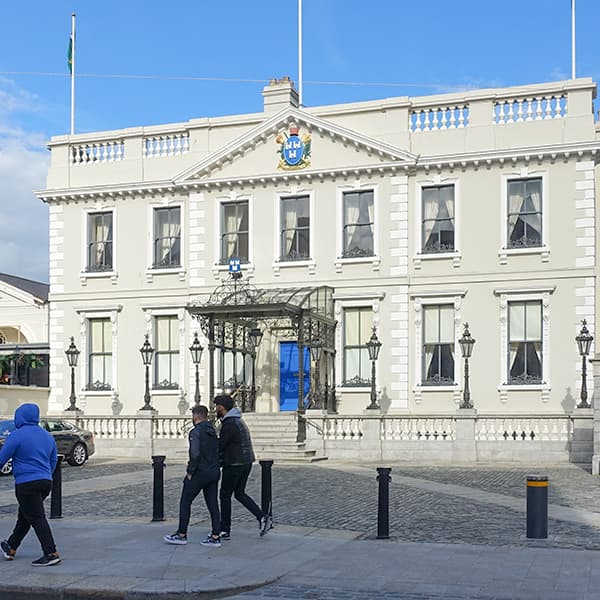
This is the Manchin House. It was built in 1710, and even today, two centuries later, it's still the official residence of Dublin's mayor. These days, the position of Lord Mayor is mostly ceremonial. It's another reminder of how gracefully older traditions continue in this modern city.
Manchin House is a classic example of what's called the Georgian style. It has a triangular pediment over the entrance giving it a classic Greek temple look. There's a balustrade across the roof and another at the base. The windows and doors give the façade a perfectly symmetrical look.
This is just the first of many Georgian-style buildings we'll see on our walk. Georgian was the prevailing style during Dublin's Golden Age in the 1700s. Manchin House also played a key role in Ireland's modern struggle for independence. After that 1916 Easter Rising, this was where a rogue Irish parliament met in defiance.
of British rule. Kind of like when America's Continental Congress signed the Declaration of Independence at Independence Hall in Philadelphia? Yes. That act of defiance was what kicked off the Irish War of Independence in 1919 that eventually made Ireland free of British rule.
Let's move on. Keep walking up Dawson Street, another half block, to the big grey church of St. Anne's on the right. Dublin has always been a breeding ground for new ideas.
It's produced some of the greatest writers and thinkers in the English language. There's Oscar Wilde, the great playwright, and Bram Stoker, who wrote Dracula. That's an oddly specific pair of names to single out. That's because of the Church of St.
Anne's. Oscar Wilde was baptized here, and it's where Bram Stoker got married. Huh. And one more random fact.
Bram and Oscar were good friends, and Bram married the same woman that Oscar had once dated. Small world in Dublin. At the church, turn left onto Anne Street South. Keep walking straight for two blocks.
Anne Street has a pleasant row of small shops, boutiques, and restaurants. This kind of small-scale, energetic commerce is typical of Ireland. Shop owners are helpful, and service comes wrapped in a small-town smile. Ireland's workforce is young and well-educated.
In fact, about 35% of the Irish population is under 25 years old. They fill jobs in high-tech, pharmaceuticals, and many opt for small enterprises like these. And after work is done, where does everyone go? The pub.
Ahead on the right, you're approaching the neighborhood's watering hole, John Kehoe's. Let's pause here for a second. There's nothing particularly special about this pub, but like so many other pubs in Dublin, it's much older and more atmospheric than almost anything you'd find in the States. This place has been serving the neighborhood at this location for more than a century.
Pubs are a basic part of the Irish social scene. And whether you're a teetotaler or a beer guzzler, they should be part of your travel here. The word pub is short for public house. It's like an extended living room.
Smart travelers use pubs to eat, drink, watch the latest sporting events, and make new friends. And as a wise Irishman once said, it never rains in a pub. And as another wise Irishman said, in a pub, you're a visitor on the first night and a regular on the next. Since 2004, all pubs in Ireland are non-smoking.
Here at Kehoe's, you may see customers spilling into the street with their cigarettes and beloved pints in hand. Technically, it's illegal to drink on the street, but because it's so common, it's rarely enforced. Let's keep going down Anne Street past the pub. The Irish take great pride in their beer.
The average Irishman spends about $5 a day on alcohol. If you ask for a pint in Dublin, you'll get a Guinness. That's the dark brown stout-style beer that was born right here in Dublin. It's still brewed here, about a mile to the west.
While loyal Dubliners like their Guinness, Ireland's other stout, Murphy's, is the local favorite in the south. You'll have to try them both to pick your favorite. Twist my arm. Neighborhood pubs are like landmarks in the Dublin landscape.
Instead of telling someone, hey, meet me on Anne Street, you're more likely to hear, meet me at Kehoe's. By now, you should be reaching the intersection with Grafton Street, where we'll be turning right. But first, stop when you reach the intersection and enjoy the scene. Rick and I will take you from there on the next track. Grafton Street.
Grafton Street
Thin Liz, busy, Beaulieu's Café, and St. Teresa's Church. Just stand here in this pleasant, pedestrianized street and appreciate where you are. Grafton Street is a constant parade of shoppers, tourists, businessmen, moms with strollers, all enjoying a walk down this row of shops.
Grafton Street is Dublin's most desirable retail address. It's home to both glitzy international stores and trendy, one-of-a-kind Irish boutiques. The bustling atmosphere here is a place here is a testament to how once quaint Dublin has now gone global. We'll stroll the boulevard in a moment.
Read more...Show less
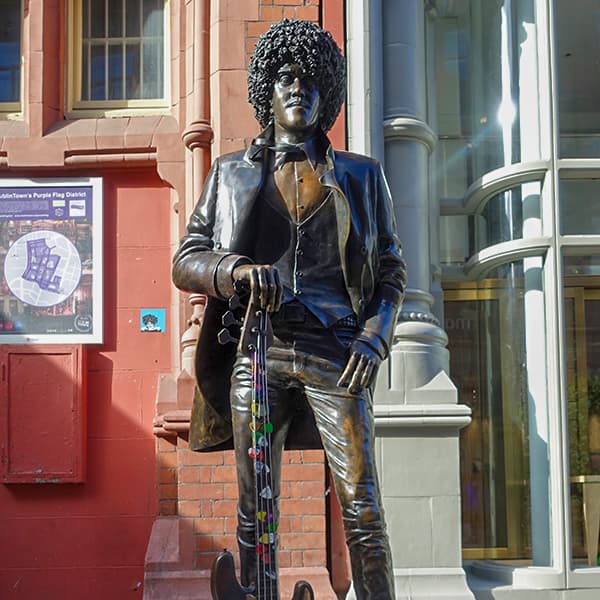
But first, let's check out a few sights nearby. Start with the bronze statue. It's not on Grafton itself, but about 20 yards off it, further along St. Anne Street.
The statue is of a hairy guy with a bass guitar. This is Phil Linnett, Ireland's first hard rock star. Just one of many Ireland has produced. Phil Linnett was raised in Dublin.
He went on to fame with the band Thin Lizzy. Oh, yeah. They had one big hit in the 1970s. The boys are back in town.
The boys are back in town. The boys are back. The boys are back. Easy there, Elvis.
Even though that was their only hit abroad, Thin Lizzy was big in Europe. Linnett became the classic rock idol, living hard and fast and dying young. He inspired countless other aspiring musicians from little old times. From old Ireland to dream of hitting the big time.
Phil Linnett's legacy clearly lives on. Fans still come to the statue and they leave guitar picks wedged in the strings as a tribute. Let's move on. Return to Grafton Street.
Take a left and join the River of Pedestrians. Our next stop is about 50 yards down Grafton Street. You know, Lisa, you could build an entire Dublin walk around the many Irish musicians who got their start here. From U2 to Sinead O'Connor.
To Enya and the Coors. To Hosier and Imelda May. Our next stop is a venerable café on the left called Bewley's. Bewley's Oriental Café is a Dublin tradition.
Grandmas and grandpas know it for its long tradition of well-priced comfort food. Check out the façade. It's the ornate art deco style with an Egyptian flair. A look popular in the 1920s after the recent discovery of King Tut's tomb.
Let's go inside. Yes, let's. Visitors are welcome to wander around for a look. Approach the café as if visiting an art gallery.
But with people eating. Head to the very back. The back wall was decorated by the famed Dublin artist Harry Clark. Wow!
Look at the stained glass windows. Kind of like the Church of the Holy Cappuccino. Harry Clark was most famous for decorating churches, this was a rare secular commission. Each of the windows depicts a different classical column.
It celebrates the four classical orders. Doric, Ionic, Corinthian, and Tuscan. Like so many Irish artists, Clark first learned his trade from his father, a maker of stained glass. There's more of Clark's art upstairs.
But we're moving on. Start making your way back outside to Grafton Street. But just a reminder that you're always free to pause the audio tour to see more. Back outside, turn left and keep walking up Grafton Street.
We're not going far to our next stop. No, just a dozen steps past Bewley's, turn left on the narrow lane called Johnson's Court. Go about 50 feet down the lane. On the right is an ornate archway.
Step through the archway and suddenly, bam! There's a church. It's the Church of St. Teresa's.
Hey, let's step inside. Yes, let's. Ah, very peaceful. Because of its location next to Grafton Street, St.
Teresa's has become a convenient place to pray for busy shoppers. It's been called the most visited church in Dublin. And no wonder St. Teresa's is a kind of oasis amid the commercial hubbub of Grafton Street.
It sure is tucked away out of sight, like it was hiding. That's because it's a Catholic church. Uh, what's so strange about that? Ireland is 80% Catholic.
Yes, but the city of Dublin has a long Protestant tradition. As you recall, Dublin was for centuries an outpost of English culture in Gaelic Ireland. And when England became Protestant in the 1500s, so did Dublin's ruling elite. That's why this Catholic church is so significant.
Tell us more. But while you do, I'm going to explore the church. Good idea. In the 1600s, the Protestant-dominated Parliament passed restrictive laws on Ireland's Catholics.
They were called the Penal Laws. For a century, Catholics were not allowed to worship openly. They couldn't vote, buy land, join the army, or even own a horse worth more than five pounds. Damn those English.
There's more. Catholic education was banned, and priests were outlawed. Catholics were forced to practice their religion secretly. Some resorted to celebrating Mass way out in the countryside at hidden altars called Mass Rocks.
Finally, in the 1770s, the Penal Laws were relaxed. St. Teresa's was built in 1792. It was one of the first new Catholic churches allowed in Ireland.
It meant that Catholics were allowed to worship in actual churches, but only if they kept a low profile. This church is delightful, but we should be moving on. Return to Grafton Street. ¶¶ More Grafton Street.
More Grafton Street
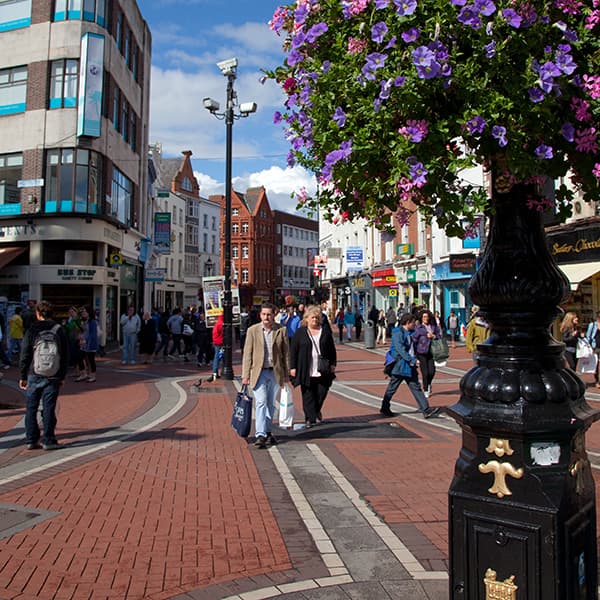
Keep going down Grafton Street. We'll be going another hundred yards or so to where the pedestrian portion of the street ends. As you make your way, enjoy this people-friendly zone. Think of how revolutionary this was when Grafton Street was first pedestrianized back in 1983.
At first, local retailers grumbled. They were sure banning cars would keep shoppers away. Instead, business boomed. The downside was that as business shot up, so did the rents, driving many small local shops away.
Read more...Show less
The result is that Grafton Street today is mostly dominated by big international chain stores and ever bigger crowds. Just keep going to the end of the street. Remember, you can always pause the audio tour to enjoy the scene. You can listen to a local busker, a street musician.
With the global popularity of Irish music, both rock and traditional, many an aspiring artist gets his or her start right here on Grafton Street. Or you could step out of the flow of humanity to explore side streets. Or stop at one of the few surviving local businesses, a street stall. Have a chat with a salt-of-the-earth woman selling flowers.
Small businesses like these are generally handed down from mother to daughter. Is that a McDonald's burger place on the right? Yep. But as commercial as this street is, it does have its standards.
You'll notice there are no huge golden arches here, just a simple facade. McDonald's is allowed, but must stay low profile. Kind of like the hidden churches, I guess. Keep going.
As you near the end of the pedestrianized section of Grafton Street, keep a sharp eye out for our next stop. It's next to the last building on the right. You're looking for a bronze plaque on the ground inset into the pavement. A few feet from the street corner.
This brass plaque honors one of Dublin's greatest writers, James Joyce. It's just one of many points of interest in the writer's life marked with plaques and signs. This particular plaque, rubbed shiny by foot traffic, remembers a scene from James Joyce's groundbreaking novel, Ulysses. The plaque depicts a man walking, which is appropriate because the novel is mainly about a man just walking around Dublin from pubs to bars.
to shops to homes of friends. The stream of consciousness tale unfolds over a single day in the life of Leopold Bloom, June 16, 1904. That date is still celebrated every year in Dublin as Bloom's Day. Passionate Joyce enthusiasts dress up in period garb, quote passages from the book, and follow Bloom's route from place to place, generally with lots of drinking involved.
Let's continue our own ramble through Dublin. Our next stop is Trinity College. The main entrance to the campus is straight ahead, about 100 yards further down Grafton Street. So keep walking down Grafton Street.
From here, Grafton Street is no longer pedestrianized. That's for sure. It's busy with trams and traffic. As you walk, enjoy a bit of music.
We'll see you when you reach the big three-way intersection with Trinity College on the right. See you there. music plays music plays gray building on the right, located at one of the most chaotic intersections in Dublin. Trinity College.
Trinity College
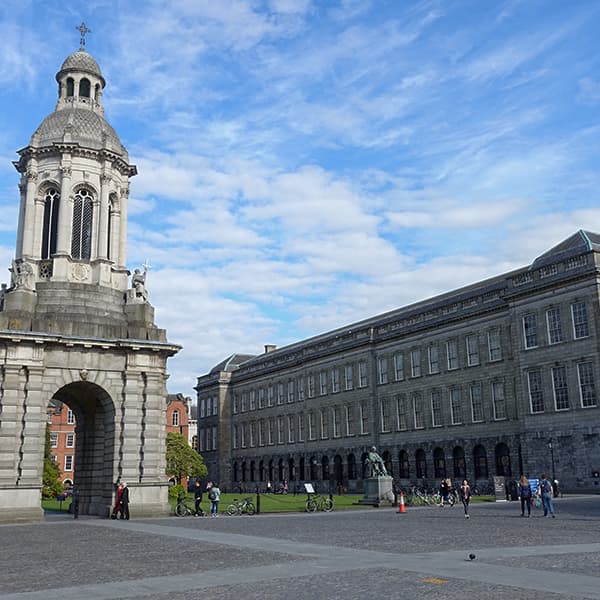
Here at this busy intersection, step through the iron picket fence to view the main entrance to the campus. Trinity College is Ireland's elite school, the equivalent of England's Oxford and Cambridge. Trinity was founded in 1592 by Queen Elizabeth. Her purpose?
To set the uncivilized Irish on the straight and righteous path to Protestant learning. By the 1700s, the college had expanded greatly. Remember, that was Dublin's golden age, while the rest of Ireland was poor, Catholic, and Gaelic. Dublin was rich, Protestant, and English.
Read more...Show less
And this college, with its grand buildings, celebrated just that. Let's go in. Enter through the door of the imposing, Greek-temple-like entrance. Once inside the gatehouse, just keep going.
You'll walk across a floor paved with hexagonal pieces of wood. This was to dampen the sound of horse hooves. As you go, check out whatever's posted on the bulletin boards. This is how students catch up on school news, sports, rooms for rent, and plays and concerts.
You emerge into a large, long, grand square flanked by impressive buildings. Stop here and survey the scene. You're in Parliament Square, the heart of Trinity College's vast 50-acre campus. The buildings from the 1700s are classic Georgian style.
They sport Greek-style columns and triangular pediments. Windows have grid-shaped panes and an occasional balustrade for decoration. This was the style of Dublin when it was Britain's second-largest city. A rich, sophisticated, English-centric and mostly Protestant city.
Georgian is the British name for what others call neoclassical. It revived the classical columns and pediments of ancient buildings. The name comes from the English kings of the time, George I, II, III, and IV. They ruled for more than a century, from 1714 to 1830.
Start with a look at the buildings. Start walking up to the center of the square. Think of it. These cobblestones have been walked on by such esteemed Trinity graduates as Oscar Wilde and Bram Stoker, Jonathan Swift, who wrote Gulliver's Travels, and the modern playwright Samuel Beckett, who wrote Waiting for Godot.
When you reach the center of the square, stop. The graceful tower straight ahead is the Campanile, or bell tower. It's probably the most recognizable building on campus. To your immediate left and right stand two identically majestic buildings.
Each has four tall Corinthian columns. The building to your left is the college chapel, and on the right, the examination hall. They're nicknamed Heaven... The Chapel.
...and Hell. The Examination Hall. Now look behind the Campanile. Those red brick buildings are called the rubrics.
Built around 1712, these are the oldest remaining buildings on campus. They almost look Dutch. Yes. They were done in the style popularized by the Dutch-born King of England, William of Orange.
Now turn your attention to the right of the Campanile. There's a long, gray, three-story building. This is the college's old library. Though we won't go inside on our tour, you definitely should at some point during your Dublin visit.
The entrance is around the right side, generally marked by a long line of tourists. Inside the library, you'll find a venerable world of some 200, 300,000 books, plus a precious collection of artifacts dear to the Irish soul. There's a 600-year-old Irish harp. This harp's likeness has become the national symbol, appearing on euro coins, on government documents...
And on every pint of Guinness. You've clearly done your studying. The library also has an original copy of the proclamation from that 1916 Easter Rising which announced Ireland's dramatic split with Britain. But the highlight of the collection, by far, is what all the tourists line up for: the Book of Kells.
This is a 1,200-year-old manuscript of the four Gospels from the Bible. It was meticulously handwritten and gloriously illustrated by faithful monks. With its intricate patterns, artistic pictures, and fantastic beasts tucked into the margins, the Book of Kells has been called the finest piece of art from Europe's Dark Ages. Now, from here in the center of the room, just take in your surroundings once again.
Trinity College is still Ireland's most prestigious university and one of the best in the world. It's home to some 12,000 students. The buildings around you hold administration offices and student dorms. Like so many universities, Trinity faces financial challenges in attracting top professors.
They raise money through ticket sales for the Book of Kells, and they attract wealthy students from China who pay full tuition which subsidizes less wealthy Irish students. Nowadays, Trinity accepts students from across the globe. But there was a time when the student body was limited to only rich Protestant men. After the penal laws were relaxed, Catholics were allowed entrance, but the Catholic Church considered it a mortal sin to get a Protestant education.
It wasn't until the 1970s that Catholics were allowed in guilt-free. Today, 70% of the student body is Catholic. Though in practice, only about 20% of Irish youth of any denomination ever actually go to church. The college tries hard to be inclusive.
Notice that the official blue and white signs are bilingual, both Irish and English. And the Irish always comes first. Before we go, check out the statue just to the left of the Campanile. This white marble statue depicts one of Trinity's provosts in the late 1890s.
He famously said, that women would only be allowed to enter Trinity over his dead body. Coincidentally, just days after he died in 1904, the first women were admitted. Today, half the students are female. Let's head back out to the street and continue our walk.
So, start backtracking the same way you came in. If you're interested in seeing the Book of Kells, you should probably get a reservation. Or, to see more of Trinity College, there are half-hour tours of the campus, led by students. You may see their ticket seller at the front gate.
Keep backtracking and exit the college the same way you came in. You emerge back out on the street at that chaotic intersection. Keep going straight ahead. Cross the street to the traffic island directly ahead, the one with the statue on it.
Yes, but cross carefully. You may need to wait for a light to turn. Don't worry, we're not going far. Make your way to that traffic island directly ahead.
The statue is of Henry Groton. Mr. Groton became famous to history as the man who... Who first cooked potatoes, Groton?
Uh, no. Groton was a legendary politician of the 1700s. Groton championed the cause of Irish self-rule with their own Irish Parliament. And that's a perfect segue to our next site, Ireland's Parliament House.
Parliament House is to the right of the statue. It's the big, classical-looking building with a rounded colonnade. These days, it functions as a bank. The Bank of Ireland,
Bank of Ireland
the former Parliament House. Though today it's a bank, this building stands as a symbol of the long fight for Irish self-rule. It was here in the 1700s that Irish politicians, men like Henry Groton, bravely spoke out against their British, Irish overlords. Appropriately, at the top of the building sits a statue of Lady Ireland extending the olive branch of peace.
Let's go inside the bank to see a remnant of its days as Parliament House. It's free and open during banking hours. So start making your way there across the street. Once on the other side, follow signs to the tourist entrance.
Read more...Show less
It's slightly to the right of Lady Ireland. As you go, let Rick set the scene. The fight for Irish independence took many, many generations. As far back as the 12th century, Ireland was dominated by the English.
English nobles ruled vast plantations with the poor Irish farmers as their virtual serfs. Ireland was split between the natives, mostly Catholic and Gaelic-speaking, and their Protestant, English-speaking landowners. Occasionally, the feisty Irish would rise up in rebellion, but time and time again, the revolts were brutally crushed. You reached the Parliament House entrance.
Go inside. Make your way into the main site inside, the Irish House of Lords Chamber. Dublin was always right in the thick of Ireland's fight for independence. On the one hand, Dublin was the center of the English Protestant presence.
On the other, as Ireland's biggest and most educated city, this is where a common Irish identity was born. And it was here, at Parliament House, that the struggle for independence switched from the battlefield to the political struggle. By now, you should be inside Parliament House, in the big House of Lords Chamber. Browse around the displays while Rick tells us more.
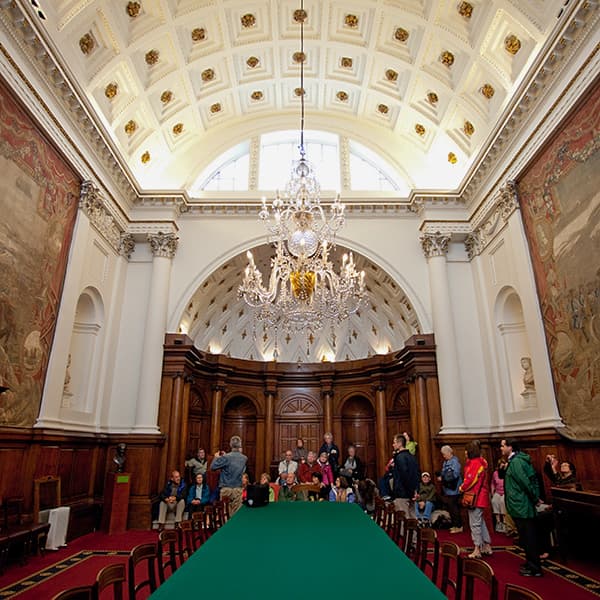
The room is decorated much as it looked back in the 1700s. There are tapestries on the walls and a fireplace carved with Irish oak. The apse-like area at the end is where the Speaker presided. On display is a huge silver ceremonial mace.
This was what the Sergeant-at-Arms wielded when he called for the army. It was a symbol of the ever-present oversight of the British monarch. The busts on display here of British kings and admirals also proclaim British authority. In this building, brave politicians rose up to denounce the British king and advocate for Irish self-rule.
Well, to be fair, most of the rabble-rousing took place down the hall in the House of Commons Chamber. Here in the House of Lords, things were more pro-English True. Most of the lords were rich Protestant elites who leaned British. The tapestries here attest to that.
They depict British victories over Irish rebels. In the tapestry on the right wall, British forces gathered to lay siege to the Irish town of Derry. Or as the Brits insisted on calling it, London Derry. The British took the town, routing this rebel stronghold.
The tapestry on the left wall shows what came next. It depicts the British King William of Orange riding in to finish the rebels off. This was at the landmark Battle of the Boyne, just a few miles from here. But despite those defeats on the battlefield, there was a gathering hope that the parliamentarians who met here could convince the British to grant Ireland independence peacefully.
Our old friend, Henry Groton, famously said, I found Ireland on her knees. I watched over her. I traced her progress from arms to liberty. Ireland is now a nation.
It looked like independence was just around the corner. That's when the British co-opted the rebellion. Exactly. They convinced the Irish parliament, mostly through bribes, to sign the landmark Act of Union of 1800.
On the one hand, that legislation granted Ireland nation status. On the other, it became part of the larger United Kingdom. So the Irish parliament moved from Dublin to London to become part of the British parliament. The movement for true Irish independence got tabled.
And here in Dublin, Parliament House was left empty. Which is why it's a bank today. Let's move on while Rick tells us the rest of the story. Start making your way back out to the street.
With Parliament gone, this impressive building was handed over to the Bank of Ireland, a conservative institution aligned with Britain's corporate interests. The House of Commons was converted into offices, and the Irish Freedoms Movement went into hibernation. Nevertheless, this building remained a potent symbol of Irish self-government. It would inspire the next generation of brave souls that would soon rise up and demand change.
That sounds like a teaser, but we'll have to save that story for our next tour, Dublin City Walk Part 2. By now, you should be back out on the big busy street. On the next track, Rick and I will take you from there. The Grand Boulevard
Grand Boulevard, Molly Malone, Bank Bar
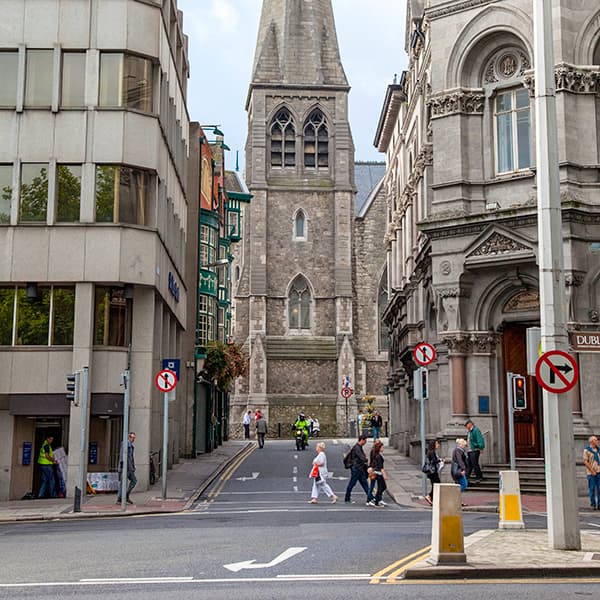
Molly Malone and the Bank Bar Leaving Parliament, turn right, and, at the corner, cross the busy boulevard. The boulevard has several names, College Green, Dame Street, so for simplicity, we'll just call it the boulevard. As you cross, glance up this long, straight boulevard. Though it's jammed with car traffic these days, this was doubled into Dublin's grand showpiece back in its golden age of the 1700s.
With a population of 50,000 people, Dublin was Britain's second city, and this was its version of a royal mile. It was lined with Georgian-style buildings linking the city's powerful institutions, Parliament, the University, the nation's banks. Further up was Dublin Castle. And way at the far end, a half mile from here, was the city's most venerable church.
Read more...Show less
We'll be walking up that boulevard in a minute, but for now, let's make a one-block detour off the boulevard. So after you cross the big boulevard, keep going straight up the narrow street called Church Lane. In Dublin's fair city Hey, I know that song. Where the girls are so pretty What's the name?
I first set my eyes on Sweet Molly Malone Yes, Molly Malone. That old song has become Dublin's unofficial theme song. Keep going up Church Lane one block. You'll run right into an old church with a well-polished bronze statue out front.
She wheeled her wheelbarrow Through streets broad and narrow Crying, Cuckles and muscles Alive, alive-o You'll soon reach the Molly Malone statue. It depicts a buxom maiden pushing a cart full of fish and wicker baskets. You've heard the song. Now let's meet the woman who inspired it.
The song from the 18th century celebrated one of the cheery street vendors of this bustling city. In Molly's case, she was selling seafood that was so fresh it was still Alive, alive-o The statue captures Molly right as she stops for a customer to show off her plump bivalves. Rick! You know, cockles and muscles?
Bivalves. The statue, is a bit tacky. Like your sense of humor. But Dubliners have embraced it.
This area is a popular hangout for street musicians and for tourists wanting a photo with the coy cockle vendor. Tour guides have created some bogus legends about how if you touch her breasts, supposedly it brings you good luck. Or good sex. Or maybe just a good seafood lunch.
Whatever. Now tourists dutifully line up to polish her cleavage. Next to the statue is the church of St. Andrews.
Although the stonework only dates from the 19th century, the church itself goes back to the 17th century. During Dublin's golden age, this was the go-to worship spot for members of the nearby parliament. Now it's been transformed into a high-end food court. After saying their prayers, MPs also popped into their go-to pub just across the street, O'Neill's.
Just for fun, let's go inside. Enter through the door on the right. Let's go in. Visitors are welcome.
Once inside, work your way through the maze-like interior. You'll eventually exit on the left, popping back out onto Church Lane. It's quite a scene. Yes, it's a sloppy and noisy wonderland of cozy alcoves scattered over three floors.
For over 300 years, the O'Neill family has been serving food and drink here to rich and poor alike. It served both parliamentary power brokers and the Molly Malones of the world. And today, this traditional pub still preserves a slice of that vibrant place known as Dublin's Fair City. When you emerge from the pub, whew, that was intense, start making your way back to the main boulevard.
Once there, we'll be turning left. We are walking and walking and then we turn left. After turning left onto the boulevard, continue a few doors up past a bank to an establishment with a nice red sandstone façade and showy banners. This is another pub that serves this area, the Bank Bar.
Step inside. Even if you're not eating here, you're welcome to stand just inside the door for a look. Wow, pretty classy. Built in 1894, the Bank Bar still staggers visitors with its Victorian opulence.
Back then, this was a bank like so many other banks lining the boulevard. Bankers dazzled their elite clients with interiors like this to assure them the bank was financially solid. When this particular bank moved to more modern offices, the building became a pub. And it still dazzles.
The stained glass ceiling sparkles. The room's many mirrors make the space seem larger than it is. And the ornate floor tiles and the crow's-nest balcony catch the eye. Ooh, and what's this in the glass case by the door?
It's a faithful replica of that 1,200-year-old manuscript The Bank Bar. It's a book of Kells. Also, on the wall on the left, check out the painting. That stately painting depicts one of Dublin's grand old buildings, the Custom House, surrounded by the ships that were so vital to Dublin's economy.
And on the right is a painting of... I recognize that. It's the Parliament House. The paintings face each other as twin pillars of society, commerce and governance.
In the far right corner are seven busts lining the wall. These are the seven signers of that 1916 Easter Rising Proclamation of Irish Independence. They became martyrs for freedom as all of them were arrested and then executed at Dublin's Kilmainham Jail. I can't wait for part two of our walk to hear even more about that 1916 Easter Rising.
But for now, let's move on. Step back outside to the boulevard. On the next track, Rick and I will direct you. We'll be right back.
Walking up the Boulevard
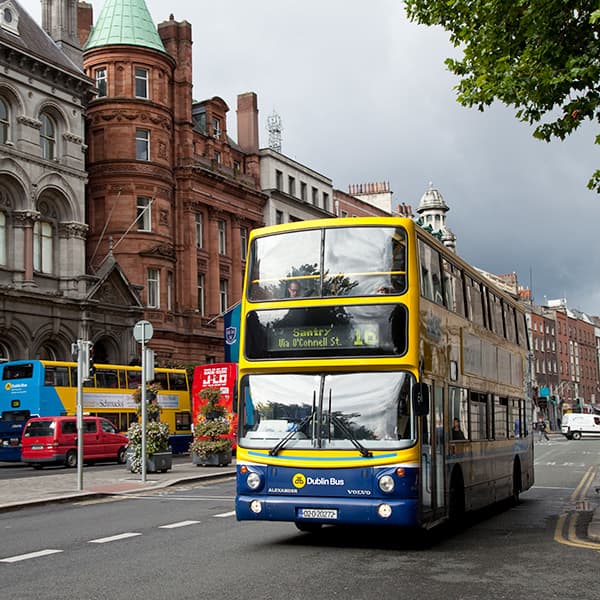
Irish music. Traditional Irish music is still going strong even in modern times. Any night of the week here in Dublin, you can find great live music at any number of pubs. You'll hear everything from bouncy jigs and reels to mournful ballads about tragic love to rowdy, drunken sing-alongs.
A traditional Irish band generally has a guitar, a fiddle, a tin whistle and a goatskin drum called a bow run. There may also be an accordion player or someone playing the bones. That's a pair of small cow's bones played like the spoons. And there's always at least one more guy, the one playing the boot, as they call it.
Read more...Show less
Right. The bystanders tapping their feet to the rhythm. So, let's listen to a bit of traditional Irish music or trad. Just keep walking.
Rick and I will return when the music ends to direct you to our next stop. ♪ ♪ ♪ ♪ ♪ ♪ ♪ ♪ ♪ ♪ Thank you. Thank you. Thank you.
Nice. By now, you should be approaching Palace Street, where we'll be going next. We'll be turning left. Palace Street is not obvious, so here are a few landmarks that can help you find it.
Palace Street comes just before the big boulevard starts curving left. It's also about 50 yards before the big white city hall building. And it's near a venerable old theater called the Olympia Theater. And there's one more landmark, a simple green post box.
Yes, I see the post box. It's ahead on the sidewalk, here on the left side of the boulevard. It's round and, looks like a stubby green column. Like all Irish post boxes, it's painted Irish green.
That's the color of the modern Republic of Ireland. This humble box is more than a century old, dating back to when Ireland was still under British rule. Originally, it was painted red, the color of the British monarchy. Look closely.
At about knee height, there's an elaborate monogram. It reads E-R... The letter E stands for Edward, and R is for Rex. That's Latin for king.
The post box dates to the reign of King Edward VII, Queen Victoria's son. After Ireland won its independence, rather than replace all the post boxes, it was more practical to just paint them Irish green and call it good. The round green post box marks the intersection with Palace Street, where we'll be turning left. At this point in our walk, we're delving deeper into Dublin's history. On the next track, Rick and I will direct you to one of Dublin's most historic sites. Dublin Castle.
Dublin Castle
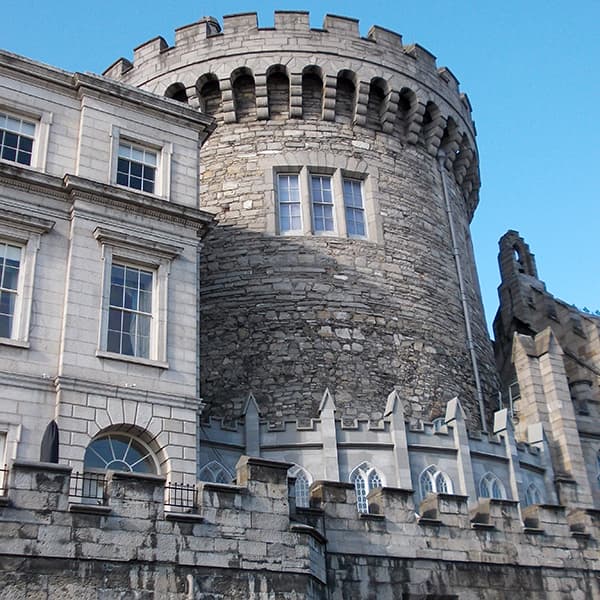
At the green post box, turn left on Palace Street. Go through the arch up ahead. We're passing through a big stone wall. Back in Medieval times, this once guarded Dublin Castle.
Keep going straight ahead along the path. After a few more steps, the wall on your right opens up, and suddenly, there it is. Dublin Castle. Stand here a moment and admire the view.
Read more...Show less
There's a round, castle-like tower in the corner of the courtyard. This is one of the few original remnants of the complex. Dublin Castle is where Ireland was governed by the British for 700 years. From roughly the year 1200 all the way to 1922.
The castle was begun in 1204. This was just a few decades after the English invaded Ireland and made Dublin their capital. It was built on this particular spot because there was a large pool right where we're standing now. That body of water served as a natural defense.
It was called the Black Pool. Or in Gaelic, the Dove-lin. Which gave the city its name. Dublin.
Dublin became the center of English rule. It was the capital of a small region of the Irish island known as the Pale. The Pale was English-speaking and civilized. The rest of the island spoke Gaelic and was considered barbaric.
That part was literally Beyond the Pale. Which is where we get that phrase for something outside the bounds of acceptable behavior, a phrase we still use today. Let's explore more of the castle. Start heading uphill.
We'll be going through the passageway in the middle of the courtyard. The castle was built by England's King John. I know John. He was the slimy king who upstaged Richard the Lionheart and who provoked the nobles so much that they made him sign the Magna Carta in 1215.
And, legends say, he battled brave Robin Hood. And it was John who made Ireland an English colony and built this castle to consolidate his conquest. As you can see, little of the castle's medieval architecture remains. There was a big fire in the 1600s and the castle was rebuilt in the style of the day.
But it's still impressive. Wander around and imagine how, for 700 years, this was the home of the Viceroy of Ireland. He was the man appointed by the King of England to rule the land. These buildings housed the Viceroy's lavish home, his entourage, the courts, and the offices of all those bureaucrats who administered Ireland.
Parliament also met here until they got their own home down the street at Parliament House. For those Irish who longed to be free of Britain, this castle must have been a symbol of oppression. Indeed, Lisa, indeed. A perfect example of that is the statue on the right side of the courtyard.
It stands atop a stone gateway. This statue is Lady Justice. But it's Justice from a British point of view. Notice she has no blindfold.
That means she's not impartial. But she leans toward the British. And she stands admiring her sword, a sword to keep the Irish in line. As Dubliners like to say, there she stands above her station, her face to the castle, her arse to the nation.
For 700 years, Britain ruled Ireland from here. And in 1922, when the Irish finally won their freedom, Dublin Castle was also the place Britain ceremonially handed the reins of power back to the people of Ireland. Today, the castle is no longer the seat of government, but it still hosts many important Irish ceremonies. It's used for fancy state dinners, visits from foreign dignitaries, and it's where each new president of Ireland is sworn in.
By the way, you can tour the castle's interior, the State Apartments, to see some of its lavish and very English rooms. Let's move on. Exit the castle courtyard through the arch underneath Lady Justice. If this gateway is closed, try the one about 30 yards uphill from this gate.
Go through the Justice Gate and continue ahead through a short alleyway. Make your way to the big white building on the right that faces the busy boulevard. This is our next stop, City Hall. Music Music Music Music Dublin City Hall.
Dublin City Hall
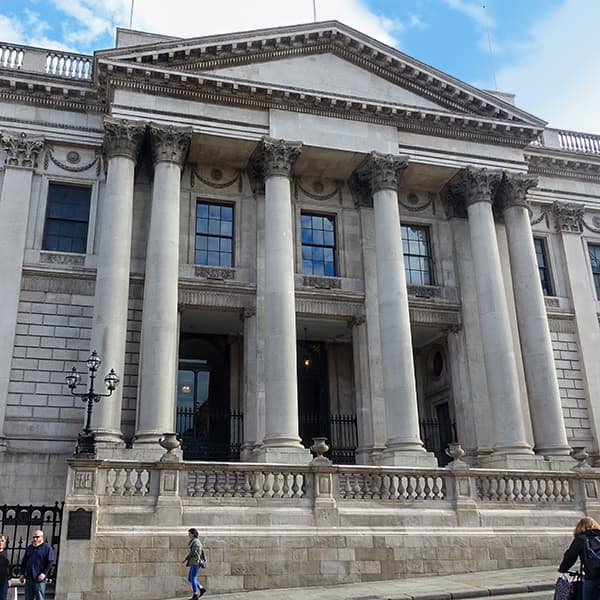
This impressive building, built in 1779, is a splendid example of that architectural style so popular during Dublin's Golden Age. The Georgian style. Yeah, I think by now we get it. Greek-style columns, balustrade across the top, grid-like windows, Georgian.
Lovely. Well, it is. And on the rooftop, if you see it from the right angle, is even a Georgian-style dome. The building started life not as a government building, but as a center of business.
Read more...Show less
This was the Royal Exchange, where businessmen from across Ireland and the British Empire met to strike deals. It's where the Irish and British currencies were exchanged. Its location made it perfect for Ireland's movers and shakers. The seat of government was just next door at the castle, and the nation's biggest banks lined the boulevard outside.
Let's go inside. It's free. You enter from the boulevard side, climb the stairs, and make your way in. You enter a grand rotunda.
It's quite an impressive space. Yeah, it really gives you a good feel for Dublin in its glory days. Once inside, admire the dome overhead. This dome was inspired by the ancient Pantheon building in Rome.
Dublin gets a lot more rain than Rome, so this dome's oculus, that's the opening in the ceiling, is actually covered. In 1852, the building became home to Dublin City Hall. Dublin is governed by a city council. The Lord Mayor, who, as we saw earlier, resides across town in Mansion House, is more a ceremonial figure.
These days, City Hall is also mostly ceremonial, with official offices moved to modern buildings nearby. Let's explore this domed room. Yes, the place serves as a kind of symbolic museum of Irish history. Who's the big statue?
He looks like Caesar. He was this Protestant city's first openly Catholic mayor, Daniel O'Connell. After becoming mayor in 1841, O'Connell went on to even greater things as a champion of Irish self-rule. More on him on our Dublin Walk Part 2.
Now, check out the coat of arms on the floor, directly beneath the dome. This is the city of Dublin's coat of arms. It shows two lady justices flanking three burning castles. The Latin inscription translates to, Obedient citizens make a happy city.
Well, that's kind of creepy. Unless you're British, I guess. Wander around. Check out the various murals on the walls.
These murals depict tales from Ireland's origins. The Irish take their legends really seriously. It's part of their national identity. These murals depict everything from St.
Patrick converting the pagans, to the first high kings of a unified country, to the medieval founding of the city of Dublin. Remember, Dublin was always central to Ireland's struggle for self-rule. In the 1916 Easter Rising, City Hall played an important role. Irish rebels occupied this strategic building to control the main gate to Dublin Castle.
When that rebellion was crushed, it was here that the first Irish heroes died. And after Ireland finally won its independence in 1921, it was here, under the rotunda, that a state funeral was held to honor the great rebel leader, Michael Collins. Let's move on. Yes, but if you want more Irish history, there's a free exhibit downstairs.
It's pretty good. Exit the rotunda the way you came in. But once outside, use the set of stairs to your right. As you descend, look on the wall for a bronze plaque.
This is the official standard that establishes the British imperial system of inches, feet, and yards. Thanks to our colonial heritage, the United States also uses these. Now find the Paris meter. That's what Ireland uses today, the metric system.
Once back on the boulevard, turn left. Start walking, continuing west up the big boulevard. We're headed toward the tall church tower in the distance. On the next track, Rick and I will guide you along. To Christ Church,
Christ Church: Medieval Origins
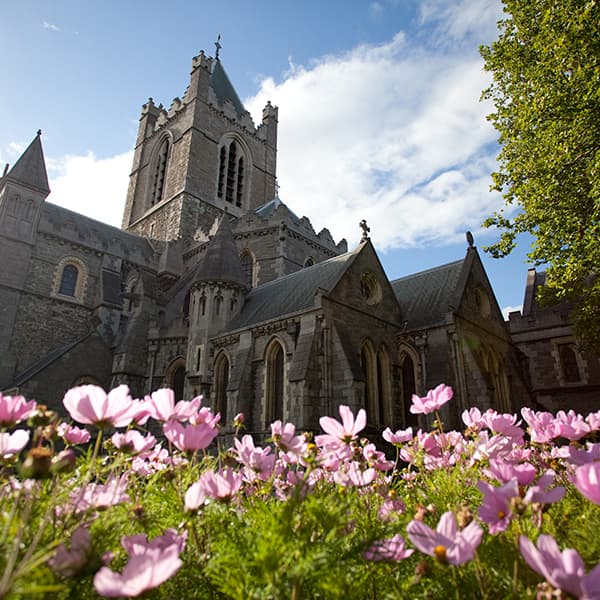
Dublin's Medieval Origins. Keep walking, toward the church tower. We're going even farther back in time. Back, back, back, to the city's murky medieval origins.
Even before there was a Dublin castle. Back to when Dublin was founded. First, by the Vikings. Oh, that's right.
Read more...Show less
You said there were Vikings here. Yes, and then after the Vikings came the Normans. The Normans? What's a Norman?
I had a weird uncle, Norman. Easy, Lisa. All will be explained as we make our way to the church. Meanwhile, as we walk up this busy street, maybe you can chew on this instead.
In Ireland, you can tell where and when a car was registered by its license plate. For example, say the license is 192 dash D. The first two digits, 19, tell you it was registered in 2019. The 2 means during the second half of the year.
And the D means... Registered in Dublin. Huh. Interesting.
Yeah. I sure see a lot of new cars and lots of Ds for Dublin. Up ahead is Christchurch. This is the oldest house of worship in all of Dublin.
At Christchurch, there are elements from every layer of Dublin's thousand-year history, from Viking to Norman to Protestant to Victorian. And it's still a working church today. That's a lot of history. Well, as the Irish like to say, when God made time, he made a lot of it.
As we continue walking to Christchurch, Rick, tell us more. While most of what you see today is from an 1870s renovation, the church itself goes back to Dublin's very origins. It was here, in the year 1030, that the Viking chief Citric Silkenbeard, a devout Christian, built a church of wood. Then came those Normans.
They were led by a warrior named Strongbow. In 1172, he turned this into a church of stone. We'll see some of those old stones in a moment. And who exactly were the Normans again?
Normans. That's really just another name for those early English rulers, like evil King John. Their ancestors had come from France. Oh, right.
The Norman conquest. 1066 and all that. You might recall that Robin Hood and his merry men were ethnic Saxons, the indigenous English people. They chafed against those Norman overlords.
After conquering the Saxons in England, the Normans next turned their sights on Ireland. When you arrive at the church, step through the gate into the peaceful churchyard. From here, you have nice views of the church and its architecture. Let's check out some of the layers of Dublin history.
Start by making your way to the sunken area around the left side of the church. These are the foundations of a church annex from way back in the 12th century. Now, turn your attention to the church itself, the part right next to the excavation site. Some of the blocks at the base of this part of the church were also from the 12th century, the age of Strongbow and his fellow Normans.
Note the door here. It has a round arch, typical of that 12th century style called Romanesque. The rest of the church was built later. It has Gothic elements, like pointed arches, cone-shaped turrets, and flying buttresses.
During the Reformation in the 1500s, this old and venerable church made the dramatic switch from Catholic to Protestant. That helped establish Dublin as a Protestant stronghold in Catholic Ireland. In the 1800s, the old church was renovated in the Neo-Gothic style to preserve its medieval legacy. Most of what you see today is Neo-Gothic.
Remember, you can always pause the audio tour, pay admission, and go inside the church. You'd see the tomb of Strongbow. It's right there in the nave. Down stairs, you'll find the crypt, which was the foundations of that Norman-era church from 1172.
There you walk among a forest of stout columns, enjoying displays of historic odds and ends, from old manuscripts to a mummified cat. Plus, a modern toilet, if you need one. After nearly a thousand years, this church still carries on today. A testament to that is the modern bronze statue you may have noticed here in the churchyard.
It's between the church and the gate through which we entered. As we head back out, take a closer look at the statue. It shows someone sleeping on a bench. It must have been someone down on their luck.
But wait, are those nail holes in his feet? In fact, the statue is called Homeless Jesus. It's by the Canadian artist, Timothy Schmalz. It shows how today's congregation keeps the Christian message of charity alive in modern Dublin.
Let's move on. Start making your way back out to the street, through the same entrance we came through. We're going from Dublin's oldest church to Dublin's oldest spot, period. For that, I'll put on my horned helmet.
And I'll slip into my hubcap bra. We're going back, way back, to the days of the Vikings. Viking pirates, yeah. As you exit through the gate of the churchyard, turn left. Stand at the head of the winding road called Fishamble Street. Viking
Viking Dublin: Fishamble to River
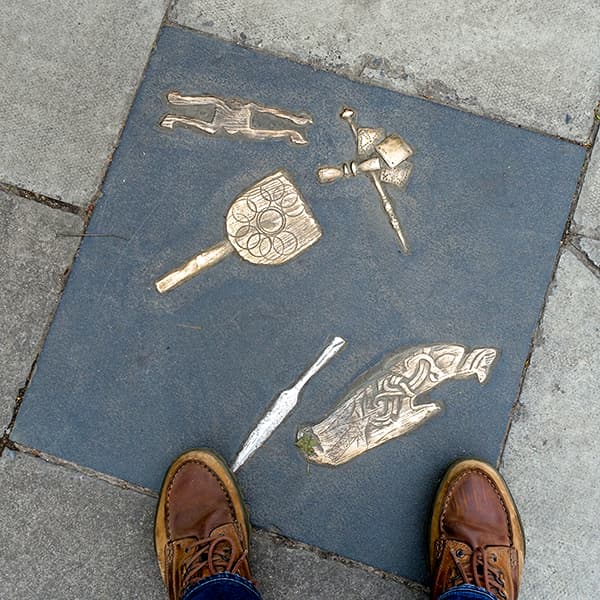
Dublin, from Fishamble Street to the river. From the church, walk about ten yards down Fishamble Street, staying on the left side of the street. Find the concrete flowerbed inscribed with the words, Dublin City Council. Now, look down.
At your feet, in the pavement, is a historical marker. You're standing on the site of Dublin's first Viking settlement, established right here over 1,200 years ago. Fishamble Street was its fish market. The Vikings initially came as marauders, but they stayed to intermarry and settle.
Read more...Show less
By the 11th century, when Christ Church was first built out of wood, Dublin was a thriving town with about 4,000 Norsemen, plus the indigenous Celtic people, and the Irish. Vikings were accomplished seafaring merchants, and Dublin provided them with a safe harbor on the River Liffey. Which is just downhill from here. Unfortunately, most of the Viking settlement still sits beneath the huge and modern Dublin City Council building.
When the building's foundations were dug in 1978, they discovered this settlement virtually intact. Over a million artifacts were carefully excavated and catalogued by eager archaeologists, but unfortunately the construction project carried on despite angry public protests. The result is that a virtual treasure trove of Viking artifacts have been left in the ground beneath this ugly building. Dublin sure has lots of layers of history, one on top of another.
They come at you bam, bam, bam. There's yet another one just ahead. All right, bring it on. Let's continue walking downhill on Fishamble Street.
By the way, if you want more about the Vikings and Dublin, consider a visit to the best historical museum in all of Ireland, Dublin's National Museum of Archaeology. It's located near where we started the walk, behind Mansion House. As you reach the bend in the road, keep your eye out on the right for a hotel called George Frederick Handel. Stop and face the hotel.
The hotel is named for the famous classical composer with an important Dublin connection. Walk through the gate to the left of the hotel. There you can see a statue. A naked and very fit Handel stands like a pillar saint atop organ pipes.
The first public performance of Handel's well-known oratorio, The Messiah, took place in 1742 in Dublin. In fact, right where we're standing. That bit of surviving wall, you see, was part of that old theater. Well, hallelujah!
Hallelujah! Hallelujah! Hallelujah! Hallelujah!
That premiere of Handel's Messiah with its rousing Hallelujah Chorus propelled it to becoming one of the most often performed classical works ever. And now, every April 13th, on the anniversary of that premiere, this humble street fills with a full orchestra and over a hundred singers to perform the Messiah. Hallelujah! Our next stop is the river. Continue walking down Fishamble Street. Stop when you reach the river. The River Liffey
The River Liffey
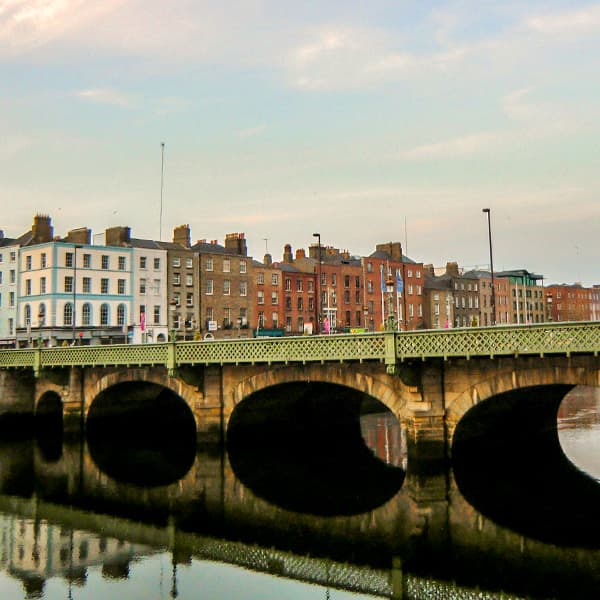
By now, you should be at the river. Of all Dublin's layers of history, we've reached the source. The river where Dublin was born. The river that gave it life.
Before we start strolling along the river, first, glance left. Across the river in the distance is a grand building with a green-domed roof. This is Ireland's Supreme Court, housed in a gorgeous Georgian building called the Four Courts. Now, turn right and start walking east along the river.
Read more...Show less
We're headed two long blocks to the second bridge. As you walk, you're going downstream. The River Liffey cuts through the heart of Dublin, flowing from west to east. In all, the Liffey runs about 80 miles through County Kildare and until it reaches Dublin.
Here, it spills out into the Irish Sea. That's about three miles away. Dublin was born here on the banks of the Liffey. The Vikings, who were great sea traders, settled here because it was an excellent inland port.
Back then, the geography looked a bit different. There was another river that flowed into the Liffey. That confluence was just ahead, beyond the bridge. Though today, that river's been channeled underground.
The place where the two rivers met made a natural harbor. The currents slowed, forming a pool. A black pool. Which, as we learned, was called in Gaelic Dublin, or Dublin.
Keep walking. Dublin grew into a major seafaring city. Even tall-masted ships could sail up the Liffey as far as here. They'd dock at wooden piers where they loaded and unloaded their goods.
But as Dublin expanded onto the north bank, several bridges were added to connect the city's two halves. One was the bridge we're passing by. The Groton Bridge, named for that parliamentarian, Henry Groton. Just keep walking, heading for the next bridge further ahead.
Dublin remained a major seaport, but everything had to be moved further and further downstream. With more bridges and ever bigger ships, the port eventually ended up right at the mouth of the river. Even today, that modern harbor at the edge of town is a bustling port. And because we're only three miles from the sea, the Liffey here is a salty river with high tides and low tides.
Our next stop is the next bridge up ahead. It's a small footbridge called Millennium Bridge. While you walk, enjoy a little more music. We'll meet up again atop that bridge. music music music music Thank you. By now, you should be standing on Millennium Bridge. Millennium Bridge.
Millennium Bridge
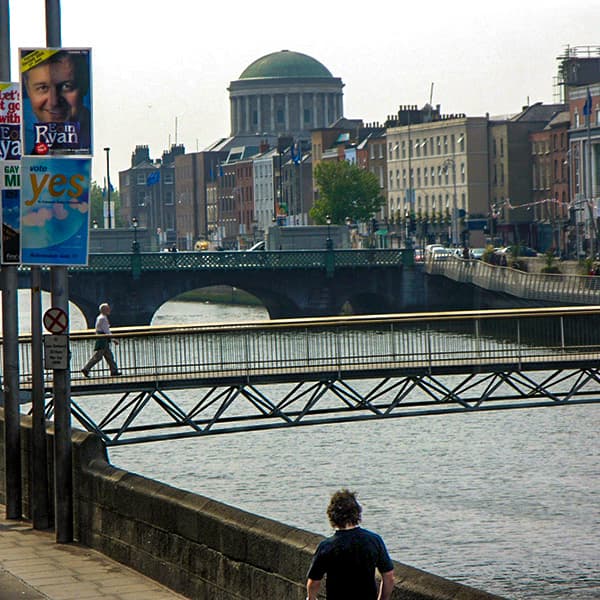
Standing atop the bridge, survey the scene. The river today is bordered by concrete quays. That's the old English word for wharf. But in times past, this area was once full of ships docked at wooden piers.
This was the bustling heart of Dublin's commerce. The Liffey divides Dublin into two halves, South Dublin, which we've been exploring, and the North Side. North and South Dublin have always had their own unique cultural identity. As the stereotypes go, South Siders are considered rich and spoiled, while Northerners are poor and a bit rough around the edges.
Read more...Show less
It's created lots of friendly rivalry and plenty of dumb jokes. Hey, Lisa, what separates humans from the animals? I don't know. The Liffey.
Ha ha! Why do South Side girls date North Side guys? To get their purses back. Okay, one last one.
What do North Siders use for protection during sex? Bus shelters. And with that, let's call a truce. Now, look downstream, at the next bridge.
The next bridge down is called the Haypenny Bridge. That's where we'll eventually end our tour. Yes, but we'll cross that bridge when we get to it. For now, admire it from a distance.
The Haypenny Bridge has been a Dublin landmark since 1816. Its graceful cast-iron arch is a prime example of the emerging bridge engineering of the Industrial Revolution. It's officially called the Wellington Bridge, named for the Duke of Wellington. Wellington was the man who famously defeated Napoleon at Waterloo in 1815 and went on to become Britain's prime minister.
And he was a Dubliner. Wellington was often teased about his Irish birth. He reportedly said, Just because you're born in a stable doesn't make you an ass. The bridge got its nickname because it was the first bridge in the world to be built.
Because it was a toll bridge. Before it was built, most people had to take the ferry across. This bridge was cheaper, only half a penny. A Haypenny.
Let's delve into the Temple Bar District. It's the neighborhood on the South Bank from here to Haypenny Bridge and beyond. Rick and I will lead you there on the next track. Temple Bar.
Temple Bar
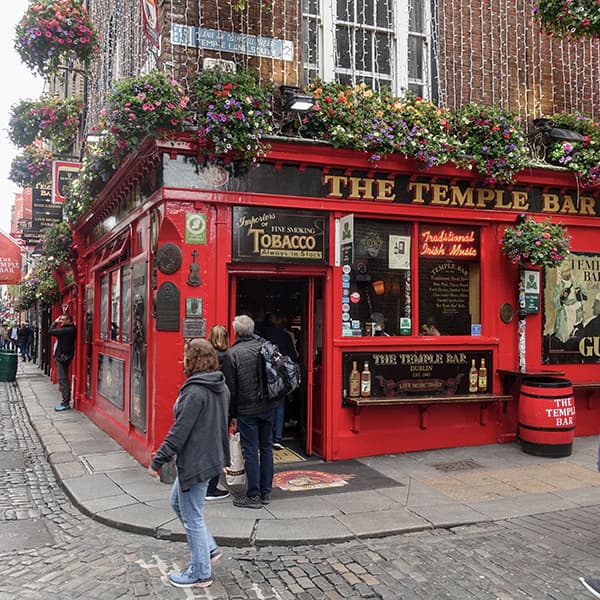
With its shops, cafes, theaters, galleries, and pubs with live music, Temple Bar feels like the heart of the old city. This is Dublin's bohemian left bank, or Greenwich Village. It's a center of the arts and nightlife, though, as we'll see, it's also extremely touristy and party-oriented. Start walking.
Go one block inland from the river. When you reach East Essex Street and the Norseman Pub, we'll be turning left. But first, stop at that intersection for a moment, while Rick sets the scene. Gaze to the left down Essex Street.
Read more...Show less
Consider that 300 years ago, this street marked the river's edge. Back then, this whole area was a muddy tidal flat. Tall ships docked at the end of long piers. The area further inland was marshy and barely inhabited.
But during Dublin's boom time, the land was reclaimed and built up. They called it Temple Bar because there was a dock or bar here, and it was owned by the Temple family. The neighborhood began as a bustling center of commerce. But later, as the shipping business began moving downstream, Temple Bar went downhill.
Start strolling slowly east on Essex Street, going one block. By the 1980s, the neighborhood was a den of drugs, prostitution, and crime. The city planned to demolish it completely to build a huge bus terminal. But by then, the area had also become home to students and struggling artists drawing up books, done by the cheap rents, giving it a bohemian flair.
So in 1991, the decision was made to just clean things up. They kept some quaint old buildings, imported charming cobbles, and gave tax breaks to entertainment businesses. The result? The artsy and touristy neighborhood we see today.
Yeah, touristy. Like the Temple Bar pub on the right. Stop here a moment. The Temple Bar pub looks venerable, but it's only a couple decades old.
Typical of so many pubs in Dublin, it was built to cash in on the district's rising popularity. At night, this pub is raucous and rowdy with crowds of drunken tourists and inflated beer prices that drove away the locals long ago. At the Temple Bar pub, turn right. Go one block up Temple Lane South.
Stop at the corner of Cecilia Street. There's more to Temple Bar than just rowdy pubs. It's also home to a number of cultural institutions, art galleries, film institutes, acting schools, and photography centers. And it's a cradle of Irish music, both traditional and modern.
At Cecilia Street, look to the right to find a red building with pictures of various rock and pop musicians with Irish ties. It's called the Wall of Fame. Let's see. I recognize U2, Bob Geldof, the Cranberries, Sinead O'Connor.
Yes, Little Ireland has produced greats like these, plus so many more. You're right, Lisa. Oh, there's U2, of course, and Sinead O'Connor. There's Damien Rice and Van Morrison.
There's Ennick, Glenn Hensert, Imelda May, the Cranberries, and the Coors. There's even a member of One Direction. There's Gallagher, Hozier. It's making me dizzy.
There's one more we cannot forget to mention. Phil Linnet. Who played within Lizzie? If you want more on Ireland's rock scene, this wall is part of the Irish Rock and Roll Museum.
It's pricey, but worth a visit for rock fans interested in seeing studio space and vintage mixing boards used by famous acts. And we can't forget traditional Irish music, or trad. A few steps up Cecilia Street is Claddagh Records. This hole-in-the-wall shop is staffed by knowledgeable music buffs who love turning visitors on to Irish tunes.
Besides Ireland's rock acts, many traditional Irish bands have gone on to worldwide fame. There's the Chieftains, the Dubliners, Irish Rovers, there's Clannad and Plexiglas. Okay, okay, we get it. Now look up above Claddagh Records to the top floor.
These rooms were once low-budget recording studios. It's where the rock band U2 did some of their earliest recording. U2's members all grew up in Dublin, where they formed the band as teenagers in the 1970s. They played some of their very first shows at a warehouse right next to the entrance to St.
Stephen's Green. Which is where we started our walk. And now we're approaching the end of our walk. Start backtracking down to that touristy Temple Bar pub.
By the way, it's not hard to find live music here in the Temple Bar neighborhood, whether it's rock, traditional, or folk. The neighborhood's leading pub for traditional folk music is a place called Gogarty's. It's near Temple Bar Square. Which is where we're headed next.
And we'll point it out. When you reach the Temple Bar pub, turn right on the main street. Keep going one block until you reach the neighborhood's main square. The street opens up into Temple Bar Square, the geographic heart of the district.
Like much of the neighborhood, Temple Bar Square is both charming and cheesy. The square is a favorite haunt of street musicians. Some good, some not. On Saturdays, there's a book market here.
The pubs around the square are certainly quaint-looking, but they're actually recreations just a couple decades old. Many of these bars are almost cartoons of an Irish pub. Like they have leprechauns living upstairs. The only real Irish people you see at those places are the ones playing the music, serving the beer, and keeping the rowdies at bay.
Regardless, Temple Bar is sure a spectacle to behold on warm weekend nights. It's one big, noisy, drunken indoor-outdoor mosh pit. It's a popular place for stag parties and the female countertops. On the other part, hen parties.
People-watching becomes a contact sport, and pickpockets abound. If the rowdy Temple Bar scene is too much, you'll find a mellower scene just across the river. Then let's start making our way back to the river. But first, let me point out that place for traditional music, Gogarty's Pub.
It's just one block beyond Temple Bar Square. Gogarty's has lively sessions both day and night, and Dublin's popular musical pub crawl starts from here each evening. At the far end of Temple Bar Square, turn left. Go up the narrow lane called Merchant's Arch.
This leads under an arch to the river and Haypenny Bridge, where we'll finish our walk. When you reach the bridge, stroll up to the midway point and take in the scene. The Haypenny Bridge.
The Ha' Penny Bridge
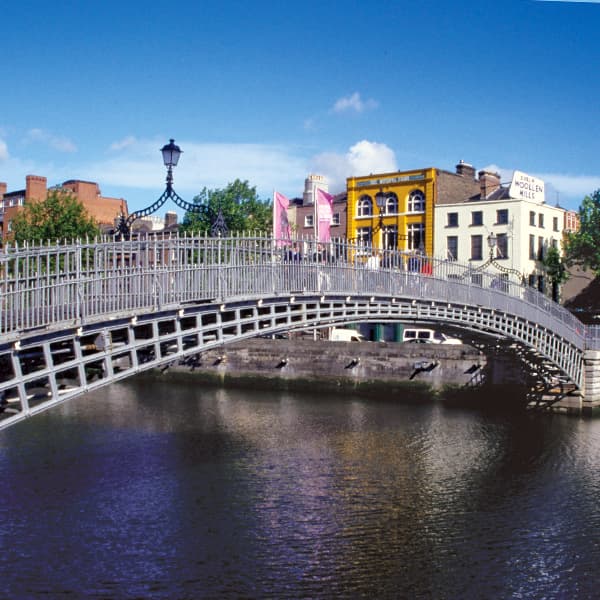
This is one of Dublin's most photogenic spots. There's the river, the ironwork bridge, the buildings along the quays, and the fascinating parade of people here on this bridge that unites the city. You're standing in the very heart of Dublin's long history. Remember, Dublin was born right here on the river.
It was home to the seafaring Vikings and the Normans who built Dublin Castle. Later, Dublin boomed as the center of the Protestant English culture in Ireland. The city was slathered with a rich layer of grand Georgian buildings. Like City Hall, Parliament House, and the Lord Mayor's residence.
Read more...Show less
It had Trinity College, the elite school that produced writers and intellectuals from Jonathan Swift to Oscar Wilde. And, as the capital of Ireland, Dublin played a key role in the nation's struggle for independence from Britain. Its parliament tried to win freedom peacefully. But, unfortunately, well...
That's an ominous-sounding silence. Well, the final push to freedom was often bloody. But it was also stirring and heroic, with many brave souls giving their all for their homeland. That's the theme of our companion audio tour, "The Dublin Walk, Part Two." That walk begins just one bridge away from here, on the O'Connell Bridge.
The O'Connell Bridge is downstream towards the skyscrapers. If you're ready for Part Two, just continue across Haypenny Bridge to the north bank, turn right, and walk to the O'Connell Bridge along the wooden Riverside Millennial Walkway. But right now, our tour is over. Think of it.
We've gone from a pleasant park... ...to this pleasant bridge over the river. We've walked Grafton Street and dipped into the college. We've seen churches and castles and government buildings...
We've seen churches and castles and government buildings... ...and pubs and pubs and pubs. Lisa, how about we finish off this walk with a fine pint of Guinness? Sounds great.
As the Irish like to say, "May you always have a clean shirt, a clear conscience, and enough coin in your pocket to buy a pint." Cheers. Sláinte. Sláinte. We hope you've enjoyed our Dublin Walk, Part One.
Thanks to Pat O'Connor and Jean Openshaw, the co-authors of this tour. To see more of Dublin, check out our companion tour, "Dublin Walk, Part Two." This tour was excerpted from the Rick Steves Ireland Guidebook, co-authored with Pat O'Connor. For more details on eating, sleeping, and sightseeing in Dublin and Ireland, refer to the latest edition of that guidebook. For more free audio tours and information about our TV shows, bus tours, and travel gear, visit our website at ricksteves.com.
This tour was produced by Cedar House Audio Productions. Thanks. Cheers. And happy travels.
Free
GPS-guided walking tour
No account needed. Walk at your own pace.
Free
17 stops ·