13 stops
GPS-guided
37 min
Duration
Free
No tickets
About this tour
A 13-stop walking tour through the heart of Italy. Visit Assisi Town Walk, Roman Amphitheater, Porta Perlici, and Assisi's Back Lanes — with narrated stories at every stop.
13 stops on this tour
Assisi Town Walk
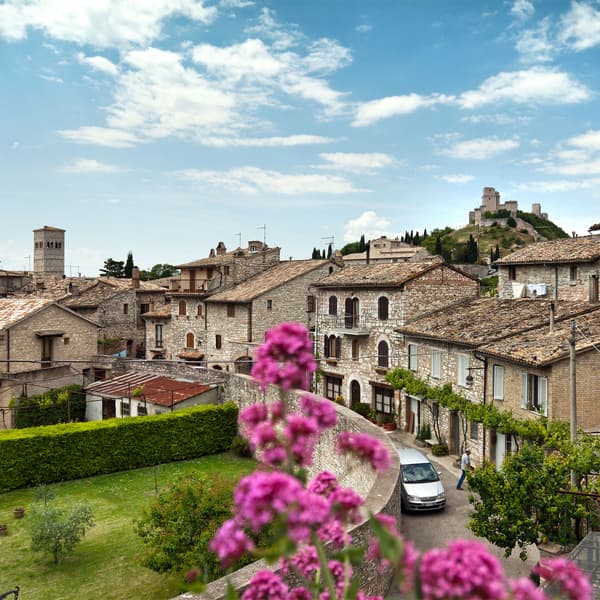
A Sisi Town Walk. Welcome to A Sisi. A Sisi is famous for its hometown boy, St. Francis, and his slow-down-and-smell-Gods-roses lifestyle.
With its hillside setting and medieval charm, A Sisi is a slice of quintessential Italy. Hi, I'm Rick Steves. This walk through A Sisi covers the town from top to bottom, literally. We'll start at the modern piazza at the uphill end of town.
Read more...Show less
Work our way down through the medieval heart and end at the Basilica of St. Francis. There, you could continue your sightseeing with our companion audio tour, which covers that wonderful church. Francis' message of love, simplicity, non-materialism, and sensitivity to the environment has a broad and timeless appeal.
And mementos of his life in A Sisi are everywhere. We'll see the church where he was baptized, the town square where he hung out, and the wooden crucifixion, the crucifix that changed his life. We'll also visit places associated with his spiritual soulmate, St. Clair.
But there's much more to A Sisi than Francis. The town is beautifully preserved and rich in history, from Roman ruins to medieval towers. We'll enjoy peaceful views of the Umbrian countryside and wander the back lanes of this picturesque town. Allow about an hour for our mile-long walk that's mostly downhill.
You may find that A Sisi has become quite popular. There's a lot of touristy, especially in the summer. But we'll get beyond the flash-in-the-pan Francis fans and glow-in-the-dark rosaries and bobblehead friars. With the right attitude, you can actually have a rewarding, travel-on-purpose kind of experience in the inspiring hill town of A Sisi.
To help us along the way, I've invited a good friend and virtual travel buddy. Welcome, Lisa. Buongiorno, Rick. Lisa will give us helpful directions and sightseeing tips throughout the tour.
And my first tip is to be sure you get our tour updates. Just press the icon at the lower right of your device. You'll find any updates and helpful instructions unique to this tour. Things like closures, opening hours, and reservation requirements.
There's also tips on how to use this audio tour and even the full printed script. Yes, so pause for just a moment right now to review our updates and special tips. It's okay. We'll wait. And then... Let the tour begin. The tour begins.
Tour Begins: Piazza Matteotti
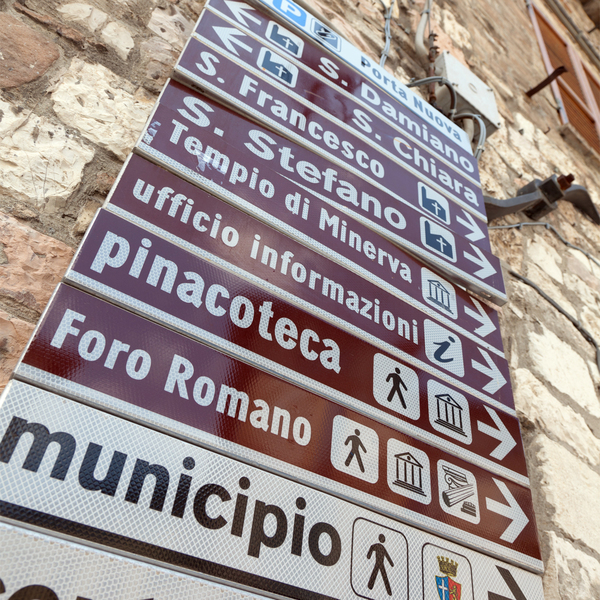
Piazza Mattiotti. Start at Piazza Mattiotti. This is the sprawling, modern square at the uphill or east end of town. It's not particularly atmospheric.
Particularly atmospheric. It's particularly butt-ugly. True, but it is attractive. It's a transportation hub where many visitors first arrive in town.
Read more...Show less
This is where regional buses arrive. For those coming by train, it's an easy taxi or city bus ride from the train station to Piazza Mattiotti. By car, there's an underground parking garage right at the piazza. Rick?
The town of Assisi spills downhill from Piazza Mattiotti, sprawling across a ridge. Above the town is a ruined castle and rising above that, Mount Subasio. Our walk goes from here to the town's main square, Piazza del Comune, and from there to the Basilica of St. Francis at the far end of town.
If you walk directly downhill, you could get from one end to the other in as little as 15 minutes. But on our walk, we'll see more of the town along the way. Our first stop, the Roman Amphitheater, is about 75 yards from Piazza Mattiotti. Exit the square from its uphill or northeast corner.
Start heading east. Start northeast, away from the city center. Check your map if you're unsure of the route. As you walk, think of Assisi's rich history.
Although it's best known as the medieval town of St. Francis, Assisi's been continuously inhabited for more than 2,000 years. You'll soon reach a lane named Via Amphitheatro Romano. Head down the lane through an arch to find an elliptical-shaped wall and a circular lane lined with charming houses. This echoes the shape of Assisi's Roman Amphitheater. The Roman Amphitheater.
Roman Amphitheater
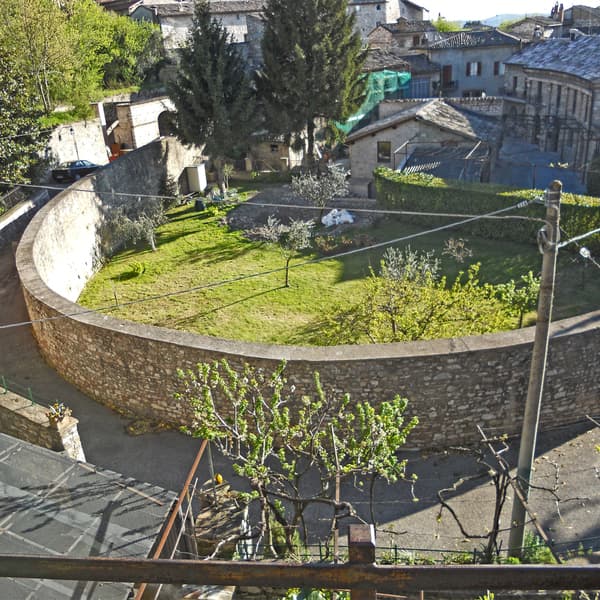
You can easily make out the elliptical shape of what was once the old Roman Amphitheater. Assisi was an important Roman town with all the traditional Roman trappings, city walls, a water system, temples, government buildings, and an amphitheater. The Romans mainly lived in the city, but not in the city. The main square, or forum, is today's Piazza del Comune, which we'll see later.
This amphitheater was likely used by the Romans as a kind of mini-coliseum for sporting contests between men and animals. Start circling the amphitheater to the right, counterclockwise. Pause at the laundry basin on the right. Imagine how colorful this place must have been in previous generations when the women of Assisi gathered here to do their wash.
Read more...Show less
Adjacent to the basin is a small, rectangular pool filled with water. Above it are the coats of arms of Assisi's leading families. Continue a few steps further to the far end of the oval. On the right is a staircase.
Hike up the stairs to the top of the hill for an aerial view of the ancient oval. As you can see, the Roman stones have long been absorbed into the medieval architecture. It was Roman tradition to locate the amphitheater outside of town, which this used to be. While the amphitheater dates from around the time of Christ, the early 1st century, the buildings filling it today were built in the 13th and 14th centuries.
Continue on, walking away from the amphitheater. Enjoy the grand view of the fortress in the distance. The lane leads down to a city gate and a great view. Porta Perlici,
Porta Perlici
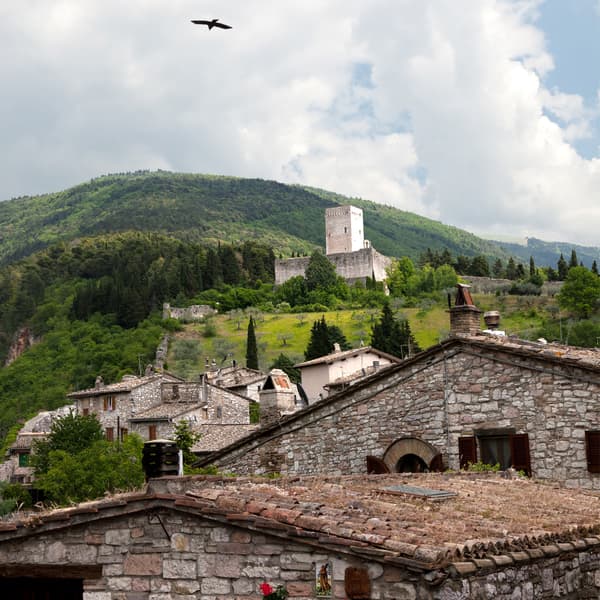
an Umbrian view. Step outside of Assisi at the Perlici Gate for a commanding view. Umbria, called the Green Heart of Italy, is the country's geographical center. It's also its only landlocked region.
Enjoy the various shades of green. Silver green on the valley floor. Those are olive trees. The emerald green grapevines.
Read more...Show less
And the deep green on the hillsides from evergreen oak trees. Also notice the ruined castle above the city called Rocca Maggiore, or Big Fortress. The current structure, built in 1367, provided townsfolk a refuge in times of attack. The quarry, which is visible outside the town under the castle, was a handy source for Assisi's characteristic pink limestone.
Behind you, atop the nearer hill, stands Rocca Minore, or Little Fortress, formerly another place of refuge. These days, the ruin serves another function. It's the make-out spot for Assisi's young romantics. From here, we'll be making our way through Assisi's back lanes on the way to the Cathedral of San Rufino.
Go back through the gate. Veer right and follow Via Porta Perlici downhill. You're headed toward Hotel La Rocca. As you walk, listen to the next track as Rick points out a few things along the way. music music music music music
Assisi's Back Lanes
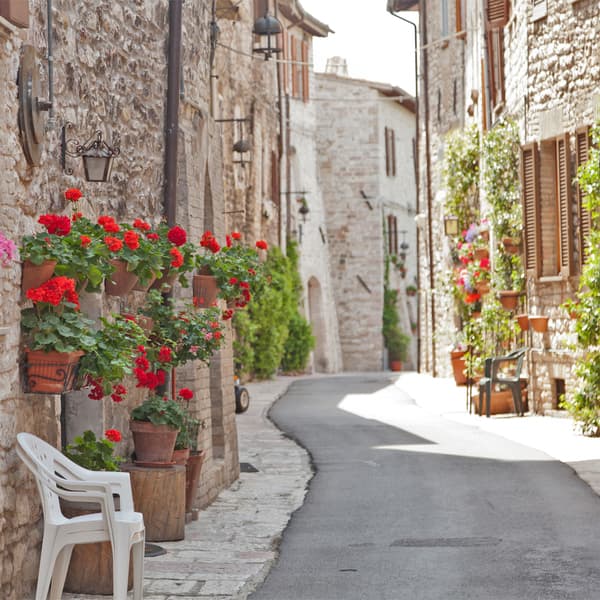
Assisi's back lanes, from Porta Perlicci to the Cathedral of San Rufino. This neighborhood is some of the most photogenic back lanes in town. Enjoy the higgledy-piggledy architecture, each generation built on the ruins of the previous one, as the city has grown over the centuries. On the left, pause at the wall containing an old Roman aqueduct.
Built 2,000 years ago, the aqueduct still brings water from a mountain spring into the city. Locals actually come here for the tastiest water in town. Push the brass tap for a taste. Ah, thank you, Romans.
Read more...Show less
Yes, no one does infrastructure like the Romans. Continue another 50 yards. As you approach Hotel La Roca, turn left. You pass through a medieval town gate.
A few yards farther, you pass a second gate dating from Roman times. Continue downhill along Via Porta Perlicci one long block. In late Roman times, Assisi, like all of Italy, was converted to Christianity. Its heyday came around the year 1200.
The town sat on the busy trade route between the city of Rome and northern Europe. Medieval Assisi grew rich. This was the world St. Francis was born into and rebelled against.
That reminds me. Hey, Lisa, quick. Who's Assisi's patron saint? Is this a trick question?
I assume it's St. Francis. That is incorrect, signora. While Francis is one of Italy's patron saints, the patron saint of Assisi is actually San Rufino.
And a church honoring him is just ahead. Continue along Via Porta Perlicci until it spills into a long square facing a big church, the Cathedral of San Rufino. The Cathedral of San Rufino.
Cathedral of San Rufino
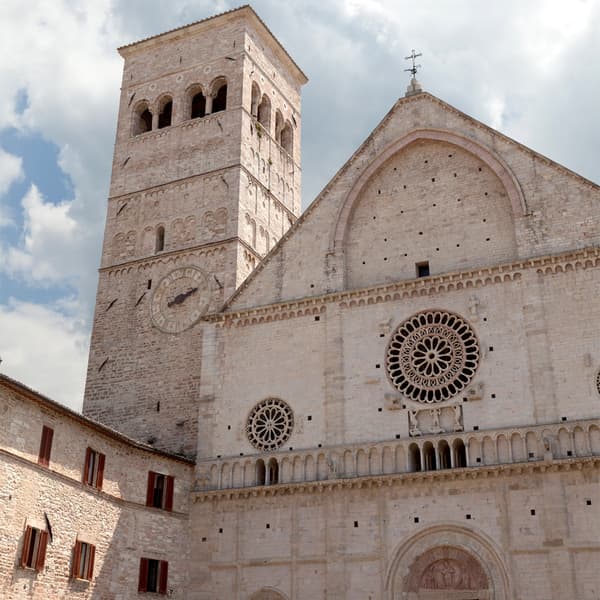
This church is Assisi's cathedral, that is, the headquarters of the local bishop. It's named for St. Rufino, the town's first bishop. In the 3rd century, Rufino converted the pagan Roman city of Assisi to Christianity.
After he was martyred, he was buried here. The structure you see today was built in the 11th century. The facade is heavy with Roman-style columns and arches and a squat tower. The big triangular false front atop the facade, was added later.
Read more...Show less
Aside from that Gothic feature, the church has one of the best and purest Romanesque facades in all of Italy. Study the lines at the base of the facade. One is eating a Christian martyr, reminding worshipers of the courage of early Christians, like San Rufino. Enter the church.
The interior is an unremarkable mix of 17th-century Baroque and 18th-century Neoclassical. Check out several points of interest near the entrance. First, notice the two fine statues, one of St. Francis and the other of St.
Clair. They date from 1888. In Francis' day, this cathedral was the main church in town, and it played a role throughout Francis' remarkable life. To your right, find the old baptismal font.
It's in the corner, topped with a black iron grate. For 10 centuries, the children of Assisi have been baptized here. In about the year 1181, a baby boy was baptized in this font. His dad was an upwardly mobile cloth salesman named Pietro Bernadone.
His mom was from France. Both parents were avid Francophiles, so they called their young son Francesco, Frenchie, or, as we know him, Francis. When Francis was 13, another baby was baptized here in this church, the daughter of a nobleman. Her name was Claire.
Eighteen years later, the paths of these two crossed again in this church. Claire attended a class here and became mesmerized by the teacher, Francis. And, as we'll soon see, these two went on to make spiritual history together. Check out a few more features in the church.
In the nave, look down through the glass panels in the floor. These reveal foundations preserved from the 9th-century church that stood here before this one. And beneath that, not visible from here, are remains of what may be a Roman temple. Christian churches were often built upon pagan temples.
Now find the old Roman cistern. It's near the church's big, arched entry. Take the three steps leading down. This triggers a light.
Marvel at the cistern's fine stonework and Roman engineering. In the Middle Ages, this served as the town's emergency water source when under attack. In the church's crypt is the Diocesan Museum. When it's open, you can see the ruins from earlier structures and cathedral art from centuries past.
The highlight is a Roman-style sarcophagus located directly under the church's main altar. This contains the remains of the man who made Assisi Christian and founded this church, Saint Rufino. Assisi's patron saint. Exit the church.
As you leave the church, start walking back down the long square in front of the church. Take a sharp left at the pizza-by-the-slice joint onto Via Donodoni. Start walking down Via Donodoni, following the sign for Santa Chiara. After about 50 yards, take a right and go down the stairway. Stop at the bottom of the steps to see some features of medieval architecture. Medieval Architecture
Medieval Architecture
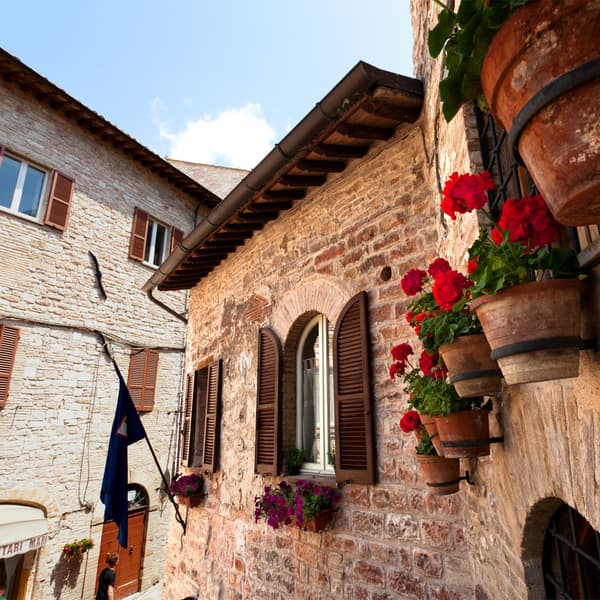
From the bottom of the stairs, you get a small taste of Assisi during its golden age, from around the year 1200. Notice the original pink limestone on the pavement. Notice also the medieval arches built over doorways. These indicate that the buildings date from the time when Assisi was booming.
Assisi thrived on the North-South trade between Northern Europe and Rome. Cities like Assisi were in the process of inventing free-market capitalism, dabbling in democratic self-rule, and creating the modern urban lifestyle. And Assisi was growing in population while hemmed in by its medieval walls. Notice the vaults that turn lanes into tunnels, creating living space above.
Read more...Show less
As the population grew, people still wanted to live within the town's protective walls. Medieval Assisi had several times the population density of modern Assisi. Also notice the beautiful blooming balconies. Assisi holds a flower competition each June.
The town is so well-preserved because after its golden age, it declined rapidly. In the 1300s, it suffered a devastating black death or bubonic plague. Neighboring cities like Perugia came to dominate. Trade dried up, and new construction was halted.
Fortunately for sightseers, Assisi never really recovered, leaving us a well-preserved medieval gem. As you stand here amid this medieval architecture, get in a medieval mindset. It's the year 1200. Business is booming.
Everybody in town wants to make money. Everyone, that is, except for a couple of troublesome young idealists. A girl named Claire and a guy they called Frenchie. Continue steeply downhill.
When you arrive at a street, turn left. Go slightly uphill for a block. When you reach the Y intersection, take the low road on the right via Serena. Head down via Serena following the Santa Chiara sign downhill to the big church.
Cross the street and walk under the church's three massive buttresses to Piazza Santa Chiara and the front of the church. Before entering the church, take in the view of the valley below. Viewpoint at the Basilica of St. Clair.
Viewpoint at Basilica of St. Clare
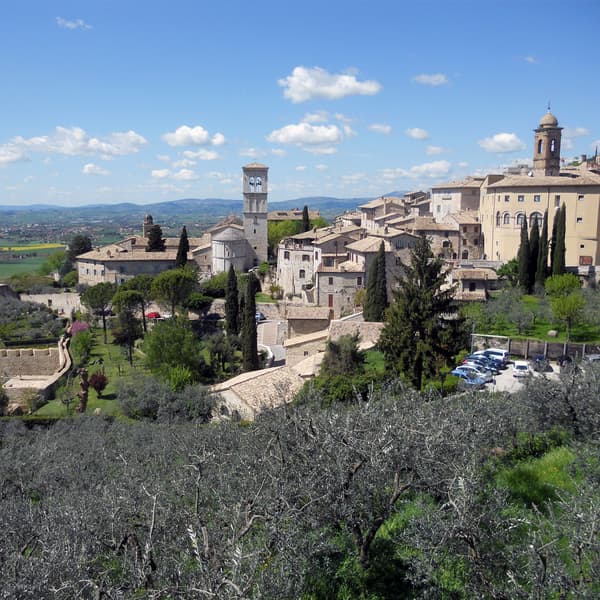
The story of St. Francis and St. Clair. As you gaze out over the valley, consider the next phase in the story of St.
Francis and St. Clair. In 1202, young Francesco Bernadone, Francis, donned armor and rode out to battle the Perugians. Francis was captured and imprisoned for a year.
Read more...Show less
He returned from Perugia a changed man. He avoided friends and his father's lucrative cloth business. He spent more and more time outside the city walls, fasting, praying, and searching for something. He finally found refuge at the humble church of San Damiano.
It's in the valley below you where the olive grove stands today. In 1206, a vision changed his life, culminating in a dramatic confrontation. Francis stood before the town leaders, stripped naked, and threw his clothes at his father. Turning his back on the comfortable material lifestyle, he declared his loyalty to God, alone.
Idealistic young men flocked to be with Francis. Like Jesus, he taught by example, living without worldly goods and aiming to love all creation. He and his followers wandered Italy like troubadours, spreading the joy of the gospel to rich and poor alike. Francis became a cult figure, attracting huge crowds.
They'd never seen anything like it. Sermons preached outdoors in everyday Italian rather than church Latin. Francis made God accessible to all. In the year 1212, Francis met up once again with Claire.
Remember, when Claire was 18, she'd taken a class from Francis at the cathedral. Though she was born rich and noble, she fell in love with Francis' non-materialist message. She made secret arrangements to meet him. The night of Palm Sunday, Claire slipped out of her father's mansion in town and escaped to the valley below.
There, a procession of friars with torches met her and took her to meet Francis. Francis cut her hair, clothed her in a simple brown tunic, and welcomed her into a life of voluntary poverty. Though Claire's father begged, ordered, and physically threatened her to return, she would not budge. Soon, Claire was joined by other women who banded together under the name The Poor Clares.
The order lived in the valley below you, in the church of San Damiano, they planted an olive grove near it, the grove you see today. It's said that Francis himself lived for a time in that same olive grove, in a simple reed hut. It was there that he wrote his poem, The Canticle of the Sun. It goes, Praise for brother sun who brings the day.
His radiance reminds us of you. Praise for sister moon and the stars, precious and beautiful. Praise and bless the Lord and give thanks and with humility serve him. Now, turn your attention to the church. The Basilica of St. Claire
Basilica of St. Clare
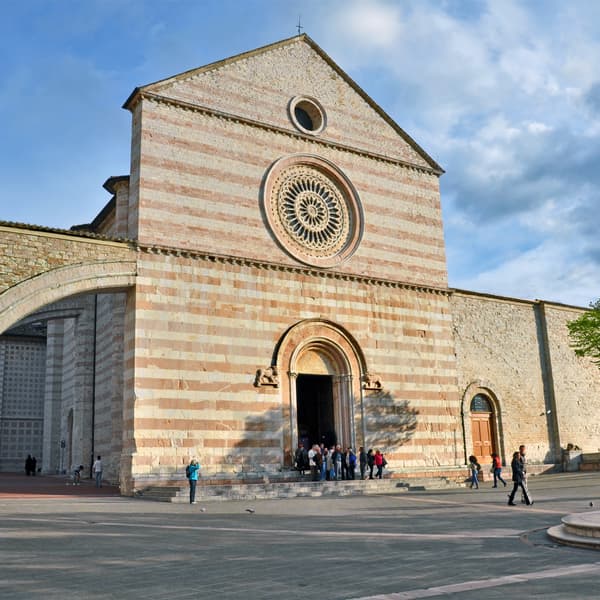
The church is dedicated to Assisi's own favorite daughter who lived from 1194 to 1253. After Claire's death, the Poor Clares needed a more glorious building than their humble church in the valley. In 1265, in 1265, they built the Basilica of St. Claire, though the huge buttresses you see today were added in the next century.
The style, Umbrian Gothic, is simple in keeping with the nuns' dedication to a life of contemplation. The attached convent still houses the community of the Poor Clares, which has flourished now for 700 years. It acts as the global headquarters of all the Poor Clares. Head into the church.
Read more...Show less
Today's whitewashed interior, done in the 1700s, is the home of the Poor Clares, covers the older original frescoes. On the left, find the battered remains of one of the original frescoes. Notice how the fresco surface was hacked up so whitewash would stick. Imagine all the pristine frescoes hiding behind neoclassical and Baroque-era whitewash, here and all over Europe.
On the right-hand side of the church is the Chapel of the Crucifix of San Damiano. It displays the wooden crucifix that changed Francis' life. In 1206, an emaciated, soul-searching, stark-raving Francis knelt before this very crucifix. Back then, the crucifix was located in the church of San Damiano, down in the valley.
Francis begged God for guidance. The crucifix spoke to him. Go and rebuild my church, it said. Rebuild my church, which you can see has fallen into ruin.
Francis followed the call. He physically rebuilt that run-down church, and metaphorically revitalized the Christian church, which had lost touch with the common people. We'll pick up the rest of Francis' story as we continue on our walk. Before leaving the church, make one more stop.
From the nave, head down a set of stairs that lead to a crypt. Here you'll find the tomb of St. Clare. Her tomb is at the far end.
The image you see of Clare's body is actually wax. Her bones lie underneath. As you circulate with the crowd of pilgrims, notice the paintings on the walls. These depict spiritual lessons from Clare's life and death.
After her conversion to Francis' way of life, Clare spent the next 40 years living within the confines of the convent of San Damiano. Her routine was simple, living barefoot, vegetarian, and largely silent. Her days were spent in prayer, meditation, and simple manual labor, especially knowing knitting. Her lifestyle impressed commoners and popes alike, and she was canonized almost immediately after her death.
St. Clare is often depicted carrying a monstrance, a little temple holding the Eucharist wafer. Pause at the opposite end of the crypt, back between the stairs, in a large glassed-in area. Here you'll find St.
Clare's robes. The silver box holds some of her hair. The enormous tunic was made by Clare herself. You'll also see relics of St.
Francis, including a stocking. The bloodstain came from the stigmata, the wounds of Christ, that Francis supposedly received in a miracle. Leave the church. As you exit, pause once again at the viewpoint over the valley.
In the distance is a grand Umbrian view. Assisi overlooks the richest and biggest valley in otherwise hilly and mountainous Umbria. While the municipality of Assisi has a population of 25,000, only 3,500 people actually live in the old town. The lower town grew up with the coming of the railway in the 19th century.
In the distant haze, find the blue-domed church. This is huge St. Mary of the Angels, or Santa Maria degli Angeli. It marks the place where St.
Francis lived, worked, and died. In his day, it was a humble church. Today, it's a major pilgrimage spot, dear to the hearts of all Franciscans. Before moving on, consider this.
Spanish-speaking Franciscans settled in California. Three of their missions grew into major cities. San Francisco was named after St. Francis, Santa Clara after St.
Clare, and the third was named after the church of Santa Maria degli Angeli. We know it as the City of Angels, Los Angeles. Now, from the church square, step out into the street called Via Santa Chiara. From St. Clare
St. Clare to Piazza del Comune
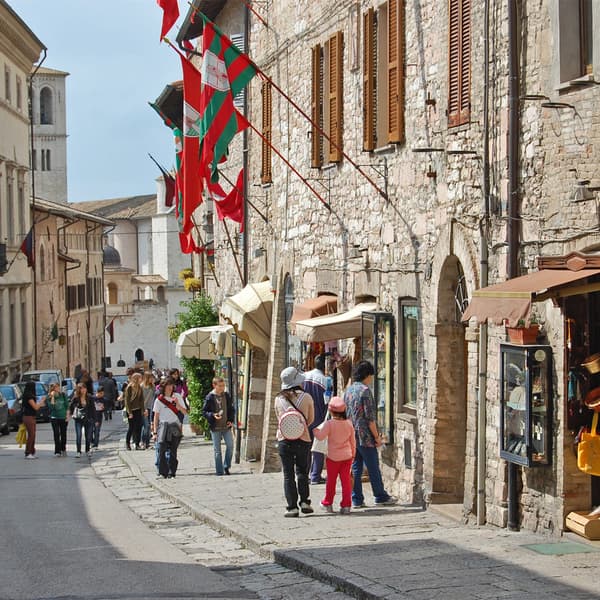
to Piazza del Comune, arches and artisans. Standing in the street called Via Santa Chiara, look left and right to find three old town gates. First, look to the left, uphill on Via Santa Chiara, the high road. This first arch marks the site of the original Roman wall.
In Roman days, this was the extent of Assisi. Now, look right beyond the church. This old gate over the road dates from 1265 as the town expanded during those boom years and the city wall was pushed outward. Further on, you can just make out the crenellations of the third gate, the Porta Nuova.
Read more...Show less
Built in 1316, this new gate marks the final expansion of Assisi before its centuries of slow decline. Now, head left and start walking uphill along Via Santa Chiara. In ancient times, this was the main drag into the city, leading to the main square. Note that as you pass through the old Roman gate, the street's name changes to Corso Mazzini.
These days, the street's lined with interesting shops selling local crafts. In fact, this is my favorite shopping street in the entire city. On the left, at number 20, you'll find the Galleria d'Arte Perna. It sells the medieval fashionwear and fantasy townscapes of Paolo Grimaldi, a local painter who runs this shop with his brother, Alessandro.
Across the street at number 31 is a helpful travel agency. Back on the left, at number 14D, you'll find a shop called Le Ulivo Scultore. It sells olive wood carvings, including beautiful Christmas manger scenes. You'll see creches like this all over Assisi.
That's because the very first nativity scene was supposedly carved by St. Francis himself. He wanted to humanize and therefore more effectively teach the Christmas message. Even today, nearby villages are enthusiastic about their living manger scenes.
And Italians everywhere enjoy setting up elaborate manger scenes in churches at Christmastime. Right next to number 14 is a bakery, Bar Sensi. It sells the traditional raisin and apple strudel called Rochatta. Continue up Corso Mazzini, another shop half block.
On the left at number 2 is Il Duomo. It sells religious art, manger scenes, and crucifixion figurines. Across the street on the right is a respected embroidery shop. Assisi has been known for its textiles since medieval times when St.
Francis' father dealt in the cloth trade. There's even a special embroidery style that features animal motifs done in just two colors. For embroidery buffs, Ooh, I love embroidery! The style's known all around the world simply as Assisi embroidery.
Continue a few more steps up Corso Mazzini until it spills into the bustling square called Piazza del Comune. If you're hungry, La Bodega dei Sappori is worth a visit for its edible and drinkable souvenirs. Stand and soak in the ambiance of Assisi's main square. Piazza del Comune
Piazza del Comune, Temple of Minerva
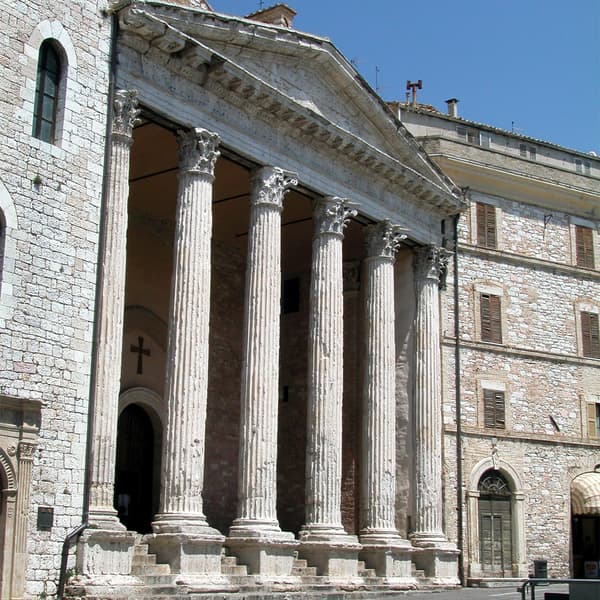
and the Temple of Minerva This square has been the center of Assisi for over 2,000 years. It's a hodgepodge of buildings from the hundred or so generations that have inhabited this spot. In Roman days, Piazza del Comune was an important square with government buildings, a marketplace, and a temple. You can visit some underground remains through the nearby Roman Forum Museum.
The six fluted Corinthian columns mark the entrance to what was the Temple of Minerva. Assisi has always been a spiritual center. The Romans went to great lengths to make this first-century-B.C. Temple of Minerva a centerpiece of their city.
Read more...Show less
Notice the columns that cut into the stairway. It was a tight fit here on the hilltop. In ancient times, the street level was much lower. In fact, the temple stairs originally went down about twice as far as they do today to the main drag, which has gradually been filled in over time.
In the 9th century, the pagan temple became a Christian church, the Church of Santa Maria Sopra, or Over, Minerva. The bell tower is from the 13th century. Pop inside the temple slash church. Today's interior is 17th-century Baroque.
Walk up to the altar. Flanking the altar are the original Roman temple floor stones. You can even see the drains for the bloody sacrifices that once took place here. Behind the statues of Peter and Paul, the original Roman embankment peeks through.
Now, head back outside for more sights on Piazza del Comune. Immediately across the square at number 11, step into the 16th-century frescoed vault of the old market. Notice the Italian flair for design. Even this smelly market was once finely decorated.
The art style is called grotesque, literally, from a cave, or grotto, grotto-esque. The name comes from the fanciful Roman paintings found on the walls of excavated Roman ruins. This scene was indisputably painted after 1492. Indisputably?
How do you know? Because it features turkeys. Turkeys were first seen in Europe after Columbus returned from the Americas with his load of exotic souvenirs. The turkeys painted here may have been that bird's European debut.
Enjoy the bustle of Piazza del Comune. St. Francis probably did. He grew up just a block south of here, in the family home where the Chiesa Nuova stands today.
It's easy to imagine young Francis before his conversion hanging out here, handsome, popular, sitting at the fountain over there, chatting up all the cute ragazzi. Have a seat yourself at the fountain. Enjoy a few minutes of people-watching. Don't you just love Italy?
It's so full of life. In medieval times, within a few hundred yards of this square, on either side were the city walls. Imagine the commotion of 5,000 people confined within these walls. No wonder St.
Francis needed an escape for some peace and quiet. Whenever you're ready to move on, we'll exit the square continuing west. Hike past the temple up the high road via San Paolo. We're headed about 150 yards up the road to via San Paolo 24.
As you walk, think about young Francis after his dramatic conversion. He confronted his rich father. Some say it took place right in the Piazza del Comune, though no one knows for sure. In front of the entire town, he rejected his dad and stripped off his fancy clothes.
Dedicating his life to God alone, he bolted out of town. He wandered the hillsides, seeking direction, from his maker. It was here, away from the hubbub of the city, that Francis eventually found peace. He forged his message of simple living in poverty, where a person could find God in the beauty of nature.
About 150 yards along via San Paolo, across from number 24, look for a sign. A sign? It's just a regular sign, Rick. The sign directs you to the left down a step away. This leads to the Church of Santo Stefano. The Church of Santo Stefano.
Church of Santo Stefano
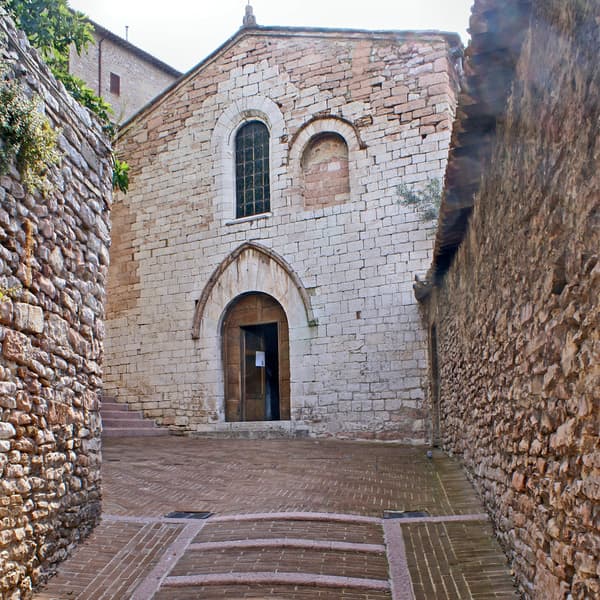
The church is surrounded by cypress, fig, and walnut trees. Santo Stefano used to be outside the town walls back in the days of St. Francis. Today, while well within the city walls, it offers a delightful bit of offbeat assisi.
Step inside. This is the typical rural Italian Romanesque church. There was no architect, just a simple structure built by simple stonemasons who put together the most basic design. And, hundreds of years later, it still stands.
Read more...Show less
The church plays a small role in the legend surrounding St. Francis. On October 3, 1226, Francis lay dying in a small church down in the valley where the massive St. Mary of the Angels church stands today.
Surrounded by his fellow monks, Francis passed away at the age of 45. Legend has it that at the moment he died, the bells of Santo Stefano miraculously rang out. Continue down the lane as it zigzags down to Via San Francesco. We're leaving the piece of suburban assisi and returning to the city's main drag.
When you reach Via San Francesco, turn right. Start making your way west toward the Basilica of St. Francis. Via San Francesco.
Via San Francesco
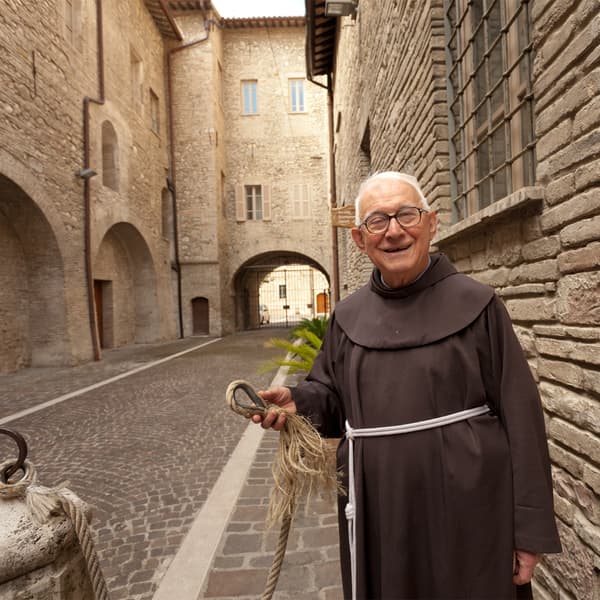
This main drag leads from the town center to the Grand Basilica that houses the body of St. Francis. Francis was a big deal, even in his own day. He was made a saint in 1228, that is, just two years after his death.
The same year he became a saint, the Basilica's foundations were laid. In 1230, his body was moved there. Before long, Assisi was a big-time pilgrimage center, and this street was its booming hub. The arch you pass through marks the end of what was Assisi in St.
Read more...Show less
Francis' day. Notice the fine medieval balcony in the building to the right of the arch. Continue a few yards further down. On the left, cool yourself at the fountain, as medieval pilgrims might have.
The hospice next door was built in 1237, and was built in 1237 to house pilgrims. Notice the three surviving faces of its fresco. There is Jesus, and along with him are his dedicated followers, Francis and Clare. Head a little further down via San Francesco.
Across from No. 12A, on the left, is the Oratorio dei Pellegrini, or Pilgrim's Oratory. This dates from the 1450s. A brotherhood ran a hostel here for travelers passing through to pay homage to St.
Francis. Peek inside. The chapel offers a richly frescoed space in which to contemplate the saint's message. Up ahead stands the grand façade of the Basilica of St.
Francis. As you approach, you'll pass lots of people. Pilgrims, tourists in shorts, Franciscans in robes. The Franciscans wear brown robes with a hood tied with a rope and sandals.
They aspire to live a simple life, like the first Christian himself, Jesus. Franciscans are not necessarily priests. Most are just ordinary people like you and me who've been touched by the message of Francis. They've all taken Francis' vow of obedience, chastity, and poverty.
They see themselves as brothers or friars, part of the human family. For many of these Franciscans, a journey here is the pilgrimage of a lifetime as they visit their spiritual Mecca, the town of Assisi. Assisi is still warmed by the spirit of St. Francis, on this walk we've traveled from Roman times through the town's medieval heyday to the very place where St.
Francis rests. The town still bears his mark. When Francis passed away, he left a legacy of humanism, equality, and love of nature that lives to this day. We hope you've enjoyed this walk through Assisi.
If you're up for more sightseeing, we have another audio tour that covers the Basilica of St. Francis. Thanks to Gene Openshaw, the co-author of this tour. This tour was excerpted from the Rick Steves Italy Guidebook.
For more details on eating, sleeping, and sightseeing here, refer to the most recent edition of that guidebook. For more free audio tours and podcasts, and for information about our guidebooks, TV shows, bus tours, and travel gear, visit our website at ricksteves.com. This tour was produced by Cedar House Audio Productions. Grazie. Arrivederci. And ciao for now.
Free
GPS-guided walking tour
No account needed. Walk at your own pace.
Free
13 stops ·