13 stops
GPS-guided
35 min
Duration
Free
No tickets
About this tour
A guided tour of Florence — Bargello Museum in Italy with 13 stops. Highlights include The Bargello Museum, Bacchus: Michelangelo, and Pitti Tondo: Michelangelo.
13 stops on this tour
The Bargello Museum
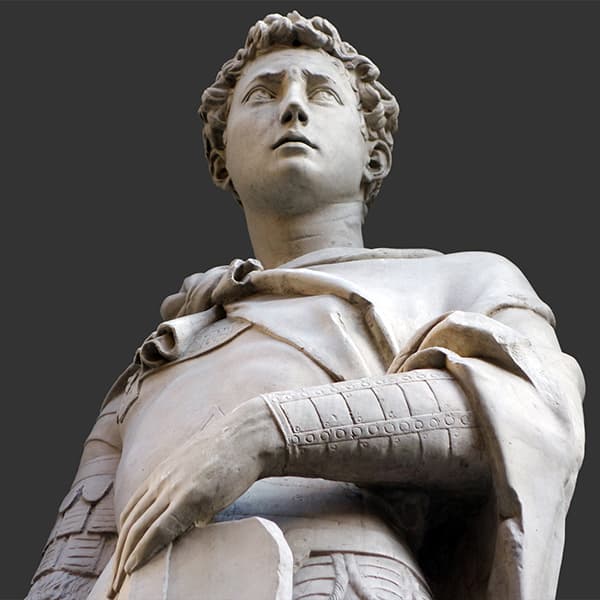
The Bargello Museum. The Renaissance began with sculpture when artists rediscovered the beauty of ancient statues. You can see the birth of this revolution in the Bargello, the best collection anywhere of Florentine sculpture. Hi, I'm Rick Steves.
Benvenuti, welcome, and thanks for joining me on this walk through the Bargello Museum. The Bargello is a small, uncrowded place, a pleasant break from the intensity of Florence. On our walk, we'll see statues by the Renaissance all-stars. We'll start right off with some minor Michelangelo statues.
Read more...Show less
Or is minor Michelangelo's an oxymoron? We'll get a glimpse of the impressive scope of Michelangelo's work over the course of his long career. We'll also see works by Donatello, the first great Renaissance sculptor who inspired the Bargello Museum. And we'll stand before two small sculptures that some have called the very first works of the Renaissance.
Now, let's head in and see 150 years of great statues spanning the history of Florence's heyday. And it's all set in a rustic palazzo with a medieval atmosphere, the Bargello. To help us along the way, I've invited a good friend and virtual travel buddy. Buongiorno, Lisa.
Ciao, Riccardo. Lisa will give us helpful directions and sightseeing tips throughout the tour. And my first tip is to be sure you get our tour updates. Just press the icon at the lower right of your device.
You'll find any updates and helpful instructions unique to this tour. Things like closures, opening hours, and reservation requirements. There's also tips on how to use this audio device to tour, and even the full printed script. Yes, so pause for just a moment right now to review our updates and special tips.
It's okay, we'll wait. And then... Let the tour begin! The tour begins.
Tour Begins
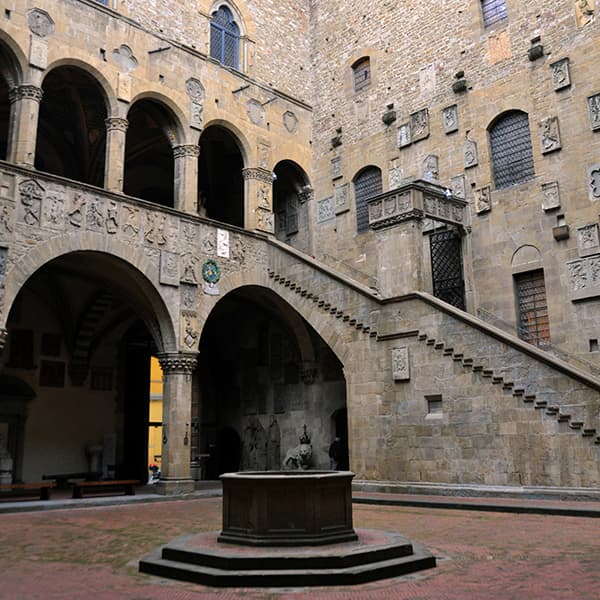
We'll start in the museum's open-air courtyard. So after buying your ticket, pass into the courtyard and find a comfortable spot. Here, away from the museum, away from the bustle of Florence, it's cool and peaceful. Take in the stone walls that rise up around you, the statues that line the arcades, and the whole 13th-century ambiance.
Ric? The Bargello, built in 1255, was Florence's original city hall. In fact, from the outside, the Bargello actually looks like a mini Palazzo Vecchio. It also functioned as the police station, or Bargello.
Read more...Show less
Look at those stone walls. The heavy fortification makes it clear that keeping the peace in medieval Florence had its occupational hazards. Take a moment to stroll around the courtyard. Check out the interesting array of statues.
Get a feel for sculpture in general and the medium of stone in particular. Sculpture is a much more robust art form than painting. Think of the engineering challenges alone. First, you have to quarry and cut the stone.
Then, transport the stone. Then, transport the four-ton block to the artist's studio. Then, all the hours of chiseling away chips. That's followed by the painstaking process of sanding the final product by hand.
It seems like a sculptor has to be strong enough to gouge into the stone, but delicate enough to groove out the smallest details. Here's a viewing tip. Every statue has an invisible frame around it. That's the rectangular shape of the stone block it was cut out of.
Visualizing this frame helps you find the center of the statue's composition. Sculpture was the perfect medium to express the Renaissance spirit of humanism. A statue shows the human form, standing alone, independent of church, state, or society, ready to fulfill its potential. Think of Michelangelo's approach to sculpting.
He wasn't creating a figure. He was liberating it from the rock that surrounds it. Let's go see a sculpture. Let's see some Michelangelo's now.
Lisa. All right. Our tour consists of just two large rooms. One is upstairs.
Note the stone staircase here in the courtyard. But we'll start here, on the ground floor, in the room at the foot of that staircase. So head into that room. As you enter, turn left.
You're greeted by a tall marble statue of a nude man, or rather, of a party animal. ♪♪ Bacchus, by Michelangelo.
Bacchus: Michelangelo
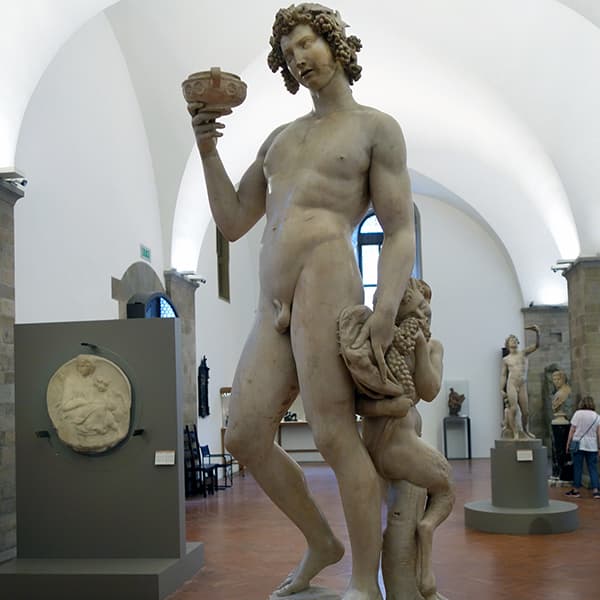
Bacchus, the Greek god of wine, raises another cup to his lips. Salute! Cheers! Bacchus is completely naked.
As an ancient pagan god should be. He has the traditional grapes in his hair. His body is covered in grapes. His pose is classic contrapposto, with his weight on one foot and slightly raising the other.
Read more...Show less
At Bacchus' feet is an impish satyr, a mythological creature with goat legs. He lovingly embraces his beloved grapes and takes a bite. This satyr has been called the first twisting serpentine figure since ancient times. When Michelangelo did this statue, Italy was in the grip of the Renaissance.
They were infatuated with ancient culture. They were infatuated with ancient gods, ancient statues, and the pagan spirit. But this statue of Bacchus takes that rowdy pagan spirit to an almost ridiculous extreme. This god of wine looks a bit...
Well, Lisa, how would you describe him? Well, the Italians might say he's un po' brillo, a bit tipsy. Tipsy? Lisa, look at him.
His eyes are glazing over. He's starting to tip backwards. He's definitely not steady on his feet. I hope he's not driving.
He's even got a bulging beer belly. Face it, Bacchus is downright drunk. Ubriaco, as the Italians would say. You're right.
He is ubriaco. He's molto ubriaco. In fact, he looks ubriaco fradizio, blind, soaking, drunk. He's ubriaco come una pina, drunk as a pine cone.
Pine cone? You could even say he's ubriaco come a chimia, drunk as a monkey. And if you ask me, it looks like he's stumbling home from an orgy. Mm-hmm.
Making the walk of shame. And I'm afraid that Bacchus is going to wake up with one big spronza. A hangover. This statue was sculpted around 1496 when Michelangelo was only 21.
It was his first major commission. 1496? Wasn't that about the time when Florence was dominated by Savonarola? Exactly.
Savonarola, the fire and brimstone preaching monk, had taken control of the city and driven out the Medici. Savonarola hated Renaissance art. He couldn't handle fleshy nudes and anything that celebrated the pleasures of the senses. Young Michelangelo fled to Rome.
There, he kept the free spirit of the Renaissance alive. In fact, this Bacchus seems almost like the anti-Savonarola, young Michelangelo's way of saying to Savonarola, F.U. As you look at Bacchus, mentally compare this statue with Michelangelo's more famous statue of David. Where David is sturdy, balanced, and noble, Bacchus is just the opposite.
Bacchus is raucous. He has a gaping mouth and stupid eyes. His flesh sags and his bulging stomach is bigger than his pea-brained head. Frankly, Bacchus was not a success with the man who commissioned it.
He wanted something more classically classical. But that's the beauty of Michelangelo, always taking risks, pushing the envelope, exploring new cities, exploring new styles. So let's take a look at another Michelangelo sculpture. It's 180 degrees different from the decadence of Bacchus. You'll find it just a few steps from Bacchus. Look for A Circular Relief. The Pititondo,
Pitti Tondo: Michelangelo
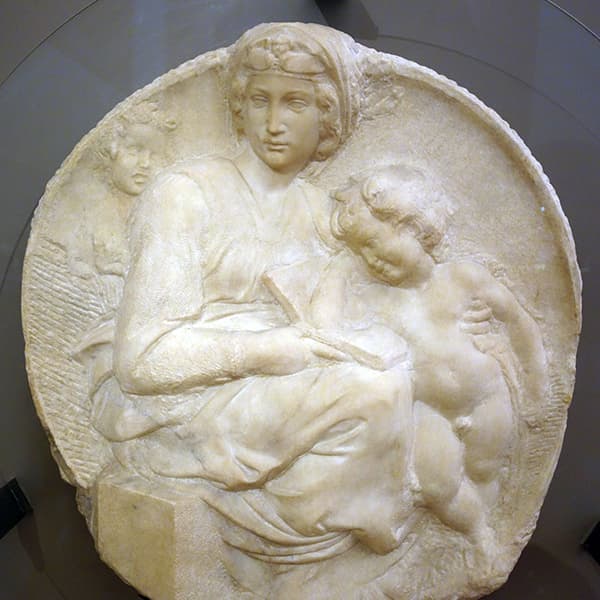
also known as Madonna and Child with the Young St. John by Michelangelo. This round marble relief shows a simple family scene. The Virgin Mary sits trying to read a book, but baby Jesus, with an impish smile on his face, leans in and tries to get his mom's attention by blocking her view.
To the left of Mary, in the hazy background, is Jesus' cousin, little Johnny the Baptist. This work was done for the wealthy Pitti family, who built the palace that stands today across the Arno River. This was sculpted just a few years after Bacchus. Savonarola had been toppled from power, and Michelangelo had returned to Florence.
Read more...Show less
The twenty-something sculptor was at the peak of his powers, with the commissions just pouring in. First, Florence hired him to build the monumental statue of David. Then, in a complete change of pace, Michelangelo turned to his next project, this quiet, small-scale relief. The round format is called a tondo.
In the early 1500s, circular paintings and reliefs like this were very trendy. Working within the ready-made circular frame, Michelangelo created an interesting composition. The Madonna sits perfectly upright, perfectly vertical. Meanwhile, her forearms and thighs go almost perfectly horizontal.
Jesus curves lovingly around his mom, echoing the round frame. It all reinforces the idea of a mother and child enfolded in a warm circle of family love. Michelangelo, then adds the third dimension, depth. You see it in the bench Mary's sitting on that juts outward.
Also, her face rises out from the stone like a cameo. Finally, Michelangelo added something new to the standard tondo format. Notice how Mary's head actually pops out from the top of the frame, so it's not too confining. Hey, Rick, the tondo is obviously unfinished.
Like John the Baptist, he's only sketched out. And with Jesus, his feet are still mired in the marble. And on the left and right, you can still see the patches of rough chisel marks that haven't been smoothed out yet. Yes, you can almost see Michelangelo at work.
Like those rough chisel marks on the left and right, that's how he first chipped into the marble to reveal the figures in the center. Then he sketched out the main outlines, things like the bench and Mary's legs. Both of those are nearly finished. Mary's blouse, that looks half finished, half not.
Yes. Notice his distinctive cross-hatch technique. Some chisel marks go one way, some the other. It was yet to be polished.
I can see some of the fine details starting to emerge, like Mary's headband, which has a tiny image of a face. That was from the final stage, which was polishing. Many sculptors left that grunt work to their assistants. But notice that, even though it's only half finished, Michelangelo has already begun polishing the most important element of this entire work, the smooth face of Mary, the Mother of Christ.
Before moving on, compare this pristine tondo with the party animal, Bacchus. These two poles, Christian and pagan, the sacred and the profane, would be themes in Michelangelo's work throughout his long life. The next work by Michelangelo is just steps away. Find the marble bust, the head and torso of a man. ¶¶ ¶¶ ¶¶ ¶¶ Bust of Brutus
Bust of Brutus: Michelangelo
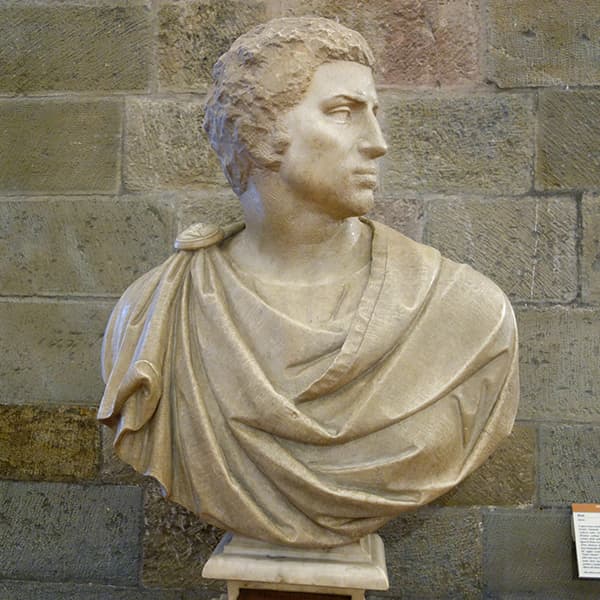
by Michelangelo This bust of a man is so ugly, it's beautiful. His features are not classically handsome. He turns to the side, suspiciously. And he's certainly intense, an intensity that's compelling.
His furrowed brow says he'll succeed against all odds. ¶¶ It's a dignified and heroic quality that might be missing if he were too pretty. The subject is Brutus, the Roman who assassinated Julius Caesar. A.2.
Read more...Show less
Brute? A. Yes, Lisa, that guy. Remember, Brutus was conflicted.
On the one hand, Caesar was his friend and mentor. On the other, Caesar had become a dictator and had to go. Michelangelo shows both sides of this political assassin. First, ¶¶ Brutus on the right side of Brutus' face, the view from the front.
From this angle, Brutus looks more heroic. He gazes strongly toward the horizon, looking like a man who'll do anything for his country. Now, check out the other side. You can view it a few steps to the right.
Here you see his drooping mouth and squinting eye. It makes him look more cunning, sneering. ¶¶ The kind of man who could murder a close friend with a knife. ¶¶ When Michelangelo was sculpting this around 1540, he was also conflicted.
Florence had come under the thumb of a Medici tyrant. Michelangelo left for Rome, where he sculpted this for a fellow Florentine in exile. Michelangelo could feel Brutus' moral dilemma. On the one hand, he was loyal to the Medici, his adopted family.
But he also resented what they'd become and lamented the loss of Florentine democracy under Medici. ¶¶ The result is a statue that captures the complexity of a good man trying to make his way in difficult times. Our final Michelangelo statue is also nearby. ¶¶ David, also known as Apollo,
David/Apollo: Michelangelo
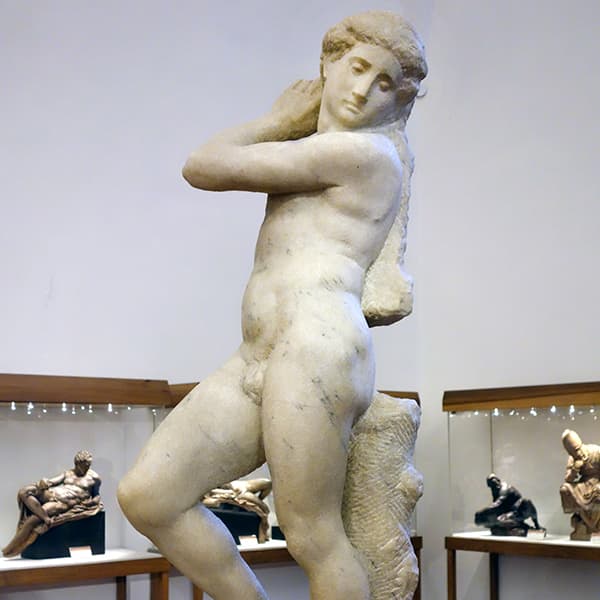
by Michelangelo. This naked man is shown twisting and reaching back with his left arm. No one is sure whether it's true that it's supposed to be David reaching for his sling or Apollo reaching for an arrow. The statue is smaller than life-size and rather demure.
He's a far cry from Michelangelo's more famous larger-than-life David. This statue is also unfinished. Check out David's upper back. He's either unfinished or David's got one crazy mullet.
Read more...Show less
By the way, we'll see three more Davids upstairs by other artists. As you check out each one, compare and contrast the styles of David's and the styles of these artists. Before moving on from Michelangelo, peruse the glass display cases in the corner. These have small-scale copies of some of Michelangelo's most famous works.
Nearby, there's a portrait of the man himself. Look around for a dark bronze bust of a brooding Michelangelo. This is Michelangelo at the time of his death at age 89. It was done by his friend and fellow sculptor, Danielle, L.A.
da Volterra. He made it from Michelangelo's death mask. The bust clearly captures Michelangelo's broken nose and his brooding nature. Think of this man's output, David, the Pietà, the Sistine Chapel, and the Dome of St.
Peter's in Rome. That he could create so many works that were so different is the genius of Michelangelo. Before we head upstairs, let's check out several other statues in this room. These are by some of the sculptors that Michelangelo influenced. Look around and find two small statues in a glass case next to a pillar. Statues by Cellini
Statues by Cellini, Giambologna
and Giambologna. The statues in the display case are labeled Models of Perseus, 1545 to 1555. by Benvenuto Cellini. They depict Perseus slaying Medusa, the monster with her hair of snakes.
These are the miniature working models of Cellini's famous life-size statue that now stands next to the Palazzo Vecchio. That statue was made using the difficult cast bronze method. So Cellini used these smaller versions, one in wax and one in bronze, to work things out. Next to the models, note the exquisite pedestal with four fine bronzes.
Read more...Show less
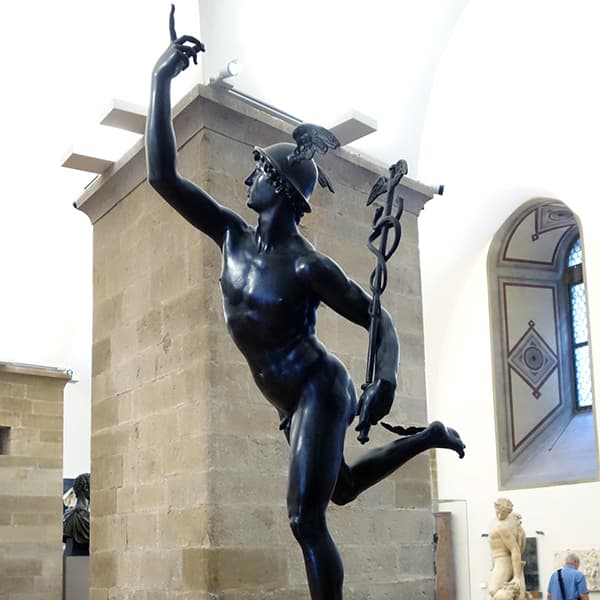
This was built to support Cellini's statue of Perseus. Next up, nearby, find another bronze statue, the well-known Flying Mercury by Giambologna. Mercury, the messenger of the Roman gods, is on the move. He's got flowers to deliver.
Ah, yes. The statue became famous as the logo of a well-known flower delivery company. Despite all the bustle and motion, this statue has a solid Renaissance core. The line of balance runs right up the center from toes to hip to fingertip.
Mercury is frozen in mid-stride. His top half leans slightly forward. That's counterbalanced by his right leg in back. And all that motion is anchored by a solid center of gravity that rests firmly at Mercury's hip bone.
And down at Mercury's toes, I like the Cupid. Looks like he's practicing for the circus. Okay, we've seen works by my friend, Michelangelo, and works by Renaissance artists he influenced. Now, let's head upstairs and see how the whole Renaissance thing got started.
To get upstairs, exit the room back out into the open-air courtyard. Once in the courtyard, start climbing the stone staircase. As you go up, wind your clock back about a hundred years from the art we just saw. It's Florence, circa 1400.
Michelangelo has not yet been born. Even though he's in the Renaissance has yet to be born. Let's see some of the groundbreaking statues that got it all started. When you reach the balcony at the top of the stairs, turn right.
You enter a large hall topped with Gothic arches and dotted with statues. Cross to the far wall and find a statue in the middle of the wall. We're looking for a marble statue depicting David. In this room, there are three different Davids.
We'll start with the earliest of them and see if they're how the Davids evolved over the course of the Renaissance. So, in the middle of the far wall, find a marble statue of a proud young man wearing a robe with a long skirt. An Early David
Early David: Donatello
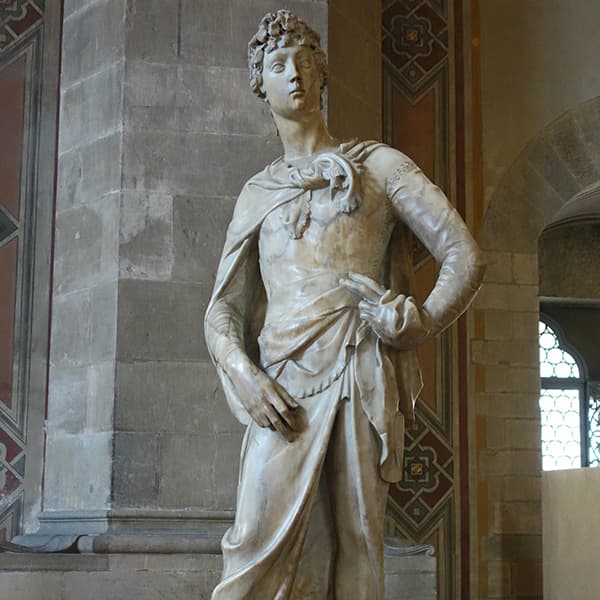
from around 1408 by Donatello. This work in marble is Donatello's first take on the popular subject of David, slaying the giant Goliath. Donatello was the first great Renaissance sculptor. He mastered realism, creating the first truly lifelike statues of people since ancient times.
Donatello sculpted this when he was only 22. You can see how Donatello still had one foot in the old Gothic world. First, like so many medieval statues, David is fully clothed, dressed like a medieval knight. He's not nude, like later Renaissance works would be.
Read more...Show less
Still, David is showing a bit of leg through his slit skirt. I wonder where he bought it. David's face is generic and his eyes are blank. He looks less like a real person than some anonymous saint on a church facade.
You'd hardly even guess it was David, except for the severed head of Goliath at his feet. To make the story clear, Donatello plants a huge rock right in the middle of Goliath's forehead. Check out David's pose. His right leg makes his body sway in the Gothic style.
On the other hand, his left leg is firmly planted in the Contrapposto Renaissance. Now step behind the statue. See how flat it is, not yet fully three-dimensional. This statue was designed not to be freestanding, but up against a wall, connected with a hook.
The Renaissance still had a ways to go. There's a completely different take on David just a few steps away. Start circling the room clockwise. The next step is the same subject, but by a different artist. David by Andrea del Verrocchio.
David: Andrea del Verrocchio
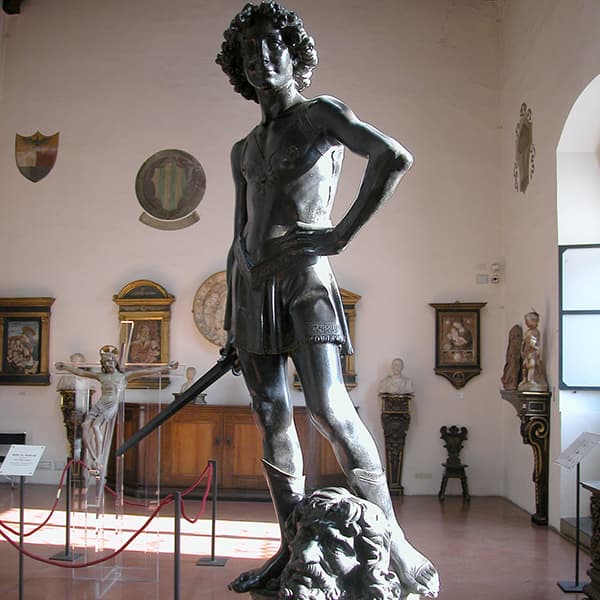
Verrocchio's bronze David is much more boyish. He's more like the shepherd boy described in the Bible. He's young and handsome with lush curly hair. David leans on one leg, but it's not your classic Contrapposto.
This is not a firm commanding stance, but a nimble one. That's especially noticeable from behind. Verrocchio is best known as the teacher of Leonardo da Vinci, but he was also the premier sculptor of the generation after Donatello, but before Michelangelo. Some have speculated that this statue was actually modeled on a real-life Florentine of that day, none other than Verrocchio's young, handsome, curly-haired apprentice, Leonardo da Vinci.
Read more...Show less
By the way, note David's David's smile. Compare that smug smile of the victor with Goliath's expression of defeat. Yeah, Goliath seems to say, oh, have I got a headache. Let's continue on. Keep circling the hall clockwise. Near the corner is a well-known bronze statue of our final David. David,
David: Donatello
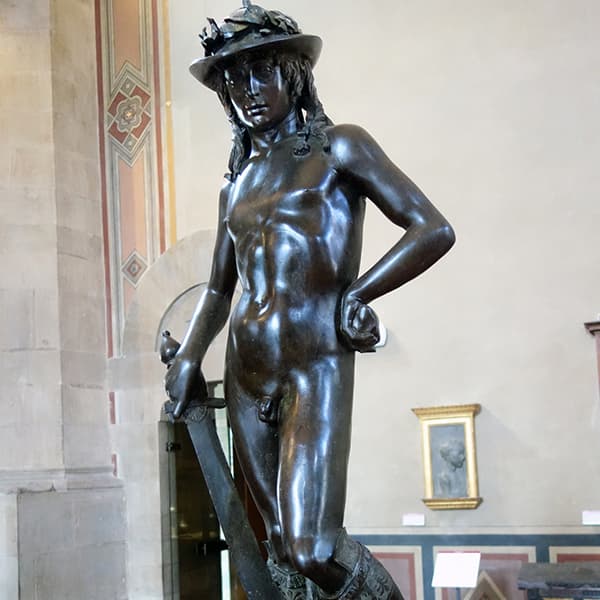
by Donatello. He's naked. Donatello portrays David as a nude teenager. He's wearing only a helmet, boots, and sword.
His skin is smooth and he sways gracefully. He pokes his sword playfully at the severed head of Goliath. By the time Donatello sculpted this, around 1440, he'd become the master of the bold new Renaissance style. Notice how David's leg is planted fully contrapposto, resting his weight on one leg.
Read more...Show less
But here, the pose gives the statue a more feminine rather than masculine look. Gazing into David's coy eyes and at his soft belly, it's a very different experience from confronting Michelangelo's more famous David. Where Michelangelo's is an older and sturdier Renaissance man, this statue is a mere Renaissance boy. Donatello's bronze David was the first freestanding male nude Europe had seen in a thousand years.
That was extremely bold. In the Middle Ages, the human body was considered a dirty thing, a symbol of man's weakness, something to be covered up in shame. But with the Renaissance, a new class of rich and powerful merchants appeared, and they bought art simply for enjoyment. Donatello's David invites you to walk around.
Start circling clockwise. From the side, you see his ramrod-straight-right leg. It's echoed by the sword he carries. Around back, glance up at David's neck.
On the hair, there are still traces of the original gilding. Check out David's prominent buttocks, clearly those of a young man, almost a boy. Now, check out the head of Goliath. David's toes curl around the severed head, drawing your attention to it.
Notice the huge feathers on the giant's helmet. It directs the viewer's eyes sensually up, up, and up to David's inviting backside. Donatello's David stood in the Medici home. That's today's Medici-Riccardi Palace.
Michelangelo grew up there, admiring this very statue, the most bold statement yet of the growing movement known as the Renaissance. Donatello was groundbreaking in so many ways. From the idealized youth of David, let's see a more down-to-earth statue. Look behind David, and you'll see a colorful bust of a man along the wall. Nicola da Uzzano
Niccolò da Uzzano: Donatello
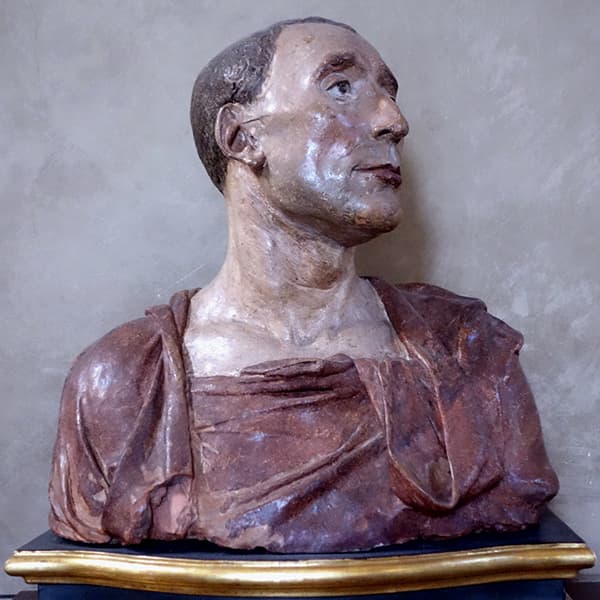
by Donatello Scholars continue to debate whether this bust is by Donatello or his student, Desiderio da Settignano. Either way, it's a marvel of Renaissance realism. The bust, depicts not an emperor, not a king, not a pope, saint, or prince, but a typical Florentine businessman. Signor Uzzano was also a politician, so he's dressed here in a toga, like a Roman senator.
In the 1400s, Florence was inventing the European Renaissance, and that also meant democracy. There was an optimistic spirit. It celebrated everyday people. Uzzano was shown just as he must have looked, an everyday guy, with wrinkles and bags on his face, under his eyes.
Read more...Show less
He's caught in mid-motion, candid, like he's turning to greet a friend. The statue is done in terracotta, that's glazed ceramic. It's molded in clay, painted, then fired. Whether this is by Donatello or his student, it clearly shows the realistic style Donatello is so famous for.
Unlike the ancient Greeks, who always sculpted idealized gods and perfect humans, Donatello caught people's individual quirks. Like this guy, he's hardly pretty, but his ugliness has a nobility that captures his proud spirit. Donatello's groundbreaking realism greatly influenced later artists. And Donatello's personality also became a model for later artists.
He was notoriously moody and prickly. He purposely set himself apart from others to concentrate on his sculpting. Donatello developed the role of the mad genius that Michelangelo would later perfect. Now, let's see one final statue by Donatello, the mad genius of the Renaissance.
The statue stands above eye level in a niche in the wall at the end of the room. St. George by Donatello
St. George: Donatello
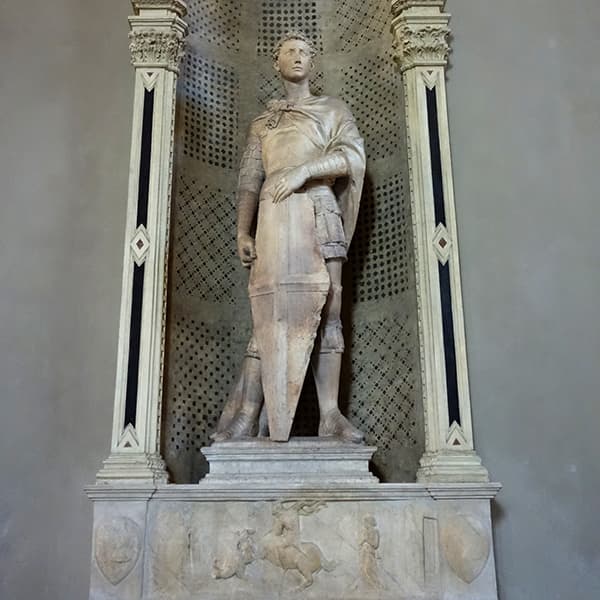
George is a proud warrior with both feet planted firmly on the ground. He stands on the edge of his niche looking out, alert. He tenses his powerful right hand and scans the horizon. He's the picture of confidence, calm, but ready to attack.
St. George was the legendary slayer of dragons. The cross on his shield makes it clear he was a Christian, just the sort of righteous warrior that proud Florentines could rally around as they battled nearby cities. George represented how they, powered by God, could slay dreaded dragons like Milanese, Fon, Pisa, and Siena.
Read more...Show less
This is the original marble statue that Donatello carved around 1417. It was designed for a niche at Orsanmicheli Church where a copy stands today. That means George stood in one of the most prominent spots in town along the main drag. No wonder that this statue came to be the unofficial symbol of a proud Florence on the rise.
Nearly a century later, Michelangelo would be inspired to create his own proud statue as a symbol of Florence. David, note the similarities. Both are Christian warriors overcoming their enemies. Both have powerful right hands, and both exude an air of relaxed intensity and intelligent determination.
This was the spirit of the Renaissance. Check out the relief panel below the statue. The scene shows George actually doing what he's been pondering, charging with his lance raised to slay the dragon and save the poor maiden. Get up close and you can make out the sketchy arches and trees.
These simple details create the illusion of a distant landscape, of depth. Donatello had apprenticed for Ghiberti, the man who did the famous reliefs for the baptistry doors. Donatello, the apprentice, is often credited with actually teaching his master how to create 3D illusions like this. And speaking of Ghiberti, let's finish our tour with his landmark early work.
On the wall next to George, you'll find some bronze relief panels. But don't look at them yet. What? Well, you can look at the panels, but at least don't read the labels just yet.
All right. We'll admire these two bronze panels from a discrete distance while Rick, hopefully, explains why we can't read the labels. The Baptistry Door Competition
Baptistery Door Competition Entries
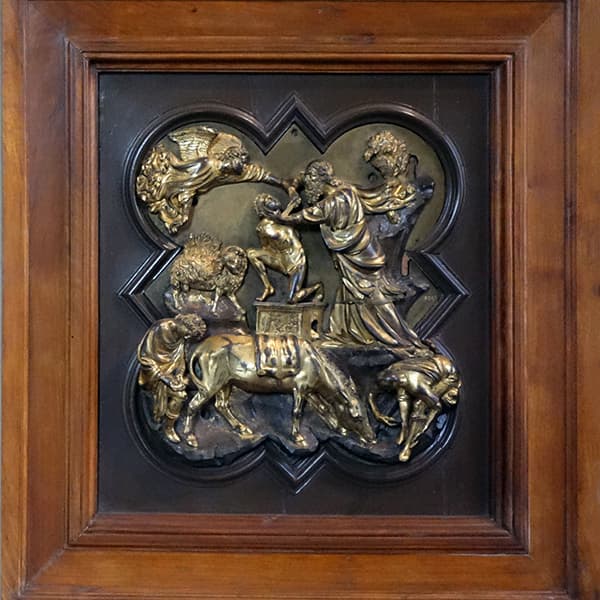
entries by Ghiberti and Brunelleschi. Some would say these two relief panels represent the very first works of the Renaissance. The year is 1401, and the city of Florence is having a contest to decide who should renovate the baptistry with new bronze doors. All the great artists entered.
These two panels, by Lorenzo Ghiberti and Filippo Brunelleschi, were the finalists. Spoiler alert, Ghiberti's panel won. But don't look at the labels just yet to see whose is whose. Right.
Read more...Show less
Ghiberti won. Yay! Brunelleschi lost. Oh.
But no, that was a good thing. Yay! Because Brunelleschi lost, it freed him to go on and design the famous Dome of the Cathedral, or Duomo. Yay!
That contest involved 1401 started an artistic revolution that would grow into the Renaissance. Now, let's take a closer look at the panels. Both depict the same subject, the sacrifice of Isaac from the Bible. They're both masterpieces.
Compare and contrast. Both artists catch the crucial moment when Abraham, obeying God's orders, is about to kill his only son as a sacrifice. At the last moment, after Abraham has passed this test of faith, an angel of God appears to stop the bloodshed. Lisa, what do you think?
Is one panel clearly better than the other? Well, hmm. I like the one where Abraham is right in the center. Look how he pulls the knife back, ready to strike.
Yeah, that is super dramatic. I pick that panel. You know, I like the other one. It has the boy Isaac in the center, crouched on the altar.
That gives the composition a focus with everything else arranged around it. Below Isaac, there's a horse and a couple of servants. Great examples of early Renaissance realism. Also, look how the angel swoops in from the upper left to grab Abraham's arm.
Now, that's dramatic. Oh, yeah? Well, look at my angel. He comes straight out of the panel right at you.
Yeah, like I wish I had my 3-D glasses. And look at my Isaac. He's ripped like a classical statue. So real and so vulnerable.
So, you know, I'm sorry, Rick, but your Isaac is pretty wimpy. And look at my Abraham's face. Man, he is intense. It makes you glad the angel's there to zoom in and out of nowhere and save the boy in the nick of time.
Whew. So, who's panel one? Well, it was obviously a tough call, but the winner was, drumroll please, Ghiberti's. Yes, we already know that.
But which panel is Ghiberti's? It's yours. Yes, I'm number one in your face, Steve's. Yeah, yeah, you were right.
Ghiberti's was chosen and for all the reasons you said. But also because he was trained as a goldsmith, which made him better suited for the technical end of things. It also may have simply come down to money. Ghiberti's proposal was to use the lost wax technique.
This was less expensive than Brunelleschi's panels, which were to be of solid bronze. Whatever the reason, Ghiberti got the gig, and that started a historic chain of events. Ghiberti went on to make the famous baptistry doors, the ones so popular with tourists. Meanwhile, Brunelleschi was free to build his awe-inspiring dome.
And Donatello graduated from Ghiberti's workshop to revolutionize sculpture. All three of these artists inspired Michelangelo, who built on their work and spread the Renaissance all across Europe. And it all started with Ghiberti. These panels.
Our tour is done, but there's much more to see from the dynamic Renaissance. On this floor, you can browse jewelry, ivories, and traditional Tuscan ceramics. There's even an upper floor with medallions, armor, colorful terracotta, and models of famous statues. The Bargello has it all, from swords to statues, from Bacchus to Brunelleschi.
From David to David to David to David. The Bargello makes it clear that Florence was the birthplace of the Renaissance. We hope you've enjoyed our Bargello tour. Thanks to Gene Openshaw, the co-author of this tour.
If you're up for more sightseeing, we have more audio tours covering the great sights of Florence for the Uffizi Gallery, the Academia, featuring Michelangelo's David, the Museum of San Marco, and a Renaissance walk through Florence. Remember, this tour was excerpted from the Rick Steves' Florence and Tuscany Guidebook, co-authored with Gene Openshaw. For more details on eating, sleeping, and sightseeing in Florence and environs, refer to this year's edition of that guidebook. For more free audio tours and podcasts, and for information about our TV shows, bus tours, and travel gear, visit our website at ricksteves.com.
This tour was produced by Cedar House Audio Productions. Grazie. Arrivederci. And buon viaggio. © transcript Emily Beynon
Free
GPS-guided walking tour
No account needed. Walk at your own pace.
Free
13 stops ·