20 stops
GPS-guided
61 min
Duration
Free
No tickets
About this tour
A 20-stop walking tour through the heart of Italy. Visit The Uffizi Gallery, Giotto: Madonna and Child, Simone Martini: Annunciation, and Gentile da Fabriano: Adoration of Magi — with narrated stories at every stop.
20 stops on this tour
The Uffizi Gallery
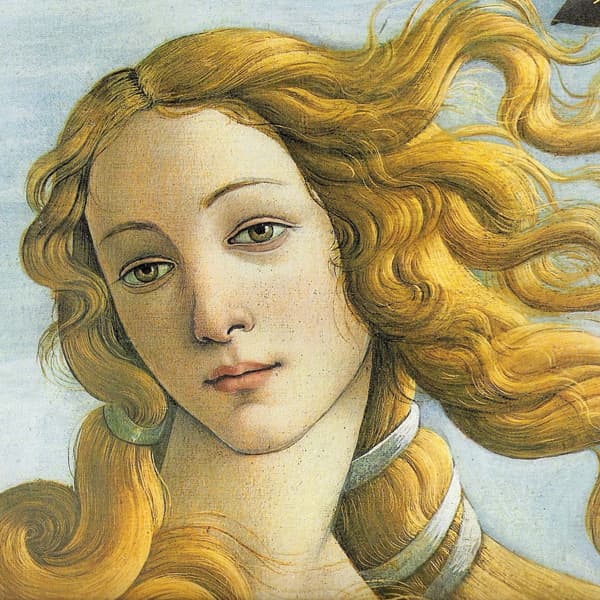
The Uffizi Gallery. In the Renaissance, Florentine artists rediscovered the beauty of the natural world. The Uffizi Gallery shows this beauty in all its three-dimensional realistic glory, capturing the optimistic spirit of the Renaissance. Hi, I'm Rick Steves.
Thanks for joining me on a guided walk through the best collection anywhere of Italian Renaissance painting. We'll see some of the essential masterpieces of the Renaissance. Botticelli's Birth of Venus, a Madonna by Michelangelo, the Venus de' Medici statue, and the first-known brushstrokes by 14-year-old Leonardo da Vinci. What makes the Uffizi especially instructive is that it's laid out in roughly chronological order.
Read more...Show less
A walk through here is like watching the Renaissance blossom before our eyes. We'll trace the evolution of art from flat and solemn to three-dimensional and lively, with all the human drama. Our visit culminates with that holy trinity of Renaissance painters, Leonardo, Michelangelo, and Raphael. They captured the sheer beauty of the movement we call the Renaissance.
Be warned, though, that the Uffizi is crowded, so book an advanced reservation, check out my guidebook for details, and allow yourself about 90 minutes to do justice to this audio tour. Now, let's get started as we dive into this colorful and groundbreaking collection in one of the world's greatest museums, the Uffizi. To help us along the way, I've invited a good friend and virtual travel buddy. Welcome, Lisa.
Ciao, Riccardo. Lisa will give us helpful directions and sightseeing tips throughout the tour. And more. And my first tip is to be sure you get our tour updates.
Just press the icon at the lower right of your device. You'll find any updates and helpful instructions unique to this tour. Things like closures, opening hours, and reservation requirements. There's also tips on how to use this audio tour and even the full printed script.
Yes, so pause for just a moment right now to review our updates and special tips. It's okay, we'll wait. Now, let's get those lights on. Let's get those little Uffizis moving. And let the tour begin. The tour begins.
Tour Begins: Top Floor
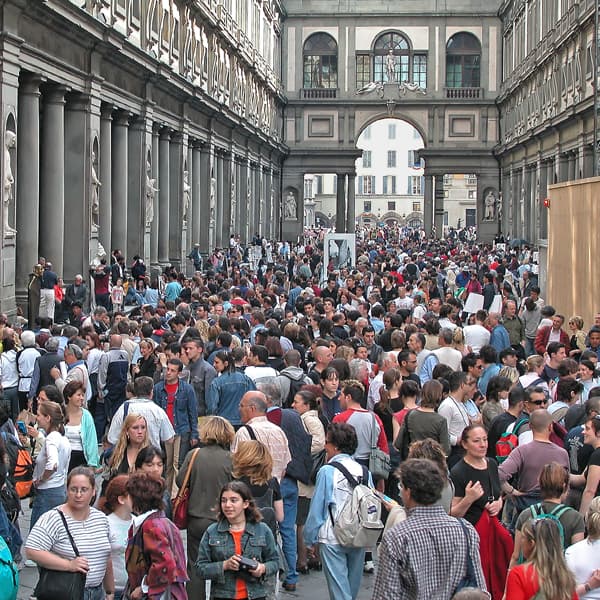
The top floor. Our tour starts on the Uffizi's top floor. So enter the Uffizi and walk up the four long flights of the monumental staircase to the top floor. Your brain should be fully aerated from the hike up.
It'll take a couple of minutes, so pause the audio guide and restart it once you reach the top floor. See you there. By now, you should be on the top floor. While you catch your breath, look out the window as Rick explains the museum's layout.
Read more...Show less
As you can see, the Uffizi is U-shaped, running around the courtyard. As we circle this floor, we'll see Italian art unfold chronologically. First come medieval altarpieces. We'll see how early Renaissance Florentine painters took these stiff, symbolic Madonnas and saints and fleshed them out, adding three-dimensional realism and human detail.
Next, we'll stroll through a connecting wing of sculpture from the ancient world, seeing works in stone that inspired the Renaissance painters. Finally, in the front, we'll see a view of the Uffizi. In the far wing, we'll see the culmination of the Florentine Renaissance, Leonardo da Vinci, Michelangelo, and Raphael. As we tour the Uffizi, we'll see the evolution of 3-D realism and follow painting as it evolves from symbolic Madonnas to human Marys to pristine goddesses.
Let's get started. Head down the hall and enter the first door on the left, room A4. We'll start in medieval times, when art was as flat-out as a book. As flat as the world. Enter room A4, with its gold-backed altarpieces. Face Giotto's giant, Madonna and Child. Giotto, Madonna and Child,
Giotto: Madonna and Child
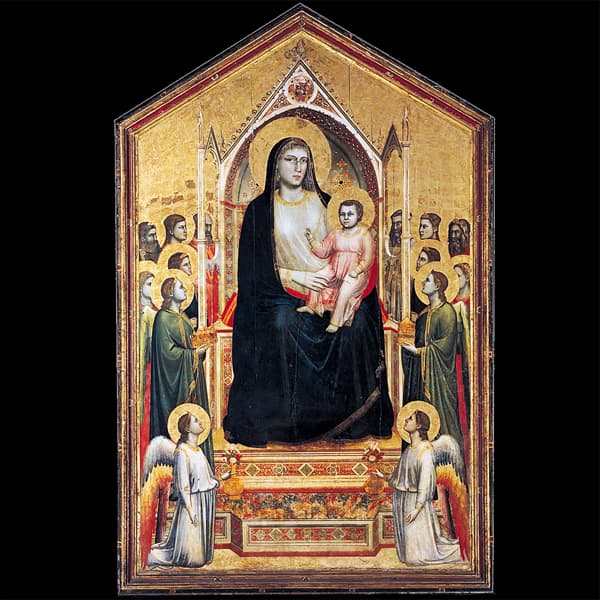
from around 1310. Mary and baby Jesus sit on a throne in a golden never-never land symbolizing heaven. It's as if, most medieval Christians couldn't imagine holy people inhabiting our dreary material world. It took Renaissance painters to bring Mary down to earth and give her human realism.
For the Florentines, realism meant 3-dimensionality. They saw the beauty of God in nature and in the human body. They used math and science to capture the natural world on canvas as realistically as possible. Giotto's Madonna and Child is just one altarpiece in this room.
Read more...Show less
Check out a couple of others. The three similar-looking Madonnas and Bambinos in this room, all painted within a few decades of each other around the year 1300, show baby steps in the march to realism. Duccio's piece, on the left as you face Giotto, is the most medieval and two-dimensional. There's no background.
The angels are just stacked one on top of the other, floating in a golden atmosphere. Mary's throne is crudely drawn. Notice that the left side is at a three-point distance. The right side is at a three-quarters angle, while the right is practically straight on.
Mary herself is a wispy cardboard cut-out figure that seems to float just above the throne. Nice try, Duccio, but not exactly realistic. On the opposite wall, the work of Cimabue is an improvement, mixing the iconic Byzantine style with budding Italian realism. The large throne creates an illusion of depth.
Mary's foot actually sticks out over the lip of the throne. Still, the angels are stacked totem-pull style, like heavenly bookends. Now return to the Giotto Madonna. Giotto uses realism to make his theological points.
He creates a space and fills it. Like a set designer, he builds a three-dimensional stage, the canopied throne, then peoples it with real beings. The throne has angels in front, prophets behind, and a canopy over the top, clearly defining its three dimensions. Steps leading up to it lead from our space to Mary's, making the scene an extension of our world.
But the real triumph here is Mary herself, big and monumental, like a Roman statue. Beneath her robe, she has a real live body with knees and breasts that stick out. This three-dimensionality was revolutionary in its day, giving us a sneak peek at the Renaissance a century before it began. Now step into room A1, to the left of Giotto, where you'll find a gold-backed painting of Mary visited by a kneeling angel. Simone Martini,
Simone Martini: Annunciation
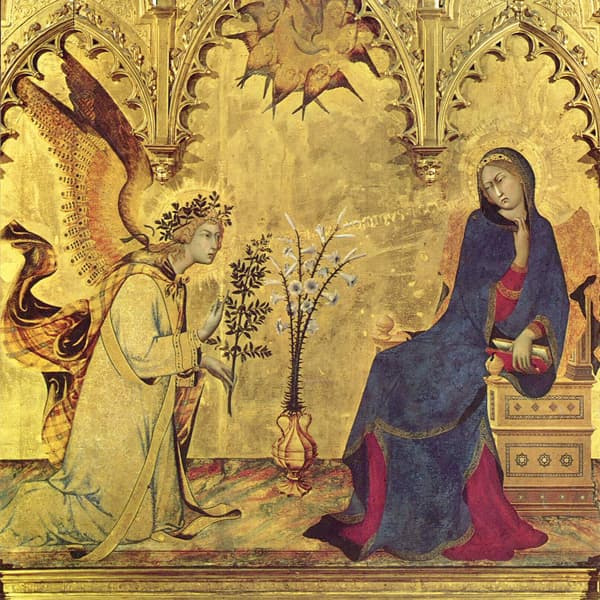
the Annunciation, from 1333. In this late medieval work, the artist boils things down to just the basic figures needed to get the message across. The angel appears to sternly announce to Mary that she'll be the mother of Jesus. In the center is a vase of lilies, a symbol of Mary's purity.
Above is the Holy Spirit as a dove about to descend on her. If the symbols aren't enough to get the message across, Simone Martini has spelled it right out for us in Latin. Ave gratia plena. Hail, favored one, the Lord is with you.
Read more...Show less
Mary doesn't look exactly pleased as punch. This is not a three-dimensional work, the point was not to recreate reality, but to teach religion, especially to the illiterate masses. This isn't a beautiful Mary, or even a real Mary. She's a generic woman without distinctive features.
We know she's pure, not from her face, but only because of the halo and because of the symbolic flowers. Before the Renaissance, artists didn't care about realism or about the beauty of individual people. Past through, room A6, and into the big room called room A7. It's full of golden altarpieces.
As you go, notice how so many of these paintings have the same medieval features. Religious subjects, gold backgrounds, two-dimensional, and with meticulous detail. Though these paintings lack photographic realism, they're certainly impressive. They create a solemn, spiritual atmosphere that was made to order for the churches they graced.
At the far end of room 7 hangs our next painting, a colorful work in an ornate, golden frame. By the way, if you can't find a particular painting I mention, it may have just been moved to an adjoining room. The Uffizi likes to keep things fresh by occasionally shuffling things around. You're looking for a big, colorful painting with a parade of people coming to greet the baby Jesus. Gentile da Fabriano,
Gentile da Fabriano: Adoration of Magi
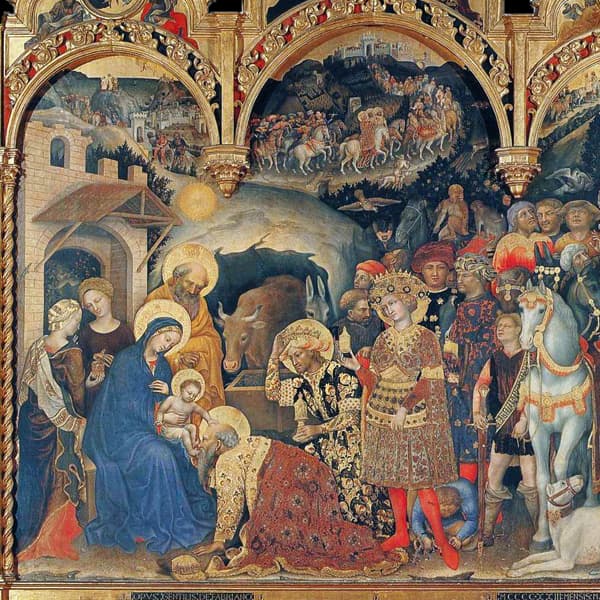
Adoration of the Magi, from 1423. Look at the incredible detail, the three kings' costumes, the fine horses, and the cow in the cave. The panel is filled from top to bottom with realistic details, but it's far from realistic. While the Magi worship Jesus in the foreground, the scene showing their return trip home dangles over their heads in the so-called background.
This is a textbook example of the international Gothic style popular with Europe's aristocrats in the early 1400s. It features well-dressed, elegant people in a colorful, design-oriented setting. The religious subject is just an excuse to paint secular luxuries like brocade-patterned clothing and jewelry. And the scene's background and foreground are compressed together to create an overall design that's pleasing to the eye.
Read more...Show less
Such exquisite detail work raises an interesting question. Was Renaissance 3D truly an improvement over Gothic or just a different style? Well, we can start answering that question next since the early Renaissance is just ahead. Exit room 7 at the far end where you'll hang a U-turn left into room A8.
You'll find our next several paintings from the early Renaissance in either room 8 or, more likely, in the following room, room A9. Look around until you find a big, dark painting of a battle scene, a tangle of men and horses. Paolo Uccello,
Paolo Uccello: Battle of San Romano
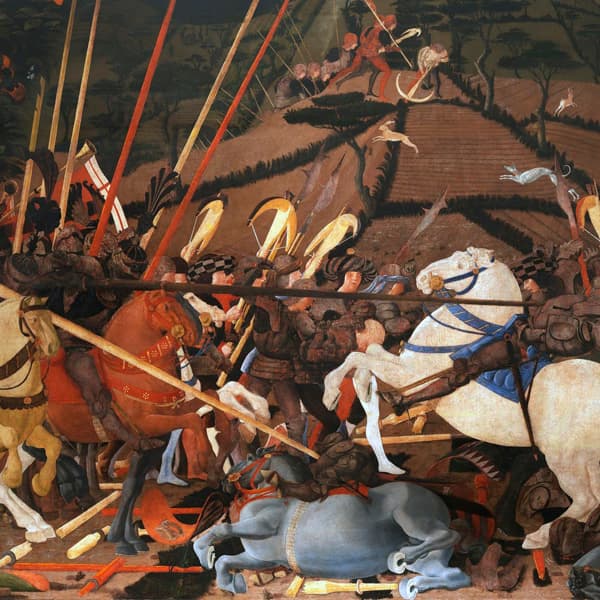
The Battle of San Romano, from circa 1435. This large painting, ten feet wide, captures the decisive moment when Florence rose to prominence in Italy. It's a battle between Florence and its arch-rival, Siena. Horses rear and knights tumble to the ground as the Florentine forces charge in from the left with their lances and crossbows.
At the peak of the battle, the Florentine captain the guy on the left on the red horse drives his lance straight into Siena's general, the knight on the white horse. The knight falls backward and the Sienese forces are routed in chaos. This painting also captures the decisive moment when early Renaissance painters first achieved victory in their long battle to master 3D. The key to achieving realism was to create the illusion of three-dimensionality on a two-dimensional canvas.
Read more...Show less
In this painting, Paolo Uccello challenged himself with every possible problem. And this colorful battle scene is not so much a piece of art as an exercise in linear perspective. Notice how the broken lances to the left set up a kind of 3D grid. Then, Uccello places this crowded scene onto that grid.
Closer objects, like the horses, are bigger than objects further away. The fallen horses and soldiers are experiments in foreshortening. Take the fallen gray horse in the center. Uccello had to paint his hooves, which are closer to us, nearly as big as his head, which is farther away, in order to create the illusion of distance.
Some of the figures are definitely A-plus material, like the gray horse. The white horse at the far right that's walking away is also well done. But some are more like B-minus work. The kicking red horse's legs look like ham hocks at this angle.
And look at the fallen soldier in the bottom right corner. If this man stood up, he'd be the size of a child. B-minus work? Some of it looks more like D-minus.
Are you on drugs work? Like the farmland in the background. It's supposed to be way in the distance, but the way the hedges converge make it look like it's right behind the cluster of soldiers. And the farmland looks really steep.
Yeah, and those soldiers running around the fields, they're supposed to be hundreds of yards away, but they're as big as the soldiers in the foreground. And the rabbit jumping the hedge, what is he, 40 feet tall? Okay, okay. But artists like Uccello did make great strides in paintings.
This was way back in the 1400s. In fact, it's said that Uccello almost literally went crazy trying to master the three dimensions. I guess he got so wrapped up in it, he kind of lost perspective. Eh, I give that joke two stars.
And I think that's generous. Our next painting is also in room A9. Find a painting of Mary and Baby Jesus. Mary has her hands folded in prayer, and Baby Jesus is being lifted up by playful angel boys. Fr. Filippo Lippi,
Fra Filippo Lippi: Madonna and Child
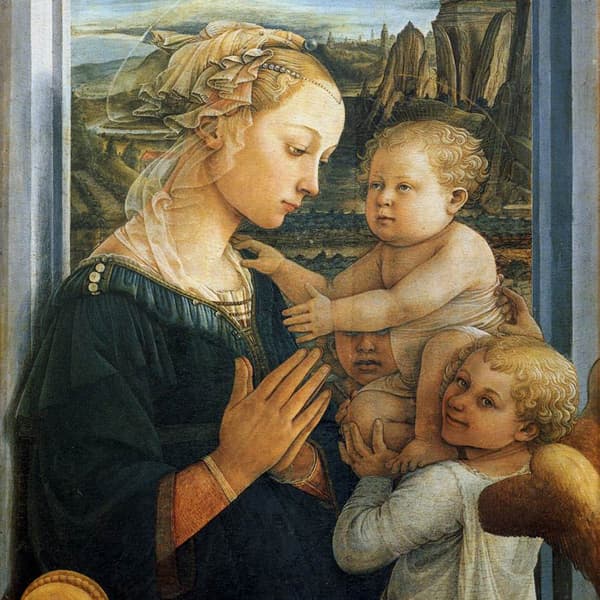
Madonna and Child with Two Angels, from 1465. Mentally compare this Mary with the generic female in Simone Martini's Annunciation. We don't need the wispy halo over her head to tell us she's holy. She radiates sweetness and light from her divine face.
Heavenly beauty is expressed by a physically beautiful woman. Fr. Filippo Lippi, or Brother Lippi, an orphan raised as a monk, lived a less-than-monkish life. He lived with a nun who bore him two children.
Read more...Show less
He spent his entire life searching for the perfect virgin. Through his studio passed the prettiest girls in Florence, many of whom decorate the walls here in this room. Lippi painted idealized beauty, but his models were real flesh-and-blood human beings. You could look through all the thousands of paintings from the Middle Ages and not find anything so human as the mischievous face of one of Lippi's little angel boys. Nearby is a freestanding gold frame displaying portraits of a man and wife. Piero della Francesca
Piero della Francesca: Portraits
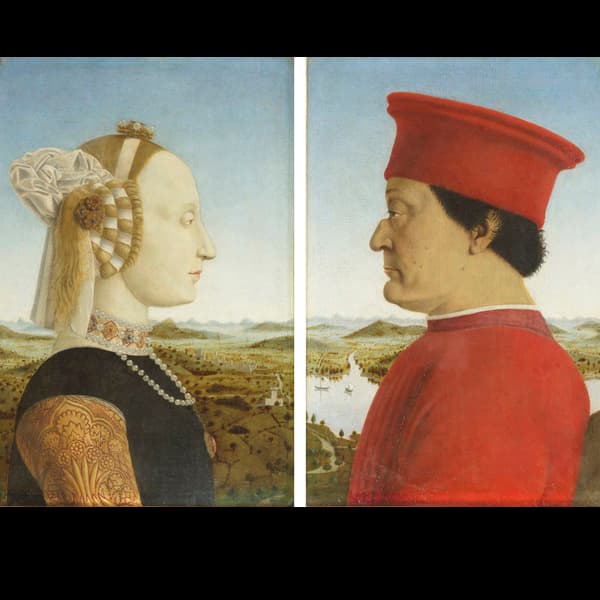
Portraits of Federico da Montefeltro and Battista Sforza Piero della Francesca from circa 1475. In medieval times, only saints and angels were worthy of being painted. But in the humanistic Renaissance, even less-than-holy folk, like this couple, had their features preserved for posterity. Federico, in the Red Fez, was a champion of the budding Renaissance.
His wife, Battista, spoke several languages and bore seven children before the age of 25. Wow! I'm doing the math, and letting that sink in. Their friends described the loving couple as like two bodies sharing one soul.
Read more...Show less
Now they're two masterpieces in one frame, gazing into each other's eyes for eternity. By the way, the usual way to do a double portrait like this was to put the man on the left. But Federico's right side was definitely not his best. He lost his right eye and the bridge of his nose fighting in a tournament.
Nevertheless, Renaissance artists discovered the beauty in ordinary people and painted them. Literally, words and all. Let's continue our walk through the Renaissance. Enter room A10.
There, we'll be introduced to an artist with an even stronger passion for depicting flesh-and-blood human beings in all their glory. In room A10, find a glass display case. It has two small works by Polaiwolo. By who? Polaiwolo. I just want to know if you wanted to hear me say it again. Antonio Polaiwolo,
Antonio Pollaiuolo: Labors of Hercules
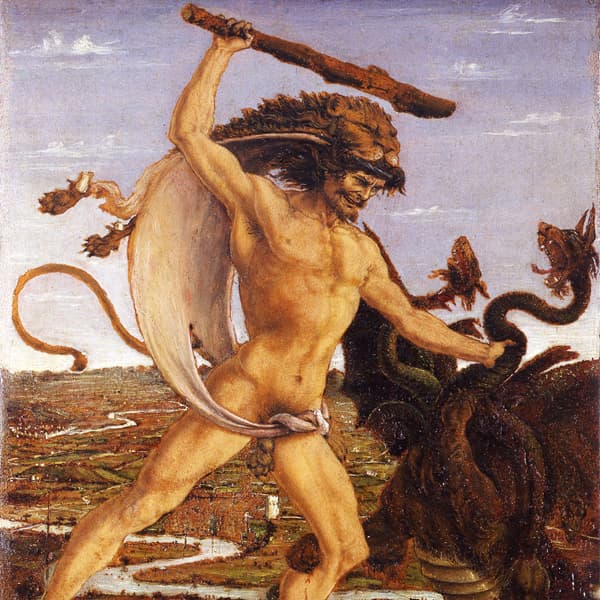
The Labors of Hercules, from 1475. Hercules gets a workout in these two small panels showing the human form at odd angles. He raises a club to battle the monstrous Hydra and picks Antaeus off the ground like a Renaissance WWF champ. The poses are the most wildest imaginable to show how each muscle twists and tightens.
While Uccello worked on perspective, Polaiwolo studied anatomy. In medieval times, dissection of corpses was a sin and a crime. The two were one back then. Dissecting was considered a desecration of the human body, the temple of God.
Read more...Show less
But Polaiwolo was willing to sell his soul to the devil for artistic knowledge. He dissected. Hmm. You know, there's something funny about this room that I just can't quite put my finger on.
I've got it. Look around. No Madonnas. There's not one anywhere.
Wait a minute. Isn't that a Madonna? Nope. You're probably looking at a classical allegory, not a Christian Madonna.
We're entering an era where Venus, the classical goddess of love, becomes as important a symbol as Mary, the mother of Christ. We've seen how early Renaissance artists struggled to conquer reality. Now let's see the fruits of their labor, the flowering of the Florentine Renaissance. Step into the large Botticelli room.
It's officially labeled rooms A, 11, and 12, but it's really just one big hall, perfect for browsing around. Take a minute just to soak up the colorful ambiance of large paintings by Botticelli and others as Rick sets the scene. piano plays in bright rhythm piano plays in bright rhythm
Florence: The Renaissance Blossoms
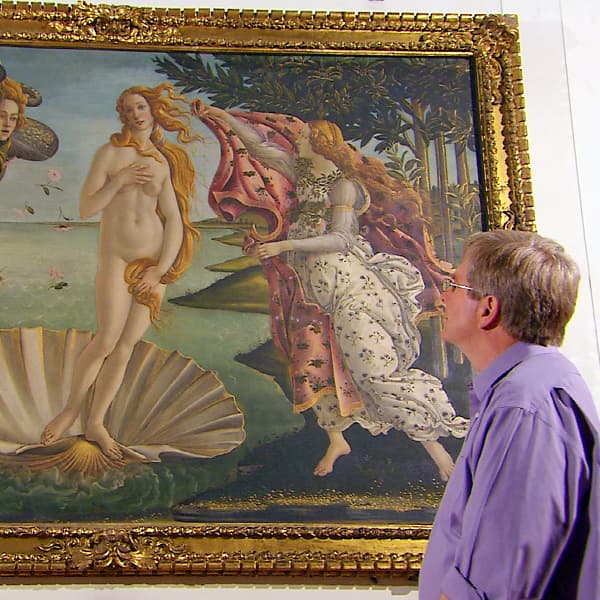
Florence, the Renaissance Blossoms. Stroll around and peruse these remarkable paintings, big, beautifully composed, and full of interesting details. The subject matter is a harmonious blend of Christian and classical, Madonnas and goddesses, saints and contemporary Florentines. These paintings reflect the prosperity and sophistication of Renaissance Florence at its peak.
Think about the optimistic generation that produced such works of beauty. The city of Florence around 1480 was a Firenze of activity. There was a can-do spirit of optimism in the air, led by prosperous merchants and bankers and a strong middle class. The government was reasonably democratic and Florentines saw themselves as citizens of a strong republic, like ancient Rome.
Read more...Show less
Their civic pride showed in the public monuments and artworks they built. Man was leaving the protection of the church to stand on his own two feet. Lorenzo di Medici, head of the powerful Medici banking family, epitomized this new humanistic spirit. Strong, decisive, handsome, poetic, athletic, sensitive, charismatic, intelligent, brave, clean, and reverent, Lorenzo was a true Renaissance man.
He deserved the nickname he went by, the Magnificent. He gathered the best and brightest of Florence for evenings of wine and discussions of great ideas. Their thoughts, writings, paintings, and taste in clothes set trends all over Europe. One of this circle was the painter Sandro Botticelli.
Another was a teenager named Michelangelo Bonaroti. In that heady time, it seemed that anything was possible for Lorenzo and his circle of artists, thinkers, and bon vivants. They felt as though the beauty of the world around them was a reflection of the God who created it. Michelangelo, who grew up to be a sculptor, painter, and architect, was also a poet, and he summed up their belief that pure beauty was the path to spiritual enlightenment.
My eyes love things that are fair, and my soul for salvation cries, but neither will to heaven rise unless the sight of beauty lifts them there. Lift your eyes up and find out Find our next painting. It's a large canvas showing Greek gods frolicking in a lush, green orchard. Sandro Botticelli,
Sandro Botticelli: Allegory of Spring
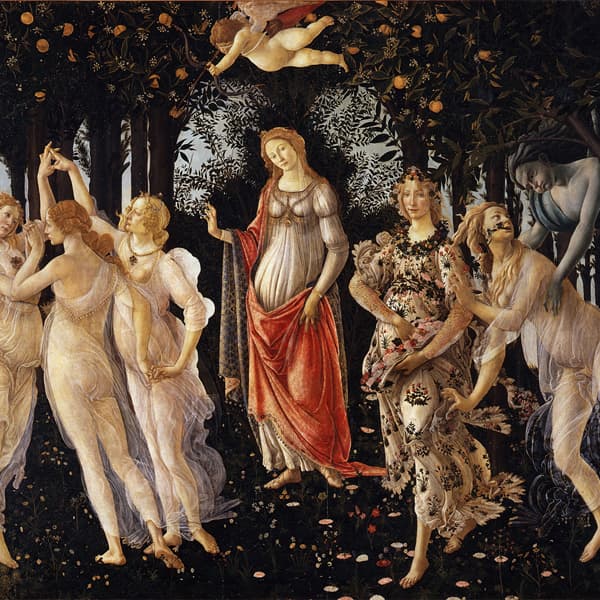
Allegory of Spring, or La Primavera, from about 1478. It's springtime in a citrus grove. The winds of spring blow in. That's Mr.
Blue on the right, causing the woman on the right to sprout flowers from her lips as she morphs into flora, or springtime. She walks by, spreading flowers from her dress. At the left are Mercury and the three graces dancing a delicate maypole dance. The graces may be symbolic of the three forms of love, love of beauty, love of people, and sexual love, suggested by the raised, intertwined fingers.
Read more...Show less
In the center stands Venus, the Greek goddess of love. Above her flies a blindfolded Cupid, happily shooting his arrows of love without worrying who they'll hit. This is the Renaissance in its first bloom, its springtime of innocence. Madonna is out, Venus is in.
Adam and Eve, hiding their nakedness, are out. Glorious flesh is in. This is a return to the pre-Christian pagan world of classical Greece, where things of the flesh are not sinful. But this is certainly no orgy, just a return to the first fresh-faced innocence and playfulness.
Botticelli emphasizes pristine beauty over gritty realism. The lines of the bodies, especially of the graces in their see-through 90s, have pleasing S-like curves. The faces, while idealized, have real human features. Venus, as the goddess of earthly love, is patterned after the Christian Mary, the saint of divine love.
In La Primavera, Venus is even framed by a kind of halo made of leaves. She wears the same tender expression of a church altarpiece and presides over a scene of pure love. But La Primavera was secular, not painted for a church. It adorned a Medici pleasure villa.
It was soon joined by an even more central Botticelli painting. In that one, Venus would cast off her robes completely for a full-frontal celebration of earthly love. For that, turn to Botticelli's most famous work and one of the masterpieces of Western art, The Birth of Venus. Or, as many tourists like to say, Venus on the Half Shell. It's not hard to find The Birth of Venus. She's always surrounded by a sea of admirers. Botticelli,
Botticelli: Birth of Venus
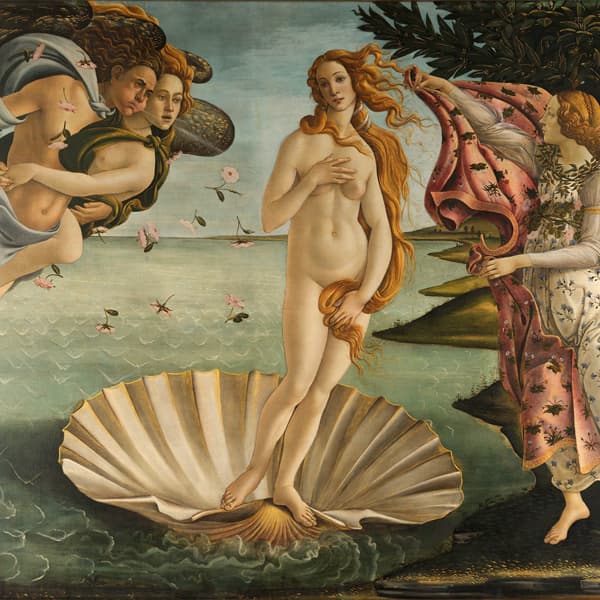
The Birth of Venus, from circa 1485. This work was written in the 18th century. It was revolutionary. It was the first large-scale painting of a naked woman in a thousand years.
It seemed to sum up the growing secular culture of Renaissance Florence. According to legend, Venus, the goddess of love and beauty, was born from the foam of a wave. Botticelli depicts her as like a fragile newborn, still only half-awake, blown by the god of wind. That's Mr.
Read more...Show less
Blue on the left. Venus floats ashore on a scallop shell. There, her maid waits to dress her in a rich robe fit for a goddess. Botticelli does everything possible to please the eye.
His pastel colors make the world itself seem fresh and newly born. He was trained as a goldsmith, so he mixed real gold into the paints. This adds a special radiance to the details. Yeah, I can see it.
It adds a special luster to Venus's hair. The scallop shell, the wind's wings, and even the sun-sparkled grass. The god of wind sets the whole scene in motion. Everything ripples like the wind.
Venus's flowing hair, the waves on the water, the swirling robes, and the jagged shoreline. It even looks like Venus's wavy hair echoes the curves of her body. Mrs. Wind has to hold on tight to her man as their bodies, wings, and clothes intertwine.
In the center of all that wavy motion stands the god of wind. It stands the still, translucent form of Venus, looking like she's etched in glass. Botticelli painted this after a trip to Rome, where he was inspired by the ancient statues he saw there. He gave Venus the same S-curve body in modestly placed hands as classical Venuses.
But as realistic as Venus may seem on first glance, in fact, Botticelli tweaked realism to amp up the beauty. Frankly, the anatomy is impossible. It's impossible. Venus's neck is too long, and she stands off-kilter.
Venus's maid even seems to float above the ground. And Mrs. Wind? How exactly does she wrap that leg around her man?
With the birth of Venus, Botticelli was creating a more ethereal beauty. It's a perfectly lit world where no one casts a shadow. The bodies curve, the faces are idealized, and their gestures exude grace. Venus's nakedness is not so much erotic as innocent.
Botticelli thought that physical beauty was a way of appreciating God. Remember Michelangelo's poem. Souls will never ascend to heaven until the sight of beauty lifts them there. Venus's beauty could arouse and uplift the soul, giving a spiritual longing for heavenly things.
Before we move on, gaze one more time into the eyes of Venus. She's deep in thought, but about what? Around her, flowers tumble in the slowest of slow motions, suspended like musical notes caught at the peak of their brief life. Venus's expression has a tinge of melancholy, as if knowing how quickly beauty fades and how innocence will not last forever.
To complete the picture of Florence in its prime, let's see one final painting by Botticelli. It's one of the smaller canvases in this big room, so you may have to search a bit to find it. It shows a chaotic scene of people in robes jostling, pointing, and hair-pulling. It all takes place against a backdrop of classical arches and statues. It's Botticelli's La Calunia. Botticelli, La Calunia,
Botticelli: La Calunnia
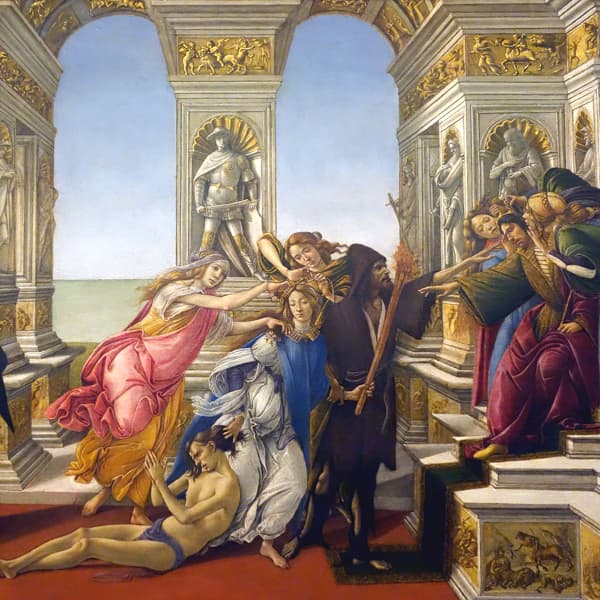
or The Calumny of a Palace, from Sorrento, circa 1495. The springtime of Florence's Renaissance had to end. Lorenzo died young. The economy faltered.
Into town rode a charismatic monk named Savonarola, preaching medieval hellfire and damnation for those who embraced the pagan Renaissance spirit. Down, down, he roared, down with all gold and decoration, down where the body is food for the worms. Savonarola presided over huge boxes and bonfires in front of the Palazzo Vecchio, where the people threw their fine clothes, jewelry, pagan books, and even paintings. This painting, Slander, spells the end of the Florentine Renaissance.
Read more...Show less
The setting is classic Renaissance architecture, but look what's taking place beneath those stately arches. These aren't proud Renaissance men and women, but a ragtag, medieval-looking bunch, a court of thieves in an abandoned hall of justice. The accusations fly. Everyone, everyone is condemned.
The naked man pleads for mercy, but the hooded black figure, a symbol of his execution, turns away. The figure of truth, naked truth, who looks like she's straight out of The Birth of Venus, looks up to heaven as if feeling the Renaissance slipping away. She asks, why have you let this happen to us? The classical statues and their niches look on in disbelief.
Botticelli himself came under Savonarola's spell. He burned some of his own paintings and changed his tune. His last paintings were darker, more somber, and pessimistic of humanity. Eventually, after threatening even the Pope, Savonarola overplayed his hand.
He himself was ultimately arrested, accused, and burned on the main square in Florence. With the death of Savonarola in the exile of the Medici, the Renaissance entered a new phase. The movement that had been born in Florence was now spreading elsewhere. All across Italy, people were rediscovering the ancient world, excavating 2,000-year-old Roman sites, and reveling in the enlightened objects they found there.
Let's go see some of those ancient statues that had such an impact. They're in the so-called Tribune Room. To get there, exit the Botticelli Rooms. Make your way forward another 20 yards any way you can.
The route changes. Keep going until you reach a room with a glass barrier where you can look in. This is the so-called Tribune Room, or Tribuna, or just plain Room A15. Gazing inside, you'll see several famous statues.
So precious, we have to view them from the doorway. This is one of the viewing points, but the best one is in the main hallway, so... Excuse me, Lisa, but how about we take a quick break? Good idea.
The best place for that is also out in the main hallway. So exit to the hallway. Ah, yes. Much better.
Breathe, sit, look out the window, admire the ceiling. It's called Sgraffito. It's done in the same squiggly, intricate style pioneered by the ancient Romans. You may even want to pause the audio tour and take a longer break before the next site.
When you're ready, we'll meet up again at the Tribune. Find a spot at one of the room's three doorways where you can look in at the famous Venus de' Medici statue. See you there. The Venus de' Medici
Venus de’ Medici
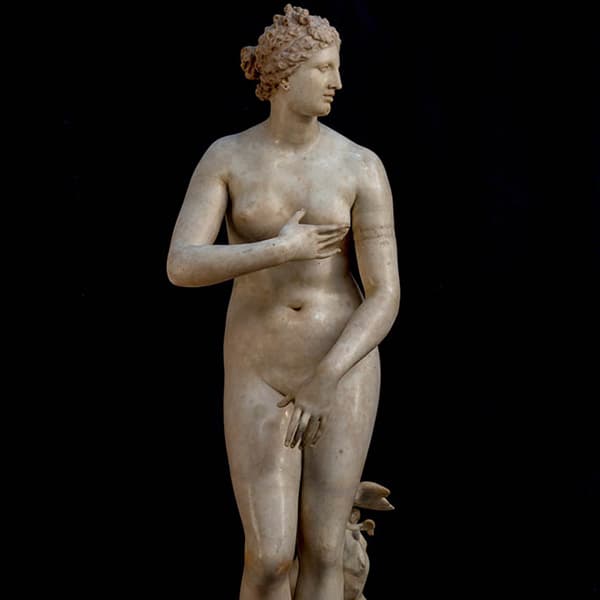
from the 1st century B.C. and other statues. If the Renaissance was the foundation of the modern world, the foundation of the Renaissance was classical sculpture. Sculptors, painters, and poets alike turned for inspiration to ancient Greek and Roman works like these in this room.
They show off the ancient mastery of human anatomy, the epitome of balance, 3D, and idealized beauty. The Tribune room features several well-known statues. Let's start with our old friend, the goddess of love. Does Venus' pose look familiar?
Read more...Show less
It doesn't take an art scholar to see that Botticelli's birth of Venus has the same position of the arms, the same S-curved body, and the same lifting of the right leg. Renaissance artists were clearly inspired by works done by the ancients 1,500 years before. This Venus is a Roman-era copy of the lost original, possibly by the great Greek sculptor Praxiteles. The Venus de' Medici is balanced, harmonious, and serene, reflecting Greece's golden age when balance was admired in every aspect of life.
Perhaps more than any other work of art, this statue has been the epitome of both ideal beauty and sexuality. Francis Louis XIV had a bronze copy made. Napoleon stole her away to Paris for himself. In the 18th and 19th centuries, when sex was thought to be dirty, the libido of cultured aristocrats was channeled into a love of pure beauty.
Wealthy sons and daughters of Europe's aristocrats made the pilgrimage to the Uffizi to complete their classical education. This is where they swooned in ecstasy before the cold beauty of this goddess of love. Ah! Okay, check out some of the other ancient statues.
Facing Venus, leaning on a tree trunk, is Venus' male counterpart, Apollino. Affectionately called Venus with a penis, Apollino is also carved by that ancient Greek master of cool, smooth lines, Praxiteles. The other works are from after Greece's golden age, the era known as Hellenistic, when quiet balance was replaced by violent motion and emotion. The Wrestlers to the left of Venus is a study in anatomy and twisted limbs, like Poliwolo's paintings were a thousand years later.
To the right of Venus, the drama of the knife grinder stems from the offstage action. He's sharpening the knife to flay a man alive. These statues are some of the finest survivors from ancient times, so don't be in a rush. Also, be sure to check out the impressive room itself.
Admire its eight-sided design, marble floor, and dazzling dome. This fine tribune room was a showroom or cabinet of wonders back when this building still functioned as the Medici offices. By the way, Uffizi is Italian for offices. The room is filled with family portraits.
It's a holistic statement that symbolically links the Medici family with the four basic elements. Air, represented by the weather vane overhead in the center of the dome ceiling. Water, that's from the inlaid mother of pearl. The fire of the red walls.
And earth, represented by the inlaid stone floor. In the 16 and 1700s, this room and its art were famous, and the values of the Florentine Renaissance that it featured spread throughout Europe. Let's see some more of the Uffizi's well-known collection of ancient sculpture. Continue on to the end of the corridor, where you'll encounter lots more statues.
These works were famous across Europe, a must-see stop on the Grand Canal and a grand tour of aristocrats everywhere. Think of the chain of history. Ancient statues inspired the medieval Florentines. They went on to create the Renaissance, which in turn inspired the rest of Europe.
At the end of the corridor, a standing male nude welcomes you to the collection of sculptures. The sculpture hall
Sculpture Hall, View of Arno River
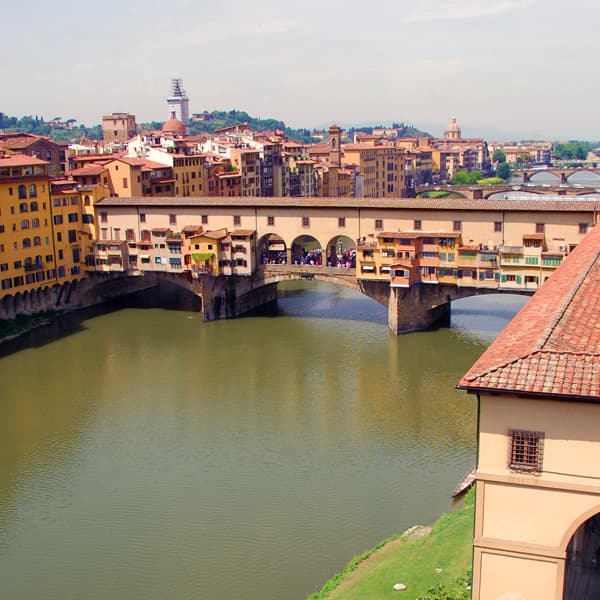
and view of the Arno River. Stand here and gaze down the hall at this impressive collection. A century ago, these statues were as popular as works by Botticelli are today. Some of these are rare 2,000-year-old Roman copies of even more rare 2,500-year-old Greek originals.
Start with the standing male nude. He's called Doriforo, or Spear Carrier. This is a high-quality Roman statue. It was patterned after a famous Greek original, by the great Golden Age sculptor Polyclitus.
Read more...Show less
Doriforo's proportions are considered absolutely perfect. His pose is called Contrapposto. Putting his weight on one leg while slightly lifting the other one. That pose inspired countless later works.
Stroll down the hall a few steps. Find the purple statue in the center. It's now just a fragment, headless and without limbs. But this was the Roman she-wolf, or Lupus.
Done around the year 120, it was sculpted when the Roman Empire was at its peak. It's carved in porphyry stone, which was extremely rare, quarried only in Egypt and in the royal color of the Caesars. Purple. The she-wolf was the animal that raised Rome's legendary founders and became the city's symbol.
Her image was reproduced throughout the Roman Empire on coins, medallions, and on statues like this one. Fast forward a thousand years and you had Renaissance Florentines marveling at it as well. They were amazed at the ancient Romans' ability to create such lifelike three-dimensional works. They learned to reproduce them in stone, and then they learned to paint them on a two-dimensional surface.
Continue to the end of the sculpture hall. The collection was begun by the Medici family, who loved all things classical. They displayed their collection in the garden of their home. The place where they were made, a place known today as the Medici-Ricardi Palace.
Yes, these ancient statues inspired Florence's great painters, Botticelli, Donatello, Leonardo, Michelangelo, the men who invented the Renaissance as we know it. When you reach the end of the sculpture hall, look out the window. This is perhaps Florence's best view of the Arno River and Ponte Vecchio, or Old Bridge. You can also see the red-tiled roof of the Vasari Palace, the so-called Secret Passageway, stretching half a mile from the Palazzo Vecchio and Uffizi over the Ponte Vecchio and up to the Pitti Palace on the other side of the river.
This was a private walkway, wallpapered with great art, for the Medici family's commute from home to work. As you enjoy the view, remember that it's this sort of pleasure that Renaissance painters wanted you to get from their paintings. For them, a canvas was a window you looked through to see the wide world. Their paintings recreate natural perspective.
Distant objects, such as bridges, were dimmer and higher up on the canvas. Closer objects are clearer and lower. We're headed down the homestretch now. If your little Uffizis are just killing you and it feels like torture, remind yourself it's a pleasant torture and smile, like the statue hanging around just over there.
Our Uffizi tour culminates in the three greatest Renaissance artists, all of whose styles were forged right here in Florence. First, we'll see Leonardo da Vinci, who combined artistic skills with the mind of a scientist to create timeless beauty. Michelangelo Buonarroti took the Florentine style and popularized it throughout Italy. And Raphael combined the techniques of both Leonardo and Michelangelo to take the High Renaissance to its peak.
We begin with Leonardo. So start heading down the far hallway. Get your little Uffizi moving. Our next stop is room 35, which is on the left. Enter room 35, which has paintings by Leonardo da Vinci. Leonardo da Vinci,
Da Vinci: Annunciation, Adoration
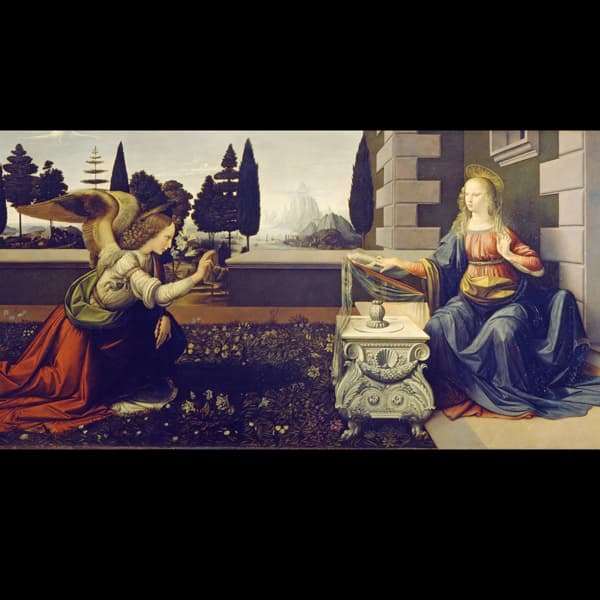
the Annunciation from around 1475 and the Adoration of the Magi from 1481. This room has a lot of rare works from when Leonardo was a young man living and working here in Florence. He was part of the Enlightened Medici Circle. He soaked up the Renaissance atmosphere, studying both art and science.
These were the years when he developed the style that would propel him to his more famous works, works like Mona Lisa and The Last Supper. Start with the Annunciation scene. It's the horizontal-shaped canvas showing Mary and a winged angel. This was Leonardo's first major work, when he was just 20 years old.
Read more...Show less
But it already shows the elements of his trademark style. In the Annunciation, the angel Gabriel has walked up to Mary and now kneels on one knee like an ambassador, saluting her. See how relaxed his other hand is, draped over his knee. Mary, who's been reading, looks up with a gesture of surprise and curiosity.
Leonardo constructs a beautifully landscaped stage and puts his characters in it. Look at the bricks on the right wall. If you extended lines from them, the lines would all converge at the center of the painting, the distant blue mountain. Same with the edge of the marble table Mary sits at and the opening in the wall behind them.
Subconsciously, this subtle touch creates a feeling of balance, order, and spaciousness. Think back to Simone Martini's Annunciation to realize how much more natural, relaxed, and realistic Leonardo's version of this same scene is. He's taken a miraculous event, an angel appearing out of the blue, and presented it in a very human way. Nothing is forced or sterile.
Leonardo seamlessly blends realistic figures, a natural setting, and mathematical perfection. Like a Renaissance architect, which Leonardo also was, he carefully composed the scene into a geometrical pattern that reflects the order seen in nature. Now turn to another Leonardo painting, it's the large, unfinished canvas showing Mary and the babes surrounded by their fans, the adoration of the Magi. This adoration scene is a complex work with lots going on.
There's the Magi themselves. The poor kings are absolutely stupefied by Mary and the Christ child. It's like they're afraid of the baby scurrying like chimps around a fire. Then there's the background, with all the crowds battling horsemen and singing, stark ruins.
This work is as agitated as the Annunciation is calm. It sure gives an idea of Leonardo's range. Leonardo was pioneering a new era of painting, showing not just the outer features, but the inner personality. This early work shows Leonardo working out his signature style.
First, even though the work seems restless, it's geometrically composed. In the center is Leonardo's trademark pyramid, with Mary's head at the peak. The bottom corners are formed by the two kneeling figures at her feet. This pyramid is enclosed by a half circle, formed by the hillside and the surrounding crowd.
I see another Leonardo specialty. Baby Jesus interacts playfully with one of the Magi. That's something Leonardo pioneered and later artists copied. In the background is a standard Leonardo fantasy landscape of ruins, mysterious figures, and a distant horizon.
And there's one final feature so typical of Leonardo. It's unfinished. It has only the undercoat and the outlines. Leonardo never got around to adding the main colors.
Part of this was because Leonardo was often pioneering newfangled techniques that were still untested and sometimes didn't work. This adoration was done in oil-based paint, not the more common egg yolk. This is an egg yolk base called tempera. Leonardo worked meticulously, adding layer upon layer of paint to get the subtle expressions just right.
He was more interested in his own creative challenges, getting those right rather than pleasing his employer. If something more interesting came up, he might turn to the new project that caught his eye, leaving the old work unfinished, like this one. That's what makes this adoration, even if it's faded, such a rare treasure, with a timeless beauty that still radiates. It's a glimpse of Leonardo's creative genius at work.
And who's the guy on the far right of the painting, the one looking away from the Madonna? Ah, Lisa. That's none other than a self-portrait of Leonardo himself. He was nearly 30, and this was his last work before leaving Florence.
He'd go on to make his mark in Milan and in France with major works like The Virgin of the Rocks and His Last Supper. One of Leonardo's greatest contributions to art was to create realistic people with probing psychological insight. For that, turn to one more painting in the room, The Baptism of Christ. It's not by Leonardo, but by Andrea del Verrocchio.
Verrocchio was young Leonardo's art teacher. As Verrocchio painted this baptism scene, he allowed his apprentice to do a small part. Little Leo painted the kneeling angel, the one farthest to the light. He's beautiful.
Curly hair, rosy cheeks, and the gaze of a cherub. Yes, when Leonardo painted this, he was only 14 years old. Legend has it that when his teacher, Verrocchio, saw that some kid had painted an angel better than he ever would, he hung up his brush for good. Before we move on, let's recap.
The three paintings here give a quick snapshot of Leonardo's evolving style. The Baptism shows how Leonardo started with an intuitive sense of capturing realistic human figures. The Annunciation applies geometry to a natural scene. And the Adoration adds more layers of complexity, new techniques, and psychological insight.
As a scientist, architect, engineer, musician, and painter, Leonardo revolutionized what we think of when we think of art. He was the epitome of the highest compliment an artist of his day could receive. A true renaissance man. Leonardo inspired the artist we'll see next, his younger contemporary, Michelangelo.
So, continue down the hallway a few more steps to room A38. Remember, Michelangelo and Leonardo knew each other, though they apparently didn't get along too well. They even faced off in a kind of renaissance smackdown when they were both hired to paint large murals for the big palace on Florence's main square, the Palazzo Vecchio. Unfortunately, neither one finished.
Enter room A38. It has paintings by both Michelangelo and the artist that he inspired, Raphael. It was a small world. Imagine, Michelangelo, Leonardo, Raphael, all working in Florence. Start with the round painting in the gold frame. Michelangelo Bonarotti,
Michelangelo Buonarroti: Holy Family
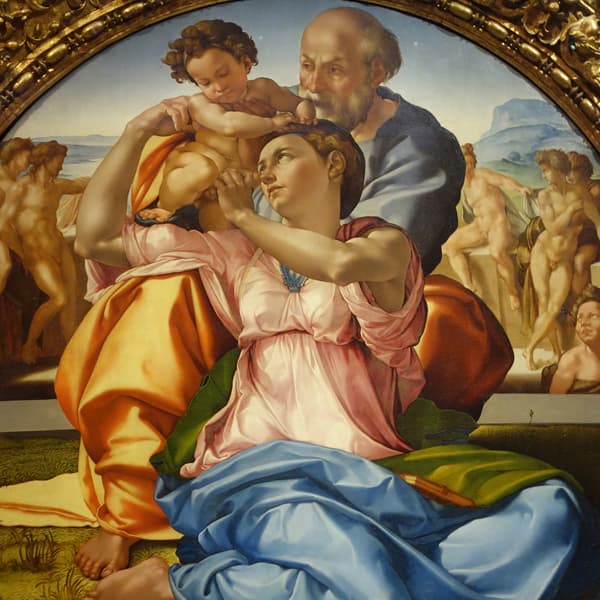
The Holy Family, circa 1506. This Holy Family is the only completed easel painting by Michelangelo. Michelangelo made his mark on history in several fields. He was the sculptor of David, the painter of the Sistine Chapel, the architect of St.
Peter's Basilica, and he was even well-known as a poet. This painting, The Holy Family, shows Michelangelo, as he was making the transition from famous sculptor he'd just finished David, to budding painter. Florentine painters were called sculptors with brushes, and this shows why. Instead of a painting, it's more like three clusters of statues with some clothes painted on.
Read more...Show less
The main subject is the Holy Family, Mary, Joseph, and baby Jesus, and in the background are two groups of nudes looking like classical statues. The background represents the old pagan world, while Jesus in the foreground is the new age of Christianity. The figure of young John the Baptist on the right is the link between the two. This is a peasant Mary, with a plain face and sunburned arms.
Michelangelo shows her from a very unflattering angle. We're looking right up her nostrils. But Michelangelo himself was an ugly man, and he was among the first artists to recognize the honest beauty in everyday people. Michelangelo painted this for a well-known Florentine businessman named Agnolo Doni.
It was to celebrate Doni's wedding, so this Holy Family may have symbolized the happy family the newlyweds hoped they'd create. Michelangelo was a Florentine. In fact, he was like an adopted son of the Medici. But much of his greatest work was done in Rome as part of the Pope's facelift of the city.
In his Holy Family, we see some of the techniques he used on the Sistine Chapel ceiling that revolutionized painting. Monumental figures with rippling muscles posed at dramatic angles and bright, clashing colors. Michelangelo's colors are all the more apparent since both this work and the Sistine Chapel have recently been cleaned. These techniques added an element of dramatic tension that was lacking in the more graceful work of Leonardo and Botticelli.
By the way, Michelangelo designed but didn't carve the elaborate frame. Also here in Rome, Room A38, are several paintings by our third great Renaissance artist, a young painter who learned tricks from both Leonardo and Michelangelo. That would be Raphael. Or Raffaello di Sanzio. Raphael,
Raphael: Madonna of the Goldfinch
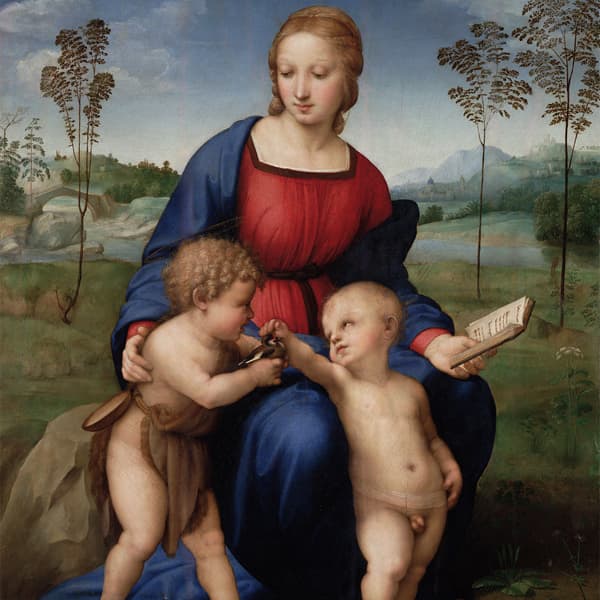
Madonna of the Goldfinch from 1506 and Dual Portraits, also known as also 1506. Start with the Madonna. The painting shows Mary dressed in red and blue with two naked little kids standing at her feet. Raphael brings Mary and Bambino down from heaven and into the real world of trees, water, and sky.
He gives baby Jesus on the right and John the Baptist a bird to play with, adding a human touch. It's a tender scene painted with warm colors and a little bit of color. And a hazy background that matches the golden skin of the children. Raphael perfected his craft in Florence following the graceful style of Leonardo.
Read more...Show less
In typical Leonardo fashion, this group of Mary, John the Baptist, and Jesus is arranged in the shape of a pyramid with Mary's head at the peak. The two halves of the painting balance perfectly. Draw a line down the middle through Mary's nose and right down through her knee. John the Baptist on the left is balanced by Jesus on the right.
Even the trees in the background balance each other out, left and right. These things aren't immediately noticeable, but they help create the subconscious feelings of balance and order that reinforce the atmosphere of maternal security in this domestic scene. It's pure renaissance. Nearby, find dual portraits of a Florentine power couple.
In fact, it's the very people Michelangelo painted his holy family for, the notorious frugal Agnolo Doni and his fabulously rich new bride, Maddalena Strozzi. They wear the rich clothes and jewelry befitting a wealthy textile merchant and his noble wife. Raphael borrowed Leonardo's technique of turning his subjects slightly at a three-quarter angle. Kind of like Leonardo's Mona Lisa.
Yes, and his subjects rest casually on their elbows. Maddalena even has Mona Lisa's folded hands. Raphael also borrowed from Michelangelo, giving this couple a sculptural solidity and more gritty realism. Raphael became the most sought-after painter of his day.
Even today, Raphael is considered both the culmination and conclusion of the renaissance. The realism, balance, and humanism we associate with the renaissance are all found in Raphael's work. He combined the grace of Leonardo with the power of Michelangelo. And when Raphael died in 1520, the high renaissance ended as well.
Our tour is nearing its end, too. Return to the hallway, turn left, and continue on. We're headed for the far end of the hall, toward a statue of a struggling man. As you go, you'll pass rooms of more displays and special exhibits.
If you're interested, you could pop into Room 42, with art from Northern Europe. What the Florentines began was soon trendy all across Europe. Northern artists learned the Italian techniques of creating 3-D scenes and realistic portraits. But we're headed straight to the statue at the end of the hall.
We're going back to the source of the renaissance, the ancient world. One of the best examples is this dramatic ancient Greek statue of Laocoon. While this one's a copy, the original's in the Vatican Museum, it's worth a look. It's a dramatic scene showing Laocoon and his two sons wrestling with snakes. Get close to the statue and let Rick explain what it's about. The Statue of Laocoon.
Statue of Laocoön
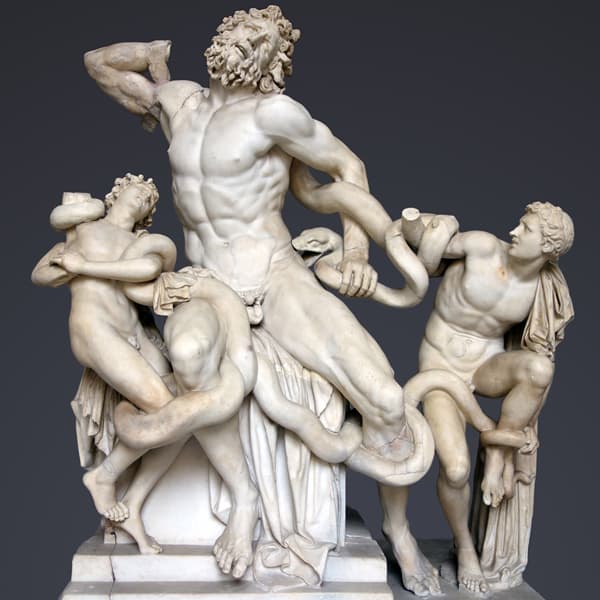
This sure is an interesting work. So what's going on? The statue of a man and his sons comes from the Trojan War. The Greeks have sent the Trojan horse full of soldiers as a trick to get into the city.
Laocoon the high priest of Troy tries to warn his people, but the Greek gods wanted the Greeks to win, so they sent serpents to kill him and his sons. The sculptor catches the scene at its most dramatic moment when Laocoon is struggling to survive, but he's realizing the snakes are just too much for them. Look at his face. His agonized expression clearly says, I and my people are doomed.
Read more...Show less
Either that or snakes. Why did it have to be snakes? This remarkable statue plays a role in Michelangelo's evolution as a sculptor. It was sculpted in ancient times and became one of the most famous statues of antiquity.
But for centuries it was lost to history. Then it was unearthed in 1506. One of the first people to see it was Michelangelo. It inspired him to amp up his figures with more motion and more emotion.
In a larger sense, this statue is a reminder of what the Florentine Renaissance was all about. The Renaissance was the rebirth of the ancient world, its optimism, enthusiasm for learning, and art that was realistic and beautiful. Now, look again at Mr. Laocoon's agonized face.
I think his expression is saying, time for a coffee break. I'm with you. Continue just past the statue where there's a fine café and a great terrace. We'll wrap up our tour there. But before we leave you, let Rick get you oriented to the rest of the museum. A final word.
A Final Word: The Rest of the Uffizi
The rest of the Uffizi. While there's much more great art in this museum, you can rest assured you've seen the creme de la creme. Or you might say the foam of the cappuccino. Consider rewarding yourself with a break right here in the café.
It has an open-air terrace where you can sip a fruity drink. Or a foamy cappuccino. Enjoy it in the shadow of the towering Palazzo Vecchio. A truly aesthetic experience.
Read more...Show less
And, perhaps, even more important, there are handy toilets just down the stairs. If you're done with the Uffizi, you can find the set of stairs that leads directly to the exit. This is marked Ushita Veloce, or Quick Exit. But if you're up for more, there's more art downstairs on the first floor.
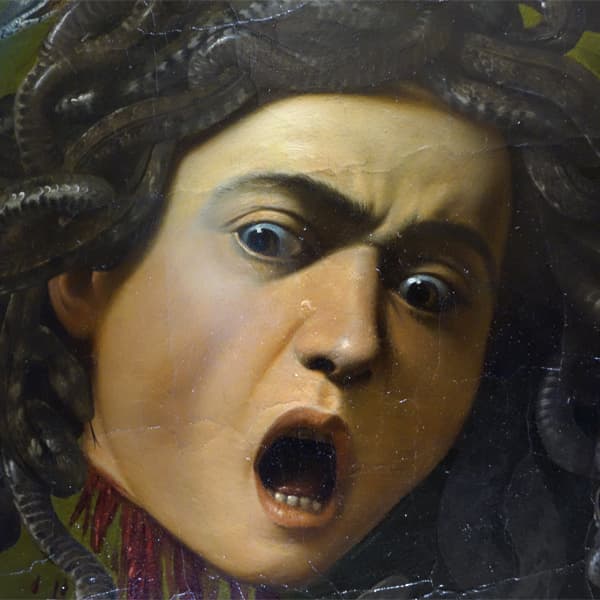
It has work from after the Great Florentine Renaissance explosion. Mannerism, Baroque, and Flemish and Dutch art. It's all laid out in a one-way route that's easy to browse as you make your way to the exit. A couple of specific highlights that are worth seeking out using your Uffizi-issued map are works by Titian and Caravaggio.
Sounds wonderful. But, for now, my little Uffizis are ready to go. They're ready for a break. Then let's call this the end of the tour.
Think back on all we've seen. We've gone from ethereal medieval Madonnas to down-to-earth Marys, from pagan goddesses to warts-and-all portraits of flesh-and-blood Florentines. We've seen the march to realism, the rise of 3D, and the three Renaissance greats, Leonardo, Michelangelo, and Raphael. And all of this took place here, in the heart of the Renaissance, the great city of Florence.
We hope you've enjoyed our Uffizi Gallery walk. Thanks to Gene Openshaw, the co-author of this tour. If you're up for more sightseeing, we have four more audio tours of Florence. A Renaissance walk through Florence, the Academia featuring Michelangelo's David, the Bargello Sculpture Museum, and the San Marco Museum.
Remember, this tour was excerpted from the Rick Steves' Florence and Tuscany Guidebook, co-authored with Gene Openshaw. For more details on eating, sleeping, and sightseeing in Florence and environs, refer to this year's edition of that guidebook. For more free audio tours and podcasts, and for information about our guidebooks, TV shows, bus tours, and travel gear, visit our website at ricksteves.com. This tour was produced by Cedar House Audio Group, Audio Productions.
Grazie. Arrivederci. And buon viaggio. ♪
Free
GPS-guided walking tour
No account needed. Walk at your own pace.
Free
20 stops ·