23 stops
GPS-guided
97 min
Duration
Free
No tickets
About this tour
A 23-stop walking tour through the heart of Italy. Visit Naples City Walk, Galleria Principe di Napoli , Via Bellini, Teatro Bellini, Piazza Bellini, and Piazza Bellini — with narrated stories at every stop.
23 stops on this tour
Naples City Walk
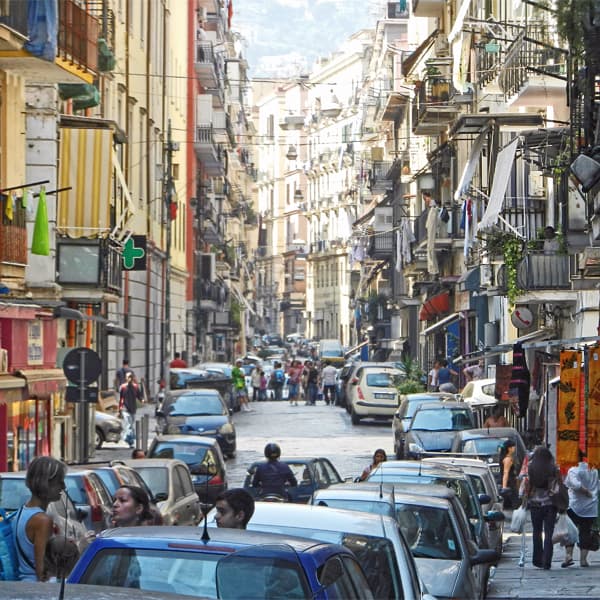
A Naples City Walk. If you love Italy, Naples is Italy at its most hardcore. While Naples has plenty of great monuments, its main site is the city itself, its timeless Italian way of life, its lively markets, everyday shops, and exuberant people. This walk gives you that and more, a slice of Neapolitan life.
Hi, I'm Rick Steves. Thanks for joining me on this walk through the historic heart of Naples. Because Naples can be, well, a bit chaotic, this walk has an easy-to-follow route. We'll start at a major landmark, the Archaeological Museum.
Read more...Show less
Then we cut through the historic old town on the ancient street called Spacanopoli. The walk ends near the central train station, which makes for an easy springboard for more sightseeing. Along the way, we'll be stepping into several historic churches, including the Capella, with its one-of-a-kind sculpture. We'll weave through impressive remnants of Naples' golden age and learn about its 2,500-year history.
But most of all, we'll see that timeless way of life that plays out on Naples streets generation after generation. Laundry hangs over alleyways, markets stink with fresh-caught squid, kitchens crank out pizzas, and couples artfully make love on Vespas. This walk works best either in the morning or in the evening. That's when sights are open and the street life is liveliest.
In the heat of mid-afternoon, some shops and churches close, so be sure to consult a guidebook to plan your time. Allow at least two hours for this walk and a little more for pizza at the end. And by the way, this walk starts at the great Archaeological Museum, which is covered on another of our audio tours. You can see that museum first, then do this Naples City Walk to maximize your sightseeing time.
Naples has a reputation for crime, for good reason. While violent crime is rare, pickpocketing, purse-snatching, and phone-grabbing are a constant risk. Keep a close eye on your belongings and stay aware of your surroundings. Besides that, rest assured that this walk takes you through streets that are safe and well-traveled.
Naples is intense, but if you're smart and on the ball, you'll be just fine. Now, let's get started, as we see a city that's as old as Europe itself and as vibrant as it is today. It's as vibrant today as it was centuries ago, the freewheeling city of Naples. To help us along the way, I've invited a good friend and virtual travel buddy.
Welcome, Lisa. Ciao, Riccardo. Lisa will give us helpful directions and sightseeing tips throughout the tour. And my first tip is to be sure you get our tour updates.
Just press the icon at the lower right of your device, you'll find any updates and helpful instructions unique to this tour. Things like closures, opening hours, and reservation requirements. There's also tips on how to use this audio tour and even the full printed script. Yes, so pause for just a moment right now to review our updates and special tips. It's okay, we'll wait. And then... Let the tour begin!
Tour Begins
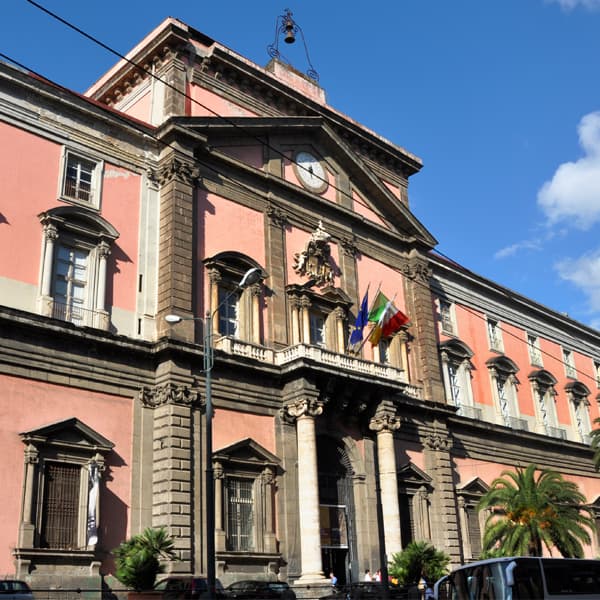
The tour begins. The Naples Archaeological Museum. Start at the Naples Archaeological Museum. It's easy to get there on the metro.
Either line 1 to the Museo stop or line 2 to Cavour. Find a place near the entrance where you can take in the expanse of this impressive building. Ricc? This palatial building captures the glory of Naples at its peak.
Read more...Show less
It's the year 1750. Naples is one of the richest cities in the world. It's one of the richest and most sophisticated cities in all of Europe. With a population of 300,000, only Paris was bigger.
This building epitomizes that golden age. Admire the warm pink facade fronted by palm trees, the ironwork balconies, the classical columns that flank the grand main entrance, the triangular Greek-style pediments, and the round Roman-style arches. Back in the 1700s, this impressive palazzo was just one of many that, dotted the wealthy city of Naples. Naples was rich from sea trade.
It had one of Europe's top universities, and in 1750, this building opened its doors to display Europe's first great collection of classical artifacts, including the artistic treasures newly excavated from Pompeii. And just a reminder, we have a companion audio tour covering this great museum. Naples of the 1700s was a melting pot of European high culture. It was home to sophisticated nobles from abroad.
French-speaking Bourbons, German-speaking Habsburgs, and the monarchs of Spain. Back then, Naples was not an Italian city. It was a world unto itself, the proud and independent Kingdom of Naples. Find the flag of the Kingdom of Naples.
There's probably one above the museum entrance. It's next to the blue European Union flag and the green and white and orange Italian flag. The yellow and red ones, is Naples' city flag, a leftover from the once-glorious Kingdom of Naples. This building is the perfect introduction to our walk.
On the first half of this tour, we'll be seeing the impressive remains of Naples' Golden Age of the 16th and 1700s. The second half goes deeper as we slice through Spokanopoli to the roots of the ancient city. All along the way, we'll see the lively Naples of today that still bustles amid fading elegance. So, let's get started.
One of the best examples of both Naples' grandeur and its elegant decline is right across the street from the museum. It's that big arch. So, with your back to the museum's front door, start crossing the street. Veer right and find a huge beige and gray arch.
This is the entrance to the Galleria Principi di Napoli Mall. If this entrance is blocked, simply loop to the right around the block to another entrance. Or, pick up our walk on the next track behind the Galleria, on Via Progia. Now, enter the arched doorway and into the mall. The Galleria Principi di Napoli.
Galleria Principe di Napoli
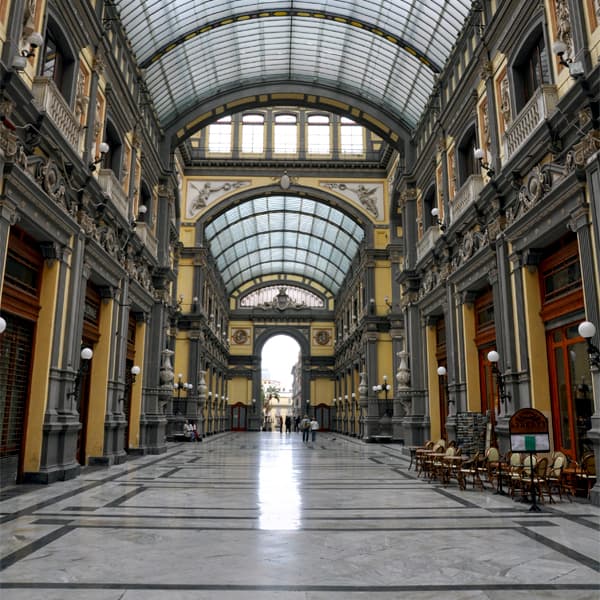
Stand at the entrance and take in this elegant 19th-century shopping mall. Enjoy the soaring glass skylight overhead. And the marble floors beneath. Now, start making your way to the center of the mall.
As you go, admire all the intricately carved woodwork, the elaborate ironwork lanterns, the balustrades and garlands, the playful cupids, and the mostly empty shops. Exactly. The mall was begun with great expectations in the mid-1800s. It was named for the first male child of the Italian royal family, the Prince of Naples.
Read more...Show less
Gallerias like this were popping up all over in Paris, London. In the United States, we call this style of decoration Art Nouveau. In Italy, it's called Liberty Style, named for a British department store that was in vogue at the time. Back then, Naples was known as the Paris of the South for its high culture.
But it's clear that the mall has suffered since then. Yes. Starting in the late 1800s, economic stagnation set in. With the unification of Italy, Naples was eclipsed by Rome as Italy's first city.
That trend has continued until today. And this Galleria, despite several ambitious renovations, has still failed to attract much business. Exit the mall from its far end. Again, if that far exit happens to be closed, no problem.
Just exit where you can and circle around to that end. That's where the tour picks up. When you reach the far end of the Galleria, just keep going straight ahead. You'll go down a set of steps to street level.
Cross the busy street, Via Brogia, and continue straight ahead. This puts you going gently downhill along a pedestrian-only street called Via Vincenzo Bellini. From Via Bellini
Via Bellini, Teatro Bellini, Piazza Bellini
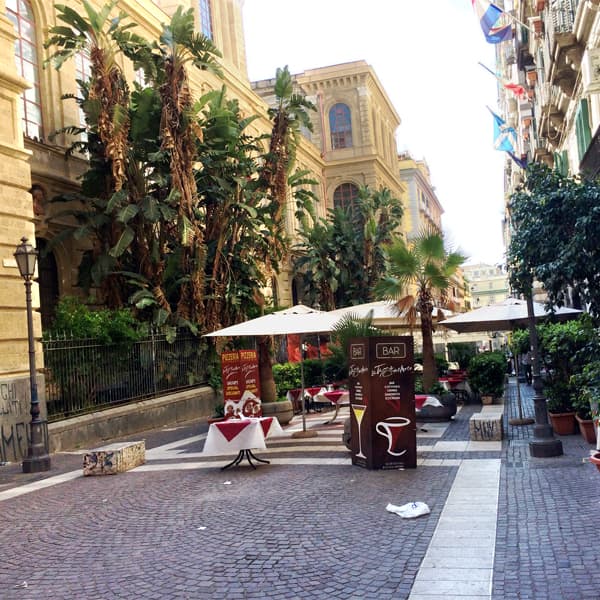
to the Teatro Bellini to Piazza Bellini. As you stroll down Via Bellini, you'll pass through a pleasant urban scene. There are tropical palm trees, banana plants, and sidewalk cafes. On your left is a golden palazzo.
This houses the city's Academy of Fine Arts. For centuries, university students from all across Europe have come here to study drawing, music, literary criticism, and the latest in graphic design. It's helped make this neighborhood a magnet for students and artists to this day. Keep going to the end of the block, where we'll be turning left.
Read more...Show less
Rick, how did Naples get to be so rich? Locale, locale, locale. With its safe harbor in the center of the Mediterranean, it was always connected to the wider world. Naples was born 2,500 years ago as a Greek colony and a key trading port.
Even when the Latin-speaking Romans took over, Naples remained Greek-speaking, highly cultured, and a busy trading center. After Rome fell around the year 500, the city powered on as an independent kingdom. Around 1500, Naples became the crown jewel in a huge Spanish kingdom that stretched across Europe. Naples attracted artists like Caravaggio and Bernini and composers like Scarlatti.
By the 1700s, this neighborhood we're walking through was a center of European culture. When you reach the end of the block, turn left. So that's left on the street called Via Conta di Ruvo. Keep going toward the end of the block.
As you walk up Conta di Ruvo, you'll pass by an elegant, yellow, white, and gray building on the right. That's Teatro Bellini. It's decorated with statues of composers, Apollo, and the Muses. It's that same fanciful style of the 1800s called the Liberty Style.
Just a reminder, keep walking past the theater, making your way to the end of the block. Teatro Bellini was a center for a new and exciting art form that Naples helped invent, and that was opera. The theater's named for the groundbreaking composer Vincenzo Bellini. Yes, Vincenzo Bellini, the guy who wrote Norma, The Sleepwalker, and The Capulets and Montague.
Lisa, you are incredible. Well, I googled it. Bellini studied music here in Naples in the 1820s. He found his first fame here and went on to help launch opera as a global phenomenon.
Today, the Teatro Bellini carries on the tradition with both opera and opera. with both classical and contemporary concerts, as well as cutting-edge plays. And this neighborhood remains a center for Naples' art scene. We're headed toward the neighborhood's center.
When you reach the end of the block, turn right onto Via Santa Maria di Constantinopoli. As you make that right turn and head downhill, you'll pass by a church made of sober gray stone. Wave to the Pope upon the facade. This is the 17th century Church of the Sapienza.
Across the street, there's yet another impressive church. They're just two of the many architectural wonders along our walk. It's part of what made Naples the final stop on what was called the Grand Tour of Europe. Aristocrats made the pilgrimage here to soak up the grandeur of the buildings, to see an opera, and to schmooze with fellow sophisticates from all across the continent.
Up ahead, you'll spill into a piazza. It's one of the oldest spots in Naples, yet today, it remains one of the most vibrant. That's certainly one of the recurring themes of this walk, how the Naples of today still throbs with life amid the remnants of its past. Continue on until the street opens up on the left into a long, narrow piazza. It has a small park with a statue in the center. Piazza Bellini
Piazza Bellini
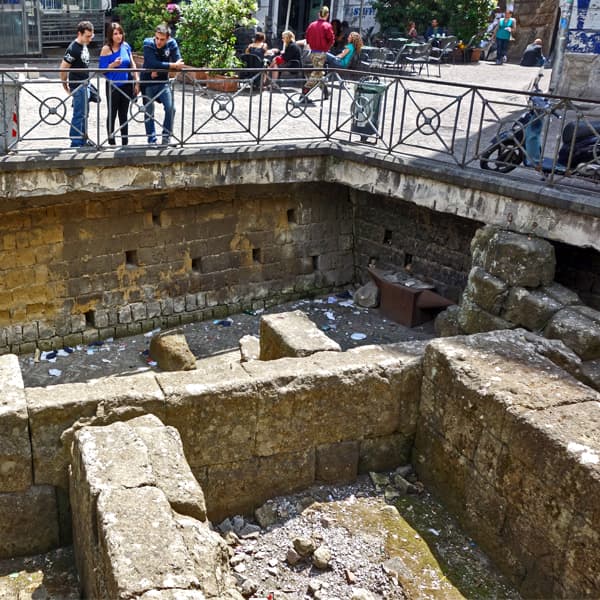
And just like that, you're in neighborhood Napoli. It's a pleasant little park surrounded by apartment buildings and artsy cafes. Start making your way toward the statue. The statue and the square itself honor that opera composer Vincenzo Bellini, who helped invent the statue.
It was a great opera in the early 1800s. But just as interesting is the square itself. It's the neighborhood gathering place. Take a moment and survey the many balconies and the people who use them.
Read more...Show less
These tiny balconies serve as an apartment dweller's backyard in this densely packed city. The apartment blocks were originally noble palaces. Above some of the grand doorways, you can still see some of the stately family crests. Shh!
Hear the sound of that. Hear what? I don't hear anything. Exactly.
We're in the middle of a city of a million people, but this square provides a kind of oasis. About all you can hear is the sound of people. Everyday people going about the business of everyday life. Just as they have here for centuries.
Let's continue on just a few steps past the statue. You'll find a spot where you can peer down into a sunken area below today's street level. You're looking down into the origins of this timeless city 2,500 years ago. You'll see blocks of a local volcanic stone called Tufa.
These blocks were part of a tower in the old city wall. So we're standing on land that, back then, was right on the western edge of town. From here, ancient people headed into the city down the main street, the dead end of the city. Decumanus Majore.
That's today's Via Tribunale. Back in the 5th century B.C. The time of Socrates and Plato. Yeah.
That's when Naples was founded by Greek traders. It was a Greek colony named Neapolis. Literally, the new city. It stayed a Greek-speaking enclave even after the Romans took over.
Neapolitans never fully adopted the Latin language or Roman ways. In fact, it was Naples' Greek culture that made the ancient Romans love the city and want to vacation here. That set the tone for the next 2,000 years. Even when under foreign rule, and that was most of its history, Naples had an independent culture and followed a different path from the rest of Italy.
Just think. For 2,500 years, laundry has blown in the breeze right here. Let's continue on. By the way, you can see how the street level has risen.
It's risen since ancient times thanks to centuries of rubble. Walk downhill about 30 yards just past the end of the square. Stop when you reach a horseshoe-shaped archway on the right. Directly opposite that arch, find a ceramic tile plaque posted on a building.
It depicts Piazza Bellini circa 1890. Not much different than today. Except the graffiti. Well, yeah, you need to learn to ignore the graffiti.
That's what locals say they do. Now turn your attention to that horseshoe-shaped archway, the Port Alba Gate. The Port Alba Gate
Port’Alba Gate and Passageway
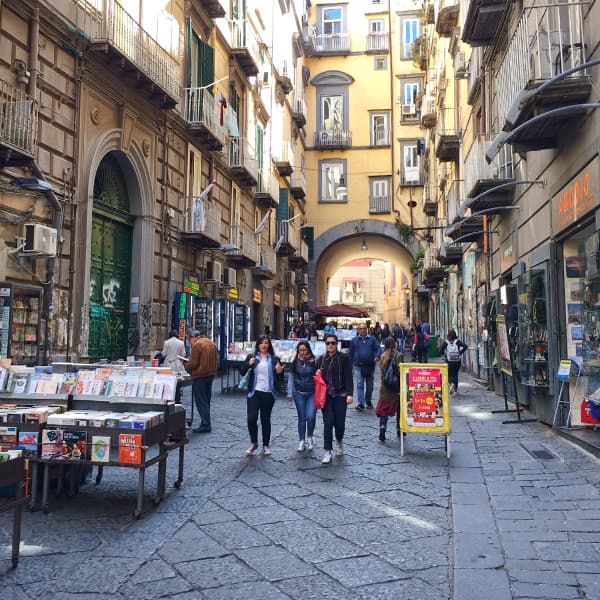
and Passageway. This gate was once part of that same old city wall. But this was from around the year 1600. That's when the city began expanding and opening up a whole new area beyond the old town.
Let's head there. Pass through the Port Alba Gate It's almost like passing into another world. You emerge into a pleasant pedestrian alley via Porta d'Alba. Keep walking down this picturesque street.
Read more...Show less
The streets line with bookstore after bookstore. The stalls spill out onto the streets filled with books old and new. Bibliophiles will be tempted to stop here. That's me.
But we should keep going. Naples students come to this street for textbooks and school supplies. Collectors hunt for rare manuscripts and engravings. It's a very civilized atmosphere.
Elsewhere, Naples can be a pretty intense urban jungle. It's the third largest city in Italy and it's one of Europe's most densely populated. But as we've seen, there are many calm and peaceful pockets like this. Naples has an underappreciated knack for living, loving, and raising children with good humor and decency.
Keep going where there's another gate at the end of the street. We're heading toward the next phase of Naples' history. After the fall of Rome, Naples went through centuries of rule by foreigners. There were Ostrogoths, Byzantines, and Lombards.
In late medieval times, it was the Germans and French Angevins. Nevertheless, Naples always maintained a measure of independence under the proud name of the Kingdom of Naples. In the 1500s, Naples came under the sway of what was then Europe's greatest power, Spain. Spain was Europe's greatest power?
Yes. It was the age of discovery. They were rich with New World gold, and they married into Europe's most powerful dynasties. The Spaniards transformed Naples from a medieval town into a world-class European capital.
That's the part of town we're entering now. So at the end of the quiet street, pass through the archway. You emerge into a huge square, Piazza Dante. Piazza Dante. Piazza Dante.
Piazza Dante
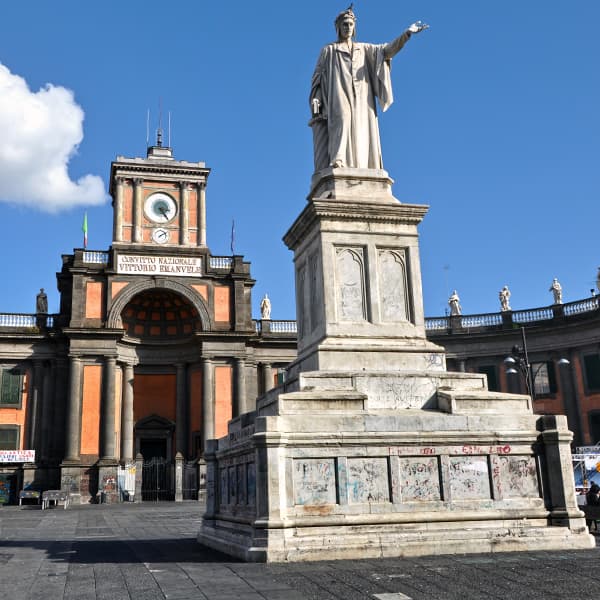
This large square is marked by a statue of Dante Alighieri, the medieval poet. Fittingly for a poet like Dante, his piazza has plenty of bookstores. Let's start heading toward the statue. Old Dante looks out over a busy boulevard.
This is Via Toledo, named for the Spanish viceroy who ruled Naples and created this boulevard in the 1500s. Almost overnight, Signor Toledo made this part of the city the high-class part of town. As you keep walking toward the statue of Dante, check out the impressive structure on your left. It's a grandiose orange-and-gray facade of columns and statues.
Read more...Show less
This was created in the late 1700s to honor the power of the Bourbon monarchy. Wait, the Bourbons? I thought it was the Spanish. Well, it does get complicated.
The Spanish rulers intermarried with both the Bourbons of France and the German Habsburgs. Needless to say, whatever the ruler, Naples just kept getting richer. At its peak around 1750, a statue of the King of Naples stood in this square, where Dante stands today. When you reach Dante, pause for a second.
Okay, Rick, what's the next phase in the story of Naples? What came next? The French Revolution. After they toppled the monarchy in France, Napoleon invaded Naples and toppled the royals here.
The king's statue on the piazza was replaced with the less politically charged figure of Dante. And on the big facade, note the name that was added a few decades later. It says, Victor Emmanuel. That was yet another ruler.
It's the next twist in the long and winding road of Naples' history. We'll continue that in just a bit. Ooh, a teaser. I like it.
Let's move on. From the Dante statue, keep angling toward the far corner of the square. You'll pass the glass-walled entrance to a metro station that Dante seems to be gesturing to. This is line one, a fairly recent addition that's transforming Naples yet again.
Locals rave about this particular underground station. It's filled with striking modern art. But let's keep going to where we meet up with Via Toledo. Today, Piazza Dante is a microcosm of Naples' long history.
It's an urban area that was once small, then grand, then chaotic, and is now slowly becoming grand again. The Neapolitan people are survivors. They've had to live under the rule of many corrupt and greedy overlords, German, Norman, French, Austrian, Spanish, Napoleon, and on and on. It's taught Neapolitans how to deal creatively with authority.
They came up with their own creative forms of justice, like organized crime. At the far end of Piazza Dante, exit the square. Start walking downhill on the busy boulevard called Via Toledo. ♪ ♪ ♪ ♪
Via Toledo
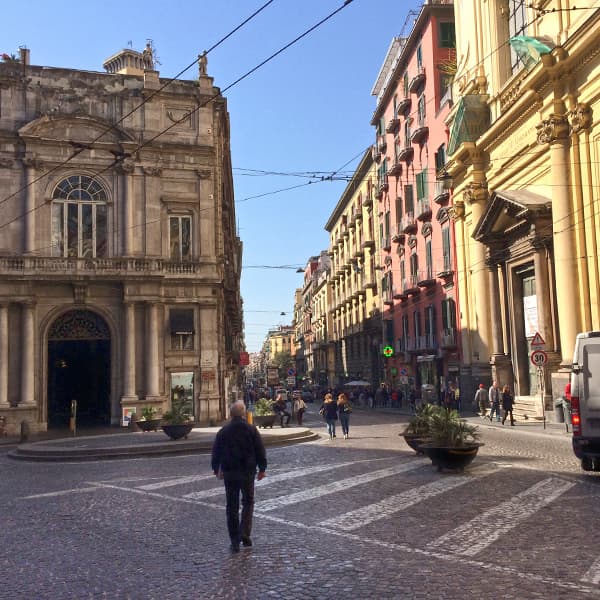
Via Toledo. Stride down this long boulevard, crowded with cars, motorbikes, and people. It's pretty obvious that we've left the genteel Naples of the 1700s and entered the crazy Naples of today. Via Toledo is the city's main shopping drag.
This particular stretch is pretty run down, lots of cheap handbags and shoes. But the street gets ritzier as you go. Look how long the street is. And how straight.
Read more...Show less
It stretches three-quarters of a mile down to the waterfront. It was laid out in the 1500s as a military road under the Spanish viceroy, Senor Toledo. Back then, this area was outside the old town walls. Toledo built this road to connect the Spanish military headquarters that was the museum where we started with the Royal Palace down by the bay.
Once it was built, this part of town became the trendy neighborhood. Where nobles built their palazzos. As you stroll, admire the fine facades. Most have similar features.
Same height, five stories, with uniform shutters and ironwork balconies. It gives the street a pleasant symmetry. The style, first pioneered in the Baroque era, has been adopted by buildings constructed more recently. As you go, peek into a few doorways.
There are some lovely atriums inside which provide a break from the big street. Keep going down via Toledo with its fading Baroque elegance. After a ways, the street will open up slightly on the left where there's a Y intersection. This forms a kind of piazza called Piazza Sette Settembre.
The square and its name mark the next phase of Naples' history, its decline. Keep walking ahead through the square toward the impressive white marble building at the far end. Focus your attention on the building's balcony. It's the year 1860, and this palazzo was a government building for Naples' rulers.
Meanwhile, the spirit of revolution was brewing throughout Italy. The great Italian revolutionary Giuseppe Garibaldi swept in and conquered Naples. He drove out the government. Garibaldi appeared on this balcony and proclaimed victory to the cheering crowds below.
The date? September 7th. Or Sette Settembre, as the piazza came to be known. Within a decade, all of Italy was united under a constitutional monarch.
Victor Emmanuel II, whose name we saw earlier. This was the start of a glorious new era for Italy. But for Naples, the birth of modern Italy was the end of an era and the start of its decline. Let's continue walking down Via Toledo one more block while Rick tells us the rest of the story.
Italy was united. The city of Rome, rather than Naples, was declared the new capital. Naples was punished for resisting the revolution. The city's scholars and bureaucrats were transferred to work in Rome.
Naples' treasury was confiscated to subsidize the industrial expansion of the north. Within a few decades, Naples went from being a thriving cultural and political capital to a provincial backwater. Its economy was left in shambles and its once sophisticated dialect was soon considered, well, Hicksville. Continue straight on Via Toledo.
You'll come to a cross street called Via Maddaloni. Find a spot at the intersection that's out of the way of traffic. Kind of hard to do, I know, but give it a try. Find a place where you can survey the scene around you. This intersection where Via Toledo crosses Via Maddaloni introduces us to Naples' most famous street called Spacanopoli. Spacanopoli
Spaccanapoli
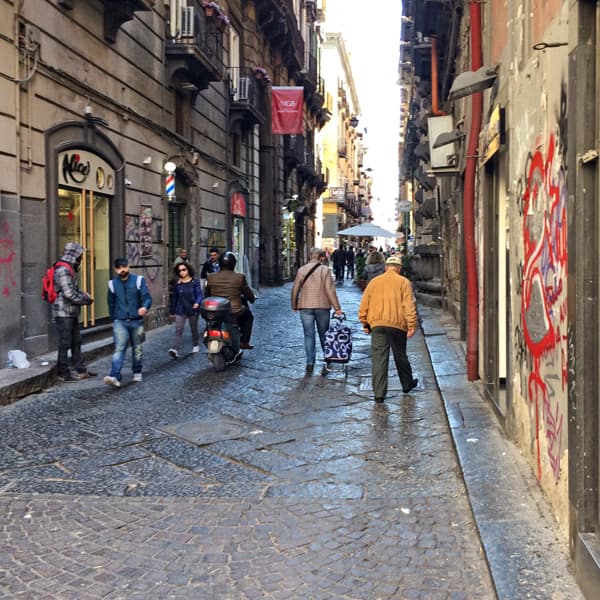
Spacanopoli Look to the left down Via Maddaloni. It's a long, long, straight and narrow street. It seems to go on forever. Via Maddaloni is the modern name for the ancient street that's better known by its nickname, Spacanopoli.
The name Spacanopoli literally translates as Split Naples. Since ancient times, this thin street has bisected the city. The ancients laid out their streets in a perfect grid. There were streets running exactly east-west, like Spacanopoli, crossed by streets running north-south.
Read more...Show less
Even today, Spacanopoli is one of the city's main thoroughfares, cutting directly through the heart of downtown. We'll be walking down that stretch of Spacanopoli later, but for now, turn and look in the exact opposite direction. It's long and straight that way, too. You really do get a sense of how Spacanopoli divides or splits this urban jungle.
Let's explore in that direction. So cross busy Via Toledo. Once across, keep going straight. Here, Spacanopoli changes names, first to Via Forno Vecchio and then Via Pasquale Scura.
Just keep going straight. You can see the street starting to slant upward toward a church facade as it climbs San Martino Hill. By the way, if you have more time in Naples, consider going up San Martino Hill. Up there, you can visit the Carthusian Monastery and an old castle.
But the best part is great views of Naples Bay and Mount Vesuvius. The easiest way up the hill is by funicular. The Montesanto funicular station is only a couple of blocks from here. Keep heading up the street Via Pasquale Scura.
We're entering a more residential part of Naples. This is the upper tip of one of Naples' most typical neighborhoods, the Spanish Quarter. It was named for the Spanish military barracks that were here back in the 16th century when the area was laid out. Many streets here are narrow and flanked by tall buildings.
This makes them pleasantly cool in the summer. The Spanish Quarter is known for the classic Neapolitan lifestyle that locals call basso, or low-living. Basso homes were tiny apartments built close to ground level that had to house entire families. Everyday life spilled out into the streets.
Even today, life happens in the streets. Flirting, fighting, playing, loving. This is the cliché of life in Naples that's seen in so many movies. It makes the Spanish Quarter Naples at its most Neapolitan.
The people are playful, the shopkeepers are friendly, but the motor scooters are bold. Watch out. By now, you should be approaching the intersection with Via Piñaseca. As you get nearer, the neighborhood action kicks up a notch.
Via Piñaseca hosts a lively market. Stop when you reach the intersection. ♪ , ♪ ♪ The Via Piñaseca Market.
Via Pignasecca Market
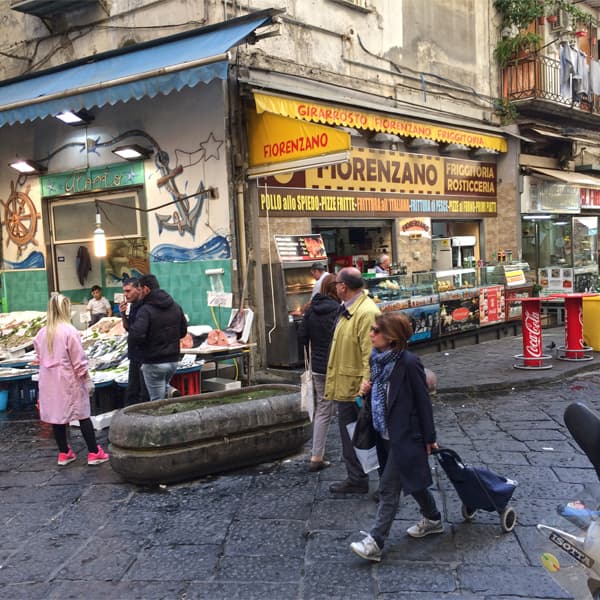
Stand at the intersection and take in the colorful scene. Naples Fish Market squirts and stinks just like it has here for centuries. Now turn left and start heading down Via Piñaseca. Along Via Piñaseca, you'll pass by a variety of vendors.
There's fish stalls, tripe mongers, butchers, and produce stands. There's stores, stores, and stores. There's stores selling cheap clothes. There's street food vendors.
Read more...Show less
Hungry? Hey, you could always just pop into a grocery store and ask the clerk to make you a sandwich. I like prosciutto and mozzarella. Keep browsing your way down Via Piñaseca.
After a long block, the street will spill out back onto good old Via Toledo. As we walk, how about a little music? Here's a selection to get you into the basso way of Neapolitan life. Enjoy the music and we'll see you in a minute or two at the far end of the street. ¶¶ ¶¶ ¶¶ ¶¶ ¶¶ ¶¶ ¶¶ ¶¶ ¶¶ ¶¶ ¶¶
Piazza Carità
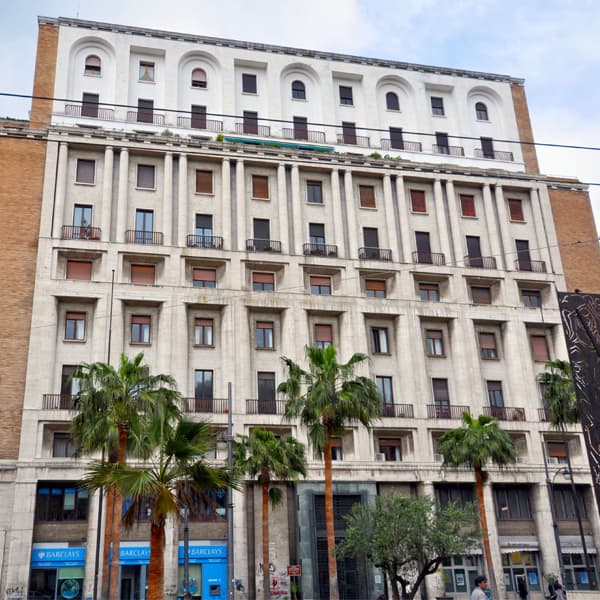
¶¶ ¶¶ the square. So cross via Toledo. Make your way toward the big modern building across the square. That big building was built in 1938, a time when Italy was dominated by the fascist dictator Benito Mussolini.
In fact, it was built for an official visit when Mussolini welcomed Adolf Hitler. The building has the distinct fascist style of the era. Lots of severe stone, a grid-like pattern, very little decoration. It's quite a departure from Naples' traditional style of elegant Baroque palazzos.
Read more...Show less
In the center of the square stands a modern statue. This celebrates a hometown hero named Salvador D'Aquino. He bravely saved 22 of his fellow Italian soldiers who stood up to the fascist. D'Aquino took the fall for their insurrection and was executed in their place.
When you reach the big fascist building, turn left. This puts you walking up a short street called Via Morgantini You may pass police cars parked along here. To the right is the local headquarters for the Carabinieri, a branch of the police. Carabinieri cars are generally black.
The regular Italian Polizia cars are blue. Carabinieri uniforms are also black with a distinctive red stripe down the pants. The Carabinieri have a reputation for being a bit thick. Italians just love to tell Carabinieri jokes, kind of like dumb blonde jokes.
Hey, Lisa, how do you burn a Carabinieri's ear? I don't know. Call him when he's ironing his pants. Oh, give me another one.
Okay. How do you keep a Carabinieri busy? How? Write, see other side on both sides of a piece of paper.
Okay, you want another? Basta. When you reach the T intersection, turn right. You spill into a quiet square with an old stone church. Piazza Monte Aliveto
Piazza Monteoliveto
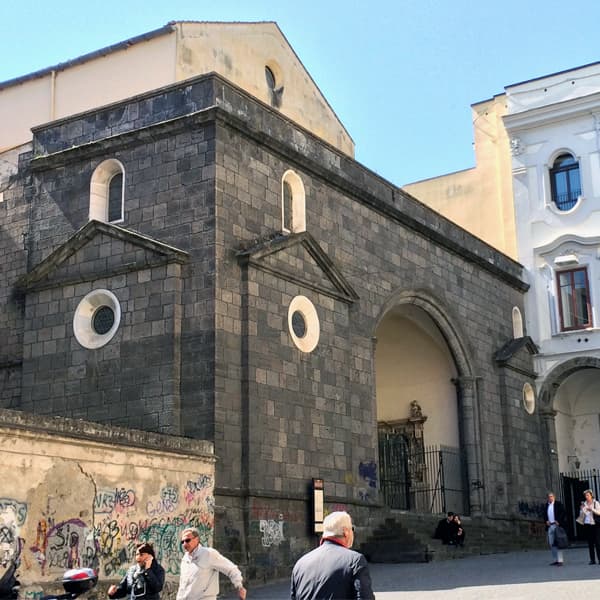
The cute little church is St. Anne of the Lombards. It was built in 1411. That's about all that remains of a once huge convent that sprawled all across this little hill we're standing on.
The rest was either torn down or repurposed. Like the Carabinieri office next door. Though the church is nice, we won't be going inside. We have three more churches up ahead.
Read more...Show less
And they're better. So start heading downhill through the square. Up ahead is a fountain topped with a statue. While the city of Rome has lots of gushing fountains, they're not so common here in Naples.
This one's a rare example, built in the late 1600s by the Spanish Viceroy. Around the base are lions and eagles. At the top stands a statue of the Viceroy's boss, Charles II. He was king of both Spain and the Kingdom of Naples.
The fountain was quite influential. With its white stone, Baroque scrolls, and verticality, it set the tone for similar monuments we'll see. Including one coming up just ahead. Continue past the fountain.
Cross the busy street. Once across the street, start climbing the hill. Take the street that angles to the left up Calata Trinita Maggiore. Keep going, heading toward the big gray-white monument at the top of the hill.
As you walk, enjoy a little more music. See you at the monument. music music Thank you. Thank you.
Thank you. By now, you should be at the tall stone monument. This marks the square called Piazza Gesù Nuovo. Piazza Gesù Nuovo.
Piazza Gesù Nuovo
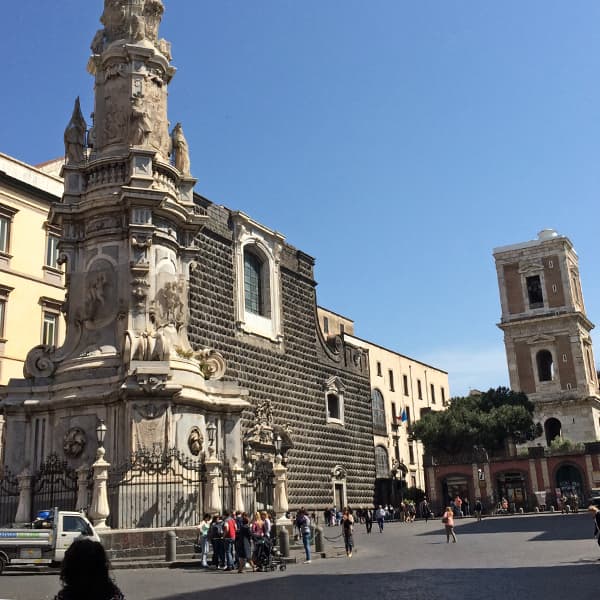
The big brick church of Santa Chiara with its rectangular bell tower. Also on the piazza, there's a tourist information office and a drinking fountain. Finally, slicing through the square from east to west is our old friend, the straight, narrow street called Spacanopoli. Let's see more of these sites.
Start with the towering stone monument. It's what's known as a plague column. Its official name is the Guglia dell' Immacolata. The pillar rises nearly 100 feet.
Read more...Show less
It was begun in the 1600s to remember a horrific plague. This is the grandest of several similar obelisks erected in Naples around that time. The pillar is a virtual museum of Baroque sculpture. You'll see scrolls, baby cherubs, balustrades, robed saints, and a spirit of exuberance.
And it's all organized neatly into five distinct stories. On top stands a statue of Mary, the woman being celebrated by this impressive monument. Around her head, she wears a diadem of stars. She stands on a globe of the earth and a crescent moon, supported by a cloud of cherubs.
This is a typical depiction of Mary in her role symbolizing the Immaculate Conception as the perfect vessel to bear the Christ child. Depending on the time of year you visit, you may see flowers at her feet. Or wilted ones. Every year at Christmas, the Naples Fire Department sends a crew up to honor Mary with a fresh batch.
Mary is the protector of Naples. In 1656, the bubonic plague clobbered Naples. More than a million people died in and around the city. This pillar was to thank Mary for finally driving the plague off.
It's similar to other plague pillars found all around Europe. But by the time this pillar was completed a century later, it had taken on a different purpose. It was to ask for Mary's help against a different kind of plague, the Protestants. It was completed by the Jesuits, the religious order who spearheaded the anti-Protestant movement called the Counter-Reformation.
The pillar came to symbolize the fierce tenacity of the Jesuits. Yes, midway up the pillar, I can make out four proud statues, all Jesuits. One depicts the order's founder, Saint Ignatius. Let's see the Jesuits' impressive home church, the Church of Jesu Nuovo.
If it's not open, you can skip ahead to the next track and pick up the tour from there. Otherwise, let's start making our way inside the Jesu Nuovo Church. The Church of Jesu Nuovo
Church of Gesù Nuovo
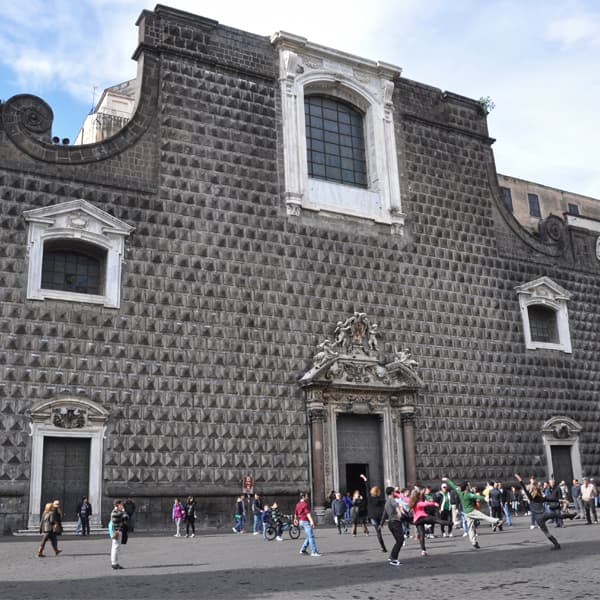
As you enter the church, you're greeted with a dazzling interior. There's pink and gray marble supporting a golden, and a golden ceiling capped with a dome. This decorative style, called Neapolitan Baroque, speaks to the wealth and the prestige of the Jesuits. Walk deeper into the church, along the right side.
Stop when you reach the second chapel on the right. This second chapel has a much-adored statue. You'll likely see a steady stream of Neapolitans filing by to pay their respects. This is a beloved local saint, Saint Giuseppe Moscati.
Read more...Show less
In the early 20th century, Dr. Moscati was famous for using his medical skills to help the poor. In 1987, he was the first modern doctor to be made a saint. Now his fellow Neapolitans pass by and kiss the good doctor's hand.
His highly polished hand after all these years. Continue on to the third chapel. From there, enter a room called the Salle Moscati. This long room is a virtual shrine to Dr.
Moscati. Look up, high in the walls. You'll see hundreds of tiny red and silver plaques. These are called ex-votos.
They're offerings given in thanks by people whose prayers were answered with the help of Saint Moscati. Each plaque has a symbol. This indicates which ailment he helped cure. Naples' practice of using ex-votos is very old.
Though it's part of Catholic rituals, similar practices go back even farther to Naples' pagan and Greek roots. There's more Moscati memorabilia on display. You'll see some reconstructed rooms from Moscati's apartment that was located not far from here. There's a glass case showing his possessions and photos of the good doctor.
Let's start making our way back out the church. But just before leaving the Moscati room, stop and look up. High in the left corner of the room is a bomb casing. During World War II, this bomb fell through the church's dome, but it never exploded and caused almost no damage.
Yet another miracle. Leave the Moscati room and backtrack to the piazza outside. As you go, enjoy more of the church's rich decor, the ceiling frescoes, the gilding, and the fine statues. As the church's name suggests, this was the new or nuovo church.
The Jesuits had outgrown their old church, which was nearby. They moved here in the 1580s. By the 1700s, they were a powerful force in Naples, even in politics. And though their influence waned in later centuries, this church remains a testament to the glory days of the Jesuit order.
By now, you should be back outside on Piazza Gesù Nuovo. Let's turn to our next site, the Church of Santa Chiara. Again, if this church is also closed, just skip to the following track and carry on from there. To reach Santa Chiara, take a few steps down Spacanopoli and enter through the big stone gate. The Church of Santa Chiara.
Church of Santa Chiara
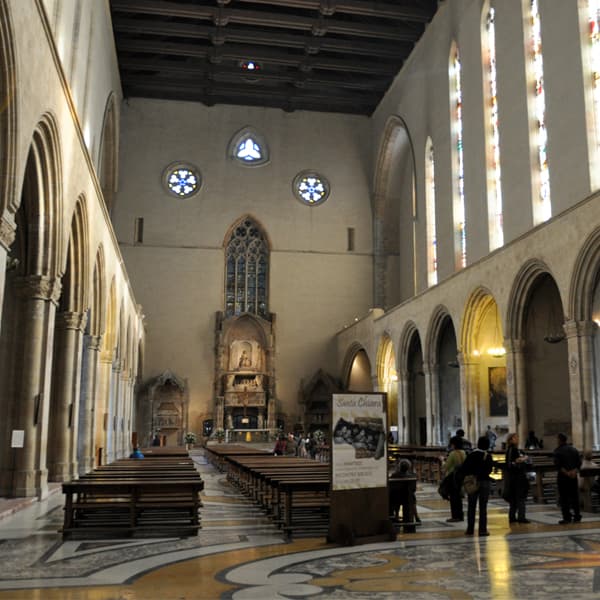
As you enter through the gate, you're passing through the wall that once surrounded this church. Keep going straight ahead and enter the church itself. The church was the center of a monastery. It was a huge complex of buildings and gardens where devotees could meditate in peace behind the safety of strong walls.
Stepping inside the church, it's a very different experience from the Gesù Nuovo church, where the Gesù was extravagant Baroque. This one is simple Gothic. Stroll up the nave. Enjoy the peaceful medieval atmosphere.
Read more...Show less
There's glorious stained glass arched windows and round rose windows with elaborate tracery. Overhead is a wood-beam ceiling. Beneath your feet is a marble floor with a huge inlaid coat of arms. This is yet another royal dynasty that ruled Naples, the Angevins.
Keep going to the far end. Santa Chiara dates from the early 1300s, the era of the Angevins from France. The church was built by the man who's buried at the far end, behind the altar. This elaborate, multi-story tomb honors Robert of Anjou, king of Naples.
He was known as Robert the Wise, and the tomb shows him high above, seated like Solomon, wisely dispensing justice. During his reign, Robert beautified Naples and made it a major medieval capital. The Angevins brought the architectural style popular in their native France, Gothic. It sure has a peaceful and solemn atmosphere, very Gothic.
The church and monastery were dedicated to the order called the Poor Clares. It was founded in the 1200s by Claire, the good friend of St. Francis of Assisi. Many noble women, including Mrs.
Robert the Wise, withdrew here to meditate and live a simpler, Christ-like life. Note the grilled windows in the altar wall. Nuns cloistered themselves on the other side of this wall. They could look through the windows and observe the view.
You can observe Mass without interacting with the public. Browsing around, you'll see a number of other tombs. This church became a kind of Westminster Abbey, where Naples royalty wanted to be buried. The carved tombs near Robert's tomb are other Angevin rulers.
To the right of the altar, there's a chapel stacked with more royal tombs. Most of these bluebloods came later in Naples' history, when Naples was ruled by the Bourbons, and then the Italians and Savoys. The painting in the chapel depicts Maria Christina of Savoy. In the 1800s, this beautiful woman married the King of Naples.
She died young, but her reputation for piety lived on. In the year 2014, she was beatified by the Catholic Church. That's one step from sainthood. The ceremony was held right here in this church.
There's also a tomb to someone we've encountered earlier, Salvador d'Aquino. He's that brave man during World War II who gave his own life to save 22 others. Now, head back to the street. As you make your way back through the nave, consider this.
During World War II, Naples was heavily bombed by the Allies as they liberated Italy. Some 20,000 Neapolitans were killed. In 1943, this church was obliterated. That's horrible.
As they rebuilt, they stripped away the gaudy 1700s Baroque decor to reveal the pure Gothic we enjoy today. Before exiting, check out a good example of this. Find the faded fresco. It's just to the right of the exit, under the stone canopy.
It depicts the Trinity, a dove representing the Holy Spirit between the heads of God the Father and Christ. Painted around 1400, it's a reminder of the tender souls who worshipped here in medieval times. We're about halfway along our walk through Naples. Halfway?
Yes, so now might be a good time to take a break. Good idea. From here, we start down Spacanopoli, which can be crowded and intense. If you want a quick break, you could take a quiet seat here, or enjoy the small park outside, or find a cafe on the piazza.
When you're ready to move on... I'm ready right now. Then let's make our way back to Piazza, Piazza Gesù Nuovo. From there, you're at the head of the street, officially labeled Via Benedetto Croce, but it's better known to everyone as... Spacanopoli. Spacanopoli, entering the old town.
Spaccanapoli: Entering the Old Town
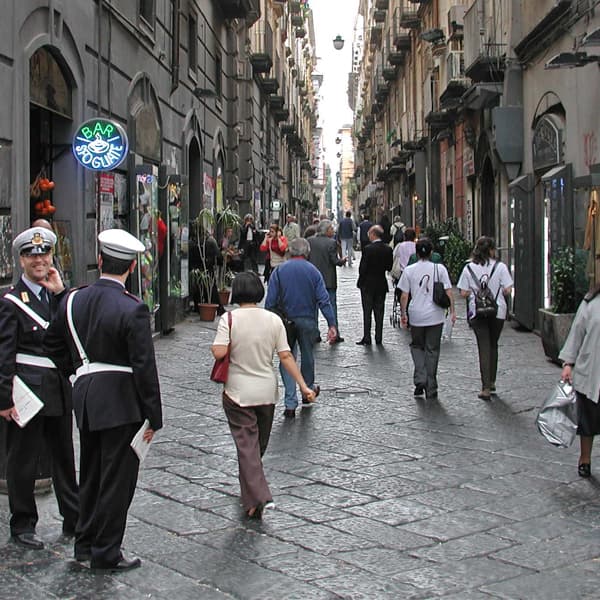
Start by just looking down the straight-as-a-Greek-arrow Spacanopoli, As we mentioned, ancient Neapolis was typical of many Greek and Roman cities laid out on a grid plan. Spacanopoli was one of three east-west thoroughfares called Decumanus. They were crossed with north-south streets called the Cardis. The whole thing was circled with a wall, creating a town of about one square mile.
Start walking down Via Benedetto Croce, or Spacanopoli. We're now entering the confines of ancient Neapolis. As we'll see, some things have changed greatly in 2,000 years, and others haven't. The street names are different.
Read more...Show less
It's called Via Benedetto Croce, Via San Biagio, and so on. But the freewheeling Naples lifestyle lives on as it has for centuries. The street is just packed day and night with people, people, people. Our next stop is on Piazza San Domenico, about 200 yards down Spacanopoli, Don't worry, we'll guide you along the way.
Just relax and let yourself get swept along in the whitewater rapids of this river of humanity. This street is some of the world's best people-watching. Since this is a university district, you're likely to see students and bookstores. The neighborhood is also famously superstitious, and you may see good-luck charms for sale.
You'll pass shops selling snack foods, coffee, gifts, souvenirs. It's certainly not a street for functionals, you won't see housewives doing their daily shopping. After crossing the first cross street, on the left side of Spacanopoli is an impressive building. This is the Palazzo Venezia.
It was the embassy of the Republic of Venice to the Kingdom of Naples, back before the unification of Italy when both were independent powers. But if you don't see it, don't worry, there's plenty of other stuff to look at here. Just keep going, enjoying the scene. You'll pass lots of shops selling snacks, eating local foods.
Naples is well-known for its unique pastries. The best-known is called sfogliatella. It looks like, well, kind of like a croissant cut in half, but it's filled with cream. The name sfogliatella means tiny leaves.
And up close, you can see why. The crust is made of extremely thin, leaf-like layers of dough. You can get it with different kinds of cream fillings. Orange, lemon, almond.
Oh! Tell me more, you sweet-talking man! And if you're still hungry, there is more. Another local delicacy you'll see is mozzarella cheese.
True mozzarella has to come from the milk of a water buffalo from the Naples region. So if you want the real deal, look for signs that proudly announce mozzarella di bufala. I'm also seeing lots of blue and white soccer gear. Yep, those are the colors of Naples Football Club.
It's insanely... insanely popular here, as we'll definitely see a little later in our walk. You'll probably also be seeing a good number of jewelry shops. Keep going down Spacanopoli.
We're headed for a spot where the narrow street opens up on the left-hand side into a plaza, Piazza San Domenico. As you walk, notice that much of Spacanopoli is paved with big basalt blocks. These are the same kinds of stones the ancient Romans used. Think of all the people who've walked this street.
First, there were Greeks in Neapolis. Then, it became a popular place for wealthy Romans to have a second home by the sea. After the fall of Rome, this treasured port city was walked by Normans, French, Spaniards, and others who ruled it as the Kingdom of Naples. For 300 years, roughly 1500 to 1800, Naples had a golden age, and this neighborhood was a ritzy part of town.
All the nobles wanted a fancy palazzo here, right in the middle of the city. in the downtown action. And look at it now. Spacanopoli still vibrates with activity.
In its way of life, this old neighborhood has remained largely unchanged for 2,000 years. By now, you should be approaching our next stop, Piazza San Domenico Maggiore. Spacanopoli opens up on the left-hand side into this pleasant square. It's lined with cafes and anchored by a big white obelisk. Piazza San Domenico Maggiore
Piazza San Domenico Maggiore
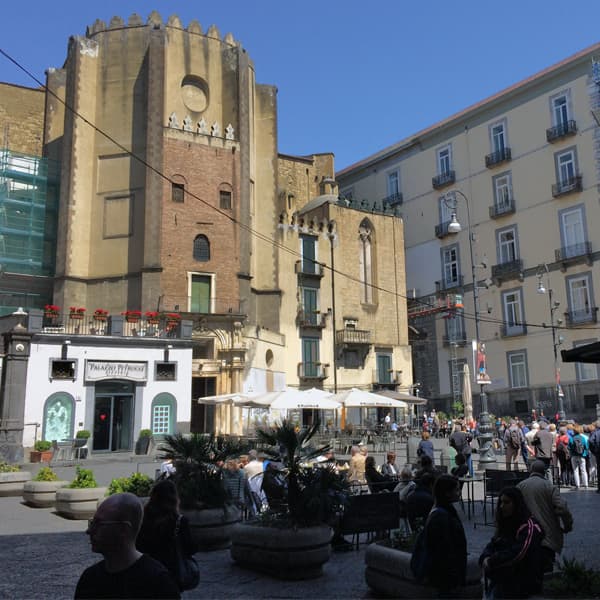
Find a place to stand and take in the scene. This is one of the most atmospheric spots in the old town. In the center stands another Naples plague column. It was also built in the 18th century after that disastrous 1656 epidemic.
This one was erected by the Dominican Order, who had their monastery here. So that's St. Dominic on top? Yep, that's the Order's founder.
Read more...Show less
The pillar is shaped like an Egyptian obelisk, but it's slathered in typical Baroque decoration. There's scrolls, coats of arms, garlands, and pudgy angel babies. Now turn your attention to the church at the top end of the sloping square. This is the Church of San Domenico Maggiore, or Church of San Domenico.
It looks more like a castle with crenellations along the roofline. This is actually the back end, or apse of the church. You enter at the far end. The church was begun 1,000 years ago, and parts of that original church still stand, even after it was incorporated into a larger church.
In the 1200s, it became a Dominican church, surrounded by a large monastery. Now turn to the right side of the square, where there's a fancy red-colored palazzo. The University of Naples, was founded right here in 1224, where this red palazzo now stands. Back then, it was part of the Dominican monastery.
The University of Naples was one of the very first universities in Europe. It was especially groundbreaking for the time because its curriculum was largely secular. It was a place to train bureaucrats and lawyers for the Naples government. The great Thomas Aquinas, my vote for the greatest mind of the medieval world, graduated from here in the 1200s.
He also taught here before moving on to Europe-wide fame in Paris. Today, this red palazzo houses a different university, the prestigious school called l'Orientale, which specializes in Asian studies. Check out a few other elegant palazzos that ring the square. In the 1700s, this square was the place to live.
The red palazzo was once the palace of the Corigliano family. You can see their family crest over the main doorway. On the opposite side of the square, is the Petrucci family palace. Eh, not so impressive today because it's been modernized.
Finally, on the Spacanopoli side, is the Palazzo Casacalenda. It's notable for the white marble columns that flank the entrances. Back in the 1700s, there was one more rich family that lived here on the square, and they left the biggest mark of all. Let's go see that one.
But first, let's get oriented. Next up on our tour is the Cappella San Severo. It's a chapel, filled with remarkable statues. It requires a paid admission, and it's a bit of a side trip.
But it's just a block away, and it's worth the price of admission. We're headed there now to go inside. After we see it, we'll return right here to this spot, the Plague Pillar. So if you're not planning to see the Cappella San Severo, you can skip the next track and resume the tour on track 19.
That picks up the tour at the same place we are now, at the Plague Pillar. Got it? Got it. So let's go see the Cappella, the Cappella San Severo.
To reach the Cappella San Severo, start walking uphill from the pillar, heading toward the upper right corner of the piazza. In other words, you want to exit the square kitty corner from where you came in, walking along the right side of the castle-like church. Keep going uphill. Exiting the square, you're on a small street called Vico San Domenico Maggiore.
Keep trudging uphill, following yellow signs that direct you to the Cappella San Severo. As you trudge, you'll pass by a big stone doorway on the right-hand side. This was the home of the family that built the Cappella San Severo. You can see the San Severo family crest over the door.
They built a small private chapel in what was back then their backyard. That's what we're headed to see. Keep going past the San Severo home. Up ahead, take your first right at the street called Via de Sanctis Francesco.
After a few steps, you'll see the Cappella San Severo with its ticket office next door. You'll need to buy a ticket, so pause the audio tour now, buy your ticket, head on in, and start the next track once you're inside. All right, see you inside the San Severo Chapel. Cappella San Severo
Cappella Sansevero
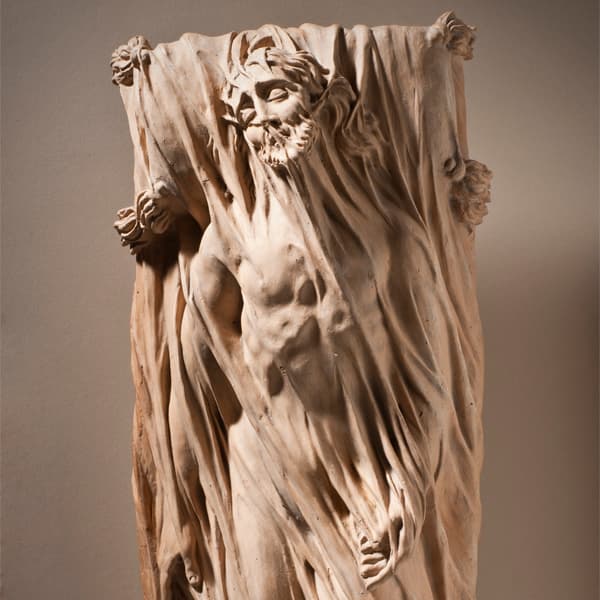
Now that you're inside the Cappella San Severo, find a place to survey this tiny but ornate church. This chapel is a Baroque explosion of statues and rich decoration topped with a lavish painted ceiling. It was built in the 1500s as the personal chapel of the San Severos, as a place to bury their honored family members. It took its current form in the mid-1700s under the San Severo prince named Raimondo di Sangro.
He hired Europe's best artists to immortalize his distinguished ancestors and their noble virtues. Raimondo was an educated man with a wide-ranging mind, a scientist, inventor, and patron of the arts. And he was also a grandmaster of the Freemasons. He used the family chapel as a Masonic temple.
Read more...Show less
So there must have been some elaborate secret ceremonies here? Yes. Masons were initiated here into the next level of their order. So Raimondo ordered his artists to fill the chapel with Masonic symbolism.
Case in point, look up at the ceiling painting. It seems as if the roof opens up to the sky. There, the dove of the Holy Spirit beams enlightenment down from the heavens. Notice the dove's halo.
It's a triangle. Exactly. The most prominent symbol of Masonry. As we'll see, this entire chapel is a complex ensemble of symbolic statues and paintings.
There's Masonic symbolism, Christian imagery, and iconography specific to the San Severo family. The Masonic layer of symbols is the most mysterious. It represents the Masonic philosophy of freedom through enlightenment. Though the Masons today are a harmless philanthropic fraternal organization, back in the 1700s, they had a reputation for secret rituals that bordered on heresy.
Let's start with the chapel's most famous statue, the veiled Christ in the center of the room. Start slowly, circling the statue clockwise from the feet to the head. Christ has just been taken from the cross. Notice at his feet the tools of the crucifixion, the nails, the crown of thorns.
Now he's been covered in a shroud, ready for burial. He lies on a stone mattress atop a gray marble bed. His head rests on two tasseled pillows. The detail work is astonishing.
The shroud seems transparent, revealing every part of the body. Every curve of Jesus' body. He almost seems still alive. You can even look through the shroud and see the wound in Jesus' side.
As you walk slowly from Christ's feet to his head, notice how the expression on Jesus' face changes. Yes, it goes from a look of suffering to one of peace. Look closely at Christ's face. You can make out a bulging vein in his forehead.
As you circle behind Christ's head, check out the pillow it rests on. You can actually see the dimples his head makes in the pillow. It's astonishing, the illusion of softness, though it's carved out of marble, one of the world's hardest stones. It's like no other statue I've ever seen.
It was done by the sculptor Giuseppe Sammartino. You can see his signature carved behind Christ's head. It says, He did it, or fetch it, in the year 1753. And, as it also says, he was proudly a Neapolitan.
He finished this amazing statue in a mere three and a half months. Wow. How did he do this? Well, much of the detail is just too fine for even the most delicate chisel.
So a lot of it was obviously done in the hard work of polishing. Keep circling the statue. Every angle is amazing. Look at Christ's left hand resting on his thigh.
Yeah, you can see the veins. Can you see the veins? Continue back to his feet. You can even see the nail holes in his feet.
And look at the lacy fringe on the shroud. Incredible. Keep in mind that for the Masons who gathered here, the statue had secret symbols. The starting point was the basic Christian message that Jesus died for our salvation.
The shroud adds a Masonic twist. For them, the shroud represented the veil of ignorance that engulfs all mortals. It's the ignorance of the body and the ego. These are obstacles to attaining real spiritual freedom.
But Christ showed us the way. He died like us mortals and was covered with a shroud. This is the state the newly initiated Mason was in. Still shrouded, but ready to be enlightened.
Then, like Christ during the resurrection, he would rise up, shed the veil, and radiate the enlightenment of eternal life. Got that, Lisa? Uh, not really. Well, it sounds like you're not ready for the next degree of Masonry.
Maybe you need a little more tutoring. Let's go to the next statue. As you wish, oh great master. Let's turn to the statue to the right of the main altar.
It shows a man engulfed in a fishing net. The man struggles to free himself from the net. A little-winged angel boy tries to help him. The statue's called The Release from Deception.
It symbolizes how we're all snared in the net of ignorance. This man struggles trying to free himself from a troubled mind. As he lifts the net from his face, he spies the angel. They make eye contact.
The angel points downward toward the source of the man's problems, the globe of the earth, the world of sin. But the angel can help light the way. Notice he has a crown of flames atop his head. These symbolize the fire of the intellect that can save us all.
There's more coded messages. At the Man's Feet is an open book. It will help you read the book. It reads, Vincula tua disrumpem.
Break your chains and the prison of darkness. The book also references passages from the Christian Bible. There's Nahum 1, verse 13. I will tear off your shackles.
And check out the carved relief at the statue's base. It depicts Christ opening the eyes of a blind man. The point of all this? If we can only attain the right knowledge, it can free us from a deceitful world.
Which was the goal of Freemasonry? You got it. The statue was sculpted by Francesco Querolo. Querolo?
Wasn't he the same guy that sculpted one of the statues for the famous Trevi Fountain in Rome? If you say it, O great master, it must be true. The entire statue we see here, the man, the net, and the little boy, is all carved out of a single piece of marble. Imagine carving that delicate net.
The sculptor had to chip away the stone to create open space without breaking the stone around it. Let's see another sculptural marvel that stands nearby. Turn to the statue to the left of the altar. It shows a standing woman covered head-to-toe by a thin veil.
That statue to the left of the altar embodies the virtue of modesty. She wears a belt of roses. Her seemingly transparent veil gives us a glimpse at her beauty. The statue is by the Venetian sculptor Antonio Corradini.
In fact, it was Corradini, a fellow mason, who helped Raimondo plan the chapel's decor. He may have even prepared the clay model for the veiled Christ. But Corradini died suddenly at age 23, and the chapel was completed by others. Corradini's specialty was veils.
And veils fit perfectly with the Masonic message. The veil was an ancient symbol dating back to the Egyptian goddess Isis. The Freemasons traced their order way back in the day. Going back to those ancient stone masons who built the Egyptian pyramids.
Coincidentally, local Neapolitan legends say that a temple of Isis had stood right here on this spot. So, as Raimondo and his mates held their rituals here, they were celebrating religious traditions that stretched back to the beginning of time. Besides all this Masonic symbolism, remember, the chapel was also a memorial to the Sansevero family. This chapel is very complex.
Masonic symbolism Christian, family, each statue has many layers. This statue of modesty marks the tomb of Raimondo's own mother. Notice the statues grabbing onto a stone plaque inscribed with a message. Paci Eterne.
Everlasting peace. But the tablet is broken, symbolizing a life cut short. In fact, Raimondo's mom died shortly after he was born. She was only 20.
Raimondo's dad is also honored with a statue. He's the guy we just saw struggling with the net. Hmm. You can't help but psychoanalyze what Raimondo must have thought of his parents.
Let's see more of the chapel. Start with the main altar. The altar is marked with a relief depicting the deposition, that is, Jesus being removed from the cross. Now do an about face and look up at the ceiling.
This spot near the altar is the best place to view the ceiling fresco. From here, the painting creates a fairly convincing 3D illusion. Though the actual ceiling is basically flat, the paint job makes it look much taller with elaborate vaulting. And it seems to be topped with a dome.
Make your way back into the nave. The entire chapel is lined with statues and medallions honoring famous San Severos, cardinals and popes, scholars and soldiers. On the floor is the blue and gold San Severo coat of arms. It has their own family motto.
Unitam Militiae Fulmin. United in defense, like a lightning bolt. Now face the altar. On the right side of the chapel, find a couple of interesting statues.
These represent virtues that the San Severo family held dear. Find the statue of a woman holding a human heart in her hand. She represents the virtue of heartfelt sincerity. Above her is a medallion with a cameo portrait.
This is the statue This is the San Severo ancestor who most embodied that virtue. Now find another statue nearby of a soldier. He's leading a lion on a leash. And he represents the virtue of, Lisa?
Courage! Good guess, but it's actually self-control. Oh, yeah, I can see that. Like keeping his inner lion in check.
By the way, this chapel is still owned by the San Severo family. The most famous San Severo of all times, all is found in the alcove along the right side of the chapel. It's the grandiose tomb of the man who created the capella we see today, Raimondo de Sangro. Raimondo de Sangro lies buried here.
You can see his portrait in the oval marble frame. Raimondo stares directly out with an intelligent, sober expression. Raimondo was scholarly and eccentric. In a way, he was typical of his time, the age of enlightenment, the 1700s.
During the enlightenment, science was gaining traction. People marveled at the rational order that seemed to exist in nature's laws. Raimondo was optimistic that the scientific method could be used to solve all problems. He experimented and invented things.
One of his inventions was the green pigment used on the chapel's ceiling fresco. Unfortunately, scientific learning was viewed with suspicion by the church. Even more suspicious was that Raimondo was a bold Freemason with all his knowledge. All their secret rituals and passwords.
Raimondo gained a sinister reputation. Locals considered him a modern Faust who sold his soul to the devil for secret knowledge. Check out the inlaid maze on the floor around De Sangro's tomb. It looks like an M.C.
Escher puzzle. Tilework like this once covered the floor of the entire chapel. The labyrinth is another Masonic symbol. It represents how the quest for knowledge can get you out of that never-ending maze of life.
Let's finish our Capella tour by going downstairs. In the last years of his life, Raimondo occupied himself with two projects, completing this chapel and creating the strange objects we're about to see. Your San Severo finale is downstairs. Here you'll find two mysterious...
well, they look like human skeletons. Skeletons covered with arteries and veins. They do look like two human cadavers, but they're not. They're known as anatomical machines.
But rumors flew. How had the mad sorcerer Raimondo created them? Did he murder a man and a woman and then inject their corpses with fluid to fossilize the veins? In fact, Raimondo made them from scratch, out of wire and beeswax.
They were like med school models to illustrate the scientific principles of the circulatory system. Raimondo lived his final days under a cloud of suspicion. He dabbled in alchemy, that is, chemical experiments that were supposed to have magical results. He wrote a book that was banned in Naples.
Raimondo was eventually excommunicated. He was forced to recant and had to live under house arrest. But he continued his scientific studies to the end. In 1771, Raimondo di Sangro died.
But his legacy of knowledge and experimentation lived on, inspiring generations of Neapolitan scholars. Our Capella Sense of Earth visit has also come to an end. But our walk through Naples continues on. When you're ready to go, leave the chapel and return to the Piazza San Domenico.
So, pause your audio tour now. Yes, pause the audio tour and start it again on the next track. Our walk picks up back at the obelisk in Piazza San Domenico. From Piazza San Domenico
P. San Domenico to Statue of the Nile
to the Piazza San Domenico, to the Piazza San Domenico, to the Piazza San Domenico, to the Statue of the Nile. Welcome back to the obelisk in Piazza San Domenico. From here, start walking, continuing down Spacanopoli. At this point, Spacanopoli is called Via Bicroce.
We're headed down Spacanopoli for just about 50 yards or so. You'll pass a red and gray church, plenty of touristy shops and street vendors. As you wade through the scene of Naples today, it's time to return to one of the themes of this walk. How little this city has changed in 2,000 years.
Read more...Show less
We're approaching the very heart of ancient Naples back when it was called Neapolis. As an international seaport, it was packed with people from every Mediterranean culture. Greeks, Romans, Etruscans, Phoenicians, and, of course, the greatest ancient civilization, Egypt. Each of these ethnic groups was assigned a different neighborhood where their traders could live and set up shop.
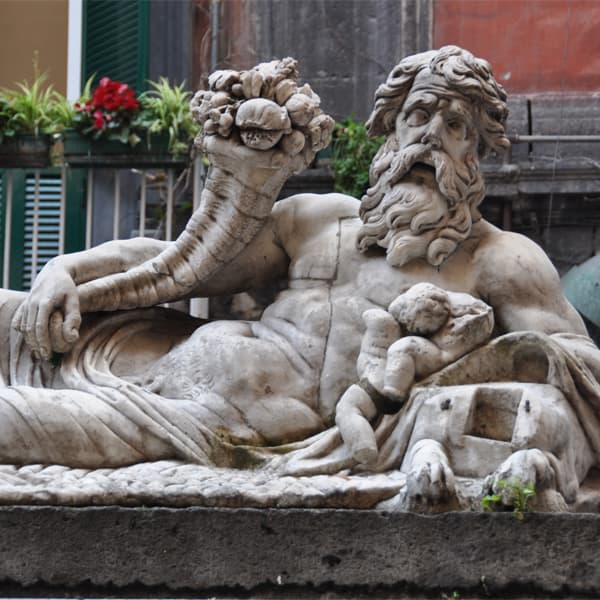
We're now entering the Egyptian quarter. Nya-nya-nya-nya-nya-nya-nya-nya-nya-nya-nya-nya-nya-nya. The focal point for the neighborhood was something that would make Egyptian traders feel right at home, a statue of the Nado. As you reach the intersection at the end of the block, you'll see a statue of a reclining man on your left.
Stop here in this busy little piazza. Find a place where you can take in the scene. This intersection is considered the center of old Naples. In ancient times, this was the center of Naples.
This was where the east-west axis of Spokanopoli was bisected by a north-south street called Via Nilo, the street of the Nile. Naples has the most intact street plan of any surviving ancient Greek or Roman city. Then, as now, there were shopfronts at street level and private homes on upper floors. Now, focus on the statue.
The Nile statue depicts a traditional river god in ancient style. He's an old bearded man reclining across his head. His pedestal. Look at his armrest.
It's a sphinx. He carries a cornucopia. That symbolizes how the waters of the Nile brought abundance to the deserts of Egypt. For 2,000 years, this statue has been an integral part of this neighborhood.
It was erected here in ancient Roman times by Egyptian merchants. They copied a statue they knew from their hometown of Alexandria. The statue gave the neighborhood its name, Nilo, or Nile. After it was erected, in more ancient times, the statue was lost for several centuries.
But the neighborhood still kept its name, Nilo. Just glancing around, I can see the Via Nilo, Piazzetta Nilo, the Nilo Church, and Bar Nilo. In medieval times, the lost statue was found again, but without its head. It was housed nearby in the town hall.
Then, in the 1600s, the beloved statue was placed here on this public square. A sculptor was hired to give poor Nilo the head we see today. No one knows whether this bearded head is accurate or not. The plaque on the pedestal says that happened in the year M-D-C-C-X-X-X-I-V.
Ah, that would be 17... 34. Yeah. But that's not the end of Mr.
Nile's story. In the 1950s, thieves broke off some fragments and made off with the face of the Nile's companion, the Sphinx. Decades later, the Sphinx Sphinx's face was discovered in far-off Austria. A grassroots campaign rose up here in Naples to restore the much-loved statue.
Thousands of shops and locals donated, and in 2014, the newly restored Sphinx statue was unveiled. The importance of this statue to the people who live here can't be underestimated. You can see it in the nickname they've given the statue, Il Corpo di Napoli, the Body of Naples. Before we move on, check out the business of the Sphinx directly opposite the statue, the Bar Nilo.
This bar is an integral part of another vital aspect of local culture, soccer. Inside the bar is a venerated shrine dedicated to Naples' most famous soccer star. You're welcome to peek in, but be warned. If you want to take a photo of the shrine, you need to buy something here.
As little as an espresso is fine, but if you don't buy anything and try to take a photo, there's a posted sign that warns that your camera may mysteriously end up damaged. Capisce? The tiny shrine inside is dedicated to football star Diego Maradona. He played for Naples during its heyday in the 1980s.
Locals consider soccer almost a religion, and this guy was practically a deity. You'll see his picture surrounded by the sky-blue colors of the Napoli football club. This gives them their nickname, the Azzurri, the Blues. You can even see a venerated statue of Diego's hair.
And that little vial? It contains teardrops. These were shed by heartbroken fans when Diego moved on to another team. Sadly, we need to move on, too.
Our next stop is about 100 yards further along. So, start walking again down Spokanopoli. ¶¶ From the Nile Statue
Via San Gregorio Armeno, Naples' Presepi
to Via San Gregorio Armeno and Naples Presepi. From the Nile Statue, our next stop is about 100 yards away. Keep going down Spokanopoli. We're right in the thick of the street's most typical businesses.
By the way, a popular Naples souvenir sold here is the corno. I'm sure you've seen it. The corno is that skinny, twisted red horn. It resembles a chili pepper.
Read more...Show less
It represents abundance and fertility. It comes with a It comes from two ancient symbols of fertility. It's a cornucopia, a horn of plenty. Like the Nile Statue had.
And it's also a phallic symbol, turned upside down. Like in ancient Pompeii, where people put phallic symbols in their homes as good luck charms. Lisa, you must have toured Naples Archaeological Museum. I did, and that's a really good tour.
Fertility is a big deal for Neapolitans, and it's not simply sexual. It provides the greatest gift a person can give, life. And it ensures that one soul will live on through the next generation. The corno represents what Naples has a lot of, the abundance of life.
I once asked a Neapolitan man to describe the Neapolitan women who are famous for their beauty. The man summed it up in a single word, abundant. You may also pass gold and silver shops. Some have signs saying Compra Oro, I buy gold, I buy gold.
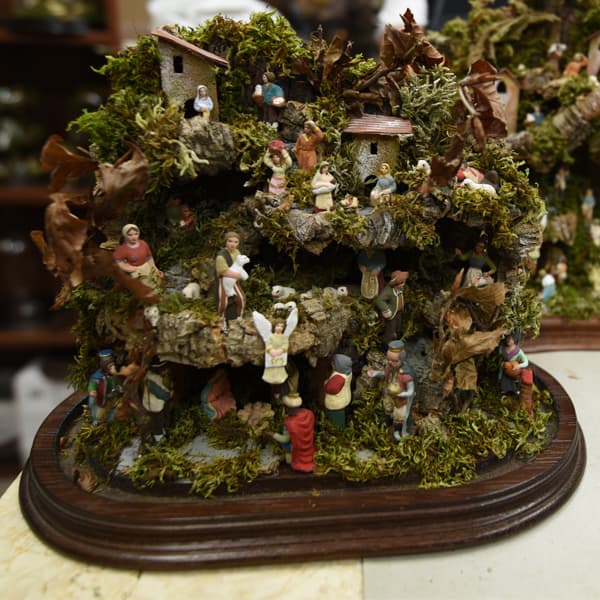
Locals say they buy stolen jewelry, melt it down immediately, and it gets resold in some other form as soon as it cools. It's an enduring sign of Naples' rough-and-tumble economic reality. Another popular item on sale here are little Christmas creches. These are nativity scenes with little figurines of Mary and the baby Jesus.
Italians call these manger scenes presepi. If you don't see any presepi right now, just keep going. You will. We're headed for the next main intersection where there's an entire street dedicated to presepi.
At Christmastime, most Italian families have a small creche in their home. It's the centerpiece of their holiday decorations, the way Americans have a Christmas tree. As Christmas approaches, every day they add another figure to the scene. Shepherds, wise men, Joseph, Mary.
The anticipation builds until finally the baby Jesus makes his grand appearance on Christmas Eve. By now, you should be getting close to our next stop. Spokanopoli will widen up a bit on the left into a tiny square. It's at the intersection with Via San Gregorio Armeno.
The little lane stretches to the left uphill. Pause here for a while. This little street, Via San Gregorio Armeno, is a little bit of Christmas all year long. Italians flock here to buy presepi and figurines.
It's like how Americans are always keeping an eye out for Christmas tree ornaments. Start making your way up Via San Gregorio Armeno. Stroll uphill toward the fanciful pink tower that arches over the street. The street's lined with stall after stall after stall.
They're selling presepi, cornos, and lots of other typical Neapolitan souvenirs. Some of it's pretty kitschy, but you'll also find some of Naples' most distinctive local crafts. Enjoy exploring. Yeah, it's kind of amazing how far up it goes.
To the right and left, there are more shops in hidden courtyards. At some places, you can even watch the craftsmen at work. You'll see manger scenes ranging from simple to elaborate. Some are made of natural bark and moss.
Some create a village scene. Others are cave-like grottoes complete with bubbling fountains. There are scenes enclosed in a glass bell. This is the classy Campane version.
You can buy the figurines separately. There's Mary, Jesus, donkeys, shepherds, angels, the whole cast of characters. You may also see some much larger presepi. At Christmastime in Italy, these are displayed in churches and on public squares.
For Italian families, it's a holiday ritual. They make a Christmas outing together, going church to church, checking the presepi out on their evening passeggiata. If you'd like to explore more shops along this pleasant street, you could always pause the audio tour. Otherwise, let's start backtracking to Spocanopoli.
You'll also see lots of other kinds of figurines on sale. There are popes and beloved saints. There's Pulcinella. He's the guy in the white clown costume with the black mask.
For centuries, Pulcinella has represented the plain-spoken Neapolitan everyman. You'll also see jokey contemporary figurines. Neapolitans love these caricatures of their local politicians, soccer stars, and other celebrities. And yes, they sometimes put these into their manger scenes, just to avoid to amuse their friends.
Our tour continues back at Spocanopoli, where we'll pick it up on the next track. See you there. To Via Duomo.
Via Duomo
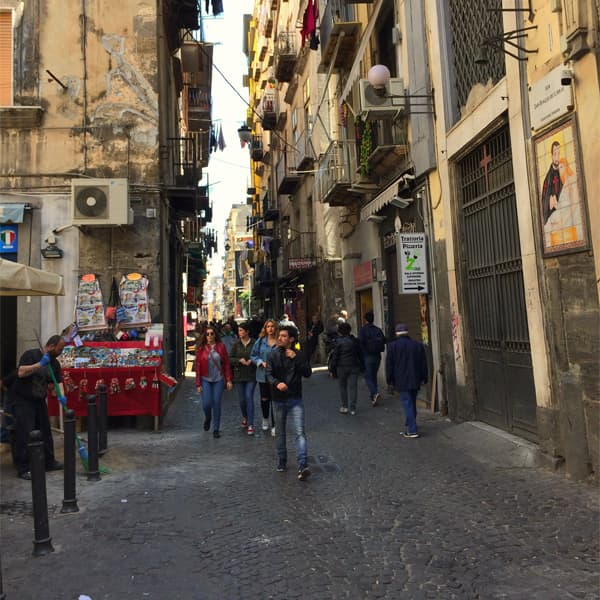
From the street with all the Proseppi vendors, continue heading down Spocanopoli. We'll be going another hundred yards or so to where it crosses a busy street. Spocanopoli has become a kind of stereotype of Italian lifestyle. Yeah, imagine living in a crowded place like this.
Shops below, apartments above, people are stacked on top of each other like a living Proseppi. This stereotypical American image of Italy comes from Naples. In the late 1800s, when Naples fell on hard times, tens of thousands of Neapolitans emigrated to the United States. They brought with them the Italy America came to know.
Read more...Show less
Pizza, spaghetti, oh, sola mia, mio. Yeah, all those things are Neapolitan customs. Not necessarily typical of Italy as a whole, but certainly part of Naples. And the song, Santa Lucia.
Santa Lucia, Santa Lucia. That was about the Santa Lucia district here in Naples. It's down by the waterfront. Immigrants in America sang that song to remember the old country.
In fact, let's hear a little bit of it from real musicians. Keep walking down Spocanopoli, enjoying the music. We'll be stopping when we reach the busy cross street. You can't miss it.
It's the one with actual car traffic. It's the street called Via Duomo. Now, enjoy a bit of Santa Lucia played on the guitar. Another of Naples' inventions.
We'll see you at Via Duomo. ¶¶ Thank you. Ah, Napoli. By now, you should be approaching the busy, cross-street called Via Duomo.
It's named for Naples' Duomo, or cathedral, which is just a few blocks to the left. But our walk continues straight ahead, on to the home stretch of Spocanopoli. From Via Duomo
Via Duomo down Via Vicaria Vecchia
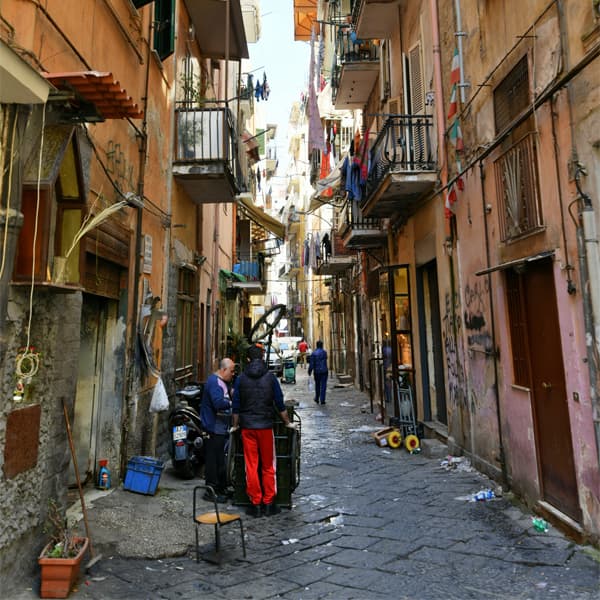
down Via Vicariavecchia. Let's cross traffic-filled Via Duomo. Once on the other side, we'll just keep going straight ahead. As you cross Via Duomo, notice the kinds of vehicles popular in this crowded city.
They're tiny, lots of motor scooters, beat-up Fiats, Ford Fiestas, and smart cars. If Italy has a reputation for crazy drivers, Naples is the gold standard. Once across the busy street and cross carefully, keep going straight on Spocanopoli. At this point, Spocanopoli is called Via Vicariavecchia.
Read more...Show less
Here, the main site is just the vibrant street life. As we go, it gets grittier and less touristy. You'll find fewer cafes, crafts, and jewelry stores, and more pantyhose, shampoo, and toilet paper. There are more practical items, things like groceries and household appliances for the people who actually live here.
It's not glamorous, but this is kind of what you come to Naples for, right? The rhythm of everyday street life. Exactly. There's more graffiti, you'll pass tiny religious shrines, and people hang their laundry from balconies.
Shop owners spill their wares out into the street. The area is said to be a center of the Camorra. That's the organized crime family here in Naples, the local version of the Mafia, which is from Sicily. But as a tourist, you won't notice.
Unless you need to park your car. Yes, then you may be approached by someone who politely offers to watch your car for you. Capisce? Keep going down Via Vicariavecchia Keep an eye out up ahead for a small patch of greenery where we'll be turning.
Naples is changing. One in five locals is under age 14. It's crowded and expensive to live here, even in a cramped apartment. Many flee to the sanity of the suburbs.
But others choose to remain right here where the action is. They pay for the privilege of basso living. And that's what we see today. Just one more page in the 2,000-year-old story of a city.
By now, you should be nearing a tiny park, a triangular patch of greenery. By the way, this park marks the center of one of the most colorful districts in Naples. It's a great place to just pause the audio tour and explore. Otherwise, we're moving on.
At the triangular park, there's a fork in the road. Take the fork angling to the right. This puts you on Via Forcella. As we angle downhill on Via Forcella, we're nearing the center of Naples.
We're nearing the end of our walk. Let's review the story of Naples. Naples got its start 2,500 years ago as Neapolis, a thriving port town for Greece and Rome. After ancient Rome fell, Naples spent 1,000 years under foreign rule as the Kingdom of Naples.
Around 1,500, Spain acquired Naples, ushering in three centuries of a Golden Age. Naples was one of the great cities on Earth, a cosmopolitan mix of Spanish nobles, German Habsburgs, and French Bourbons. But as Europe industrialized, Naples languished. Napoleon conquered the city.
And when Italy united in 1870, Rome became the premier city. Naples faded, and many immigrants fled to America. The city was bombed heavily in World War II. After the war, the economic recovery of the North never trickled south, and Naples remained backward, under the thumb of the Camorra.
The good news, that very lack of development, has preserved a proud and independent way of life that dates back centuries. The street spills out into a spacious square, Piazza Vincenzo Calenda. Turn right. As you turn right, after just a few steps, you'll find a small circular fence.
Belly up to the railing, and look down inside. This protects another chunk of that ancient Greek wall of Neapolis. It's another reminder that visitors today enjoy a city that's been continuously inhabited for 2,500 years. It seems that our walk has come full circle, so we must be done, right?
Not quite so fast. The walk's not over until we get something to eat. All right. From the Greek wall, continue ahead.
You'll exit the square on Via Pietro Coletta. Here, you'll find the final stop on our walk, food. Some typical Neapolitan eateries.
Some Typical Neapolitan Eateries
You'll find three classic eateries along Via Pietro Coletta. First up is at number 41, the Polo Nord Gelateria. Step into the North Pole, the oldest gelateria in Naples. Four generations of a single family have worked here since it opened in 1931.
Before you order, sample a few flavors. If I must... Hmm... I like the flavor called Baccio, or Kiss.
Read more...Show less
It's a combination of chocolate and hazelnut. Delizioso. And like all of Polo Nord's gelatos, it's made fresh daily. Okay, let's move on.
Are you kidding? You can always come back. We're just going to the end of the block. Then you're free to graze wherever you like.
All right. Let's continue a few more steps down Via Pietro Coletta. On the left side of the street is Pizzeria Piazza. Pizzeria Trianon da Ciro.
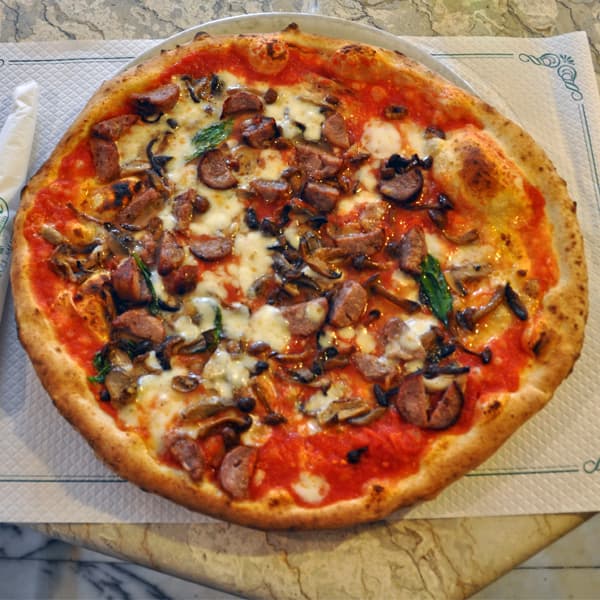
Trianon has been serving up pizza hot and fast for almost a century. Naples is the birthplace of pizza. Naples-style pizza uses fresh dough so the crust is soft and chewy. As opposed to Roman-style, which is thin and crispy.
The classic Naples pizza is topped with only mozzarella and tomatoes. And it has to be cooked in a traditional wood-burning oven. Trianon is old, but the oldest pizzeria of all, is a half block farther. Continue a few steps farther.
When you reach the fork, look to the right to find Antica Pizzeria da Michele. Some say this restaurant, da Michele, is where pizza was born. A disclaimer. Various breads with toppings have been eaten since the beginning of time.
But it was in Naples in the late 1800s that pizza as we know it debuted. From here, it spread to the rest of Italy and beyond. Some say it originated, right here, at Michele's. Judging by the lines it often has outside the door, it's certainly famous.
Michele's has pizza for purists. It serves just two classic varieties. There's marinara, topped with tomato sauce, oregano, and garlic, with no cheese. The other is pizza margarita.
This was supposedly invented for Margaret, the Queen of Italy. It comes with the three patriotic colors of the Italian flag. Red, the tomato sauce, white, mozzarella cheese, and green, garnished with a sprig of basil. Viva l'Italia!
Choose your pizza place, Michele's or Trianon. Michele's is more famous, but Trianon is usually less crowded and it's got an upstairs with air conditioning. At either place, even if you don't eat, at least step inside and watch the pizza artists in action. Nearby, there are plenty of other eateries that have popped up to catch the tourist overflow.
Our walk is over. From here, it's easy to return to Central Station. Just continue straight ahead, downhill one block, until you hit the Grand Boulevard, Corso Umberto I. From there, turn left, and it's a straight 15-minute walk to Central Station.
Or you could cross the street and flag a taxi or hop on a bus. They all go to the station. But first, I'm getting a bite to eat. Naples is famous for lots of foods, whether it's pizza, seafood, or limoncello.
In Naples, you really can't go wrong. Treat yourself. You deserve it. You've traveled through this chaotic, fascinating city that's survived for 2,500 years.
And you've survived, too, and enjoyed it. Bella Napoli! We hope you've enjoyed our Naples walk. Thanks to Gene Openshaw, the co-author of this tour.
If you're up for more sightseeing, we have more audio tours covering the great sights of the area. There's the Naples Archaeological Museum, as well as a tour of Pompeii. Remember, this tour was excerpted from the Rick Steves Rome Guidebook, co-authored with Gene Openshaw. For more details on eating, sleeping, and sightseeing in Naples, Rome, and environs, refer to this year's edition of that guidebook.
For more free audio tours and podcasts, and for information about our TV shows, bus tours, and travel gear, visit our website at ricksteves.com. This tour was produced by Cedar House Audio Productions. Grazie. Arrivederci. And buon viaggio.
Free
GPS-guided walking tour
No account needed. Walk at your own pace.
Free
23 stops ·