18 stops
GPS-guided
38 min
Duration
Free
No tickets
About this tour
A 18-stop walking tour through the heart of Italy. Visit Pompeii, Pompeii's Streets, Forum, and Mt. Vesuvius — with narrated stories at every stop.
18 stops on this tour
Pompeii
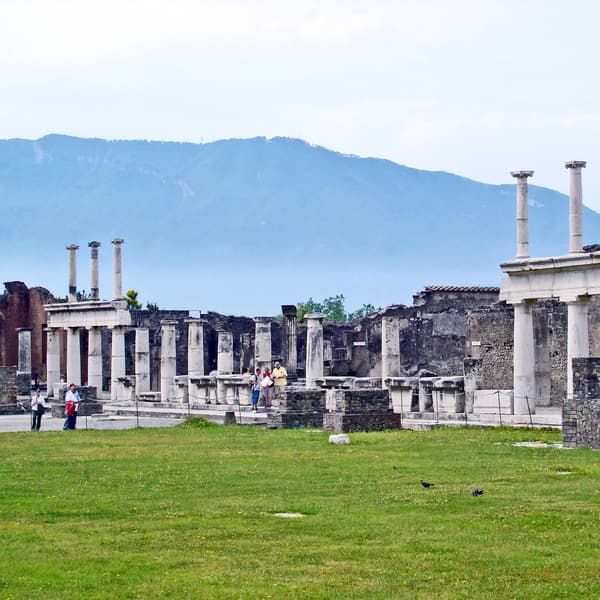
Pompeii. Stopped in its tracks by the eruption of Mount Vesuvius in 79 A.D., Pompeii offers the best look anywhere at what life in Rome must have been like 2,000 years ago. An entire city of well-preserved ancient ruins is yours to explore. Hi, I'm Rick Steves.
Thanks for joining me on a walk through Pompeii. We'll travel the same streets the ancients did, see once-thriving businesses, and enter citizens' homes still covered with frescoes. We'll even see the Pompeians themselves in the plaster casts of hapless volcano victims captured in their final moments. Allow three hours to visit Pompeii, and perhaps a little extra time to ponder the question of whether these ancient people were really that different from each of us.
Read more...Show less
To help us along the way, I've invited a good friend and virtual travel buddy. Welcome, Lisa. Ciao, Ricardo. Lisa will give us helpful directions and sightseeing tips throughout the tour.
And my first tip is to be sure you get our tour updates. Just press the icon at the lower right of your device. You'll find any updates and helpful instructions unique to this tour. Things like closures, opening hours, and reservation requirements.
There's also tips on how to use this audio tour, and even the full list. Yes, so pause for just a moment right now to review our updates and special tips. It's okay. We'll wait.
And now, let's step into our time machine, set the dial for the first century, and off we go to... The ancient city of Pompeii. The tour begins.
Tour Begins: Porta Marina Entrance
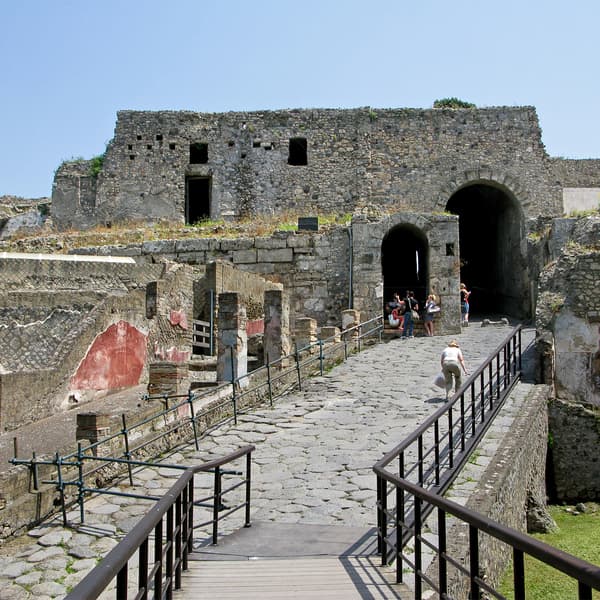
The Porta Marina entrance. Start at the Porta Marina entrance. Start at the Porta Marina entrance. Start at the Porta Marina entrance.
Start at the Porta Marina entrance. Which is the main entrance to the site. It's a block from the Pompeii-Scavi train station. At the site's tourist information window, pick up the free map and information booklet.
Read more...Show less
Now, buy your ticket and enter Pompeii. After showing your ticket to the ticket taker, start your approach up to the site, there on the hill ahead of you. Rick? Thanks, Lisa.
The city of Pompeii was born on that hill, and we're approaching the original town gate. Founded around 600 B.C. from Greek and Etruscan roots, Pompeii eventually became a booming Roman trading city. Not rich, not poor, it was middle class.
A fine example of typical Roman life. By the first century A.D., Rome controlled the entire Mediterranean, making it a kind of free trade zone, and Pompeii was a bustling port town. In fact, before Vesuvius blew and changed the landscape, the sea came right up to the town. Looking down, you can see the stone rings where ships were tied to the dock just outside the city wall.
Walk up the ramp and approach the original entrance gate. Notice that the gate has two openings. Both were left open by day to admit major traffic. At night, the larger one was closed for better security.
Pass through the Porta Marina. When you emerge on the other side, continue up the street. Head for the three large stepping stones in the middle of the road. Pompeii's Streets
Pompeii's Streets
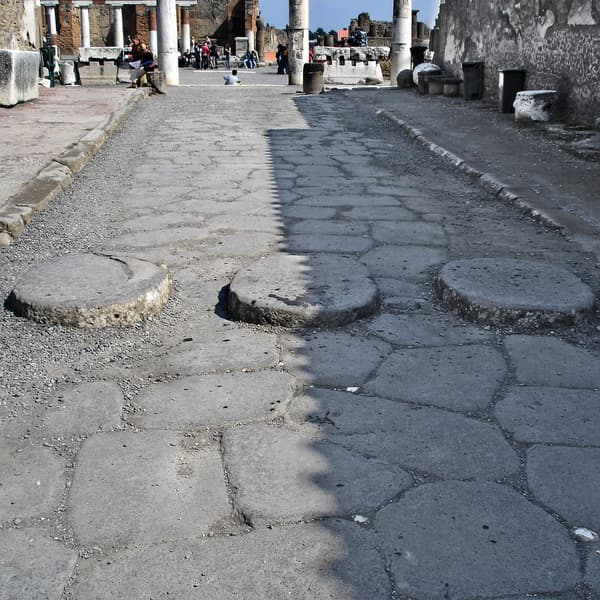
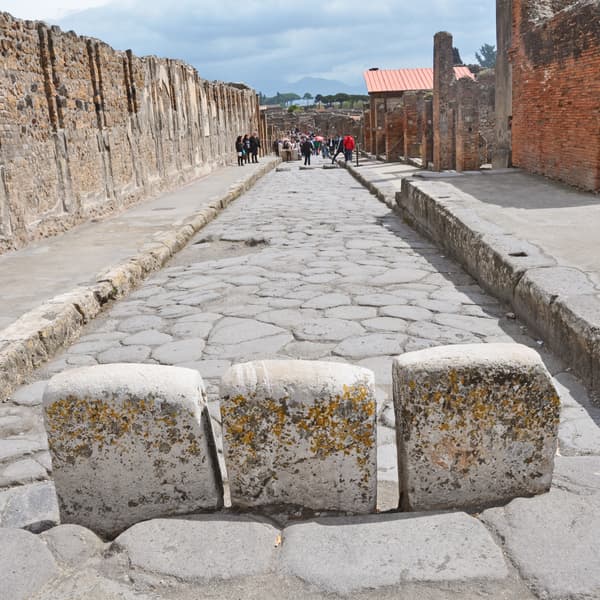
You're entering Pompeii on the same main street the ancients used. The basalt stones are the original Roman pavement. The sidewalks, which were elevated to hide plumbing underneath, were paved with bits of broken pots. It was an ancient form of recycling.
They were also studded with a piece of brick. They were also studded with bits of reflective white marble. These so-called cat's eyes helped people get around after dark, either by moonlight or with the help of lamps. The three raised stones in the middle of the road were a kind of ancient crosswalk.
Read more...Show less
Every day, Pompeians flooded the streets with gushing water to clean them out. These stepping stones let pedestrians cross without getting their sandals wet. Chariots traveling in either direction could straddle the stones, Roman chariots all had standard-size axles. A street with a single stepping stone in a road meant it was a one-way street.
A pair of stones indicates an ordinary two-way lane, and three stones, like this, signifies a major thoroughfare. Continue straight ahead. Don your mental toga. Mine's purple with white trim.
And enter the city as the Romans once did. Roman, Roman, Roman. Roman, Roman, Roman. The road opens up into the spacious main square.
This is the Forum. Stand at the near end of this rectangular space and look north toward Mount Vesuvius. Take in the scene, the open space, the ruins, and the volcano in the distance. The Forum.
Forum
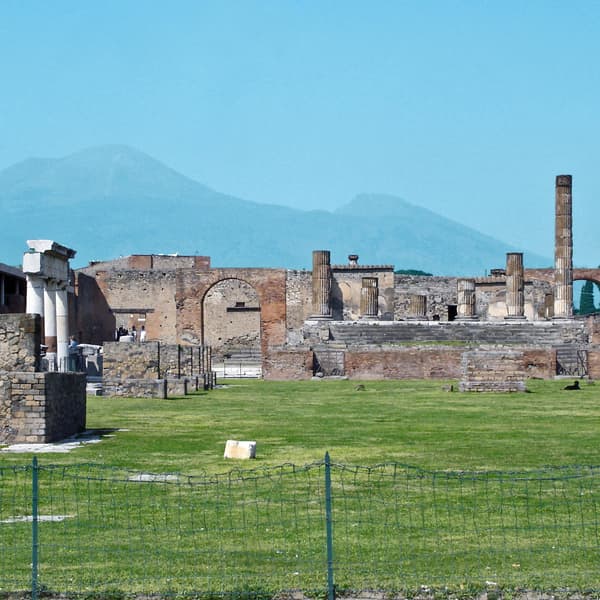
Pompeii's commercial, religious, and political center, the Forum, stands at the intersection of the city's two main streets. While this main square is the most ruined part of Pompeii, it's grand nevertheless. Picture Pompeii in its first-century heyday, population 20,000. Pompeii's citizens, wearing togas and tunics, gathered here in the main square to shop, do business, and socialize.
The piazza was surrounded by two-story buildings on all sides. The pedestals that line the square once held statues, now safely displayed in the museum in Naples. At the far end of the square stands the Temple of Jupiter, king of all the gods. It's marked by a half-dozen ruined columns atop a stair-step base.
Read more...Show less
People came here to make offerings. You might be able to make out Jupiter's little white marble head at the center rear of the temple. At the near end of the square, just behind where you're standing, is the Curia, or city hall. Like many Roman buildings, it was built with brick and mortar, then covered with a marble veneer.
To your left, as you face Vesuvius, is the Basilica, or courthouse. It's filled with stubby columns. Since Pompeii was a typical Roman town, it has the same layout and components that you'd find in any Roman city. Basilica, Curia, temples, shops, and axis of roads and commercial buildings, all centered on its main square, or forum.
Even the power of the people was expressed right here, since this is where they gathered to vote. With 20,000 prosperous citizens and brilliant white buildings of ground marble stucco, Pompeii was an impressive town with a bright future. At least, so it seemed as the sun rose on August 24, 79 A.D. He said, to appreciate the catastrophic event that buried Pompeii in an instant, look beyond the Temple of Jupiter into the hazy distance to Mount Vesuvius. Mount Vesuvius.
Mt. Vesuvius
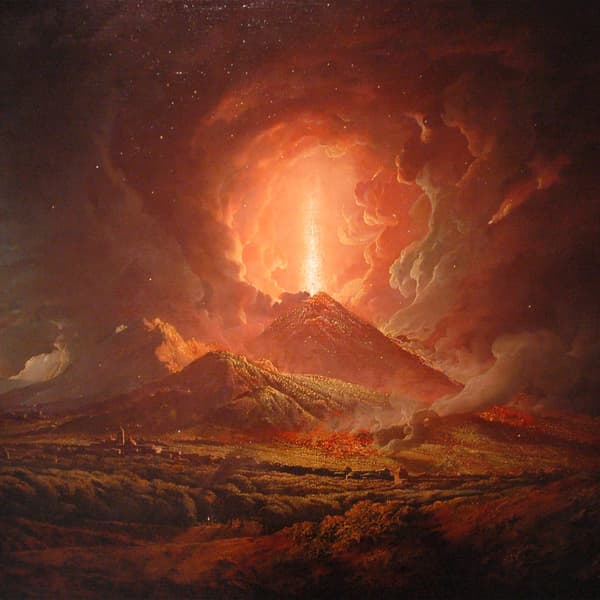
Five miles to the north of Pompeii looms the ominous back story to this site, Mount Vesuvius. Mentally draw a triangle up from the two rooms and the two remaining peaks to reconstruct the original cone shape of the mountain before it literally blew its top. At about noon on August 24, 79 A.D., Mount Vesuvius erupted, sending a mushroom cloud of ash, dust, cinders, and rocks 12 miles into the air. Pompeians were astounded.
Despite the rumblings they'd heard for several days, they had no idea they were living under a volcano since Vesuvius hadn't erupted for 1,200 years. Imagine the wonder, then the horror, as the column of smoke roared upward. It spewed for 18 hours straight. As winds blew the cloud southward, the white-gray ash began to fall over Pompeii, some like hailstones, some like rain, some falling softly like snow.
Read more...Show less
As the debris accumulated, it collapsed roofs and wooden floors but left the walls standing. In a few hours, everything was buried under a suffocating blanket of fine dust. Many Pompeians escaped in time, but the eruption left 2,000 of the city's 20,000 residents entombed. The next morning, Vesuvius struck again.
Its rising plume became a deadly torrent, falling to earth, picking up speed as it went, creating a cloud of ash, pumice, and gas. The red-hot avalanche, a pyroclastic flow, sped down the side of the mountain at nearly 100 miles an hour. While fortunately it missed Pompeii this time, it engulfed the city of Herculaneum four miles away, burying it in nearly 60 feet of hot mud which cooled into stone. For archaeologists, the eruption was a shake-and-bake windfall.
Pompeii lay buried and forgotten until it was rediscovered in the 1600s. Excavations began in 1748, unearthing a ghost town unchanged since that day in August of 79, when Pompeii was frozen in time. By the way, Mount Vesuvius is still an active volcano, having last erupted in 1944. Now let's continue looking at Pompeii's forum.
As you face Vesuvius, the basilica is to your left. It's the rectangular space lined with stumps of columns. Step inside the basilica and see the layout. The Basilica
Basilica
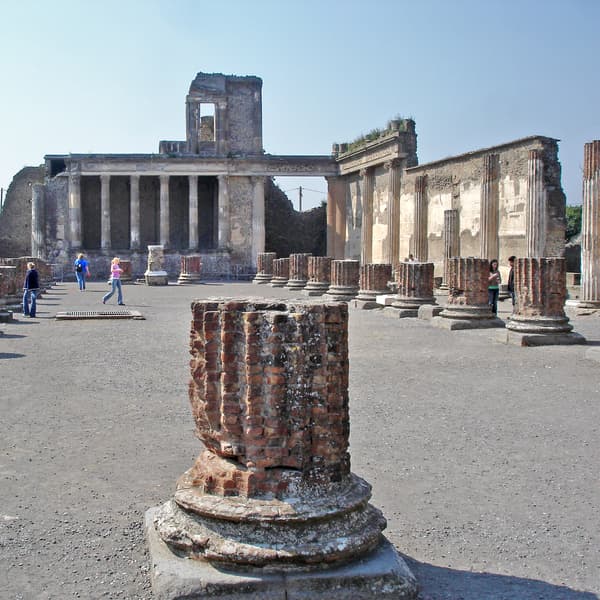
The Basilica Pompeii's Basilica was a first-century palace of justice. This ancient law court has the same floor plan later adopted by many Christian churches, which are also called basilicas. The big central hall, or nave, is flanked by rows of columns marking off narrower side aisles. Notice that the column stumps are all about the same height.
These were not ruined by the volcano. Rather, they were left unfinished at this height when Vesuvius blew. In 79 A.D., the basilica was in the midst of a rebuilding project, having been damaged 17 years earlier when Pompeii was rattled by a severe earthquake. The half-built columns show off the technology of the day.
Read more...Show less
Uniform bricks were stacked around a cylindrical core. Once finished, they would have been coated not with pure marble, but with stucco made of marble dust, designed to simulate marble columns. This was a cost-cutting method found throughout Pompeii and, in fact, throughout the Roman Empire. On the other hand, the basilica's side walls did have real marble panels.
You can still see some traces today. Besides the earthquake and the eruption, Pompeii's buildings have suffered other ravages over the years. There were Spanish plunderers around 1800, 19th-century souvenir hunters, World War II bombs, destructive vegetation, and another earthquake in 1980. The fact that the entire city was covered by the eruption of 79 A.D.
actually helped preserve it, saving it from the 6th-century barbarians who plundered many other Roman towns into literal oblivion. Exit the basilica and cross the square. On the far side, find where the city's main street hits the forum. Looking down via Appendanza, which stretches into the distance, you get a sense of the extent of this city. Via Abbondanza.
Via Abbondanza
Pompeii's main street, lined with shops, bars, and restaurants, was a lively pedestrian zone. The streets were jammed with customers from sunup to sundown. Pompeii was not a quiet bedroom community. It was a place for action and shopping.
It was tacky and gritty. There were no posh neighborhoods. Rich and poor mixed it up as elegant houses existed side-by-side with simple homes. The city served its 20,000 residents with some 40 bakeries, 30 brothels, and 130 bars, restaurants, and hotels.
Read more...Show less
At the point where Via Abbondanza meets the forum, find three, three stones jutting up from the pavement. These beaver-teeth stones are traffic barriers that kept chariots from entering the pedestrian-only street. On most of Pompeii's streets, chariots vied with shoppers, but here, the emphasis was on making a pedestrian mall for shoppers and nightlife. Ancient Romans, like modern-day Italians, knew the beauties of making their towns pedestrian-friendly.
On the square just to the left of Via Abbondanza, take a close look at the dark travertine column standing next to a white one. Notice that the marble drums of the white column are not chiseled entirely round. Another construction project left unfinished when Vesuvius messed up everyone's plans. This tour will end at the theater a few blocks down Via Abbondanza after making a big loop.
Now head toward Mount Vesuvius, cutting diagonally across the forum. To the left of the Temple of Jupiter is the granary. The Forum Granary
Forum Granary
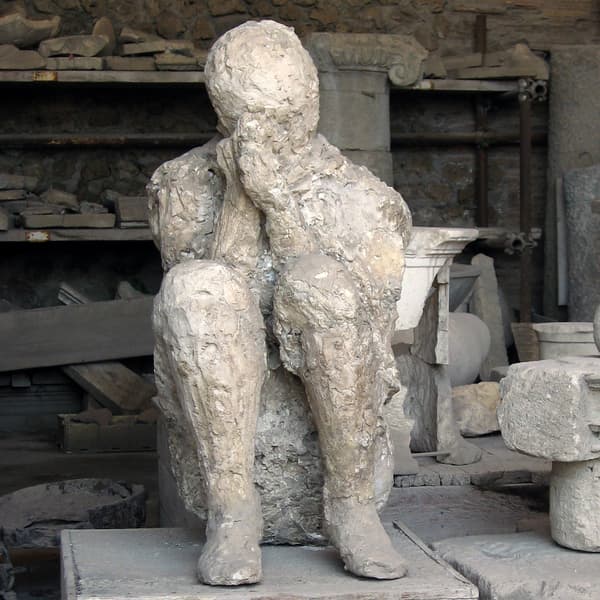
A substantial stretch of the west side of the forum was the granary and ancient produce market. Today, this warehouses thousands of artifacts excavated from Pompeii. You'll see lots of crockery, pots, pans, jugs, containers used for transporting oil and wine. You'll also see a couple casts of victims, including a dog, of the eruption.
These casts show Pompeians eerily carrying captured in their last moments in fetal position, hands covering their mouths as they gasped for air. They were quickly suffocated by a superheated avalanche of gas and ash, and their bodies were encased in volcanic debris. While excavating, modern archaeologists detected hollow spaces underfoot created when the victims' bodies decomposed. By gently filling these holes with plaster, the archaeologists were able to create molds of the Pompeians who were caught in the disaster.
Read more...Show less
If you like, pause your audio guide for a closer look at these molds and of the artifacts. A few steps to the left of the granary is a tiny alcove. It's called the Mensa Ponderaria. It was a counter with the standard units, like a liter or a gallon, used to check the quantities sold of liquid and solid food here in the forum.
And just to the right of the granary is the remains of a public toilet. Peeking into this little room, you can imagine the many seats, lack of privacy, and constant flushing stream running through the room. Exit the forum by walking across it again in front of the Temple of Jupiter. Turn left to go under the arch and leave the square.
In the road are more of those beaver-teeth traffic blocks. On the pillar to the right, look for the pedestrian-only road sign. It shows two guys carrying an amphora, or ancient jug. Keep going past the modern cafeteria straight ahead.
It's the only eatery inside the archaeological site. It has a coffee bar, a WC, and welcomes picnickers who buy a drink. Twenty yards past the cafeteria, on the left-hand side at number 24, is the entrance to the Baths of the Forum. The Baths of the Forum.
Baths of the Forum
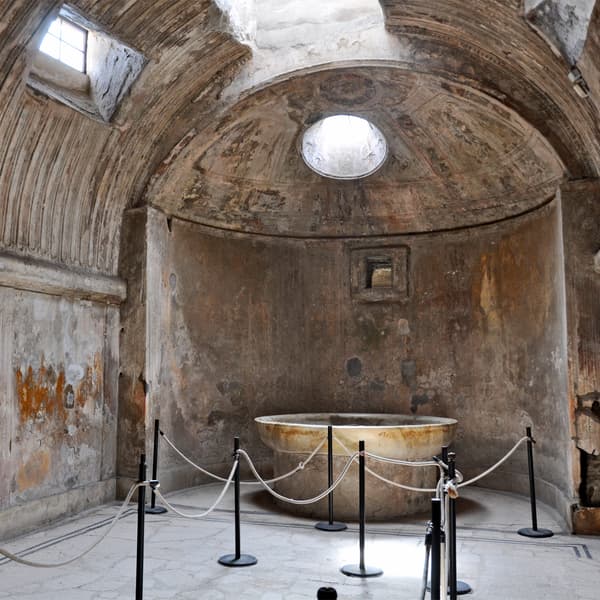
Pompeii had six public baths, each with a men's and a women's section. Stepping inside, you're in the men's zone. The leafy courtyard at the entrance was the gymnasium. After working out, clients could relax with a hot bath, the caldarium, warm bath, tepidarium, or cold plunge, frigidarium.
After the courtyard, the first big plain room you enter served as the dressing room. Holes on the walls were for pegs to hang clothing. The window, with Neptune underneath, was originally covered with a less translucent Roman glass. Walk over the non-slip mosaics into the next room.
Read more...Show less
This was the tepidarium. It's ringed by many statues of male figures used as supporting pillars. These divided the lockers. Clients would warm up here, perhaps stretching out on one of the bronze benches near the bronze heater for a massage.
Look up at the ceiling. It's half crushed by the eruption and half intact. The ceiling is half crushed Notice the fine blue-and-white stucco work. Now head into the next room, the steam bathroom, or caldarium.
Admire the engineering. The double floor was heated from below, so nice with bare feet. If you look through the grate, you can see the brick support towers of the double floor. The double walls with their terracotta tiles held the heat.
Roman soaked in the big tub, which was filled with hot water. Opposite the big tub is a fountain. It spilled water onto the hot floor, creating steam. Lettering on the fountain reminded those enjoying the room which politicians paid for it.
You can actually read how much they paid. 5,250 sestertii. Look up at the ceiling and notice the grooves. To keep condensation from dripping annoyingly on patrons, fluting or ribbing was added to carry water down the walls. Exit the baths. Immediately across the street is a series of rectangular marble counters. A fast food joint.
A Fast-Food Joint
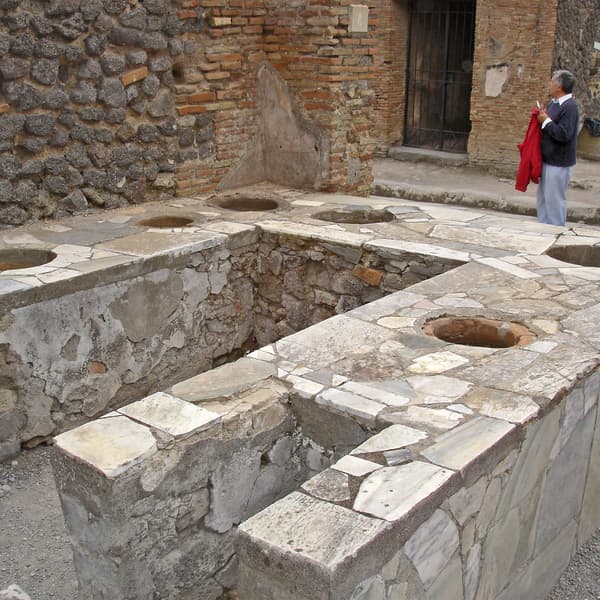
After a bath, it was only natural to want a little snack. So just across the street is a fast food joint marked by a series of rectangular marble counters. Most ancient Romans didn't cook for themselves in their tiny apartments, so to-go places like this were common. Places like Julius in the Box, McCaesar's, and Burger Imp.
The holes in the counters held pots filled with food. Each container was like a thermos, with a wooden lid to keep the soup hot, the wine cool, and the rodents out of Caesar's McNuggets. Notice the front doorstep. The groove you see was for the shop's folding accordion-style doors.
Read more...Show less
Out on the curb, look for little holes. These likely accommodated cords for stretching awnings over the sidewalk to shield the clientele from the hot sun. In the street, look at the wheel grooves in the pavement worn down through centuries of chariot traffic. You'll also see more of those stepping stones pedestrians use to hopscotch across flooded streets.
Just a few steps uphill from the fast food joint is the house of the tragic poet. piano plays softly The House of the Tragic Poet
House of The Tragic Poet
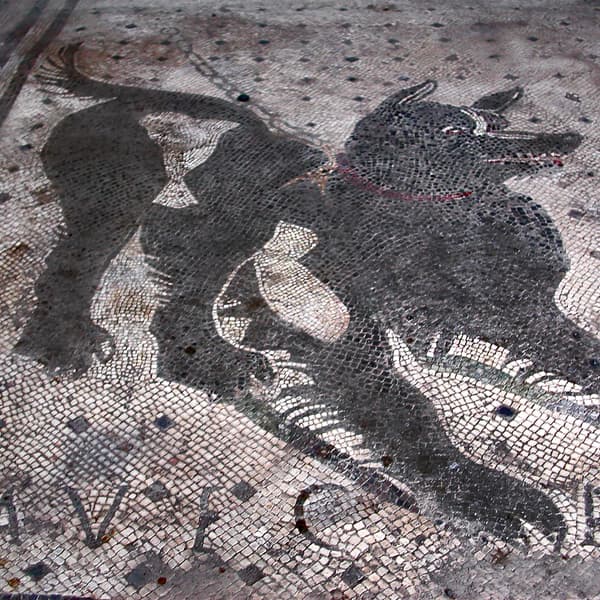
This house has a typical Roman floor plan. The entry is flanked by two family-owned shops. Notice that each shop has one of those tracks for a collapsing accordion-style door. In the entryway is the famous mosaic reading, Cave Canem, Beware of the Dog.
From the entryway, you'd find the rooms in a line. First, the atrium, with a skylight and a pool to catch the rain. Next came the den, where the shopkeeper struck deals with his customers. Then the garden, with various domestic rooms facing onto it and a shrine to remember both the gods and family ancestors.
Read more...Show less
Today's visitors enter the home through the back door. If it's open, circle around the building to the left and go in. Once inside, find the marble wellhead. The grooves on its lip were formed by generations of dragging the barbs and the bucket up by rope.
The richly frescoed dining room is just off the garden. Diners lounged on their couches, the Roman custom, and enjoyed frescoes with fake windows giving them the illusion of a bigger and airier room. Just to the right is a humble barbecue-style kitchen with a little closet for the toilet. As the kitchen and bathroom shared the same plumbing, they were typically side-by-side.
When you're ready to move on, return to the fast food place. From there, continue about 10 yards downhill to the big intersection. From the center of the intersection, look left to see a giant arch. It frames a postcard view of Mount Vesuvius. Aqueduct Arch
Aqueduct Arch
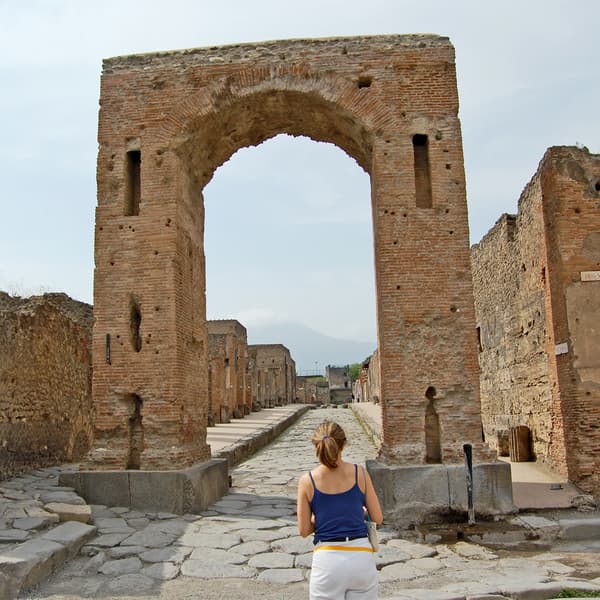
Ancient Plumbing Water was critical for this city of 20,000 and this arch was part of Pompeii's water delivery system. A long aqueduct carried fresh water down from the hillsides to a big reservoir perched at the highest point of the city wall. Since overall water pressure was disappointing, Pompeians built arches like this one as substations. This built arches brick arch, originally covered in marble, had a water tank hidden at the top.
Water from the main reservoir flowed downhill into the arch's tank, which in turn provided the neighborhood with reliable water pressure. Continue straight downhill, that is, headed east. Go one block, about 50 yards. On the left-hand side of the street, find number two, the House of the Fawn. The House of the Fawn
House of The Faun
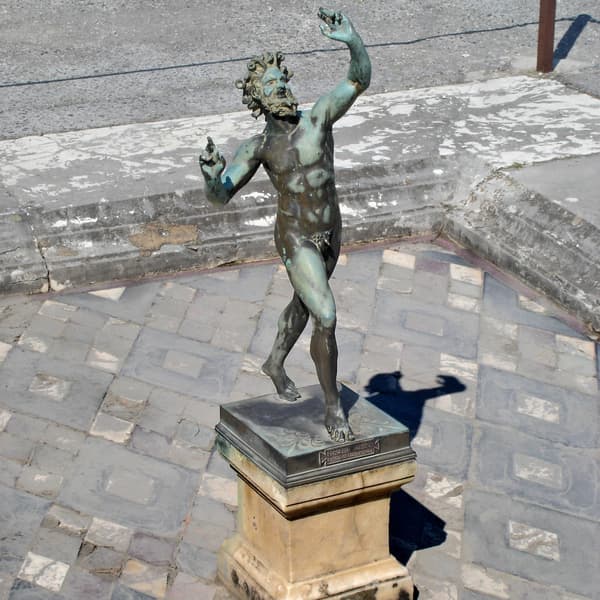
Before going inside, stand across the street. Marvel at the grand entry with its welcome reading Have. That's Latin for Hail or Be Well. Now go on in.
Notice the two shrines above the entryway. One is dedicated to the gods, the other to this wealthy family's ancestors. You're standing in Pompeii's largest home. With 40 rooms and 27,000 square feet, it covers an entire city block.
Read more...Show less
In the courtyard stands the delightful, if small, statue of the Dancing Fawn. The bronze statue is famous for its realistic movement and fine proportion, but this is only a copy. The original is in Naples Archaeological Museum, as are so many of Pompeii's statues, frescoes, and mosaics. Continue further into the house.
The next floor mosaic with an intricate diamond-like design decorates the homeowner's office. Beyond that is the famous floor mosaic of the Battle of Alexander. Once again, the original of this is in the museum in Naples. Study the mosaic.
It's 333 B.C., and the great Greek conqueror Alexander the Great is facing off against Darius and the Persians. Alexander is on the left side of the scene, the one with curly hair and sideburns. Darius is in the center, in a chariot, wearing a turban and a beard. Notice that Alexander is the only one without a helmet.
He's the confident master of the battlefield, while everyone else is fighting for their lives, eyes bulging with fear. Alexander defeated Darius in this pivotal battle, establishing the great Greek empire that the Romans would later inherit. Educated Romans decorated their homes with Greek motifs. This historic mosaic and the diamond-like dancing faun statue show that, while most of Pompeii's nouveau riche may have had notoriously bad taste, the owner of this house had class.
The house's back courtyard leads to an exit in the far right-hand corner. As you head for that exit, notice that the courtyard is lined with pillars rebuilt after the 62 A.D. earthquake. Take a close look at the brick mortar and fake marble stucco veneer.
Exit the house of the faun through its back door in the far right-hand corner. Pass through the door and turn right onto the street behind the house. If this exit is closed, you can reach the street by returning to the entrance and making a U-turn left around to the back of the house. However you get to the street behind the house of the faun, find the metal cages along the right-hand side of the street. These protect some ancient pipes.
Original Lead Pipes
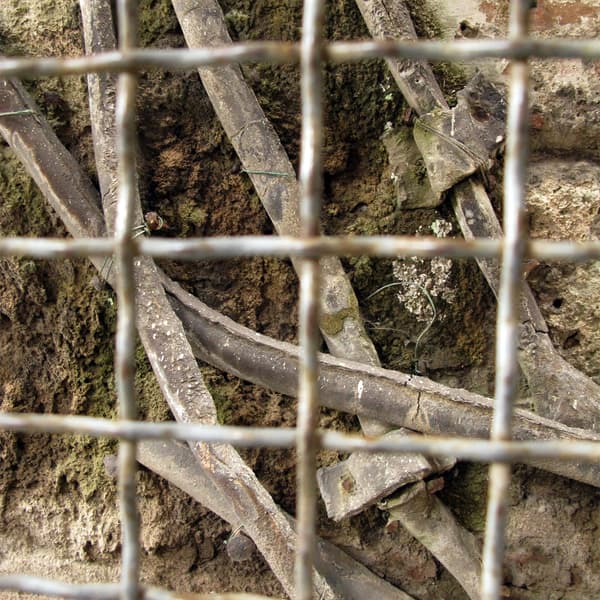
Original lead pipes. These 2,000-year-old pipes were part of the city's elaborate water system. They're made of lead imported from Britannia, or Roman Britain. The aqueduct-fed water tank at the high end of town fed water to three independent systems.
One was for the bathhouses, one was for private homes of the wealthy, and one for neighborhood wells. If there was a water shortage, Democratic priorities prevailed. First, the baths were built, then the private homes. The last water supply to go was the public fountains where all citizens could get water for cooking and drinking.
Read more...Show less
Continue east along the street. Take your first left on the street called Vicolo dei Vetti. Walk about 20 yards and find the entrance, on the left, to the House of the Vetti. If it's closed for restoration, you can at least look through the door. The House of the Vetti
House of the Vetti
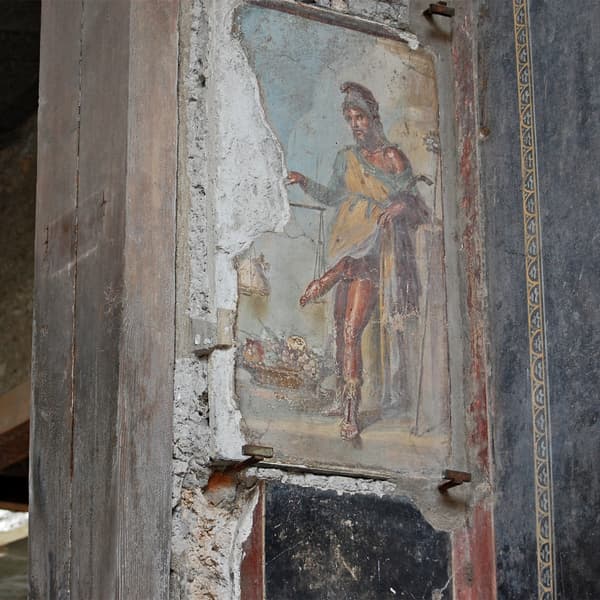
This is Pompeii's best-preserved home, retaining many of its mosaics and frescoes. The House of the Vetti was the bachelor pad of two wealthy merchant brothers. In the entryway, spot the huge erection. This is not pornography.
There's a meaning here. The penis of the Vetti and the sack of money balance each other on the goldsmith's scale above a fine bowl of fruit. Translation? Only with a balance of fertility, the erection, and money, the gold, can you enjoy true abundance, the fruit.
Read more...Show less
If it's open, step into the atrium with its ceiling open to the sky to collect light and rainwater. The pool, while nice-looking, was a functional water supply tank. It's flanked by large money boxes anchored to the floor The brothers were certainly successful merchants and possibly money lenders, too. Exit the atrium on the right.
This leads you through several rooms. First comes the tight servant quarters. Passing through here, you spill into the kitchen with its bronze cooking pots. In the kitchen, you'll also see an exposed original lead pipe on the back wall.
The passage dead-ends in the little Venus room, which features erotic frescoes behind glass. Return to the atrium. From there, pass into the big colonnaded garden. It was replanted in modern times with the same plants archaeologists found evidence of in the volcanic ash.
Ringing the courtyard are rooms the brothers used for entertaining. Circle counterclockwise and see how each is decorated. The dining room is frescoed in black and red, the distinctive color known as Pompeian red, made from iron, iron rust pigments. Study the detail.
Between the wall and the floor, notice the lead humidity seal designed to keep the moisture-sensitive frescoes dry. Had Leonardo da Vinci taken this clever step, his last supper in Milan might be in better shape today. That's right. Continuing around the courtyard, notice the square white stones inlaid in the floor.
These are more of those cat's eyes. Imagine, these reflecting like little eyes as the brothers and their friends wandered around by oil lamp late at night with their sacks of gold, bowls of fruit, and enormous Rick? enormous egos. In the yellow room, near the exit, more frescoes show off ancient Rome's mastery of perspective, which would not be matched elsewhere in Europe for nearly 1,500 years.
Our next stop, the bakery, is located about 150 years south or downhill from the House of the Vetti. To get there, return to the street in front of the house. Facing the entrance to the House of the Vetti, turn left and walk downhill along Vicolo dei Vetti. Go one block to where you dead-end at a T-intersection with Via della Fortuna.
The intersection is marked by a stone fountain with a bull's head for a spout. Intersections like this were busy neighborhood centers, where the rent was highest, and people gathered. From the intersection, find the road that lets you continue south. You'll need to go left a few steps, then immediately right.
When you find the road, continue south along this gently curving road. Mmm. What's that I smell? Is that rolls or pizza?
Or... You'll find out soon enough. On the left side of the street at number 22, find four big stone silos, cylinders that mark... the bakery. The Bakery and Mill
Bakery and Mill
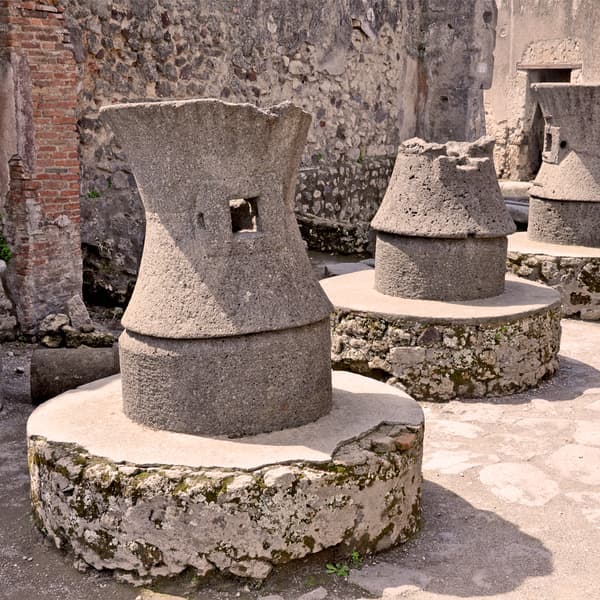
The stubby stone towers are flour grinders. Grain was poured into the top, and donkeys, or slaves, tread in a circle, pushing wooden bars that turned the stones. The powdered grain dropped out of the bottom as flour, flavored with tiny bits of rock. Nearby, the thing that looks like a modern-day pizza oven was a brick oven.
Each neighborhood had a bakery just like this. Continue down the curving road to the next intersection. That's Via Delle Agustale. As you walk, look at the destructive power of all the plants and vines that you see around you.
Read more...Show less
Also, notice how deep the chariot grooves have worn into the pavement. Deep grooves like these could break wagon wheels. Next, you suddenly reach an ungroovy stretch of the street. This road was in the process of being repaved when Vesuvius blew.
When the curvy road reaches the intersection with Via Delle Agustale, turn left. Head east about 50 yards down this street to number 44 on the left. Here you'll find the Tabernacle, an ancient tavern. Great, I'm thirsty.
It's been closed for 2,000 years. Oh. But its original floor mosaic is intact. Great.
Can I take a peek? Sure. When you're done, continue on. Just past the tavern, turn right and walk downhill. Find number 18 on the right-hand side of the street. Oh. I don't know where you are.
Brothel, or Lupanare
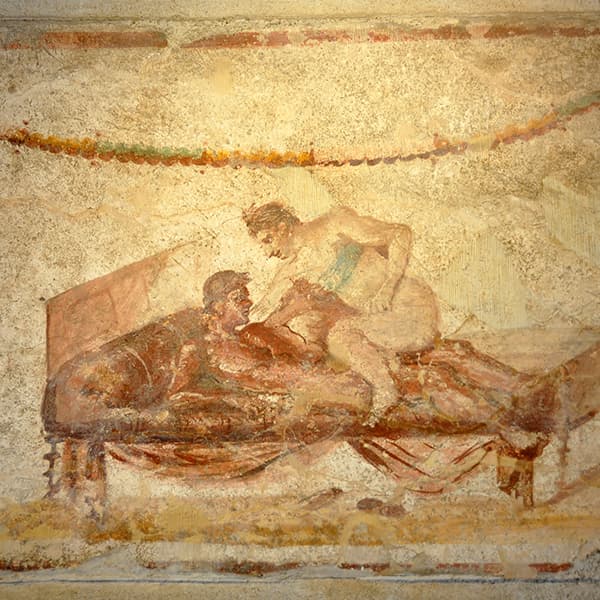
The brothel, or lupinare. You'll find the biggest crowds in Pompeii at a place that was also popular 2,000 years ago. The brothel. Back then, a prostitute was nicknamed lupa, or she-wolf, alluding to the call they made when trying to attract business.
Oh, oh, oh! Stepping inside, you'll see that the brothel was a simple place with a few cell-like bedrooms and beds and pillows made of stone. Notice that the bed legs came with little disc-like barriers to keep critters from crawling up. The ancient graffiti on the walls includes tallies and exotic names of the women, indicating that prostitutes came from all corners of the Mediterranean.
Read more...Show less
The graffiti also served as feedback from satisfied customers. The faded frescoes above the cells may have been a kind of menu for services offered. One woman is depicted wearing an early bra. Note that the women are idealized, always shown with white skin, which was considered beautiful and contrasted with the darker skin of their horny customers.
We have one more stop, the theater. When you're ready to continue, leave the brothel, go right, then take the first left. Continue going downhill. After two blocks, you reach the intersection with Pompeii's main drag, Via Abundanza.
At this intersection, you're at the center of Pompeii's action. To your right, Via Abundanza leads to the forum and to the exit. To the left, the road takes you to the huge amphitheater, a ten-minute walk east. It's impressive, but we won't go there on this guided walk.
For now, turn left on Via Abundanza in the direction of that amphitheater and go about 150 yards. Then turn right on Via Stabiana, which leads downhill to the cute Teatro Piccolo, or Little Theater. Go inside and check it out. From there, follow signs to the nearby and much bigger Main Theater. The Theater
Theater
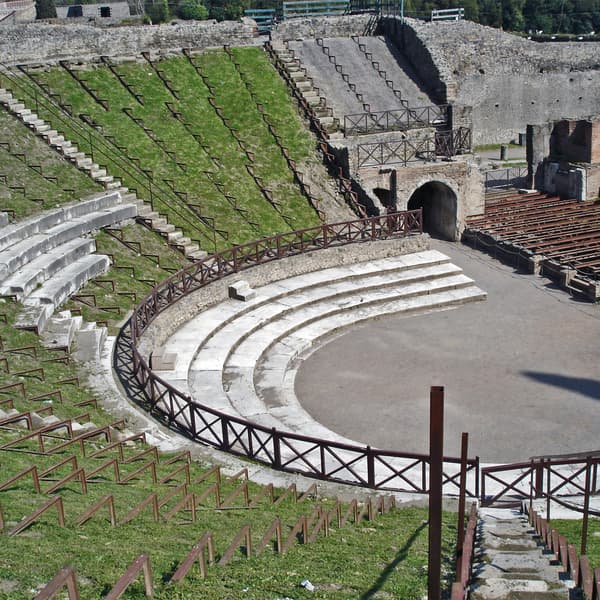
Pompeii's Theater is built in the Greek style, that is, built into the curve of a hillside. It's built that way because it actually was a Greek theater back when Pompeii was a Greek port founded in 470 B.C. By Roman times, the theater could seat 5,000 people in three sets of seats, all with different prices. Check them out.
Closest to the stage, was the five marble terraces, which were filled with romantic wooden seats for two. Next was the main section. And finally, notice the cheap nosebleed section, surviving only up on the right. The square stones above the cheap seats once supported a canvas awning.
Read more...Show less
Take note of the high-profile box seats flanking the stage. These were for guests of honor. Also, from this perch in the upper part of the theater, you can look beyond the theater to see the colonnaded courtyard nearby that housed the gladiator barracks. Gladiators lived in tiny rooms, trained in the courtyard, and fought in the nearby amphitheater or gladiator arena.
There's so much more of Pompeii to explore, but by now, you've seen the highlights, the homes, shops, and temples of those people whose busy lives were suddenly stopped and preserved forever by the eruption of Mount Vesuvius 2,000 years ago. We hope you've enjoyed this slice of Rome thanks to Gene Openshaw, the co-author of this tour. If you're planning more sightseeing, we have lots of audio tours available for Rome, including a walk through the heart of Rome, the Colosseum, the Roman Forum, the Pantheon, St. Peter's, the Vatican Museums, and Sistine Chapel, as well as walks through Trastevere, the Jewish Ghetto, and the remains of Ostia and Pompeii.
In one day? No. Remember, this tour was excerpted from the Rick Steves Rome Guidebook by Rick Steves and Gene Openshaw. For more details on eating, sleeping, and sightseeing in Rome, refer to the latest edition of that guidebook.
For more free audio tours and podcasts, and for information about our TV shows, bus tours, and travel gear, visit our website at ricksteves.com. This tour was produced by Cedar House Audio Productions. Grazie. Ciao. And buon viaggio. ♪
Free
GPS-guided walking tour
No account needed. Walk at your own pace.
Free
18 stops ·