13 stops
GPS-guided
54 min
Duration
Free
No tickets
About this tour
A 13-stop walking tour through the heart of Italy. Visit Vatican Pinacoteca , Niccolò: Last Judgment, Giotto: Stefaneschi Triptych, and Melozzo: Angel Musicians — with narrated stories at every stop.
13 stops on this tour
Vatican Pinacoteca
The Vatican Pinacoteca. Bite-sized and beautiful, the Vatican Museum's painting gallery is a delightful break from the hordes of tourists packing the rest of the museum. If the Sistine and company are an artistic feast, the Pinacoteca is a light appetizer or a tasty dessert to round out your Vatican visit. Hey, I'm Rick Steves.
Thanks for joining me for a visit to the Vatican's colorful collection of paintings. Focusing on the highlights, we'll see the art unfold like a time-lapse blossoming of an artistic flower as it evolves from medieval to Renaissance and beyond. Along the way, we'll marvel at glittering gold altarpieces, rock out with a band of musician angels, and see rare masterpieces by artistic giants like Leonardo da Vinci, Raphael, and Caravaggio. This gallery is a peaceful corner of an otherwise crowded and hectic museum.
Read more...Show less
Visiting the Pinacoteca is a great chance to just slow down and savor a select few works in all their sumptuous details. And that's what we'll do with this tour. Because the massive Vatican Museum can be overwhelming, be sure to plan ahead. Budget most of your energy for the main museum in the Sistine Chapel.
And, by the way, we have audio tours for each of those. The Pinacoteca can easily be fitted in either before or after the tour. Before or after seeing those must-see parts of the museum. To help us along the way, I've invited a good friend and virtual travel buddy.
Welcome, Lisa. Ciao, Ricardo. Lisa will give us helpful directions and sightseeing tips throughout the tour. And my first tip is to be sure you get our tour updates.
Just press the icon at the lower right of your device. You'll find any updates and helpfulness on all instructions unique to this tour. Like closures, opening hours, and reservation requirements. There's also tips on how to use this audio tour and even the full printed script.
Yes. Pause for a moment right now to review our updates and special tips. It's okay. We'll wait. Now, buckle up for a quick sweep through Western art and... Let the tour begin!
Tour Begins: Pieta Copy
The tour begins with a familiar work. You'll find the Pinacoteca conveniently located just inside the Vatican Museum's entrance at the top of the entrance escalators. So you'll enter the museum, go through security, and up that long series of escalators. At the top of the escalators, you'll start seeing signs pointing to the various parts of the Vatican Museum.
The Sistine Museum is a place where you can see the Vatican Museum. The Sistine Museum is a place where you can see the Vatican Museum. The Sistine Museum is a place where you can see the Vatican Museum. The Sistine Museum is a place where you can see the Vatican Museum.
Read more...Show less
The Sistine Museum is a place where you can see the Vatican Museum. The Sistine Museum is a place where you can see the Vatican Museum. The Sistine Museum is a place where you can see the Vatican Museum. The Sistine Chapel and the main museum rooms are to the left, which is where all the crowds are going.
The cafeteria is straight ahead of you, as well as a great view of the Vatican Gardens and St. Peter's Dome. And the Pinacoteca is located to the right. Pinacoteca to the right.
Got it. There are signs pointing the way. Turn right and start making your way to the Pinacoteca. It's about 50 yards from the escalators.
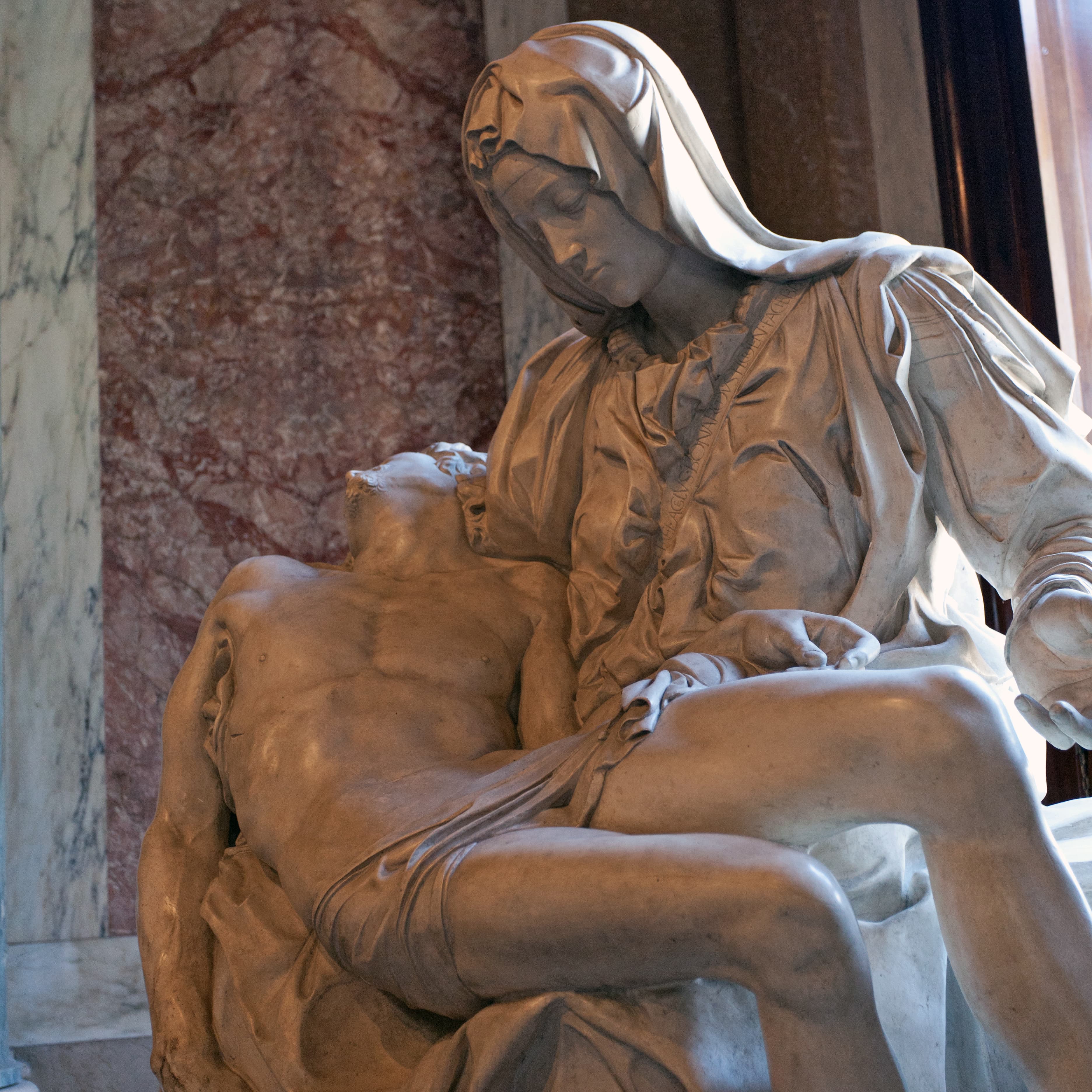
Enter the Pinacoteca through the big entrance doors. Once inside, in the entry hall, find a familiar-looking statue, Michelangelo's famous Pietà. This, of course, is just a plaster copy of the Pietà, but it's an excellent version, faithfully showing Mary cradling the dead body of Jesus across her lap. Get close to this plaster Pietà while Rick introduces us to our tour.
Rick? Thanks, Lisa. Take a moment to admire the Pietà. Imagine it's the year 1500 and Michelangelo's Pietà stands in St.
Peter's Basilica, welcoming the faithful. The Renaissance is in full bloom. Michelangelo's statue captures many of the features we love about Renaissance art. It's realistic and lifelike.
It's emotional, drawing us in and bringing a divine event down to Earth in a powerful way. But the Renaissance didn't just pop out of nowhere. On this tour, we'll see how artists through the centuries gradually developed these techniques as art evolved from medieval to Renaissance to Baroque, getting ever more realistic, emotional, and dramatic. Let's get started.
From the entry hall with the faux Pietà, head into Room 1. It's lined with altarpieces. Room 1 has some of the earliest surviving Christian altarpieces, from nearly a thousand years ago. Dominating the room is a big depiction of the Last Judgment with a round top and rectangular bottom. Niccolò e Giovanni,
Niccolò: Last Judgment
the Last Judgment, was the last judgment. Before we focus on the big Last Judgment altarpiece, start by just browsing around while Rick sets the stage. You'll see paintings of crosses, saints, and the Virgin Mary. They're beautiful in their own way, I guess, but not realistic the way Michelangelo's Pietà was.
These figures are stiff, scrawny, and wooden. The scenes are flat, with no background, just gold. Why the gold background? Well, these are the figures These altarpieces are not really about this earthly world, but about the heavenly world.
Read more...Show less
And nobody's ever been to heaven and come back to tell us what heaven looks like. So, to imagine heaven, they referred to the thing that on earth was the most precious and luminous. Gold. These altarpieces were painted 500 years after the fall of ancient Rome and the fall of artistic knowledge to depict realistic figures.
Realistic figures, like many of the statues that are right here in the Vatican Museum. Right, like the ancient statues of Apollo Belvedere or Laocoon. Those techniques had been lost. Besides, since Christian art was focused away from the real world, it only needed to be realistic enough to tell basic Bible lessons with a few simple gestures and symbols, to be inspirational, not necessarily beautiful or realistic.
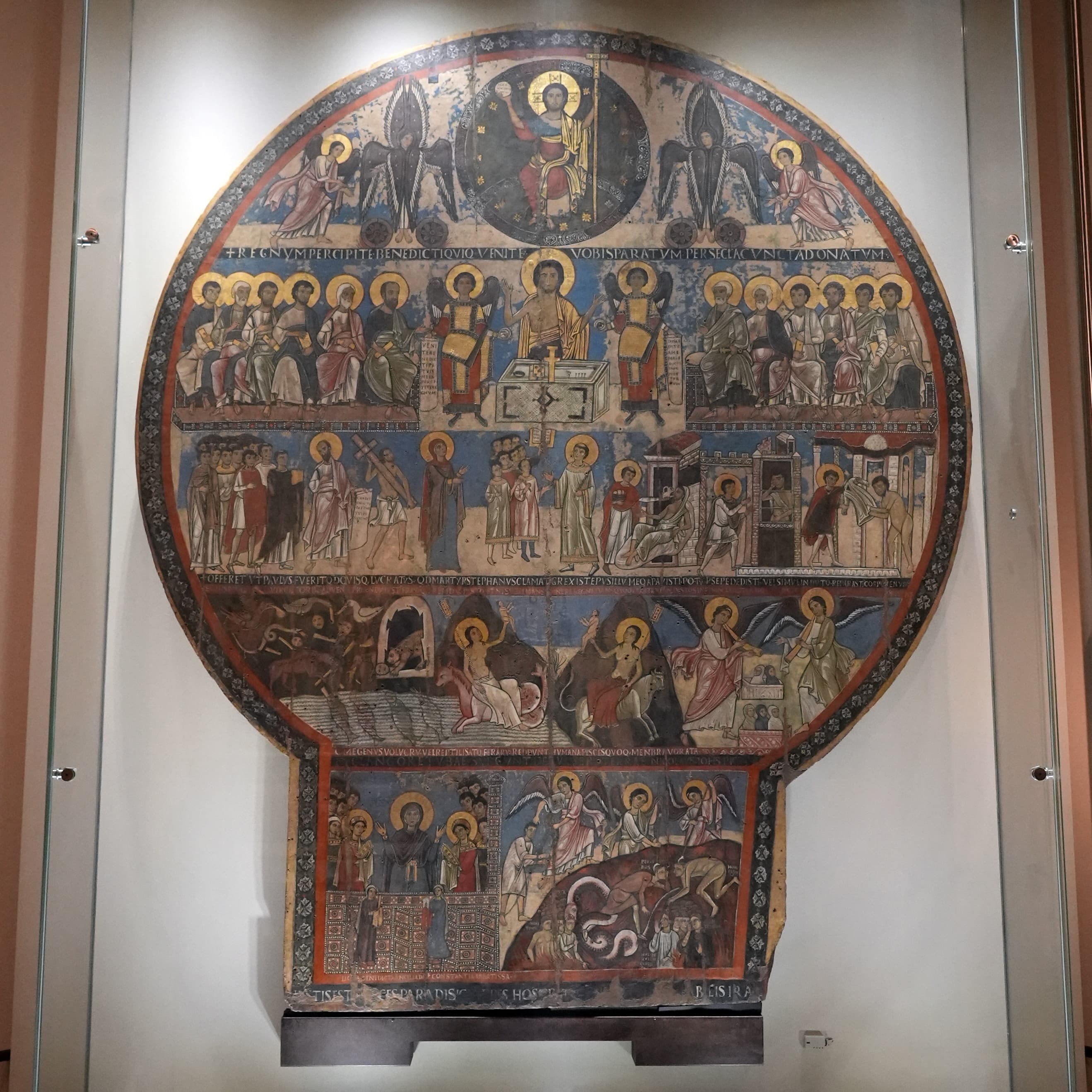
Now, let's focus on that biggest altarpiece, the Last Judgment, by a commentator, by a couple of little-known artists named Niccolo and Giovanni. This is the oldest painting in the Pinacoteca, from the 12th century. Remember, this was originally in a church. So, let's liberate our minds from the museum.
Ah, I'm free! Imagine being a medieval peasant gazing on this scene and thinking of that glorious and dreaded day when your soul would be raised from the grave to be judged. Though it's a jumble of images to our modern eyes, a peasant, a peasant could easily recognize who's who. Let's start at the very top.
At the top, that's obviously Christ triumphant. He's come to judge who's been naughty and who's been nice. And below him are the nicest ones, a row of saints. It's clear they're righteous because they all have halos.
Very noticeable halos. Like gold dinner platters on their heads. The whole scene is neatly divided into horizontal layers, like a schematic diagram carefully explaining the logic of this supernatural scene. So the layer below the row of saints explains the good deeds that got them to heaven.
I can see one man helping another guy who's sick and laying down. Another visits someone in prison. And another gives a shirt to someone who needs it. The art isn't terribly realistic, but it doesn't really have to be.
Medieval Christians already knew the Bible verses these simple gestures referred to. The next layer down I think is the most interesting. On the right, angels are blowing their trumpets on this judgment day to wake the dead. Yes, I see dead people.
They're in those little boxes meant to represent their tombs. The dead emerge and rise up. Like you said, it's realistic enough to get the gist, but the proportions are weird. Yeah, the tombs are too small.
They're like little stage props. Who are those two guys at the center riding animals? Oh, they're taking the risen souls to be judged. Look, they're holding the tiny souls in their hands like dolls.
And further to the left is the most dramatic moment of all. It's when the sinners meet their fate. We know they're sinners because they don't have halos and they're in very scary situations. Ew!
They're literally getting chewed up by wild animals. Wolves, birds of prey. They're picking at them. You can see human body parts sticking out of their mouths.
Even the fish in the sea have limbs in their mouths. Yeah, I see the fish under the rippling waves, but they're just laying there like they're on the grill. Again, not realistic, but it certainly makes the point symbolically. Rick, go to hell.
Okay, Lisa. That's in the lower right-hand corner. That's where the damned end up, devoured eternally by wild animals and encircled by eternal flames. To the medieval mind, it must have been absolutely terrifying to look at art like this as they reflected on their own behavior.
Contrast hell in the lower right with the scene in the lower left corner. It's a building symbolizing heavenly Jerusalem. Imagine the effect these visions of doomsday had on people who believed in a literal heaven and hell. Despite its lack of realism, this altarpiece would have been a powerful sermon.
Now, take a step back and take in the whole painting one last time. This is how the Last Judgment would be represented for centuries, symbolic and schematic. It's very different from Michelangelo's Last Judgment in the Sistine Chapel painted 400 years later. For Michelangelo, there was no halos, no layers, no wings on the angels.
He brought every Christian's worst nightmare to life in ultra-realistic 3D. The paintings we'll see here in the Pinacoteca show us how art evolved from medieval science to medieval schematics like we saw here to Michelangelo's realism. Then let's move on. Continue to the next room, Room 2.
It's lined with more altarpieces with more gold backgrounds and stiff figures. Focus your attention on the large altarpiece that's freestanding in the middle of the room by the greatest artist yet, Giotto. piano plays softly Giotto di Bondone
Giotto: Stefaneschi Triptych
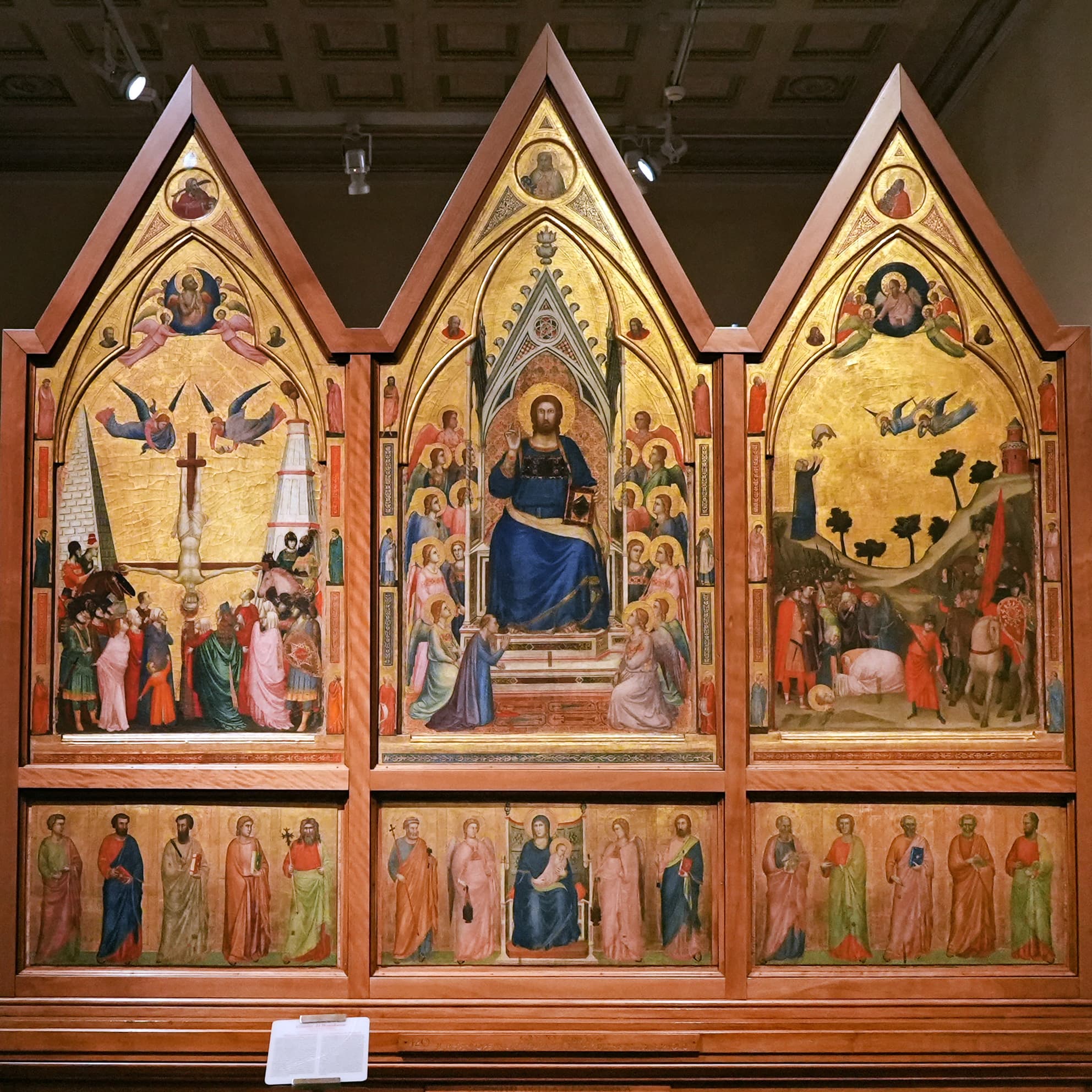
The Stefaneschi Triptych Every now and then, an artist comes along who actually changes the way we see things. In the 1300s, that enlightened visionary was an Italian named Giotto. This groundbreaking masterpiece shows both the traditional world he came out of as well as his innovations. The altarpiece is painted on both sides.
Let's start with the altarpiece. Let's start with the near side, which depicts a row of saints. In the traditional medieval style, this altarpiece is a triptych, meaning it's divided into three panels. Admire this painting as if you were a visitor to St.
Read more...Show less
Peter's Basilica back in the 1300s when it adorned an altar. The side we're looking at right now was the side that faced the worshiping public. So this side is more formal and traditional. That's right.
The background is standard-issue gold and the saints are posed stiffly, all facing up and facing forward. In the central panel sits Peter, the first pope, for whom St. Peter's Basilica was named. How can we be sure it's Peter?
The same way unschooled peasants back then would know, by the keys. Giotto gave him his traditional symbols, the keys to the kingdom of heaven and a bushy beard. Who's the guy kneeling at Peter's feet in white? That would be Signor Stefaneschi, the Roman nobleman who donated this altarpiece to St.
Peter's. We know he's not one of the saints because he's the only one without a halo. Look real close at what he's holding. It's a prickly gold frame he's giving to Peter.
And inside that is a painting. It's the very painting we're looking at. Right. A painting within a painting.
Very impressive. Yes. Giotto was way ahead of his contemporaries. His saints are clothed in gorgeous robes with solid statues and sober, thoughtful faces.
Remember, this was the official side of the altarpiece, the side that faced the public. Now, let's take a peek behind the scenes. Walk around to the other side of the altarpiece. This was the side that only priests could see.
Since it was for a more intimate space, Giotto could cut loose and show off some of his artistic innovations for the educated elites. In the center sits Christ on a throne. His poem, mirrors that of Peter. Notice the budding realism.
The floor in front of Christ's throne has rectangular panels. These create a sense of depth. And Christ is more 3D. He's practically surrounded by angels, some in front, some in back.
Kneeling at Christ's feet is our old friend, Stefaneschi. But this time, he's dressed in his more casual clothes. With his bald head and distinctive features, this is the flesh-and-blood Stef. That his colleagues would have known.
Now let's turn our attention to the left panel, which has more of Giotto's innovations. The left panel depicts Peter being crucified upside down. And while Peter's body is pretty rigid, I'll say, the scene around him vibrates with life. Giotto clearly places the event in the natural world.
He creates a kind of three-dimensional stage and peoples it with believable figures. The two towers in the distance mark the back ground. Two horses define the middle ground while a crowd stands in the foreground. Giotto shows these people not just posed looking straight ahead, but from every angle.
Like that one woman with her back completely turned to us. These figures move naturally, caught in mid-motion, like a snapshot. Most impressively, there's actual emotion in the scene. One woman hugs the cross.
Another dressed in blue with a white veil touches her hand to her face, showing how sad she is. And a woman further left flings her arm, caught up in the agony of the moment. This is not just teaching us anymore, it's engaging us, eliciting our empathy. From the soldiers to the horses to the grieving onlookers, this is something Europe hadn't witnessed since ancient times.
A real scene set in the real world. Finally, check out the panel on the right. This is the beheading of St. Paul.
There's Paul's severed head in the lower left with his traditional halo still intact. And overhead, a couple of helpful angels toss a rag down to sop up the blood. But Giotto also works hard to make this a realistic scene. He used the hillsides and trees to form the background for the crowd in the front.
The executioner, the guy in red, is especially well done. He's posed as naturally as a Greek statue, casually, casually bending at the hips to sheathe his sword. And now, with the dirty deed done, the horse to the right lifts his hoof and gets ready to ride off. Innovations like these may have been baby steps, but in the history of art, they were monumental milestones in the march toward realism.
3D scenes, statue-like figures, natural motion, human emotion, those are the hallmarks of Renaissance art. But Giotto was pioneering them a century before. Before the Renaissance. Now, let's fast forward a few decades and see where the art takes us next.
Head into the next small room, room three. But don't stop there. Keep going into room four. This room is lined with paintings of angels in a blue sky. Some of them are playing musical instruments. Welcome to the early Renaissance. ¶¶ Malozzo di Forli,
Melozzo: Angel Musicians
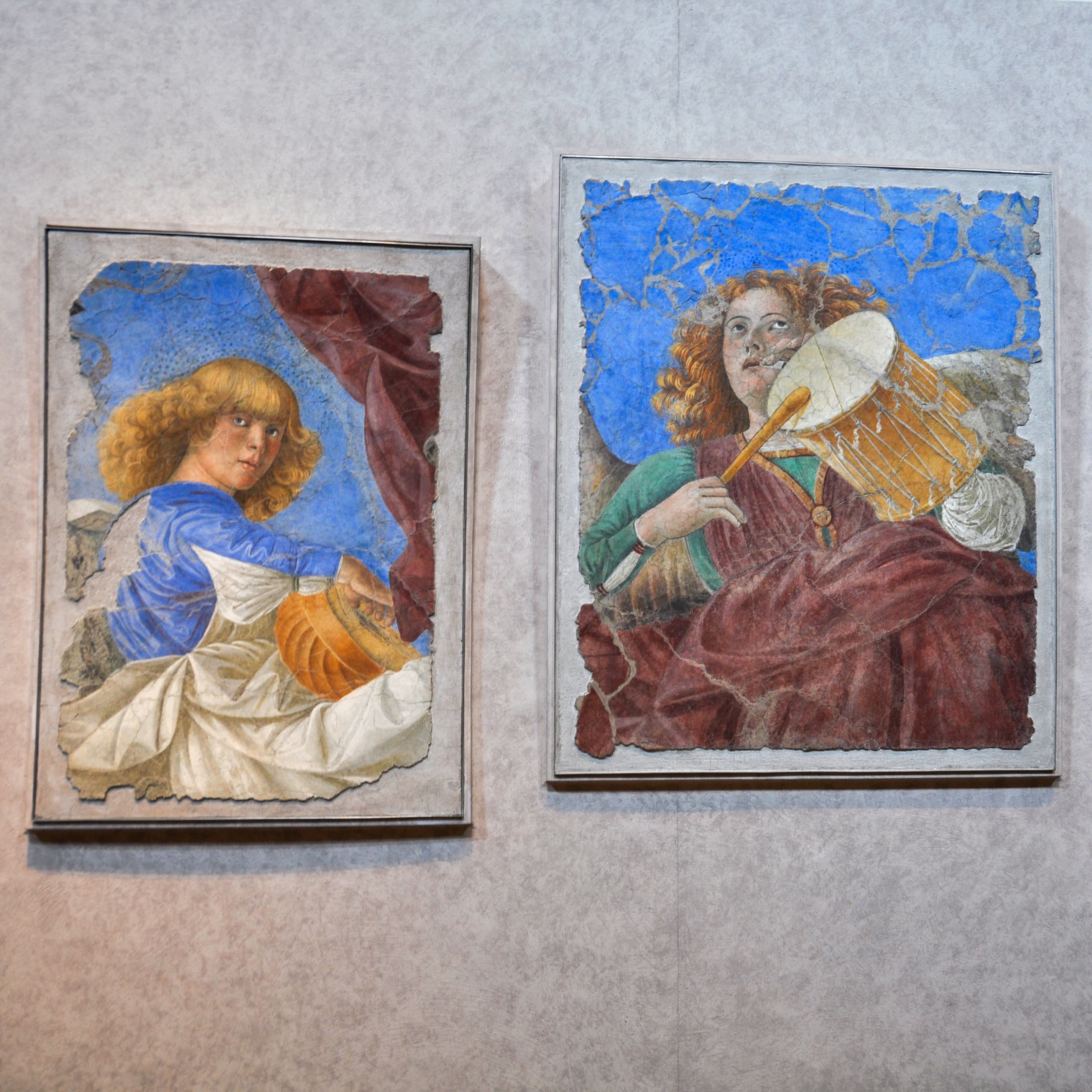
group of angel musicians. This playful series of frescoes shows the delicate grace and nobility of Italy during the time known fondly as the Quattrocento, or 1400s. This early Renaissance art, is marked by budding realism, bright colors, and human emotions, but without the heavy drama of later Renaissance art. Focus first on the angels playing musical instruments.
Some are strumming lutes, some bowing violas, or beating drums and tambourines. Rock on, heavenly dudes. These wonderful angels feel even more real than Giotto's saints. They're very human angels.
Read more...Show less
Notice the details, the serene faces, the curly hair, the soothing primary colors, the bright and even light, the classical purity. And there's no gold backgrounds. It's the blue, blue sky. The blue was made with lapis lazuli, a stone that could only be quarried in the far-off mountains of Afghanistan.
That made it incredibly precious. In the Quattrocento, I guess blue was the new gold. You know, before we go on, let's take a few moments to just enjoy these heavenly virtuosos with a little music from that age and those instruments. ¶¶ , ¶¶, ¶¶, ¶¶, ¶¶, ¶¶.
¶¶, ¶¶, ¶¶, ¶¶, ¶¶, ¶¶. ¶¶, ¶¶, ¶¶, ¶¶, ¶¶. ¶¶, ¶¶, ¶¶, ¶¶. Nice.
These paintings were groundbreaking in another way. They took 3D perspective to a whole other level. These fragments were once part of a larger scene in a church in Rome. You'll see that scene in the small half-dome model in the room that recreates the church's apps.
Imagine looking up into this half-dome, it's as if the ceiling literally dissolved and you had a vision of heaven. You'd see a veritable orchestra of some 20 angels singing and strumming, hovering realistically above you in the wide-open sky above the altar. They were providing the soundtrack for a divine event, Christ's triumphant ascension into heaven. Also in the scene were several of Christ's apostles.
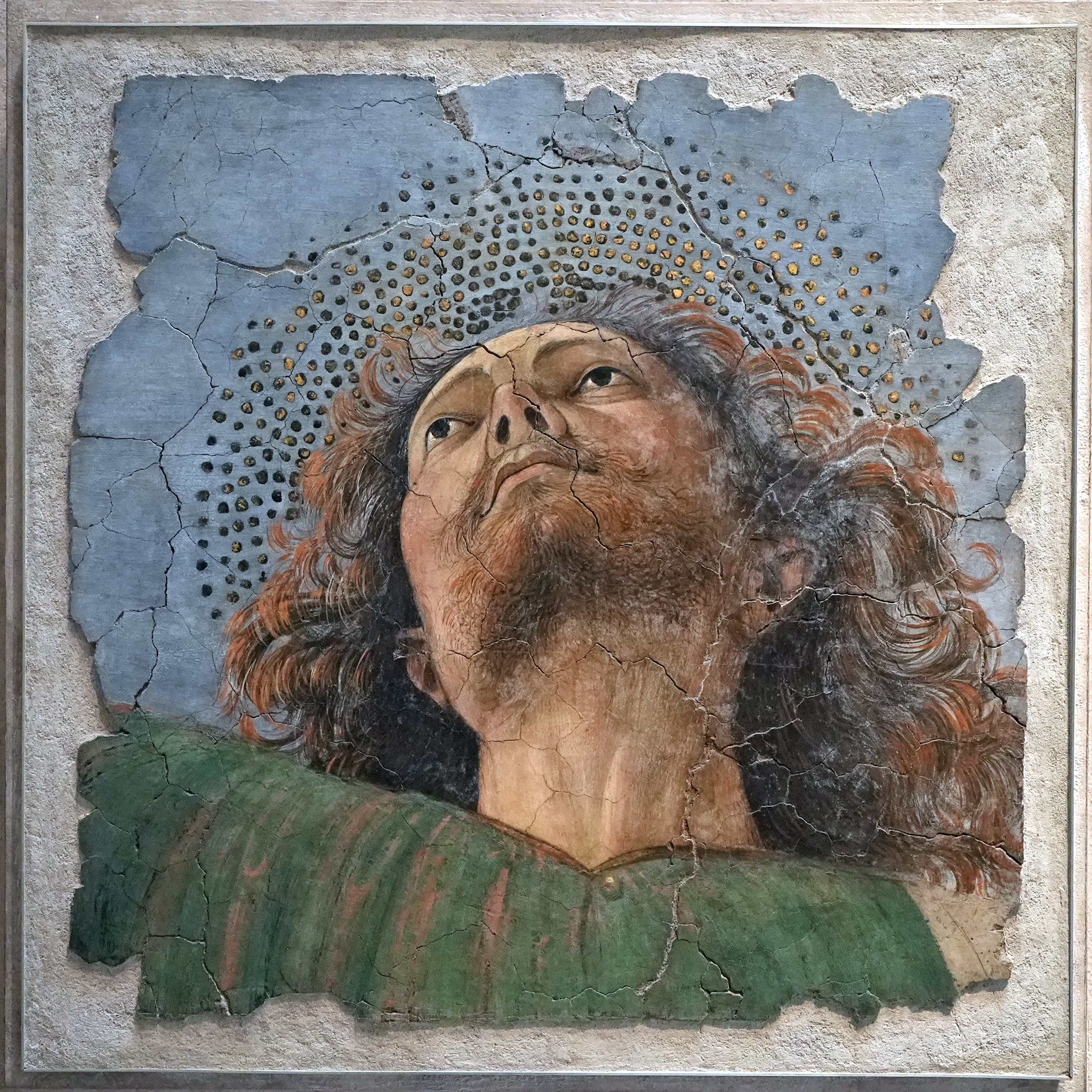
They're shown gazing up, watching him disappear into heaven. The frescoes of those apostles are right here in this room. Check them out. They're along the left wall.
They look up in wonder at the same thing the worshipers did, Christ and the angels. Look closely at the first apostle on the left. He's so much more realistic than anything even Giotto did. We can even look up his nostrils.
Imagine how hard it would be to paint this in the correct perspective, on the curved surface of a half-dome, seen from the point of view of somebody way below on ground floor. Topping it all off, the artist Malozzo did it in fresco. Right, fresco, or painting on fresh plaster. It requires painting quickly before the plaster dries.
If you make a mistake, you have to pull the plaster down and start all over. But when you get it right, as Malozzo did, the plaster dries, locking in the colors so the painting positively radiates. Malozzo pioneered the art of fresco, the same medium Michelangelo would use, a generation later, to do the Sistine Chapel ceiling. And speaking of the Sistine, before we leave Room 4, let's check out one final painting by Malozzo.
It's the large painting that does not feature angels, but real-life people, including the Pope, who built the Sistine Chapel. Malozzo da Forli,
Melozzo: Sixtus IV
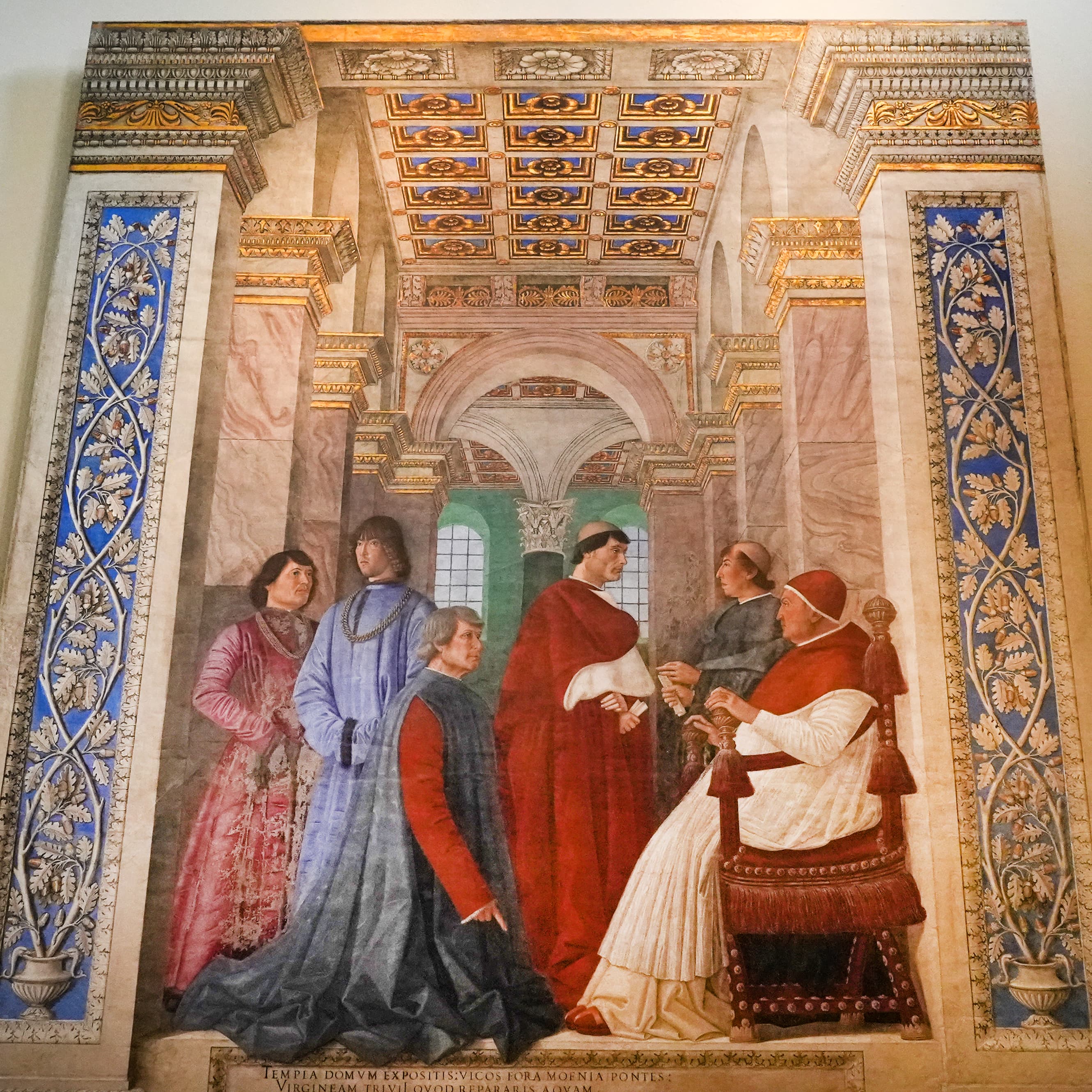
Sixtus IV. As an early Renaissance master, Malozzo was honing the techniques of how to depict a believable three-dimensional space. Space, the final frontier. Here, Malozzo creates a spacious room, then fills it with living, breathing people.
The illusion of depth is achieved with columns and arches that recede into the background. The coffered ceiling also helps create the illusion of a room stretching to the windows in the distance. Notice how everything converges toward the exact center of the painting. The column.
Read more...Show less
And everything gets smaller as it goes back. These were techniques of perspective, or how to depict three-dimensional space on a two-dimensional surface. When perspective is done well, like this, the painting becomes almost like a window in the wall, an extension of the space we stand in. Like we could step through the frame and actually walk through it.
Like among these people. And these are real people. Not angels, not saints. They're Malozzo's contemporaries.
In fact, this may be the very first ceremonial portrait of the Renaissance. The guy in the right-hand side sitting down, that's Pope Sixtus IV. You're sure it's not Pope Forstus VI? Ha, ha, ha.
Sixtus was the pope who built the Sistine Chapel and gave it its name, Sixtus, or Sistine. The tall man, standing in the center in red, is the future pope, Pope Julius II. Who hired Michelangelo to do the Sistine ceiling. Malozzo pioneered many techniques that would become standard in Quattrocento art.
Things like realistic three-dimensional space and realistic portraits. Not to mention his delicate musician angels. But one of his biggest legacies may be what this painting has in spades, a serene atmosphere of architectural balance and, in symmetry. Let's move ahead to the next generation, the peak of Quattrocento art.
Pass through the next two rooms. So go through the small room five and the larger room six. As you go, you'll see plenty of large, impressive, prickly, gold-backed altarpieces. It's a reminder that while artists like Giotto and Malozzo were exploring new techniques, other fine artists were just content to crank out high-quality works in the traditional style.
Keep going. Headed for room seven. Don't worry about passing paintings by. A museum is like a library.
You don't have to read them all. Just pick a few to enjoy. Finally, you'll reach room seven. On the left wall near the center, find a large painting depicting Mary. She's dressed in green and blue, seated on a throne. ¶¶ Perugino.
Perugino: Madonna and Child
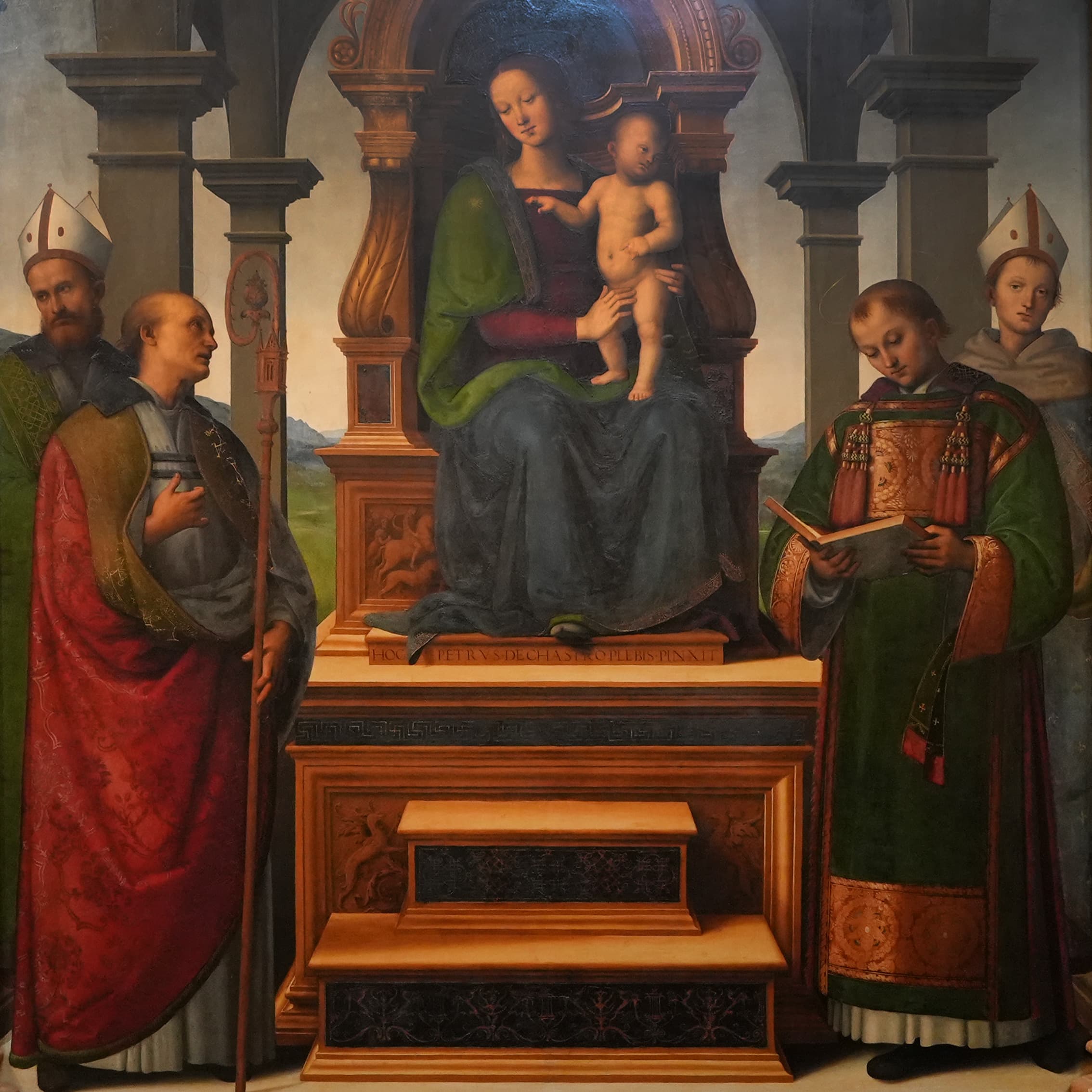
Madonna and Child with Saints. With its Virgin Mary, baby Jesus, and saints, this painting by Pietro Perugino has many of the same themes as so many other altarpieces in this museum. Yeah, but what a difference. Rather than a sermon, this one brings the sacred scene right down to earth.
And in a very beautiful way. Mary anchors the scene. She's seated on an elaborately carved wooden throne beneath an airy canopy with rolling hills and a sunny sky in the distance. Flanking Mary are several saints lost in thought, dressed in colorful, intricately detailed robes.
Read more...Show less
The painting depicts a common quattrocento theme known as a sacred conversation. Conversation? They're not exactly a chatty bunch. No.
A sacred conversation. A sacred conversation is really just a scene showing Mary and various saints gathered together in a relaxed atmosphere. What unites them is their meditative expressions. In this case, they're all reflecting on the inevitable death of Jesus.
You know what strikes me most about this painting? The perfectly symmetrical composition. Mary sits dead center. There's two columns to the left, two to the right, two saints to the left, two saints to the right.
Stand up, sit down, fight, fight, fight. They are kind of cheering for Jesus. And there's two matching bishops' hats. Accentuating all this symmetry is the grid formed by the vertical columns and the horizontal throne.
Mary is framed by the arch over the throne, which is echoed by the wider arch in the canopy above. It's symmetrical, true, but not to the point of monotony. I like how Perugino adds a little movement here, a human touch there, like Mary cocking her head ever so gently to one side. One of the saints turns inward while another looks down to read.
Yeah, the whole atmosphere is soft, serene, balanced, harmonious. Perugino brought quattrocento art to its peak, a perfectly symmetrical space, delicate, graceful, intricately detailed, perfectly lit, and never harsh or gritty. Perhaps Perugino's biggest contribution was passing this artistic language along to his young student, a prodigy named Raphael. Now, let's see how Raphael took those techniques and put them all together, turning the delicate grace of the early Renaissance into the monumental power of the next phase of art, the High Renaissance.
From the Perugino room, enter the next large room, Room 8. They've turned on the dark to let the art shine. Room 8 is lined with a dozen big tapestries and a few colorful paintings, all by the great artist, Raphael. These works are huge, like so much High Renaissance art.
As artists like Raphael and Michelangelo flocked to Rome in the early 1500s, they saw firsthand the monumentality of ancient Roman art, and that inspired their work. Let's start with Raphael's paintings. There are three paintings hanging in the middle of the long wall. The biggest one, showing Christ floating high in the air, is his famous, famous Transfiguration. Raphael Ossantio,
Raffaello: Transfiguration and 2 Others
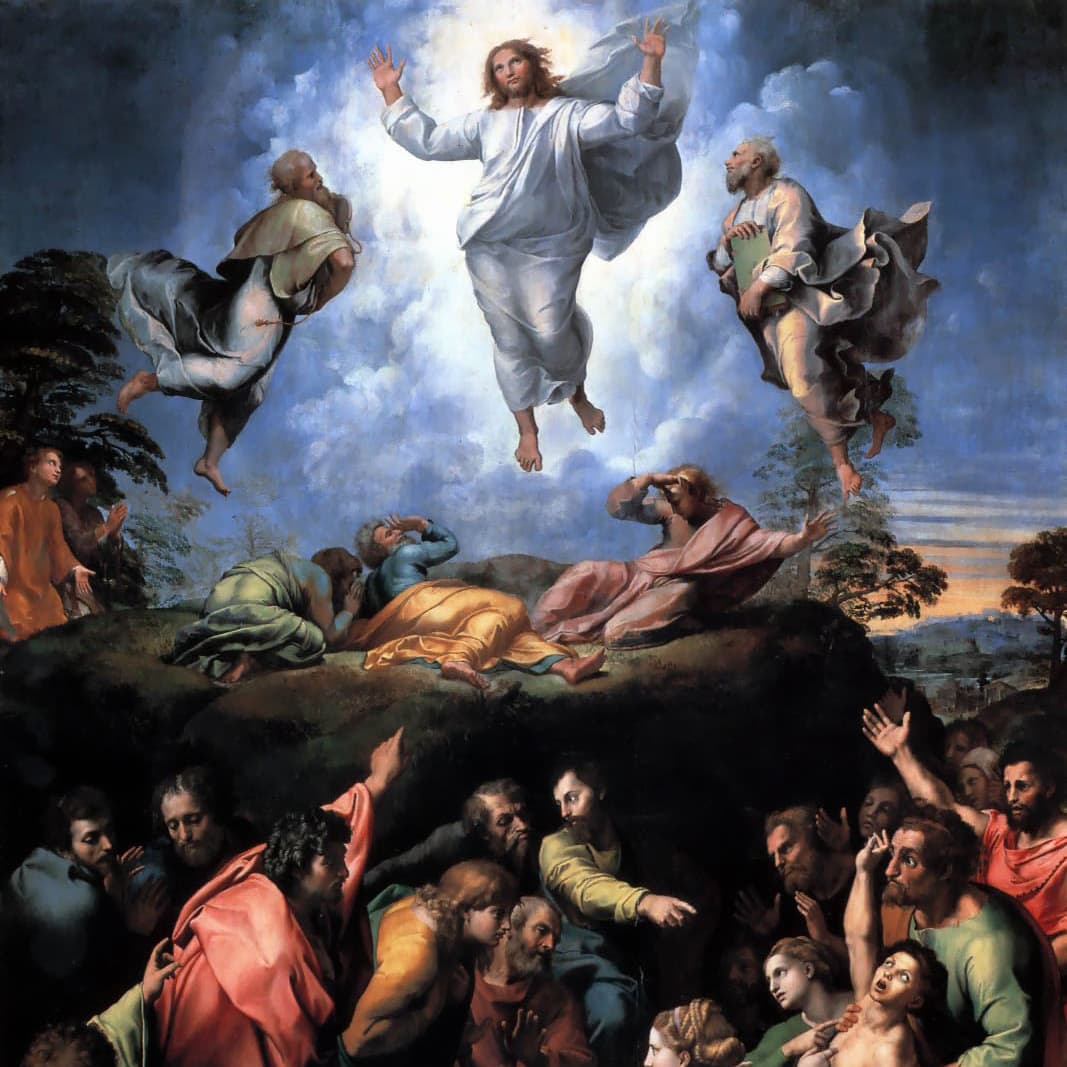
the Transfiguration, and two other Raphael paintings. In this impressive canvas called the Transfiguration, Jesus is caught up in a heavenly vision while down below, his followers are left in total disarray. This has many of the hallmarks of the High Renaissance style. It's big and colorful with monumental figures.
Raphael has fully mastered three-dimensional space. It's full of motion and emotion, capturing a miraculous event with earthly realism. The High Renaissance was dominated by three towering figures. The Holy Trinity of Italian Art.
Read more...Show less
Michelangelo, Leonardo da Vinci, and Raphael. All working around that pivotal year, 1500. As we've seen, the High Renaissance didn't just pop out of nowhere. It was built on techniques forged step-by-step over the centuries.
Let's see how Raphael learned from Perugino and took those lessons to a whole new level. We'll return to the Transfiguration in a bit, but for now, turn your attention to the painting to the right. This is an early Raphael work known as, The Coronation of the Virgin. Raphael was just 20 years old when he did this and still under the influence of Perugino's Quattrocento style.
The painting is neatly divided between an upper section, where Mary's crowned, and a lower section, where the disciples stand around an empty tomb and wonder where she's gone. Heaven above, earth below. The composition is perfectly symmetrical. Some would say simplistic.
Yes, it is pretty rigid and not so much so. Not completely realistic. We only really know it's heaven because of the symbolic little baby angel faces. They are cute, though.
Mary's dress isn't very well defined. The musician angels aren't quite real, more like pretty figurines. And that strip of cloud that divides the two halves looks too solid. It's like a floor, so the angels' feet don't sink into it.
But with the lower half, young Raphael is starting to come into his own. The apostles are more relaxed. More solid and three-dimensional, like Roman statues. Each one strikes a slightly different pose, with a different gesture and facial expression.
Now, turn your attention to the painting to the left of the Transfiguration. This is Raphael's Madonna di Foligno. Now it's 1511, ten years later, and Raphael is evolving even more as an artist. There's still the separation between heaven and earth, but the composition isn't so rigid and simple.
The cloud in between is softer, with Mary resting gently on it, turning naturally at the waist. The lower half is set on the real earth, with a rolling landscape leading to a town in the distance. The saints move and gesture and interact as real people do. The kneeling man to the right is the patron who commissioned this painting.
It looks like St. Jerome is thanking him by patting him on the head. Most of all, check out the guy on the left, John the Baptist. He looks directly out of the painting, right at us.
That's totally new in art. John is inviting us to participate in the experience, pointing us toward Mary. This isn't just devotion anymore. It's engagement.
Where the Quattrocento loved a mathematically perfect space, the High Renaissance focused on how people move within that space. We can imagine these figures turning, walking around, heading off into that distant background. Wait, what's that? What's what?
There, in the center of the painting. Beneath Mary? Yeah, beneath the rainbow. Coming in on the right is a tiny...
What is it? A ball of fire? A meteorite? Maybe it's lightning?
It must be something miraculous because this painting was commissioned as a way to say thanks for some miraculous event. The angel below is holding a plaque that's supposed to tell us what it was. But the plaque is blank. So, no one knows exactly what happened.
So... So, that's all I got. Oh. So, how about we move on...
Good idea. ...and bring Raphael's artistic evolution full circle? Sounds good. Let's return to Raphael's final and perhaps greatest masterpiece, the Transfiguration.
Raphael was in his mid-thirties and at the height of his powers when he did the Transfiguration. He'd learned the grace of Pirogino and the power of God. And the muscular power of Michelangelo's Sistine. Then, he put it all together in a work in the High Renaissance style.
Big, complex, full of motion and human emotion and ultra-dramatic. There's sure a lot going on in this painting. Yes, and the genius of it is how Raphael took this Rubik's Cube of elements and arranged them in a way that reinforces the message. Let's unpack it.
Christ is on top, floating in the air, accompanied by the prophets Moses and Elijah. Just below them, lying on a mountaintop, are Christ's disciples. They shield their eyes from this awesome vision when Jesus was divinely transfigured, as the Bible says. His face shining like the sun.
His clothing white as light. That's the upper half. So, what's going on below? There's a chaotic crowd.
They're desperate. Among the crowd is a young boy. Yes, I see the boy. On the right.
He has no shirt on. He flails his arms and his eyes roll up in his head. He looks crazy. He's possessed.
The terrified apostles are trying to heal him, but they can't. Only Christ can. So, once again, we have a painting split with upper and lower scenes. The contrast is striking.
The upper part is light and wondrous. The lower half, dark and hectic, full of twisting and turning, of uncertainty and despair. But look close. Though the gestures and glances seem chaotic and random, pointing here and there, back and forth, in fact, they ultimately lead our eyes in one direction, up.
Yes, up toward Christ, who can heal the boy and bring peace. So, the composition reinforces the message that Christ is our only Savior. Each of the two dozen figures in this painting has their own story to tell. But all part of a unified composition.
In fact, the composition is an ascending pyramid of motion. It bubbles up from the chaos below, up the flailing arms to the mountaintop, then to the three hovering figures until, finally, you come to rest at the peak of the pyramid, Christ's radiant face. Nice. Unlike earlier artists, Raphael was not just a skilled craftsman painting what his patron told him to.
The idea came from his own mind. Artists like Raphael, Michelangelo, and Léonard, Leonardo da Vinci were independent-minded and celebrities. The Transfiguration marks the culmination of Raphael's evolution, from the symmetry and grace of the Quattrocento style to the theatrical drama of the High Renaissance. It even has elements that would inspire the later Baroque style, like figures floating in the air, billowing clouds, robes whipped in the wind, and twisting poses expressing their inner restlessness.
No wonder this painting became so famous. Easily, one of the most celebrated paintings in the world. It debuted at Raphael's own funeral, which was here in Rome in the Pantheon. Next, it was displayed in St.
Peter's Basilica. It was even stolen by Napoleon as a war trophy. The Transfiguration was Raphael's last painting before he died in 1520 at age 37. In fact, the last thing Raphael ever painted?
This angelic face of Jesus, perhaps the most beautiful Christ in all of history. It was the most beautiful of art. Now, let's focus on the tapestries in the room, which were designed by Raphael. Start by just browsing around, getting a feel for these large woven works, while Rick introduces them. Raphael's
Raphael: Sistine Tapestries
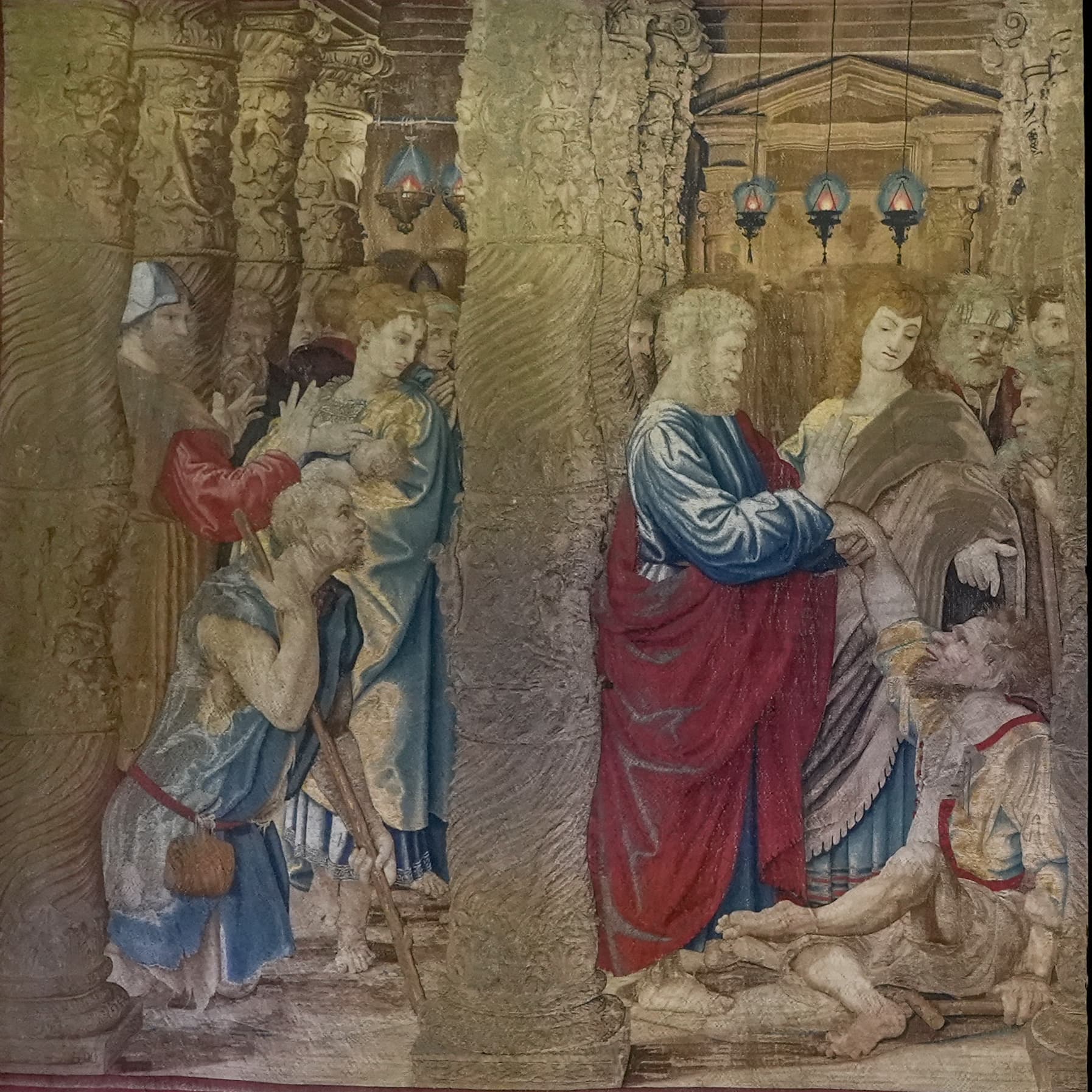
Sistine Tapestries Raphael designed these tapestries to be hung in a very special spot, the Sistine Chapel. They were only displayed on special occasions. Imagine the scene. As dignitaries gathered in this Holy of Holies, they'd be surrounded by these magnificent tapestries adorning the walls, beneath Michelangelo's radiant Sistine ceiling.
With their stories of Sts. Peter and Paul, they fleshed out the Sistine's Christian history by adding these Acts of the Apostles. The tapestries were extremely expensive, so costly to manufacture the threads of silk and wool, to dye them, and, of course, to weave them. These remarkable rugs actually cost five times more than Michelangelo's Sistine ceiling.
Read more...Show less
They're certainly impressive, but... But, yes, I have to admit, they're faded. The colors have faded somewhat over time. In fact, that's why the room's so dark, to protect them from further damage.
Look closely at the workmanship. Making these tapestries was a painstaking process. Raphael started by creating large drawings called cartoons. These were given to the weavers as a guide.
The cartoons were actually backwards, a reverse image because they were placed on the backside of the loom. Then the weavers had to recreate the scenes with countless colorful threads woven together, back and forth, back and forth. The work was done in Europe's tapestry capital, in far-off Brussels. Italy didn't have great tapestry factories for a very simple reason.
It's not cold enough. Exactly. Tapestries were first and foremost to help keep rooms warm. Now, let's seek out a few specific tapestries.
But don't stress if you can't find these particular works. Generally, you'll find the tapestries about Peter on the wall to the right of the Transfiguration with Paul to the left. Let's start by looking for a tapestry featuring Peter. It's usually on the right side of the right wall.
It shows a cluster of apostles with Christ standing on the right in a white robe with gold speckles. It's called Christ's Charge to Peter. This tapestry depicts what has to be every pope's favorite moment in the entire Bible, the biblical basis of Roman Catholicism. It shows Jesus Again, he's the one in white and gold handing the symbolic keys of heaven to a kneeling Peter, thus anointing him to be the head of the church, the first pope.
Raphael masterfully sets this scene in a beautiful, airy landscape with a river and trees in the distance. Note the dominant color scheme of the apostles' robes. Red, yellow, and blue, the primary colors. That's because the range of dyes was very limited.
To get the in-between colors, you had to weave many primary threads together and make them blend accurately. As for the gold tones, like in Christ's robe, those come from thread wrapped in actual gold leaf. With both gold and silver threads, these tapestries in their day absolutely glittered. Throw in candlelight and it was like Renaissance-era special effects.
Now let's find another tapestry of Peter, also usually along the right wall. Look for the scene set amid corkscrew columns. It's Peter Healing the Lame Man. There in the center, between the corkscrew columns, is Peter, dressed in red and blue.
He's taking the hand of a crippled man to pull him to his feet. To either side, are crowds of amazed onlookers stirring with excitement. Raphael was clearly inspired by Michelangelo's dramatic, restless figures on the Sistine ceiling. Peter is the calm center of a complex composition that features many people.
It's all neatly divided into three sections by the columns. Obviously, Raphael had also studied ancient Roman architecture. And Roman statues as well. His figures are fully three-dimensional and monumental.
They twist and turn remarkably lifelike. In fact, none of the figures are represented directly from the front. That would be boring and like so quattrocento. Peter is in profile, and John, standing behind him, is shown at three-quarters.
Before we leave the room, there's an especially engaging tapestry, often displayed to the right of Raphael's paintings. But again, if you can't find it, no worries. All the tapestries are interesting. This particular tapestry shows a serene blue lake, with muscular fishermen in tiny boats.
It's called The Miraculous Draft of Fishes. First, on the right, find Jesus. He's being thanked by a couple of disciples for leading them to a huge catch of fish. To the left, you can see the men bending down and straining to pull in the heavy nets.
The men's straining poses show the weight of the fish. The birds along the shore flex restlessly while they wait to pounce on the leftovers. In the background is a spacious, beautiful landscape rendered in beautiful colors that just exudes the joy of the moment. Raphael has captured this miraculous event in a completely realistic, natural, and three-dimensional way.
All in the difficult two-dimensional medium of tapestry. With these tapestries, Raphael brought the High Renaissance to a new level. He took centuries of styles and techniques and, uh, wove them together to create a realistic and truly awe-inspiring experience. Nice.
Now, when you're ready to move on, head for the exit door that leads to our next room, Room 9. Room 9 has a work by the first, and some would say the greatest, of that holy trinity of the High Renaissance, Leonardo da Vinci. As you enter Room 9, look left to find our next stop, a brown painting of a bald, emaciated, and crouching saint. ¶¶ Leonardo da Vinci,
Leonardo da Vinci: St. Jerome
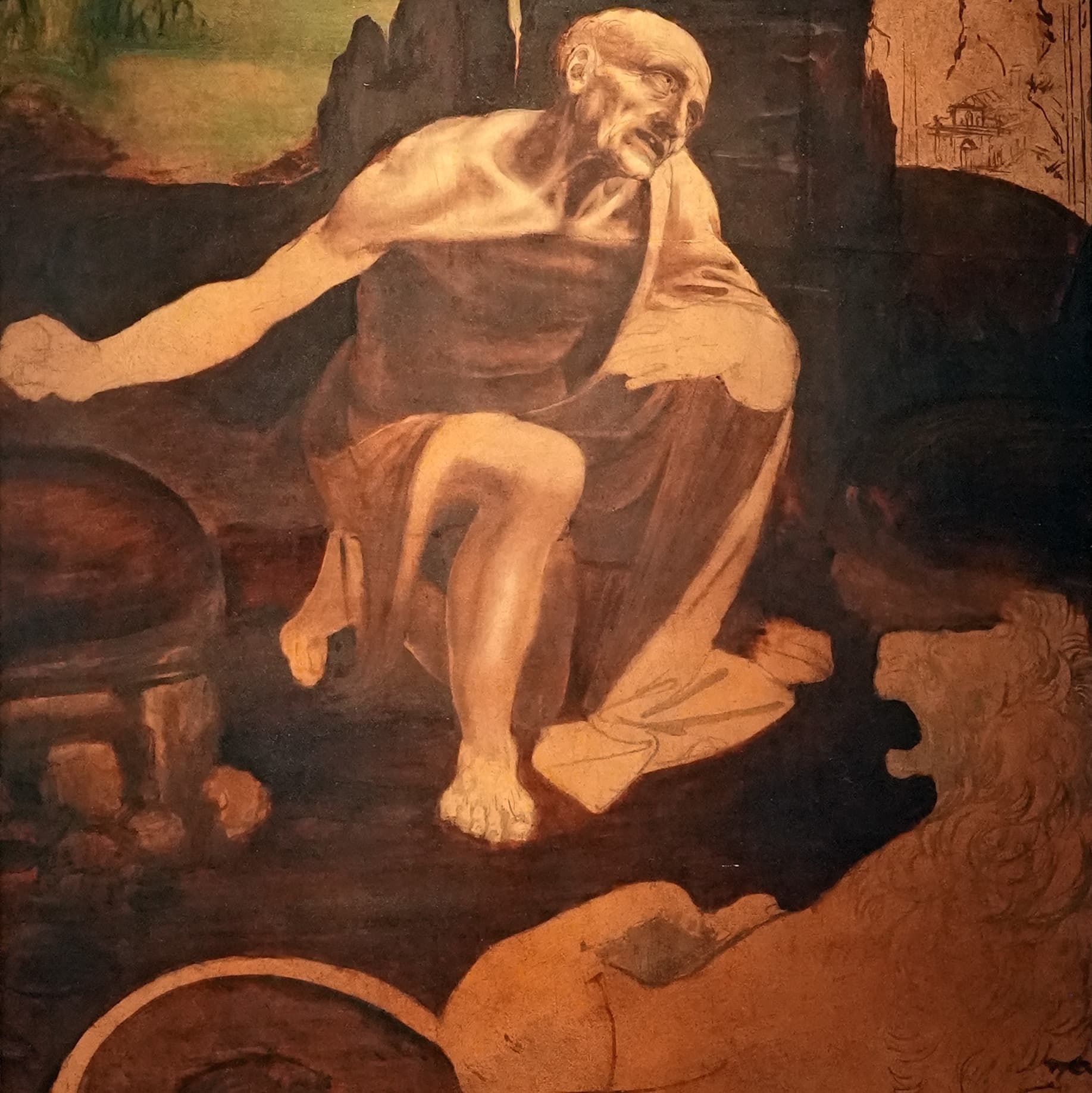
Saint Jerome in the Wilderness. The multifaceted genius Leonardo da Vinci depicts Saint Jerome, a fourth-century hermit and scholar, squatting in the rocky desert. He spent years alone, meditating on his sins and beating his chest with a rock in penance. His body is emaciated from fasting, reduced to bones and skin, and sinews.
His head looks more like a skull, and his grimace and sunken eyes make him look feverish. His only companion is a lion in the lower right. But Jerome is even more determined in his faith. He has a fire in his eyes.
Read more...Show less
The intensity of his passion that radiates out of his soulful face is echoed by his friend, the roaring lion. This rather odd-looking painting was obviously left unfinished. It's just the brown undercoat. Leonardo often struck out and struggled to complete things before something else captured his attention.
His brain was so restless that the hand that held the paintbrush often just couldn't keep up. Restless, solitary, passionate. Hmm, maybe a bit like Jerome. This painting may be unfinished, but it gives us a behind-the-scenes glimpse at Leonardo's true genius.
This work packs a psychological punch. It shows us not just Jerome's body, but what he's feeling inside. His emaciated, crouching, bony body expresses his intense penitence. And despite his sins, his pleading eyes hold a glimmer of hope for divine forgiveness.
Leonardo wrote that a good painter must paint two things, man and the movements of his spirit. In this work, we find both. By the way, the painting's patchwork effect is because it was apparently lost and damaged. At one point, Jerome's head was cut out and used as the base of the seat of a stool in a shoemaker's shop.
Before we move on, let's take stock of where we are in our walk through Western art. Remember that landmark year of 1500? The three giants, Leonardo, Michelangelo, and Raphael were all working, forming the High Renaissance style. Leonardo was the oldest at 48.
With works like Saint Jerome, he pioneered this highly realistic and dramatic style. Michelangelo was 25, having incorporated inspiration from Leonardo into his Pietà. Raphael, just 17, would soon take their innovations and create his great paintings and tapestries. By the 1520s, the energy of the High Renaissance was spreading throughout Europe.
The world was changing and new styles were dawning. Let's push on. Let's. From Leonardo's Jerome, enter the next room, room 10.
Glance briefly at these altarpieces. You'll notice they still have the traditional themes, Mary and the saints and so on, but one thing is missing. Gold. We've left the days of gold backgrounds behind for good.
From now on, even sacred events always take place in the real world, like our next painting. Continue into the next room, room 11. Pause at the first painting on the right by Il Barocci. ¶¶ ¶¶ Il Barocci, Rest on the Flight into Egypt.
Il Barocci: Flight to Egypt
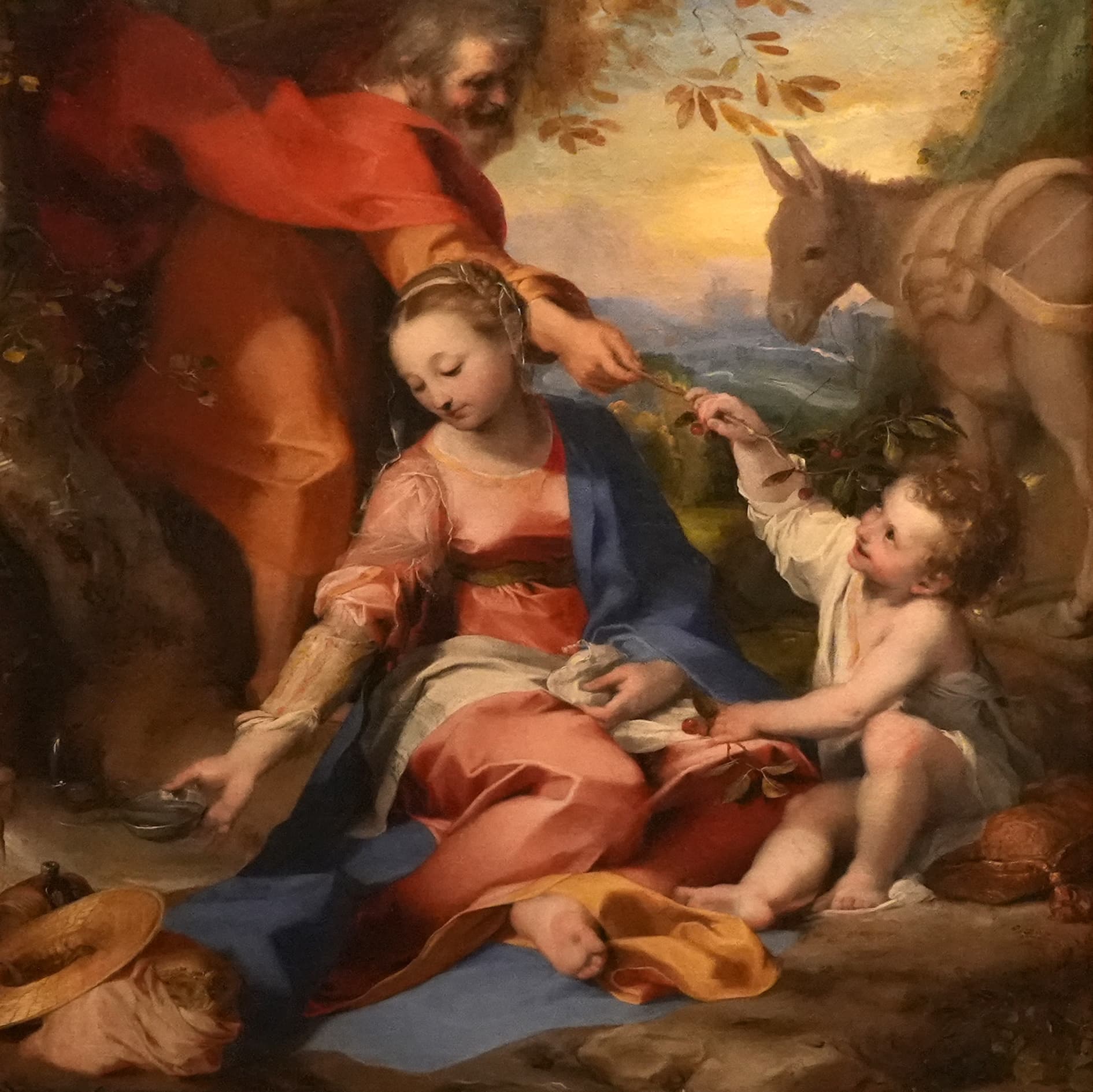
This influential work from around the year 1570 is a snapshot of how art was changing after the High Renaissance. It shows the Holy Family, Mary, Joseph, and young Jesus, pausing by a leafy stream. It's certainly realistic enough, but what's striking is how the artist tweaks reality, exaggerating it to make the already pretty scene even more beautiful. Their pink-cheeked faces border on saccharine sweetness.
Joseph's red cape ripples extravagantly in the wind, even though there's not a hint of weather. And the poses are somewhat stilted in order to serve the composition. The composition is interesting, though. Yes, notice how the energy runs down Joseph's arm, through the trunk, through the twig he hands to Jesus, then back through Jesus' other arm to Mary, and finally down to the lower left as Mary reaches for a cooling drink of water.
Read more...Show less
This kind of hyper-sophisticated composition and exaggerated beauty mark the style known as Mannerism. It was the perfect style at a time when the Protestant Reformation was making inroads. Counter-Reformation paintings like this, of a friendly, accessible family, could inspire the Roman culture, as well as the Catholic faithful. Mannerism would serve as a bridge to the next great art style, Baroque.
And that's next. Continue into the next room, the large Room 12, where you'll find our final works. In the middle of Room 12 is a weathered statue of a kneeling angel. We're going to take a look at it in just a few moments. We're going to take a look at it in just a few moments.
Bernini: Angel Model
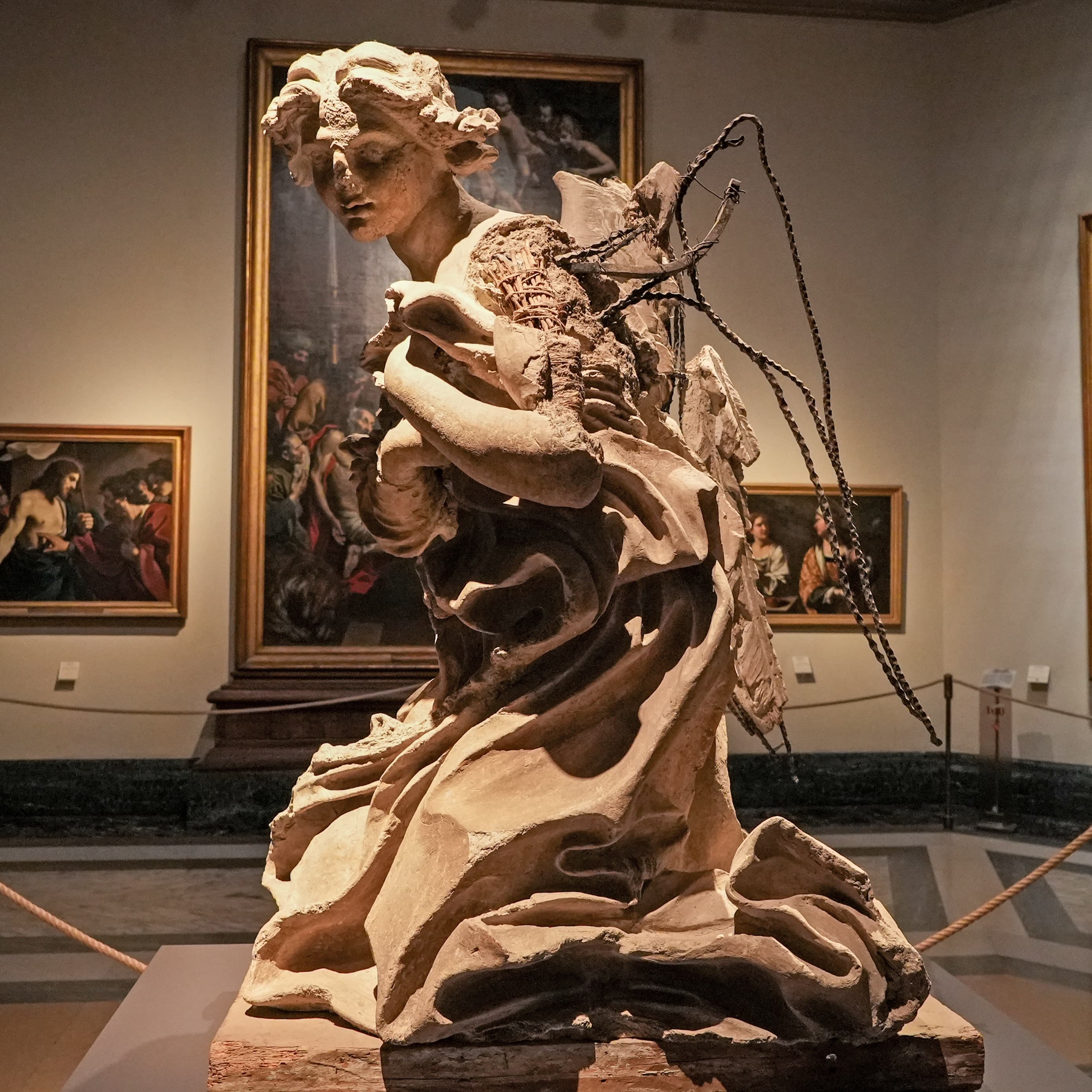
Gian Lorenzo Bernini, angel model for St. Peter's Basilica. This is one of several plaster models that the great Baroque artist Bernini used to create the various angel statues we now see adorning St. Peter's Basilica.
This particular one became a bronze angel for the Blessed Sacrament Chapel. Though eroded, this angel has all the hallmarks of Bernini's Baroque style. The swirling lines, the rippling robe, the windblown hair, the expressive pose. It's the colorful, flamboyant style seen all over St.
Read more...Show less
Peter's and in so many other churches in Rome. Baroque. This rough model is a wonderful opportunity to look behind the scenes at the artistic process. It's made of humble plaster, iron bars, and straw, and it still sits on its original wooden platter where the artist worked on it.
In the twisted metal outlines of the wings, the rough textures, the hay sticking out here and there, we witness creativity at work. You can almost imagine the hands of the artist molding these materials, turning the image in his mind into a physical thing, turning the spark of artistic intuition into art. At the far end of the room is a tall painting showing a group of people holding the body of Jesus. Though it's also Baroque, it's quite a contrast from Bernini's angel. ♪♪ Caravaggio, "Deposition from the Cross."
Caravaggio: Deposition
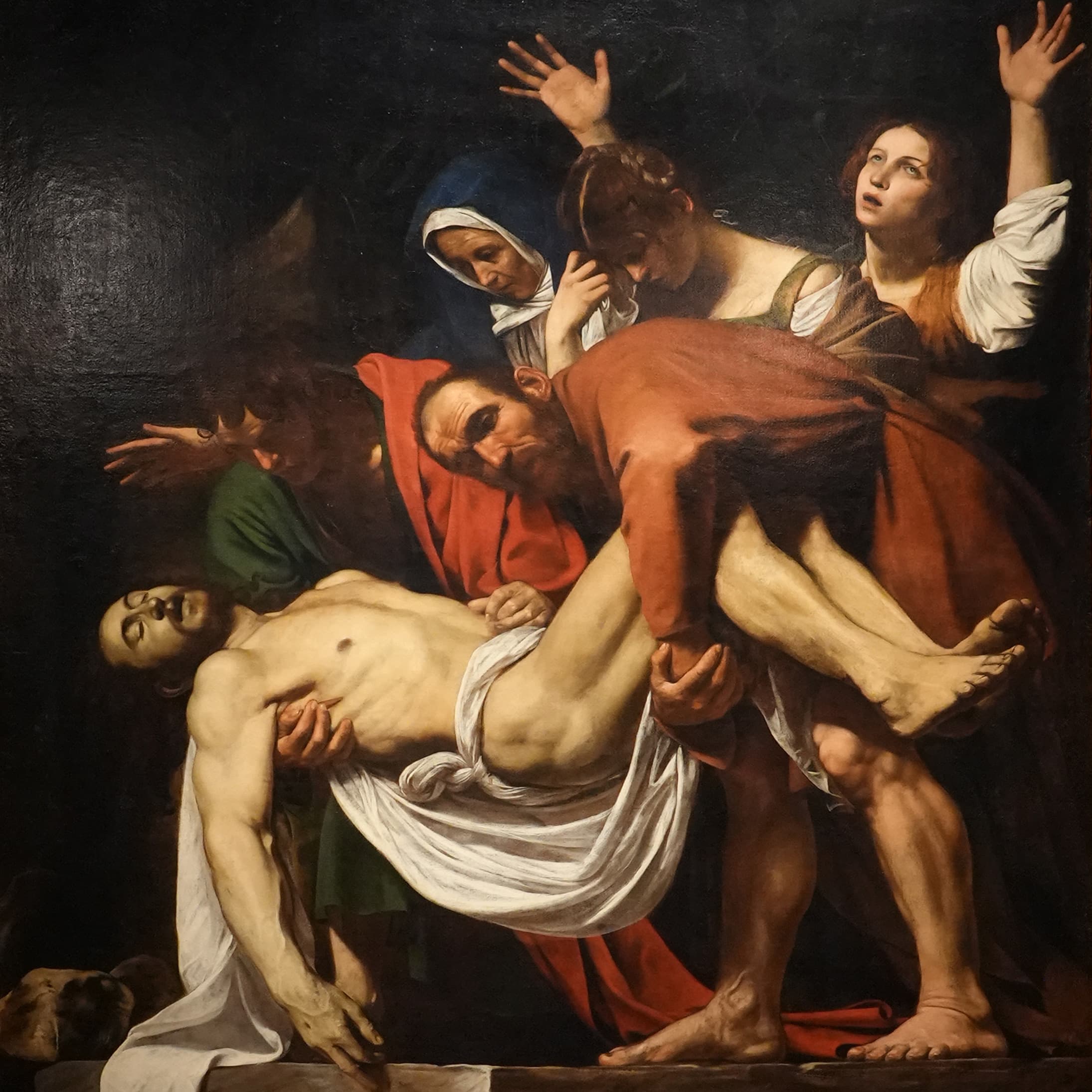
In this painting, Caravaggio depicts the grim scene when Christ is brought down from the cross to be buried. His body has a death-like color. His followers are consumed with grief. Out of the darkness, the faces embrace him, and they emerge, lit by a harsh light.
A tangle of sorrow rises up as Christ's heavy body nearly pulls the whole group with him into the tomb. Caravaggio expertly accentuates the dead weight of the body. After this museum, I know the feeling. Caravaggio was the first painter to intentionally shock his viewers.
Read more...Show less
He did it with ultra-realistic details. Nicodemus, the guy in brown, has a wrinkled, sunburned face. And look at his legs. They're swollen with bulging veins.
Mary, wearing what looks like a nun's headdress, is older than we've ever seen her, with a wrinkled face. Talk about realistic. Even Christ has dirty toes. These holy people look like the everyday street people Caravaggio hired as his models.
Caravaggio enhances the tragic mood with his signature technique, an extreme contrast between dark and light. He shines a brutal third-degree interrogation light on the scene. Caravaggio was revolutionary in his ultra-realism. It draws us in to participate as if we were eyewitnesses.
Notice the dramatic composition. From the lower left corner, a diagonal line runs up from Christ to his followers, who are increasingly grief-stricken, to the upper right, where a woman flings her arms in despair. Most of all, we're drawn back to Jesus himself. His once-strong body has turned pale and heavy in death, reminding us of his humanity and that his suffering was all too real.
Yet in the darkness, there is hope. The green plant in the lower left corner of the tomb reminds us that because of Christ's sacrifice, life will return. And that brings us to the end of our tour. Think of how far we've come.
Gone are the cheery colors of Malozzo's musician angels. Gone is the mathematical symmetry of Perugino and the serene beauty of Raphael. The world was changing. Italian culture was spreading northward, where a new generation of artists would take up the paintbrush.
This painting brings our tour to a fitting conclusion. We've gone from the march to realism in the medieval world to the triumph of realism in the Renaissance to this work of dramatic, hyper-realism by Caravaggio, who could be considered the first modern artist. We hope you've enjoyed our Pinacoteca walk. Thanks to Jean Openshaw and Francesca Caruso, the co-authors of this tour.
If you're up for more Vatican sightseeing, we have a Vatican Museum tour and one for the Sistine Chapel, as well as a tour of St. Peter's Basilica. We also have numerous other tours for the city of Rome, as well. This tour was inspired by Francesca Caruso's passionate guiding, and it was excerpted from the "Rick Steves' Rome Guidebook," co-authored with Jean Openshaw.
For more details on eating, sleeping, and sightseeing in Rome, refer to the latest edition of that guidebook. For more free audio tours and podcasts, and for information about our guidebooks, TV shows, bus tours, and travel gear, visit our website at ricksteves.com. This tour was produced by Cedar House Audio Production Productions. Grazie. Arrivederci. And buon viaggio.
Free
GPS-guided walking tour
No account needed. Walk at your own pace.
Free
13 stops ·