15 stops
GPS-guided
86 min
Duration
Free
No tickets
About this tour
A 15-stop walking tour through the heart of Spain. Visit Madrid City Walk, Calle de Postas, Plaza Mayor, and Bullfighting Bar: La Torre del Oro Bar — with narrated stories at every stop.
15 stops on this tour
Madrid City Walk
Madrid City Walk. Madrid is the hub of Spain. This modern capital, with a population of over 3 million, is upbeat and vibrant. With every step, you'll feel it.
Walking Madrid's historic streets amid the throng of strolling Spaniards, you'd swear you can feel the very soul of Spain. Hi, I'm Rick Steves. Bienvenidos, and welcome to this walk through the historic core of Madrid. We'll start at the city's Times Square, Puerta del Sol.
Read more...Show less
Then, we'll make our way across town to the impressive Royal Palace before circling back to our starting point, about a mile in all. Along the way, we'll stop in the Plaza Mayor, one of the world's most elegant squares. We'll pop into the bustling San Miguel Market, a trendy hive of shoppers and tasty food. We'll see historic churches and stare into the eyes of famous bulls.
We'll learn about Spain's culture, and order tasty treats from cookie-dispensing nuns. Most of all, we'll be immersed in the Madrid of today. This is a pedestrian-friendly city, and everyone seems to be out strolling the streets at all times of day. Oh, and don't forget snacks.
There are opportunities all along this walk for us to sample everything from traditional sweets to local olives to chocolate and churros to the Iberian specialty, jamón. Now, let's get started. Let's get started as we dive deep into the very center of Spain, the bustling metropolis and world capital that is Madrid. To help us along the way, I've invited a good friend and virtual travel buddy.
Welcome, Lisa. Hola, señor Ricardo. Lisa will give us helpful directions and sightseeing tips throughout the tour. And my first tip is to be sure you get our tour updated.
Just press the icon at the lower right of your device. You'll find any updates and helpful instructions unique to this tour. Things like closures, opening hours, and reservation requirements. There's also tips on how to use this audio tour and even the full printed script.
Yes, so pause for just a moment right now to review our updates and special tips. It's okay. We'll wait. And then... Let the tour begin.
Tour Begins: Puerta del Sol
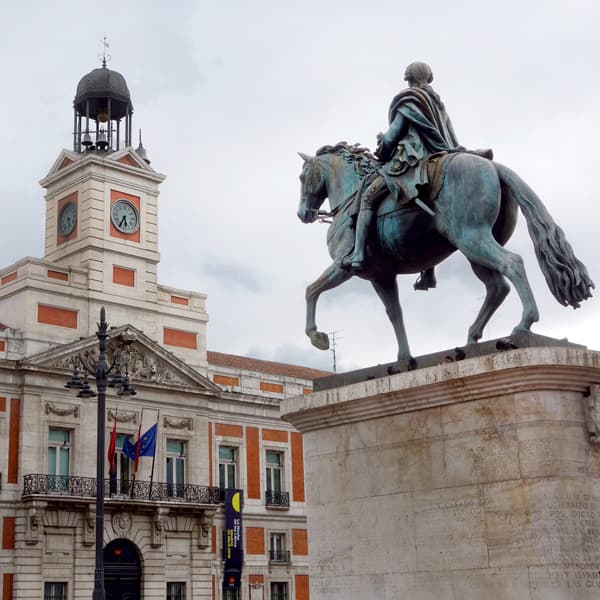
The tour begins. The Puerta del Sol. Start in the middle of the sprawling square. Find a place near the statue of a man on a horse.
Pan your surroundings a full 360 degrees. Appreciate the harmonious architecture. Yellow cream buildings four stories tall with balconies of iron, shuttered windows, and balusters. The bustling Puerta del Sol is the center of Madrid.
Read more...Show less
In many ways, it's also the center of Spain. For Spaniards, this place, with its teal peppy sign, is probably the most recognizable spot in the country. It's a popular site for political demonstrations and for national celebrations. For Madrilenos, Puerta del Sol is a transportation hub for the metro, local trains, and several main roads.
It's also a magnet for strolling locals, light-seers, pickpockets, revelers, and characters dressed as local cartoons who pose for photos for a fee. In recent years, the square has undergone a facelift to become a mostly pedestrianized and wide-open gathering place for the people of Madrid. In many ways, it's the soul of the city. I guess that's why they call this the Puerta del Sol.
Of course, the word soul actually means sun. In fact, the name of the square comes from, well, let's let a Spanish local explain why. I asked my friend and fellow tour guide, Federico Garcia Barroso, to tell us a bit more about some of the sights we'll be seeing along our walk. Federico has years of experience showing travelers around his hometown.
A while back, Federico joined me on this same walk through Madrid's bustling streets, where he and I chatted about the sights we saw. I recorded our conversation so he could join us, sharing his insights and local perspective on things. He'll pop into our narration, here and there, all along this walk. I asked Federico why this plaza is called the Puerta del Sol, rather than the Plaza del Sol.
Puerta del Sol, the sun gate. A long time ago, there used to be a gate here, one of those gates facing east. The gate would be demolished in the war a few years later, and now we still have the sun, and not the gate, but the sun. This place should be called, in my opinion, the Sun Square.
But, well, despite we have no gate, this is still the Puerta del Sol. As the Puerta del Sol made the transition from the city gate to the public square, there was one particular man who was instrumental. That's the man whose statue stands in the middle of the square, a king on a horse. The equestrian statue honors King Charles III.
It was Charles who built the building that has come to define this square. It's the building the statue faces, the red and white building with a clock tower, or bell tower, topped with a small dome. In the 1760s, Charles built that as the main post office. That was a big deal back then, and it's now become the centerpiece of the Puerta del Sol.
More on that building in a bit. For now, let's focus on the statue of Charles. Charles III was born in Madrid. It was during his reign in the mid-1700s that Madrid took the shape we see today.
He decorated squares like this with beautiful fountains. Charles built the Prado Museum and established a modern underground sewer system. He started the public schools and made Madrid's royal palace the wonder of Europe. He even opened the Prado Museum and opened up his own private garden to the general public to create today's vast Retiro Park.
Because of his enlightened urban policies, locals still call him by his nickname, the best mayor of Madrid. I asked Federico for his take on King Charles. Charles III is just a man. I can tell you, I don't need to be diplomatic to tell you that some of the kings and queens that we had in the history of Spain were quite useless.
And Charles III is absolutely unique. He was a man with brain. He was a man with a great longevity. And he was born in this city.
He became the best mayor of the city, the best king of Spain because he was in power for nearly 30 years, doing wonderful things for Spain without attacking, without damaging any other country in the world. And just because of that, he's our hero. A king who did no evil. Unbelievable.
Let's stroll through the square a bit. Start making your way to the slightly uphill end of the square. Keep an eye out for a statue of a bear, a bear that's standing on its hind legs, flying a tree. The statue isn't much to look at, but locals love it.
This image, a bear and a tree, has become the symbol of Madrid. They've appeared on the city's coat of arms since medieval times. Back then, bears used to live in the royal hunting grounds outside the city. In that particular tree, the madroño was everywhere back then.
The madroño trees produce a berry. It's used to make the traditional local liqueur, also called madroño. You can see the city symbol and drink the liqueur. The liqueur throughout Madrid.
Now start making your way back toward the Charles III statue. We're headed for the building the statue is facing, that big red and white building with the bell tower. As I mentioned, Charles built this building as Madrid's first post office. For centuries, it's been one of the region's most important buildings.
Today, it's the county governor's office, home to the president who governs greater Madrid. The Porta del Sol is a kind of Times Square of Madrid. Like Times Square in New York, this is the place to gather on New Year's Eve. And this building, with its clock and its bells, plays a pivotal role in the festivities.
Picture the scene. Crowds of partiers pack the square. Meanwhile, the rest of Spain watches it all unfold on TV. As midnight approaches, all eyes are glued on the clock tower.
At the top of the hour, bong, bong, bong, the bell chimes 12 times. It's the 12th hour, but it also symbolizes the upcoming 12 months of the year. As the bell chimes, Madrilenos perform a curious ritual. They eat one grape for each ring.
Here's how Federico describes the scene. New Year's Eve, we have a kind of a childlike, a very funny tradition. We just gather here thousands and thousands of people, and we are just looking at the clock tower and waiting for that specific moment in which we listen to those 12 chimes, and then we have to eat. We have to synchronize, you see, those chimes with those 12 grapes.
We have to eat, eat that, you know, one by one, and then if you finally succeed, you know, then you will have a happy, happy, happy New Year. Then, when the bells chimed 12 times and they've eaten their 12 grapes, everyone yells, Happy New Year! Or, as they say in Spain, Feliz Año Nuevo! Feliz Año Nuevo!
Woo-hoo! Yeah! Get closer to the county governor's building. Near the entrance, look down.
In the pavement, find the mosaic that reads K-M-0. That plaque marks Kilometer Zero. You're standing at the center of Spain, or rather, the symbolic center. As the marker says, this is the origin of the radial roads.
The country's six major highways radiate out from here. Madrid is not precisely at the geographical center of Spain, but it's certainly the country's most central major city. That's one reason it became the capital. Madrid is Europe's second-highest capital at more than 2,000 feet above sea level.
There's a population of over 3 million and about 6 million people live in Greater Madrid. This is another good spot to survey the square. Stand on the zero marker with your back to the governor's office. Directly ahead at 12 o'clock is the famous Tio Pepe sign.
This big neon sign, 25 feet high and 80 feet across, pictures a Jante Andalusian caballero with a sombrero, and guitar. He's been advertising a local sherry wine since the 1930s. Beyond the sign is a thriving commercial zone with the huge department store El Corte Inglés. A bit to the right at 2 o'clock starts the cedier Monterra Street.
It's a street with shady characters and pushy prostitutes that leads to the trendy, pedestrianized Fuencarral Street. Further to the right at 3 o'clock is the biggest apple store in Europe. The Prado Museum, is beyond that, about a mile away. And over on the left at 10 o'clock you'll see the pedestrianized Arenal Street.
That's where we'll end this walk. Now turn around. On either side of the entrance to the governor's office are two white marble plaques. The plaques remember two important dates when Madrilenos came together in times of dire need.
The plaque on the right marks an event from 1808. An angry crowd gathered here to rise up against a recent invasion by France. Suddenly, French soldiers stormed the square and began massacring the Spaniards. The event galvanized the country, which eventually drove the French out.
The painter Francisco de Goya, whose studio was not far from here, captured the event in his famous painting, The Third of May, which is now in the Prado Museum. The plaque to the left of the entry remembers a more recent tragedy. This was on March 11, 2004. That's when brave Spanish citizens helped fellow citizens in the wake of horrific terrorist bombings in their city.
We have our 9-11. Spain has its 3-11. By the way, this government building has a notorious past. It was once the police headquarters under the fierce 20th century dictatorship of Francisco Franco.
Franco had enemies of the state detained here and brutally interrogated. A scandalous number of these were thrown out of its top windows to their deaths. The authorities claimed they fell while trying to escape. Even though those tragic deaths happened 60, 70 years ago, for some people, the decades of oppression under Franco live on.
People still come to this spot to remember the atrocities under Franco. Every Wednesday, we find here in this place, in the late afternoon, we find a group of people protesting, a group of people with that flag, the flag of the independent Republic of Spain. In those years before the Spanish Civil War, before Franco's coup d'etat, that was the legal flag of Spain with the purple color, you see, and those people are still here asking for justice, because we are talking about, they actually come here and they all say together, this was a place where people were tortured. This was a place where people were killed.
Ugh. Let's move on. Before we leave, notice the civil guardmen at the entry. Locals joke about their funny hats.
The hats have square backs. That's right. It said those were specifically designed so that when these soldiers take a cigarette break, they can lean against the wall. Start heading for the downhill end of the square.
We're looking for a pastry shop, La Mayorquina. It stands at the corner of Puerto del Sol and the street called Calle Mayor. La Mayorquina is a confiteria, or pastry shop. The sign over the door proudly announces it was fundada, or founded, in 1894.
Step inside. Just try and stop me. You'll find tempting racks of goodies hot out of the oven. Enjoy the churning energy at the bar.
It's usually lined with madrilenos popping in for a quick coffee and a sweet treat. There's also an upstairs room that's more genteel, with nice views overlooking the square. The shop is most famous for its cream-filled pastries called napolitanas. Locals, young and old, flock here and line up to get them.
Which ones are the napolitanas? It's kind of like the flat croissant, stuffed with goodies. You can eat it here, or get one to go. They're very cheap, just a couple of euros.
I want one. Por favor, senor? If you just say, napolitana, por favor, the guy behind the counter will say, great, which one? Because there are actually three different types.
There's the savory ham and cheese, and then the sweet ones, stuffed with vanilla or with chocolate. Got it. I'll take three. Uh, that's three of each, type.
Once you're ready, we should be moving on. Backtrack to the doorway we came in. As you approach the exit, stop. Look up at the tile over the door.
It has a picture showing the Puerta del Sol as it originally looked back in the 1700s. Back then, the Puerta del Sol was much smaller and with a church at its top end. In fact, the square was outside the city proper, next to that city gate Federico mentioned, the Puerta del Sol. It was called the Gate of the Sun because it had a rising sun carved onto it, and because it stood at the eastern edge of the town.
Now, let's exit the shop. As you leave, turn right, cross the busy street, and turn right again. From here, we began our walk through the historic town that dates back to medieval times. We're leaving Puerto del Sol along busy Calle Mayor, heading west.
After a few steps, just past the McDonald's, veer left. We'll be heading uphill on a pedestrian alley called Calle de Postas. Calle de Postas
Calle de Postas
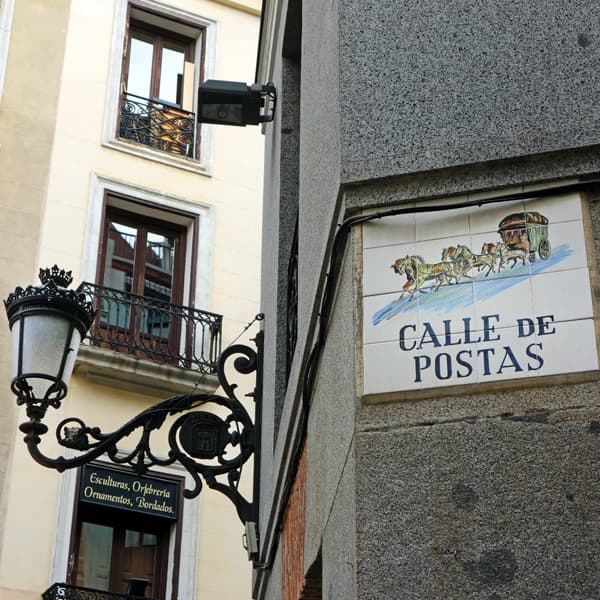
Calle de Postas Start by checking out the old-style street sign posted on the first building on the left. It's a colorful tile plaque. A bit above eye level. It shows a stagecoach drawn by horses.
This was the postal delivery carriage heading for that famous first post office. In medieval days, street signs like this were the norm. They included pictures so the illiterate peasants and the foreign tourists, yes, so they could read them. Keep going up Calle de Postas one block.
Read more...Show less
Though the shops today are modern ones, this street still captures a bit of the historic character of the city. Narrow, pedestrian-only lanes where people and buildings are packed tightly together. You can imagine how lively the town must have been back when Madrid was becoming the premier city in Spain. These days, Calle de Postas still bustles, lined with traditional eateries.
To gain an appreciation for Spanish cuisine and the Spanish lifestyle, let's pop into one. There's no need to actually buy anything in this busy place. Enter the Museo del Jamón. It's on your right.
Though the Museo humorously calls itself a museum, it's actually a restaurant, part of a popular chain. Go inside and then down a few steps. You'll enter a delightful bar scene. Delightful, unless you happen to be a pig.
Ham hocks line the walls of this so-called museum of ham. Browse the menus and the glass deli cases. You'll see all kinds of traditional Spanish foods. There's bocadillos, or sandwiches, and a wide variety of tapas, small plates of everything from cheeses to seafood to local olives.
But it's clear what the real specialty is here. Ham! Or in Spanish, that's jamón. Jamón is a national obsession.
Federico will expound more on that subject in just a moment. Jamón is cured ham that's been salted and hung to dry in climate-controlled conditions for months at a time. Spaniards just love the thin-sliced cuts on sandwiches or as an appetizer. Take a moment to browse the various ham hocks.
Yes, I see there are some huge price differences in euros per kilogram. There's the cheaper stuff, like the ham hocks labeled Serrano. But what really gets Spaniards going is the more expensive stuff, like jamón ibérico, or ibérico de biota. You can ask for a taste.
If you're lucky, you may get to taste it. Taste a tiny bit of Spain's very best ham, ibérico de biota. Mmm. Oh, my goodness.
Close your eyes. Let the taste just fly you away. Oh. I'm in a land of very happy acorn-fed pigs.
Little black hooves tap-dancing like castanets. Uh, Earth to Rick, you were telling us about jamón? I'm not to be disturbed at this moment. Let Federico take over.
Federico? Jamón. Wow, jamón. Jamón ibérico, Iberian ham, you see.
With all my respect, you see, to Italian prosciutto and French jambon, you know, this is better. This is better. This is a fact. And all along the wall, we have 10, 20 different kinds of jamón.
Exactly. Those, they have different jamones from different regions. And when we talk about ibérico, we talk about basically a couple of concepts. The race of the animal, a black pig with a black hoof.
You see, we call that black hoof. Pata negra. Pata negra. Black hoof, exactly.
And also the way we feed the animal with those acorns. Nothing more than that. No chemical products. And then it has to be cured, and after a few months, you get that, the liscous ham, which is ibérico.
The serrano, serrano one, would be the ordinary ham, which is good enough, and quite similar to the French one or to the Italian one, you see. The ibérico is really, really, really unique. So, I see serrano, about 22 euros per kilo. I see ibérico for about 65.
And I see ibérico de bolota, 100 euros per kilo. Bellota means acorn. So they are telling you that specifically those pigs were fed with acorns. Five times as expensive as serrano?
Is it five times as good? Yeah, I really think so. And then when you taste it, you can see, you can feel the difference, you see. Let's say that the other one is absolutely fine, you know, for anyone, for kids, you see.
For your children. For children, you see. A ham sandwich here, serrano. Exactly, a ham sandwich.
That's true for kids, you see, for children. But the other one is really, really, you can feel it in the color. It's darker, it's a little bit more oily, and it is super, super tasty. So when you put a little bit of ibérico de bolota in your mouth, how do you feel?
I feel good. I feel really good. I have to say that. Those are the things that you miss, you know, when you just go abroad and for a long, long, long time, you really miss that flavor of that jamón.
That is not easy to find anywhere else, that's true. Jamón. Jamón. Okay, okay, enough hamming it up.
Let's leave here and return to Calle de Postas. So go back up the stairs and back outside onto the street. Where there are other bars and fast food joints nearby. In fact, directly across the street is a classic sandwich bar, or bocadillo bar.
Check out the menus. Complete with photos, they give a fun review of your eating options. The specialty here? Squid rings.
Calamari. Young Spaniards who live fast-paced around-the-clock lives have embraced the concept of fast food. Places like this offer traditional fast food, like bocadillos. But McDonald's and Burger King also thrive in Spain.
Keep going up Calle de Postas one more block, to where the road bends to the right. As you walk, listen to what Federico has to say about how young Spaniards have embraced fast food chains. Well, I can tell you personally, you know, we know that nowadays, the quality of the food, you know, in McDonald's or Burger King here in Spain, is not bad. It's not really bad.
They actually have good coffee and good salads, you see. It's not bad. And then we have those Spanish choices, like Pansa and Company, which is basically the same thing that you have in America, Subway, with that baguette bread, you see. It's quite popular.
Nowadays, younger people, and not necessarily younger people, they just go everywhere, and it's basically the same stuff, you know. So, young people, it's an international kind of culture. You go to the fast food place. We live in the age of globalization, you know, talking about food, talking about anything, and that's a fact.
Yeah, that's a fact. Continue up Calle de Postas and take a slight right on Calle de la Sal. This leads through an arcade. There, you emerge into a spacious square surrounded by stately red buildings. Plaza Mayor. Plaza Mayor. This vast, cobbled square
Plaza Mayor
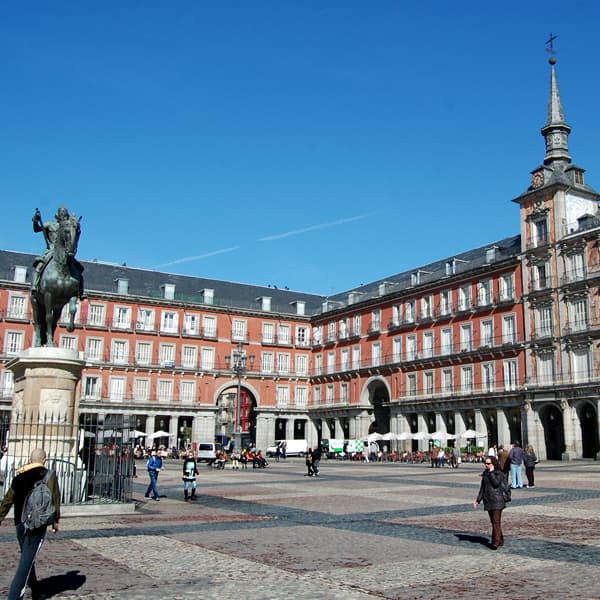
dates back to Madrid's glory days, the 1600s. Back then, this, not Porta del Sol, was Madrid's main square. The place is huge, 140 yards long, about 100 yards wide. It's enclosed all around by three-story buildings, all with symmetrical features, the same windows, balconies, slate roofs, and steepled towers.
It kind of looks like a palace turned inside out. The square was designed by Juan de Herrera. Herrera made a big impact on Madrid. His distinct look, steeples, towers, symmetry, is now found all over town.
Read more...Show less
Stroll to the center of the square, where there's a statue of a man on a horse. This plaza was the center of city life back in the mid-1600s, when Madrid's population was about 100,000. Many Spanish cities have a Plaza Mayor, so I asked Federico to explain why that is. Plaza Mayor, main square.
Mayor, the word mayor in English language has several meanings, but it's mostly used as something like a main place to stay. Plaza Mayor is a place where everything happens. You see it any time, any place. This is, Plaza Mayor is one of those concepts of civil art, architecture, that we find in Spain that was exported to all Latin America.
Now, when you go to any Latin American city, you find the main square where action takes place. Everything happened here. Political events, religious processions, I mean, carnival parades, music festivals, executions by the Spanish Inquisition, bullfighting, many more things here. Now focus on the man on horseback in the middle of the square.
I like his ruffled collar. Nice look. This is Philip III from the 1600s. Although, Philip III wasn't an especially great king, he was vital to Madrid.
Philip's father was the great Philip II, the man who first established Madrid as the national capital. Philip III built upon his dad's legacy. In 1619, he created this square, Plaza Mayor, as the centerpiece of the growing capital. He did it by transforming an old marketplace into the fine plaza we see today.
Rick, catch us up to date about how Madrid fits into Spain's history. Certainly, but as I do, feel free to browse around the square. The city of Madrid is relatively young. You see, back in medieval times, Madrid was just another dusty village in the high central plains.
Spain itself was not even a nation, just a peninsula of feuding kingdoms. Then, in 1469, modern Spain was born. It happened at a wedding. Ferdinand of Aragon married Isabel de Almeida, of Castile.
Just like that, their two huge kingdoms were united. You may recall it was Ferdinand and Isabel who sent Columbus to America. This made Spain filthy rich with new world gold and colonies. By the 1500s, Spain had the world's grandest empire, and it was ruled by Ferdinand and Isabel's great-grandson, Philip II.
Philip II chose tiny Madrid, located roughly in the center of the country, as his new capital. His son, Philip III... Whose statue is here. Yes, Philip III transformed the budding capital into a major European city, starting with this Plaza Mayor.
Each of the kings who followed... Like Charles III, who we saw on Puerta del Sol. Yes, each king put his mark on Madrid, their grand new capital. Bringing it up to modern times, by 1900, Madrid had half a million people.
But they were still packed within a small area, with Plaza Mayor, as the center of the town. But in the mid-1900s, the city exploded, with farmers moving in from the countryside. This created the sprawling metropolis we know today, with Puerta del Sol, rather than Plaza Mayor, as the center of the action. Fortunately for tourists, Madrid's historic core survives, intact and easy to navigate.
And Plaza Mayor still feels like the stately center of that glorious capital they envisioned four centuries ago. Locate the lamppost near the statue, with benches at its base. Let's head there. As Federico mentioned, this square served as the outdoor venue for the city's major events.
Bullfights were staged here, parades during carnival season, religious processions, royal pageantry, even some of the gruesome events of the Spanish Inquisition. For that story, look closely at the lamppost. At its base, you'll find some bronze reliefs on the seat backs. These depict events from the Inquisition.
During the Inquisition, many people were put on trial right here. Suspected heretics, Protestants, Jews, unlicensed tour guides, and Muslims. Muslims whose so-called conversion to Christianity was considered dubious. Thousands of people packed the square to watch the proceedings.
The authorities watched from specially erected bleachers. The wealthy rented balconies, and the poor crowded around the fringes. The guilty were paraded around the square. They had to wear billboards listing their many sins.
Then a bonfire was lit, and the heretics were burned alive. Other criminals were slowly strangled. That was called garrotted. They were given a crucifix to hold and died hearing the reassuring words of a priest.
How cheery. Rick, tell us about the square today. Today, the buildings are mainly private apartments. Ooh, I want one.
It'll cost you several hundred thousand euros to buy even the tiniest attic studio. For a bigger flat, expect to spend a couple million. The square is currently painted burgundy, a color chosen directly by Madrid citizens in a citywide referendum. Ever since the undemocratic Franco regime, there's been a passion here for voting.
Even the most trivial issues require the okay by the citizenry. They vote. Locate the building to Philip III's left. The one on the north side beneath the Twin Towers.
This grand structure was once home to the Baker's Guild. Now, it houses the tourist office. Which is wonderfully air-conditioned. Consider taking a break from our walk here on the square.
Day or night, Plaza Mayor is a colorful place to take a seat outdoors at one of the cafes. It's affordable to enjoy a cup of coffee or a drink. Meals are generally overpriced, but you sure can't beat the atmosphere. Throughout Spain, Plaza Mayor's like this one provide peaceful pools in the whitewater river of Spanish life.
Now, let's start crossing the square, heading for the far corner on the right-hand side. On your way, stop at the bar at number 26 on the right, under the arcade. This is La Torre del Oro, Bar Andalou. They serve drinks, tapas, and meals.
But it's also a kind of small museum to bullfighting. ♪ ♪ ♪ ♪ ♪ ♪ ♪ ♪ ♪ ♪ ♪ ♪ ♪ ♪ ♪ ♪ ♪ ♪ ♪ ♪ ♪ ♪ ♪ ♪ ♪ ♪ ♪ ♪ ♪ ♪ ♪ ♪ ♪ ♪ ♪ ♪ ♪ ♪ ♪ ♪ ♪ ♪ ♪ ♪ ♪ ♪ ♪ ♪ ♪ ♪ ♪ ♪ ♪ ♪ ♪ ♪ ♪ ♪ Step inside and order a drink.
Bullfighting Bar: La Torre del Oro Bar
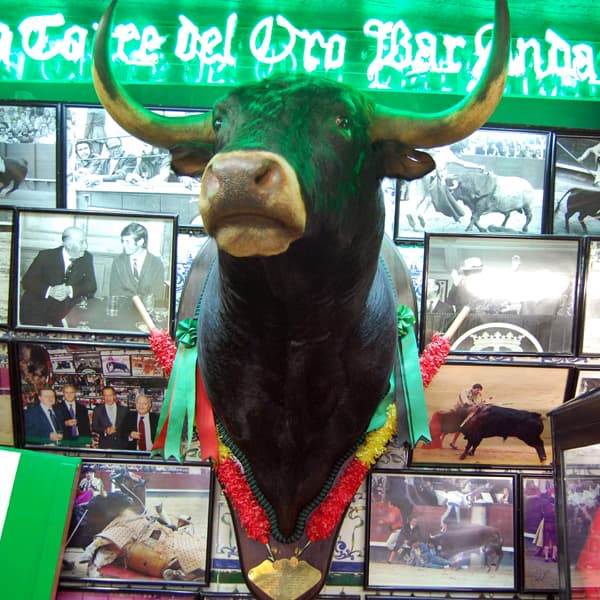
Warning before going inside. The staff can be rather gruff, though they're certainly entertaining. Also, they may try to push expensive tapas on you, when all you want is a drink at the bar or a small portion of tapas. I suggest you read the price list posted outside.
You want the cheaper prices you get standing at the bar. That would read bara on the menu. Not seated out on the terrace. Step inside.
Read more...Show less
You're welcome to just look around for a few minutes without ordering anything, but it's fun to step up to the bar and order a drink. I'm getting a caña, or a small beer. You can pay when you're ready to leave. I'm sticking with something non-alcoholic, maybe a...
a Schweppes Limon, or just a Coke. The interior is like a temple to bullfighting. It's colorfully festooned with gory decor. The main decoration is the stuffed heads of famous bulls killed in bullfights.
How tasteful. Find the head of Barbaro the Bull. He's the one in the center, facing the bar. Underneath, at about eye level, you'll see the actual knife used to put poor Barbaro out of his misery.
The plaque explains everything about Barbaro, his weight, birth date, owner, date of death, and which matador killed him. Check out the photos on the walls. Many show famous matadors and bulls in action. Just to the left of Barbaro, there's a photo.
It shows longtime dictator and bullfight aficionado Francisco Franco. He's shown alongside... Yes, he's with a famous bullfighter, the one called El Cordobes. Back in the 1960s, El Cordobes was a true working-class hero.
He was incredibly famous. Kind of the Elvis of bullfighters. Now locate another photo. It's at the head of the stairs leading down to the toilet.
This one also shows El Cordobes, but in this one, he's with another famous figure of the 60s. Robert Kennedy. They look like brothers. They do.
Just above Kennedy, find the photo of the famous matador from the 1970s, Paciri. It captures a poignant moment shortly after being gored as he's bleeding out of his neck. He's bleeding to death and about to take his last breath. And he smiles at the camera?
As a matador, his death is a moment of glory. Now look below and left of the Kennedy photo. Find the shot of a matador being gored. This is El Cordobes' illegitimate son.
Though disowned by his famous dad, he adopted his dad's nickname, El Cordobes, and Jr. carried on the tradition. Finally, head for the end of the bar and find a glass display case. This has a spangled matador's costume.
Yes, you can see why they call it a suit of lights. This was worn by the great El Cordobes in an ill-fated 1967 fight. The bull gored him. El Cordobes survived.
But the bull didn't. Before we pay our tab and move on, let's check out a few final photos. In the same case as the suit, notice the photo of a different matador. Not El Cordobes.
Horrifyingly hooked by a bull's horn. Yikes. Now, let's take a slow browse the entire length of the bar past photos of matadors having both very good and very bad days. You can play Spot the Celebrity.
I spy Bruce Springsteen. And... Hey, hey, Lisa, look over here. That's Jimmy Carter.
Bullfighting also attracts the most macho of aficionados, from Hemingway to the Latin American revolutionary Che Guevara. His photo's over here, near where you entered, in the corner just to the left of the door. And with all the literally gory encounters with bulls, you can understand why religion and superstition followed matadors into the ring. Between Che and the door, you'll find a small shrine to the Virgin Mary.
I'm saying, a prayer that our bartender doesn't overcharge us too much. Let's pay our tab and leave. Good idea. La cuenta, por favor.
If you'd like to linger, there's plenty of other photos and memorabilia, but we're moving on. Leave the bull bar, turn right, and follow the arcade to the corner of the square. On your way, you'll pass a traditional hat shop. It's called La Favorita at number 15.
As the plaque in the pavement says, this shop has been serving the public since 1894. Exit Plaza Mayor at its far right corner. This puts you on a short street called Calle de Ciudad Rodrigo. On this street, you'll pass a series of traditional turn-of-the-20th-century storefronts and sandwich joints.
The place called Casa Rua is famous for a local specialty, bocadillos de calamares. That's fried squid rings on a roll. At the end of this short lane, turn left. Head downhill toward the covered market hall just ahead. This is the Mercado de San Miguel. The Mercado de San Miguel.
Mercado de San Miguel
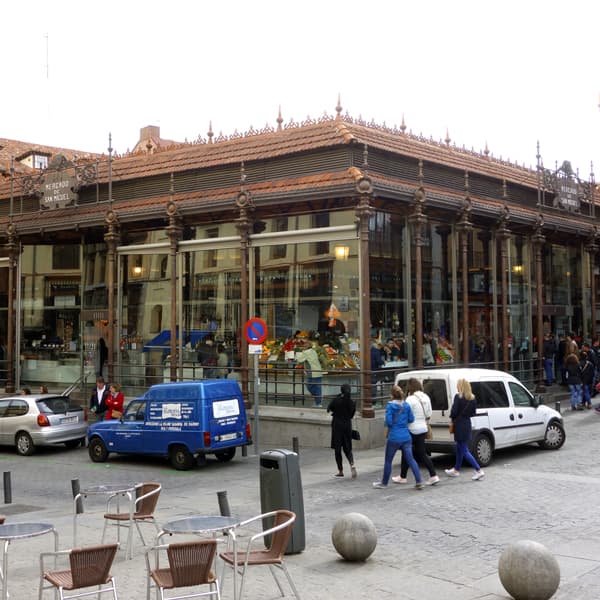
Before entering the market, stop near the entrance. Look downhill. Down a street called Cava de San Miguel. Lining that street are a series of traditional dives called mesones.
The mesones stretch like caves far back from the street. At night, especially on Fridays and Saturdays, they're packed with madrilenos out on dates. If you like singing, sangria, and sloppy people with no sense of personal space, come back after 10 p.m. and visit one of these bars.
Read more...Show less
Emboldened by sangria, they break out in song. It's a local, lowbrow, electric keyboard, karaoke-type ambiance. My kind of place. The odd shape of these bars isn't a contrivance for the sake of atmosphere.
Plaza Mayor was built on a slope, and these underground vaults are actually part of the structural foundation that supports the level plaza. For a more refined setting, take in the Mercado de San Miguel. This historic iron-and-glass structure dates from 1916. It stands on the site of an even earlier marketplace, and this is the place This is the city's oldest surviving market hall.
Recently renovated, it's still a market, which now hosts some 30 high-end vendors. Let's go in. Make your way slowly down the center aisle to the far end. It's a food lover's paradise.
Stands sell fresh produce and gourmet foods. People shop to take home or take a seat and eat there. They sample wines by the glass, order tapas, and even enjoy full meals. Locals and tourists alike gather for the food, the trendy ambiance, and the social scene.
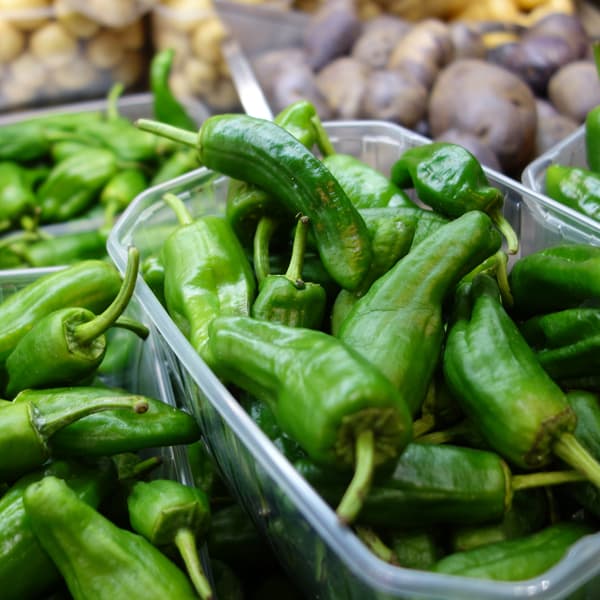
Go on an edible scavenger hunt. You'll find plenty of one-of-a-kind local delicacies. Ooh, I see fish tapas, gazpacho. Hey, check out the green peppers.
Those are called pimientos padrón. It's the local chili pepper. They're generally mild, not spicy, and served roasted and salted. I love them.
There's artisan cheeses and lots of olives. Madrid's favorite olives are the small ones. They're called campo real. When olives are skewered, skewered on a toothpick, it's called a banderilla.
A banderilla. Isn't that... Yes, they're named for the bengaled spear they thrust into the bull's back at the arena. Also, you can sample local wines and sherry.
The letters V-O-R-S mean literally very old, rare sherry, dry and full-bodied. Finally, there are treats for your sweet tooth. Bon appetit, or as they say here, buen provecho. Let's take some time to just wander around.
As you do, listen to Federico. I asked him about his personal memories of the Mercado. This is one of those markets I remember, you know, when I was a child, San Miguel Food Market, was just a kind of ordinary market, you see, and nothing special to say about that. Well, we have to say that the building is quite unique.
This is the building from the year 1925, iron, red brick, glass, you know, all right. But then the market was quite unique. It was quite abandoned in many ways. And finally, someone had a great idea just a few years ago how to transform this into a kind of a fusion market, a place where local people come here to grab the food and go home, or some visitors or also locals, we just come here to consume the food here.
I mentioned to Federico that there's lots and lots of olives here. I just, I love these olives. They're both high-quality olives for eating, as well as olives used just to make olive oil. Wow, we have in this canter I think that we have more olive trees than people living in the canter, you see.
Olive trees everywhere. We consume olive oil and we consume those olives. You see it from many different varieties of black, green. And let me also tell you that those olives that we eat are the ones that are, you know, when those farmers go to do the picking of the olives, you see, when they have to shake those trees, what they do first, they get those ones that are on the floor, the ones that are really mature, those are the ones that we eat as appetizers.
And then the ones that are still in the tree that are not enough to be mature, those are the ones that have to be shaken, you know, and that is where we get the oil from those ones. But the ones that are on the floor are the ones that we eat here. Those are the ones that you'll eat. Finally, I asked Federico about sangria.
Though there are many different recipes, here in Spain it's usually not a sweet and fruity drink like they serve in the States, but very light and refreshing. Sangria is that kind of refreshing wine, you know, which is slightly sweet with a little bit, not even sour, just cinnamon. A little bit of cinnamon and some little pieces of fruit, like orange or lemon or, you know, and ice. And no gas water.
Some people mix that up with a little bit of gas water. So the classic sangria would be? Just kind of a table wine. Table wine?
With that cinnamon, a little bit of fruits and ice. And that's it. Nothing more than that. And very popular in the summer?
It's very popular in the summertime. The heat is here too much and we just drink sangria everywhere. It's a kind of light wine for us, yes. Before, anyone starts hitting the sangria bar, I think we should be moving on.
Exit the market at the far end. As you exit, turn left. This puts you heading downhill on Calle del Conde de Miranda. At the first corner, turn right. You enter a small square called Plaza del Conde de Miranda. The church and convent
Church and Convent of Corpus Christi
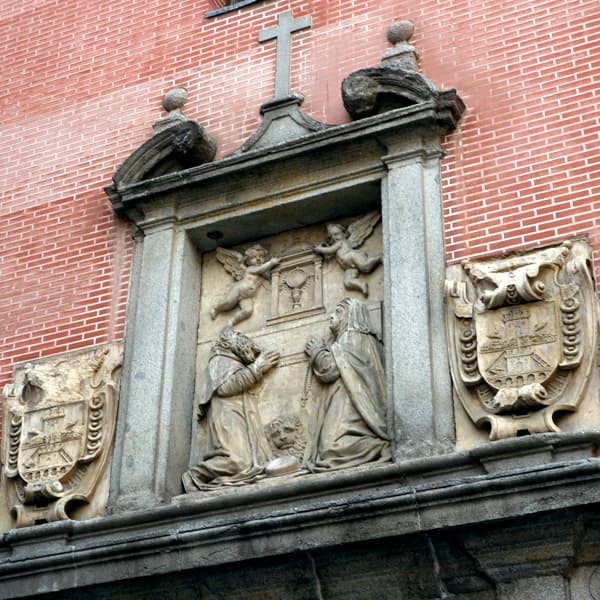
of Corpus Christi. Make your way to the far end of Plaza del Conde de Miranda. There's a brick building. It's actually a low-profile church.
This church is part of a Hieronymite convent built in 1607. Check out the proud coat of arms over the entrance. This belongs to the rich family that paid for the church. In 17th century Spain, the most prestigious thing a noble family could do was to fund a convent.
Read more...Show less
To get the most out of the goodwill that created in your community, you'd want your family's insignia right there for all to see. So in the central panel, you can see the donating couple, like a 17th century Bill and Melinda Gates kneeling before the communion wafer. You could step inside the church. Though we won't.
But if you did go inside, you'd find a cool and quiet oasis with a beautiful Last Supper altarpiece. But we're going shopping for cookies. Yes. Now for a unique shopping experience.
Turn right and head a half block uphill on Calle del Codo. Find a big brown door. It's on your left at Calle del Codo number 3. This is the church's convent.
Here you can buy goodies from the convent's cloistered nuns. Here's how. Find that brown door. The sign reads, Venta di Dulces.
Sale of sweets. Buzz the button that says Monjas. Doing that now. Wait patiently.
Cookies, cookies, dulces. One of the sisters should greet you over the intercom. Whatever she says, you should respond with, Dulces? Meaning, I want to buy some sweets.
She'll let you in. When the lock buzzes, push open the door. Walk straight in and then to the left, following the signs to the torno. That's the lazy Susan that lets the sisters sell their baked goods without being seen.
Scan the menu. You can buy a half kilo of galletas, that's shortbread cookies, for about 10 euros. Or try the pastas di almendra, that would be almond cookies. Announce your choice to the sequestered sister behind the screen.
When you've made your selection, place your money on the torno. She'll spin the wheel, your money, and your money will disappear and your goodies and change will appear. Well, that's a one-of-a-kind experience. Mmm.
And delicious. Let's continue our walk. Continue uphill on Calle del Codo. Mmm.
Galletas. Shortbread cookies. My favorite. As you walk up Calle del Codo, check out the historic tiled street signs.
The picture on the sign makes it clear that in centuries past, this was where people shopped for armor. The street turns left, becoming a narrow alleyway. You're headed toward the Plaza de la Villa. But just before entering the square, notice an old door on your left.
The door is made of wood lined with metal. It's set within a stone keyhole arch in the old Moorish style. It's important to remember that for many centuries, from 711 until 1492, the Muslims, or Moors, ruled parts of Spain. Even after the Reconquista, when Christian forces reconquered Spain, Moorish influence lived on.
This is considered the oldest door in town. It's on Madrid's oldest building, inhabited since 1480. Now, look up and you'll see a tower. That was once used as a prison.
Now continue into the square called Plaza de la Villa. It's dominated by Madrid's City Hall. ¶¶ ¶¶ ¶¶ The City Hall
City Hall
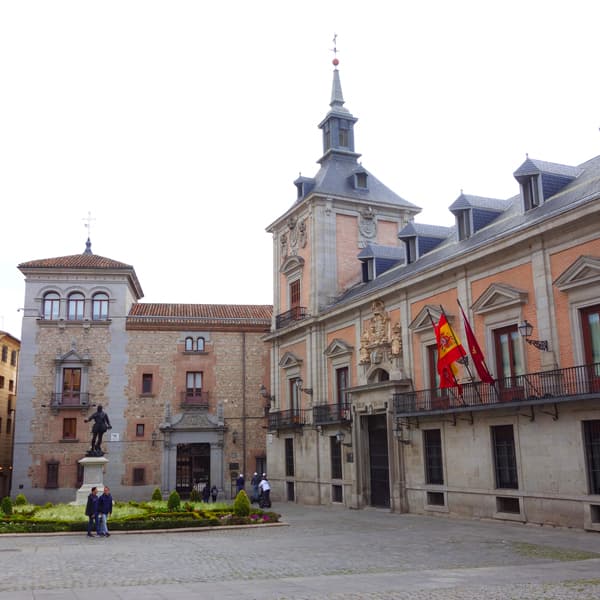
The impressive historic City Hall features Madrid's distinctive architectural style. Symmetrical towers topped with steeples and a slate roof. It's the style pioneered by the man who did the Plaza Mayor, Juan de Herrera. The style is known as Castilian Baroque.
The building was Madrid's Town Hall. Look over the Town Hall to the left of the City Hall's doorway. You'll see three coats of arms. These sport many traditional symbols of Madrid's rulers.
Read more...Show less
You'll see Habsburg crowns on each of them. The Habsburgs were the Germanic family that came to dominate much of Europe for centuries. They entered Spain when a Habsburg prince married the daughter of Ferdinand and Isabel. As a result, many of Spain's greatest monarchs during its Golden Age -- Charles V, Philip II, III, and IV -- were all Habsburgs.
Now, turn to the center shield. That's where you'll find the symbol of Castile. Let me guess. Castles!
Castles, that's right. Castile is the central region of Spain, where Madrid sits. Castile has lots of castles. On the left shield is the symbol of the city of Madrid.
Our old friend, the berry-eating bear. This Town Hall square was once the ruling center of Madrid. These days, the official city government has moved elsewhere. But this square is now the symbol of Madrid.
This square saw Madrid's rise from a humble medieval village to a glorious imperial capital. Imagine, it's the mid-1500s, Spain's Golden Age. New world gold was pouring in. Conquistadors were establishing vast colonies under the Spanish flag.
Spain presided over a global empire, bigger even than the empire of ancient Rome. Meanwhile, its government was stuck in the old Spanish capital, Toledo, 50 miles south of here. Toledo? That's tiny.
Exactly. Spain was outgrowing its traditional capital. In 1561, King Philip II suddenly announced that the capital was moving to Madrid. Everyone was shocked.
Back then, Madrid was little more than a dusty outpost. But Philip II moved the capital from Toledo to here. Madrid proved to be a perfect choice. It was located roughly in the geographical center of the country.
It united the two great kingdoms that merged when Philip's great-grandparents, Ferdinand and Isabel, got married. And with plenty of room to grow, Madrid became the ideal spot from which to administer the growing Spanish empire. Philip II went on a building spree. Then his son, Philip III, continued it.
This particular building, City Hall, reflects the hasty development. It's glorious, yes, but notice that it's done somewhat on the cheap. The building, like much of Madrid, was built with brick rather than elegant and more expensive stone. This venerable City Hall has also overseen the decline of Spain's fortunes after its golden age.
Check out the statue in the garden. This is of Philip II's admiral, Don Alvaro de Bazán. He defeated the Turks in the pivotal Battle of Lepanto in 1571. That was Spain's last great triumph.
Mere months after Bazán's death, the mighty Spanish armada was destroyed by the English. And from that moment on, Spain's empire began its slow, three-century-long fade. How tragic. Well, Lisa, all empires must someday pass.
No, it's tragic that I've already finished my nun cookies. Well, you're in luck. There's a cute shop nearby that sells the same traditional pastries by those same nuns. It's just down the lane, Calle Cordón Nº 1.
But we're moving on. From here, we'll continue west along the busy street called Calle Mayor. This leads downhill toward the Royal Palace. ♪♪
Calle Mayor
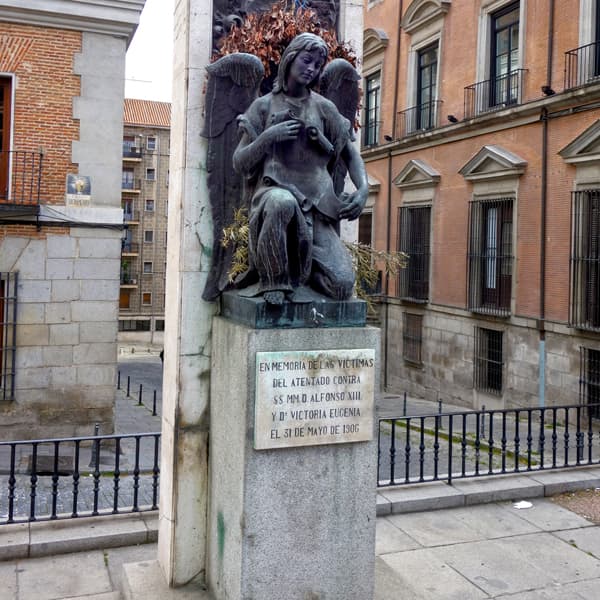
Calle Mayor. Head down Calle Mayor two blocks to where the road opens up on the left. Along the way, if you're interested, you'll pass by a bookstore on the right at number 80. It specializes in books about Madrid.
The Calle Mayor is busy with traffic. This is one of the few corridors where some cars are allowed in this largely traffic-free city. Much of Madrid's traffic is actually routed underground. It's an ingenious way to control urban traffic.
Read more...Show less
So I talked with Federico about these underground car tunnels. Well, we have some beautiful tunnels under the city. We spend a lot of money on that, you see. I can even tell you how some travelers who come here, you know, and they discover those tunnels under the city and say, "Wow, that goes money and time, of course." And we are quite happy to see how Madrid, which is a big city in European terms, we are nearly 5 million people here, and then the old town is mostly, mostly a walkable area.
You see, and the cars are underneath. After two blocks, Calle Mayor opens up a bit on the left. There's a small plaza with a church. There's also a memorial with a small statue along the sidewalk.
It shows a grieving angel. This statue memorializes a 1906 assassination attempt. The target was Spain's King Alfonso XIII... Lucky 13.
...and his new bride. It was their wedding day, and they were parading down this main street while the happy crowd threw bouquets of flowers. Little did they know that among the crowd was an angry anarchist, as terrorists used to be called back then. He was watching from the balcony at number 84.
It's over there, directly across the street. As the royal couple passed by, the anarchist threw his bouquet of flowers. It had a bomb attached. The bomb went off.
Fortunately, the bomb missed the royal newlyweds, but unfortunately, it killed 28 bystanders. There's more to the story, but let's start walking. Continue down Calle Mayor one more block. As you walk, here's the rest of the story, with a happy ending.
Fortunately, the king and queen went on to live to a ripe old age. Unfortunately, they were forced into exile during the Franco years. But fortunately, they produced many happy children. Their grandchild, Juan Carlos, restored the monarchy after Franco's death in 1975.
And their great-grandson is Spain's current and very popular king, Felipe VI. Walking down Calle Mayor, you soon reach a busy cross street, Calle de Bailén. From that intersection, you can take in the big gray dome of our next site, the Almudena Cathedral. The Almudena Cathedral.
Almudena Cathedral
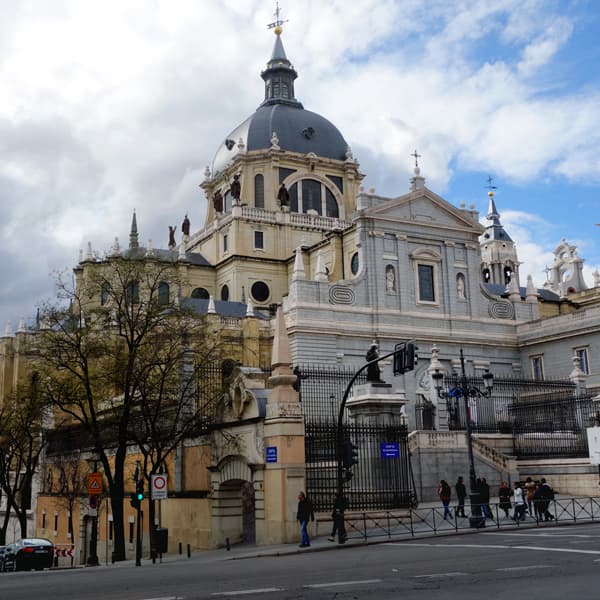
Madrid's gray-and-white cathedral is massive, 110 yards long and 80 yards high. It's also relatively new. It opened its doors in 1993, precisely 100 years after workers started building it. Let's go inside.
Find the side entrance for tourists just a few yards uphill on Calle de Bailén. A small donation is requested. Climb the steps to the church courtyard. You come to a monument commemorating the 1993 visit by Pope John Paul II.
Read more...Show less
He came to Madrid to consecrate the new cathedral. This ended a 300-year stretch when Toledo had a cathedral and Madrid didn't. Madrid kept requesting one but was ignored. Step inside.
Make your way to the center, immediately under the dome. The interior decor is clean and modern, with white walls and colorful ceilings and windows. Stand under the dome and face the altar. Beyond the altar, colorful modern paintings brighten the apse.
These were done in 1993, actually rushed to completion for the pope's visit. Also at the rear of the nave, gaze up at the glittering pipe organ. Head for the right transept. Look for a set of stairs.
The faithful climb these steps to venerate an altarpiece that dates from the 1400s. The altarpiece has a popular statue of the Virgin Mary. This is a striking Gothic treasure inside the otherwise 20th-century neo-Gothic interior. Now, backtrack to the nave.
Stroll around behind the main altar. As you enter the apse, find a chapel that contains the church's historic highlight, a coffin from the 1200s. This 800-year-old coffin is made of painted leather on wood. It's now empty, but it once held Madrid's patron saint, San Isidro, or, in English, Saint Isidore.
The story goes that Isidro was a poor, humble farmer, but he was exceptionally devout. He was a Christian, living at a time when much of Spain was under the control of the Moors, that is, Muslims. One day, he came across some helpful angels. They agreed to do his plowing for him so he could continue to do what he wanted to do most: spend his time praying.
When he died, he was buried in this simple coffin. Forty years later, the coffin was opened. His body was found to have been miraculously preserved. This convinced the pope to canonize Isidro.
He is now the patron saint of farmers and of the city of Madrid. Exit the church out the way you came in. When you reach Calle de Bailén, turn left and continue uphill. While you make your way back to the busy street, listen to what Federico has to say about San Isidro.
We call him, actually, Isidro in Spanish or Isidore in English. Well, you know, this is also a fascinating story about this man because he was just one of those, you know, Isidoro was one of those Christians in a Moorish territory. He was a social minority, but he's actually an icon of Christianity, you know, the Reconquista and how to, you see. So we know that he actually existed, but what we know nowadays about him is a kind of a fiction character.
It's not easy to find that line between reality and fiction. But anyway, San Isidore is a perfect excuse to understand historically, you know, to draw somehow that story about Spain, in those crusades, specifically in the case of Madrid. Once outside the church, go uphill on Calle de Bailén. Passing one of those tunnels Federico mentioned, the tunnels where traffic has been rerouted.
Near the top of the hill, turn left. You enter a wide plaza, the Plaza de la Armería. From here, you stand in between the cathedral and our next site, the Royal Palace. A good place to view the palace is from the steps of the cathedral's main door. The Royal Palace.
Royal Palace
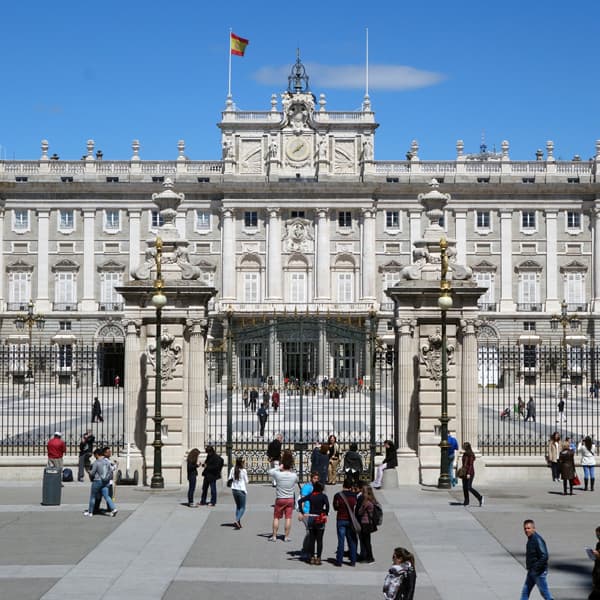
This spot has been Madrid's center of power for over 1,000 years. Over the centuries, as Spain changed hands, the palace reflected those changes. In the 800s, there was a Moorish castle here. In later medieval times, it was a Christian fortress.
Designed to battle those Moors. Then, a Renaissance palace. The current structure was built in the 1700s. It represents the wealth of Golden Age Spain.
Read more...Show less
Or rather, it reflects the accumulated wealth, even as that empire was beginning to fade. The palace is so big, it's hard to take it all in. It has a huge courtyard, surrounded by the imposing palace in gray-white stone. This building is considered Europe's largest palace, there are 2,800 rooms, totaling nearly a million and a half square feet.
I'd say it's probably Europe's third greatest palace, after Versailles and Vienna's Schönbrunn. It has arguably the most sumptuous original interior, packed with royal antiquities and tourists. The palace is the work of many kings over the years. King Philip II got things started with a wooden palace here in the 1500s.
It was built in the 12th century. When that palace burned down, it was rebuilt in the early 1700s by Philip V. Philip V was the grandson of King Louis XIV of France. He was the first Spanish king from the Bourbon family in France.
He probably ordered tapas and sangria in French. Oui. Philip V's model for the palace was obviously his grandpa's palace, Versailles, where he was born. Like Versailles, the palace is Baroque -- heavy columns, classical-looking statues, a balustrade roofline, and a false front entrance.
Imagine this place in its heyday, with a courtyard full of soldiers on parade. Or imagine a nighttime scene by lantern light as horse carriages arrive for a grand ball. The interior was mostly decorated in the mid-1700s by Philip V's son. That would be Charles III, the best mayor of Madrid, whose statue we saw at the start of this tour.
Hey, I'm paying attention. Charles did the interior in Italian style, since that's where he'd grown up. As a member of the sophisticated Bourbon family, Charles made it his mission to raise crude Spain up to the level of civilized Italy and France. He hired foreign artists to oversee the decoration.
The tapestries and porcelain were copied from French styles, though made in local factories. Decade by decade, the palace grew as each Spanish king tried to outdo his predecessor. The palace was home of Spain's kings from 1764 until 1931, when Spain became democratic. It remained unoccupied during the 40 years of Franco's dictatorship.
After Franco died in 1975, the royal successor, King Juan Carlos, took power. He surprised everyone by voluntarily turning the real power back over to Spain's parliament -- in other words, to the people. Thanks to King Juan Carlos, Spain became a constitutional monarchy with a figurehead king. Today's king is also a Bourbon.
It's Juan Carlos' son, Felipe VI. The royal palace is still the official royal residence, though these days the royal family lives most of the time in a mansion just a few miles away. But the opulent royal palace is still used for formal occasions, state receptions, royal weddings, and tourist stay dreams. You could pause the audio tour and visit the palace now, using the self-guided tour in the Rick Steves' "Spain Guidebook," but we won't go inside.
But if you did, you'd find a palace that's ridiculously supersized -- those 2,800 rooms filled with tons of luxurious tapestries, a king's ransom of chandeliers, frescoes by Tiepolo, priceless porcelain, and bronze décor covered in gold leaf. But we're moving on. Wait a minute, but it's so good, do we have to go? Yes.
But we can come back later if we want to? Absolutely. Okay, let's move on. Return to Calle de Bailén and turn left.
From this point, we're beginning our walk back to our starting point, way back to the Puerta del Sol. Walk one long block north alongside the palace. There's a park up ahead on the right. We'll be entering that park in a minute.
As you walk, directly ahead in the distance, is a skyscraper. This is the so-called Tower of Madrid. It's 460 feet tall. That may not be all that impressive these days, but it was sure a big deal when it was built in the 1950s.
Back then, it was one of the tallest buildings in Europe and the pride of Franco and his fascist regime. Spain was enjoying an era of prosperity because, though a fascist dictatorship, it sided with the United States and the West during the Cold War. Here's how Federico describes the tower. Torre de Madrid, Madrid Tower, one of those buildings from the 50s, from the 1950s.
It was a skyscraper in those days, not anymore. That was a very big deal in the 50s. A very big deal for such a country like Spain in the 50s, you see. And, well, mostly private offices, many airlines.
Many airlines, you know, were there. The head offices were there. And also some private condos and apartments. Quite expensive, you know, because that was a super cool tower in those days, and people paid location, location and apartment.
And the name again? The name is actually Torre de Madrid. Where the street opens up, turn right into the park. This is Plaza de Oriente. It's a park with trees, grass, landscaped hedges, and dotted with statues. The Plaza de Oriente.
Plaza de Oriente
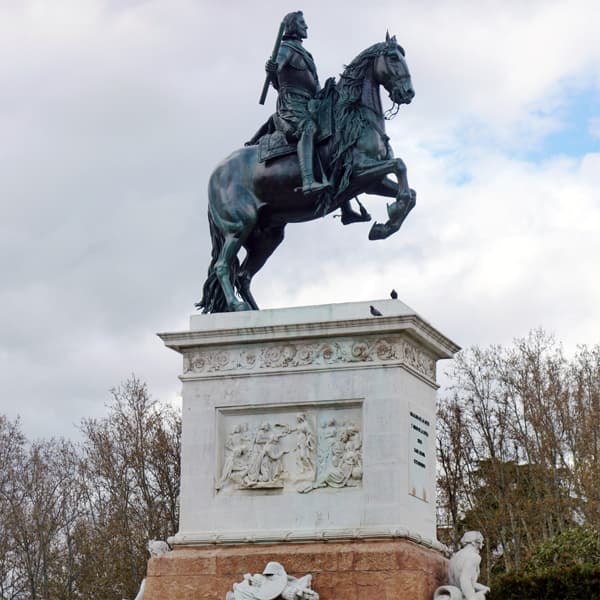
Start working your way deeper into the park, pretty much straight ahead to the center of the park. We're looking for a big bronze statue of a man on horseback. As you walk, enjoy all the pleasant greenery as well as the... Shh!
Listen. Hear that? I don't hear anything. Exactly.
Read more...Show less
That's what's so strange. We're in a major city surrounded by more than 3 million people, but you can still hear the birds, the fountains, distant bells. And where are all the noisy cars? In tunnels, one of which is directly under our feet.
Exactly. This grand, yet people-friendly plaza is typical of today's Spain and Europe in general. Everywhere, energetic governments are converting car-congested wastelands into inviting public spaces like this. I like all the statues in the park.
Yes, you'll see an entire line of kings. These statues honor the original Visigothic kings of Spain. The Visigoths were one of the so-called "barbarian tribes" from Germany -- Goths, Vandals, Lombards, and so on -- who conquered the Roman Empire around 500 A.D. The Visigoths swept into Spain and ruled for the next two centuries until the invasion of the Muslim Moors in 711.
Kings of Spain have, in an attempt to legitimize themselves, traced their heritage back to these distant Visigothic ancestors. Now, take in the big bronze equestrian statue in the center of the park. This is King Philip IV, the last of the great Habsburg kings. He ruled around 1630, as Spain's Golden Age was waning.
Philip was the enlightened patron of Spain's greatest painter, Velázquez. In fact, the statue was patterned after a famous Velázquez painting. You can see it in the Prado. I've seen it.
It's very dramatic. It shows Philip in total command as his horse rears back on its hind legs. Precisely. That pose is what made this statue such a striking technical feat in its day.
It's perhaps the world's first equestrian statue with the entire weight balanced atop the horse's fragile back ankles. It must have taken an engineering genius. I think so. They did it with the scientific help of none other than the great Galileo.
Oh, and they cheated a bit. They also used a tail for a little more support. The statue of King Philip IV faces our next site, Madrid's Royal Theater. Start walking toward the theater, veering slightly to the right.
We'll be walking along the building's right side as we make our way to the far end of the theater. This puts you heading east on the street called Calle Carlos III. The Royal Theater and the Plaza of Isabel II.
Royal Theater, Plaza of Isabel II
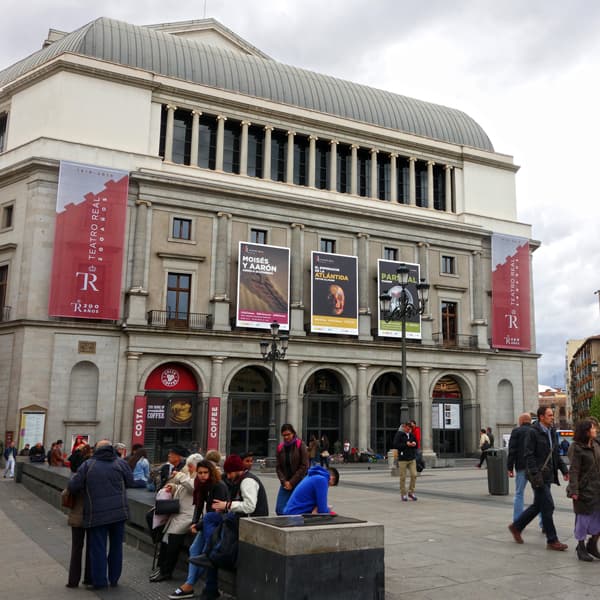
Keep making your way alongside the Royal Theater toward its main entrance on the Plaza of Isabel II. The Grand Royal Theater was built during the mid-1800s. Opera was all the rage throughout Europe, but Spain was conservative, ultra-religious, and isolated. This theater and its opera company was a way of playing catch-up.
Over the decades, the theater has undergone numerous reconstructions. It reopened in 1997 as a world-class, 1,700-seat performance venue. Today it hosts traditional opera, ballets, and concerts. It also hosts a kind of light opera still popular in Spain today called zarzuela.
Read more...Show less
I asked Federico to define this unique Spanish art form called zarzuela. Zarzuela is a stage work. It's actually a musical stage work that is born specifically in Spain. It will be also exported to Latin America.
And we talk about those Spanish musicals in those late 1800s and the beginning of the 1900s. So sort of light opera, sort of the Gilbert and Sullivan of Spanish culture? Very, very similar, exactly. The name again?
Zarzuela. At the far end of the Royal Theater, the street emerges into the spacious Plaza of Isabel II. In the middle of the square is the metro stop called Opera. Find the bronze statue atop a pedestal.
This is Queen Isabel II. Isabel II ruled Spain in the mid-1800s when this theater was built. Isabel had a rocky reign. Her father, the king, had ignored the ancient law that forbid females from ascending the throne.
As queen, Isabel met with strong resistance because of her gender and also for her policies. She was an arch-conservative, out of step with the rest of Europe. Isabel was finally driven from power in the so-called Glorious Revolution of 1868. This ushered in Spain's first, if brief, attempt at self-ruling democracy.
Today, Isabel's statue stands before her most lasting legacy, the Royal Theater she built. Now turn your attention to the side of the plaza directly opposite the Royal Theater. There you'll find the Royal Movie House, or Real Cinema. This is a grand old movie palace from the 1920s.
It's another example of Spain's persistent conservatism. As the rest of the world embraced Hollywood movies and their liberal mores, Spain approached it cautiously. During Franco's conservative rule, many foreign movies were banned, and others were allowed only if they were dubbed into Spanish. That made them easier to censor.
Franco's censors edited out sexual innuendo or liberal political references. Strangely, that tradition of dubbing continues even in today's more liberal Spain, where foreign films are still commonly dubbed. To see a movie with its unadulterated original soundtrack, look for the VO, meaning "original version." Let's continue on. Facing the Real Cinema, start heading toward the upper right corner of the plaza.
We'll exit the plaza there. Funny story. It's actually true. One time, Franco's censors were asked to rewrite some suggestive dialogue in a movie.
So they changed the entire situation from lovers having an illicit affair to a brother and a sister talking about just ordinary things. But the on-screen chemistry was still so sexually charged, they wound up turning a questionable relationship into an incestuous one. Awkward. Exit the plaza of Isabel II by heading gradually uphill on the street called Calle del Arenal. From here, it's a straight shot back to Puerta del Sol. ♪♪ ♪♪ Calle del Arenal
Calle del Arenal and Chocolatería
and the San Ginés Chocolatería. Start by checking out the colorful tiled street sign for Calle del Arenal. The picture shows workers with piles of sand. The Calle del Arenal was the "Street of Sand," where dirt was stockpiled during construction.
Keep going, making your way gradually uphill. We're headed about 200 yards up the street to a red-brick church on the right-hand side. As you pass various cross streets, check out the various illustrated street signs. You'll see that some of these streets are also named for the traditional crafts originally located here.
Read more...Show less
This sure is a pleasant place to walk -- the shops, the people strolling, the colorful pavement stones. Yes. Quite different from the traffic inferno it was a decade ago, before the city pedestrianized it. As you continue walking up the street, look at how orderly it all is.
Glancing down the side streets, you'll see how they've installed rows of bollards. These neatly divide the street into a place for cars and a place for pedestrians. And it's all enforced by police cameras. I see one on top of a post at an intersection.
They make sure only those with permits can enter, like taxis, delivery trucks, and residents. And if a stray tourist drives through here, they'll be greeted by a pretty expensive ticket when they get home. Consider how many people are simply out strolling. In Spanish, strolling is called "the paseo." The paseo has a strong tradition.
People of all generations enjoy simply being out, together, making the scene. I asked Federico to explain why the paseo has taken root in Spain. Paseo -- we just enjoy to walk, you know. This is a country where we have good weather, good food, and consequently happy people.
I mean, we really socialize. We use drinks and food as an excuse to meet friends, you see. And then you see all these walking streets everywhere. We enjoy to walk and to meet people, you know.
Even in wintertime, you know. Our winter is not really cold, cold, cold winter, you see. So we enjoy to walk and walk and meet friends, you see. And that is actually quite Spanish.
I will say that it's one of those Spanish stereotypes. El paseo, yeah. Is the paseo generally after work and before you settle in that home? Mostly, mostly.
Although we also have to consider that there are people in this country with different job schedules, you see. But it's true. It's true that that time, you know, let's say after 6 p.m. and before 10 p.m., you find people, children, families, everywhere walking around, meeting friends.
That is the moment. And of course, those weekends, you know. But let's say that in the late afternoon, people are everywhere walking around. And part of the paseo would be going from bar to bar and eating ugly things on toothpicks.
Yes, exactly. Those pinchos, those tapas, those aperitivos, raciones, and banderillas, you see. Yeah, food is good, food is inexpensive, and then we meet friends in those bars and cafés and taverns. That's what we do.
You'll soon reach a big red brick church on your right at number 13. The San Ginés Church is actually one of the oldest churches in Madrid. Its bell tower, now topped with a steeple, dates back to medieval times. Along the left side of the church is a bookstore, clinging like a barnacle to the wall of the church.
This charming place has been selling books on this spot since 1650. But this church, though historic, means something else altogether to the locals. It means temptation. It marks the way to the best chocolatería in town.
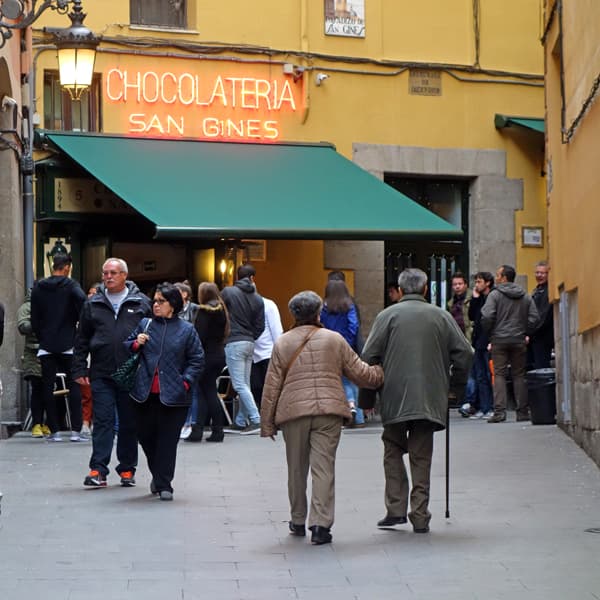
Ooh, let's go there. Just past the church, turn right, heading past the bookstall down a narrow alley. Head down Pasadiso de San Ginés to the far end. There, like a high-calorie red-light district, is a neon sign spelling out the name of our destination -- Chocolatería San Ginés.
This is every local's favorite place for a unique Spanish treat -- hot chocolate and churros. It's open 24/7, so people come here whatever the occasion. Browse around here while Federico tells us more about chocolate and these beloved local fritters. So, after a long, long time, after a long night of going to the bars and tapas and all of the prowling around, the last stop might very well be chocolate and churros.
Yes, why not? Let's go to San Ginés, which is the place. There are many, many places, but San Ginés is the place. It is supposed to be the best chocolate place in Spain, and there is something even better to say about that.
They are open 24 hours. The place is open 24 hours. They are waiting to give you a cup of hot chocolate. Spanish hot chocolate is very dense, very rich, you see, and then they give you those churros, the thin ones, or those soporras, the thicker ones, and then you dip that, you see, into the chocolate, and then you go to heaven, I guess.
For less, for less than four euros, you get a hot chocolate, Spanish chocolate, and San Ginés is the place. It's a very, very charismatic tavern from the late 1800s, and everyone is coming here. Everyone. You could pause the audio tour now to try some chocolate and churros.
Otherwise, we're backtracking up the alley to continue our walk. As you backtrack to Calle del Arenal, let's let Federico explain a bit more about chocolate and, mmm, these delicious churros. Chocolate con churros. Chocolate con churros.
Chocolate. We actually, in Europe, we know chocolate here thanks to Spaniards and Portuguese people. You know, we brought that from Mexico and Brazil. And the Spanish chocolate, the chocolate is very dense, very rich, you know.
It's not so light. It's like pudding. It's like pudding, exactly. And then we have those churros.
I used to say that word in English, fritters, but everyone now in English language know what a churro is. And the thin ones in Spain, the thin ones are called churros, and the thicker ones are called porras. So you just come here and you say, "Hey, you know what? I want to have chocolate with churros." They will give you four churros.
But if you say, "I want to have chocolate with porras," they will give you two porras because those are thicker than the churros are, you see. For the same amount of money, you get the best chocolate, the best churros in a very nice atmosphere. It is a wonderful place. The Chocolateria San Ginés is open 24/7, isn't it?
24/7. Why is it open so late? Because there are many people with many different priorities. I can tell you how the Chocolateria is just located between a church and a disco, you see.
So, you see, you find different generations, people who go there after praying, they just go to get a hot chocolate, or just teenagers who are dancing and dancing and dancing all night long. Finally, they are so, so hungry, they just come here at 2, 4, or 6 a.m. to get a good cup of hot chocolate, you see. So, the last nail in your coffin is going to be "chocolote con churros." Of course.
By now, you should be back at the San Ginés church. We'll continue our walk going gradually uphill on Calle del Arenal. ♪♪ Calle del Arenal, Part 2,
Calle del Arenal: Part Two
from San Ginés to Puerta del Sol. This is the final stretch of our walk. It's a straight shot to where we started, Puerta del Sol. We'll be focusing on some contemporary slices of Madrid.
First up, right next to the church, is the famed performance venue, the Eslava Theater. Originally, people used to come here to see those operettas called zarzuela. Then, it was a popular dance club. It's huge inside, and reveling young Spaniards used to come here and pack the former stage, floor, and balconies.
Read more...Show less
Throughout Europe, Spaniards have a reputation as the craziest late-night partiers. In Spain, once you turn 18, you can do it all -- buy tobacco, drink, drive, and serve in the military. And they party very late. Many dance clubs don't even open before 10 p.m., and no one shows up before midnight.
And you party till the sun comes up. Thank God for the afternoon siesta. The Joy Eslava starts its evening as an alcohol-free, all-ages disco. Then, at midnight, it becomes a thriving adult space.
Their slogan? "Go big or go home." Our slogan is, "Go a few steps up Calle del Arenal to the next corner." Today's Madrid is an interesting mix of both local traditions and international trends and globalism. For example, Starbucks -- there's one over on the corner on the left. It's very popular with young locals.
They like the inviting ambiance, American-style muffins, and free Wi-Fi. But the coffee itself is a little too tame for many Spaniards. From here, continue up Calle del Arenal about 30 yards to number 8 on the left. Notice and be thankful for the shade screens high above, stretched over the street.
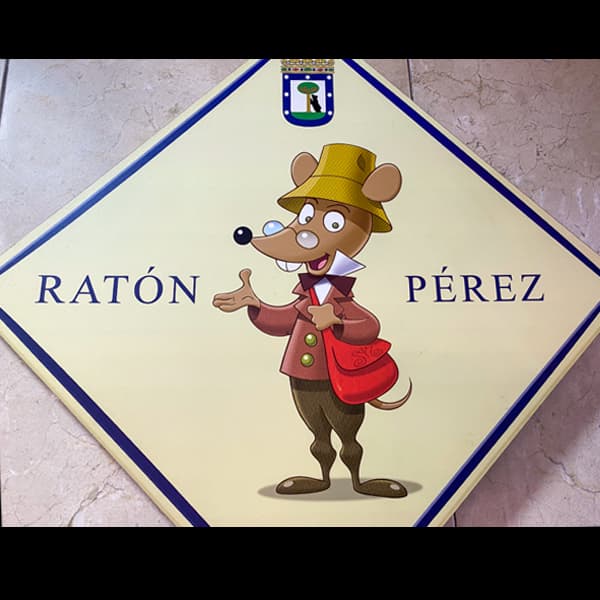
With climate change and this culture's outdoor lifestyle, shade in Spain is ever more appreciated. At number 8 on the left, pop into the little mall. Here at number 8 is the Museo de Ratón Pérez. This place celebrates the Mickey Mouse of Spain.
In the lobby, find the tiny little bronze statue. This lovable mouse. Pérez the mouse -- is cherished by Spanish children. If you want to explore more, upstairs is the fanciful Museum of Ratón Pérez.
It's got a fun window display. A steady stream of adoring children with their dutiful parents pour through here. Why is he so popular? Well, he's more than just a lovable rodent.
He's the equivalent of Spain's tooth fairy. As you look around, let Federico fill us in on what this little mouse means to Spanish kids. Oh, Ratón Pérez. Our Mr.
Pérez Mouse. We have in America Mickey Mouse. We have here this Pérez Mouse. And this is a wonderful story for kids.
It's based on a real story. You know, a writer in Spain in the late 1800s, he wrote a wonderful book for our King Alphonse when he was a child, you see, telling him the story of what you call in America the tooth fairy. The tooth fairy. Exactly, the tooth fairy.
Thank you. And this is exactly the same story but with a mouse. It's a kind of adorable mouse who is actually visiting those kids who are actually leaving that teeth under the pillow and getting some money, you know, a few hours later. So when you were a little adorable child, just four years old, and a tooth fell out, what would you do and what would happen?
I was looking forward to meeting the mouse, you see, but I never met him. But, well, that is beautiful. You put the tooth under your pillow? Oh, of course I did.
And Perón came. Of course I did, yeah, yeah, yeah. I got some money. It was not about the money.
It was about the magic. The magic of it. Of that character, you know, that mouse, you see, yeah. And it's here.
We can see here these cartoons and this story. And there's actually cartoons about this mouse. Yeah, even a movie. There's a movie.
So popular for the kids even today, the Spanish Mickey Mouse. The Spanish Mickey Mouse. Or Mickey Mouse is the American Perón. Who knows?
Who knows? I never thought about that. That's a good question. Now make your way outside and continue up Calle del Arenal.
Next door, at number 6 on the left, is a shop that sells soccer paraphernalia. This is an official retailer for Madrid's local soccer team, Real Madrid, or Royal Madrid. You can step inside to see posters, jerseys, balls, and memorabilia of this ultra-successful sports franchise. Madrid is absolutely crazy about their football.
In fact, they actually have two teams, the famous Real Madrid and their arch-nemesis, Atletico. It's kind of like David and Goliath. Real Madrid is the giant, and little Atletico is the pesky underdog. Here's Federico for more.
Many people are supporting Real Madrid because Real Madrid is classified as the best football team ever in the history of the 20th century. They tell you that. They have the plaque there of the Real Madrid stadium. But Atletico is more connected to the people, more popular, you see, and it's more, you know.
The Atletico are the losers, so we always support them. You know, because when they win, you know, this becomes a kind of a wild party. So like the Yankees and the Mets. Yeah, exactly.
That would be a very good example. We're nearing the end of our walk. Yeah, let's bring this baby home. Continue to the end of the street, where Calle del Arenal spills out into Puerta del Sol.
And we're right back where we started. As you enter the square, you're met by a statue. It's known locally as La Mariblanca. The statue, which is at least 400 years old, represents a kind of Spanish Venus, possibly a fertility goddess.
This statue is one of the only surviving remnants of the original Puerta del Sol. At her feet, notice that she has Madrid's coat of arms. Our old friend the bear and the berry tree. Today, La Mariblanca stands tall amid all the modernity as she blesses the people of this great city.
As you survey Puerta del Sol, think back on all we saw, think back on all we've seen. We've walked winding lanes that date back to Madrid's roots as a small medieval town. We've seen grand squares and monuments from when Madrid became a major capital during Spain's golden age of the 15 and 1600s. We've admired the royal palace, which reflects the opulence of Spain's elegant decline.
And we've talked with Federico about the Madrid of today, from chocolate to traffic tunnels to magic mice to jamón. To jamón, jamón, and more jamón. Our walk is over, but your paseo through the joys of Madrid is just beginning. We hope you've enjoyed our Madrid City Walk.
Thanks to Jean Openshaw, the co-author of this tour, and thanks to local guide Federico Garcia Barroso for his insights. If you're doing more sightseeing in Spain and Portugal, check out our walking tours of Barcelona and Lisbon. Remember, this tour was excerpted from the Rick Steves Spain Guidebook. For more details on eating, sleeping, and sightseeing in Madrid, refer to this year's edition of that guidebook.
For more free audio tours and podcasts, and for information about our TV shows, bus tours, and travel gear, visit our website at ricksteves.com. This tour was produced by Cedar House Audio Productions. Gracias. Adios. And happy travels. ♪♪♪
Free
GPS-guided walking tour
No account needed. Walk at your own pace.
Free
15 stops ·