Edinburgh: Grassmarket, Greyfriars & the Vaults
9 stops
GPS-guided
2.0 km
Walking
45 minutes
Duration
Free
No tickets
About this tour
The dark side — Diagon Alley, Tom Riddell real grave, a woman who survived hanging, body snatchers, underground city.
9 stops on this tour
Victoria Street & West Bow
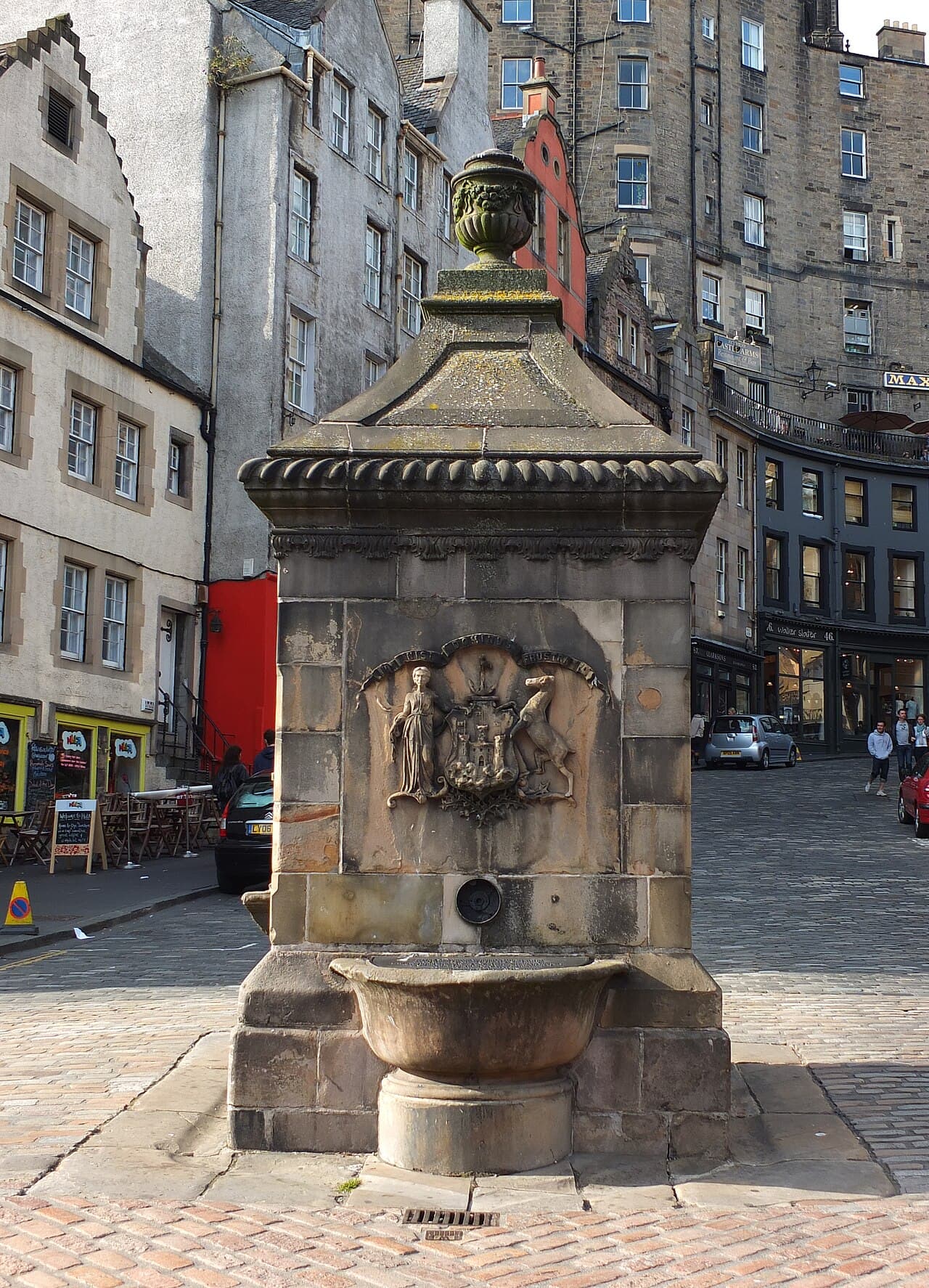
You're standing at the top of one of the most photographed streets in Scotland, and honestly, it earns every single click. Look down the curve of Victoria Street as it sweeps towards the Grassmarket below — that ribbon of cobblestone lined with painted shopfronts in reds, blues, yellows, greens, all stacked on top of each other like a wonky layer cake. It's gorgeous. And it's also only about two hundred years old, which by Edinburgh standards makes it practically brand new.
Before Victoria Street existed, this route was called the West Bow — a brutally steep, zigzagging lane that was one of the only ways to get from the Grassmarket up to the Royal Mile. Imagine hauling a cartload of grain up that. In eighteen twenty-seven, the Edinburgh Improvement Act gave architect Thomas Hamilton the job of replacing it with something more practical. He carved this elegant curving street between eighteen twenty-nine and eighteen thirty-four, connecting the Grassmarket to the newly built George IV Bridge. But here's the twist — Hamilton was Edinburgh's great neo-classical architect, a man who worshipped ancient Greek temples. For this street, the city told him to forget all that and design in the Old Flemish style instead, inspired by the turrets of George Heriot's School nearby. It must have killed him.
Read more...Show less
Now, the Harry Potter question. Yes, plenty of people call this Edinburgh's Diagon Alley. Look at it — a curved, cobbled street full of eccentric shops, including an actual joke shop called Aha Ha Ha with a giant moustache on the facade. There's Museum Context, which is basically a three-storey Harry Potter emporium. J.K. Rowling was writing the early books in cafes just minutes from here. But she's gone on record saying Diagon Alley wasn't based on any real place. Take that as you will.
The old West Bow had its own dark magic. A man called Major Thomas Weir lived here in the sixteen hundreds. He was a devout Puritan, a former military commander, known locally as the Bowhead Saint for his public piety. Then in sixteen seventy, while gravely ill, he suddenly began confessing to a lifetime of horrific crimes. He was tried, found guilty, and strangled and burned at the stake. His house on the West Bow stood empty for over a century afterwards because neighbours swore it was haunted. They said his enchantments made people climbing the stairs feel like they were walking downward instead.
Right, start walking down Victoria Street. Take your time — the shops deserve a browse. At the bottom, you'll emerge into the wide open space of the Grassmarket. Head for the circular stone memorial near the eastern end of the square.
Grassmarket — Gallows Memorial
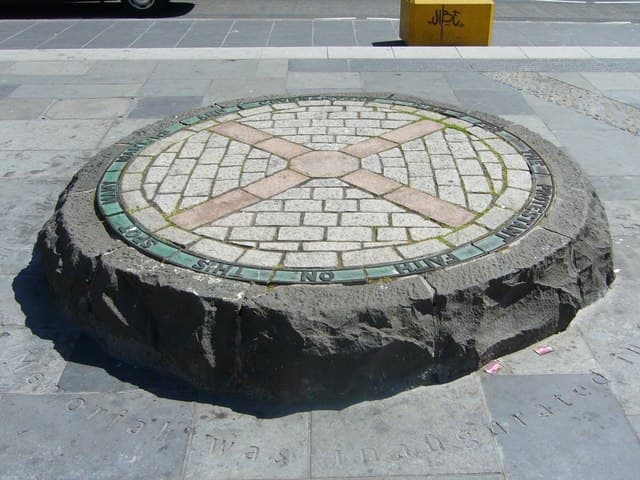
You're now standing in the Grassmarket, one of Edinburgh's oldest public spaces and, for centuries, one of its most brutal. That circular stone memorial in front of you marks the spot where the city's gallows stood. Hundreds of people were executed right here, and the outline of a gibbet has been set into the dark paving stones beneath your feet. Look down — you can trace its shadow.
The Grassmarket has been a market square since at least the fourteen hundreds. The name is literal — farmers brought livestock and hay here to sell. King James the Third granted a charter for a weekly market here in fourteen seventy-seven. But it doubled as Edinburgh's main execution ground, and between sixteen sixty-one and sixteen eighty-eight, during the period the Scots call the Killing Time, it became something far worse.
Read more...Show less
The memorial you're looking at was erected by public subscription in nineteen thirty-seven, and it commemorates over one hundred Covenanters who were hanged on this spot. The Covenanters were Scottish Presbyterians who refused to accept the king's authority over their church. In sixteen thirty-eight, thousands of them signed the National Covenant at Greyfriars Kirk — we'll visit that shortly — pledging to defend their right to worship as they chose. The Crown's response was decades of persecution. Covenanters were hunted, imprisoned, and dragged here to die. The plaque beside the memorial lists their names, where known.
Imagine this square on an execution day. Crowds packed the windows and balconies of the surrounding tenements. The condemned were paraded from the Tolbooth prison down the Royal Mile. Some were offered a last drink at a tavern — we'll get to that story in a moment. Then the trapdoor opened.
The last person hanged in the Grassmarket was a man named James Andrews, executed on the fourth of February, seventeen eighty-four, for a robbery in the Meadows. After that, the city moved its executions to the Tolbooth on the High Street, and the Grassmarket went back to being a market.
Today it's one of Edinburgh's best spots for a pint. If you fancy a coffee first, Mary's Milk Bar is just across the square — it's an artisan gelato and ice cream parlour run by Mary Hillard, who trained at the Carpigiani Gelato University in Bologna. The queue snakes out the door most days, and the flavours change daily. Try whatever's seasonal.
Now, look to the southwest corner of the square. You'll see a narrow passageway climbing steeply uphill between two buildings. That's the Vennel. Walk over to the bottom of those steps.
The Vennel Steps
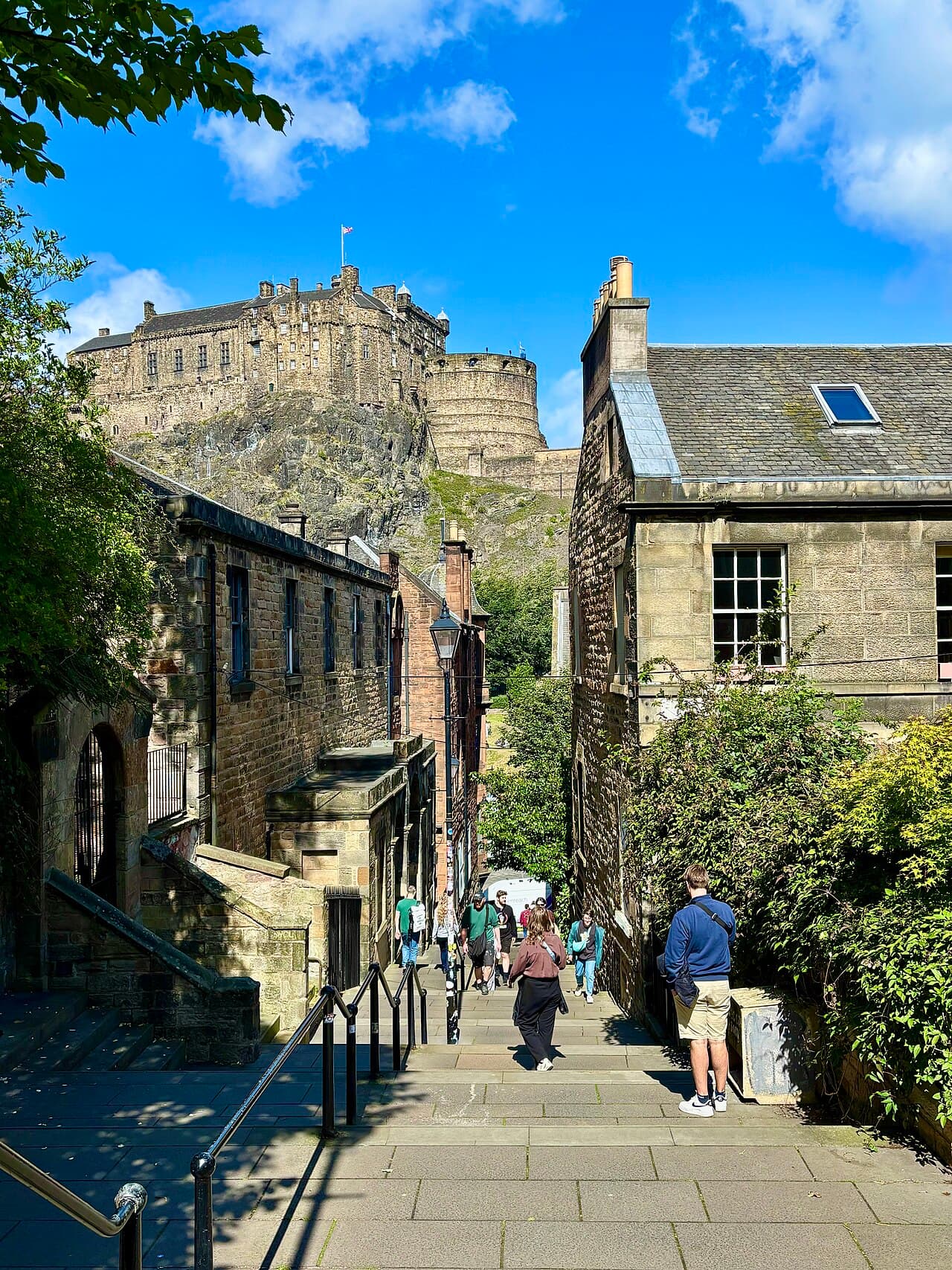
You're at the foot of the Vennel Steps, and I need you to start climbing. It's steep, I know, but what's waiting at the top is arguably the best view in Edinburgh, and this city has no shortage of competition.
The word vennel is an old Scots term borrowed from the French venelle, meaning a narrow lane or alley. Edinburgh is full of them — tight passageways connecting the higher streets to the lower ones, a legacy of a medieval city that was hemmed in by walls and had nowhere to grow but up and down.
Read more...Show less
As you climb, run your hand along the wall on your left. Feel how thick that stone is. What you're touching is a surviving section of the Flodden Wall, Edinburgh's defensive fortification built after one of the worst military disasters in Scottish history. On the ninth of September, fifteen thirteen, King James the Fourth led a Scottish army south to fight the English at the Battle of Flodden. It was a catastrophe. The king was killed — the last British monarch to die in battle — along with an estimated ten thousand Scottish soldiers. That's nobles, knights, ordinary men, wiped out in a single afternoon.
Edinburgh panicked. An English invasion seemed inevitable. The city council ordered a new defensive wall to be built around the Old Town, and construction began in fifteen fourteen. But here's the thing — so many men had died at Flodden that much of the building work was reportedly done by women and children. The wall wasn't completed until fifteen sixty, nearly fifty years later. The invasion never came, but the wall defined Edinburgh's boundary for centuries.
Now look up. You should be near the top of the steps, and there it is — Edinburgh Castle, filling the sky in front of you. From here you get a side-on view that most tourists never see: the Great Hall, the Half Moon Battery, the volcanic rock face dropping sheer below the ramparts. This is the view that goes viral on Instagram, and I promise you it's even better in person. If the light is right — early morning or late afternoon — the castle practically glows against the sky.
Take a photo, catch your breath, and soak it in. When you're ready, head back down the Vennel Steps to the Grassmarket. Turn left and walk east along the north side of the square. You're looking for two pubs with very dark names: the Last Drop, and Maggie Dickson's.
The Last Drop & Maggie Dickson's
You're standing between two of Edinburgh's most darkly named pubs, and both of them are telling you exactly the same story. The Last Drop isn't named after a splash of whisky — it's named after the last drop of the gallows trapdoor. This is where condemned prisoners were brought for a final drink before being walked to the scaffold, just a few steps from where you're standing now. Look back towards the memorial — that's where they were heading.
But the real star of this stretch of the Grassmarket is the pub next door: Maggie Dickson's. And Maggie's story is one of the wildest in Edinburgh's very wild history.
Read more...Show less
Margaret Dickson was a fishwife from Musselburgh, just east of Edinburgh. In seventeen twenty-four, she was living apart from her husband and working as a servant in an inn in Kelso. She became pregnant — a dangerous situation for a separated woman in eighteenth-century Scotland. When the baby was born prematurely and died, Maggie hid the body. She was discovered, arrested, and charged under Scotland's Concealment of Pregnancy Act, a brutal law that presumed if a woman hid a pregnancy and the baby was found dead, she must have committed murder. There was no need to prove she actually killed the child. The concealment itself was the crime.
On the second of September, seventeen twenty-four, Maggie was hanged right here in the Grassmarket. She was pronounced dead. Her body was cut down and placed in a coffin for transport back to Musselburgh for burial. But on the road out of Edinburgh, the funeral party stopped at a roadside pub for refreshments — because of course they did, this is Scotland. And while they were inside, someone noticed the coffin lid moving.
Maggie Dickson was alive.
She was pulled from the coffin, and by the next day she was well enough to walk the rest of the way to Musselburgh under her own power. The courts ruled that since the sentence had been carried out — she had been hanged — she couldn't be executed again. She was a free woman. Maggie went on to live another forty years, earning the immortal nickname Half-Hangit Maggie.
She even remarried — some accounts say she reunited with her original husband, since the marriage had technically been ended by her legal death.
Stop in at either pub for a pint if you fancy one. The Last Drop does a solid fish and chips. When you're ready, walk east out of the Grassmarket. Follow Candlemaker Row uphill — it's the road that curves up to the right. At the top, on the corner of George IV Bridge, you'll find a very small, very famous bronze dog.
Greyfriars Bobby Statue
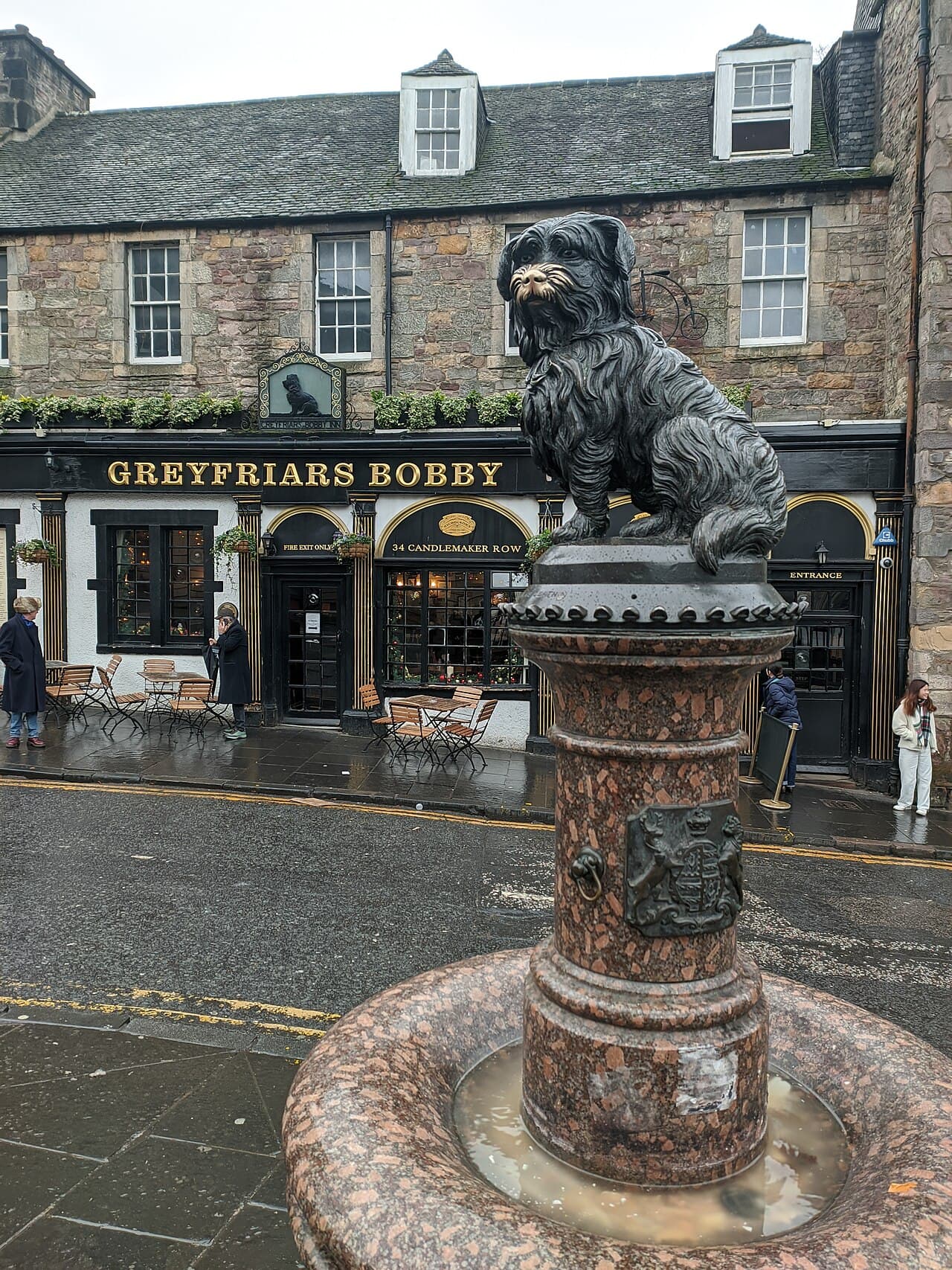
There he is. A tiny bronze Skye terrier sitting on top of a granite drinking fountain, right at the junction of George IV Bridge and Candlemaker Row. This is Greyfriars Bobby, and his story has been making people cry since the eighteen sixties.
Here's what we know. A man named John Gray worked in Edinburgh — most accounts say as a night watchman for the city police, though some researchers believe he was a gardener. He died on the fifteenth of February, eighteen fifty-eight, and was buried in Greyfriars Kirkyard, the graveyard just behind you. His dog, Bobby, reportedly refused to leave the grave. For fourteen years, in rain, snow, and Edinburgh wind — which is really saying something — this little dog sat by his master's resting place.
Read more...Show less
The story goes that every day at one o'clock, when Edinburgh Castle's time gun fired, Bobby would trot from the kirkyard to a nearby coffee house run by a man called John Traill, who'd feed him a hot meat pie. Then Bobby would pad back to the grave. Crowds started gathering at the kirkyard entrance at lunchtime just to watch him leave.
Bobby became a local celebrity. In eighteen sixty-seven, the Lord Provost of Edinburgh, Sir William Chambers, personally paid for Bobby's dog licence and gave him a collar with a brass plate reading "Greyfriars Bobby, from the Lord Provost, eighteen sixty-seven, licensed." That collar is now in the Museum of Edinburgh.
Bobby died on the fourteenth of January, eighteen seventy-two, of jaw cancer, at the age of about sixteen. The statue you're looking at was commissioned by the English philanthropist Baroness Angela Burdett-Coutts and sculpted by William Brodie. It was unveiled on the fifteenth of November, eighteen seventy-three.
Now, you'll notice Bobby's nose is shinier than the rest of him. Tourists have been rubbing it for luck since around twenty twelve. I should tell you — this is not an ancient tradition. It's basically an Instagram thing, and it's actually damaging the statue. The city council has asked people to stop. Bobby is a Category A listed monument. So maybe just give him an admiring nod instead.
Is the whole story true? Historians have questioned parts of it. The one o'clock gun didn't start firing until eighteen sixty-one, three years after Gray died. Traill didn't own his coffee house until four years after Gray's death. Some researchers think there may have been two different dogs. But honestly? Whether Bobby was one dog or two, the devotion was real, and this little statue is one of the most beloved landmarks in Edinburgh.
Turn around and walk through the gate into Greyfriars Kirkyard. You're entering one of the most atmospheric graveyards in Britain — and one that shaped modern fiction in ways you might not expect.
Greyfriars Kirkyard — Tom Riddell's Grave
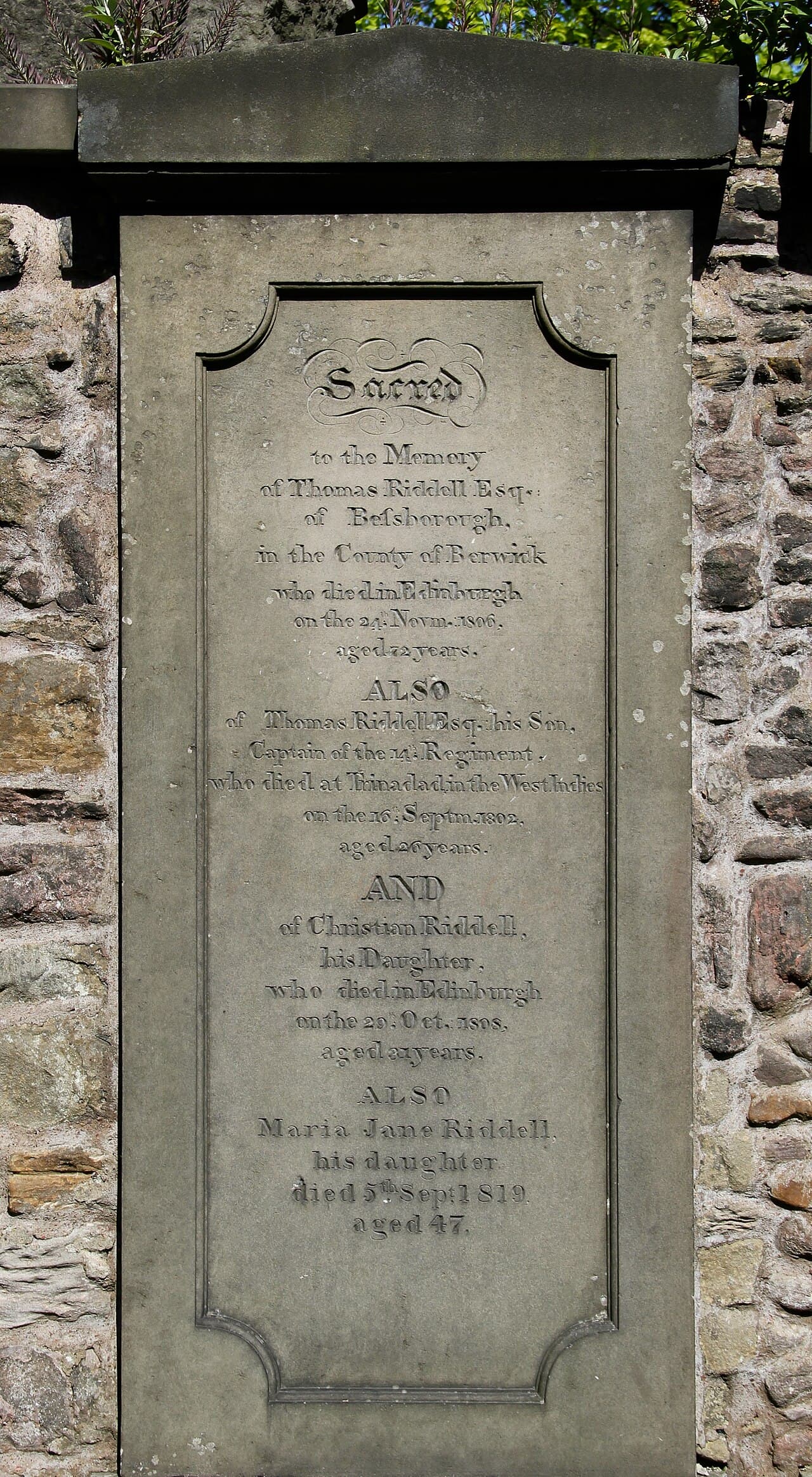
Welcome to Greyfriars Kirkyard, where the dead have stories worth hearing. This graveyard has been in use since the late fifteen hundreds, and it surrounds Greyfriars Kirk, where, on the twenty-eighth of February, sixteen thirty-eight, Scottish nobles and ministers signed the National Covenant — that pivotal document we talked about at the gallows memorial. That single act of defiance led to wars, persecutions, and those hundred-plus executions in the Grassmarket.
But you're probably here for a different name. Walk along the path and keep your eyes on the headstones to your right. You're looking for a flat-topped tomb with the name Thomas Riddell, who died on the twenty-fourth of November, eighteen oh six, at the age of seventy-two. Sound familiar? Tom Riddle. Lord Voldemort. The spelling is slightly different — Riddell with two L's versus Riddle with one — but both the first and last names are nearly identical.
Read more...Show less
J.K. Rowling was writing the early Harry Potter novels in cafes within walking distance of this graveyard. From the Elephant House cafe on George IV Bridge — which sadly suffered a major fire but has since reopened — you could look right down into this kirkyard. Rowling has been cagey about exactly how much inspiration she drew from these stones. She once mentioned that one of her children went on a walking tour here and came back with information that was new to her. Make of that what you will.
But Riddell isn't the only Potter connection buried here. There's a gravestone for William McGonagall — yes, like Professor McGonagall. The real McGonagall was a Dundee weaver who became famous as one of the worst poets in Scottish history. His most celebrated work, The Tay Bridge Disaster, is so spectacularly bad it's become a classic. His grave was unmarked until nineteen ninety-nine, when an inscribed slab was finally installed. And there's a stone for Elizabeth Moodie — close enough to Mad-Eye Moody to raise an eyebrow.
Now, there's a locked section at the back of the kirkyard called the Covenanters' Prison. After the Battle of Bothwell Brig in sixteen seventy-nine, around twelve hundred captured Covenanters were imprisoned here in the open air, guarded by a man called Sir George Mackenzie — known to history as Bloody Mackenzie. The conditions were horrific. It's been called one of the world's first concentration camps. And since nineteen ninety-nine, visitors have reported scratches, burns, and unexplained bruises after entering the area. The city council eventually locked it. You can only visit now on guided tours, and honestly, even in broad daylight, it's unsettling.
When you're ready, walk to the southern wall of the kirkyard. Look through the railings. That magnificent turreted building on the other side is George Heriot's School.
George Heriot's School
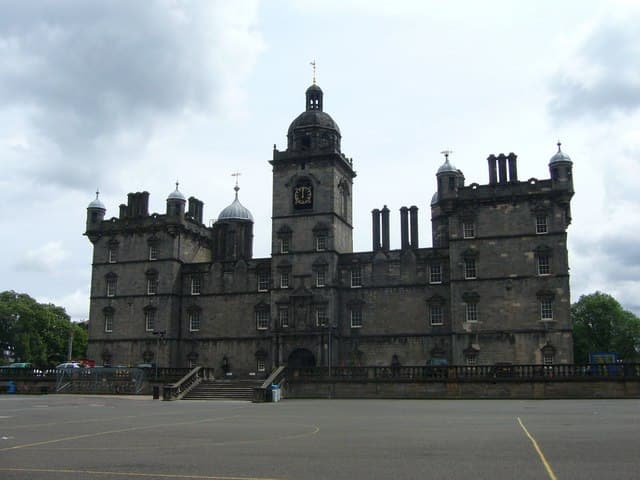
Look at this building. Four towers, a grand Renaissance facade, turrets, courtyards, stone walls that seem to go on forever. If you're thinking it looks like Hogwarts, you're not the first, and you won't be the last. But the real story of George Heriot's School is even better than fiction.
George Heriot was born in fifteen sixty-three in Gladsmuir, East Lothian. He set up shop as a goldsmith in a small booth near Saint Giles' Cathedral on the Royal Mile. He was so good at his trade that he became the official goldsmith to Anne of Denmark, wife of King James the Sixth of Scotland, and then to the king himself. But here's the business model that really made him rich: he lent money to the royals and charged interest. James the Sixth was permanently broke — running Scotland and then England is expensive — and Heriot became his personal banker. The nickname stuck: Jinglin' Geordie, because his pockets were always full of coins.
Read more...Show less
When Heriot died in London in sixteen twenty-four, he left twenty-three thousand, six hundred and twenty-five pounds — a staggering fortune — to found a school for, in his words, "puir, faitherless bairns." Poor, fatherless children. Sons of Edinburgh tradesmen who'd fallen on hard times. The building you're looking at was designed by William Wallace — the master mason, not the freedom fighter — and construction began around sixteen twenty-eight. But wars, plague, and Cromwell's occupation of Edinburgh meant it didn't open until sixteen fifty-nine.
Now, the Hogwarts connection. George Heriot's has four houses — Lauriston, Greyfriars, Castle, and Raeburn — just like Hogwarts has Gryffindor, Slytherin, Ravenclaw, and Hufflepuff. The school has an ongoing house competition each year. It has towers, turrets, and a quadrangle that could double as a quidditch pitch. Rowling could see this building from the cafes where she wrote. She has denied that Heriot's directly inspired Hogwarts, but come on. Stand here, look at those towers, and tell me you don't see it.
The buildings associated with Victoria Street, which you walked down earlier, were actually designed in the Old Flemish style specifically to match the look of Heriot's. That's how iconic this place was even two hundred years ago.
Today, George Heriot's is a private school — one of the best in Scotland. It went co-educational in nineteen seventy-nine. The chapel has stunning stained glass, and the courtyard is one of the finest Renaissance spaces in Britain. Unfortunately, you can't just wander in — it's a working school — but the views from here give you plenty.
Walk back through the kirkyard, exit onto Candlemaker Row, and head east. Turn left onto the Cowgate. You'll know you're there when the sky disappears.
The Cowgate
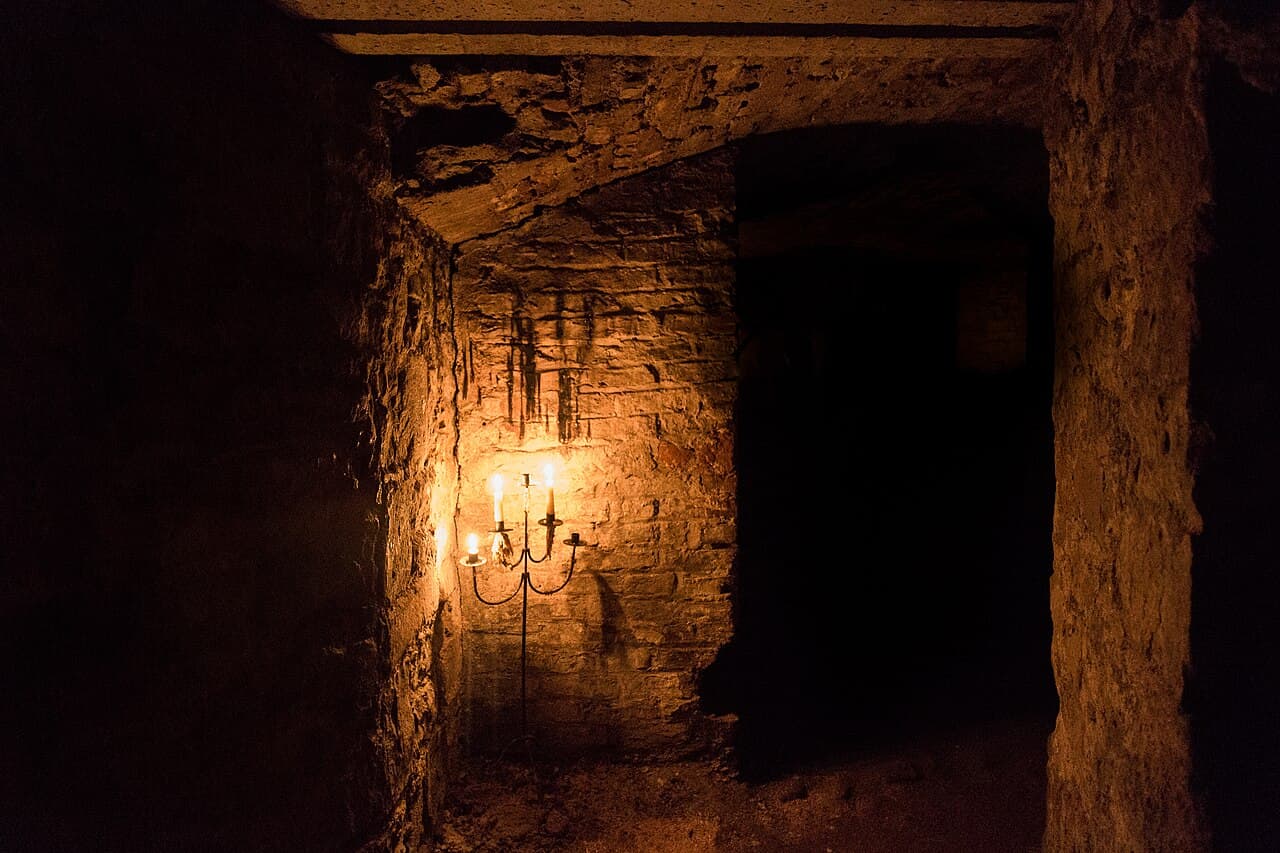
You've reached the final stop on this tour, and it's the creepiest. Look up at the arch of South Bridge above you. This bridge was completed in seventeen eighty-eight, designed by Robert Kay, and it spans the Cowgate valley with nineteen stone arches. But here's what makes it extraordinary — you can only see one of them. This one. The other eighteen were enclosed by tenement buildings on both sides, creating hidden chambers inside the bridge's structure. These are the South Bridge Vaults, and for over two centuries, most of Edinburgh forgot they existed.
When the bridge first opened, those vault rooms were used as workshops and storage for the businesses above — cobblers, saddlers, wine merchants. But the construction had been rushed and nobody bothered to waterproof the surface. Within a few years, water was seeping through the stone. By the seventeen nineties, the vaults were already being abandoned by tradespeople.
Read more...Show less
So who moved in? Edinburgh's poorest. As the Industrial Revolution drove waves of migrants into the city, the Cowgate became a slum, and the vaults became slum housing. Imagine the conditions: no sunlight, no ventilation, no running water, no sanitation. Entire families of ten or more people crammed into single damp rooms. The only light came from candles or oil lamps. Disease was rampant.
And then there were the body snatchers. Edinburgh in the eighteen twenties was the centre of medical education in Europe, and anatomy professors needed fresh corpses for their students to dissect. A legal supply didn't exist, so a black market emerged. William Burke and William Hare are the most infamous names — between eighteen twenty-seven and eighteen twenty-eight, they murdered at least sixteen people and sold the bodies to Dr Robert Knox at the university's anatomy school. Burke and Hare operated nearby in the West Port, and while there's no direct proof they used these specific vaults, the underground network of the Cowgate would have been the perfect place to move bodies unseen.
The vaults were sealed and forgotten. Then in the nineteen eighties, a former Scottish rugby international named Norrie Rowan found a tunnel leading into them. He and his son Norman spent years excavating by hand, hauling out hundreds of tonnes of rubble. They found thousands of oyster shells, broken pottery, and the ghostly outlines of rooms that hadn't seen daylight in two centuries.
Today you can tour the vaults with Mercat Tours — they have exclusive access to the Blair Street system on the north side of the arch. It's a fascinating experience, part history lesson, part genuine shiver down the spine. Book ahead, because they sell out fast.
And that brings us to the end of this walk through Edinburgh's dark side. You've covered Victoria Street, the Grassmarket gallows, the Vennel's castle views, Half-Hangit Maggie, Greyfriars Bobby, Voldemort's grave, Hogwarts in real life, the underground Cowgate, and the forgotten vaults. Not bad for two kilometres.
If you need a drink after all that — and you probably do — head back up to the Grassmarket. The Last Drop is waiting. And now you know exactly why it's called that.
South Bridge Vaults
You've reached the final stop on this tour, and it's the creepiest. Look up at the arch of South Bridge above you. This bridge was completed in seventeen eighty-eight, designed by Robert Kay, and it spans the Cowgate valley with nineteen stone arches. But here's what makes it extraordinary — you can only see one of them. This one. The other eighteen were enclosed by tenement buildings on both sides, creating hidden chambers inside the bridge's structure. These are the South Bridge Vaults, and for over two centuries, most of Edinburgh forgot they existed.
When the bridge first opened, those vault rooms were used as workshops and storage for the businesses above — cobblers, saddlers, wine merchants. But the construction had been rushed and nobody bothered to waterproof the surface. Within a few years, water was seeping through the stone. By the seventeen nineties, the vaults were already being abandoned by tradespeople.
Read more...Show less
So who moved in? Edinburgh's poorest. As the Industrial Revolution drove waves of migrants into the city, the Cowgate became a slum, and the vaults became slum housing. Imagine the conditions: no sunlight, no ventilation, no running water, no sanitation. Entire families of ten or more people crammed into single damp rooms. The only light came from candles or oil lamps. Disease was rampant.
And then there were the body snatchers. Edinburgh in the eighteen twenties was the centre of medical education in Europe, and anatomy professors needed fresh corpses for their students to dissect. A legal supply didn't exist, so a black market emerged. William Burke and William Hare are the most infamous names — between eighteen twenty-seven and eighteen twenty-eight, they murdered at least sixteen people and sold the bodies to Dr Robert Knox at the university's anatomy school. Burke and Hare operated nearby in the West Port, and while there's no direct proof they used these specific vaults, the underground network of the Cowgate would have been the perfect place to move bodies unseen.
The vaults were sealed and forgotten. Then in the nineteen eighties, a former Scottish rugby international named Norrie Rowan found a tunnel leading into them. He and his son Norman spent years excavating by hand, hauling out hundreds of tonnes of rubble. They found thousands of oyster shells, broken pottery, and the ghostly outlines of rooms that hadn't seen daylight in two centuries.
Today you can tour the vaults with Mercat Tours — they have exclusive access to the Blair Street system on the north side of the arch. It's a fascinating experience, part history lesson, part genuine shiver down the spine. Book ahead, because they sell out fast.
And that brings us to the end of this walk through Edinburgh's dark side. You've covered Victoria Street, the Grassmarket gallows, the Vennel's castle views, Half-Hangit Maggie, Greyfriars Bobby, Voldemort's grave, Hogwarts in real life, the underground Cowgate, and the forgotten vaults. Not bad for two kilometres.
If you need a drink after all that — and you probably do — head back up to the Grassmarket. The Last Drop is waiting. And now you know exactly why it's called that.
Free
GPS-guided walking tour
No account needed. Walk at your own pace.
Free
9 stops · 2.0 km