12 stops
GPS-guided
42 min
Duration
Free
No tickets
About this tour
A 12-stop walking tour through the heart of UK. Visit The Westminster Walk, London Eye, River Thames, Statue of Boadicea, and Parliament Square — with narrated stories at every stop.
12 stops on this tour
The Westminster Walk
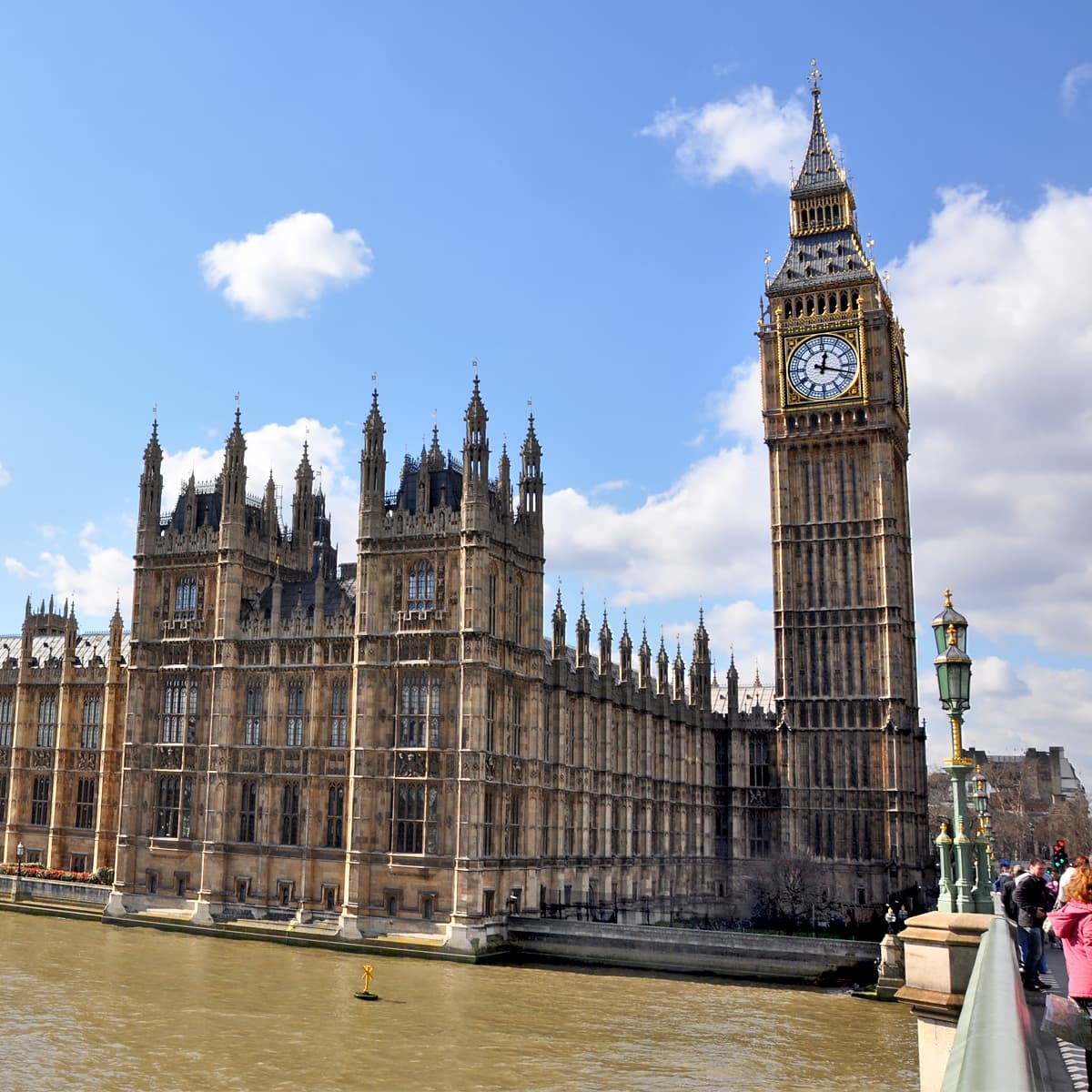
The Westminster walk London is the Los Angeles, Washington, D.C. and New York City of Britain all rolled into one. This walk starts with London's star attraction, continues to its capital, passes its answer to the White House and ends at its time square. Hi, I'm Rick Steves.
Thanks for joining me on a walk through Westminster from Big Bend to Trafalgar Square. As London's political center, the Westminster neighborhood is both historic and contemporary. We'll see the River Thames where London was born, past statues and monuments from London's past, admire the halls of Parliament where Britain's ruled today, and take a peek at number 10 Downing Street, home of the Prime Minister. Allow about an hour for this walk as we weave through modern traffic and big city bustle to survey 2,000 years of fascinating history.
Read more...Show less
Our walk ends at Trafalgar Square, where we'll stand at the very center of one of the world's great cities, London. To help us along the way, I've invited a good friend and virtual travel buddy. Welcome Lisa. Cheers Rick.
Lisa will give us helpful directions and sightseeing tips throughout the tour. And my first tip is to be sure you get our tour updates. Just press the icon at the lower right of your device. You'll find any updates and helpful instructions unique to this tour.
Things like closures, opening hours, and reservation requirements. There's also tips on how to use this audio tour and even the full printed script. Yes, so pause for just a moment right now to review our updates and special tips. It's okay. We'll wait. Now let's go to Westminster.
Tour Begins: Big Ben
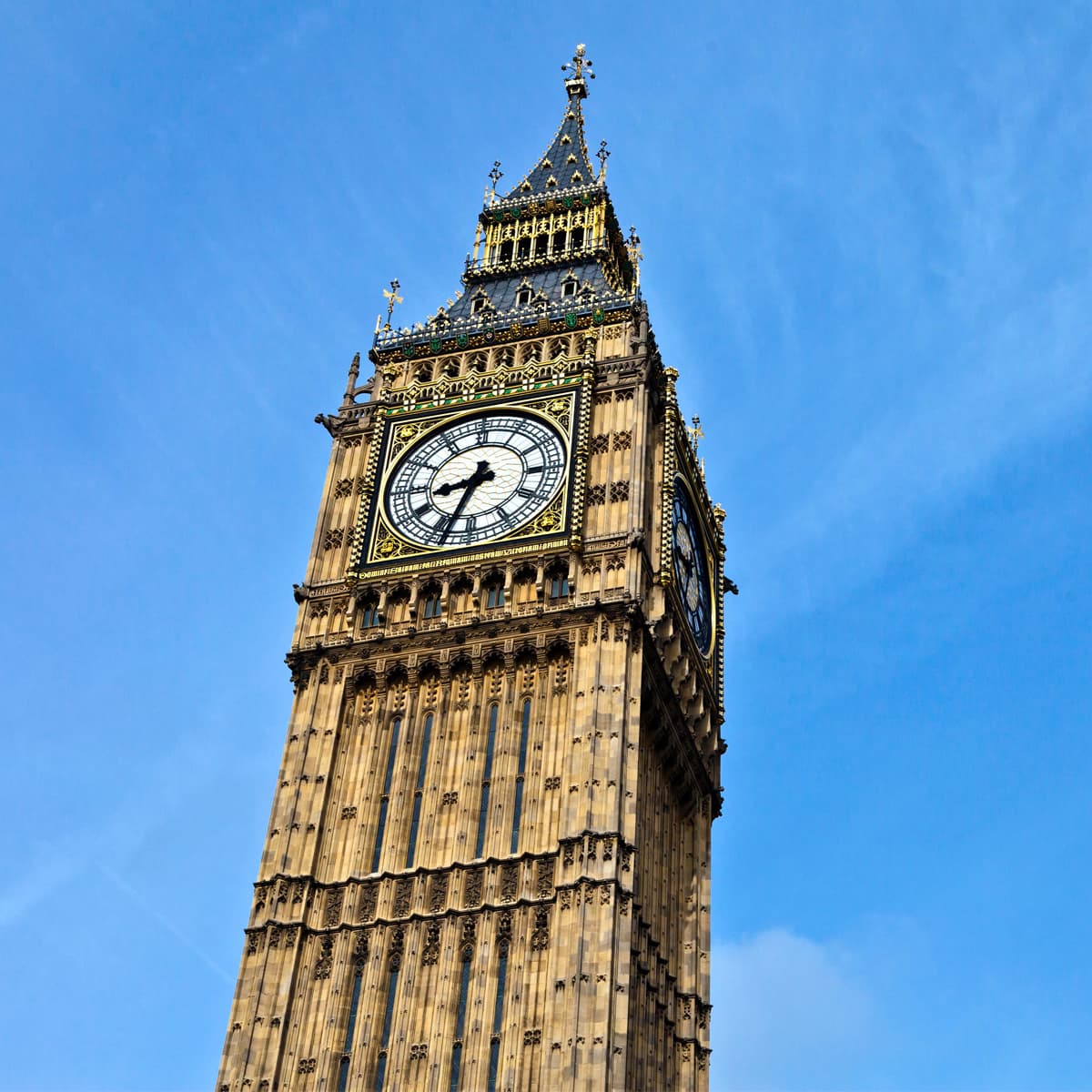
The tour begins, Big Ben and the Halls of Parliament. Start on Westminster Bridge, which straddles the River Thames. Walk halfway across the bridge where you have great views. The river flows from south to north at this point.
The London Eye Ferris Wheel dominates the East Bank. On the other side is the awe-inspiring sight of Big Ben and the Halls of Parliament. Ding, ding, ding, ding, ding, ding, ding, ding, ding, ding. Yes indeed, you are in London.
Read more...Show less
Big Ben is actually not the clock, not the tower, but the bell inside that tolls the hour. However, the 1310 bell can't be seen from the street, so everybody calls the whole works Big Ben. The clock tower was built in 1859 and was likely named for a fat bureaucrat who installed the bell. Ben is scarcely older than my great-grandmother, but it's quickly become the city's symbol.
The tower is 320 feet high and the clock faces are 23 feet across. The minute hand is 13 feet long and sweeps the length of your body every five minutes. The bell chimes a short ditty every 15 minutes and does its full song at the top of the hour. Big Ben hangs out in the north tower of the houses of Parliament that stretches along the Thames.
Britain is ruled from this building, which was originally a palace built on this spot in the 1090s. For five centuries it was the home of kings and queens. Then as democracy was foisted on tyrants, a Parliament of nobles was allowed to meet in some of the rooms. Soon, commoners were elected to office and there went the neighborhood.
The royalty packed up and moved to Buckingham Palace, a fire gutted the Old Westminster Palace in 1834. Only the core part Westminster Hall survived. The rest was rebuilt with the full medieval look we see today. The prickly flamboyant spires epitomized the uniquely British style called Perpendicular Gothic, the fanciest and final stage of Gothic.
As this is from the 19th century, it's actually Neo-Perpendicular Gothic. Today the House of Commons, which is more powerful than the Queen and Prime Minister combined, meets in one end of the building. The rubber stamp House of Lords grumbles and snoozes in the other end of this thousand-room complex. The two houses are very much separate.
Notice the Riverside tea terraces with the color-coded awnings, royal red for lords, common green for commoners. Alluding to the traditional leanings of the two chambers, locals say green for go, red for stop. Britain is ruled by some 600-plus members of Parliament or MPs in the House of Commons. Their offices are across the street from Big Ben in the modern port-cullis building.
It's the building with the two black chimneys. MPs commute to the houses of Parliament by way of a tunnel beneath Bridge Street. Visitors are welcome to go inside the halls of Parliament and watch Britain's government in action. The hours are variable, but you can tell if Parliament's open.
Look toward the far south end of the halls of Parliament. If a flag is flying from the Victoria Tower, Parliament is in session. Now turn your attention to the north. That is, look downstream from the center of Westminster Bridge. The London Eye and the River Thames.
London Eye, River Thames
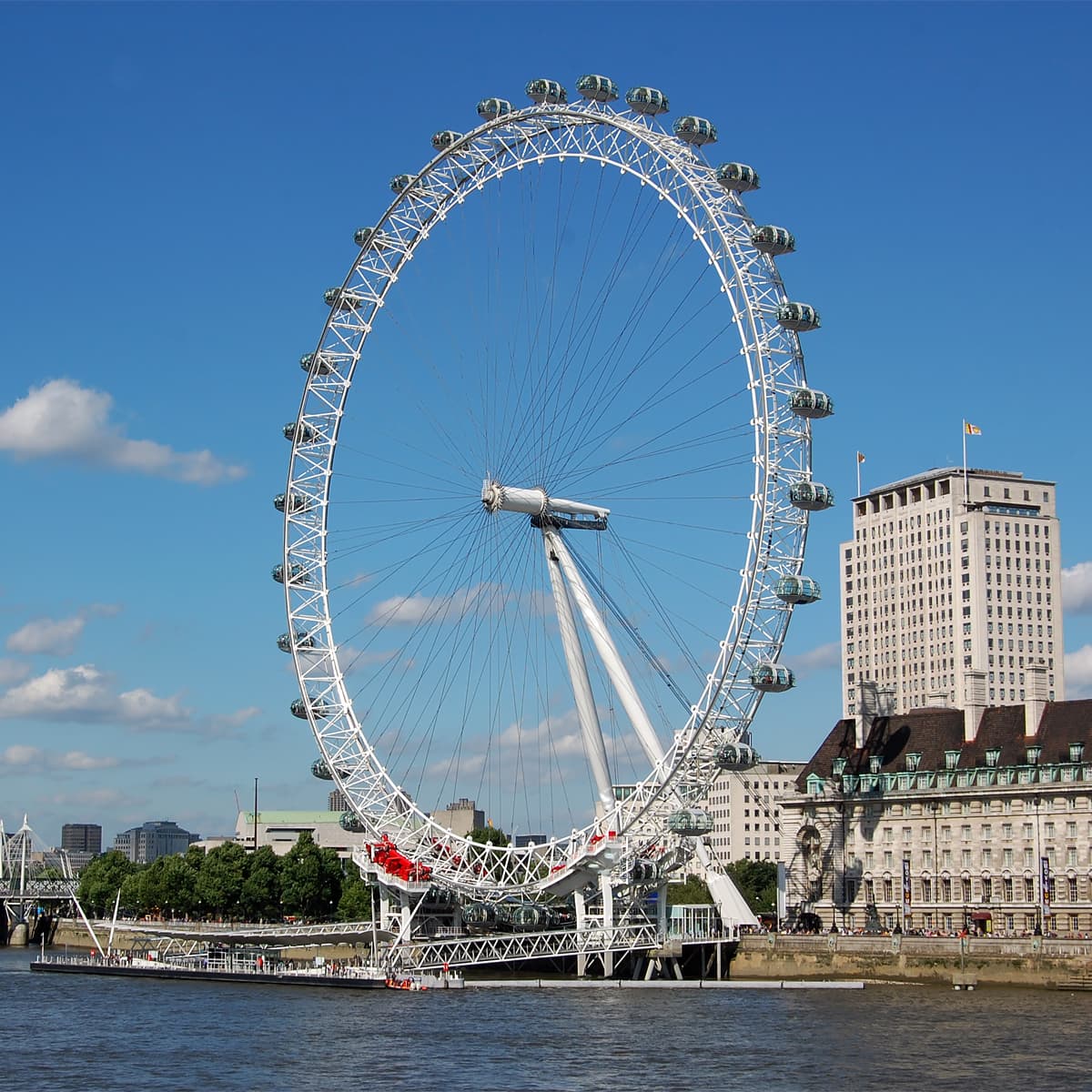
The London Eye Observation Wheel, 443 feet tall, was built in the year 2000 to celebrate the millennium. As it's designed and spins like a big bicycle wheel, it's not technically a Ferris wheel. It slowly spins 32 capsules each filled with a maximum of 25 visitors up to London's best viewpoint. They claim you enjoy 25 miles of visibility on a clear day, which is rare in London.
The London Eye was originally nicknamed the London Eye Saur. But now it's generally appreciated by locals as a much-needed addition to the city's skyline. Aside from Big Ben, Parliament and the Dome of St. Paul's Cathedral, which is not visible from here, London's skyline is underwhelming.
Read more...Show less
It's a city that wows from within. Next to the wheel sprawls the huge former county hall building, now a hotel and tourist complex. The London Eye marks the start of the Jubilee Walkway, a pleasant one-hour riverside promenade along the south bank of the Thames. It takes you through London's vibrant, gentrified arts and cultural zone.
Along the way you'll enjoy views across the river of St. Paul's St. Le Dom and the financial district called the City. The river Thames flows swiftly beneath your feet.
London's history is tied to the Thames. The river flows 210 miles from the interior of England to the North Sea. London got its start in Roman times as a trade centre along this watery highway. As recently as a century ago, large ships made their way upstream to the city centre to unload.
Today London's major port is 25 miles downstream and its tourist cruise boats that ply this stretch of the river. On either bank of the Thames you'll see their departure pierce. This is an efficient and scenic way to get from here to the Tower of London or Greenwich, both downstream or to Cue Gardens upstream. This bridge is relatively new until 1750 only London bridge crossed the Thames.
Then Westminster Bridge was built here and others were added later. Early one September morning in 1802 William Wordsworth stood where you're standing now and described what he saw. This city now doth like a garment where the beauty of the morning, silent bear, ships, towers, domes, theatres and temples lie open unto the fields and to the sky, all bright and glittering in the smokeless air. Our next stop is the large statue on the west or Big Ben end of the bridge.
As you walk walking through that smokeless air, look along the riverbank. Lining the river are a series of lamp posts. Beneath the lamp posts find the little green copper lion's heads with rings for tying up boats. Before the construction of the Thames barrier in 1982, that's the world's largest movable flood barrier located downstream near Greenwich.
These lions monitored the river level. For centuries, high tides from the nearby North Sea made floods a recurring London problem. The police kept an eye on these lions. When the lions drank, the saying went, the cities at risk.
Keep going. We're headed toward a statue that remembers the very first Londoners 2,000 years ago. Back then, London was a tiny village of Celtic people living in thatched huts along the Thames. When the Romans came, they transformed it into a full-fledged city with a European outlook.
The statue tells the story of that difficult transition when the Romans tried to force their way of life on the native Celts. Mayor Westminster Peer is a big statue of a lady on a chariot. She's called Boa Decia. The Londoners call it the first woman driver.
Look Ma, no rains. Ha, ha. Stop when you get a good view of the statue. The statue of Boa Decia, Queen of the Icini.
Statue of Boadicea
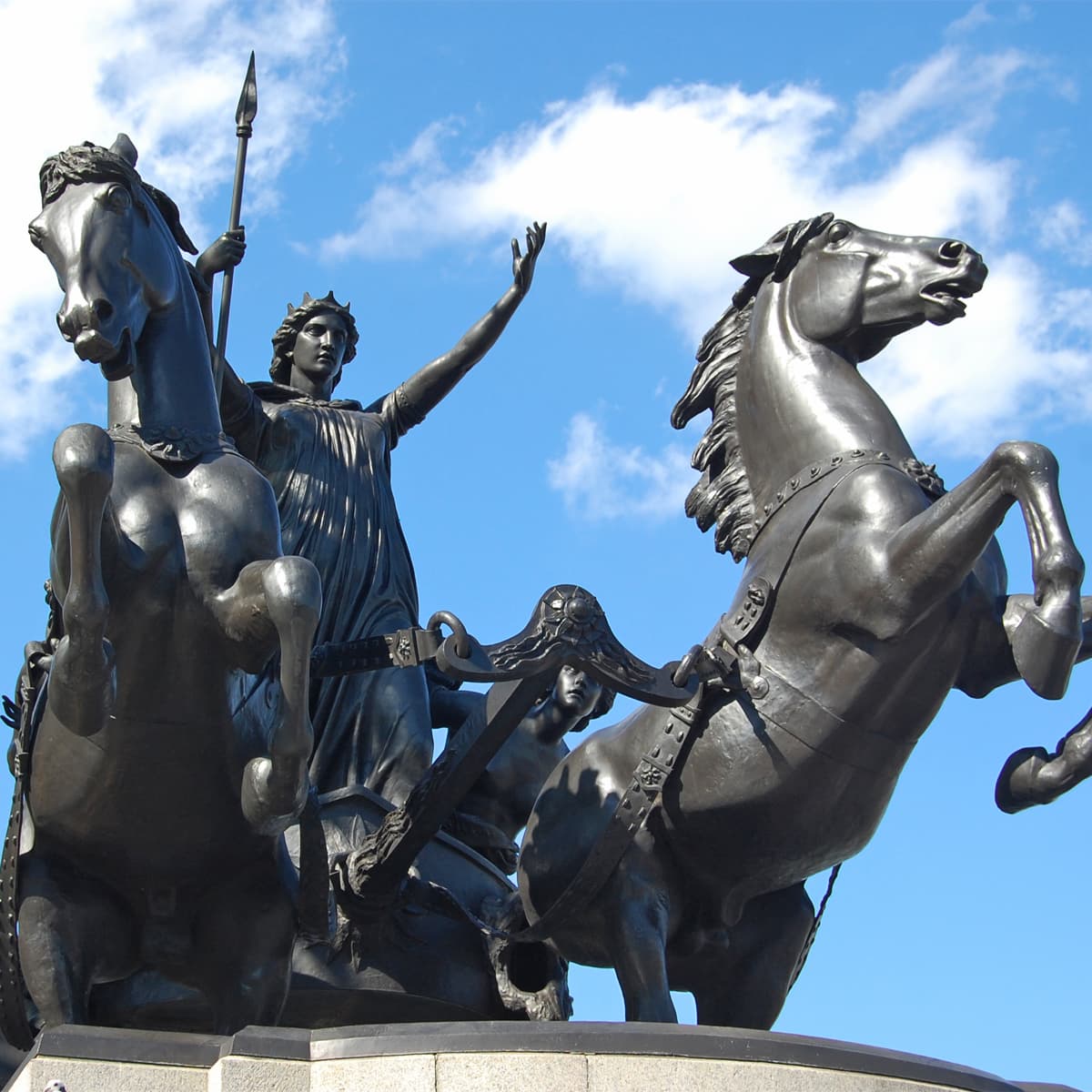
Riding in her two-horse chariot, daughters by her side, this Celtic Xena leads her people against Roman invaders. Julius Caesar was the first Roman general to cross the channel, but even he was weirded out by the island's strange Celtic inhabitants who worshipped trees, sacrificed virgins, and went into war painted blue. The Romans subdued and civilized the Celts. They built roads and made this spot in the Thames a major urban center.
Its name, Londonium. But Boa Decia refused to be Romanized. In 60 AD after Roman soldiers raped her daughters, she rallied her people. She liberated London in the process massacring its 60,000 Romanized citizens.
Read more...Show less
Eventually the brief revolt was snuffed out, and Boa Decia and her family took poison rather than surrender. London remained under Roman control for four centuries, establishing it from then on as a major European capital. Continue one block inland to the busy intersection of Parliament Square. It'll take a couple of minutes to get there because you may have to wait for the light at some busy crosswalks.
Don't worry, we'll wait for you. While we wait and walk, I'm sure Rick can find a few random factoids to build the time. No problem. As your walk past mighty big Ben, here's a fun fact.
Every year they adjust Ben's clock. If it's been running fast, they set an old British penny on the pendulum to slow it down. If it runs slow, they take a penny off. Is that where we get, take a penny, leave a penny?
No. But here's another fact about Big Ben. During World War II, much of London was bombed by German warplanes, the Blitz. But Big Ben thankfully escaped damage.
By the way, this area by Big Ben is a great place to call home from. Make your call about three minutes before the hour. Just to let your loved ones hear Big Ben ring. Walking along on your left is the houses of Parliament, and on your right is the building where members of Parliament have their offices.
Which means that under your feet right now, there may be MPs and staff members hurrying back and forth on the nation's business. In fact, take a look at the people all around. Many are tourists, of course. But many others are part of the big bureaucratic machine that makes the United Kingdom tick.
Hey, Lisa, here's another fun fact. The Queen is not allowed in the House of Commons chamber. Ever. In fact, the last monarch to actually enter the chamber was King Charles I.
And we'll see what happened to him later in the walk. You'll soon reach Parliament Square, a big green expanse lined with buildings. The squares dotted with statues of famous Brits. But except for the statue of Winston Churchill, most aren't all that famous.
Stand on the street corner and get oriented. The entrance to the halls of Parliament is to your left, a half block down. The twin towers of Westminster Abbey are located kitty corner across the square. To your right, stretches the broad boulevard called Parliament Street, which becomes Whitehall.
Whitehall leads to Trafalgar Square, where our tour will end. But for now, survey Parliament Square. Parliament Square. You're standing at ground zero of Britain's political life ever since medieval times.
Parliament Square
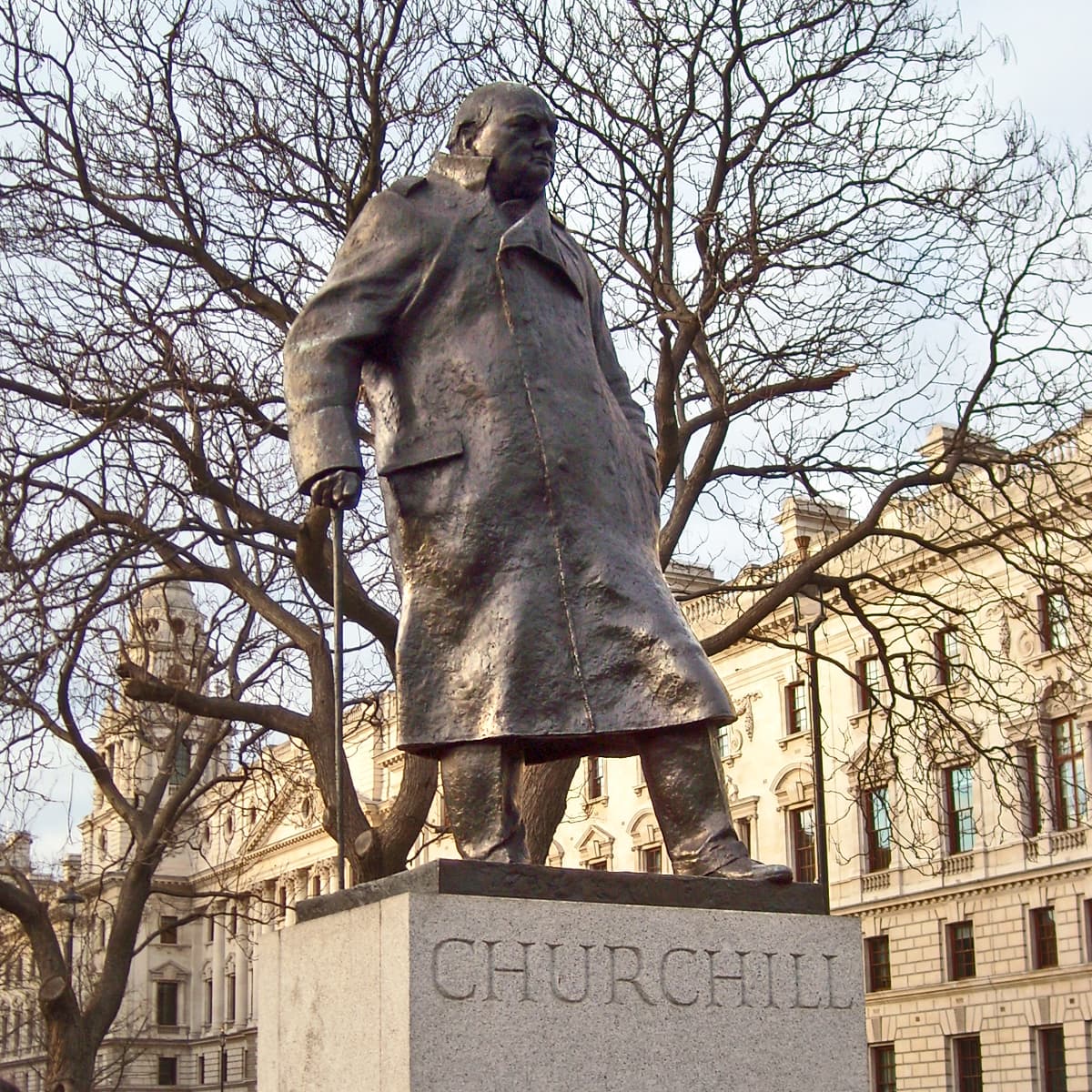
The square itself is a non-site, except as a stage for demonstrators who gather here to attract TV cameras. This square is the heart of what was once a suburb of London, the medieval city of Westminster. Like Buddha and Pest, later Budapest, London is two cities that grew into one. In Roman and medieval times, the city was centered near St.
Paul's Cathedral. That was the place where people lived. But in the 11th century, King Edward the Confessor moved his court, the political power, here. He built a palace and a church or a minster here in the west, creating the city of Westminster.
Read more...Show less
The sandstone-colored houses of Parliament sit atop the remains of the original Palace of Westminster. Over time, the palace evolved into a meeting place for debating public policy, a Parliament. To this day, the houses of Parliament are known to Brits as the Palace of Westminster. The main entrance is located midway down the long building.
If Parliament is in session, the entrance is lined with tourists and staked out by camera crews interviewing members of Parliament for the evening news. Across the square, the two white towers of Westminster Abbey rise above the trees. Westminster Abbey is the most historic church in the English-speaking world, where the nation's kings and queens have been crowned and buried since 1066. Within its stained glass splendor lie a thousand years of English history, three thousand tombs, the remains of 29 kings and queens and hundreds of memorials, to poets, politicians and warriors.
It holds the coronation spot. Each new monarch must walk down the nave, kneel at the altar, take a seat on the throne, and da-da-da-da, be crowned ruler of all England. Rick doesn't cover Westminster Abbey's fascinating interior on this audio guide, because admission there includes an excellent audio guide produced by the Abbey. The cute little church of St.
Margaret's, with the blue sundial, stands nearby. It snuggles under Westminster Abbey, as they say, like a baby lamb under a U. Since 1480, this has been the place for politicians' weddings, including Winston and Clementine Churchill. Find Winston Churchill's statue on Parliament Square, the man who saved Britain from Hitler as shown wearing his military overcoat and leaning on a cane.
According to local tour guides, the statue has a current of electricity running through it. This is to honor Churchill's wish that if a statue were made of him, his head wouldn't be soiled by pigeons. Now look 90 degrees to the right. The broad boulevard of Whitehall, here it's called Parliament Street, stretches to your right up to Trafalgar Square.
In 1868, the world's first traffic light was installed on the corner where Whitehall now spills double-decker buses into the square. Let's leave the square. Walk north up Parliament Street, which soon changes its name to Whitehall. Rick will explain things as you stroll along Whitehall.
Walking Along Whitehall
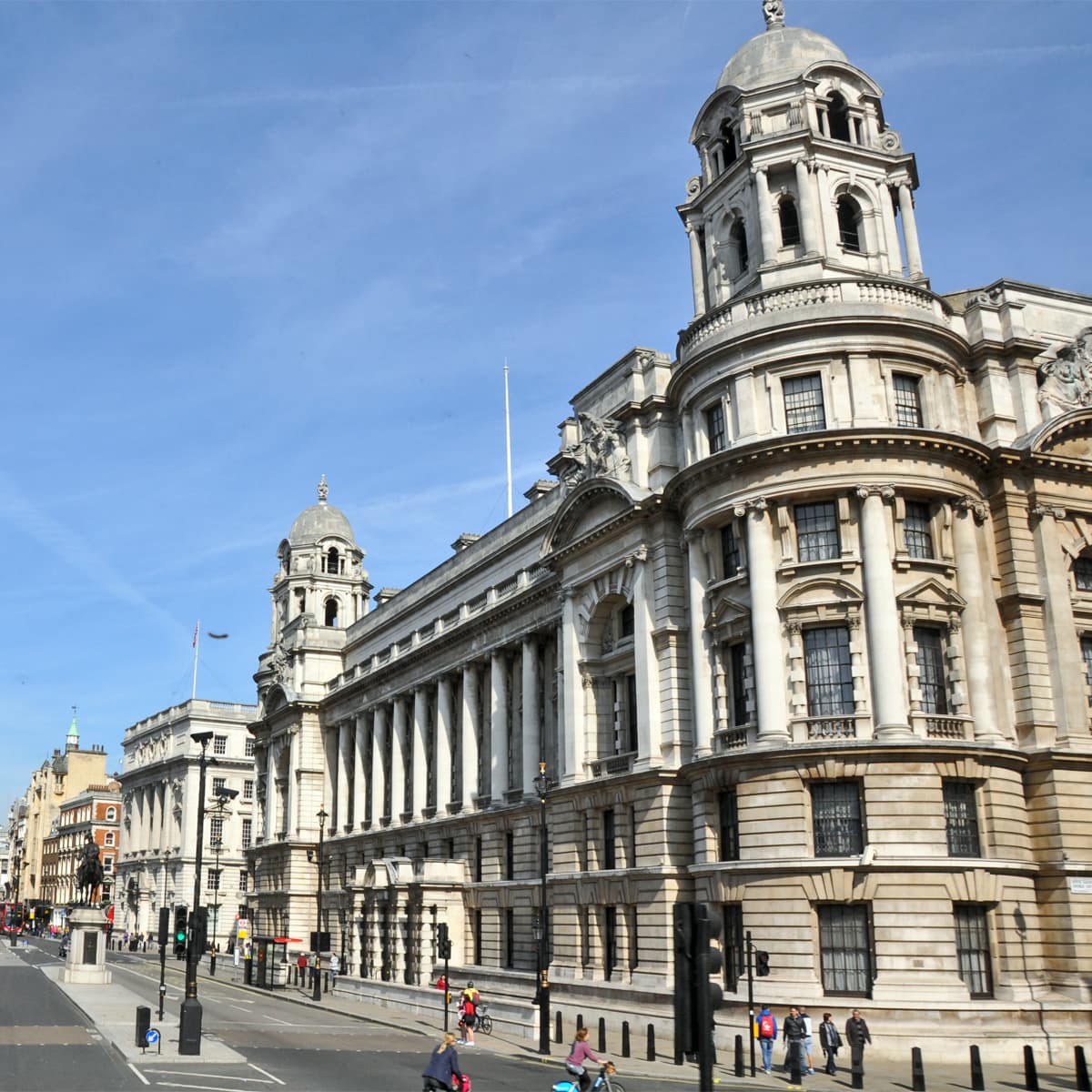
Walking along Whitehall. Today, Whitehall is choked with traffic, but imagine the effect this broad street must have had on out of towners a century ago. In your horse-drawn carriage, you'd clip-clop along a tree-lined boulevard. You'd pass well-dressed lords and ladies, dodging street urchins, dazzled by the white marble walls of this man-made canyon.
Whitehall is the most important political street in all of Britain. It's lined with the ministries of defense, finance, treasury, and so on. You may see limos and camera crews as important dignitaries come and go. Political demonstrators come here to wave signs and chant slogans, sometimes about familiar issues and sometimes about the obscure struggles of former British colonies.
Read more...Show less
Notice the security measures. Iron grates seal off the concrete ditches between the buildings and sidewalks for protection against explosives. The city's been on orange alert since long before September 2001, but Londoners refused to be terrorized. Continue toward the tall, square, concrete monument in the middle of the road called the Senataf.
As you approach the Senataf, on the right-hand side of Whitehall is a colorful pub, the Red Lion. On the left side is King Charles Street, which leads about a block to the Churchill Museum and Cabinet War Rooms. This was the underground bunker of 27 rooms that was the nerve center of Britain's campaign against Hitler. If you're into 20th century history, this is one of London's most fascinating sites. Now, turn your attention to the Senataf.
The Cenotaph
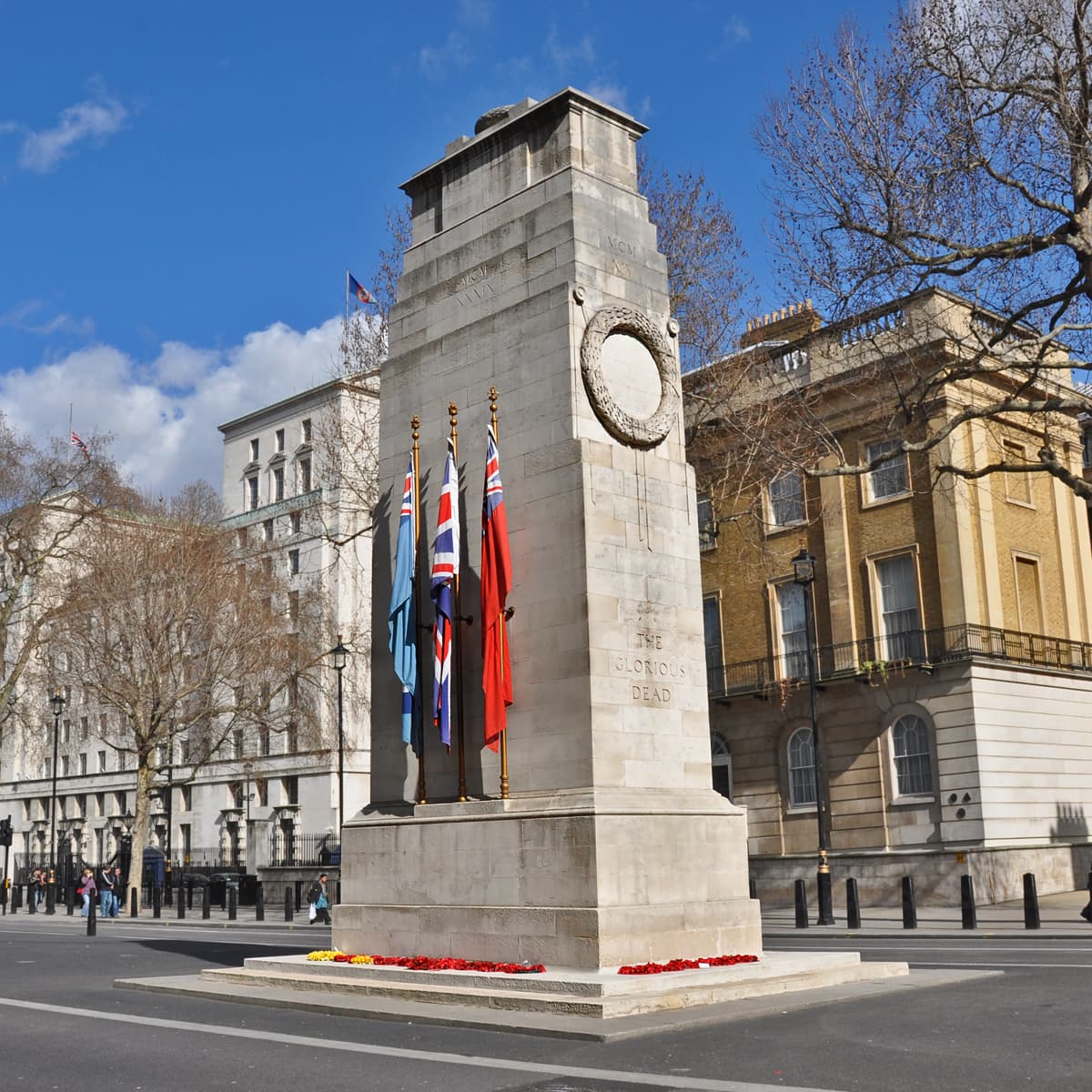
The Senataf. The Senataf is an empty tomb. This big, white stone monument honors those who died in the two events that most shaped modern Britain, World Wars I and II. The monumental devastation of those wars helped diminish the importance of Britain on the world stage.
Atop the pillar sits a ceremonial stone tomb. You'll see no religious symbols on this memorial. The dead honored here came from many creeds and all corners of Britain's vast empire. The Senataf looks lost in a sea of noisy cars, but on each remembrance Sunday, that's the one closest to November 11th, it takes center stage.
Read more...Show less
Whitehall is closed off to traffic, the royal family fills the balcony of the foreign ministry, and a memorial service is held around the Senataf. Pause at the Senataf and think what this monument means to the people of Britain. It's hard for an American to understand the impact of the Great War or World War I on Europe. It's said that if the one million World War I dead from the British Empire were to march past the Senataf four by four, the sad parade would last for a week.
As if eternally pondering the Senataf in a question statue stands just up the street. It remembers Field Marshal Douglas Hague, the commander-in-chief of the British Army from 1916 to 1918. Hague was responsible for ordering so many brave and not so brave British boys out of the trenches and under the killing fields of World War I. Continue up Whitehall.
From here we'll cross over to the left side of the street. There's a crosswalk just ahead. When you get the green light across the street, making your way toward the black iron security fence on the other side. Lisa, when I think about Britain in World War I, I always think of a single day.
July 1st, 1916. On that day in the Battle of the Somme, the British suffered nearly 60,000 casualties. Eventually that single battlefield would claim more than a million dead and injured on both sides. Once you reach the other side of Whitehall, turn right and continue a few steps up to the black fence.
It's always guarded, 24-7 by policemen. Go ahead, cat with the bobbies. In spite of their important task, they're actually pretty approachable. This is the well-protected entrance to Downing Street.
Belly up to the gate and peer down the street to locate London's most famous address. Number 10 Downing Street Britain's version of the White House, where the Prime Minister and his family live, is at Number 10 Downing Street.
#10 Downing Street
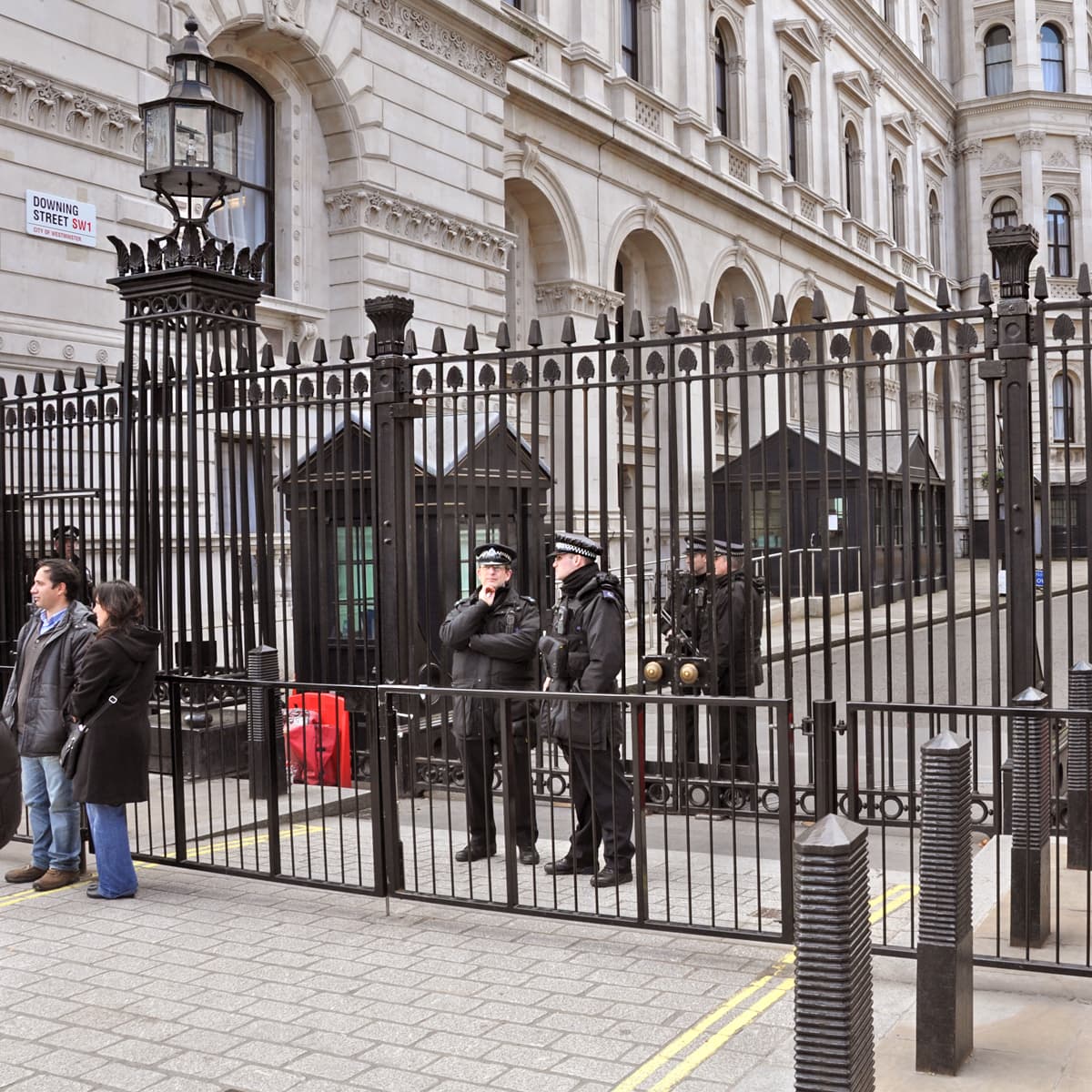
It's the Black brick building 300 feet down the blocked off street on the right-hand side. It's not at all obvious since Number 10 has a pretty complex structure. But the Black door, marked Number 10, is a highly symbolic point of power, popular for photo ops to mark historic occasions. This is where suffragettes protested in the early 20th century, where Neville Chamberlain showed off his regrettable peace treaty with Hitler, and where Winston Churchill made the famous V for Victory sign.
This is where newly elected Prime Minister and his family live. This is where Newly-elected Prime Minister and his family live. This is where Newly-elected Prime Minister and his family live. This is where Newly-elected Prime Minister and his family live.
Read more...Show less
This is where Newly-elected Prime Minister celebrate victories, and where they pose with visiting American presidents to show solidarity between the close allies. Number 10 looks modest, but the entryway does open up into fairly impressive digs. It houses the Prime Minister's offices downstairs, his residence upstairs, and two large formal dining rooms. The Prime Minister's staff has their offices here, and the cabinet meets here on Tuesday mornings.
This is where foreign dignitaries come for official government dinners, where the Prime Minister receives honored school kids and victorious soccer teams, and where he gives his monthly addresses to the nation. Next door at number 11, the Chancellor of the Exchequer or Finance Minister lives with his family, and at number 12 you'd find the Prime Minister's press office. This has been the traditional home of the Prime Minister since the position was created in the early 18th century. But even before that, the neighborhood, if not the building itself, was a center of power.
Edward the Confessor and Henry VIII both had palaces here. The facade is, frankly, pretty cheap. It was first built in the 1680s as part of a middle-class cul-de-sac of homes by American-born George Downing. When the first Prime Minister moved in, the humble interior was combined with a mansion in the back.
During a major upgrade in the 1950s, they discovered that the facade's black bricks were actually yellow. But they'd been stained by decades of industrial age soot. To keep with tradition, they now paint the bricks black. The Prime Minister, Britain's chief executive, is not elected directly by voters.
Rather, he assumes power as the head of the party that wins a majority in the parliamentary elections. Just as the American political landscape is dominated by two major parties, Britain has the Labor Party and the Conservatives or Tories. Focus for a second on the security measures here at Downing Street, the police, the fence, the road barrier in the middle of the street. The guarded metal gates were installed in 1989 to protect against Irish terrorists.
Even so, number 10 was hit and partly damaged in 1991 by an Irish Republican Army mortar who was launched from a nearby van. These days, there's typically not much to see unless a VIP happens to drive up. Then the Bobby's snap two and check credentials, the gates open, the cars inspected for bombs, the traffic barrier midway down the street drops, the car drives in, and the Bobby's go back to mugging for the tourists. Our next stop is the Banqueting House, located about 200 yards farther up Whitehall.
Continue up Whitehall, staying on the left side of the street, and let Rick point out a few other sites as he stroll. First, there's a black slab monument just ahead in the middle of Whitehall. The empty uniforms draped down its sides are meant to honor the women who fought and died in World War II. The huge building across Whitehall from Downing Street is the Ministry of Defense or M.O.D.
This bleak place, the British Pentagon as it were, looks like a Ministry of Defense should. In front are statues of illustrious defenders of Britain, including Field Marshal Bernard Montgomery of World War II. Monty, as he's known, commanded an army of tanks that beat the Nazis in North Africa. He defeated Irwin Rommel, the notorious desert fox at the Battle of L.
Aleman. This victory gave the Allies a jumping off point to retake Europe. Along with Churchill, Monty breathed confidence back into a demoralized British army, persuading them that they could ultimately defeat Hitler. As you walk along, you may be enjoying the shade of London's plain trees.
These trees do well in polluted London. It's in their design, roots that work well in clay, waxy leaves that self-clean in the rain, and bark that sheds and regenerates so the pollution doesn't get into their vascular systems. Up ahead is the equestrian statue of Field Marshal Hague. We mentioned him earlier.
Hague was the commander at that bloody Battle of the Somme. A military magazine recently voted him World War I's worst general. When you reach the equestrian statue, you'll be flanked by the government offices of Wales and of Scotland, two countries that are part of the United Kingdom. Just past the equestrian statue, look across to the other side of Whitehall to our next stop, the Banqueting House.
It's a classy looking two-story building decorated with Greek half columns, big windows, and topped with a bellistrod. Stand here and admire this classic facade. The Banqueting House
The Banqueting House
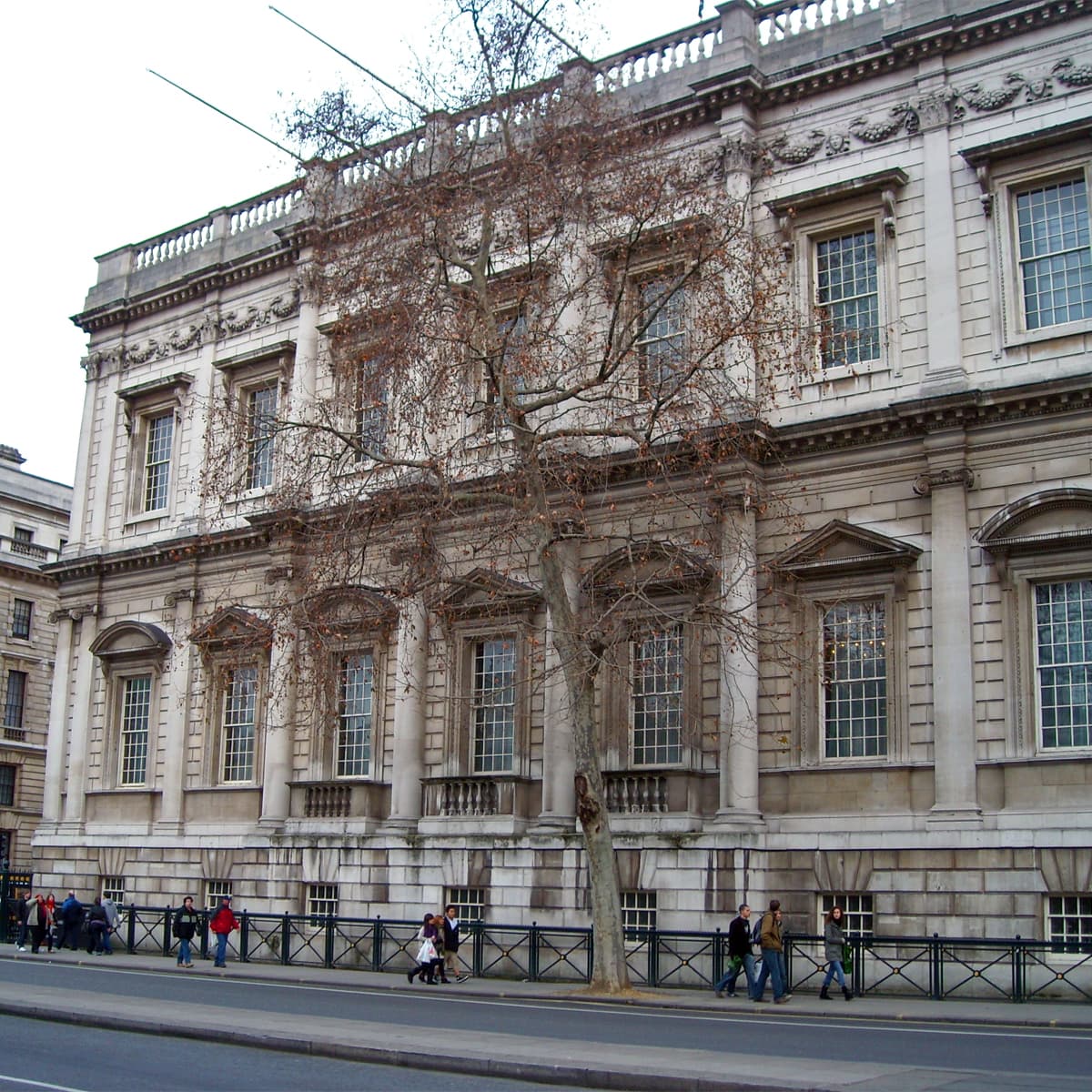
This building is just about all that remains of what was once the biggest palace in Europe, Whitehall Palace. The palace once stretched from Big Bend to Trafalgar Square, which is just ahead of you. Henry VIII started it when he moved out of the Palace of Westminster, now the Parliament, and into the residents of the Archbishop of York. Queen Elizabeth I and other monarchs added on to the palace as England's worldwide prestige grew.
The Banqueting House was the sprawling palace's party house. Kings and nobles gathered in the grand ballroom on the first floor for feasts that became famous all across Europe. Finally, in 1698, a roaring fire destroyed everything at Whitehall Palace except the name and this building, the Banqueting House. The Banqueting House built in 1620 was designed by the influential architect Inigo Jones.
Read more...Show less
He used Greek style columns and triangular pediments over the windows. The proportions are perfect, 112 feet wide by 56 feet tall and 56 feet deep. Let's see. That makes the building a double cube.
Jones's neoclassical style was revolutionary at the time, but a century later the Banqueting House was the inspiration for countless buildings built all over England in what's called the Georgian style, named for the kings who ruled in the 18th and 19th centuries. Focus your attention on the very center of the facade. This was the scene of one of England's pivotal moments. On January 30, 1649, a huge crowd gathered outside the Banqueting House.
A man dressed in black appeared at one of the first floor windows, then stepped out the window and onto a wooden platform. It was King Charles I. He gave a short speech to the crowd, framed by the magnificent backdrop of the Banqueting House. His final word was, remember.
Then he knelt and laid his neck on a block as another man in black approached. It was the executioner who proceeded to cut off the king's head. With the beheading of Charles, the concept of divine monarchy in Britain was also decapitated. England became embroiled in a bitter civil war which pitted Parliament against the monarchy.
Oliver Cromwell, the Protestant anti-monarchist, became England's leader. Eventually, the royalty was restored and Charles' son, Charles II, got his revenge right here in the Banqueting Hall by living well. His elaborate parties celebrated the restoration of the monarchy. But from then on, every king knew that he ruled not by the grace of God, but only by the grace of Parliament.
Continue up White Hall, staying on the left-hand side. About 50 yards up is our next stop, a building known as Horse Guards. It's guarded by traditionally dressed soldiers who are also called Horse Guards. Enjoy the colorful sight of their horses.
Endless Mell. And the crowds of tourists. Endless Mell. Rick. Well, it's true. Pew. Horse Guards.
Horse Guards
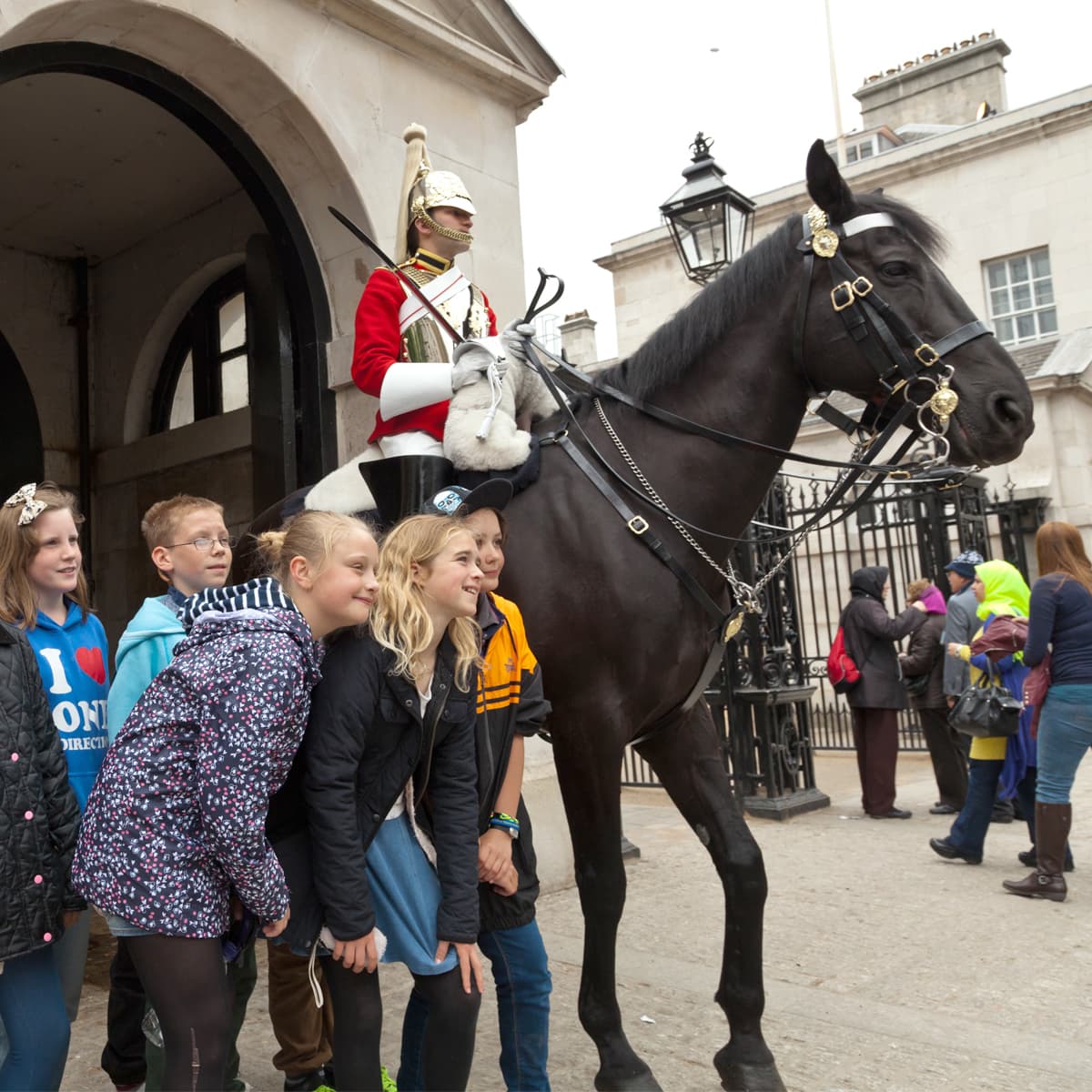
For 200 years, soldiers and cavalry uniforms have guarded this arched entrance along White Hall. The entrance was once a key and carefully guarded access point to the Mell, the street that leads to the royal residence Buckingham Palace. The soldiers are the Queen's personal bodyguard. Two different squads alternate, so depending on the day you visit, you'll see soldiers in either red coats with white plumes in their helmets, called the Life Guards, or soldiers in blue coats with red plumes called the Blues and Royals.
Besides their ceremonial duties here in Old Time uniforms, these elite troops have fought in Iraq and Afghanistan. Both Prince William and Prince Harry have served in the Blues and Royals. There's a low-key changing of the guard ceremony here every day. Check a guidebook or posted information for current times.
Read more...Show less
And at any time, it's a great place for a photo op standing alongside the Stoic soldiers. Explore a little deeper, step between the two mounted guards through the gate and into the courtyard. The Horse Guards building in the courtyard was the headquarters of the British Army during the American Revolution. The British military continued to be run from here until the bigger Ministry of Defense was created in World War II.
The Horse Guards Museum offers a glimpse at the stables and a collection of uniforms and weapons. Back when this archway was a crucial security checkpoint, anyone on horseback had to dismount before passing through. Today, by tradition, you must dismount from your bicycle, Vespa or Segway and walk it through this historic gate. Our next stop is Trafalgar Square. Continue up Whitehall while Rick describes some sights along the way.
More of Whitehall
More of Whitehall, walking to Trafalgar Square. You'll pass by another equestrian statue in the middle of Whitehall. It depicts Field Marshal George, Duke of Cambridge. The grandson of Mad King George III, he served as Commander-in-Chief of the British Army for 39 years.
He inherited the job in 1856 when Britain's global empire was peaking, then oversaw the army's gradual decline. As you continue up the street, think about Britain in the mid-1800s when Westminster really came into its own. This was the Victorian era. Britain reigned supreme.
Read more...Show less
The Industrial Revolution was in full swing, textile factories, coal mines, gas lights, and steam-powered trains. By centuries-end, there was electricity, telephones, and the first subway system. Queen Victoria ruled for 64 years, presiding over an era of unprecedented wealth, peace, and middle-class values. Britain was at the zenith of its power with a colonial empire that covered one-fifth of the world.
That empire was managed from the building just ahead on the left. Its number 26 marked by the row of white columns and arches. The old admiralty complex. Hail Britannia, Britannia rules the waves.
This was the headquarters of the Royal Navy when Britannia ruled the waves. Now look directly across Whitehall. You'll see the old Clarence pub. Behind the Clarence pub once stood the original Scotland Yard.
That was the headquarters of London's crack police force in the days of Sherlock Holmes. Keep walking up Whitehall toward the big column while Rick tells a little more about Scotland Yard. It got its name from a former Scottish palace that once stood there. Scotland Yard has London's Metropolitan police force, known even today as the Met.
Originally, these police only arrested criminals caught in the act. But during Victoria's reign, Scotland Yard also opened a detective wing. They used forensics and intellectual know-how to actually investigate past crimes. CSI Whitehall.
Yeah. That work inspired the stories of the fictional Sherlock Holmes, who solved crimes that Scotland Yard couldn't. These days, London's police force, the Met, is headquartered at New Scotland Yard. It's located not far from here, just a few blocks past Westminster Abbey.
Did Scotland Yard investigate Jack the Ripper? Yes. Remember Jack the Ripper was a serial killer of the 1880s. He brutally murdered several prostitutes in East London that'd be East of St.
Paul's Cathedral. He was never caught, not even by Sherlock Holmes. The Ripper symbolized the dark side of Victorian society. Imagine here in Westminster they were erecting these shiny marble monuments.
Meanwhile, across town, the old city was in decay. The wealthy were fleeing west. When you read Charles Dickens, you can actually see that London itself was a tale of two cities. Victorian London had a huge gap between the rich and poor, between the wealthy ladies and gentlemen, and the grubby Oliver Twist street urchins.
Some things never change. As you approach the big column, look down near its base to find an equestrian statue. Where Whitehall spills into Trafalgar Square, you'll see a statue of Charles I on horseback, the king who was beheaded at the Banqueting House. Charles is remembered today at one end of Whitehall, while the man who had him executed, Oliver Cromwell, is given equal time at the other end with a statue at Parliament.
The statue of Charles I stands in front of a small plaque in the pavement. This marks the place from which all distances in the city are measured. You've reached the centre of London. Whitehall opens up into the grand and noisy Trafalgar Square.
The square is interesting from every angle and is made to order for interacting with the locals. Start making your way to the top of the square. Our final destination is the high ground in front of the National Gallery, the domed building overlooking the square. To get into the square itself, you'll need to cross the busy street.
This will probably take some time and you'll want to keep an eye out for traffic. So if you need to, pause the audio tour. Restart it on the other side when you enter Trafalgar Square. Trafalgar Square
Trafalgar Square
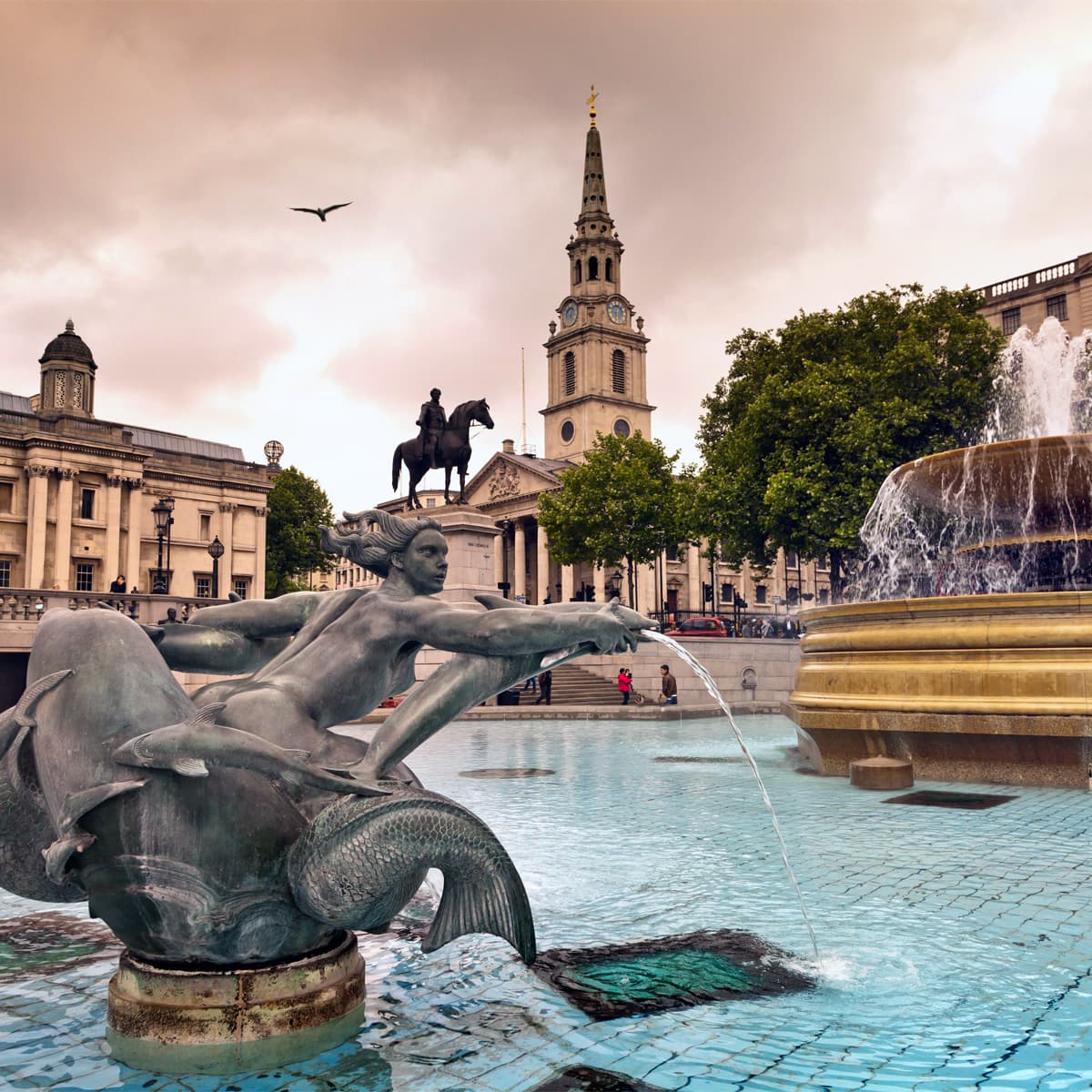
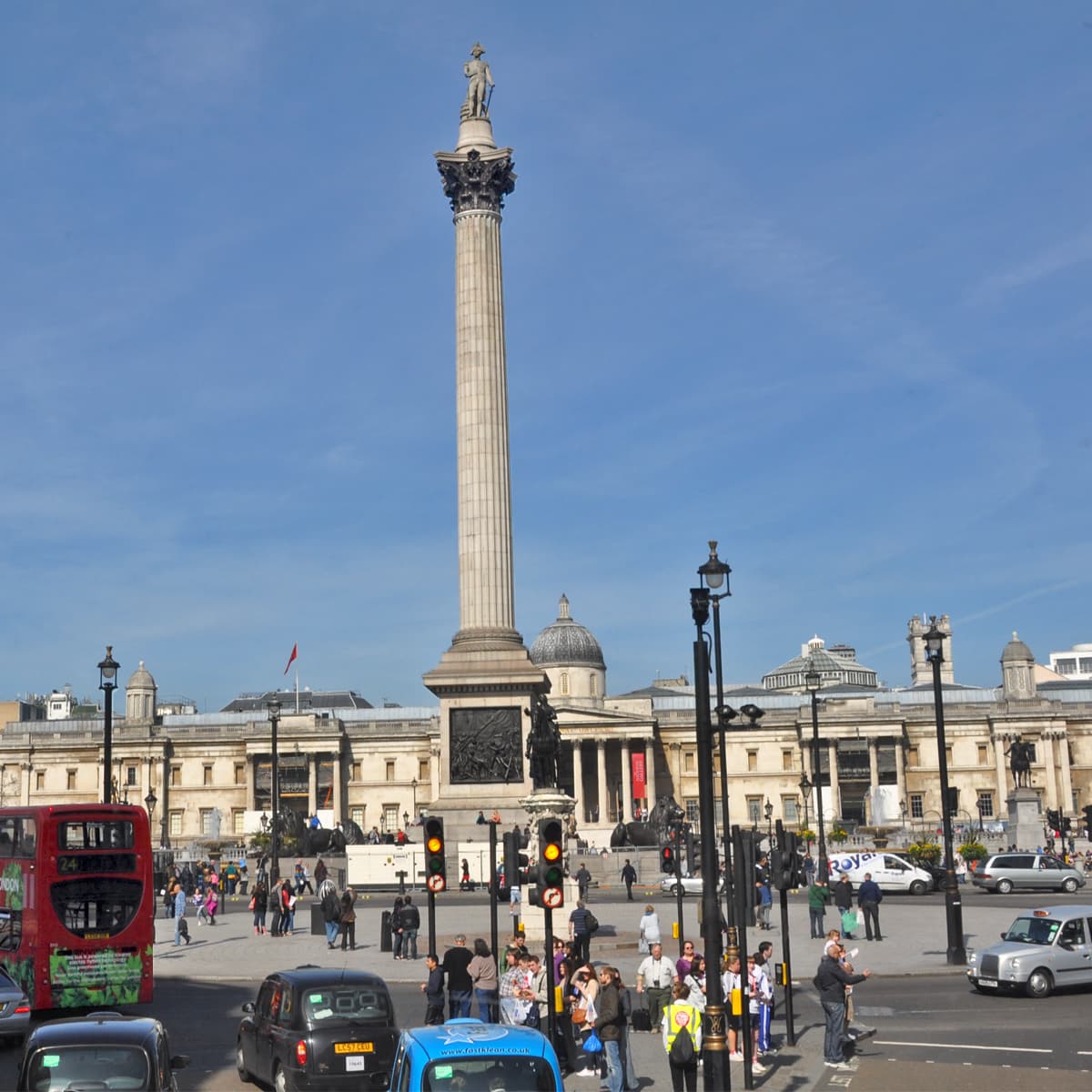
Now that you've reached the square, start making your way uphill toward the dome of the National Gallery. As you walk, let Rick describe some of the sights. London's version of Times Square bustles around the world's biggest Corinthian column. Atop that column, Admiral Horatio Nelson stands 170 feet tall, overlooking London.
He's facing in the direction of one of the greatest naval battles in history, for which this square is named. Nelson saved England at a time as dark as World War II. In 1805, Napoleon was poised on the other side of the channel, threatening to invade England. Meanwhile, more than 900 miles away, the one armed, one-eyed and one-minded Lord Nelson attacked the French fleet off the coast of Spain at Trafalgar.
Read more...Show less
The French were routed, and Britannia ruled the waves. The once invincible French army was slowly worn down, then ultimately defeated at Waterloo. Nelson, while victorious, was shot by a sniper in the Battle of Trafalgar. He died gasping, thank God I've done my duty.
At the base of Nelson's column are bronze reliefs cast from melted-down French cannon. The four huggable lions are dying to have their photo taken with you. Of the many statues that dot the square, find the empty pedestal on the northwest corner. This is the so-called fourth plinth, which is periodically topped with contemporary art.
At the top of Trafalgar Square sits the domed and free national gallery with its grand staircase. This houses one of the world's great collections of painting, from Leonardo da Vinci and Raphael to Monet and Van Gogh. To the right is the steeple of St. Martin in the fields built in 1722.
This church inspired the steeple over the entrance style you'll see in so many town churches in America's New England. The church is also known for its music, stop by for a list of concerts. By now you should have reached the top of the square. You have great views back over the square and down Whitehall.
Stand here and take it all in. Trafalgar Square is indeed the center of modern London. It connects Westminster, the districts known as the City and the West End. Stand at the top of the square, pan clockwise and survey the London of today.
Looking to the south down Whitehall is the center of government Westminster. Turning clockwise to the south west down the broad boulevard called the Mal is Buckingham Palace. Further to the right down Palmal is St. James Palace where Prince Charles lives when in London.
A few blocks northwest of Trafalgar Square is Piccadilly Circus. Directly north a block behind the National Gallery sits Lester Square, the jumping off point for Soho, Covent Garden and the West End Theatre District. Near St. Martin in the fields church is the boulevard called the Strand.
This takes you past Charing Cross Station then eastward to the city, the original wall town of London and today's financial center. In medieval times when people from the city met with the Westminster government it was here at the Midway Point, Trafalgar. Finishing our clockwise spin, Northumberland Street leads southeast to the Golden Jubilee pedestrian bridge over the River Thames. Along this street stands the Sherlock Holmes pub.
It's housed in Sir Arthur Conan Doyle's favorite watering hall with an upstairs replica of 221B Baker Street. We've reached the end of our Westminster walk, soak it in. Your smack dab in the center of London, a thriving city built upon 2,000 years of history. We hope you enjoyed your walk through Westminster.
Thanks to Gene Openshaw, co-author of this tour. If you're up for more London sightseeing we have audio guides of the British Museum, the British Library, St. Paul's Cathedral and the City. Remember this tour was excerpted from the Rick Steves London guidebook co-authored with Gene Openshaw.
For more details on heating, sleeping and sightseeing in London, refer to this year's edition of that guidebook. For more free audio tours and podcasts and for information about our TV shows, bus tours and travel gear, visit our website at ricksteves.com. This tour was produced by Cedar House Audio Productions. Thanks! Cheers! And goodbye for now.
Free
GPS-guided walking tour
No account needed. Walk at your own pace.
Free
12 stops ·