San Francisco: Chinatown, North Beach & Coit Tower
10 stops
GPS-guided
2.7 km
Walking
1 hour 15 minutes
Duration
Free
No tickets
About this tour
From the oldest Chinatown in North America to the birthplace of the Beat Generation, this walk traces San Francisco's most storied neighborhoods. You'll watch fortune cookies being folded by hand, climb a narrow staircase to a Taoist temple from eighteen fifty-two, stand where the American flag first flew over San Francisco, browse the bookstore that changed free speech law, drink espresso where Coppola wrote The Godfather, and descend a hidden garden staircase on Telegraph Hill while wild parrots scream overhead.
10 stops on this tour
Chinatown Dragon Gate
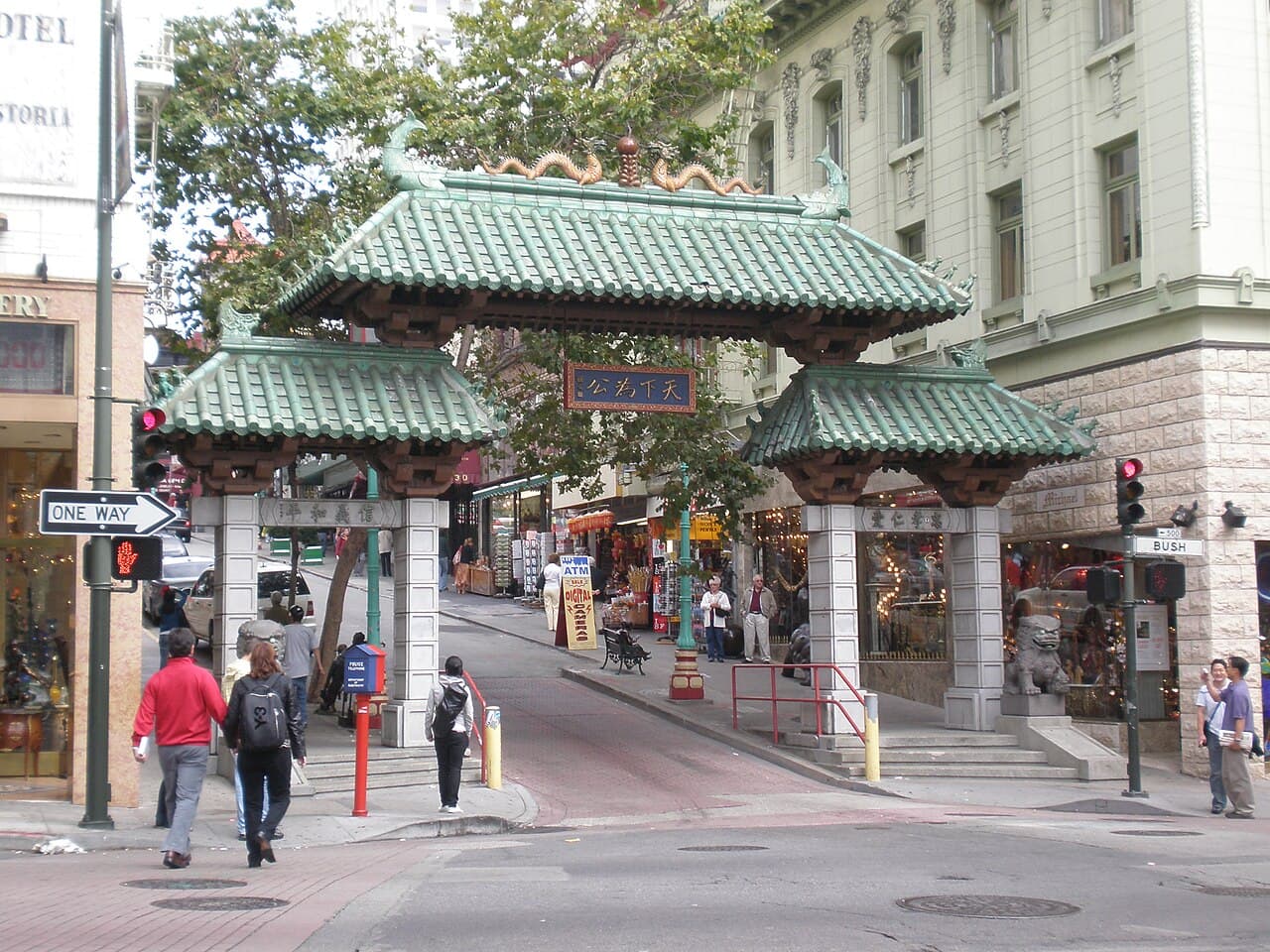
Welcome to San Francisco. You're standing at the corner of Grant Avenue and Bush Street, looking up at one of the most photographed gates in America — the Chinatown Dragon Gate. Three green-tiled pagoda roofs stacked above the road, a pair of stone foo dogs guarding the entrance, and two dragons twisting across the top. It looks ancient, but it was actually donated by the government of the Republic of China and dedicated in nineteen seventy.
What's ancient is the neighborhood behind it. This is the oldest Chinatown in North America, and it's been here since the Gold Rush. Chinese immigrants began arriving in San Francisco in eighteen forty-eight and eighteen forty-nine, drawn by the same fever that pulled people from every corner of the world. They called California Gam Saan — Gold Mountain.
Read more...Show less
By the eighteen seventies, this neighborhood was a dense, vibrant, self-contained city within a city. It had its own temples, theatres, newspapers, and pharmacies. It also had its dark chapters — the Chinese Exclusion Act of eighteen eighty-two banned Chinese laborers from entering the country, the first federal law to restrict immigration by nationality. That law wasn't fully repealed until nineteen forty-three.
Then came the nineteen oh six earthquake. The fires that followed leveled Chinatown completely. City officials saw an opportunity to relocate the Chinese community somewhere less prime — this was valuable real estate, after all. But Chinatown's leaders outmaneuvered them, hiring American architects to rebuild in a deliberately exotic style that would attract tourists and make the neighborhood too valuable to move. Those pagoda-topped buildings you'll see along Grant Avenue? That was strategy, not tradition.
Look through the gate and up Grant Avenue. That's our route — straight into the heart of it. The street will be packed with produce stands, souvenir shops, and the smell of roast duck drifting from the barbecue joints.
When you're ready, walk through the gate and head north up Grant Avenue. We're going about four blocks to a tiny alley where fortune cookies are made by hand.
Golden Gate Fortune Cookie Factory
As you walk up Grant Avenue, soak it in. The lanterns strung across the street, the bilingual signs, the produce bins spilling onto the sidewalk — bok choy, bitter melon, lotus root. This is one of the most densely populated neighborhoods in the United States, and it hums with energy.
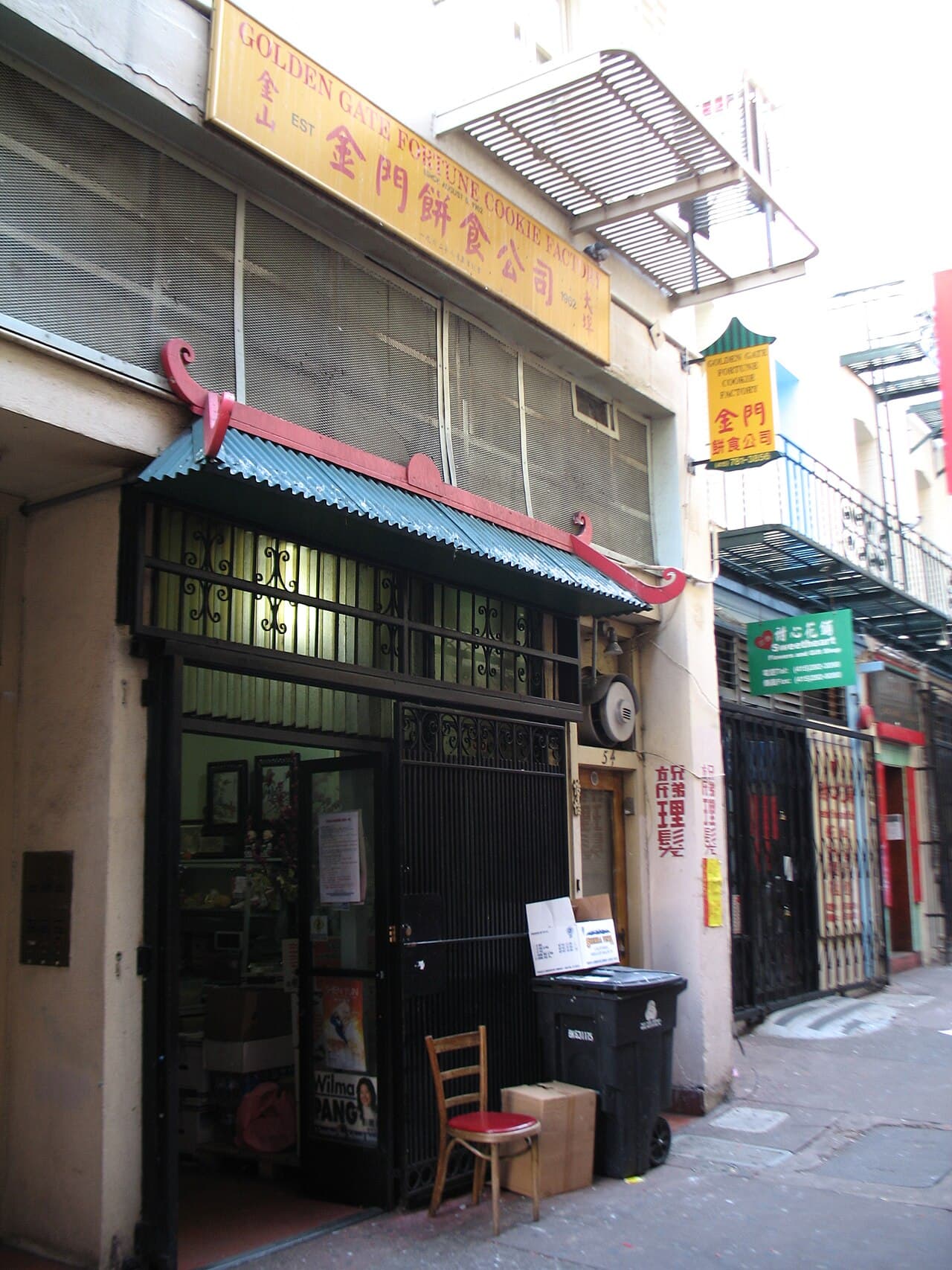
Now — turn left off Grant onto Ross Alley. It's easy to miss. A narrow passage between buildings, barely wide enough for a car. This is one of Chinatown's original back alleys, and in the nineteenth century, these alleys had a reputation. Gambling dens, opium rooms, and worse. Today, Ross Alley is quiet and a little scruffy, and about halfway down on your left, you'll find a shopfront with a hand-painted sign: the Golden Gate Fortune Cookie Factory.
Read more...Show less
Step inside. It's tiny — barely bigger than a living room. And there they are: women sitting at circular griddles, pulling warm discs of batter off the iron, slipping a paper fortune inside, and folding each cookie by hand before it cools and hardens. They've been doing this since nineteen sixty-two, using machines that look like they haven't changed since then either.
Here's the thing most people don't know: fortune cookies are not Chinese. They're Japanese. The predecessor is a cracker called tsujiura senbei — a rice-flour cookie with a fortune tucked inside the fold — that's been documented in Japanese bakeries since at least the nineteenth century. In San Francisco, a man named Makoto Hagiwara, who maintained the Japanese Tea Garden in Golden Gate Park, is widely credited with introducing fortune cookies to America in the early nineteen hundreds.
So how did they become Chinese? The answer is one of the uglier chapters of American history. During World War Two, Japanese Americans on the West Coast were forced into internment camps — including the families who ran the bakeries making fortune cookies. Chinese-American entrepreneurs stepped in and took over production. By the time the war ended, fortune cookies were firmly associated with Chinese restaurants, and nobody corrected the record.
You can buy a bag of fresh cookies here — flat ones without fortunes are cheaper, and honestly, they taste better warm.
Head back out of Ross Alley to Grant Avenue, turn left, and continue north. Take your next left onto Waverly Place — you'll know it by the painted balconies overhead. We're heading to the top floor of number one twenty-five.
Tin How Temple
Waverly Place. Stop for a moment and look up. This narrow street is sometimes called the Street of Painted Balconies, and you can see why — the buildings are stacked with iron balconies painted in vivid reds, greens, and yellows. It's one of the most photogenic blocks in San Francisco.
Now find number one twenty-five. There's a modest doorway at street level — easy to walk right past. Push it open and climb the narrow staircase. Keep going. Past the second floor. Past the third. All the way to the top. The stairs are steep and the building smells of incense, and when you reach the fourth floor, you'll step into one of the oldest Taoist temples in the United States.
Read more...Show less
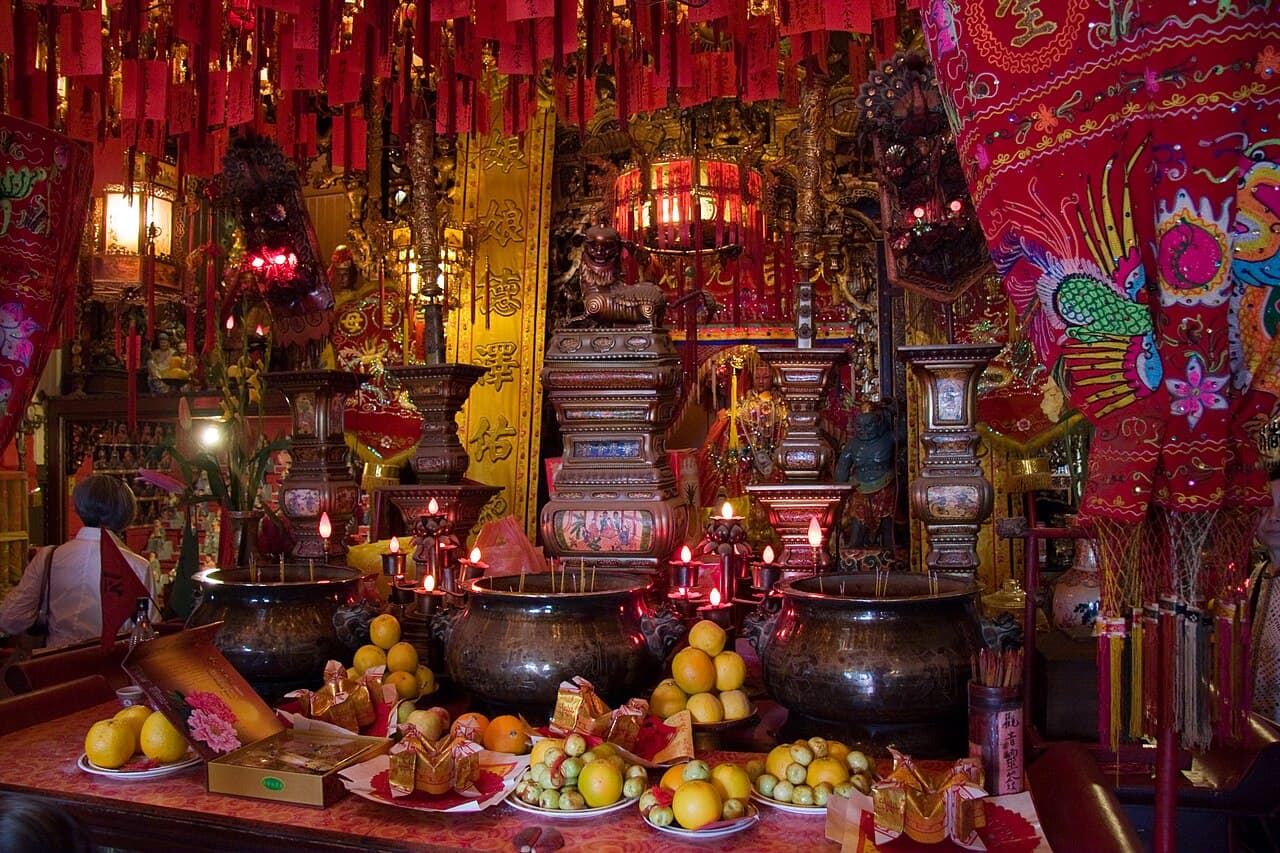
This is the Tin How Temple, dedicated to Tian Hou — the Queen of Heaven and protector of travelers and seafarers. It was founded in eighteen fifty-two by Chinese immigrants who had just crossed the Pacific and needed all the divine protection they could get. That makes it over a hundred and seventy years old.
The original building was destroyed in the nineteen oh six earthquake, like nearly everything in Chinatown. But here's what survived: the altar, the carved image of the goddess, and the temple bell. The community saved them from the fires and installed them in this building when it reopened in nineteen ten.
Look around. The ceiling is hung with red paper lanterns and coils of incense spiraling down from above — some of those coils burn for weeks. The altar is covered in offerings: oranges, tea, flowers. Gold-and-red banners line the walls. The light is dim, the air is thick with smoke, and for a moment you could be in a temple in Fujian province rather than a fourth-floor walkup in San Francisco.
The temple asks for a small donation and requests no photography. Please respect both. And take a moment to stand quietly. People have been coming to this room to pray, give thanks, and ask for safe passage for over a century. The weight of all those hopes hangs in the incense smoke.
When you're ready, head back down the stairs and walk east on Washington Street toward Kearny. In about two blocks, you'll reach Portsmouth Square — San Francisco's original town plaza.
Portsmouth Square
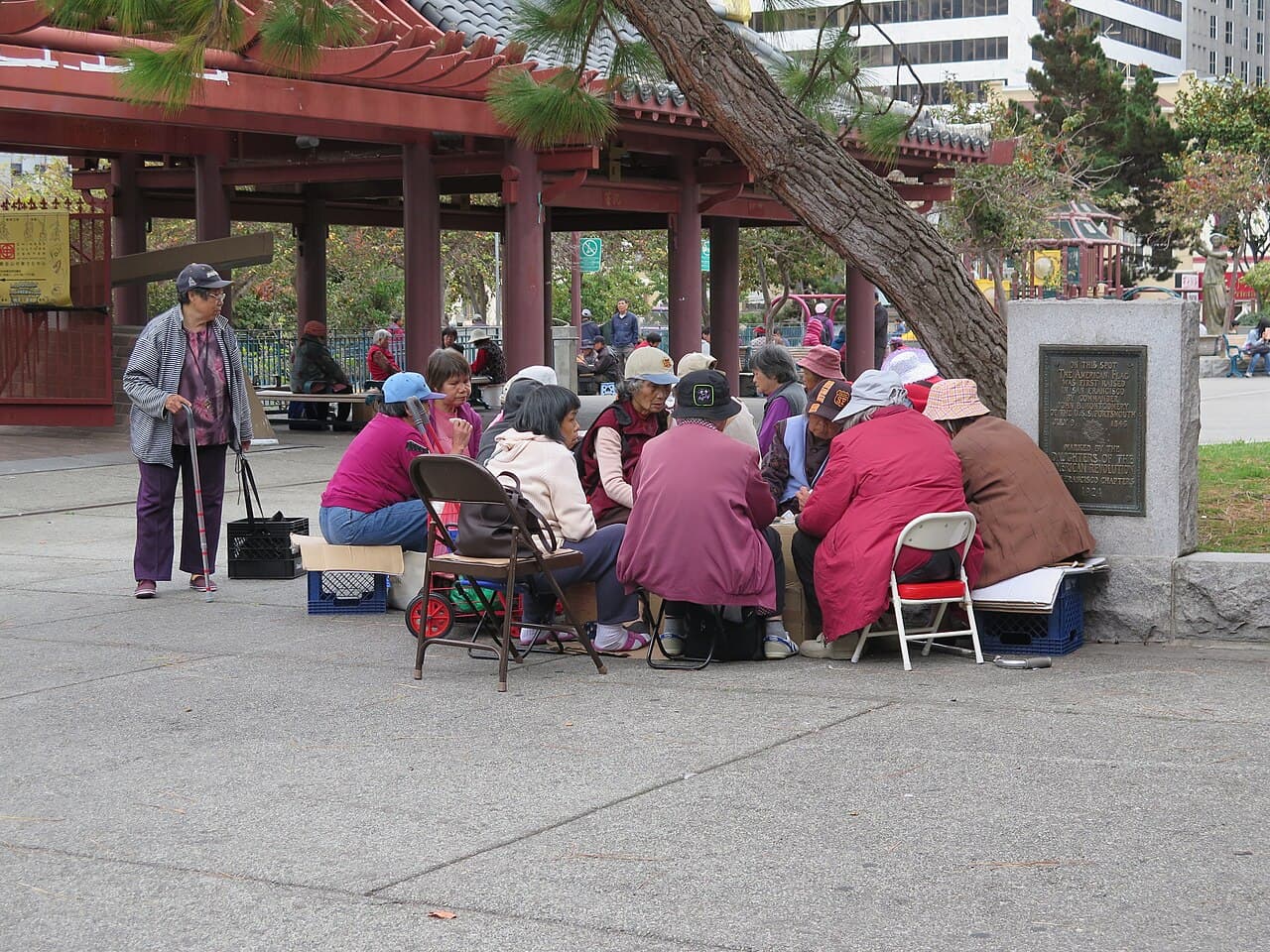
Cross Kearny Street and here it is — Portsmouth Square. It doesn't look like much at first glance. A concrete plaza on a parking garage, some benches, a playground, clusters of elderly residents playing cards and chess. But this plain little square is where San Francisco began.
On July ninth, eighteen forty-six, Captain John B. Montgomery of the USS Portsmouth rowed ashore from his ship in the bay and marched up to this plaza — which was then the center of the tiny Mexican settlement called Yerba Buena. He raised the American flag right here and claimed the town for the United States. Two years later, they renamed it San Francisco.
Read more...Show less
Imagine this spot in eighteen forty-eight, when Sam Brannan came running through the streets waving a bottle of gold dust and shouting that gold had been found at Sutter's Mill. The Gold Rush started right here, in this square, with that one act of showmanship. Within months, San Francisco's population exploded from about two hundred to tens of thousands.
Portsmouth Square became the center of everything. The first public school in California was built on this plaza. The first newspaper. The Jenny Lind Theatre stood here. It was the beating heart of the young city — until the city grew south and the financial district swallowed the old town center.
Today, the square belongs to Chinatown. Come here at seven in the morning and you'll see dozens of people practicing tai chi in synchronized slow motion. By mid-morning, the chess players have claimed the stone tables and they'll be here until dark. On weekends, elderly men gather around card games so intense they draw crowds.
Look for the bronze galleon ship on a granite pedestal — that's the monument to Robert Louis Stevenson, who spent the autumn of eighteen seventy-nine sitting in this square, broke and lovesick, before sailing to Samoa. The plaque quotes from his Christmas Sermon.
Take the pedestrian bridge from the square across Kearny Street and head north along Columbus Avenue. The architecture is about to change. The pagoda roofs will give way to Italian delis, espresso bars, and murals. You're leaving Chinatown and entering North Beach — San Francisco's Little Italy and the cradle of the Beat Generation. It's about a five-minute walk to our next stop.
Jack Kerouac Alley & City Lights Bookstore
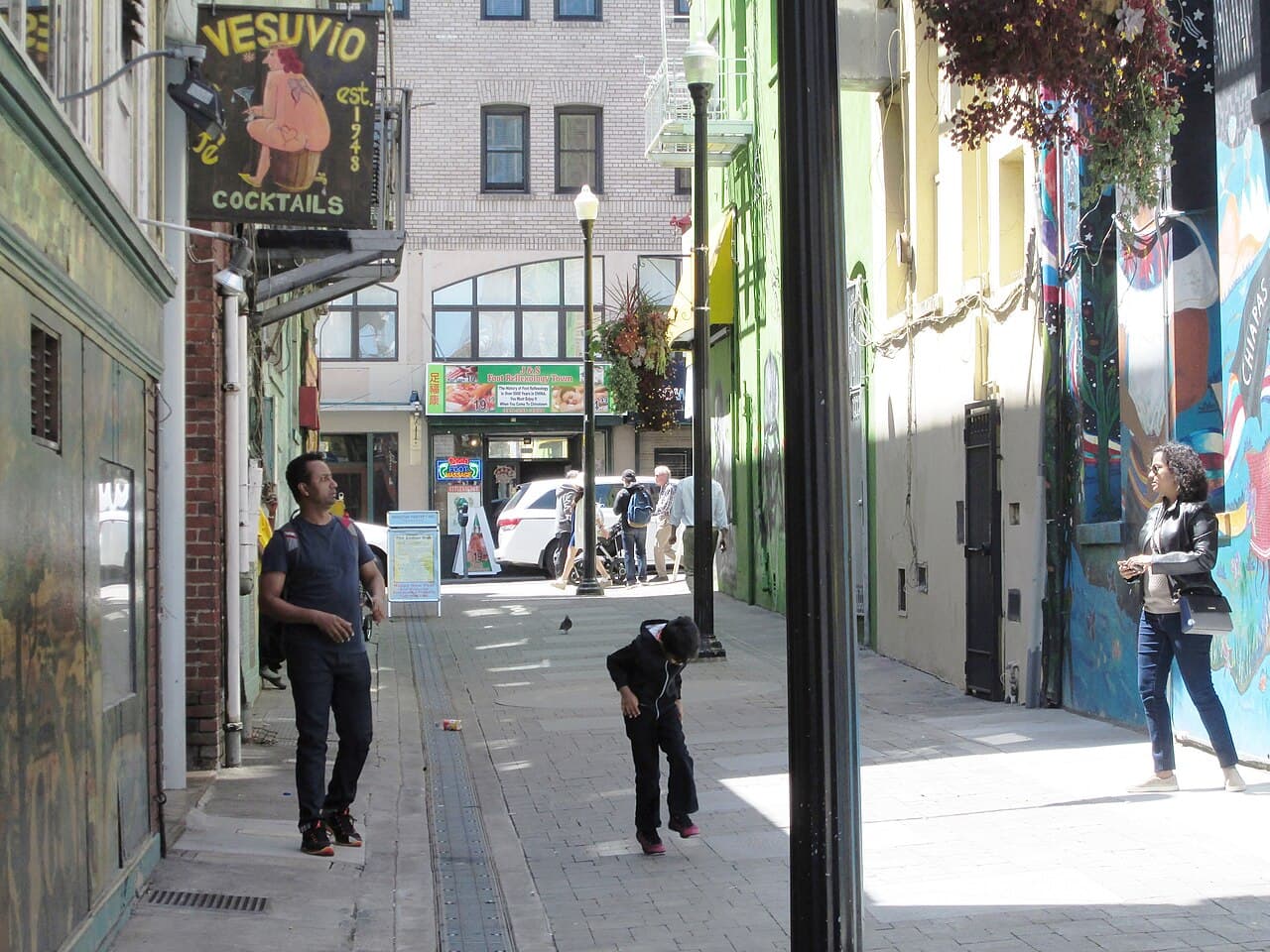
As you walk north along Columbus Avenue, notice how the neighborhood transforms. The Chinese grocery shops give way to Italian bakeries, the scent of incense is replaced by espresso. North Beach has been San Francisco's Italian quarter since the late nineteenth century, and it still feels like it — cappuccino at every corner, focaccia in every window.
But North Beach became famous for something else entirely. And you're standing in front of it.
Read more...Show less
City Lights Bookstore. Two sixty-one Columbus Avenue. That iconic triangular storefront on the corner, books piled in the windows, the black-and-white awning. This is holy ground for anyone who cares about literature, free speech, or the right to say what you think.
Lawrence Ferlinghetti opened City Lights in nineteen fifty-three as a paperback bookshop — one of the first in the country to sell only paperbacks, making literature affordable to everyone. But Ferlinghetti was also a publisher, and in nineteen fifty-six he published a slim volume of poetry that would change American culture: Howl and Other Poems by Allen Ginsberg.
Howl was raw, ecstatic, furious. It opened with the line: I saw the best minds of my generation destroyed by madness. It talked about drugs, sex, mental institutions, and the crushing conformity of nineteen fifties America. And the authorities were not amused.
In nineteen fifty-seven, US Customs seized copies of Howl at the San Francisco port. Then the San Francisco Police Department arrested the store manager, Shigeyoshi Murao, and charged him with selling obscene material. Ferlinghetti was charged too. The American Civil Liberties Union stepped in to defend them.
The trial became a national sensation. Judge Clayton Horn ruled that Howl was not obscene — that a work couldn't be judged obscene if it had the slightest redeeming social importance. The ruling was a landmark for free speech and made City Lights the most famous bookstore in the world.
Before you go inside, look to your left. See that narrow alley running between Columbus and Grant? That's Jack Kerouac Alley, named after the Beat writer who practically lived in this neighborhood. The alley physically connects Chinatown to North Beach — which is perfect, because the Beats saw themselves as a bridge between worlds. The pavement is inlaid with quotes from Kerouac, Ginsberg, and other writers.
Go into City Lights. Wander the creaking wooden stairs. The basement poetry room is where the magic lives.
When you emerge, cross the alley to a hidden bar that's been here since nineteen sixty-eight.
Specs' Twelve Adler Museum Cafe
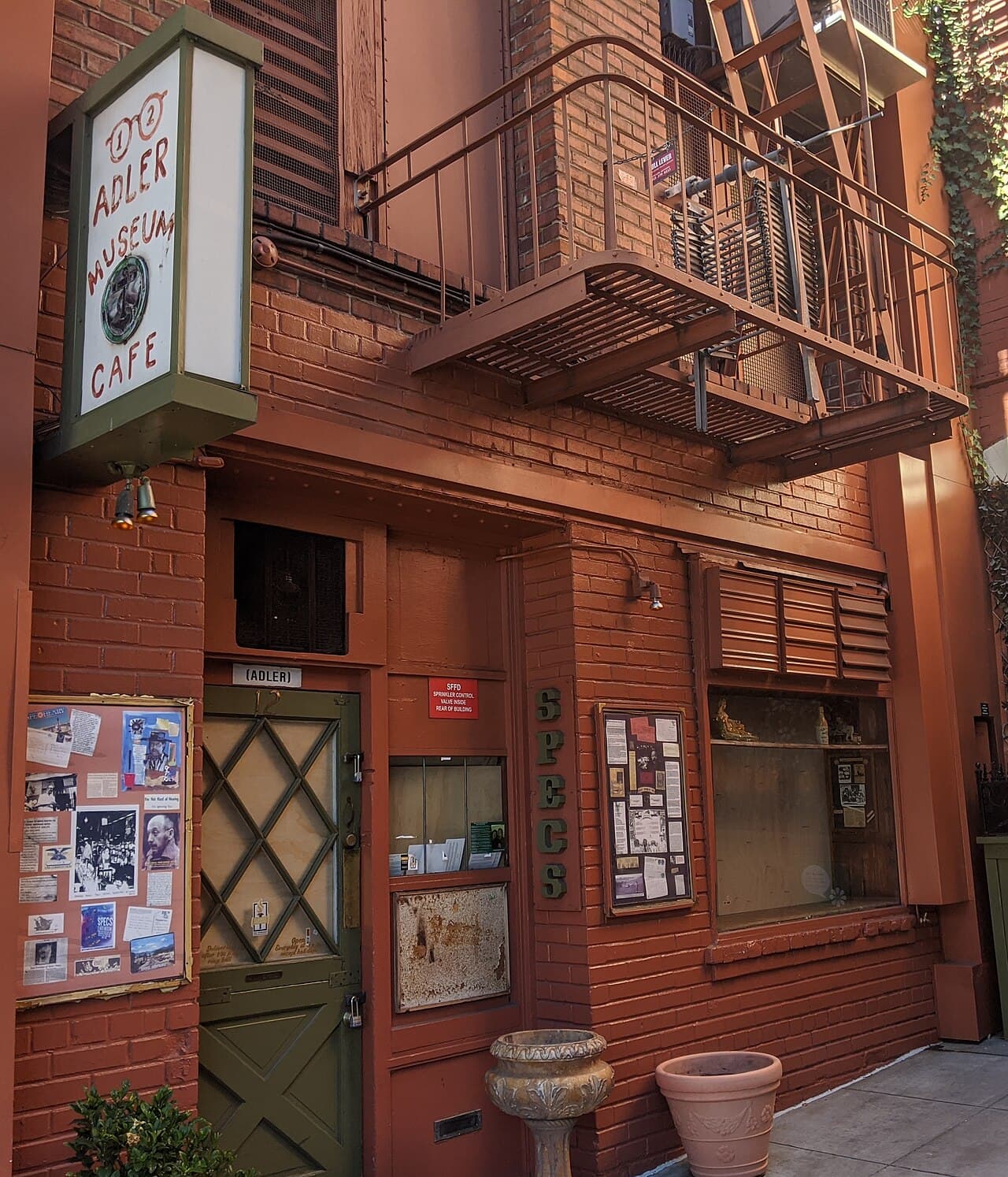
Step into the narrow passageway called William Saroyan Place — named after the Armenian-American writer who won the Pulitzer Prize and then refused it. On your left, you'll find a door that's easy to miss. No flashy sign, no Instagram-friendly branding. Just a dim entrance into one of the greatest bars in America.
This is Specs' Twelve Adler Museum Cafe. It opened on April twenty-sixth, nineteen sixty-eight, founded by a man named Richard Simmons — everyone called him Specs, for the glasses. He created something that defies description, so let me try anyway.
Read more...Show less
Imagine a bar that's also a junk shop, a maritime museum, a political archive, and someone's deeply eccentric living room, all crammed into a space not much bigger than a railway car. Every inch of wall and ceiling is covered. Old photographs. Ship figureheads. Political posters. Nautical instruments. Flags from countries that no longer exist. IWW labor movement memorabilia. A walrus skull. Tribal masks. Things you can't identify and the bartender won't explain.
Specs didn't curate this collection — he accumulated it. Sailors and longshoremen from the nearby waterfront would drink here and leave things behind. Artists and poets would trade objects for bar tabs. Over decades, the walls became an archaeological record of North Beach itself — its labor history, its maritime roots, its artistic soul, its magnificent weirdness.
The bar was named a San Francisco Legacy Business, which means the city officially recognizes it as a cultural institution worth protecting. And it is. In an era when every bar in every city looks the same — exposed brick, Edison bulbs, a cocktail menu on kraft paper — Specs looks like absolutely nothing else on earth.
Order whatever they have on draft. The bartender might talk to you. They might not. Either way, you'll feel like you've stumbled into a secret that the rest of the world forgot to find.
When you peel yourself away, head north up Columbus Avenue about two blocks. On the corner of Columbus and Vallejo Street, you'll find an Italian cafe that helped fuel the Beat Revolution — and a certain movie about a family you can't refuse.
Caffe Trieste
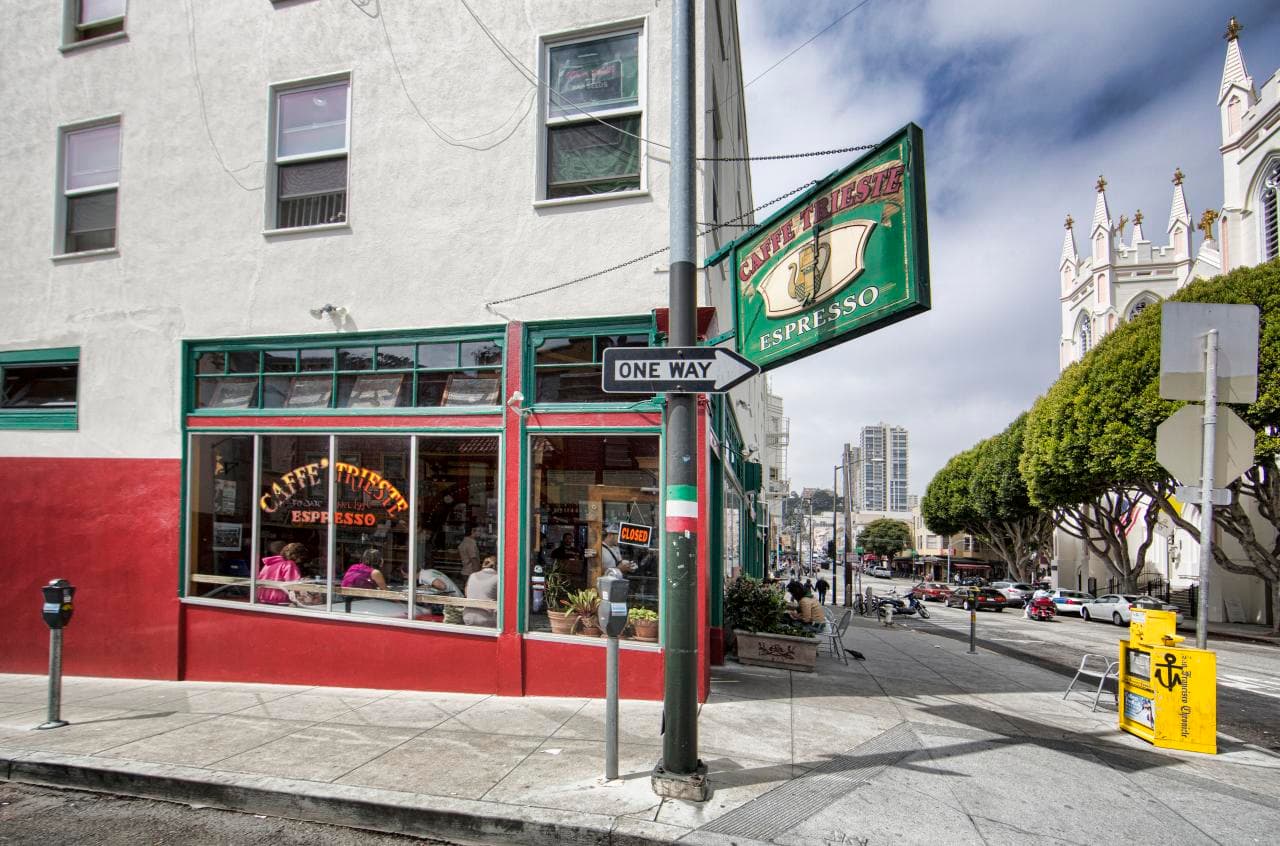
Six oh one Vallejo Street, on the corner of Grant Avenue. Welcome to Caffe Trieste — and if you don't stop here for an espresso, you're making a serious mistake.
This place was founded in nineteen fifty-six by a man named Giovanni Giotta, though everyone knew him as Papa Gianni. He had emigrated from the Italian town of Rovigno — which is now in Croatia — and he opened the first espresso coffeehouse on the West Coast right here. Before Starbucks, before Peet's, before the entire West Coast coffee obsession, there was Papa Gianni and his espresso machine on Vallejo Street.
Read more...Show less
Look around the interior. The walls are covered with old opera posters, photographs, newspaper clippings, and Italian memorabilia. On Saturday afternoons, the Giotta family and friends still perform live Italian music — accordion, guitar, opera arias. They've been doing this since the early days, and it's free. Just buy a coffee, find a seat, and listen.
But the reason every film student in the world knows about Caffe Trieste is Francis Ford Coppola. In nineteen seventy, the young director sat at a table right here — there's a plaque marking the spot — and wrote much of the screenplay for The Godfather on his yellow Olivetti typewriter. He was adapting Mario Puzo's novel, and he was under enormous pressure. Paramount had given him the job partly because he was Italian-American and partly because he was cheap.
Coppola delivered the one hundred and fifty-five page screenplay on August tenth, nineteen seventy. The rest is cinema history. The Godfather became one of the greatest films ever made, and this unassuming corner cafe became part of the mythology.
The espresso here is still excellent — dark, strong, no fuss. Order a cappuccino if it's morning, a macchiato if it's afternoon. The Italians have rules about these things, and in North Beach, you follow them.
Finish your coffee and head north on Grant Avenue, then turn left onto Union Street and continue west to Washington Square Park. It's about a five-minute walk. You'll see the twin white spires of a church rising above the trees — that's where we're going.
Washington Square Park

And here it is — Washington Square Park, the green heart of North Beach. A broad lawn surrounded by trees, park benches full of old Italian men arguing about politics, dogs chasing each other across the grass, and presiding over all of it, one of the most beautiful church facades in San Francisco.
Saints Peter and Paul Church — look at those twin white spires reaching into the sky. The church was completed in nineteen twenty-four, rebuilt after the nineteen oh six earthquake destroyed the previous structure. The ornate facade is Romanesque Revival, and the inscription across the front reads, in Italian: the glory of God in the highest, and on earth peace to people of good will.
Read more...Show less
This was the spiritual home of North Beach's Italian community. Mass was said in Italian here for decades. Immigrants from Genoa, Sicily, Naples — they all came to this church. Joe DiMaggio, the greatest baseball player of his generation, grew up just blocks from here. His family ran a fishing boat on the wharf.
And that brings us to one of the best stories in San Francisco. On January fourteenth, nineteen fifty-four, Joe DiMaggio married Marilyn Monroe. The photos of Marilyn on the church steps — her in a dark suit with a white ermine collar, DiMaggio looking like the luckiest man alive — are iconic. But here's what people always get wrong: they did not get married in this church. They couldn't. DiMaggio was divorced from his first wife, and the Catholic Church doesn't permit divorced people to remarry in a church ceremony. The civil ceremony was at City Hall. They came here afterward for photographs only.
The marriage lasted nine months. But DiMaggio never stopped loving her. After she died in nineteen sixty-two, he had roses delivered to her grave three times a week for twenty years.
Now look at the statue in the park — the one of the firefighters. That memorial was funded by a woman named Lillie Hitchcock Coit, and she is the reason we're about to climb a hill. Lillie is one of the most extraordinary characters in San Francisco's history, and you're going to hear all about her at our next stop.
Head east out of the park on Filbert Street. When you reach the foot of Telegraph Hill, follow the signs to Coit Tower. It's a steep climb — about ten minutes uphill — but the view from the top is worth every step.
Coit Tower
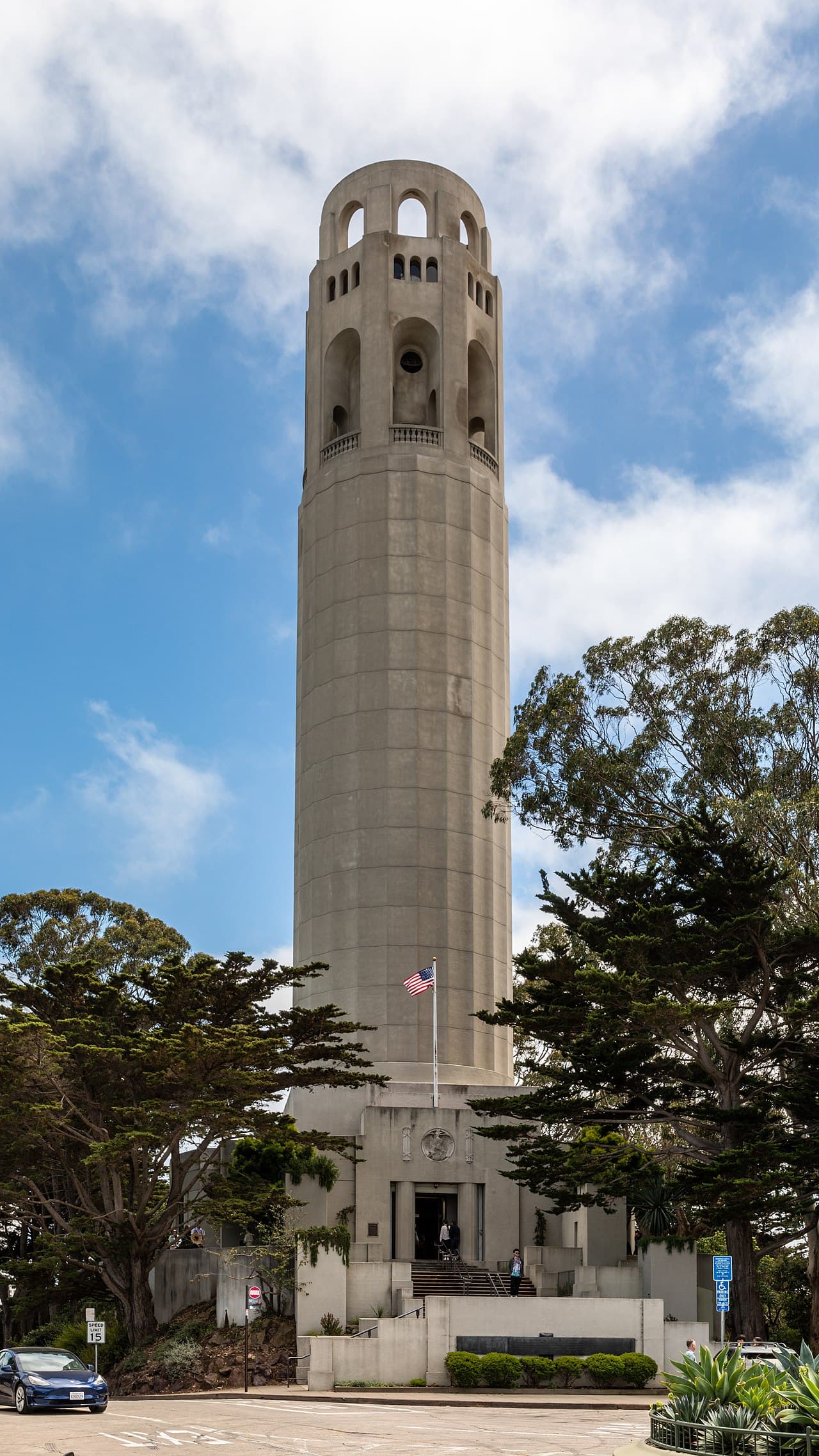
You made it. Catch your breath and turn around. That view — the Bay Bridge to the east, the Financial District's glass towers, Alcatraz sitting in the bay like a stone fist, the Golden Gate Bridge framing the horizon to the west. On a clear day, this is one of the great views in any city on earth.
Now look at the tower itself. Coit Tower is a fluted concrete column, two hundred and ten feet tall, standing on the summit of Telegraph Hill. And it exists because of one of the most wonderfully eccentric women San Francisco has ever produced.
Read more...Show less
Lillie Hitchcock Coit arrived in San Francisco as a child in the eighteen fifties. In eighteen fifty-eight, when she was fifteen years old, she was walking home and saw Knickerbocker Engine Company Number Five struggling to pull their fire engine up a hill — they were short-handed and losing the race to a fire. Lillie threw down her schoolbooks, grabbed the rope, and started pulling. A crowd gathered and joined in, and Knickerbocker Five made it to the fire.
From that day on, Lillie was obsessed with firefighting. She attended every fire she could, chasing the engines through the streets, sometimes still in her evening gown. Knickerbocker Five made her an honorary member in eighteen sixty-three — the only woman ever given that honor. She embroidered a gold numeral five on everything she owned and signed her name Lillie Hitchcock Coit Five.
She was also a crack shot, a poker player, a cigar smoker, and she occasionally dressed in men's clothing to sneak into places women weren't allowed. Victorian San Francisco didn't quite know what to do with her.
When Lillie died in nineteen twenty-nine, she left a third of her estate to the city, with instructions to use it to add to the beauty of the city which I have always loved. The city used the money to build this tower, completed in nineteen thirty-three.
Now, you'll hear people say the tower was designed to look like a fire hose nozzle as a tribute to Lillie's love of firefighting. It does look like one. But the architect, Arthur Brown Junior, said the resemblance was coincidental.
Before you leave, step inside. The ground floor is covered in murals painted in nineteen thirty-four by twenty-six artists as part of the Works Progress Administration during the Great Depression. The murals depict California life — farm workers, factory workers, city streets, libraries. They were controversial from day one. Several panels include radical imagery — a hammer and sickle, labor newspapers, clenched fists. The tower's opening was actually delayed while officials debated whether to paint over them. They didn't, thankfully. The tower finally reopened on October twelfth, nineteen thirty-four.
When you're ready, head to the east side of the tower and look for the Filbert Street Steps heading downhill toward the Embarcadero. That hidden staircase through the gardens is our final stop — and if we're lucky, you'll hear the parrots before you see them.
Filbert Street Steps & Wild Parrots

And here we go — down the Filbert Street Steps, one of the great hidden treasures of San Francisco. This wooden and concrete staircase plunges down the east face of Telegraph Hill through a canopy of trees, flowering gardens, and overgrown cottages that look like they belong in a fairy tale rather than a major American city.
The gardens on either side are maintained by volunteers — residents of the tiny cottages that cling to the hillside. You'll see fuchsia, roses, agapanthus, birds of paradise. Hummingbirds dart between the flowers. It feels impossibly lush, impossibly quiet, just steps from downtown.
Read more...Show less
And then — listen. Do you hear that? A high-pitched screeching, getting louder. Look up into the treetops. Those flashes of red and green? Those are the wild parrots of Telegraph Hill.
They're cherry-headed conures, native to the forests of Ecuador and Peru. They are definitely not supposed to be here. The colony started in the nineteen eighties, when escaped or released pet birds found each other and began breeding on Telegraph Hill. Many of the original birds had leg bands — proof they'd been captive. They chose this hillside because the lush gardens and warm microclimate reminded them, apparently, of home.
The flock grew. By the early two thousands, there were dozens of them — screaming through the trees, squabbling over berries, and completely charming the neighbors. A filmmaker named Judy Irving made a documentary about them in two thousand three called The Wild Parrots of Telegraph Hill, following a musician named Mark Bittner who had befriended the flock. The film became an unexpected hit and made the parrots famous.
They're still here. The flock has grown and spread to other parts of the city, but Telegraph Hill remains their stronghold. If you're lucky, you'll see them clustered in the cypress trees, preening and chattering. If you're very lucky, one will land close enough for you to see that brilliant red head and green body. They look like someone painted a parrot in the most outrageous colors possible and then set it loose in Northern California.
Keep heading down the steps. The staircase eventually delivers you to Sansome Street, and from there it's a short walk south to Levi's Plaza — the headquarters of Levi Strauss, the company that made its fortune selling denim to Gold Rush miners. There's good coffee at the cafe there, and benches where you can sit and process everything you've just seen.
And that's our walk. You've gone from the Dragon Gate to Telegraph Hill, through two of the most layered neighborhoods in America. You've passed through a hundred and seventy years of history — Gold Rush immigrants and Beat poets, fortune cookies and fire engines, a goddess on the fourth floor and parrots in the treetops. San Francisco keeps all of it, somehow, piled on top of itself on these impossible hills.
Thanks for walking with me. Enjoy the city.
Free
GPS-guided walking tour
No account needed. Walk at your own pace.
Free
10 stops · 2.7 km