In the mid-nineteenth century, Barcelona was suffocating. Crammed inside medieval walls with a population density higher than contemporary London, the city was ravaged by cholera and typhus. Life expectancy in the poorest quarters was barely 23 years. When the walls finally came down in 1854, civil engineer Ildefons Cerda seized the moment with one of the most ambitious urban plans ever conceived: a vast grid expansion that would give every resident equal access to sunlight, fresh air, and public services.
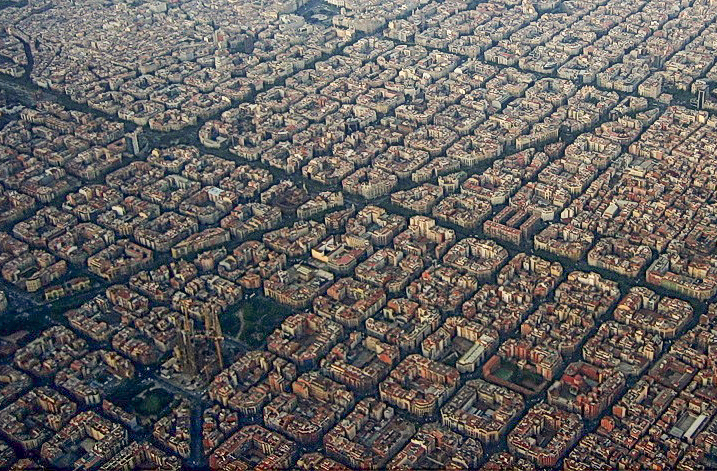
Cerda's 1859 plan divided the new district into square blocks measuring 113 by 113 metres, with distinctive 45-degree chamfered corners that created small octagonal plazas at every intersection — improving visibility and allowing trams to turn. Streets were 20 metres wide (with 5-metre pedestrian sidewalks on each side), and the two main arteries, Gran Via and Passeig de Gracia, were given extra width of 50 and 60 metres respectively. Each twenty-block unit was designed as a self-sustaining neighborhood with its own market, school, and services.
It was utopian, and reality quickly corrupted it. Developers filled in the communal garden courtyards that Cerda had mandated, built higher than his limits allowed, and turned the democratic vision into prime real estate. But the grid survived, and the Eixample became the showcase for Catalan Modernisme. Gaudi's Casa Batllo and La Pedrera, Domenech i Montaner's Hospital de Sant Pau, Puig i Cadafalch's Casa Amatller — the Eixample's boulevards are an open-air museum of Art Nouveau architecture.
Walk the chamfered corners today and you can still feel Cerda's logic at work. The octagonal intersections remain distinctive, and the grid is navigable even without a map. It's one of the few urban plans from the 1800s that still works as well today as it was designed to.
Verified Facts
Ildefons Cerda's 1859 plan created a grid of 113x113 metre blocks with 45-degree chamfered corners
Streets were designed at 20 metres wide with Passeig de Gracia at 60 metres and Gran Via at 50 metres
Life expectancy in Barcelona's poorest quarters before the walls came down was barely 23 years due to overcrowding and disease
The medieval walls of Barcelona were demolished in 1854, enabling Cerda's expansion plan to proceed
Get walking directions
Eixample, Barcelona, Spain