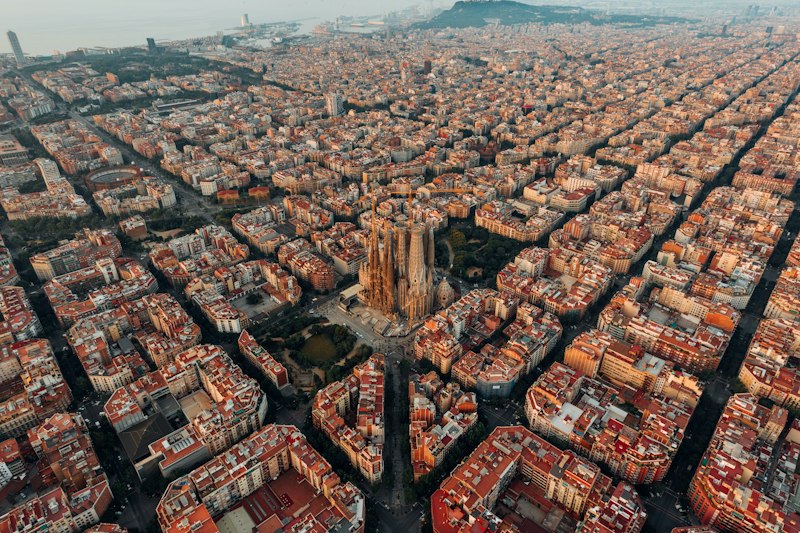
Walking Tours in Barcelona
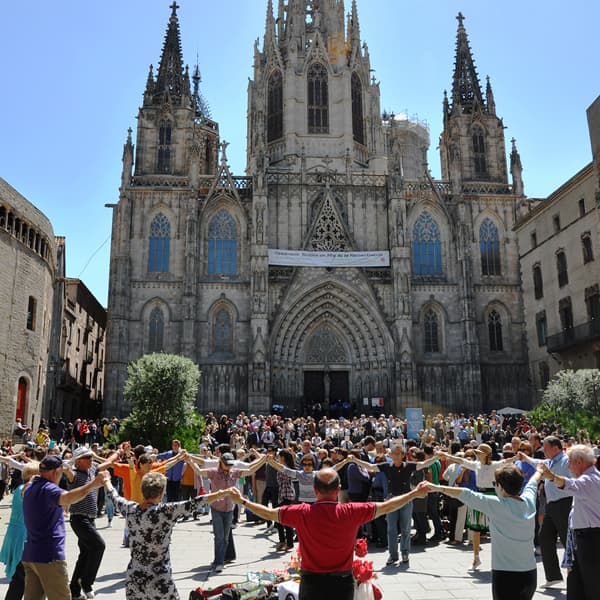
Barcelona City Walk
A 3.5 km GPS-guided walk through the heart of Spain. Visit Barcelona City Walk, The Ramblas, Carrer de Santa Anna, Church of Santa Anna, and Avinguda del Portal de l’Angel — with narrated stories at every stop.
Barcelona: Barceloneta — From Fishermen's Quarter to the Sea
Deep into the 18th-century fishing village grid — birthplace of the bomba croquette, barefoot flamenco, standing-room cava bars, and the clock tower that helped define the meter.
Barcelona: Eixample — Gaudí & the Modernist Rivals
The battle of the architects — three rivals on one block, a quarry that scandalized a city, a house with two faces, and a sculptor who hid a cyclist in the stonework.
Barcelona: El Born & La Ribera — Medieval Merchants' Quarter
Through the medieval merchants' quarter east of the Gothic Quarter — Picasso's formative streets, a 2,000kg stained glass skylight, excavated 1714 siege ruins, and the cathedral the dock workers built.
Barcelona: Gaudí, Gothic Quarter & La Rambla
Begin inside Gaudí's unfinished masterpiece — the most visited building in Spain — walk the medieval lanes of the Gothic Quarter past a Roman temple and a cathedral built over a mosque, stroll La Rambla past flower stalls and mimes, reach the waterfront where Columbus pointed toward the New World, and understand a city that invented its own kind of beauty.
Barcelona: Las Ramblas — Beyond the Tourist Trap
The real stories behind Barcelona's most famous street — an anarchist's bomb at the opera, a Miró mosaic everyone walks over, Gaudí's first commission, and an 800-year-old goat market turned foodie paradise.
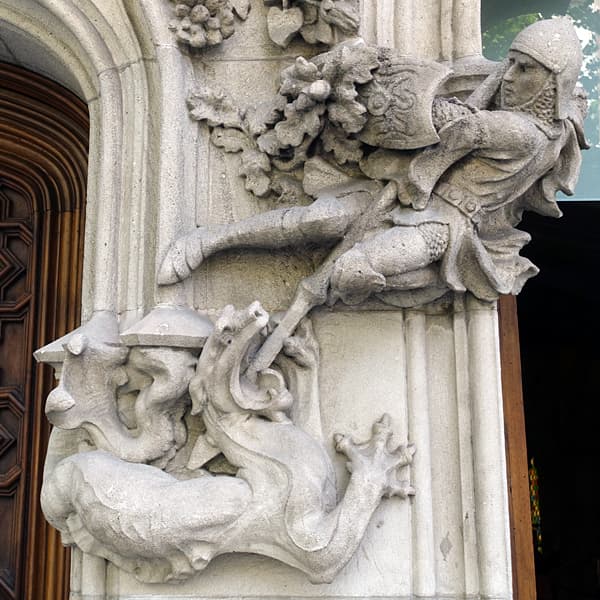
Barcelona's Eixample Walk
A 17-stop walking tour through the heart of Spain. Visit The Eixample Walk, La Pedrera (a.k.a. Casa Milà), Carrer de Provença, and Rambla de Catalunya — with narrated stories at every stop.
30 Landmarks in Barcelona
Arc de Triomf
Passeig de Lluís Companys, Ciutat Vella, Barcelona, 08003, Spain
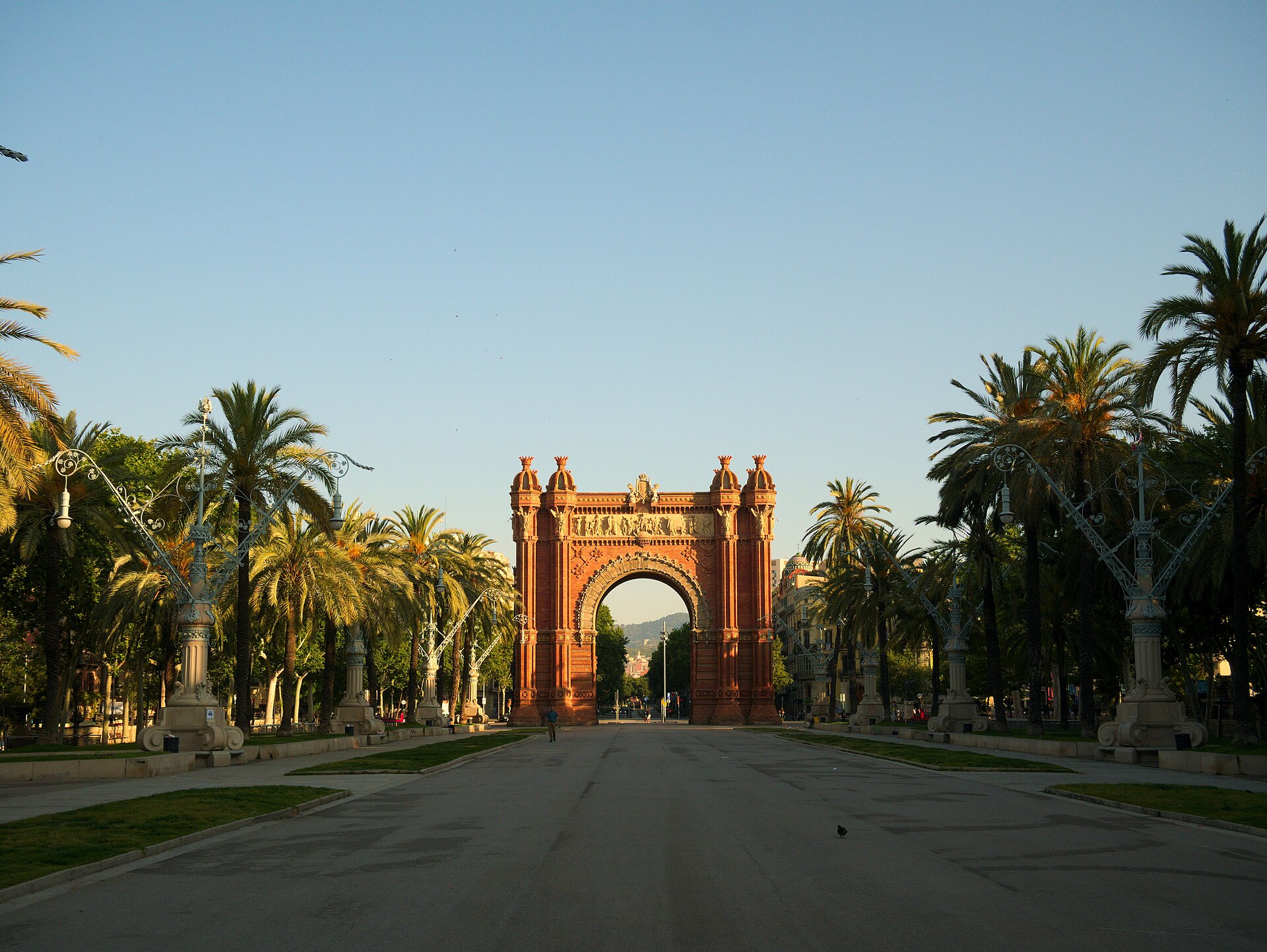
Unlike most triumphal arches, this one isn't celebrating a military victory. When architect Josep Vilaseca i Casanovas designed Barcelona's Arc de Triomf in 1888, it was built as the main entrance to the Universal Exposition — a gateway to a world's fair, not a battlefield monument. It was meant to welcome visitors rather than intimidate them, and that spirit is embedded in the design. The arch stands 30 metres tall and is built entirely of red brick in the Neo-Mudejar style, drawing on the Islamic architectural traditions of southern Spain rather than the Roman imperial model used by Paris and other European cities. It was a deliberate statement of Spanish identity. At the top, the coats of arms of all 49 Spanish provinces encircle the crown of Barcelona at the center. Themed friezes around the arch represent agriculture, industry, commerce, science, and the arts — the peaceful pursuits of a nation trying to present itself as modern and cosmopolitan. The 1888 Exposition was a pivotal moment for Barcelona. It was Spain's first international world's fair and announced Barcelona as a European capital capable of hosting the world. The fair was held in the Parc de la Ciutadella, and the arch marks the beginning of the Passeig de Lluis Companys, the wide promenade that leads directly to the park. Today the promenade is one of the best people-watching spots in Barcelona. Skateboarders use the wide paving as a practice ground, musicians busk under the trees, and on weekends the walkway fills with families, runners, and vendors. The arch frames the tree-lined avenue perfectly, and at sunset the red brick catches the last light in a way that makes it glow.
Barcelona Cathedral
Ciutat Vella, Barcelona, Spain
Christians have been worshipping on this spot since the fourth century, and the building you see today is the third church to stand here. Count Ramon Berenguer I and his wife Almodis began a Romanesque cathedral on these foundations in 1046, but the current Gothic structure wasn't started until May 1, 1298. It took 150 years to build — the cloister was completed in 1448 — and then Barcelona ran out of money for the facade, leaving a plain flat wall for over four centuries. That unfinished front didn't get its elaborate neo-Gothic makeover until 1882 to 1913, when architects Josep Oriol Mestres and August Font i Carreras finally gave the cathedral the ornate entrance it deserved, funded by a wealthy banker named Manuel Girona. So the facade that looks the most medieval is actually the newest part — younger than many of Barcelona's Modernista buildings. Inside, the cathedral is dedicated to the Holy Cross and Saint Eulalia, Barcelona's co-patron saint who, according to tradition, was martyred by the Romans at the age of thirteen. Her alabaster sarcophagus sits in the crypt, and the cloister houses thirteen white geese — one for each year of her life. The geese have lived in the cathedral's cloister garden since at least the medieval period, and their honking echoes off the Gothic arches in a way that never stops being surreal. The cloister itself is a hidden jewel: a palm-shaded courtyard with a moss-covered fountain and that flock of geese, tucked away from the tourist crush of the Barri Gotic. Look for the small chapel doors ringing the walkway — there are twenty-six of them, each paid for by a different medieval trade guild.
Barceloneta Beach
Passeig Marítim de la Barceloneta, Ciutat Vella, Barcelona, 08003, Spain
Thirty-five years ago, this beach didn't exist. The entire Barceloneta waterfront was an industrial wasteland of railway sidings, derelict warehouses, and factories that had turned their backs on the sea. Barcelona was a major Mediterranean city that had essentially walled itself off from its own coastline. Then the city won the bid for the 1992 Olympics, and everything changed overnight. The Olympic transformation created a two-mile strip of beach where there had been none. The Passeig Maritim was laid out with bars, restaurants, and Frank Gehry's shimmering "Peix d'Or" sculpture — a 52-metre golden fish — at the Port Olympic end. It was the single most dramatic piece of urban renewal in Barcelona's modern history, and it turned a working-class fishing neighborhood into one of the city's most desirable postcodes. But Barceloneta itself is much older than its beach. The neighborhood was built in the mid-eighteenth century for residents displaced when King Philip V demolished the Ribera quarter to build the military fortress of the Ciutadella after the War of 1714. Military engineer Juan Martin Cermeno designed the area on a grid of narrow streets with uniform low-rise buildings. The triangular neighborhood still has that compact, village-like feel — laundry strung between balconies, old men playing dominoes on the Placa de la Barceloneta. Rebecca Horn's rusting steel sculpture "Homenatge a la Barceloneta" stands on the sand like a monument to the old chiringuitos — the beach shacks that were cleared away during the Olympic cleanup. It's a memorial to what was lost as much as a marker of what was gained.
Bunkers del Carmel
Carrer del Turo de la Rovira, Horta-Guinardó, Barcelona, 08032, Spain
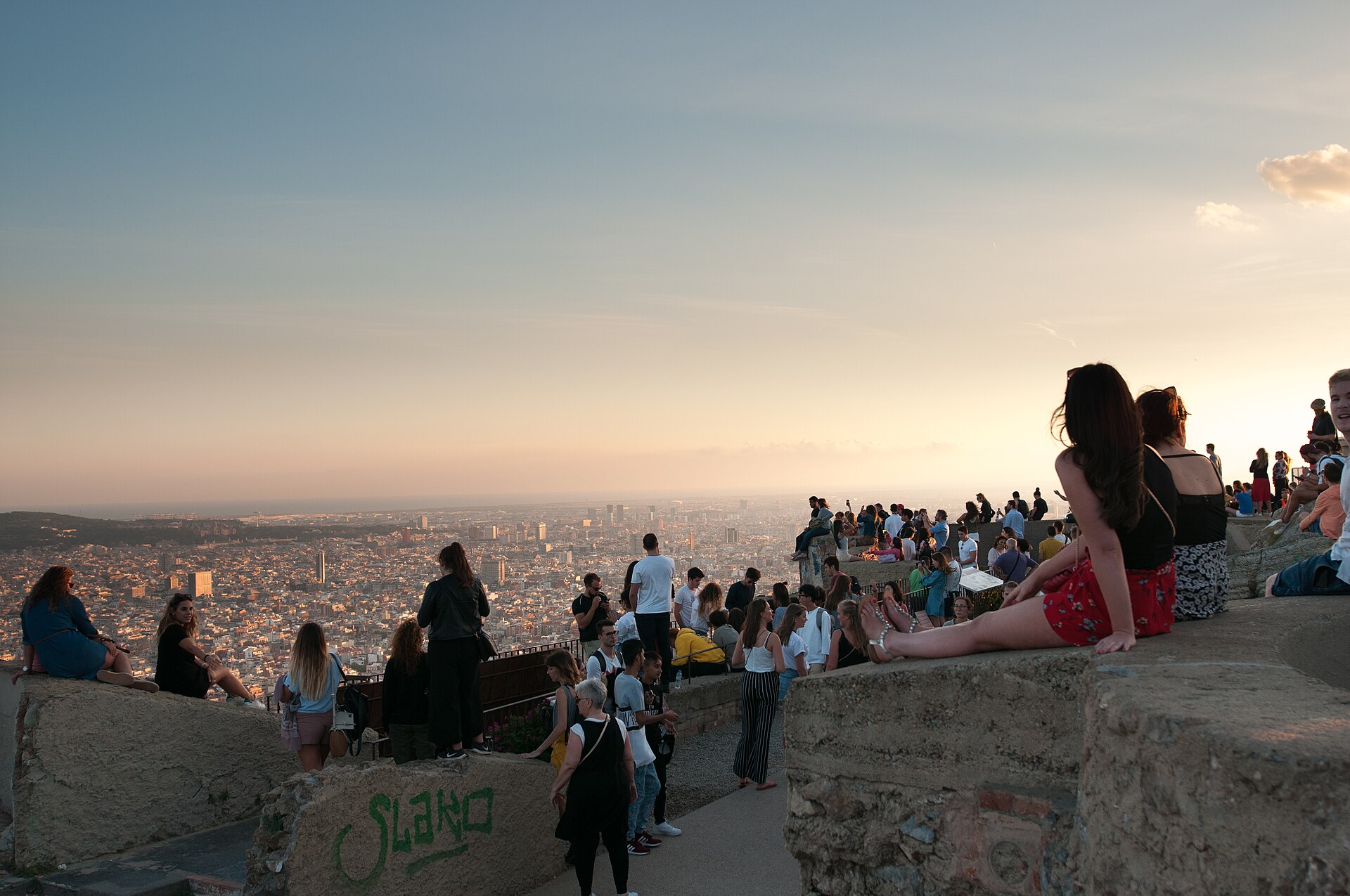
Barcelona holds a grim distinction: it was the first major city in history to be massively and systematically bombed from the air. During the Spanish Civil War, Italian Legionary Air Force planes and the German Condor Legion dropped their payloads on residential neighborhoods, killing an estimated 2,750 people and injuring 7,000 more over roughly 200 bombing raids. In 1938, the Republic built this anti-aircraft battery on the Turo de la Rovira, a 262-metre hilltop in the Carmel neighborhood, to try to defend the city. After the war ended, the abandoned gun emplacements took on a second life. In the 1940s, families from southern Spain — mostly impoverished migrants who couldn't afford housing — built a shantytown among the bunker ruins called "Els Canons." At its peak, about 110 shacks housed 600 people on this hilltop. The settlement survived for decades until the Barcelona City Council relocated all residents to proper housing before the 1992 Olympics, clearing the site entirely. The bunkers sat forgotten and overgrown for years until 2011, when MUHBA (the Barcelona History Museum) excavated and partially restored the site, installing a small museum inside one of the bunkers that tells the story of both the wartime battery and the postwar shantytown. It was a neighborhood twice — first as a military installation, then as an informal village — and both layers of history are still visible. The views are why people come now. At 262 metres above sea level and positioned almost exactly at the geographic center of the city, the Turo de la Rovira offers an unobstructed 360-degree panorama: the Sagrada Familia, the sea, Montjuic, the Eixample grid stretching to the hills. It's free, it's never as crowded as Park Guell, and at sunset it might be the best seat in Barcelona.
Camp Nou
Carrer d' Aristides Maillol, Les Corts, Barcelona, 08028, Spain
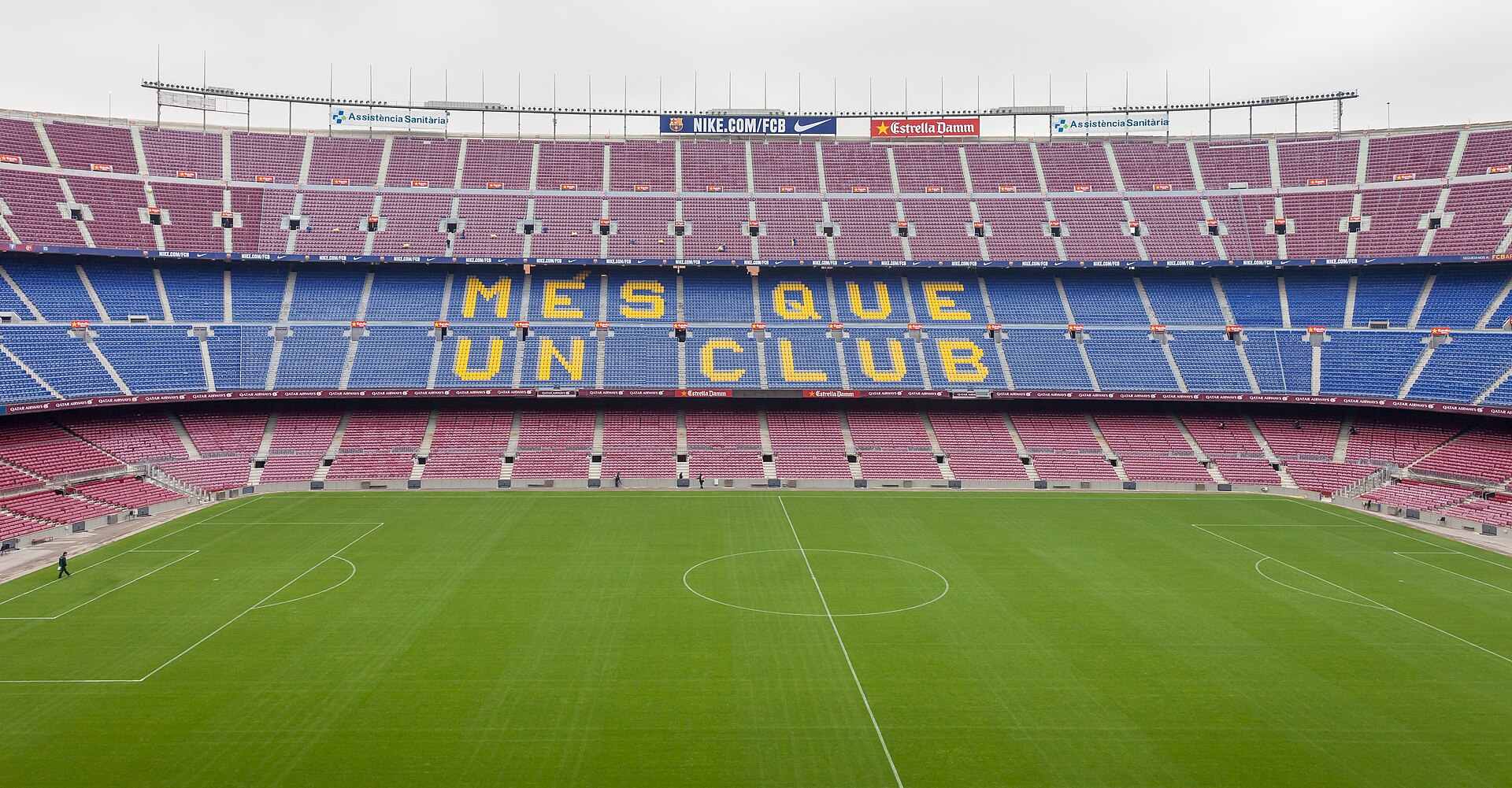
FC Barcelona is famously "more than a club," and its stadium is more than a stadium. During the Franco years, when the Catalan language was banned and regional identity was suppressed, Camp Nou became one of the only places where 100,000 Catalans could gather and, in the privacy of a roaring crowd, speak their language and express their identity. The stadium was a sanctuary of resistance disguised as a football ground. Construction started on March 28, 1954, driven in part by the 1950 signing of Laszlo Kubala, a Hungarian striker so talented that Barcelona's old ground at Les Corts simply couldn't hold the crowds that came to watch him. Camp Nou was inaugurated on September 24, 1957, with around 90,000 people in the stands. The capacity grew to 121,401 for the 1982 FIFA World Cup, and the record attendance was set on March 5, 1986, when 120,000 packed in for a European Cup quarter-final against Juventus. In 2022, music streaming service Spotify acquired the naming rights for four years in a deal worth $310 million, officially rebranding it "Spotify Camp Nou." A massive renovation began after the 2022-23 season to modernize the aging structure. The stadium partially reopened in November 2025 at reduced capacity, with full completion of the 105,000-seat renovation scheduled for June 2026. The club's motto — "Mes que un club" — is embedded in the stadium's identity. This is where Cruyff, Maradona, Ronaldinho, and Messi played. The museum inside is the most visited museum in Barcelona, drawing more visitors per year than the Picasso Museum. Football or not, the scale of the place is humbling.
Casa Batllo
43 Passeig de Gràcia, Eixample, Barcelona, 08007, Spain
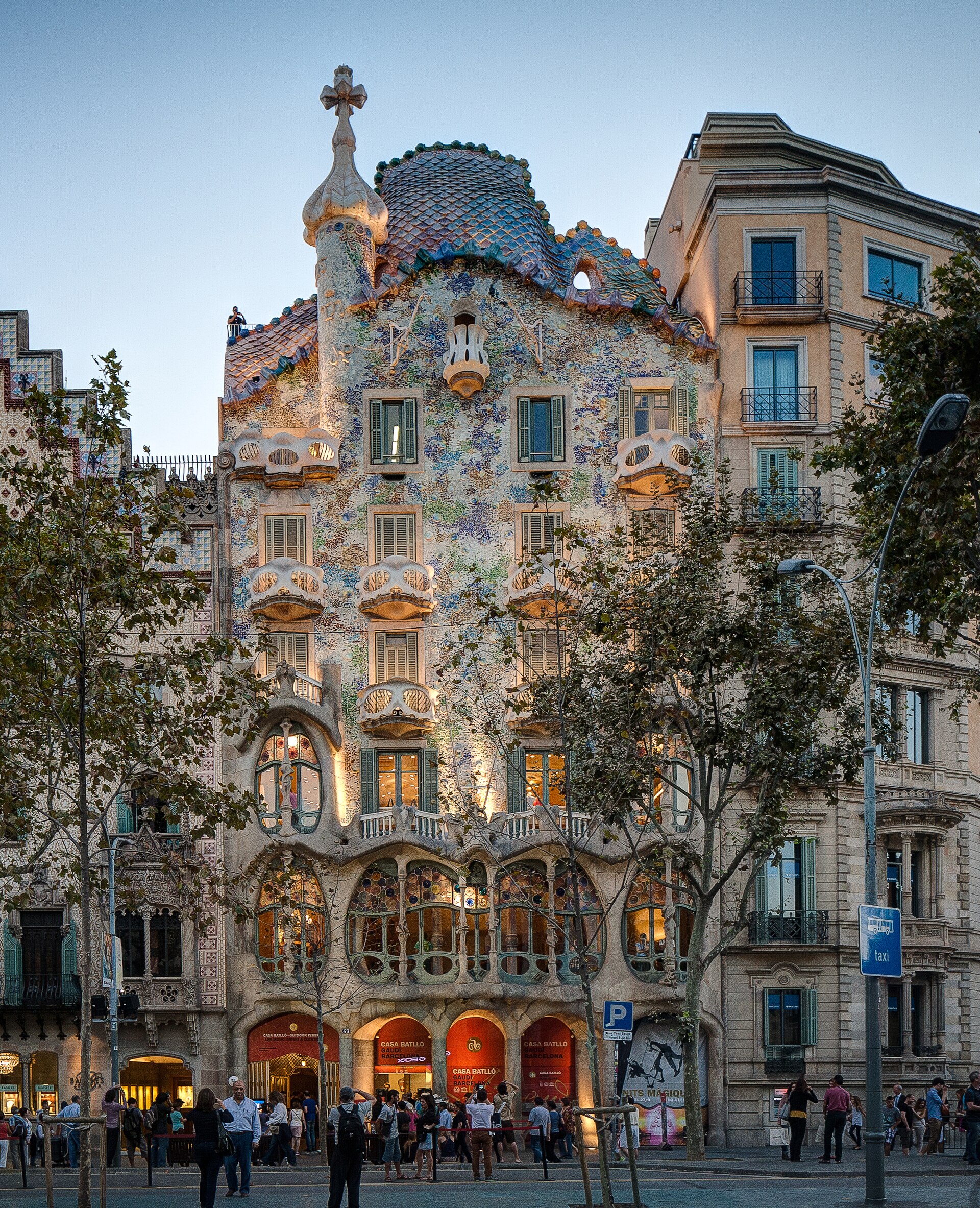
The locals call it the "House of Bones," and once you see it, you'll understand why. The balconies look like skulls, the columns resemble tibias, and the entire facade ripples as if the building is breathing. In 1904, textile industrialist Josep Batllo hired Gaudi to demolish his unremarkable apartment block and start fresh. Gaudi talked him out of demolition and instead performed what might be the most spectacular renovation in architectural history, finishing in 1906. The most widely accepted interpretation is that the whole building is a three-dimensional tribute to Catalonia's patron saint, Sant Jordi, and his battle with the dragon. The roof, covered in iridescent ceramic scales, represents the dragon's back. The tower topped with a cross is Sant Jordi's lance, plunged into the beast. The facade's bone-like columns are the dragon's victims. It's a fairy tale told entirely through architecture. Casa Batllo sits on the Passeig de Gracia in a stretch known as the "Block of Discord" — a row of buildings by four different Modernista architects all competing for attention. Gaudi's neighbors include Domenech i Montaner's Casa Lleo Morera and Puig i Cadafalch's Casa Amatller. The name isn't about conflict — "discordia" references the mythological apple of discord, because deciding which building is most beautiful is an impossible judgment. The building was listed in Barcelona's Heritage Catalogue in 1962, declared a Historic and Artistic Monument in 1969, and became a UNESCO World Heritage Site in 2005. After hosting various businesses and residents for decades, the Bernat family opened the house to the public in 1995. It now welcomes roughly one million visitors per year.
Casa Mila (La Pedrera)
92 Passeig de Gràcia, Eixample, Barcelona, 08008, Spain
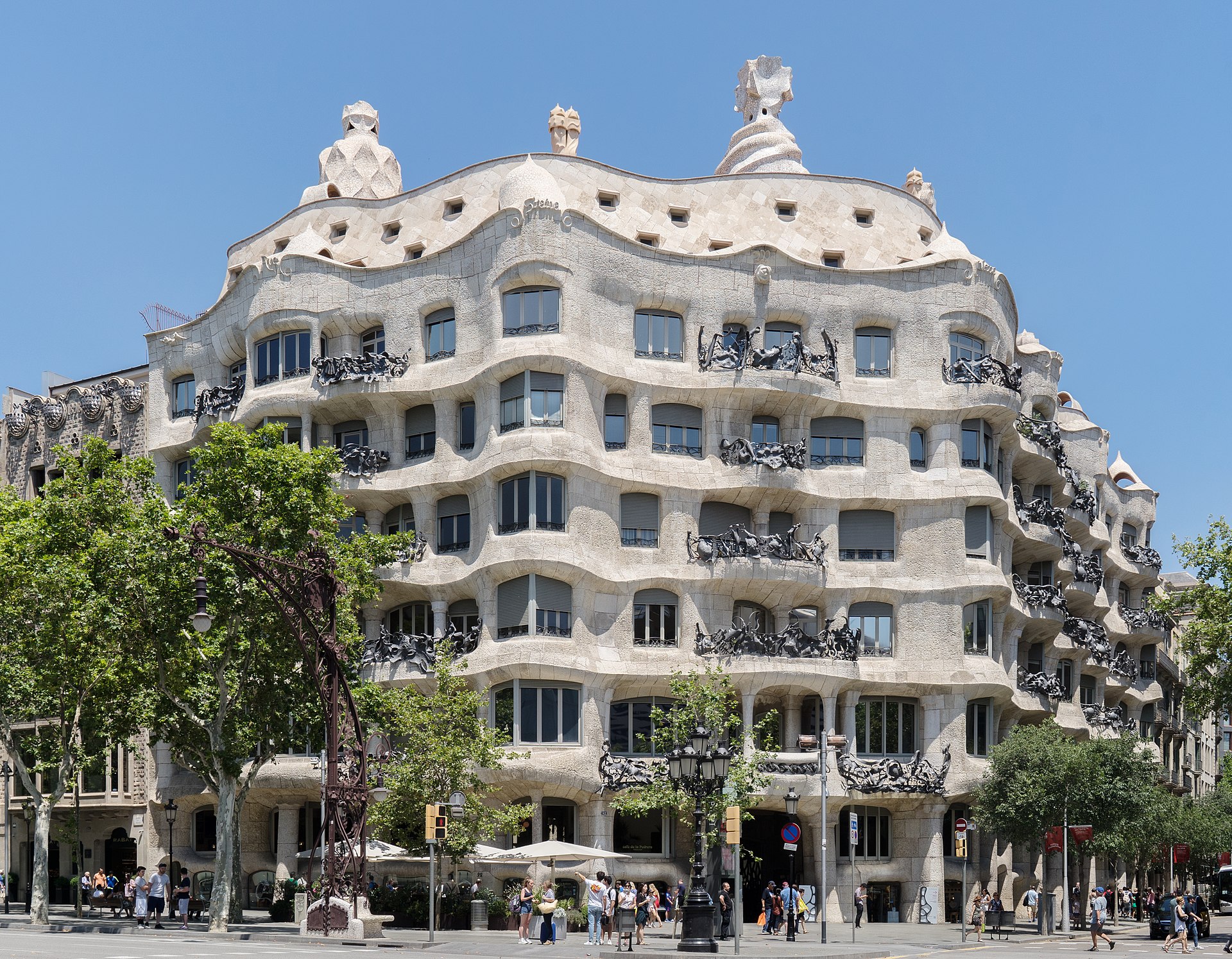
When this building went up between 1906 and 1912, Barcelonans thought it was so ugly they called it "La Pedrera" — the quarry. Satirical newspapers compared it to a garage for zeppelins. Cartoonists drew tenants trying to park their blimps on the undulating facade. It was Gaudi's last private commission, and he didn't care one bit what anyone thought. Pere Mila and his wife Roser Segimon had commissioned Gaudi to build a luxury apartment block on the prestigious corner of Passeig de Gracia and Carrer de Provenca. What Gaudi delivered was a building with no straight lines, no load-bearing walls, and a self-supporting stone facade that was revolutionary for its time. The entire floor plan is flexible — interior walls can be moved or removed without affecting the structure, a concept that wouldn't become standard in architecture for another half century. It was also the first building on Passeig de Gracia with an underground parking garage, designed for horse-drawn carriages. The rooftop is where Gaudi let his imagination loose. The ventilation shafts and chimneys are sculpted into warrior-like figures — some wearing helmets, others resembling storm troopers decades before Star Wars existed. George Lucas has never confirmed the connection, but the resemblance is uncanny and widely noted. The rooftop terrace offers sweeping views across the Eixample to the Sagrada Familia and the sea. In 1984, La Pedrera was declared a UNESCO World Heritage Site alongside Park Guell and Palau Guell. The building still functions as apartments on several floors — real people live behind that famous facade — while the attic, rooftop, and a recreated early-twentieth-century apartment are open to visitors.
Columbus Monument
Plaza Portal de la Pau, Ciutat Vella, Barcelona, 08002, Spain
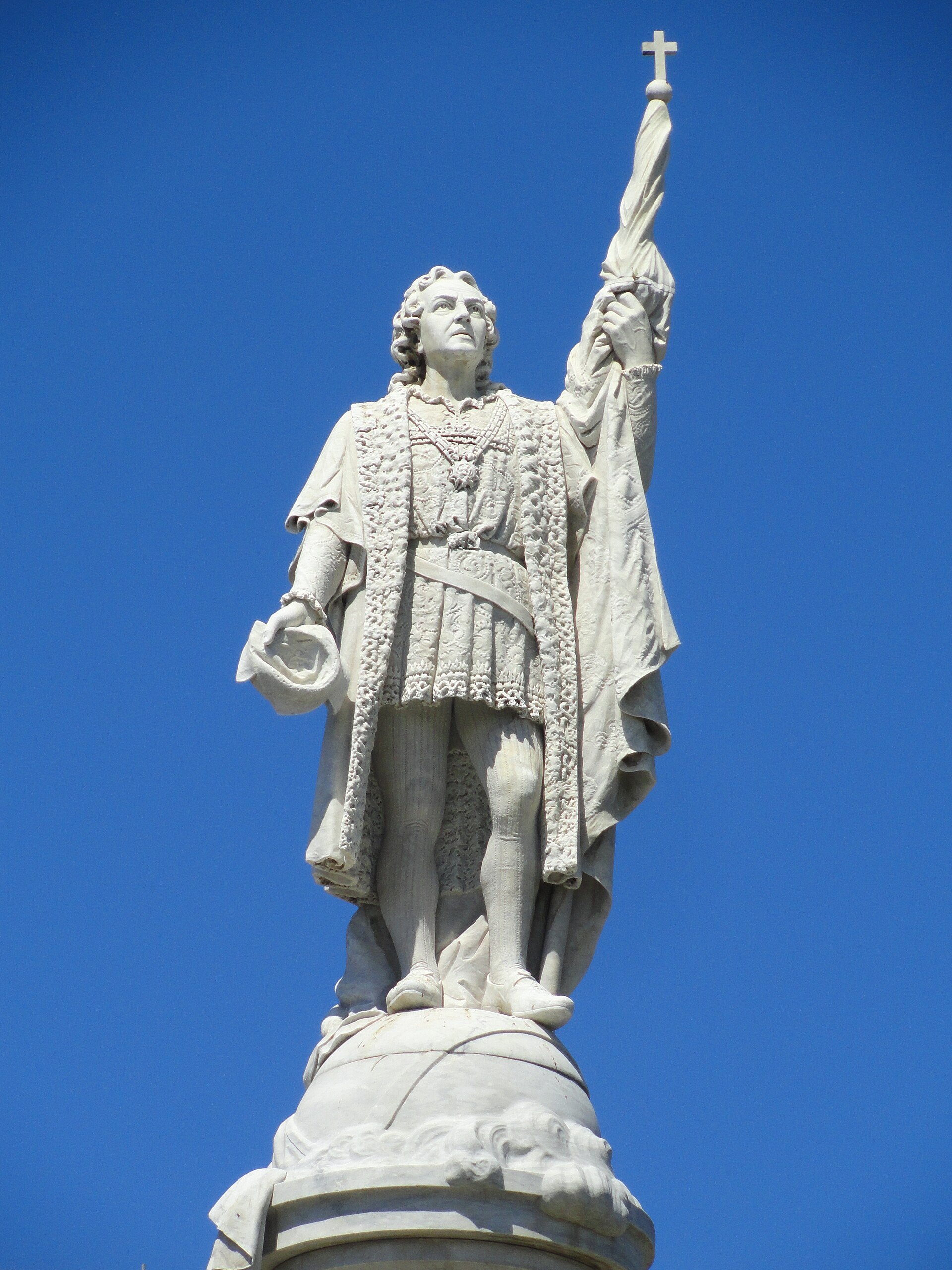
The idea to build this monument came from a man named Antonin Fages i Ferrer in 1856, and it took him sixteen years of failed attempts before Barcelona's mayor finally backed the project in 1872. A competition was held among Spanish artists, won by Catalan architect Gaeta Buigas i Monrava. The monument was inaugurated on June 1, 1888, just in time for the Universal Exposition, and most of the money came from private donors — only twelve percent was publicly funded. The column stands 60 metres tall, with a 40-metre Corinthian column supporting a bronze statue of Columbus by sculptor Rafael Atche. He points his right hand outward with a scroll of parchment in his left. There's an old joke that he's pointing toward Mallorca rather than the Americas, but the direction is roughly southeast — which at least gets you to the Mediterranean. An elevator inside the iron column takes visitors to a small viewing platform at the top, just below Columbus's feet. The monument marks the approximate spot where Columbus is believed to have been received by King Ferdinand and Queen Isabella after returning from his first voyage to the Americas in 1493. Barcelona was the royal court's seat at the time, and the reception was reportedly lavish, with Columbus displaying gold, parrots, and several kidnapped indigenous people from the Caribbean. Four bronze statues at the top of the column represent the continents of Europe, Asia, Africa, and America. The stone base is covered with reliefs and figures of prominent Catalans linked to Columbus's voyages. At 60 metres, it's the largest Columbus monument anywhere in the world — there are 64 worldwide, and this one dwarfs them all.
Eixample District
Eixample, Barcelona, Spain
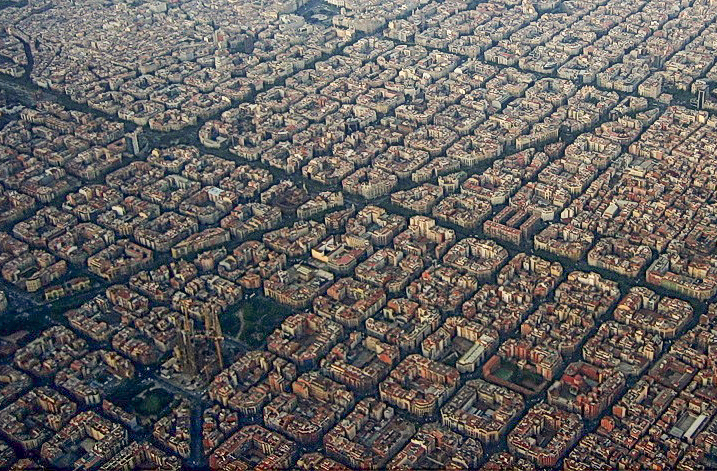
In the mid-nineteenth century, Barcelona was suffocating. Crammed inside medieval walls with a population density higher than contemporary London, the city was ravaged by cholera and typhus. Life expectancy in the poorest quarters was barely 23 years. When the walls finally came down in 1854, civil engineer Ildefons Cerda seized the moment with one of the most ambitious urban plans ever conceived: a vast grid expansion that would give every resident equal access to sunlight, fresh air, and public services. Cerda's 1859 plan divided the new district into square blocks measuring 113 by 113 metres, with distinctive 45-degree chamfered corners that created small octagonal plazas at every intersection — improving visibility and allowing trams to turn. Streets were 20 metres wide (with 5-metre pedestrian sidewalks on each side), and the two main arteries, Gran Via and Passeig de Gracia, were given extra width of 50 and 60 metres respectively. Each twenty-block unit was designed as a self-sustaining neighborhood with its own market, school, and services. It was utopian, and reality quickly corrupted it. Developers filled in the communal garden courtyards that Cerda had mandated, built higher than his limits allowed, and turned the democratic vision into prime real estate. But the grid survived, and the Eixample became the showcase for Catalan Modernisme. Gaudi's Casa Batllo and La Pedrera, Domenech i Montaner's Hospital de Sant Pau, Puig i Cadafalch's Casa Amatller — the Eixample's boulevards are an open-air museum of Art Nouveau architecture. Walk the chamfered corners today and you can still feel Cerda's logic at work. The octagonal intersections remain distinctive, and the grid is navigable even without a map. It's one of the few urban plans from the 1800s that still works as well today as it was designed to.
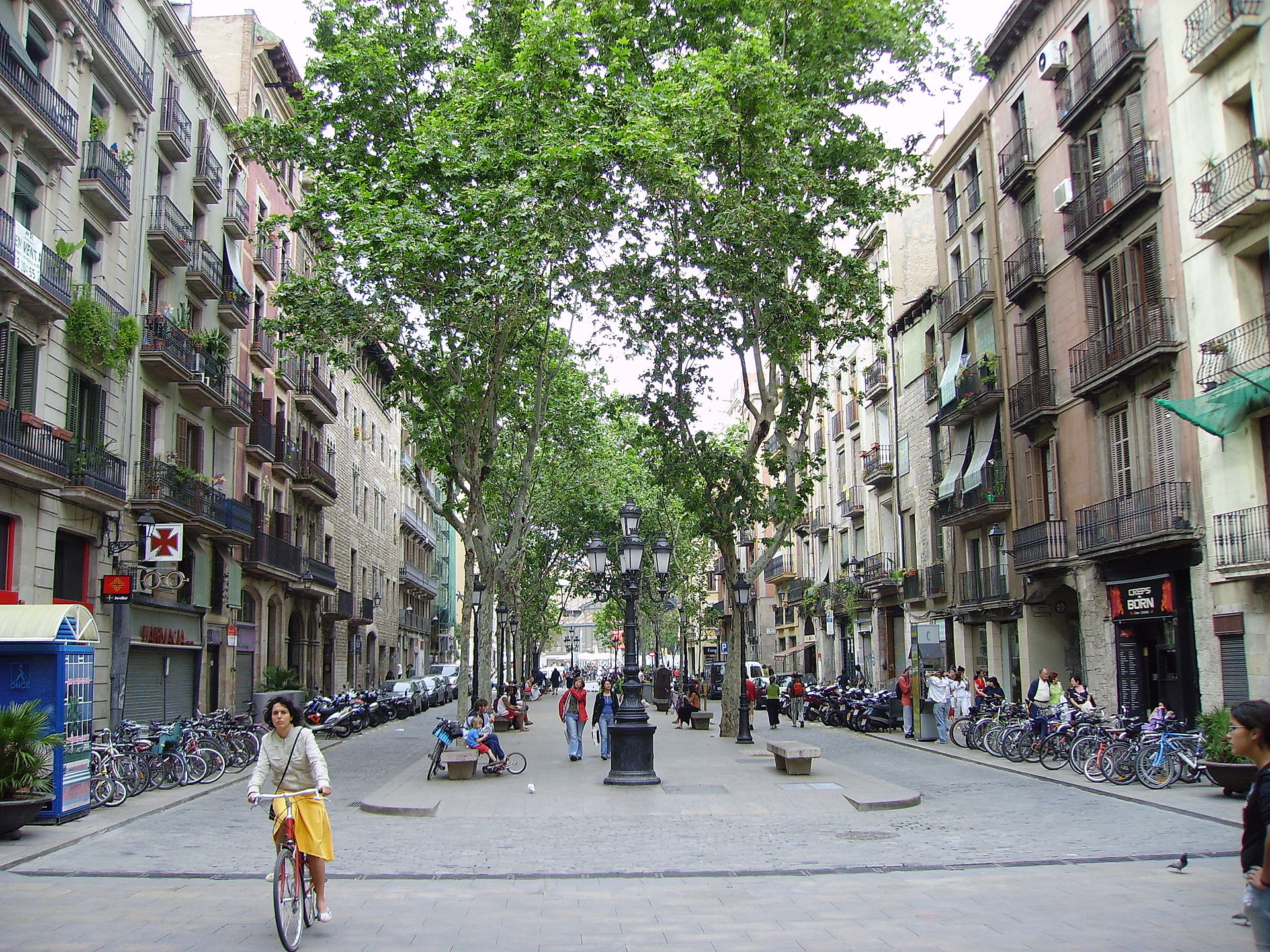
El Born Centre Cultural
12 Plaça Comercial, Ciutat Vella, Barcelona, 08003, Spain
In 2001, workers digging foundations for a new library accidentally uncovered an entire neighborhood that had been buried for three centuries. Beneath the iron-and-glass canopy of the old Born market, they found the remains of 42 streets and 60 houses that had formed part of the Ribera quarter — a thriving commercial district that King Philip V ordered demolished in 1714 as punishment after Barcelona fell in the War of the Spanish Succession. Philip didn't just destroy the neighborhood. He used the rubble to build the Ciutadella fortress directly on top of it, turning the homes and shops of thousands of displaced Barcelonans into the foundation of a military citadel designed to keep them in line. The residents were relocated to the hastily planned neighborhood of Barceloneta. It was one of the most vindictive acts of urban destruction in European history, and the discovery of the ruins turned a construction project into an archaeological sensation. The market building itself is worth attention. Designed by architect Josep Fontsere and completed in 1876, it was one of Barcelona's first structures built with an exposed iron framework, inspired by Les Halles in Paris. It served as a wholesale market from 1921 until 1971, sat abandoned for years, and was then repurposed as this extraordinary cultural center, inaugurated in 2013. Today you can walk above the excavated ruins on elevated walkways, looking down into the streets of 1714 Barcelona — complete with foundations of homes, wells, and drainage systems. The site has become a potent symbol of Catalan identity and resistance, particularly around the September 11 Diada, the national day of Catalonia that commemorates the 1714 defeat.
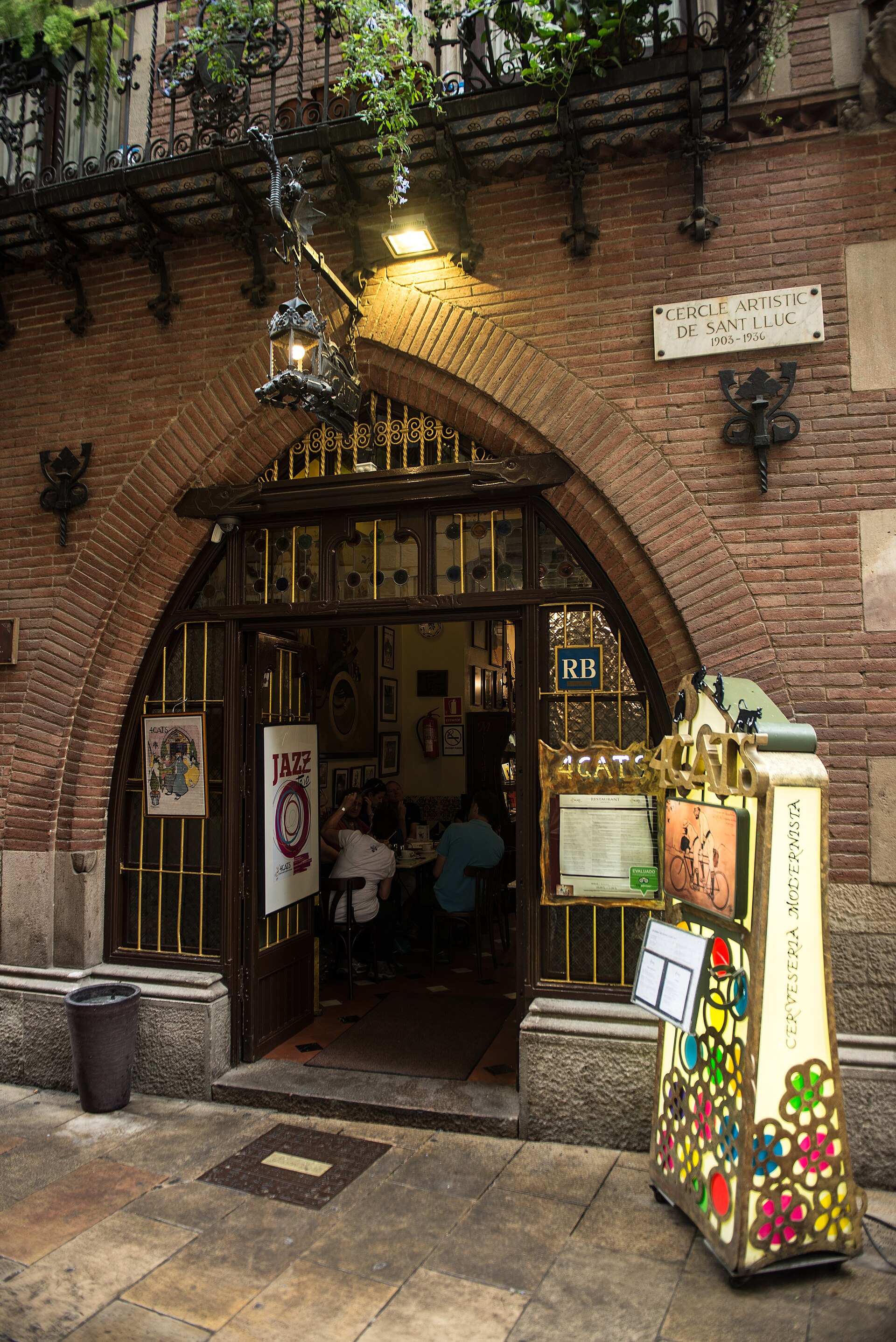
Els Quatre Gats
3 Carrer de Montsio, Ciutat Vella, Barcelona, 08002, Spain
In 1899, a seventeen-year-old Pablo Picasso walked into this cafe on Carrer de Montsio and held his first solo exhibition in the main room. He'd been frequenting the place for barely a year, sketching the regulars and soaking up the bohemian atmosphere. The exhibition didn't make him famous — that would take a few more years — but it marked the moment a teenage art student began behaving like a serious artist. He even designed the menu cover, which is still reproduced today. Els Quatre Gats — "The Four Cats" — opened in 1897 on the ground floor of Casa Marti, a neo-Gothic building designed by Josep Puig i Cadafalch in 1896. The name is a Catalan expression meaning "just a few people," referring to the outsiders and eccentrics who saw themselves as too interesting for mainstream society. The founders intended it as Barcelona's answer to Le Chat Noir in Paris: a bohemian cabaret where artists, writers, architects, and musicians could drink, argue, and show their work. And they came. Gaudi was a regular. So were architects Puig i Cadafalch and Domenech i Montaner, sculptor Julio Gonzalez, painters Ramon Casas and Santiago Rusinol. Casas painted a famous image of himself and the cafe's owner Pere Romeu riding a tandem bicycle, which hung on the wall. The cafe hosted puppet shows, piano concerts, art exhibitions, and the kind of heated arguments about aesthetics that could last until dawn. The original cafe closed in 1903 after just six years, but it was faithfully restored and reopened in 1978. Today you can eat a meal in the same room where Picasso showed his early work, surrounded by reproduction artwork and Gothic arches. The menu is solid Catalan cooking at tourist-area prices.
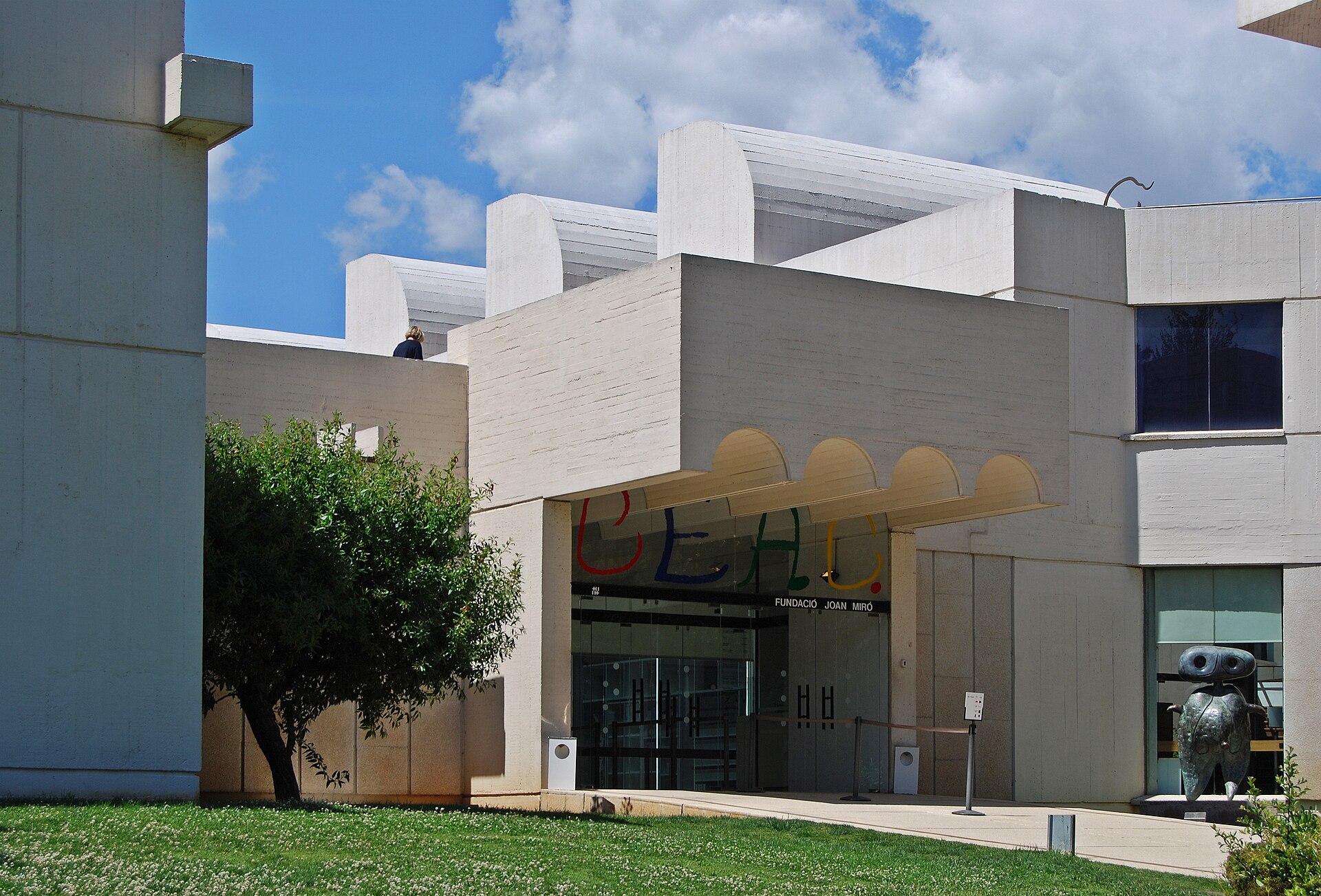
Fundacio Joan Miro
147 Pg Migdia, Sants-Montjuïc, Barcelona, 08038, Spain
Joan Miro wanted a museum that was the opposite of a museum. When he conceived the idea in 1968 with his friend Joan Prats, they imagined a living space where young artists could experiment, not a mausoleum of finished works under glass. Miro chose his friend Josep Lluis Sert — a Catalan architect who had designed the Spanish Republic's pavilion for the 1937 Paris Exposition (the one that displayed Picasso's Guernica) — to create a building that would be as much about light and movement as about the art inside. The foundation opened on June 10, 1975, just five months before Franco's death. That timing wasn't coincidental — Miro had waited decades to establish the foundation in Barcelona, and the project gathered momentum as the dictatorship weakened. The building sits on Montjuic hill, a white Mediterranean structure with open courtyards, rooftop terraces, and skylights that pour natural light onto the art. It was expanded in 1986 and 2000 and received the Twenty-Five Year Award from the American Institute of Architects in 2002. The collection is enormous: 217 paintings, 178 sculptures, 9 textile works, 4 ceramics, and nearly 8,000 graphic works — close to the complete graphic output of Miro's career. But the foundation also honors Miro's wish by maintaining "Espai 13," a dedicated space for young experimental artists, making it as much a launchpad as an archive. It was Barcelona's first contemporary art museum. Walk through the rooftop sculpture garden for views across Montjuic and the city. Miro's playful, primary-colored forms — half biology, half cosmos — look extraordinary against the blue Mediterranean sky.
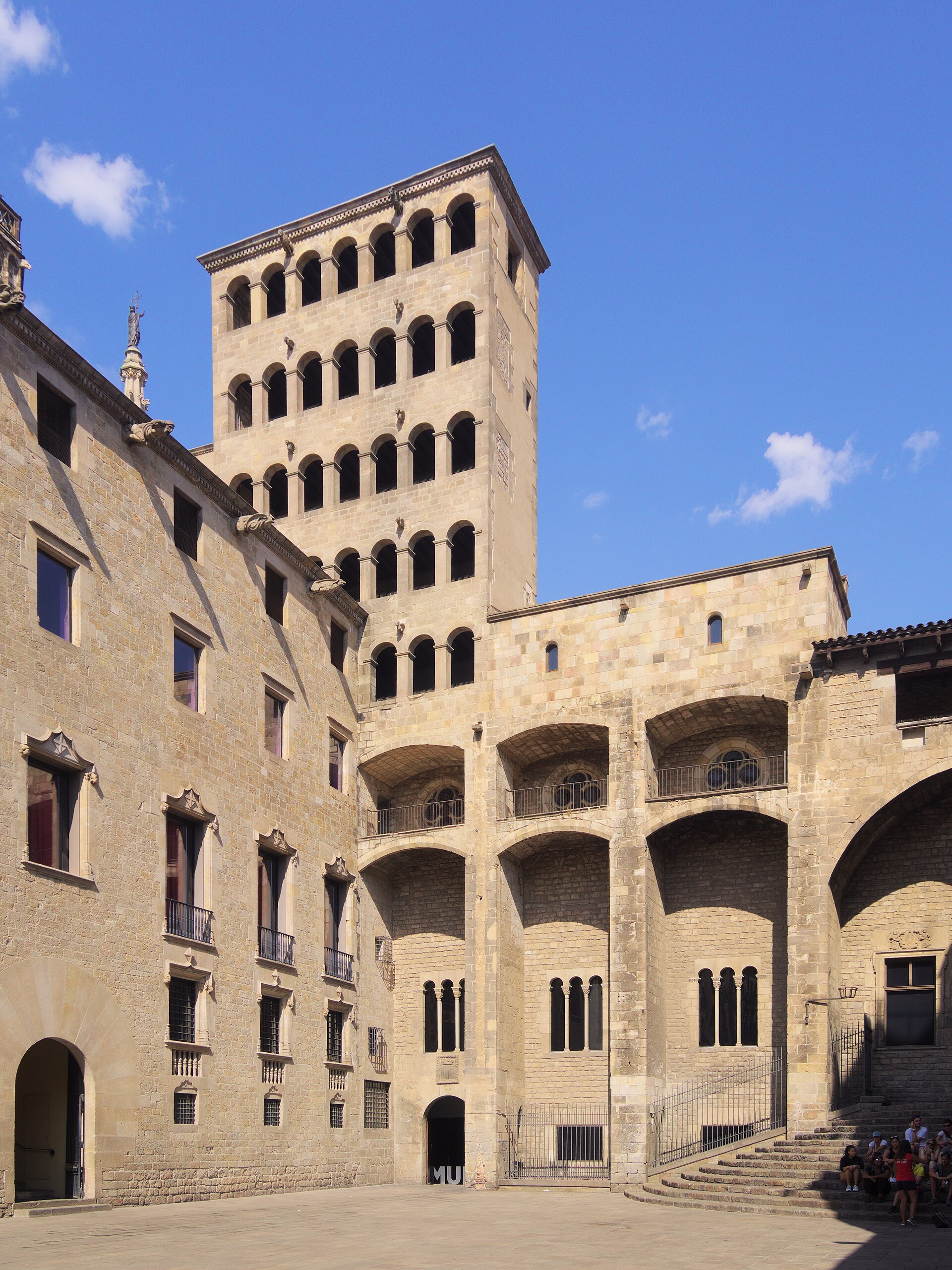
Gothic Quarter
Ciutat Vella, Barcelona, Spain
Here's the thing about Barcelona's Gothic Quarter: a surprising amount of it isn't actually Gothic. In the 1920s, the city embarked on an aggressive beautification campaign ahead of the 1929 International Exposition, and architects added neo-Gothic facades, moved medieval buildings stone by stone, and essentially dressed up the neighborhood to look more dramatically medieval than it ever actually was. The Pont del Bisbe — that photogenic bridge on Carrer del Bisbe that everyone assumes is ancient — was built in 1929. But underneath the cosmetic surgery, the bones are genuinely old. Roman walls from the first century BC still stand in several places, and you can walk sections of them near Placa Nova. The street plan follows the Roman grid of Barcino, the original settlement founded by Emperor Augustus around 15 BC. In some buildings, you can see Roman columns built directly into medieval walls, layers of history literally cemented together. The quarter's labyrinth of narrow streets was purpose-built for confusion. In the medieval period, twisting alleys and dead ends were a defensive feature — invaders couldn't charge through them on horseback. Today that same layout creates the quarter's magic: you turn a corner and suddenly you're in a tiny square with a fountain and three-hundred-year-old facades, no tourists in sight. Then you turn another corner and you're back in the crush. Wander toward Placa de Sant Felip Neri, a small square with a church whose facade is pockmarked with shrapnel damage from a Francoist bombing raid in 1938 that killed 42 people, many of them children sheltering in the church basement. It's one of the quietest and most haunting spots in the city.
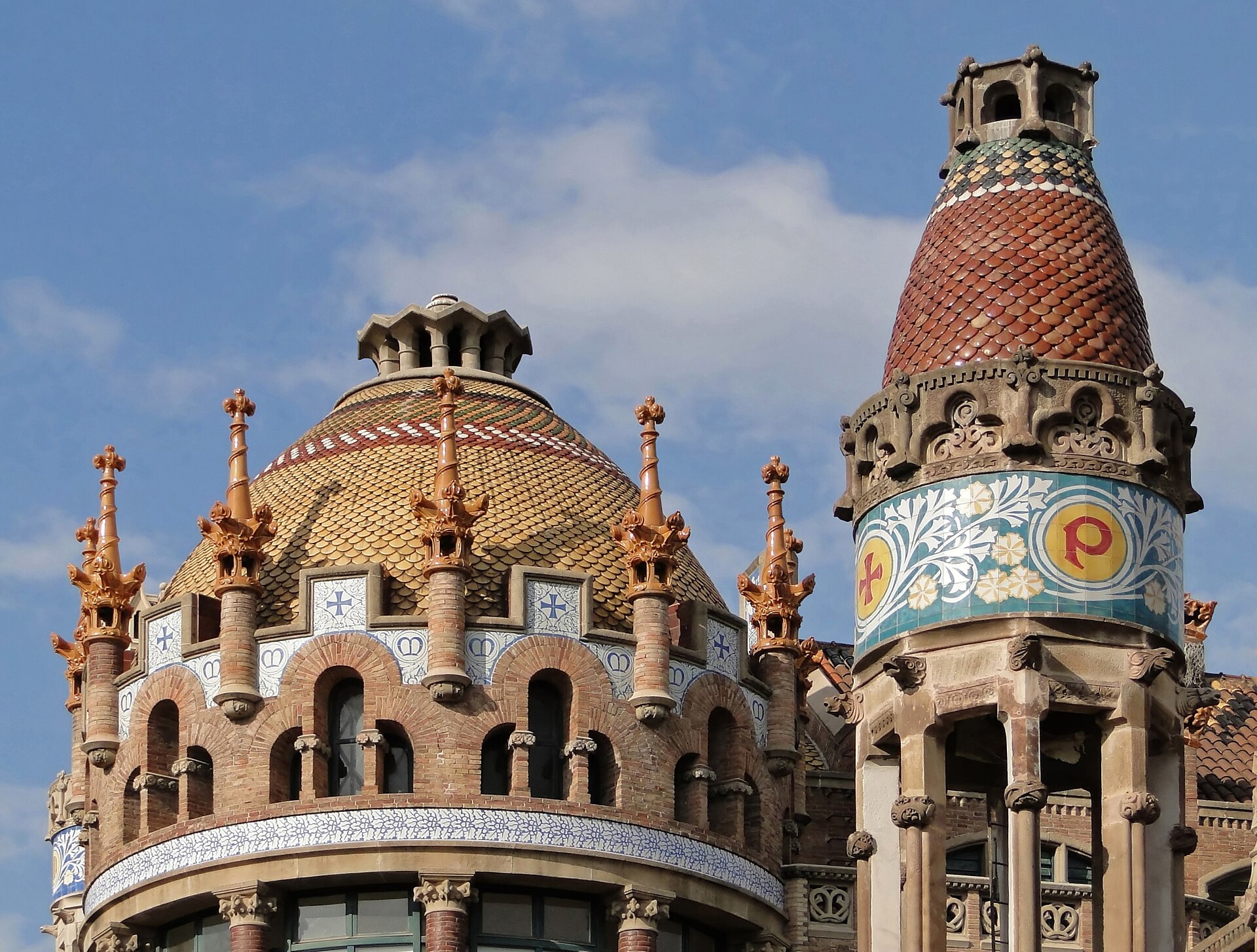
Hospital de Sant Pau
167 Carrer de Sant Antoni Maria Claret, Horta-Guinardó, Barcelona, 08025, Spain
For over eighty years, this was a functioning hospital — and it's one of the most beautiful buildings in Barcelona. Designed by Lluis Domenech i Montaner, the same architect behind the Palau de la Musica Catalana, the Hospital de Sant Pau is the largest Modernista complex in the world, covering more than 350,000 square metres. Construction began on January 15, 1902, just a thousand metres from the Sagrada Familia, and continued under Domenech i Montaner's son Pere until 1930. The concept was revolutionary for its time. Domenech i Montaner believed that sunlight, fresh air, and beautiful surroundings could help patients heal faster. He designed standalone pavilions connected by underground tunnels, set in gardens rather than crammed into a single block. Each pavilion was lavished with stained glass, ceramic tiles, sculpture, and mosaic — making a surgical ward look more like a palace. Curved surfaces covered in ceramic tiles weren't just decorative; they minimized places where germs could hide. It was public health through beauty. The hospital's origins go back much further than the Modernista building. The Hospital de la Santa Creu was founded in 1401 when six small medieval hospitals merged, making it one of the oldest medical institutions in Europe. The move to the current Eixample site came when the old Gothic hospital in the Raval became too cramped. Healthcare operations moved to a modern building next door in 2009, and the Modernista complex was painstakingly restored and reopened as a cultural campus. Together with the Palau de la Musica, it was declared a UNESCO World Heritage Site in 1997. Today it houses international organizations and hosts exhibitions in the restored pavilions.
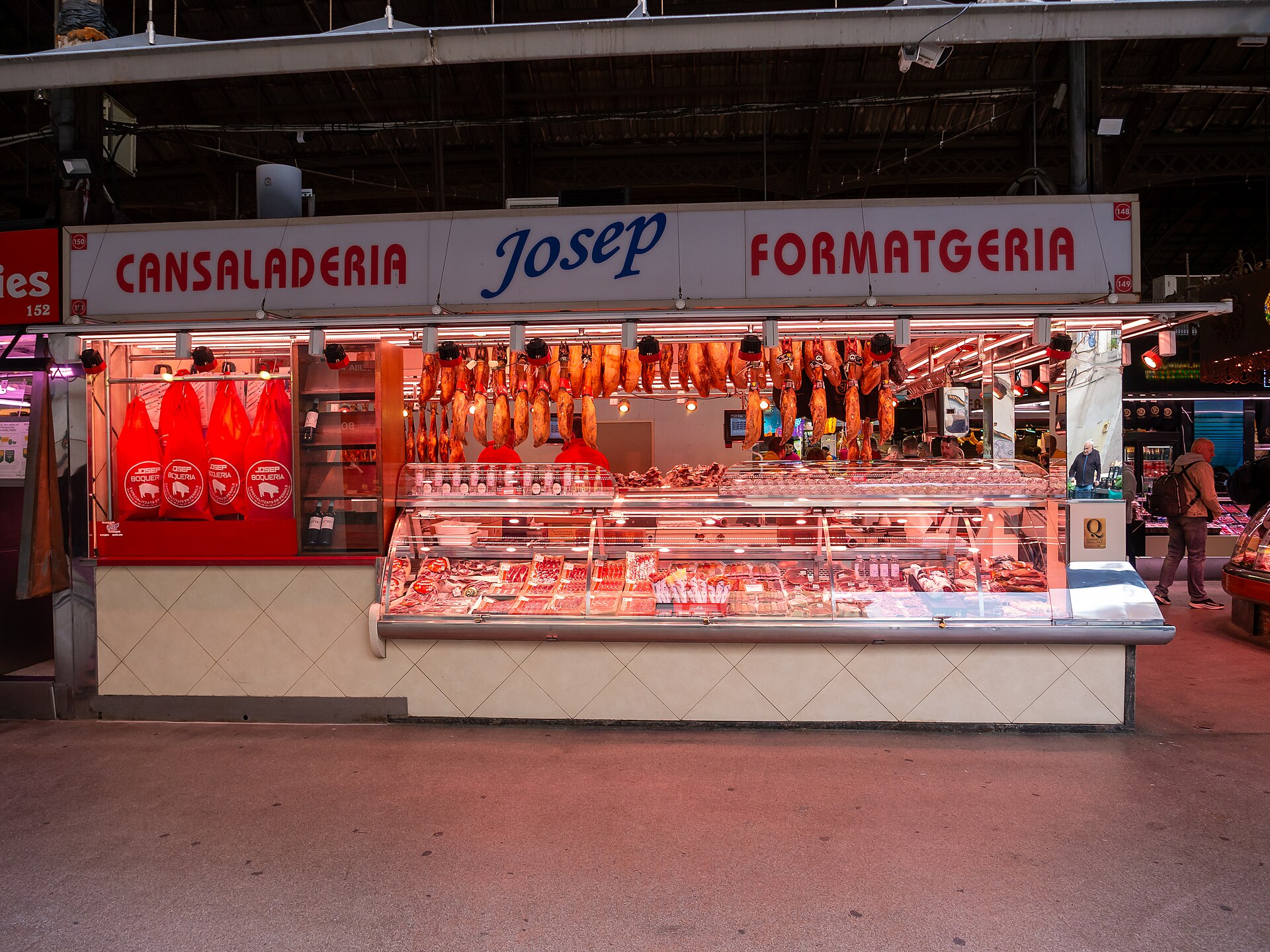
La Boqueria
91 La Rambla, Ciutat Vella, Barcelona, 08002, Spain
People have been selling meat at this spot since 1217 — that's over 800 years of commerce on the same patch of ground. The first records describe simple tables set up near the old city gate to sell goat meat, which is likely where the name comes from: "boc" is Catalan for goat, so "boqueria" means a place where goat is sold. By 1470, a regular pig market had established itself here, and the site has never stopped trading since. The market wasn't officially recognized until 1826, and the formal structure was begun on March 19, 1840, under architect Mas Vila. Plans kept changing, and the building wasn't inaugurated until 1853. It finally got its iron-and-glass roof in 1914, turning it into the covered market you see today. At nearly 27,000 square feet with over 200 stalls, it's the oldest food market in Spain and one of the most visited markets in Europe. La Boqueria sits on the site of the former Convent of Sant Josep, which was demolished during the anti-clerical upheavals of 1835. Locals still sometimes call it the Mercat de Sant Josep. Walk past the tourist-trap fruit cup stalls near the entrance and push deeper inside — that's where the real market lives. Fishmongers who've held the same stall for three generations, butchers selling cuts you won't find in any supermarket, and tiny bar counters where chefs eat standing up at seven in the morning. The market's most famous fixture was Pinotxo Bar, a stall near the entrance run by the legendary Juanito Bayen until he retired. It became arguably Barcelona's most beloved counter, serving chickpeas and salt cod to everyone from construction workers to visiting presidents.
La Rambla
La Rambla, Ciutat Vella, Barcelona, 08002, Spain
Before this was Barcelona's most famous promenade, it was an open sewer. The name comes from the Arabic "ramla," meaning sandy riverbed, and for centuries that's exactly what it was: a seasonal stream that snaked along the medieval city walls, carrying waste down to the sea. In the fifteenth century, the city diverted the sewer, paved over the channel, and accidentally created the most celebrated walkway in Spain. La Rambla stretches 1.2 kilometres from Placa de Catalunya down to the Columbus Monument at Port Vell. It's actually five different streets stitched together, each with its own name — Rambla de Canaletes, Rambla dels Estudis, Rambla de Sant Josep, Rambla dels Caputxins, and Rambla de Santa Monica — which is why locals say "Les Rambles" in the plural. The first trees were planted in 1703: 280 birch trees that were later replaced by elms, then acacias, and finally the London plane trees that line the boulevard today. Federico Garcia Lorca called it "the only street in the world which I wish would never end." George Orwell was less romantic — he fought a street battle here during the May Days of 1937 and wrote about it in Homage to Catalonia, describing how he was pinned down by sniper fire from the rooftops of the very buildings tourists now photograph. Walk it from top to bottom in the evening, when the living statues are mid-performance and the flower stalls are still open. At the very top, stop at the Font de Canaletes — the ornate iron fountain where FC Barcelona fans gather after every major victory. Legend says that anyone who drinks from it will always return to Barcelona.
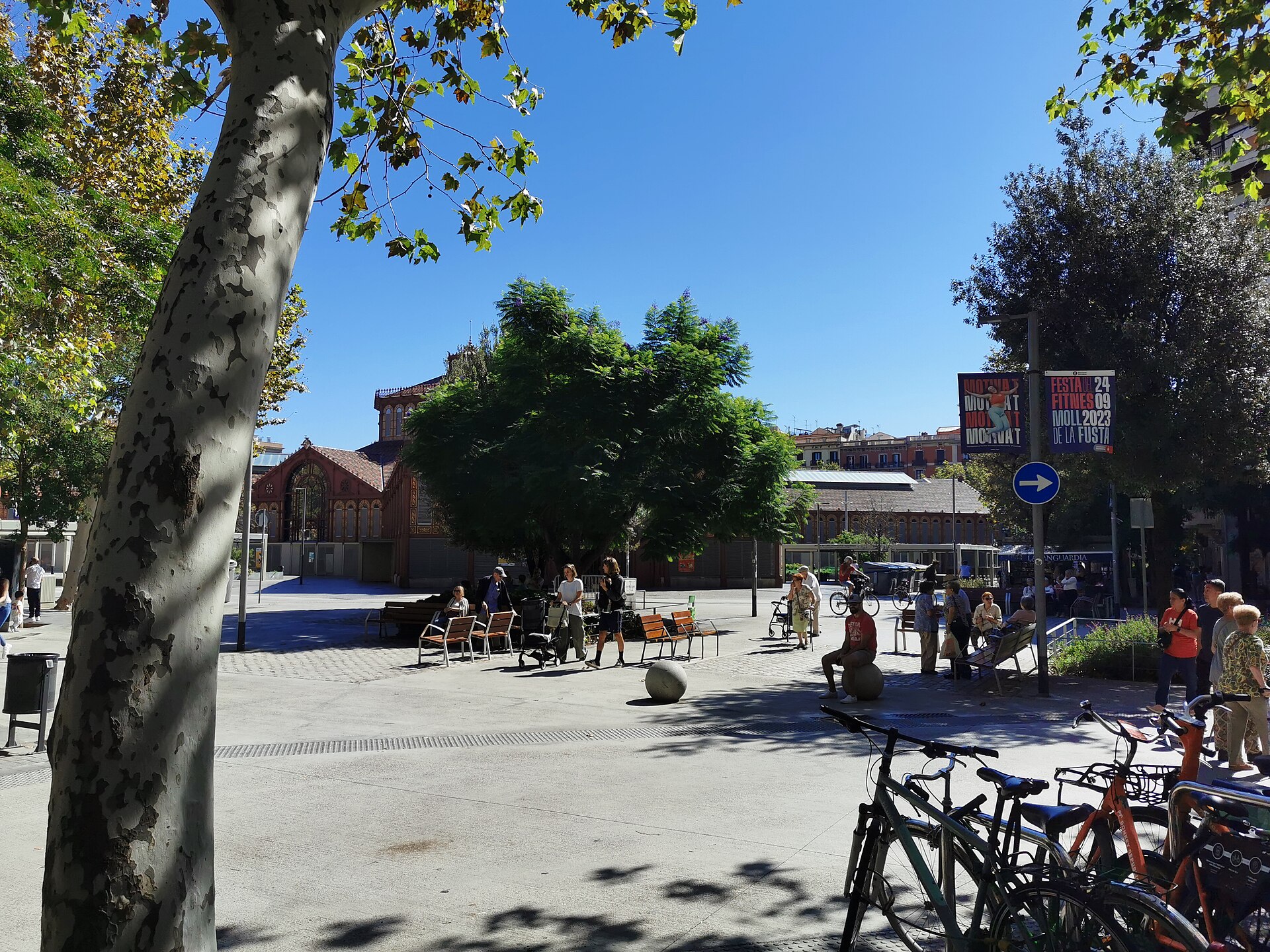
Mercat de Sant Antoni
1 Carrer del Comte d'Urgell, Eixample, Barcelona, 08011, Spain
This is the market where Barcelonans actually shop. While La Boqueria drowns in tourists, Sant Antoni is where locals buy their weekly groceries, argue about the price of gambas, and linger over coffee at the market bar. Designed by municipal architect Antoni Rovira Trias and inaugurated in 1882, it was the first market built outside Barcelona's old city walls and the largest in the city — technically three markets in one: food, clothing and flea market, and the famous Sunday book market. The building is an X-shaped iron-and-glass structure that combines Modernista elements with neoclassical influences. Built by La Maquinista Terrestre i Maritima — the same industrial firm that built locomotives — the market's cast-iron framework creates bright, airy halls that feel more like a railway station than a grocery shop. Mayor Rius i Taulet inaugurated it as one of his signature public works. In 2009, the market closed for what was supposed to be a quick renovation. Workers immediately discovered Roman remains beneath the foundations, and the project ballooned into an 80-million-euro, nine-year restoration that didn't finish until 2018. The renovated market is stunning — the original iron structure has been beautifully restored, a new basement level displays the archaeological finds, and modern amenities were woven in without destroying the building's character. Every Sunday, the surrounding streets host one of Europe's largest open-air book markets, with 78 stalls selling everything from first editions to vintage comics. The tradition dates to the 1930s and has survived civil war, dictatorship, and the nine years of renovation. It's the kind of place where you go for a secondhand novel and leave with a bag of tomatoes, three vintage postcards, and an opinion about local politics.

MNAC
6 Lloc Mirador del Palau Nacional, Sants-Montjuïc, Barcelona, 08038, Spain
The building is absurdly grand — a palace built for a temporary fair. The Palau Nacional was constructed for the 1929 International Exposition, designed by architects Eugenio Cendoya and Enric Cata in the Beaux-Arts style, with towers, domes, and cascading fountains that make it look like the seat of a small empire rather than an exhibition hall. After the fair ended, the city had to figure out what to do with it. The answer: fill it with the best collection of Romanesque art in the world. The Museu d'Art de Catalunya officially opened on November 11, 1934, and its Romanesque collection is genuinely unmatched anywhere. In the early twentieth century, teams of conservators physically removed medieval frescoes from crumbling rural churches in the Catalan Pyrenees and reinstalled them in the museum — entire curved apse walls were transferred, creating walk-in chapels that surround you with thousand-year-old painted saints. If they hadn't been rescued, many would have been sold to American collectors or lost to decay. The fully consolidated museum didn't take its current form until December 16, 2004, when the Romanesque and Gothic collections were finally united with nineteenth- and twentieth-century Catalan art. The range is staggering: from eleventh-century murals to works by El Greco, Velazquez, Ramon Casas, Gaudi's furniture, and Dali. Stand on the terrace in front of the Palau Nacional at dusk and you get one of Barcelona's great free shows: the Magic Fountain of Montjuic performs a choreographed water, light, and music display against the backdrop of the city below. The fountain was designed by Carles Buigas for the 1929 Exposition and has been delighting crowds ever since.

Montjuic Castle
66 Carretera Montjuïc, Sants-Montjuïc, Barcelona, 08038, Spain
Montjuic has been used to watch, control, and kill the people of Barcelona for nearly four centuries. The first fortification was thrown up in 1640 during the Catalan Revolt against the Spanish crown, and within a year it saw battle — Catalan forces led by Francesc de Tamarit defeated the Spanish at the Battle of Montjuic in January 1641. The basic fort became a proper castle in 1694 when new bastions and battlements were erected, and military engineer Juan Martin Cermeno rebuilt it entirely in 1751 into the star-shaped fortress that still stands today. For Catalans, Montjuic is synonymous with repression. In the late nineteenth century, the castle became a prison and torture facility for anarchists and political dissidents. During the Spanish Civil War, it served as a detention center and execution site. The darkest chapter came on October 15, 1940, when Lluis Companys — the president of the Generalitat of Catalonia — was executed by firing squad on Franco's orders. He remains the only sitting president of a European democratic government to have been executed. His last words, reportedly, were "Visca Catalunya" — long live Catalonia. The castle sat for decades as a military museum under Franco's regime, a bitter irony for the city. It wasn't until 2007 that the Spanish government finally transferred it to Barcelona City Council, and the long process of transforming it from a symbol of oppression into a civic space began. Despite its dark history, the views from the ramparts are among the finest in Barcelona. The entire city unfolds below — the port, the Eixample grid, the Sagrada Familia in the distance, and the Mediterranean stretching to the horizon. You can reach the castle by cable car from Paral·lel, adding a dramatic ride above the city to the experience.
Palau de la Musica Catalana
4 Carrer del Palau de la Música, Ciutat Vella, Barcelona, 08003, Spain
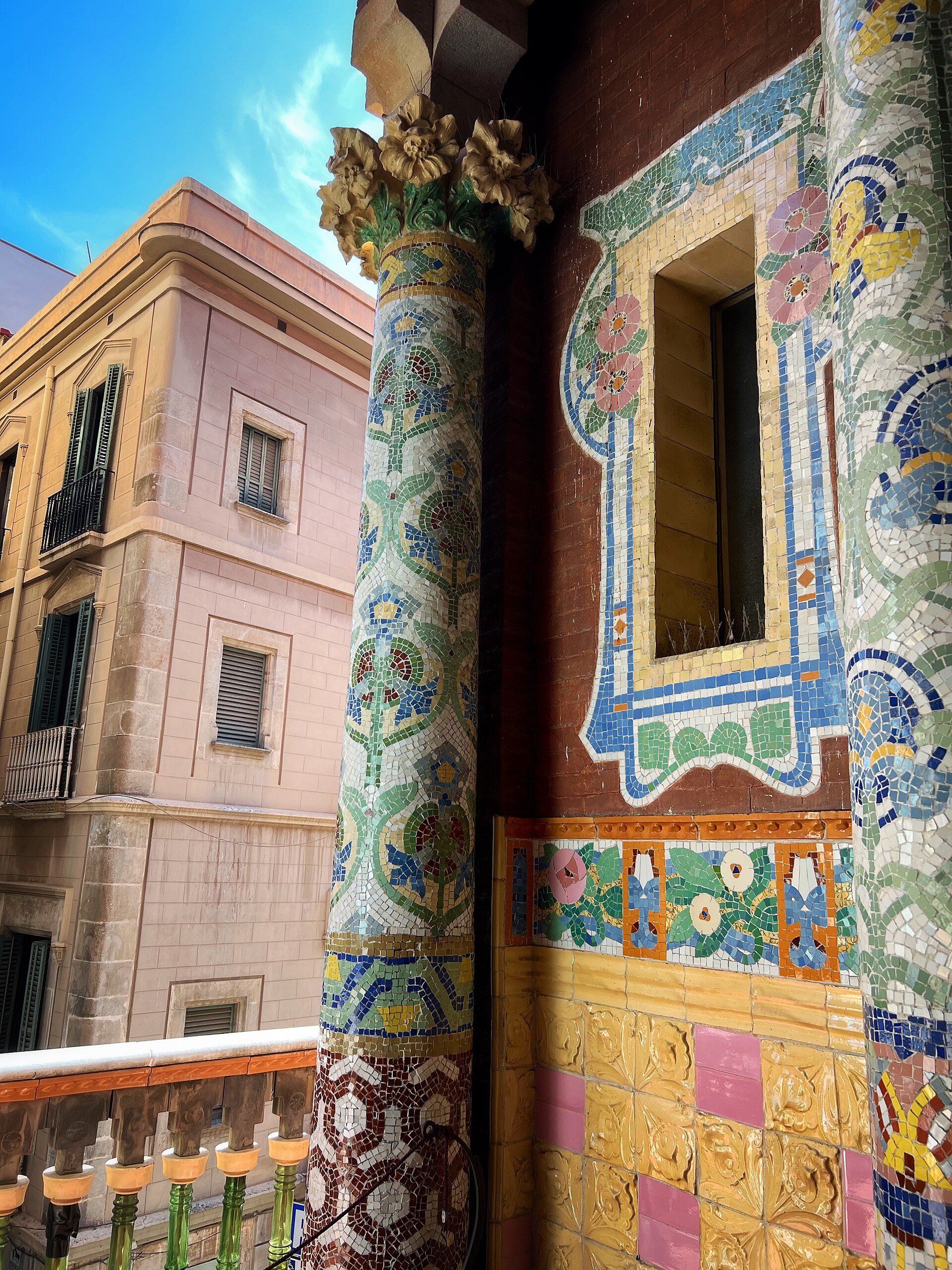
This concert hall is so extravagantly decorated that when it opened in 1908, some critics thought it was vulgar. Built for the Orfeo Catala choral society — a choir that was as much a political statement of Catalan identity as a musical group — the Palau was designed by architect Lluis Domenech i Montaner, Gaudi's great rival in the Modernista movement. Where Gaudi worked in curves and organic forms, Domenech i Montaner worked in light and color, and this building is his masterpiece. The concert hall seats around 2,200 people and is the only auditorium in Europe illuminated entirely by natural light during the day. The walls on two sides are made almost entirely of stained glass, and overhead hangs an enormous inverted dome of stained glass shaped like a teardrop — a skylight that seems to drip color into the room below. The effect is like sitting inside a kaleidoscope. When the choir sings beneath it, the acoustics are extraordinary. The building's walls were among the first curtain wall structures ever built — meaning the facade doesn't bear the building's weight. This allowed Domenech i Montaner to replace solid walls with expanses of glass and decorative ceramic. The exterior explodes with mosaic columns, sculptural clusters, and a corner sculpture of Sant Jordi slaying the dragon. Every surface is covered in something — tile, glass, carved stone, iron. The Palau was declared a National Monument in 1971 and became a UNESCO World Heritage Site in 1997. Between 1982 and 1989, architect Oscar Tusquets led a careful restoration and modernization. Financed entirely by public subscriptions from ordinary Catalans when it was built, the Palau remains a potent symbol of Catalan cultural pride.
Palau Guell
Carrer Nou de la Rambla 3-5, 08001 Barcelona
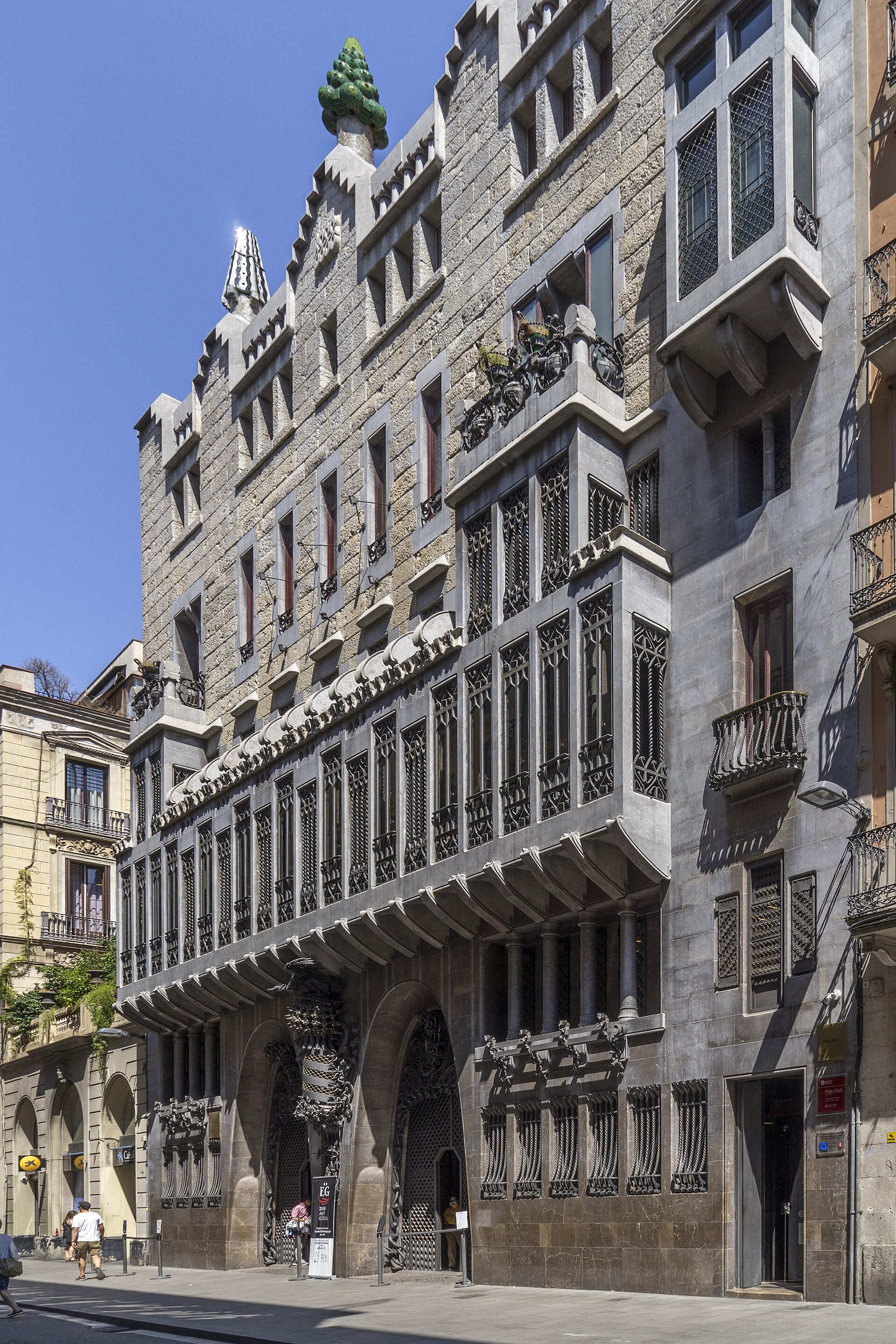
Gaudi was only 34 years old when industrialist Eusebi Guell commissioned him to build a family palace just off La Rambla in 1885. Construction started in October 1886 and was finished in time for the 1888 Universal Exposition — a tight schedule that Gaudi met by working at a pace he would never repeat. While the Sagrada Familia crawled along for decades, the Palau Guell was built in just two years. From the street, the building is deliberately restrained — almost severe — with its dark stone facade and two parabolic arch entrances wide enough for horse-drawn carriages. But step inside and the restraint explodes. The interior pivots around a central hall three stories high, capped by a parabolic dome pierced with small holes that let in pinpoints of light, creating the effect of a starry sky. Gaudi used over twenty different types of materials — marble, wrought iron, hardwoods, ceramics — and designed every detail down to the furniture. The rooftop is where Gaudi first experimented with the mosaic-clad chimneys that would become his signature. Twenty chimneys and ventilation towers erupt from the roof in fantastical shapes, covered in trencadis — broken tile mosaics — that prefigure the explosion of color he would later unleash at Park Guell and Casa Batllo. This roof was the laboratory for everything that followed. Guell only lived in the palace for about twenty years before moving to Park Guell in 1910, shortly after the violent Setmana Tragica (Tragic Week) shook Barcelona. In 1945, his youngest daughter Merce donated the building to the Barcelona Provincial Council. It was declared a UNESCO World Heritage Site in 1984.
Parc de la Ciutadella
Passeig de Picasso 21, 08003 Barcelona
This park is built on the ruins of the thing Barcelona hated most. After the city fell in the War of the Spanish Succession in 1714, King Philip V ordered the construction of a massive star-shaped citadel designed by military engineer Prosper Verboom to keep Barcelona under the crown's boot. An entire neighborhood — the Ribera quarter — was demolished to make room for it, displacing thousands of residents. For over 150 years, the Ciutadella was a symbol of foreign domination. In 1869, General Juan Prim gave the citadel to the city with instructions to turn it into a park. Barcelona demolished the fortress with enthusiasm, keeping only the governor's palace, the chapel, and the arsenal building (which now houses the Catalan Parliament). Architect Josep Fontsere designed the park to host the 1888 Universal Exposition, and a young, unknown architecture student named Antoni Gaudi helped with the design of the Cascada fountain — a dramatic waterfall structure loosely inspired by the Trevi Fountain in Rome. The Cascada was first inaugurated in 1881 without its sculptures, which were added over the next seven years. It remains one of the park's most photogenic spots, with griffins, Venus, and a dramatic Aurora riding her chariot across the top. The park also contains Barcelona's zoo, which opened in 1892 and was home to the famous albino gorilla Snowflake from 1966 until his death in 2003. Today the park is Barcelona's green lung: 70 acres of palm trees, a boating lake, and lawns where half the city seems to gather on sunny weekends. It contains over 100 species of plants and trees that are more than a century old. The Catalan Parliament still meets in the old arsenal, making this one of the few public parks in Europe that contains a working legislature.
Park Guell
Carrer d'Olot, 08024 Barcelona
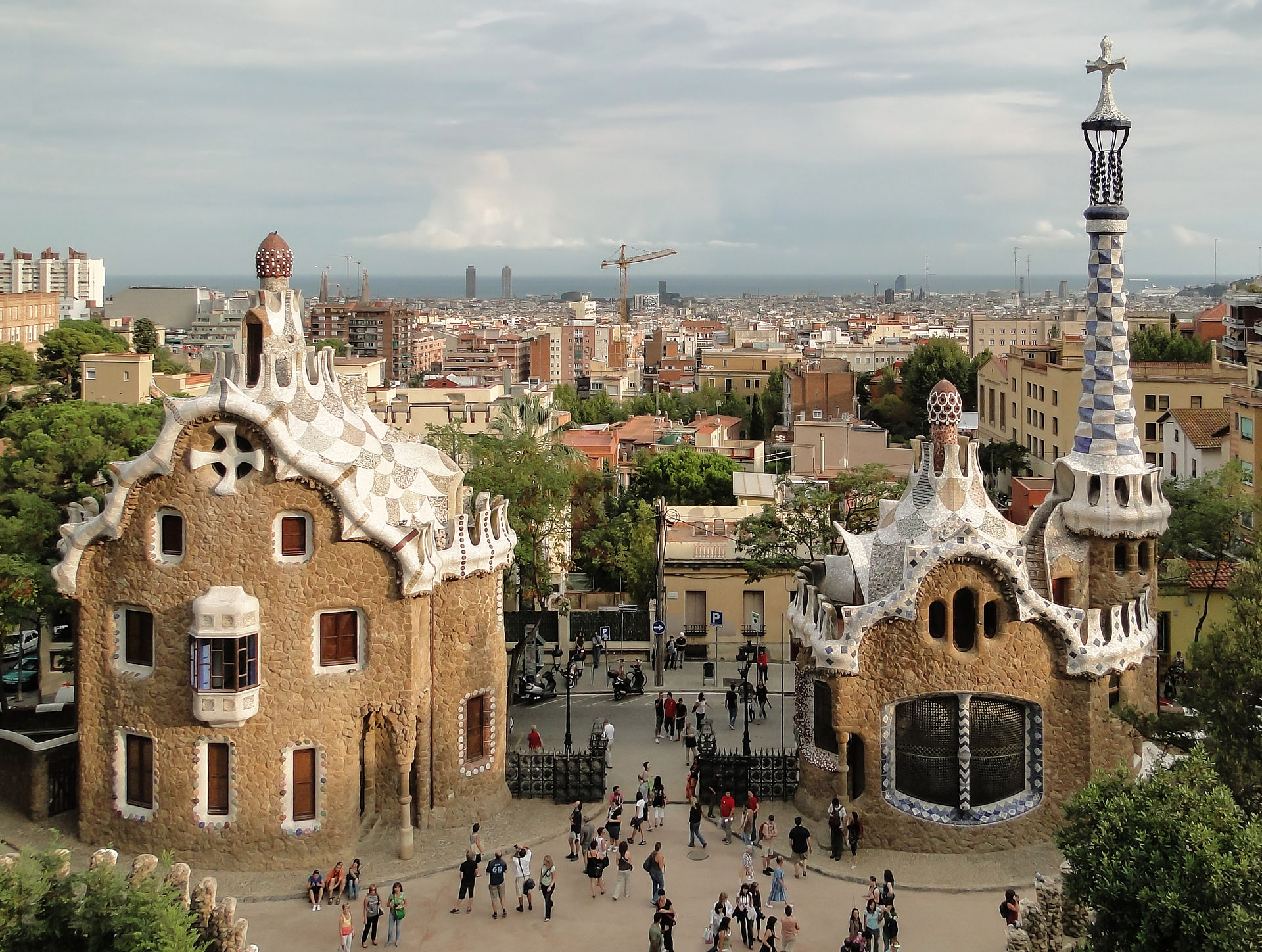
Park Guell was supposed to be a gated community for Barcelona's wealthy elite, and it was a spectacular commercial failure. Industrialist Eusebi Guell commissioned Gaudi in 1900 to build a luxury housing estate on a rocky hillside with views of the city and the sea. The plan called for sixty homes surrounded by gardens, markets, and communal spaces — a Catalan version of an English garden city, which is why it's spelled "Park" in English rather than "Parc" in Catalan. Construction ran from 1900 to 1914, and in that time exactly two of the sixty planned homes were built. One of them was bought by Gaudi himself, who lived there from 1906 until shortly before his death in 1926 — it's now a small museum. The market area became the famous Sala Hipostila, a forest of 86 Doric columns originally designed to support a marketplace above. Water from the terrace above filters through the columns and feeds the dragon fountain at the entrance. That dragon — or salamander, depending on who you ask — is probably Barcelona's most photographed non-building. Covered in colorful trencadis mosaic, it guards the entrance stairway and has become an unofficial mascot of the city. The serpentine bench on the terrace above, designed in collaboration with Gaudi's assistant Josep Maria Jujol, is covered in shattered tile fragments and is ergonomically shaped to fit the human body — Gaudi reportedly had workers sit in wet clay to determine the perfect curve. After Guell died in 1918, his heirs sold the park to the city. It opened as a municipal park in 1926 and was declared a UNESCO World Heritage Site in 1984. The monumental zone now requires timed tickets, but the surrounding forested areas remain free and are where locals actually go to walk their dogs and escape the crowds.
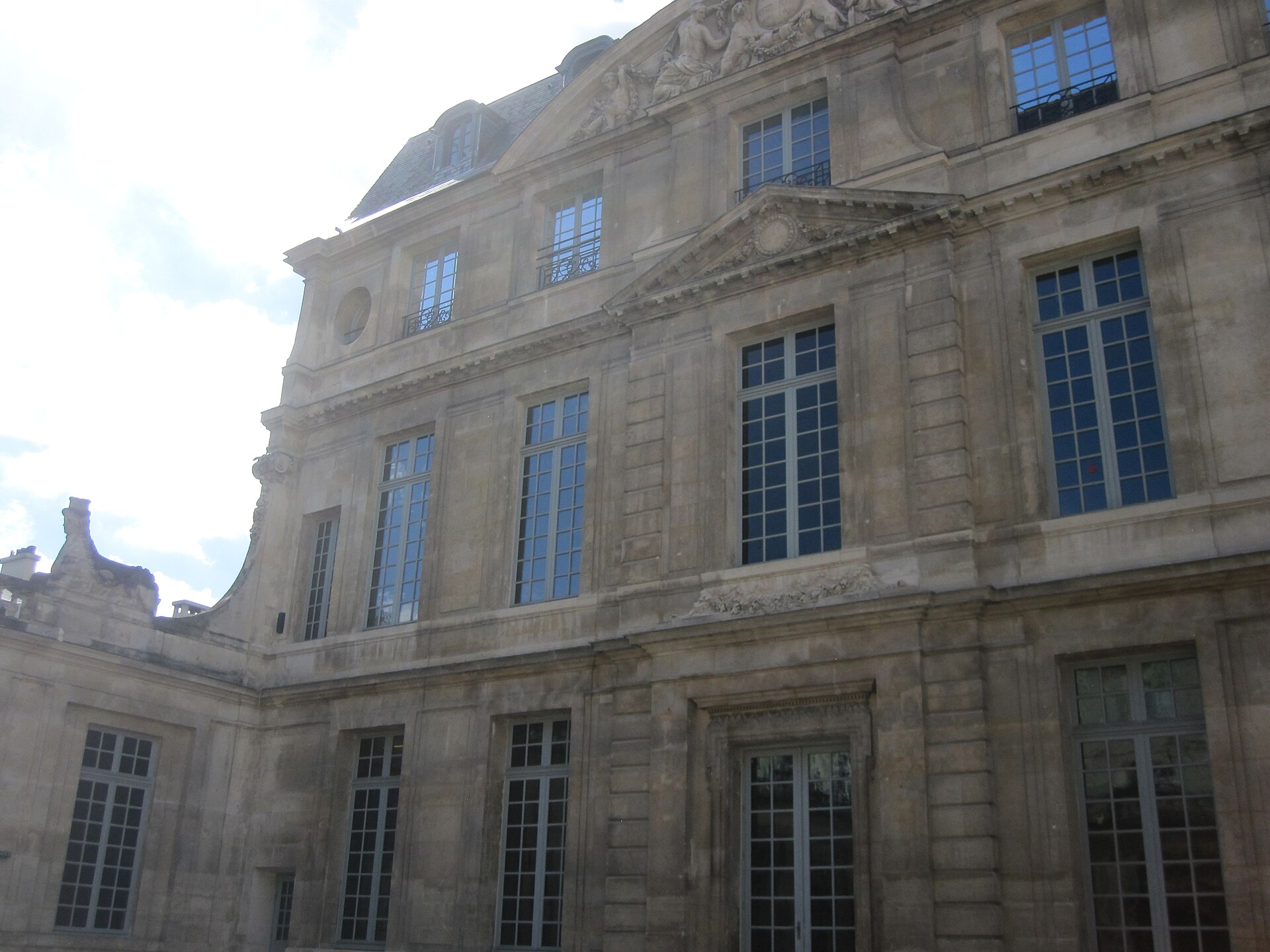
Picasso Museum
Carrer de Montcada 15-23, 08003 Barcelona
The first museum dedicated to Pablo Picasso anywhere in the world opened right here on March 9, 1963 — and it almost didn't happen. Picasso despised Franco's regime and had vowed never to return to Spain while the dictator ruled. The idea came from Jaume Sabartes, Picasso's lifelong friend and personal secretary, who wanted to create a permanent home for the collection. When Sabartes proposed Paris, Picasso insisted on Barcelona — the city where he'd spent his formative years and held his first exhibition at seventeen. The museum opened under the deliberately low-key name "Sabartes Collection" to avoid provoking Franco's government. Barcelona's mayor, Josep Porcioles, went against Madrid's wishes to approve the museum. The gamble paid off — and after Sabartes died in 1968, Picasso donated his complete Las Meninas series, 58 paintings reinterpreting Velazquez's masterpiece, as a memorial to his friend. The collection is housed in five adjoining medieval palaces on Carrer de Montcada, one of Barcelona's most architecturally significant streets. These thirteenth-to-fifteenth-century mansions were once home to the city's merchant aristocracy, and walking through their interconnected courtyards and staircases is an experience in itself. The museum holds over 4,250 works, making it the most comprehensive collection of Picasso's early period anywhere in the world. What makes this museum different from Picasso collections in Paris or Malaga is its focus on the young artist. You can trace his development from childhood sketches and school notebooks through his Blue Period works and the experimental paintings he made during his Barcelona years. The museum owns two of his first major works: "The First Communion" from 1896 and "Science and Charity" from 1897, painted when he was just fifteen and sixteen years old.
Placa de Catalunya
Placa de Catalunya, 08002 Barcelona
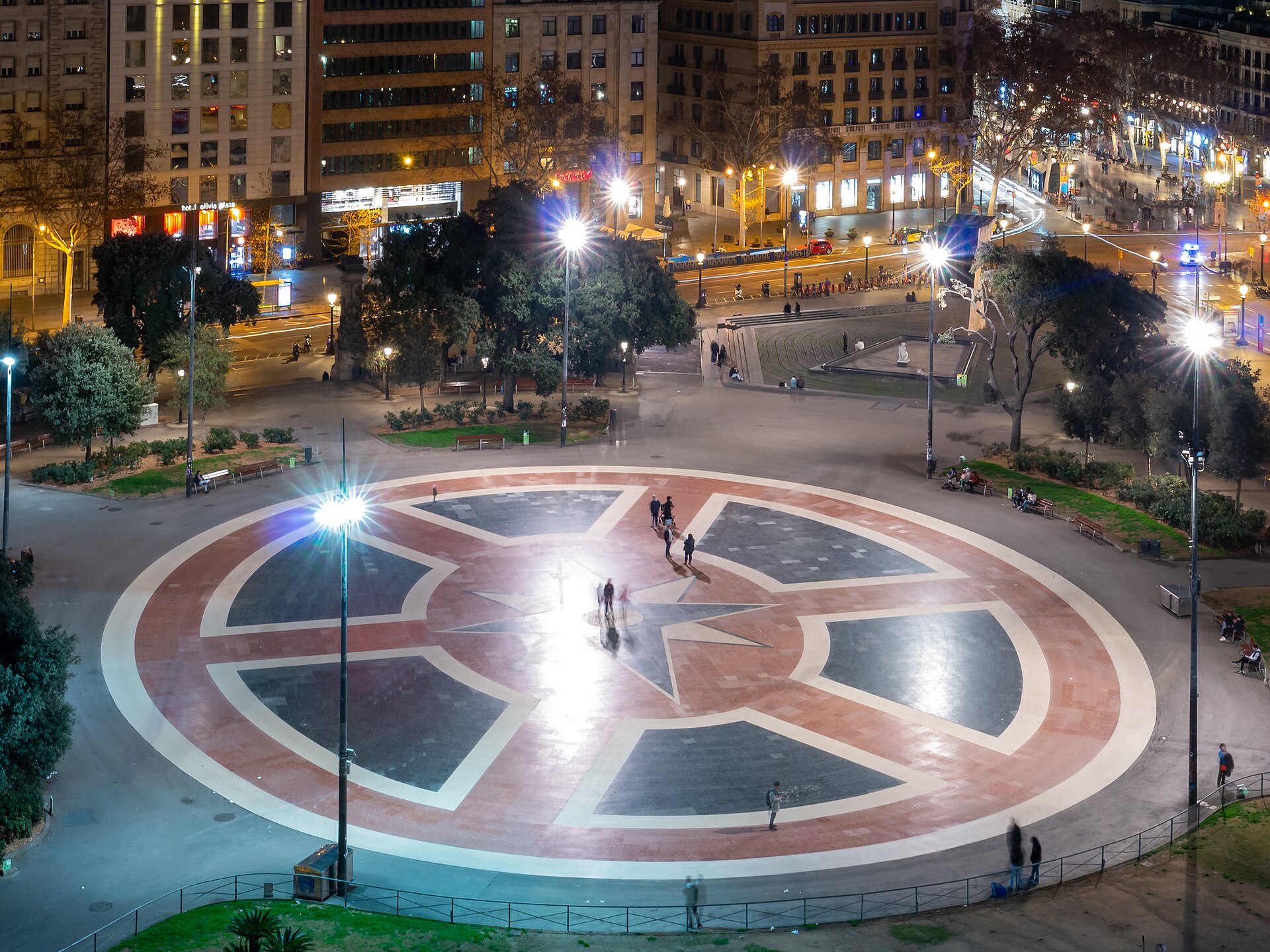
Less than two centuries ago, this 50,000-square-metre plaza was empty scrubland outside Barcelona's ancient fortifications. The city had been strangled for centuries inside medieval walls that limited its growth, and when those walls finally came down in the 1850s, this open patch became the hinge between the cramped old town and the ambitious new grid of the Eixample. It took decades of political wrangling before anything got built — the square was conceived as part of the Rovira plan in 1859 but didn't receive official government approval until the 1888 Universal Exposition forced the issue. The plaza took its modern form when it was officially inaugurated on November 2, 1927, and further reshaped for the 1929 International Exposition. Today it's ringed by department stores, banks, and the enormous El Corte Ingles, but its real function is as Barcelona's central compass point. Every major shopping street, tourist route, and transit line converges here. Look down and you'll spot a compass rose inlaid in the pavement. During the Spanish Civil War, the square was a flashpoint — particularly during the May Days of 1937, when rival Republican factions fought each other in the surrounding streets. More recently, in May 2011, Placa de Catalunya became the epicenter of Spain's Indignados movement, with thousands of anti-austerity protesters camping in the square for weeks. The plaza's sculptures are an underappreciated open-air gallery spanning Noucentisme to the avant-garde. Josep Clara's "The Goddess" stands at the center, and there are works by Pablo Gargallo and other Catalan sculptors scattered around the perimeter. But most people don't look at the statues — they're too busy navigating the pigeons.
Placa del Rei
Placa del Rei, 08002 Barcelona
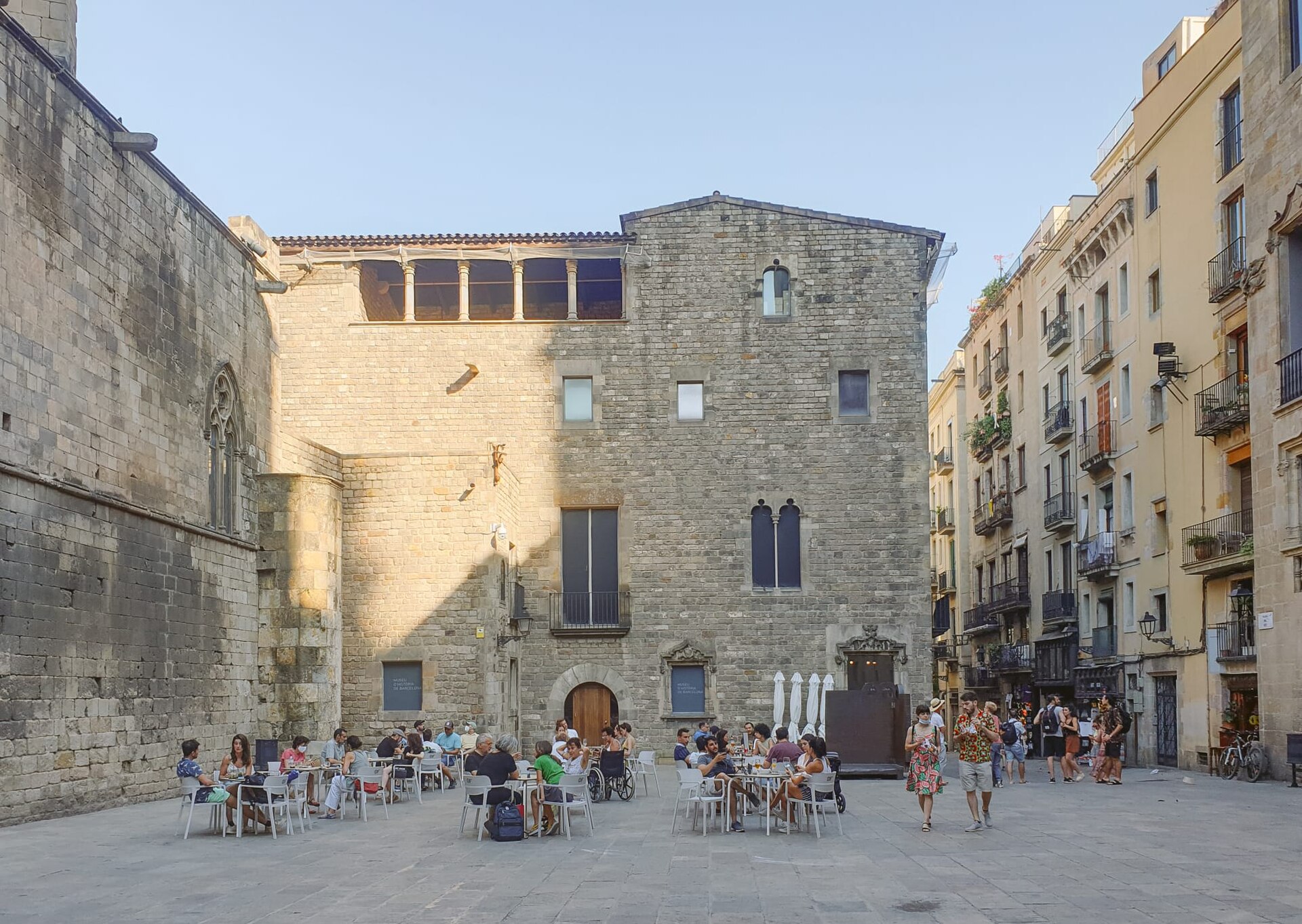
If Barcelona has a single spot where you can feel the weight of medieval power, it's this enclosed square tucked deep in the Gothic Quarter. The Placa del Rei was the courtyard of the Palau Reial Major — the royal palace of the Counts of Barcelona and Kings of Aragon from the ninth to the fifteenth century. Stand in the center and you're surrounded on three sides by walls that have witnessed coronations, inquisitions, and one of the most famous audiences in history. The Salo del Tinell, the palace's great hall, is a stunning feat of fourteenth-century engineering: six massive stone arches spanning seventeen metres without a single column for support. It was here, according to deeply ingrained local legend, that King Ferdinand and Queen Isabella received Christopher Columbus in 1493 after his first voyage to the Americas. Whether or not the meeting actually happened in this room is debated by historians, but the story is too good for Barcelona to let go. Beneath the square lies one of the city's best-kept secrets: an underground archaeological site run by MUHBA, the Barcelona History Museum. Descend below street level and you can walk through the excavated streets, shops, wine-making facilities, and fish-sauce factories of Roman Barcino, dating from the first century BC to the sixth century AD. The preserved area covers about 4,000 square metres — one of the largest underground Roman sites in Europe. Above ground, King Martin's Watchtower rises five stories from the corner of the square. Built in the fifteenth century as a lookout, it offers views across the rooftops of the old city. Next to it stands the Royal Chapel of Saint Agatha, a fourteenth-century chapel with a distinctive crown-shaped octagonal bell tower.
Pont del Bisbe
Carrer del Bisbe, 08002 Barcelona
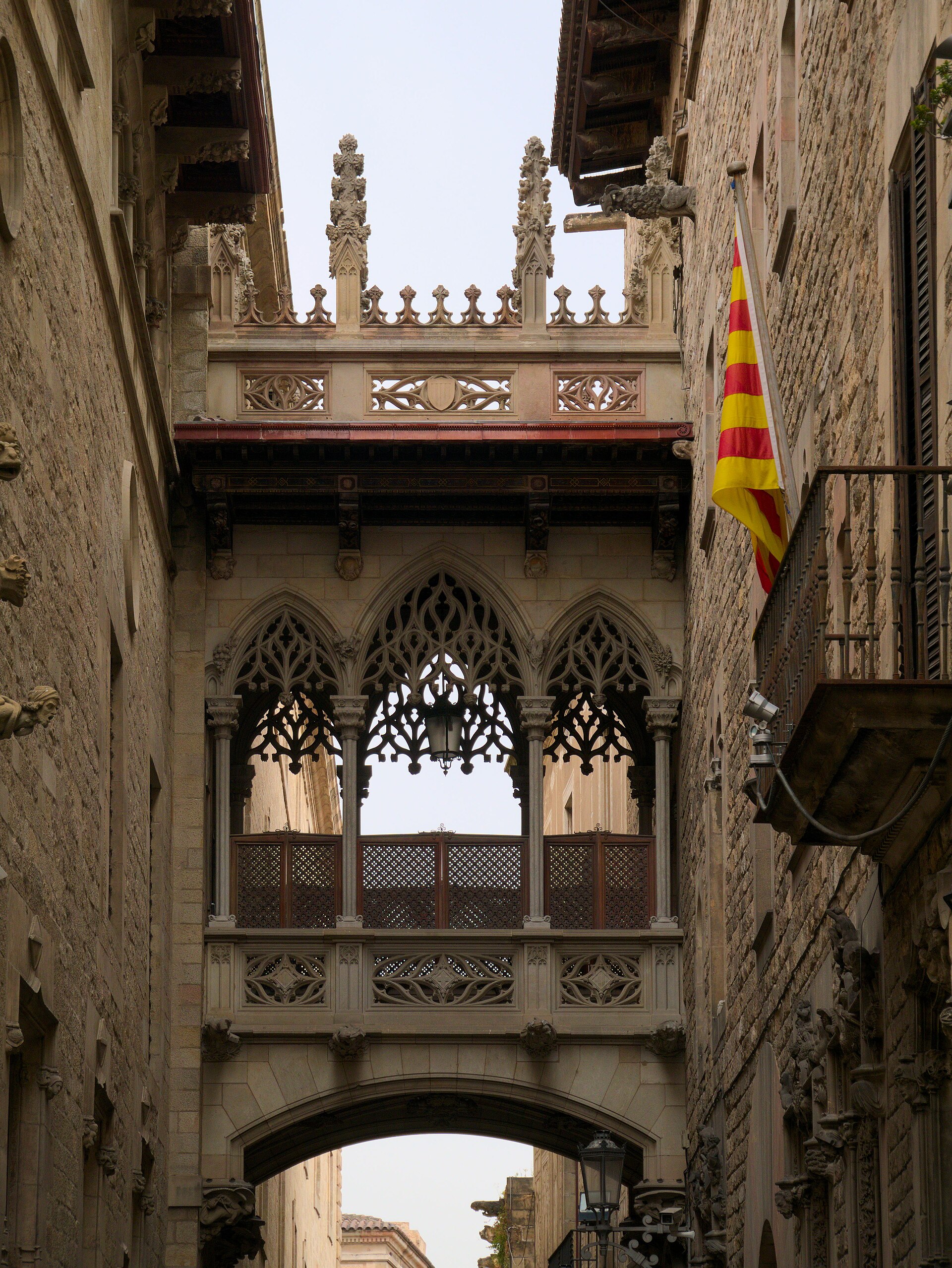
It's one of the most photographed spots in Barcelona, and almost everything people believe about it is wrong. The Pont del Bisbe looks like it's been connecting the Palau de la Generalitat to the Casa dels Canonges since the Middle Ages, but it was actually built in 1929 by architect Joan Rubio i Bellver — a student and collaborator of Gaudi who had worked on Park Guell and the Sagrada Familia. The neo-Gothic bridge was designed for the 1929 International Exposition, when the city was busy making the Gothic Quarter look more Gothic. Rubio i Bellver had far grander ambitions. He proposed a sweeping neo-Gothic transformation of the entire neighborhood, but his plans were harshly criticized by the architectural establishment and ultimately rejected. All that was approved was this single footbridge over Carrer del Bisbe. Whether he took the rejection gracefully is another matter — look up as you walk underneath and you'll spot a human skull pierced by a dagger, carved into the underside of the bridge. Nobody knows for certain what the skull means. The most popular theory is that Rubio i Bellver placed it as a curse on his critics — death to those who killed his dream. Another interpretation is that it symbolizes his project being figuratively stabbed to death. A wilder urban legend claims it's a real human skull and that if the dagger ever falls out, it will mean the end of Barcelona. Yet another legend says you can make a wish come true by walking backwards under the bridge while staring at the skull. It's a tiny bridge on a narrow street, easily missed if you don't look up. But it's a perfect little story about ambition, rejection, and a grudge carved in stone — or possibly a real skull. Barcelona isn't telling.
Sagrada Familia
Carrer de Mallorca 401, 08013 Barcelona
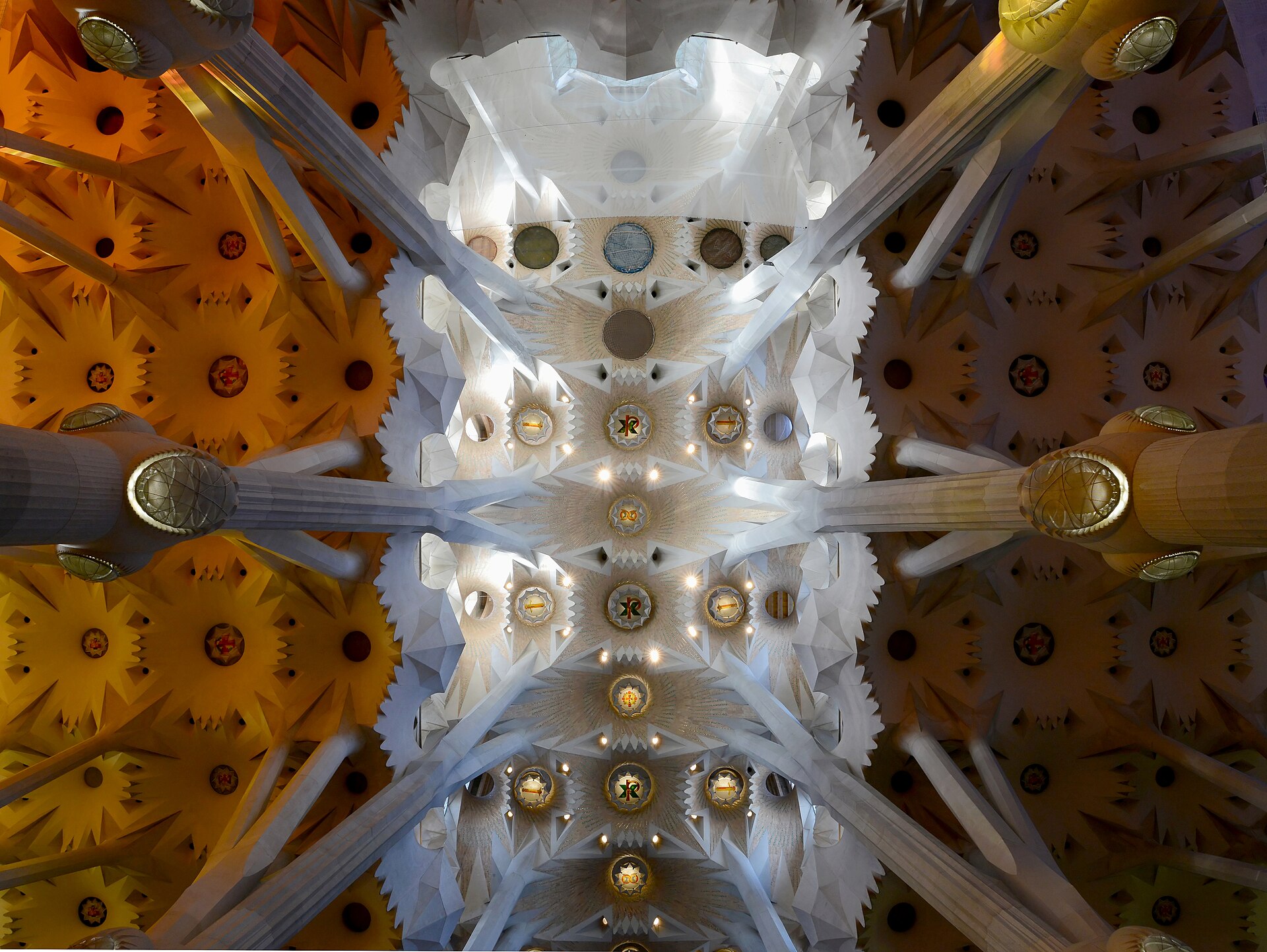
Nobody alive when this building started has lived to see it finished. Construction began on March 19, 1882, under architect Francisco de Paula del Villar, who quit after a year over a disagreement about materials. A 31-year-old Antoni Gaudi took over and promptly threw out every plan, transforming what was meant to be a conventional neo-Gothic church into something the world had never seen. Gaudi devoted the remaining 43 years of his life to the project, eventually moving into the workshop on-site, sleeping among his plaster models. By the time he was struck by a tram and killed in 1926, less than a quarter of the building was complete. What makes the Sagrada Familia structurally extraordinary is that Gaudi abandoned flying buttresses entirely. Instead he designed tree-like columns that branch at the top to distribute weight, a system he developed by hanging weighted strings from the ceiling and photographing the resulting curves upside down. The interior feels like standing inside a stone forest, with light pouring through stained glass that shifts from cool blues on the north side to warm golds and reds on the south. During the Spanish Civil War, anarchists broke into Gaudi's workshop and destroyed many of his original models and drawings. Reconstruction of those plans has guided builders ever since, supplemented by computer modeling that Gaudi never could have imagined. In February 2026, the central Jesus tower reached its full height of 172.5 metres, making it the tallest church in the world, surpassing Germany's Ulm Minster. The building has eighteen towers in total: twelve for the apostles, four for the evangelists, one for the Virgin Mary, and the tallest for Jesus Christ. After 144 years of construction, the exterior was completed in late 2025, though sculptural details and the main entrance stairway will continue until 2034.
Santa Maria del Mar
Placa de Santa Maria 1, 08003 Barcelona
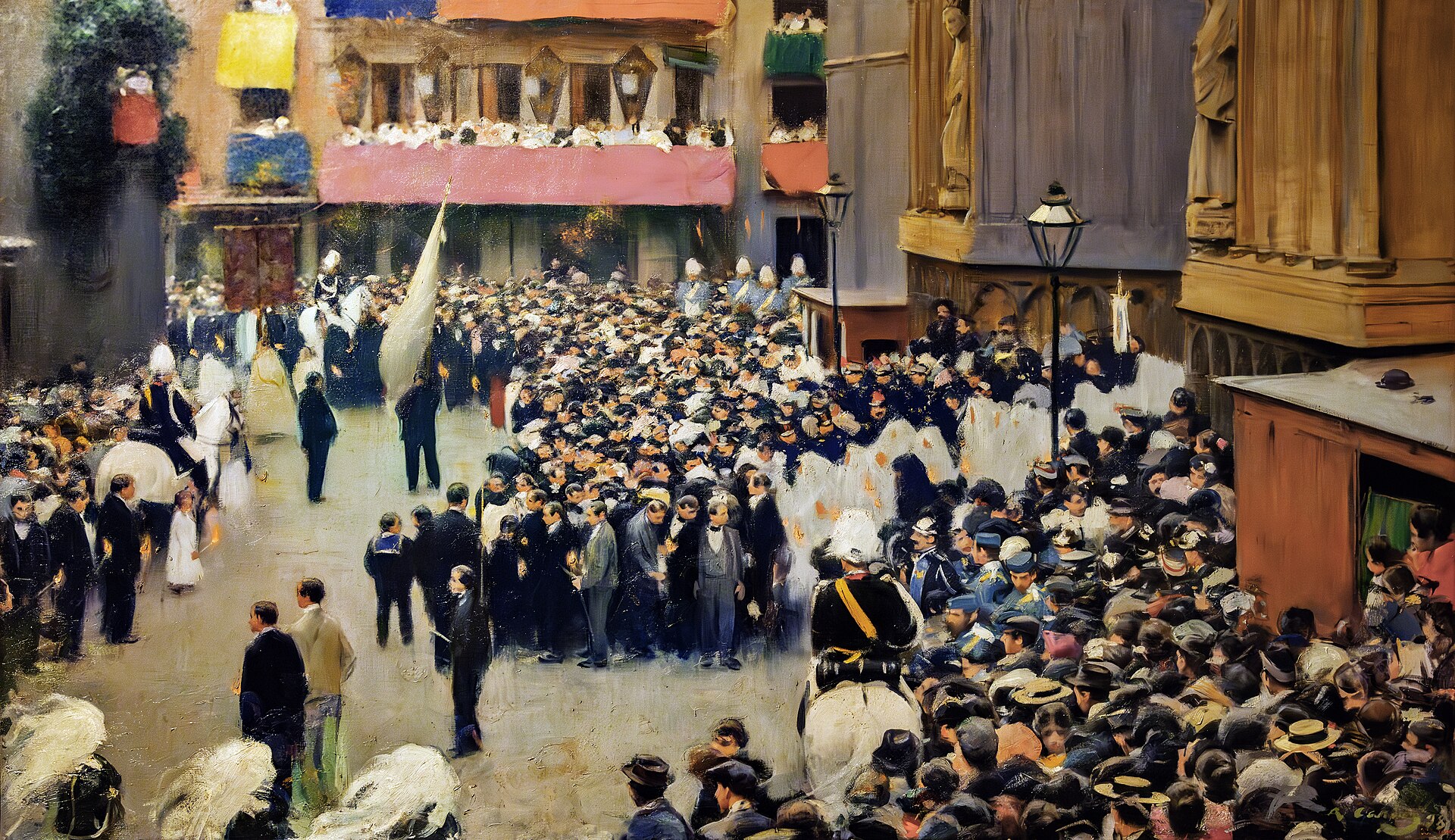
This is the people's church. While the cathedral was built by bishops and funded by the crown, Santa Maria del Mar was raised by the common people of Barcelona's waterfront — the shipbuilders, fishermen, and dockworkers of the Ribera neighborhood. Construction began on March 25, 1329, and what makes this church extraordinary is that it was completed in just 55 years, a remarkably short span for a major medieval building. That speed gave it something rare: a purity and unity of style that most Gothic churches, built over centuries, can never achieve. The construction was a community effort in the most literal sense. The bastaixos — stone carriers from the port — hauled massive stone blocks on their backs from the quarries of Montjuic to the building site. A bronze relief on the church's main doors immortalizes these laborers, bent under the weight of their loads. It's one of the few medieval churches in Europe that explicitly honors the workers who built it rather than the nobles who paid for it. Inside, the church is breathtaking in its simplicity. The three naves are the same height, supported by slender octagonal columns set 13 metres apart — a distance unsurpassed by any other medieval building anywhere. The result is a vast, open interior flooded with light, completely unlike the shadowy forests of columns you find in most Gothic cathedrals. In 1936, at the start of the Spanish Civil War, anti-clerical rioters set fire to the church. It burned for eleven days, destroying the Baroque altar, decorations, and religious images. What survived was the pure Gothic skeleton — and many architectural historians argue that the fire actually improved the building by stripping away centuries of accumulated clutter and revealing its original austere beauty.
Tibidabo
Placa del Tibidabo 3-4, 08035 Barcelona
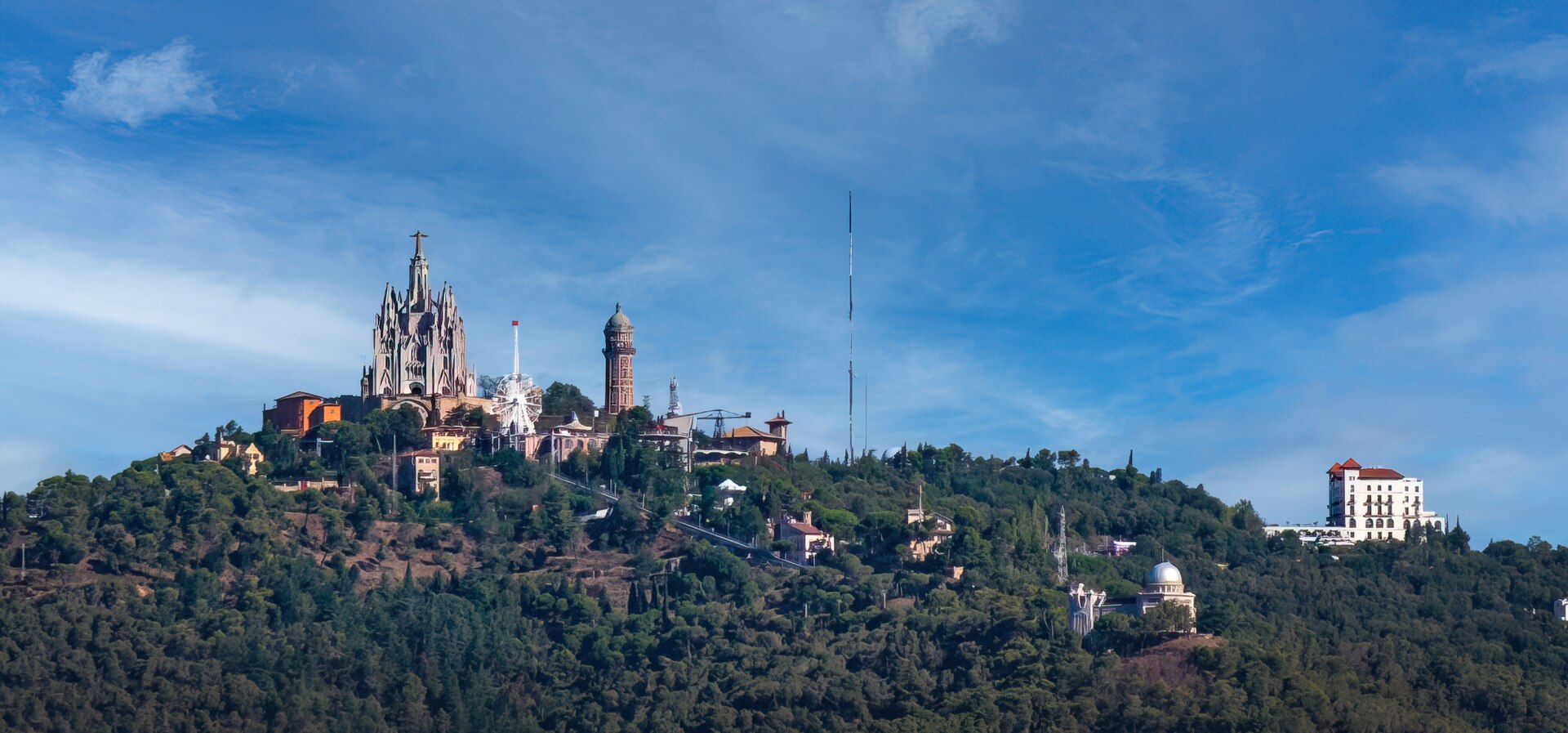
The name comes from the Devil. In the Latin Vulgate Bible, when Satan tempts Jesus in the desert by showing him all the kingdoms of the world, he says "Haec tibi omnia dabo" — "All this I will give you." Locals shortened it to "Tibidabo," and when you stand at the summit of this 512-metre mountain and see all of Barcelona spread below you, you understand why the name stuck. It's the kind of view that could tempt anyone. At the top sits an unlikely pair: a church and an amusement park, sharing the summit like neighbors who have learned to coexist. The Temple del Sagrat Cor (Temple of the Sacred Heart) was designed by Enric Sagnier and built between 1902 and 1961 — sixty years of construction that blended neo-Gothic and Modernista styles into something that looks like a wedding cake topped with a monumental bronze Christ figure by sculptor Josep Miret Llopart. It was consecrated as a Minor Basilica by Pope John XXIII in 1961. Next door, the Tibidabo Amusement Park opened in 1901, making it the oldest amusement park in Spain and one of the oldest in the world. Pharmacist Salvador Andreu first proposed the idea in 1899, envisioning a funicular railway, tram line, and rides to draw Barcelonans up the mountain. Several original rides from the early 1900s are still operating — including a beautifully restored airplane ride that swings you out over the edge of the mountain with the city far below. Getting there is half the experience. The Tramvia Blau — a vintage blue tram running since 1901 — takes you partway up the mountain, and a funicular completes the journey. On a clear day, you can see Montserrat and even Mallorca from the top.