Palau de la Musica Catalana
This concert hall is so extravagantly decorated that when it opened in 1908, some critics thought it was vulgar. Built for the Orfeo Catala choral society — a choir that was as much a political statement of Catalan identity as a musical group — the Palau was designed by architect Lluis Domenech i Montaner, Gaudi's great rival in the Modernista movement. Where Gaudi worked in curves and organic forms, Domenech i Montaner worked in light and color, and this building is his masterpiece.
The concert hall seats around 2,200 people and is the only auditorium in Europe illuminated entirely by natural light during the day. The walls on two sides are made almost entirely of stained glass, and overhead hangs an enormous inverted dome of stained glass shaped like a teardrop — a skylight that seems to drip color into the room below. The effect is like sitting inside a kaleidoscope. When the choir sings beneath it, the acoustics are extraordinary.
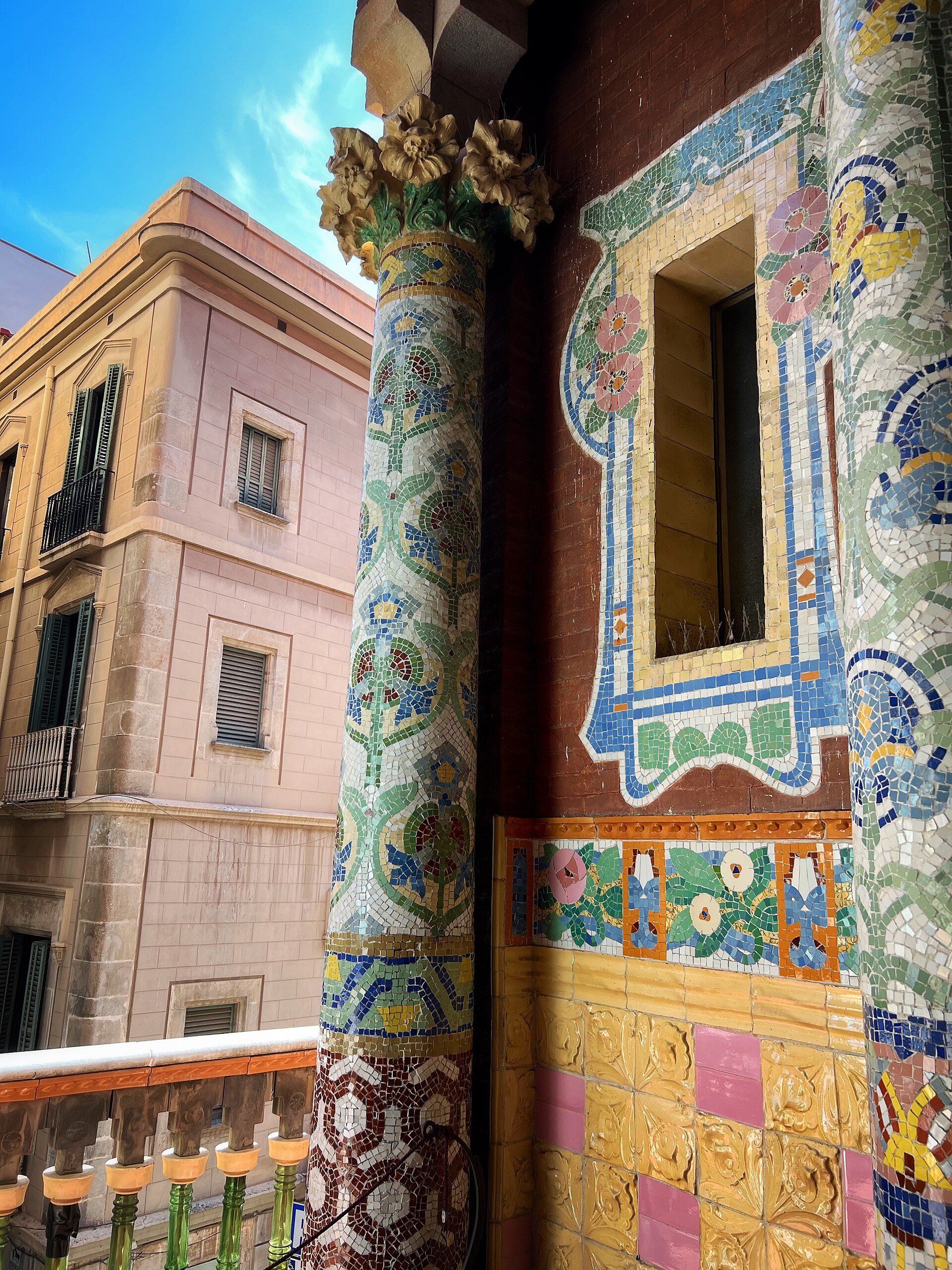
The building's walls were among the first curtain wall structures ever built — meaning the facade doesn't bear the building's weight. This allowed Domenech i Montaner to replace solid walls with expanses of glass and decorative ceramic. The exterior explodes with mosaic columns, sculptural clusters, and a corner sculpture of Sant Jordi slaying the dragon. Every surface is covered in something — tile, glass, carved stone, iron.
The Palau was declared a National Monument in 1971 and became a UNESCO World Heritage Site in 1997. Between 1982 and 1989, architect Oscar Tusquets led a careful restoration and modernization. Financed entirely by public subscriptions from ordinary Catalans when it was built, the Palau remains a potent symbol of Catalan cultural pride.
Verified Facts
Designed by Lluis Domenech i Montaner and built between 1905 and 1908 for the Orfeo Catala choral society
It is the only concert hall in Europe illuminated entirely by natural light during daylight hours
The building features some of the first curtain wall structures ever built, with non-load-bearing glass facades
Declared a UNESCO World Heritage Site in 1997 alongside the Hospital de Sant Pau
Get walking directions
4 Carrer del Palau de la Música, Ciutat Vella, Barcelona, 08003, Spain