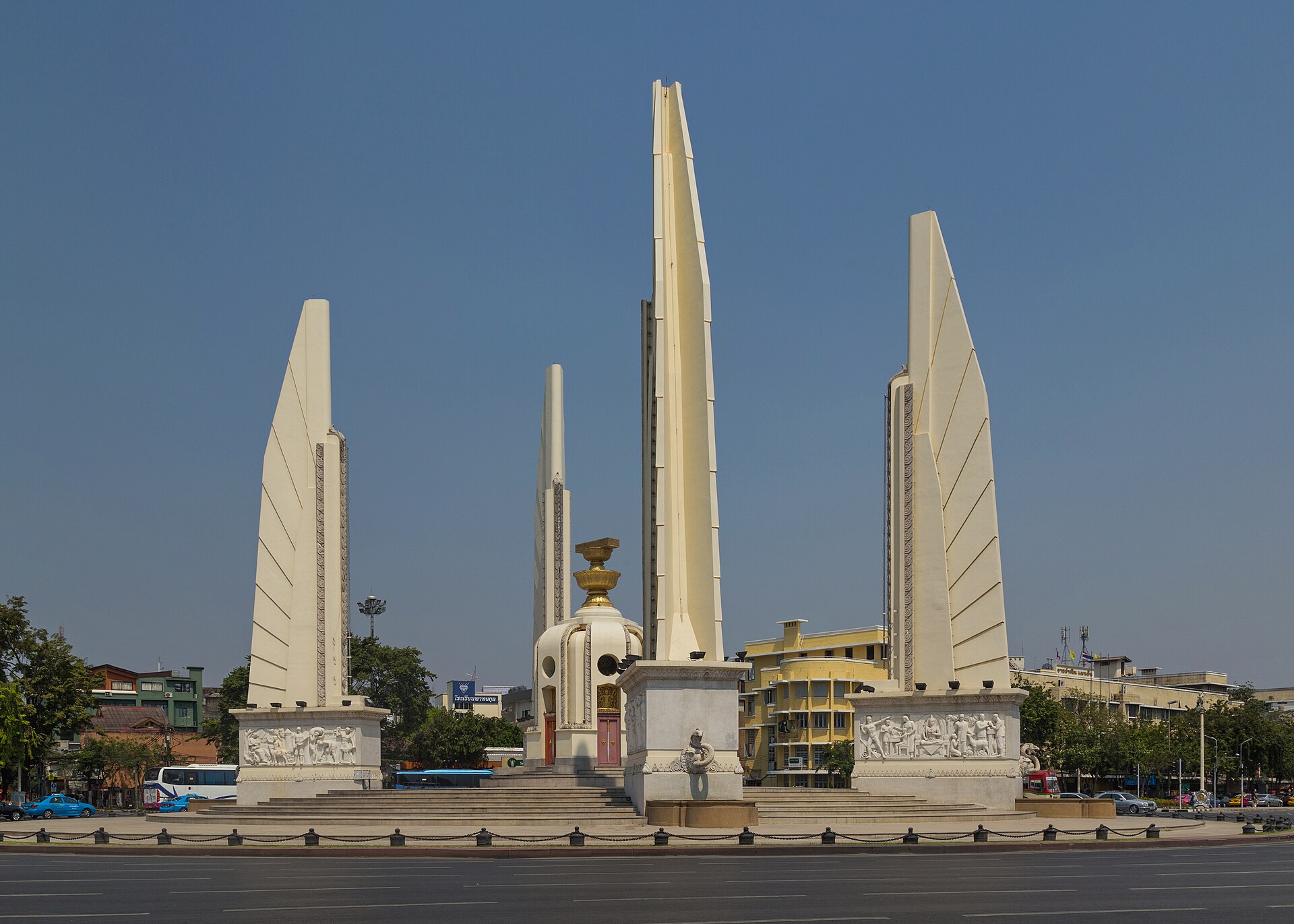
The Democracy Monument sits in the middle of a traffic roundabout on Ratchadamnoen Avenue, which is either a metaphor for how democracy works in Thailand or just bad urban planning. Built in 1939 to commemorate the 1932 revolution that ended absolute monarchy, every element of its design is loaded with symbolism that most people driving past it never notice.
The four wing-shaped structures are each 24 metres tall — representing 24 June, the date of the revolution. The 75 cannon balls embedded in the base represent the Buddhist year 2475 (1932). The central metal tray holds a copy of the constitution and sits atop a turret that represents the canon of law. The Italian-trained Thai architect Chitrasen Aphaiwong designed it to feel both triumphant and solemn, though the roundabout somewhat undermines the solemnity.
The monument has become far more significant as a gathering point for political protest than its designers ever intended. It was a focal point of the 1973 student uprising, the 1992 Black May protests, and the 2020 pro-democracy movement. In 2020, a brass plaque commemorating the 1932 revolution mysteriously vanished and was replaced with one glorifying the monarchy — an act that itself became a symbol of the tensions the monument embodies. Standing here, you're at the geographic and emotional centre of Thailand's ongoing struggle with the question of what democracy means.
Verified Facts
The Democracy Monument was built in 1939 to commemorate the 1932 revolution
The four wings are each 24 metres tall, representing 24 June
The 75 cannon balls represent the Buddhist year 2475 (1932 CE)
The monument was a focal point of the 1973 student uprising and the 2020 pro-democracy movement
A brass plaque commemorating the 1932 revolution disappeared in 2017
Get walking directions
Ratchadamnoen Klang Road, Phra Nakhon, Bangkok