330 N Wabash (Mies van der Rohe)
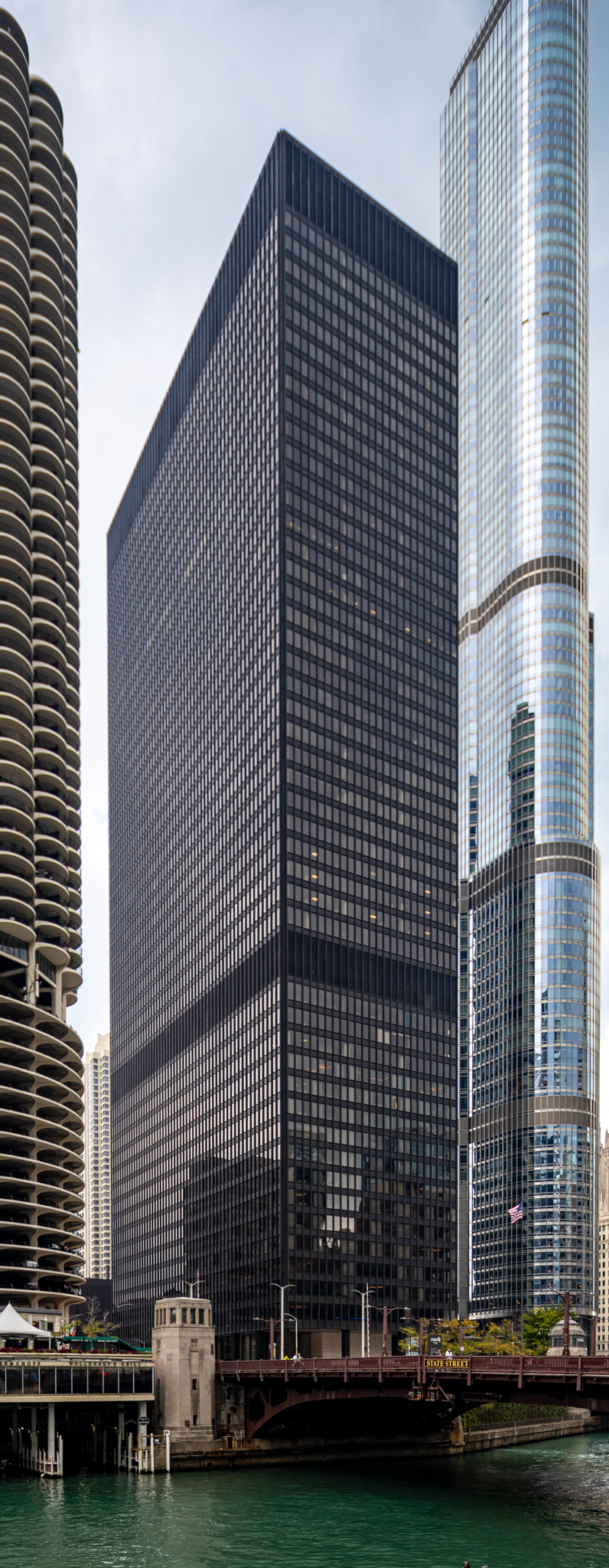
330 North Wabash — originally the IBM Building — was the last American office building designed by Ludwig Mies van der Rohe, and it's the purest expression of his 'less is more' philosophy in Chicago's skyline. Completed in 1973 (the same year as Willis Tower, which embodies a completely different approach to tall buildings), the dark aluminium and bronze-tinted glass tower stands on the north bank of the Chicago River like a Mondrian painting rendered in three dimensions.
Mies, who spent the last three decades of his career in Chicago after fleeing Nazi Germany, designed the building as a 52-story box with no ornament, no setbacks, and no concessions to the idea that a building should be anything other than perfectly proportioned structure. The ground floor is a glass-enclosed lobby that appears to float — the columns that support the tower are set back from the glass, creating the illusion that the 52-story mass above is weightless. The plaza, with its steps descending to the river, frames views of the Wrigley Building across the water.
The building is Mies's farewell to the city that adopted him, and understanding it requires understanding what he rejected: the decorative, the expressive, the individual. Every element serves a structural purpose. The window bays are identical. The proportions are mathematical. For Mies, perfection meant eliminating everything unnecessary, and this building — stark, precise, and unbothered by the Gothic, Art Deco, and Postmodern neighbours competing for attention around it — makes that argument with more authority than any lecture.
Verified Facts
330 North Wabash was the last American office building designed by Mies van der Rohe
The building was completed in 1973
Originally known as the IBM Building
Mies van der Rohe moved to Chicago after leaving Germany
Get walking directions
330 N Wabash Ave, River North, Chicago, 60611, United States