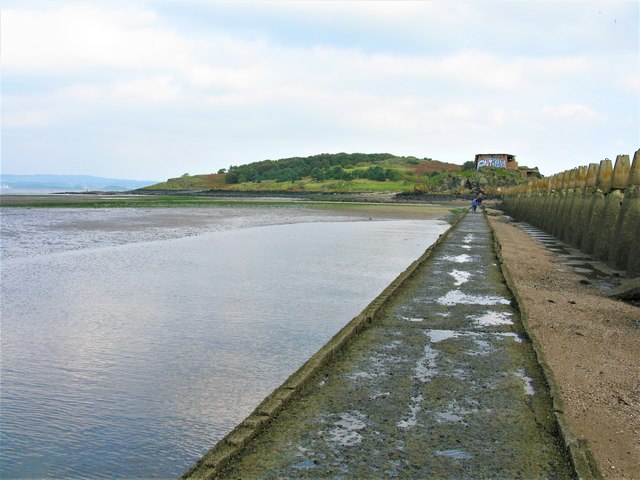
Twice a day, the sea parts and you can walk to an island. Cramond Island sits in the Firth of Forth, connected to the mainland by a mile-long concrete causeway that emerges at low tide and disappears completely when the water returns. The causeway was built during World War II as part of coastal defences, and it runs alongside a row of brutalist concrete pylons that once supported an anti-boat boom stretching all the way to Inchcolm Island and the Fife coast — a barrier designed to stop German torpedo boats and submarines from attacking ships and the nearby Rosyth naval dockyard.
The island itself is a windswept grass-and-scrub outpost dotted with the decaying remains of WWII military installations. Gun emplacements for 75mm and 12-pounder guns still point seaward, their searchlight housings rusting alongside shelters, stores, and two engine rooms that once powered the island's defences. During the war, soldiers stationed here manned the guns around the clock, watching for any vessel that tried to breach the estuary boom. After 1945, the military left and nature gradually reclaimed the island.
The walk across the causeway is extraordinary — sea on both sides, the concrete pylons marching into the distance, the Edinburgh skyline visible to the south. But the tide is no joke. Walkers who misjudge the tidal window get stranded every year, sometimes requiring coastguard rescue. The causeway is passable for about two hours either side of low tide, and local tide tables are posted at the entrance. Ignoring them is an Edinburgh tradition that the coastguard would very much like to end.
Cramond village itself is one of Edinburgh's prettiest corners — a small harbour with whitewashed cottages at the mouth of the River Almond. A Roman fort once stood here, and excavations have uncovered a stone lioness sculpture thought to date from the second century AD, now displayed in the National Museum of Scotland.
Verified Facts
The concrete causeway was built during WWII as part of coastal defences against German torpedo boats and submarines
An anti-submarine net and anti-boat boom stretched from Cramond Island to Inchcolm and the Fife coast to protect Rosyth Dockyard
WWII gun emplacements, searchlight housings, and engine rooms survive on the island
The causeway is passable for approximately two hours either side of low tide
Get walking directions
Almond, Edinburgh, EH4, United Kingdom