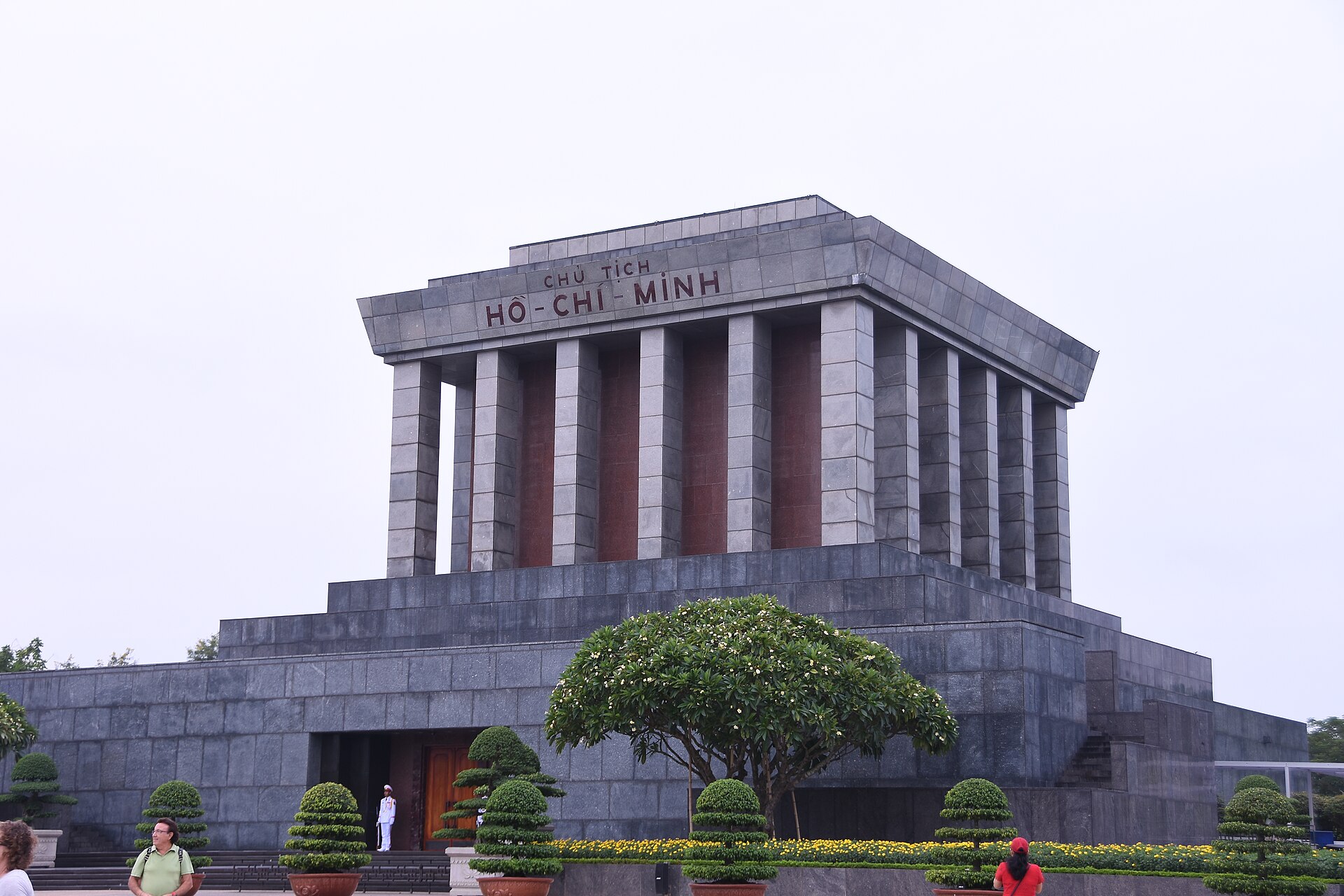
The Hồ Chí Minh Mausoleum is where the embalmed body of Vietnam's founding father lies in state — a granite and marble structure on Ba Đình Square modelled on Lenin's Mausoleum in Moscow, where visitors queue in silence to file past the glass sarcophagus containing the preserved remains of the man who led Vietnam's independence movement and is universally known as 'Uncle Ho.' The mausoleum was completed in 1975, and the irony that Hồ Chí Minh requested cremation and the scattering of his ashes has not prevented the Vietnamese state from preserving his body as a national relic.
Ba Đình Square, in front of the mausoleum, is where Hồ Chí Minh read Vietnam's Declaration of Independence on September 2, 1945 — a document that quotes the American Declaration of Independence and the French Declaration of the Rights of Man, reflecting Hồ's belief that Vietnam's fight for independence was part of a universal struggle for self-determination. The square is the site of national ceremonies and is patrolled by immaculately uniformed guards.
The surrounding complex includes Hồ Chí Minh's Stilt House (a modest wooden house on stilts where he lived and worked from 1958 to 1969, preferring its simplicity to the Presidential Palace next door), the Presidential Palace (a French colonial mansion that Hồ used for official functions but refused to sleep in), and the One Pillar Pagoda (a small Buddhist pagoda built on a single stone pillar in a lotus pond, rebuilt after French destruction in 1954). The complex is free, though the mausoleum has limited hours and a strict dress code.
Verified Facts
The mausoleum was completed in 1975
Hồ Chí Minh requested cremation but was embalmed against his wishes
Vietnam's Declaration of Independence was read on Ba Đình Square on September 2, 1945
Hồ's Stilt House is where he lived from 1958 to 1969
Get walking directions
2 1 Dich Vong Hau Lane, Dich Vong Hau, Hanoi, Vietnam