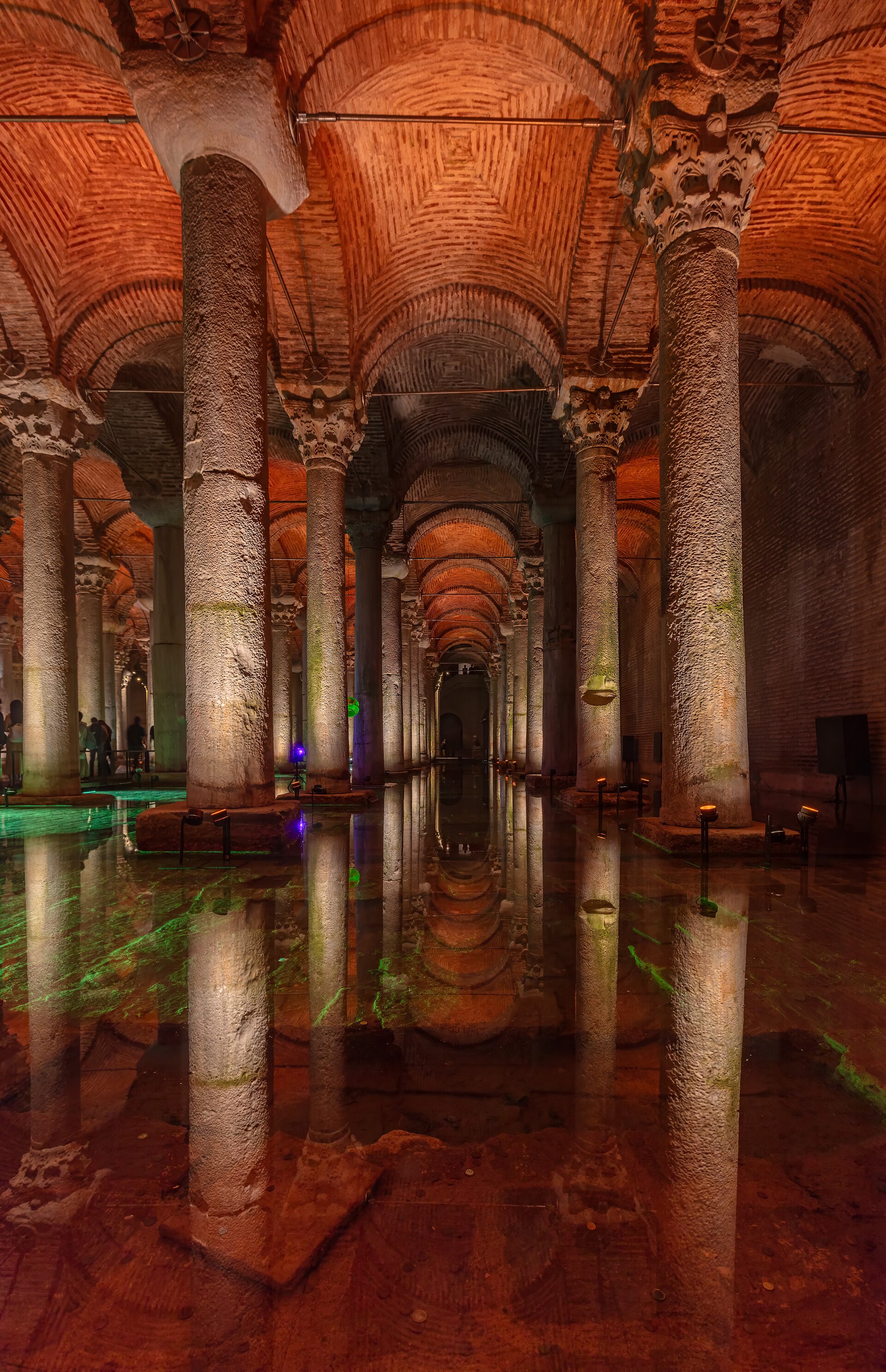
Beneath the busy streets of Sultanahmet, 336 marble columns rise from still water in an underground cathedral that was never meant for worship. Emperor Justinian I built this vast cistern in 532 AD to supply water to the Great Palace, and it was so thoroughly forgotten afterward that for centuries, locals drew water through holes in their basement floors without knowing what lay beneath — some even caught fish through the gaps.
The cistern stretches over 9,800 square meters, capable of holding 80,000 cubic meters of water. Its columns were recycled from ruined temples across the Byzantine Empire, which is why no two are quite alike — you will spot Ionic, Doric, and Corinthian capitals standing side by side, each stolen from a different ancient building. The most famous columns sit in the far northwest corner, where two enormous Medusa heads serve as bases. One is placed sideways, the other upside down, and nobody knows exactly why.
The most popular theory is that the Medusa heads were simply the right size to support the columns and were repurposed without ceremony — ancient builders were practical, not sentimental. But the mystery has proved irresistible. Some say they were positioned to neutralize Medusa's legendary power; others suggest the builders were making a statement about conquering pagan Rome. The truth, like much of this city, is probably buried under fifteen layers of competing narratives.
The cistern was rediscovered by French scholar Petrus Gyllius in 1545, who noticed locals drawing water through their basement floors. It was restored and opened to the public in 1987, and a subsequent renovation in 2022 added atmospheric lighting and art installations that turn the ancient waterworks into something between a museum and a fever dream. James Bond fans will recognize it from the 1963 film "From Russia with Love."
Verified Facts
The cistern contains 336 marble columns arranged in 12 rows of 28, each standing approximately 9 meters tall.
Two Medusa heads serve as column bases — one placed sideways, one upside down — and their origin and positioning remain unexplained.
The cistern can hold 80,000 cubic meters of water and covers approximately 9,800 square meters.
It was forgotten for centuries and rediscovered in 1545 by French scholar Petrus Gyllius, who noticed locals drawing water through holes in their basement floors.
Get walking directions
1 Yerebatan Cd., Cagaloglu, Fatih, 34110, Türkiye