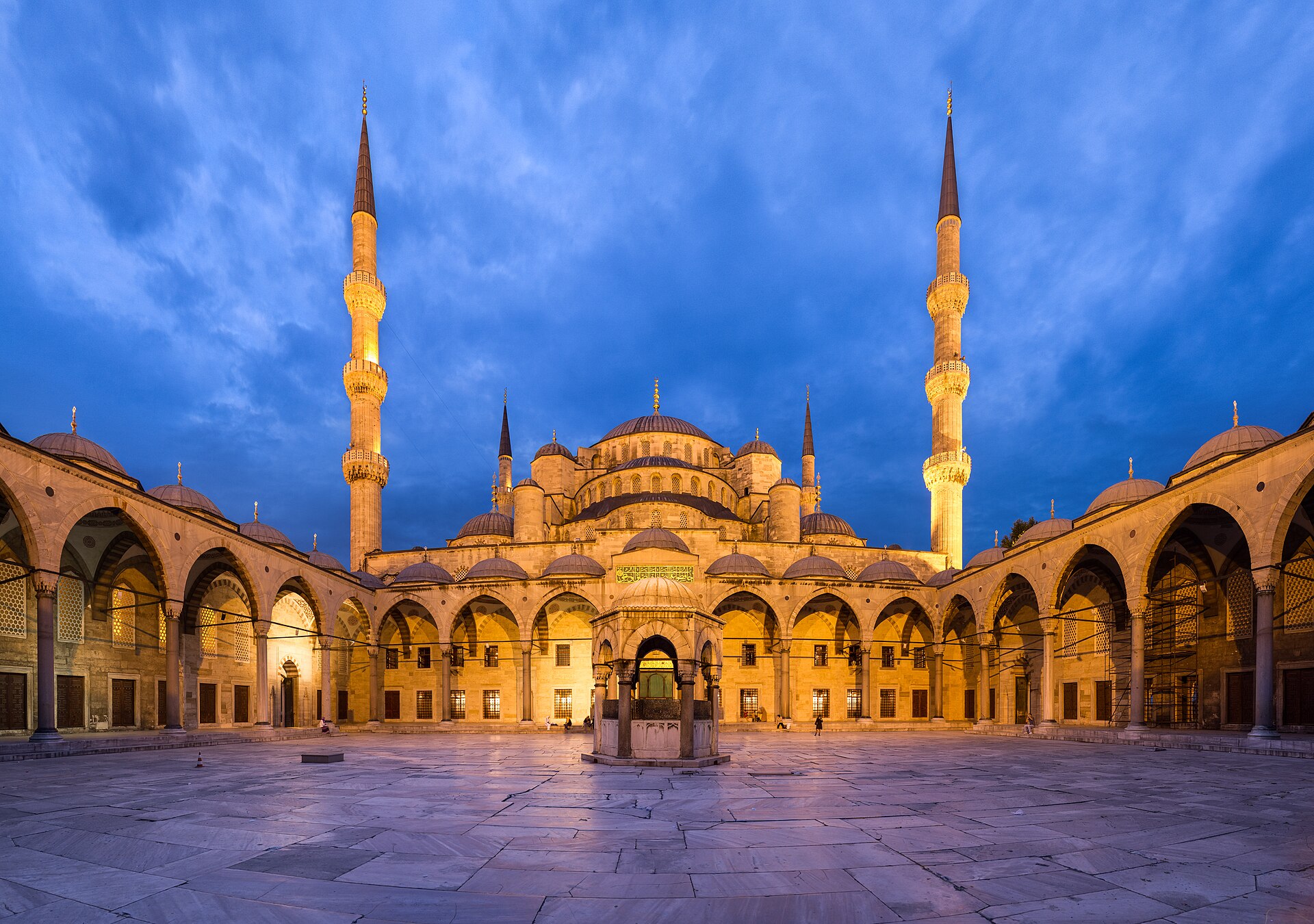
The Blue Mosque exists because of a misunderstanding — or so the legend goes. When Sultan Ahmed I ordered "altın minareler" (golden minarets), his architect supposedly heard "altı minare" (six minarets) and built accordingly. The problem was that six minarets matched the mosque at the Ka'aba in Mecca, which was considered deeply presumptuous. The Sultan's solution? He funded a seventh minaret for Mecca to maintain its supremacy.
Step inside and the nickname makes instant sense. More than 20,000 handmade İznik tiles cover the interior in cascading patterns of tulips, carnations, and cypress trees, all in shades of blue that shift depending on the light filtering through 260 windows. These tiles were produced during the golden age of İznik ceramics, and Sultan Ahmed reportedly drove the İznik workshops to the edge of bankruptcy with his demands, commandeering their entire output and forbidding them from filling other orders.
The mosque was completed in 1617 after seven years of construction — Ahmed was just 27 years old and would die within a year of its completion. He broke with Ottoman tradition by having himself buried in a mausoleum right next to his mosque rather than in a separate complex. His tomb, with its mother-of-pearl inlaid sarcophagus, sits just outside the walls.
The cascading dome system is an architectural showpiece — a central dome 23.5 meters in diameter sits 43 meters above the floor, buttressed by four semi-domes that themselves are buttressed by smaller domes, creating a visual rhythm that draws your eye upward in stages. At night, the exterior is dramatically lit, and the six minarets — whether born from a misunderstanding or not — create one of Istanbul's most recognizable silhouettes.
Verified Facts
The interior features more than 20,000 handmade İznik ceramic tiles in predominantly blue patterns, giving the mosque its popular nickname.
It is the only mosque in Istanbul with six minarets, which was historically significant as it matched the number at the mosque of the Ka'aba in Mecca.
Sultan Ahmed I was only 19 when he commissioned the mosque in 1609, and he died just a year after its completion in 1617.
The central dome is 23.5 meters in diameter and 43 meters high, supported by four massive pillars known as "elephant legs."
Get walking directions
7 At Meydani Cd., Cankurtaran, Fatih, 34122, Türkiye