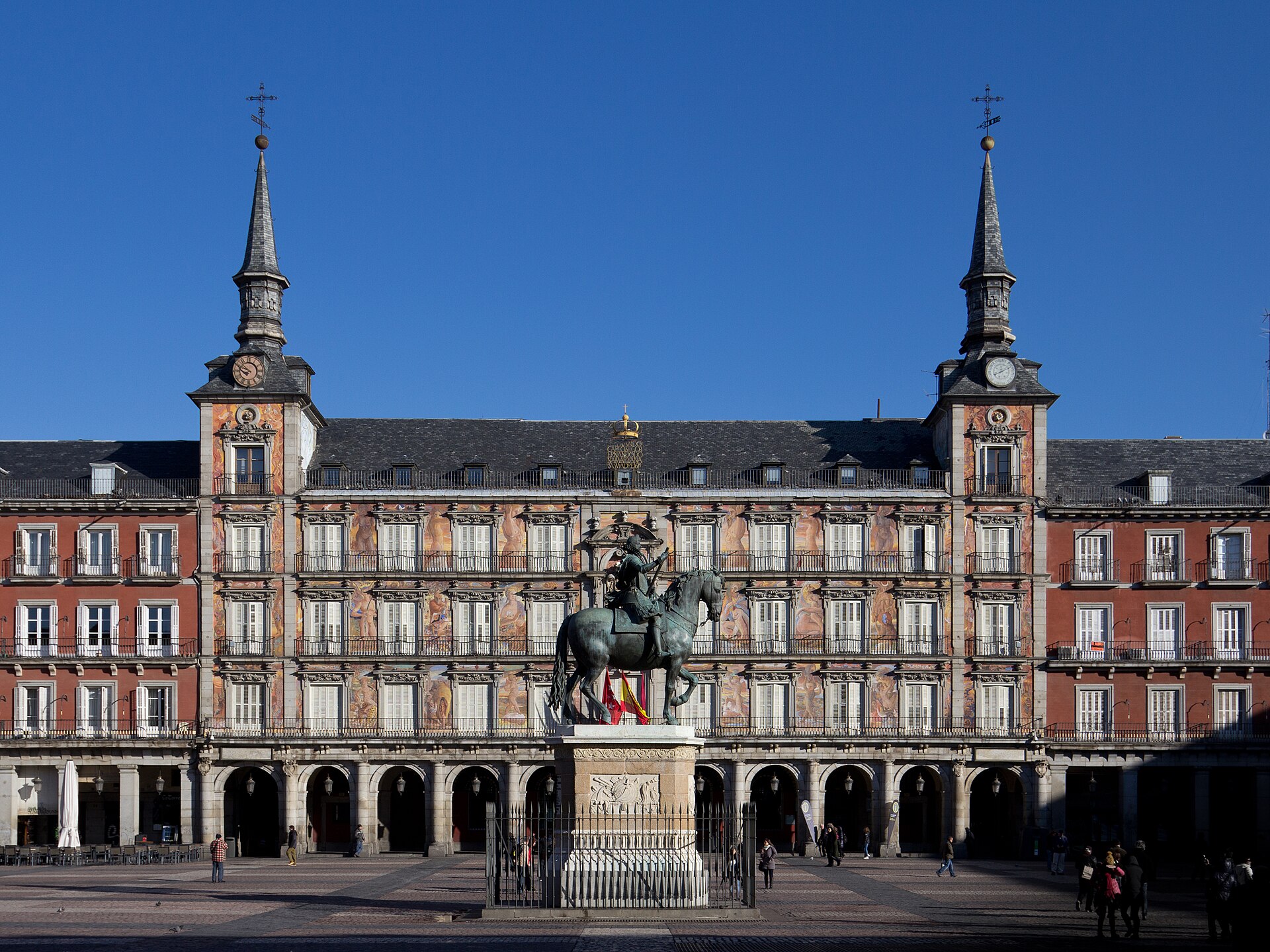
This grand rectangle of rust-red facades and slate rooftops has been the stage for some of Spain's most dramatic public spectacles — bullfights, royal coronations, theatrical performances, and executions by the Inquisition. On June 30, 1680, the plaza hosted a massive auto-da-fe in which 117 people were sentenced before a roaring crowd, with twenty-one condemned to burn. The cobblestones beneath your feet have soaked up more history than most countries' entire capitals.
Philip III commissioned the plaza in 1580, and architect Juan Gomez de Mora finished the job in 1619, creating a fully enclosed rectangular square ringed by 237 balconies — each one a VIP box for watching whatever spectacle was playing below. The equestrian statue of Philip III in the center looks serene now, but it nearly killed someone during its installation. The bronze horse was found to be hollow, and over the centuries, sparrows nested inside it — a colony of birds living in the belly of a king on horseback. During a 1930s restoration, workers discovered hundreds of bird skeletons inside the statue.
Fire has ravaged the plaza three times — in 1631, 1670, and 1790. After the last and worst blaze, architect Juan de Villanueva rebuilt it, reducing the buildings from five stories to three and closing off the corners with arched entranceways. The nine arched gates you walk through today are his design.
Now the plaza is mostly cafes and Christmas markets, portrait artists and street performers. But look up at the Casa de la Panaderia on the north side — the old bakery guild hall, covered in mythological frescoes painted in 1992 — and you can still feel the weight of four hundred years of spectacle.
Verified Facts
The plaza was designed by Juan Gomez de Mora and completed in 1619 under Philip III
On June 30, 1680, a major auto-da-fe saw 117 people sentenced by the Spanish Inquisition, with 21 condemned to death
The plaza was devastated by three major fires in 1631, 1670, and 1790, and was rebuilt after each
After the 1790 fire, Juan de Villanueva redesigned the plaza, reducing it from five stories to three and adding the arched entranceways
Get walking directions
Plaza Mayor, Centro, Madrid, 28012, Spain